After seeing a recent seminar on legal industry stats, one stat jumped out at me. The stat was interesting not because it was new, but instead since it just keeps slowly trending in the same direction … down. The Stat: Productivity.

Productivity is essentially the number of hours billed per day per attorney. The ‘per day’ approach is used to filter out months with more days and months with more holidays. The number is telling of how busy lawyers are, where busy means billing time to clients. On one level you might say – so what? Everyone knows the market is not doing well.

Well … in the same presentation it was noted that the market for legal services is flat or slightly up. Which is another way of saying it is not going down.

Q: So if there is the same amount of work out there, why is productivity going down?
A: Firms have too many lawyers.
Q: And why do firms have too many lawyers?
A: They keep hiring more of them. Q: And why do firms keep doing this?
A: Because that’s the way they’ve always done it.

Recruiting has always been highly focused on keeping the talent pipeline full. The basic idea is that partners don’t leap fully formed into the world. Instead they arrive as associates who are stuffed in to the bottom of the talent pipe. Ten years later they emerge from the top of the pipe as partners. Only not all of them survived the entire length of the pipe. Consider the pipe more like a French drain pipe with openings here and there. Some, well actually a majority, of those that go in to the pipe are pushed out through these openings.

Which ones get pushed out? There is a very simple metric for selecting those that “fall” out. It’s called the 1900 Rule. When your hours drop below 1900, you start to feel a push towards they edge of the pipe. Too many years under 1900 and you find yourself outside the pipe. The only real potential for the system failing is a lack of associates going in to the pipe. The system is truly elegant in its simplicity.

But the system was built during a different time when talent was scare and hours were plentiful.

So why are so many firms still approaching recruiting this way when those two factors are now completely the opposite? With talent plentiful and hours scare you would think recruiting practices would have changed substantially? You would until you considered that partners are partners having survived the 1900 Pipe. So for them – this system obviously works perfectly.

It may be time to call a plumber.

I was getting my morning fill of Twitter updates this morning, when I saw a tweet from Emily Clasper go by that made a simple, yet intriguing statement:

I know most librarians have no clue about the ideas at #sesnyc but how are we supposed 2 b info experts if we don’t know how the info works.

Emily is Manager of Systems Operations and Training at Suffolk Cooperative Library System (SCLS) up in New York. The #sesnyc that she mentions is a Search Engine conference that discusses many topics including Search Engine Optimization (SEO) and Search Engine Marketing (SEM) techniques, along with a number of other topics. “The Clue” she is talking about is understanding how things that we use everyday in our research strategies actually work. These are topics that Emily is passionate about, and that we’ve discussed here on 3 Geeks before. It is also this passion that makes Emily a “Mover & Shaker” in the library world, especially in the Tech area of libraries.

I love Emily’s passion. I think that she is a valuable asset in the library community, and that she has a lot to offer any of us that will listen to her. But we can’t all be Emily Claspers. Luckily, we can all learn from Emily and others out there that have similar passions. Whether it is through Social Media resources like Twitter, LinkedIn, etc., or through conferences, or even through old fashion emails, we can communicate, learn, teach, and gain experiences from experts that know a lot about specialized areas of knowledge information, and are happy to share their expertise.

There’s a saying in the library field that we may not always know the answers, but we know where to find those answers. Traditionally, the “finding” has been through books. In the past 30 years, it has shifted to online resources. In the past couple of years, I see a trend that some of those answers lie within people, not print or electronic resources. The access to “people” has exploded with all the instant communications (email, Twitter), and the archives of past experiences that these experts have shared with us (Google, LinkedIn, Blogs.) That is a very powerful expansion of knowledge. In addition, that expansion doesn’t just apply to your specific field. If you notice, Emily is not a law librarian like I am. Perhaps in the past, we would have never known about each other because our “analog-selves” run in different circles. However, our “digital-selves” cross paths quite often.

Although I consider myself a tech geek, I don’t think I’m close to the expert in the field as the Emily Claspers of the world. Fortunately, I don’t have to be. There are those that know a lot about a niche part of the profession… and there are those that know a little about a lot of areas. Both have their uses. Generalists can learn pieces of knowledge from the experts, and in return, experts can learn practical applications from the generalists. That can be a powerful combination as long as we are all willing to share and to listen.

Below is an excerpt of what Law 360 emailed to its current client base re/the news of this acquisition.

The combination of Law360 and LexisNexis will deliver powerful improvements to Law360’s news coverage and will allow us to continue to expand our coverage into new practice areas and jurisdictions.

In the intermediate term, the acquisition will not result in any changes for Law360 clients:

  • Law360 will operate as a stand-alone company
  • Law360 content and newsletters will remain the same
  • Law360 account executives will continue to manage client relationships

Over time, Law360 will leverage the depth and breadth of LexisNexis resources to continue to expand its coverage of litigation and public policy. Clients will notice gradual improvements in Law360 content as our newsroom gets access to the rich tools and data resources available on the LexisNexis platform.

And here are some excerpts of the Lexis press release:

“Breaking legal news and analysis are critical for legal professionals as they drive success for their businesses and clients,” said Bob Romeo, CEO of Research and Litigation Solutions at LexisNexis. “Law360 is a key element of our growth strategy because it adds legal news and analysis, a crucial part of an attorney’s workflow and a key entry point to legal research.”

The acquisition of Law360 is part of the continuing LexisNexis commitment to provide critical legal and business content to help customers increase productivity and achieve better outcomes for their organizations and clients.

They will continue to run the company as a stand-alone business, while leveraging the content and analytical resources and distribution of LexisNexis.

My first thoughts for what they are worth!

  1. Glad it appears that at least in the interim (how long will that last?) for existing clients there will be no changes, but what about new clients under the Lexis umbrella? Likely to be a separate add on cost?
  2. Sounds alot like the BNA BLaw acquisition model, in that Law 360 will continue to operate as a stand alone company  – good and hopefully lasting news!
  3. Very curious about the pricing models to come for this content on Lexis. Not likely to play out as the ALM acqusition did as it appears to be a different type animal. Law 360 native to online environment and not content that was ever on Westlaw like ALM content was.
  4. Definitely hoping that Lexis has taken notes on the BNA BLaw blog discussions!

Guest blogger,

Cheryl Niemeier
Director of Library Services
Bose McKinney & Evans LLP

Having married into a very artistic family, I discovered that I’m really not as “artistically inclined” as I once thought. Not that this lack of skill has prevented me from doodling during meetings and conferences, mind you, but even the doodles aren’t really all that great. Fortunately, I came across a website that can help even the most artistically challenged among us to at least come up with a logo design that looks pretty good, and is very easy to create.

LogoType Maker has created a very simple website that allows you to enter in a company name (or anything that you’d like to see as a business card style logo) and have it randomly create logos on the fly, or even allow you to do some minimal editing of the logo from a cache of stock logo designs. Once you’ve set up the logo the way you like it, you can download it in .zip, .png, or even high-quality PDF formats. The basic logo design is free, or you can email them for their pay-services if you need anything more than the basic design setup.

Even if you don’t need to create a logo or business card… it’s a great place to go to have some fun looking at the different design possibilities. So, if you have a bit of time to waste investigate, then go over to  LogoType Maker and have some fun. I’m treating the other geeks to a twitter-version of their personal logos!

Image [cc] Oran Viriyincy
[Follow-Up Post from Marlene Gebauer]
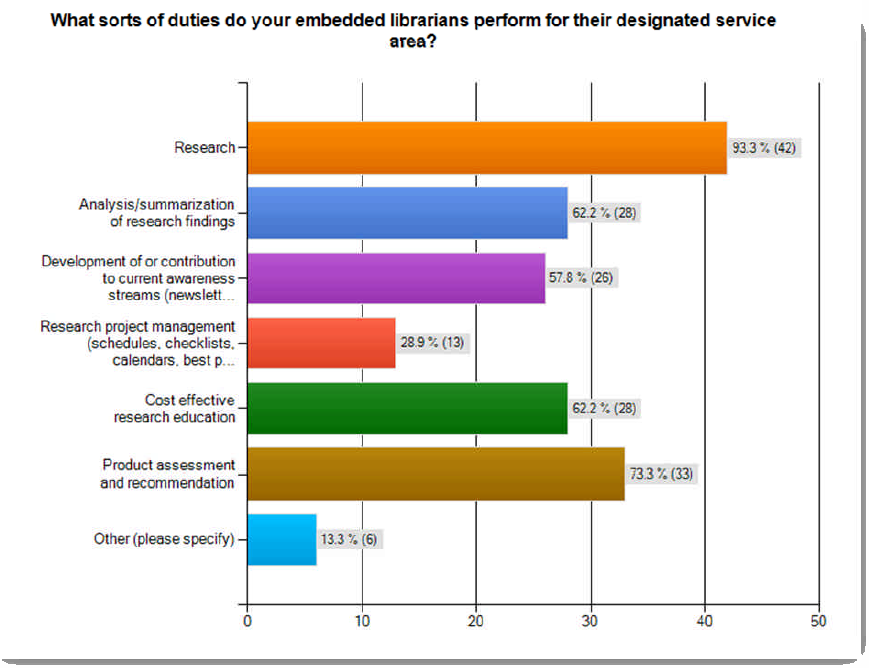
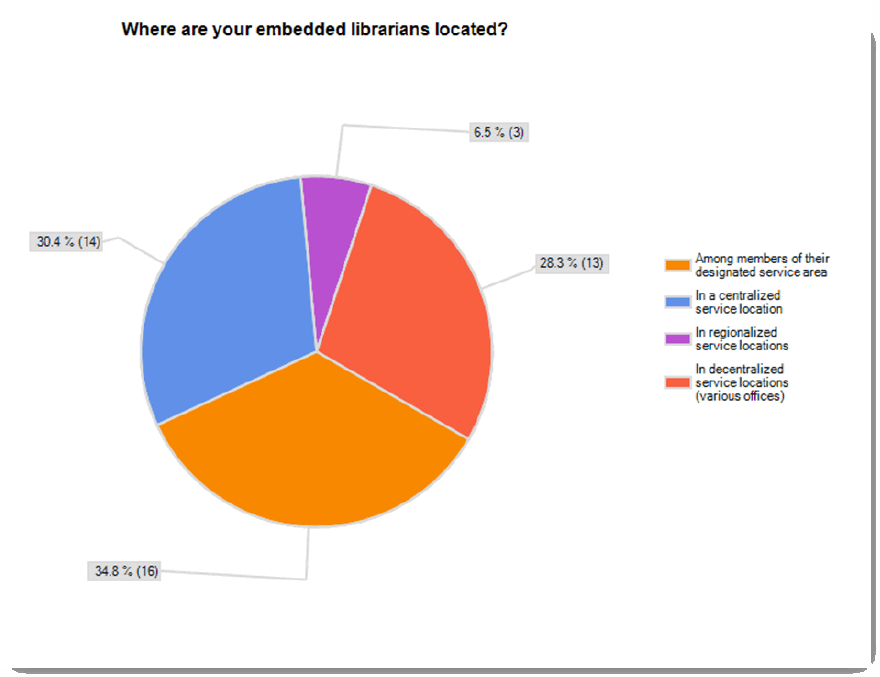
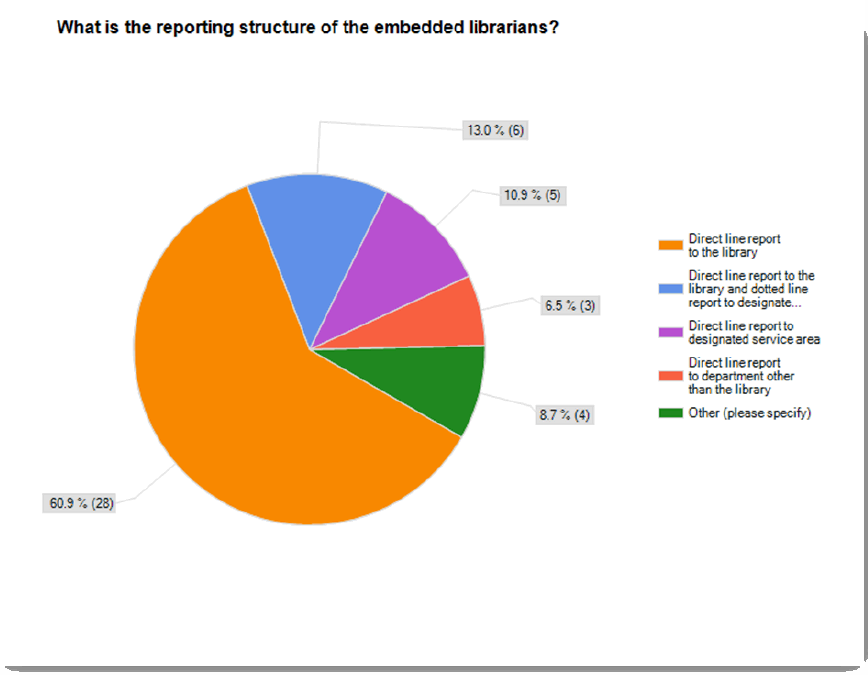
The Embedded Librarians survey results are out! [Download the PDF compilation]
Thanks to Ark and 3 Geeks for allowing us to publish them for review.
There was a very healthy turnout for the survey (244 participants). Percentages as well as total count have been provided. Graphs have been provided for quick review. On page 4, “Other” is comprised mostly of Tax, Banking and Finance, Insurance and Health Care.
There are some interesting things to note as you review the data:
  • While the clear majority of firms participating in the survey do not have embedded librarians or specialists, when compared to those firms that do and are considering it, the split is nearly 50/50. 
  • While most firms with embedded specialists/librarians have had them in place from 1-5 years, there is also strong number of firms where the position has been in place for 11+ years 
  • Embedded Specialists/Librarians seem to find success in a variety of business support models, most being housed with the department they support, in a centralized location or in decentralized locations. 
  • The large majority of embedded specialists/librarians report directly to the library. The next largest group have a direct line to the library and dotted line reporting to the practices they support. 
  • Some of the benefits firms have experienced from having an embedded specialist/librarian are developing stronger relationships with their respective groups and better understanding research need as applied to practice, cross training of the library staff, improved workflow, improved evaluation of research products needed to support practice areas and a higher profile in the firm. 
What are your takeaways from the survey? What other questions would you liked to see asked? Would you like to see this survey updated annually?

Sometimes a 3 Geek post generates responses that expand the idea presented and make it even better. The recent post of Managing the Law Firm Risk Role in Outsourcing is one such example.
My good friend Laney Altamar at Special Counsel keyed in on one of my closing points, “Firms should also consider leveraging technology to better connect and integrate LPO services into their matter management processes.” This statement highlights the need for firms to use technology to directly connect with an LPO or other outsourced provider to truly enable ‘adequate supervision’ per the ethics rules.
Not surprisingly, Laney agrees completely with this assessment. However, she suggested I should ‘up my game’ a bit on the topic. Which lead to an interesting conversation about the ethical duty of ‘adequate supervision.’
My take-away from the conversation is that what ERM is offering is likely necessary, but perhaps not always adequate. In some circumstances, supervision could mean something more like ‘over the shoulder’ oversight. So the real crux of the issue is that ‘adequate supervision’ requires different levels of supervision in different situations. In some cases, partner review of a document might be sufficient. In other cases, project management oversight will do (ala ERM). But at the highest level, supervision would mean actually witnessing the work performed.
Here’s the good news – Special Counsel has a tool, aptly named SightManager, that allows lawyers to view the computer screens of those performing outsourced worked. The screen shot shows what the application looks like in practice. A lawyer is viewing the various screens of outsourced workers and has the ability to zoom in on any of them and watch tasks being performed real-time. Impressive stuff.

Now the bad news – SightManager is only available when working with Special Counsel (which is actually good news for Laney). I give credit to Special Counsel for innovating this way, using technology to truly create a collaborative environment. Perhaps we will see more products like this in the market soon.
In my original post I referenced how I enjoy lively dialogs with ethics counsel on these issues. By chance, my current ethics counsel stopped by my office yesterday. Instead of our usual highly charged debate, when I mentioned the capabilities of SightManager to him, all I got was a smile.

Back in August, some of you may remember I blogged about the power of news aggregators, asking the question, How Do We Make Them Read? Since that time, I have been watching new aggregators come on to the scene, new products being offered, new interfaces introduced, new pricing models worked out and all the while, I still can’t help but wonder how we make them read. Though, three new trends I am seeing out there in the world of aggregators is getting making the job of getting attorneys to read the news just a bit easier.

  1. Several of the products on offer, have started to include robust back end analysis and metrics with the aggregators. Clients (especially people like me in the competitive intelligence community) want to know who is reading, when they read and what articles have my clients clicked all the way through to read the full text. What are the trending topics of interest with a particular practice. Then I can be a step closer to understanding the issues of interest and how can I turn that into action, or identify a lead. Library Services, meet Business Development.
  2. Semantic analysis, though it can never replicate the human element completely (more on this in item #3). Some of the aggregator out there such as Digimind are offering a semantic analysis with the tool. The accuracy can be hit or miss on the tone owing to the algorithms and taxonomy, but it is nice to have a baseline for what you are reading, coded right into the article and interface. Certainly when helps to know if all the press on a given client is negative, or even perceived as such even if it is only 60-75% of the time. Maybe some crisis management or litigation is in coming down the pipe….Public Relations, meet Business Development.
  3. The most intriguing offering to me at the moment is the pairing of aggregators with other industry professionals. There have been others, but the most recent to come to mind is that of ShiftCentral announcing earlier this month, that former lawyer turned law firm CMO Mark E. Young, has joined the aggregator to head up what they are calling an Intelligence Agency. Competitive Intelligence meets Marketing.

As I sit with partners and watch their inboxes fill up with newsletters/bulletins/internals blogs and other informaton/intelligence items we have aggregated, I still can’t help but wonder how we’ll make the shift from better packaging and synthesis to action. News aggregators, like the ones reviewed in the past, or mentioned here today, certainly can take us part of the way. I think we are almost there…but the rest….

I always enjoy conversations with ethics counsel, whether at law firms or in bar associations. All of the changes in the market tend to challenge different ethics rules. So talking with these people is usually an opportunity to see how new ideas may run afoul of the rules.
At my last firm, I recall one particular conversation about ethical issues in using LPOs. In Texas, and many other jurisdictions, there are limitations to how lawyers can make money on third party services. Many firms just pass the cost along, with no mark-up for administrative overhead, let alone allowing for a margin. The ethics conversation touched on this issue, but quickly shifted to the ethical duties of firms using outsourced services. The duty to ‘adequately supervise’ was the primary reason ethics counsel thought it was a bad idea to utilize such services. My come-back was that if we let the clients decide on the LPO providers, we retain the ethical risk, but lose the ability to vet the provider.
This issue was driven home recently by two disparate events. The first was attending a webinar sponsored by Integreon on the ethics of outsourcing. The main point made by the presenter was the primary ethics duty of law firms is conducting due diligence of the LPO providers. The lawyers’ duty to provide adequate supervision over the services means they better understand the organizational structure, quality control and qualifications of the providers.
The second event was seeing a demo from ERM Legal Solutions. One point made in the demo was that a hosted project management tool like ERM’s could be used to manage work performed by outsourced providers. This got me thinking about how when it comes to an outsourcing situation, due diligence was not enough for lawyers. ‘Adequate supervision’ is a day-to-day, on going duty. And how possibly could lawyers in one location be adequately supervising non-lawyers from another company in another location? Absent a process tool for providing the capability of oversight like ERM’s, lawyers must basically review and confirm every piece of work coming from the outsourced provider. But even then have no direct knowledge of how and when the work was done.
This ‘supervision’ challenge already exists with many third party providers, such as e-discovery vendors. In those circumstances, smart firms are always evaluating the providers, making sure their processes are adequate. LPOs are really on a higher plane in this regard, as their services tread much deeper in to practicing law. With services like “contract drafting” and patent preparation, the evaluation and oversight of an LPO by a firm should be much deeper and hands-on.
My Advice: Law firms bear a significant ethics liability (a.k.a. Risk) whenever an LPO is involved in the work, whether hired by the firm or the client. Therefore, law firms would be wise to proactively engage with LPOs and have their homework done before the need arises. Firms should also consider leveraging technology to better connect and integrate LPO services into their matter management processes. Otherwise, they may end up shouldering all of the risk with no opportunity for sharing in the rewards.
Image [cc] pzed

In the prior segments of this series, we described litigation funding and looked at its impact on clients and firms. In this final segment, we look at the size of the market, explore some ethical pitfalls and finally, attempt to predict the future.

How big is the market?
On the demand side of the market, according to Selvyn Seidel, of the Burford Group, “if you only looked at the United States, the market for claims undoubtedly must be spoken of as having billions and billions of dollars of claims needing funding.” On the supply side there appears to be a handful of funders with maybe a billion dollars in play. Needless to say, there is significant room for growth in this market. And with the potential for high returns on investment, investors will find this market very attractive.
Ethics?
I would say the jury is still out on the various ethics issues involved in litigation funding. You have your basic ‘who’s the client?’ ethics question. Firms will also have interesting conflicts issues to address, especially if they develop relationships with the Litigation Funding Companies (LFCs). And finally, there’s the issue of extending privilege to LFCs. Suffice it to say, these issues will probably be worked out over time and new ones may well arise. Given the amount of capital in the market and potential demand for LFC money, there will be plenty of people motivated to find solutions to them.
One caveat – LFCs have an obvious interest in the settlement timing and amount. Therefore we should expect them to play some role there. Depending how this role evolves, law firms could be placed in very interesting (a.k.a uncomfortable) ethical situations where the client’s best interest may not be entirely the same as the LFC’s.
In searching for some guidance on the role and influence of LFCs, I found this Code of Conduct for Litigation Funders in the UK. Be warned, it is quite comprehensive, running a full page and a half in length. At least it’s a step in the direction of creating some guidelines.
Where is this happening?
With LFCs in Australia, Europe and now in the U.S., this is very much a global market.
LFCs prefer larger claims, say above $10m. And they are understandably very concerned about time-lines. Cases with better defined end-dates mean LFCs can add time in to their return on investment calculations. International arbitrations are also better options, with shorter time-lines and treaties in place to enforce payments of judgments – which is to say the everyone gets paid faster.
Prognosis?
Third party litigation funding could prove to be very interesting to clients. GC’s will like going to their CEOs with some good news about legal fees. CFOs will like how this approach outsources cost and financial risk. CEOs will enjoy passing this news along to their boards. With such a bottom-line benefit to clients, we should expect the use of LFCs to grow.
For law firms, they have shown some initial interest in LFCs as well, since it means they get paid. However, as noted above, LFCs may well be a double-edged sword when it comes to getting paid. Instead of GCs picking over law firm bills, business people with a sharp eye on costs and ROI may also be involved in performing that task. I would expect these business people to be better at holding rates and fees down.
Law firms may also consider the business development advantage of involving LFCs. Bringing LFCs to the table may enhance the value of a firm to its clients.
In the long-run, I could see this LFC approach moving down-market. Once LFCs systematize valuing cases and establishing risk, their cost-per-deal should go down, enabling them to fund smaller and smaller claims.
I’ll admit my prognosis is a bit of conjecture, since most of what LFCs do occurs out of the market’s view. And that may be the most interesting aspect of this trend. With very little market information available, LFCs will remain in a position to achieve high returns on their investments.
Is this all good or bad? I suppose we’ll just all have to wait and see …

Ed Walters and I had a little fun on Twitter this morning when Ed tweeted this week’s answer key. Being the rather smart-alecky person I am, I filled in the “questions” just for fun. Kind of like the old Johnny Carson routine of Carnac the Magnificent.

So, I thought we’d have a little fun and post an answer key of our own. We’ll let you pick one or more and give us the corresponding question.

Answer Key:

A1:    2% this year.

A2:    4th Quarter of 2015.

A3:    The New Westlaw

A4:    Microsoft Office, Flash, and Google+

A5:    Apocalyptic Coding

A6:    Stockholm School of Law

A7:    Wal-Mart, K-Mart, Sears, and Target

A8:    Scheduled to premier at SXSW in 2013

A9:    Social Media Guru

A10:  3 Geeks and a Law Blog

Put on your thinking caps… turn up your sarcasm… and give us some questions to go with these answers!