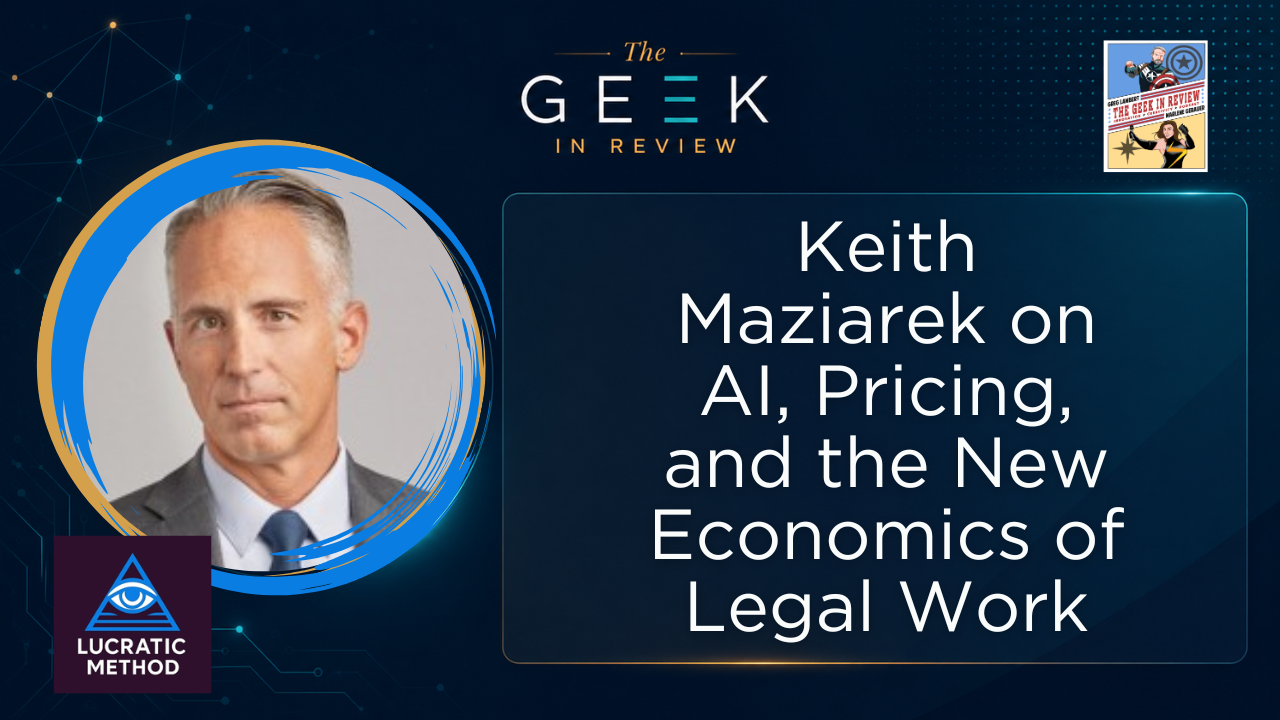
This week on The Geek in Review, we talk with Keith Maziarek, founder of Lucratic Method and Bodhi Solutions, about the shifting economics of legal work, AI’s impact on pricing, and why law firms and clients need better commercial conversations. Keith brings more than two decades of experience in pricing, profitability, legal project management, and business-of-law strategy from firms including DLA Piper, Perkins Coie, and Katten. His new consulting work focuses on aligning client value with law firm operations, a topic gaining urgency as AI changes how legal work gets produced, measured, and priced.
Keith argues the legal industry has spent too much time asking what technology firms use, while ignoring how economic models, client expectations, and service delivery structures support the work. For him, the problem is less about whether BigLaw is broken and more about both firms and clients being “tone deaf” to each other’s business realities. Firms talk about realization rates. Clients talk about cutting spend. The better conversation starts with mutual value, risk, predictability, staffing, and clarity around which work deserves premium treatment and which work should be systematized.
The discussion turns directly to generative AI and the mistaken assumption that faster work must always mean cheaper work. Keith makes an important distinction between routine, high-volume work and complex, high-stakes legal matters. AI will reduce variance and improve budget predictability in many workflows, especially where tasks are repeatable and pattern-based. But in complex work, AI’s greater value might come from better preparation, broader analysis, and stronger outcomes, rather than dramatic cost reduction. The Neil Katyal Supreme Court preparation example gives this point a useful frame. AI might not reduce time, but it might improve judgment.
Keith also explores how AI will reshape law firm staffing and leverage. Fewer junior associates might be needed for some traditional tasks, but firms will need more data professionals, technologists, process experts, and other allied professionals to make AI-driven work reliable. This raises hard questions about associate development, talent pipelines, compensation, and the future shape of the partnership model. The old pyramid might narrow into something closer to a specialized team, with carefully selected lawyers and business professionals working together around data, process, and client value.
The episode closes with Keith’s view of the next phase of legal transformation. Firms are still experimenting, but the experimental period will give way to sharper questions about revenue models, profitability, AI-enabled service delivery, and whether certain work belongs inside the firm, with an ALSP, or in a hybrid model. His crystal ball points toward a market where firms with mature commercial thinking gain ground, while firms slow to rethink pricing, staffing, and process risk falling behind. As Keith suggests throughout the conversation, the future of legal work is not only about smarter tools. It is about whether firms learn to run better businesses.
Listen on mobile platforms: Apple Podcasts | Spotify | YouTube | Substack
[Special Thanks to Legal Technology Hub for their sponsoring this episode.]
Email: geekinreviewpodcast@gmail.com
Music: Jerry David DeCicca
Transcript:
Continue Reading Keith Maziarek on AI, Pricing, and the New Economics of Legal Work
 Vanderbilt Law School Professor,
  Apple Podcasts
 Overcast
 Spotify