This week, we welcome longtime friend and legal tech veteran Ken Crutchfield, founder of Spring Forward Consulting. Ken brings his extensive experience from major legal information vendors like Thomson Reuters, Bloomberg, and Wolters Kluwer into a timely and candid discussion about the current phase of artificial intelligence in the legal industry. Comparing today’s generative AI surge to the American Industrial Revolution, Ken describes this moment as the “Wild West” era—full of promise, hype, overinvestment, and, critically, few rules.

Drawing historical parallels to railroads, oil barons, and steel magnates, Ken illustrates how unchecked growth and technological innovation can outpace regulation until market forces or policy catch up. He notes the resurgence of large-scale infrastructure investment, now not in steel or steam, but in compute power and data centers. Just as J.P. Morgan helped stabilize chaotic markets in the 19th century, Ken suggests today’s AI frontier needs a similar recalibration, and possibly new rules of engagement.

The conversation shifts toward the practical realities of legal tech adoption. Ken emphasizes that law firms’ expectations of perfection often collide with startups’ resource limitations. Vendors need to rethink how they engage with firms by building credibility, focusing on integration, and delivering actual use-case wins. Firms, in turn, must move beyond the billable hour mindset and consider new metrics like Return on Experience. Adoption is no longer optional, it’s strategic, competitive, and increasingly client-driven.

Ken also unpacks the looming implications of content rights and data ownership in the age of AI. If firms aren’t investing in data hygiene now, they risk being left behind when more sophisticated AI tools demand clean, structured, and secure datasets. AI isn’t just about automating workflows, it’s about being ready to plug into a future where interoperability, metadata, and permissions will dictate who thrives and who gets leapfrogged.

Finally, Ken calls for scenario planning: not just reacting to what OpenAI or Anthropic might do next, but anticipating it. Firms and vendors alike should double down on what works, define success before launching new projects, and invest in meaningful adoption strategies. In a world moving this fast, it’s no longer about who gets there first, it’s about who gets there with a plan.

Listen on mobile platforms:  ⁠⁠⁠⁠⁠⁠⁠⁠⁠⁠⁠⁠⁠⁠Apple Podcasts⁠⁠⁠⁠⁠⁠⁠⁠⁠⁠⁠⁠⁠⁠ |  ⁠⁠⁠⁠⁠⁠⁠⁠⁠⁠⁠⁠⁠⁠Spotify⁠⁠⁠⁠⁠⁠⁠⁠⁠⁠⁠⁠⁠⁠ | ⁠⁠⁠⁠⁠⁠⁠⁠⁠⁠⁠⁠⁠YouTube⁠⁠⁠⁠⁠⁠⁠⁠⁠⁠

[Special Thanks to Legal Technology Hub for their sponsoring this episode.]

Blue Sky: ⁠@geeklawblog.com⁠ ⁠@marlgeb⁠
⁠⁠⁠⁠⁠Email: geekinreviewpodcast@gmail.com
Music: ⁠⁠⁠⁠⁠⁠⁠⁠⁠⁠⁠⁠⁠⁠⁠⁠⁠Jerry David DeCicca⁠⁠⁠⁠⁠⁠⁠⁠⁠

Transcript

Continue Reading The Wild West of AI: A Legal Tech Reckoning with Ken Crutchfield
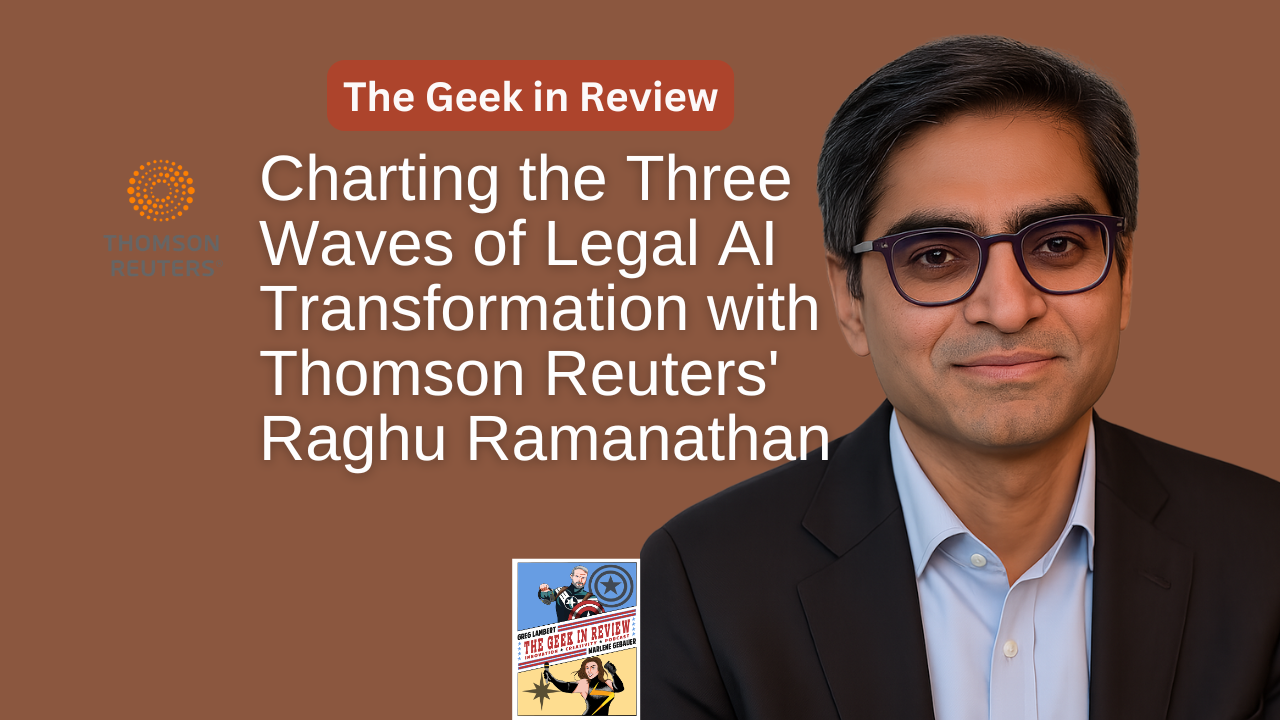
This week we welcome Raghu Ramanathan, President of Legal Professionals at Thomson Reuters, for an insightful discussion on the profound impact of Artificial Intelligence (AI) on the legal industry. Bringing a fresh perspective shaped by his extensive background in technology leadership at companies like SAP and strategy consulting with McKinsey, Raghu shares why he believes the legal sector, alongside healthcare, stands at the forefront of the AI revolution. His journey into the legal tech world, driven by the transformative potential of AI, sets the stage for a deep dive into current trends, future predictions, and the strategic initiatives shaping the future of law.

Central to the conversation is Raghu’s updated perspective on the evolution of law firms, revisiting predictions he first made in 2017. He outlines a compelling framework describing “three waves” of AI adoption currently underway. The first wave, “Optimization,” which many firms are experiencing now, focuses on using AI to enhance existing workflows, making tasks faster and more efficient. The second wave, “Re-engineering,” involves fundamentally rethinking processes, staffing models (including the traditional pyramid structure), pricing strategies, and the very nature of legal work to leverage AI’s capabilities more deeply. Looking further ahead, the third wave anticipates the emergence of entirely “New Business Models,” where law firms might offer tech-based services, explore adjacent business lines, embrace true outcome-based pricing, and potentially even reshape the legal value chain.

The discussion delves into the significant implications these waves have for law firm talent and structure. Raghu predicts a shift in the traditional law firm pyramid, potentially leading to leaner associate ranks but a greater need for experienced partners and, crucially, integrated tech talent. This necessitates not only attracting technologists but also potentially rethinking firm equity structures to retain them. Furthermore, the skill set required for the “lawyer of the future” is evolving; proficiency in delegation to AI tools, broader unstructured problem-solving, and embracing technological integration will become paramount, demanding changes in legal education and professional development.

Thomson Reuters is actively navigating and shaping this transformation, particularly through its AI platform, CoCounsel. Raghu highlights the rapid evolution of CoCounsel, emphasizing the continuous development of new “skills”—capabilities ranging from summarization and research to drafting and complex analysis like the innovative “Claims Explorer.” He explains TR’s strategy involves integrating proprietary data (like Westlaw), client-provided documents, and public information, leveraging advancements in Large Language Models (LLMs) from various providers to deliver comprehensive and powerful AI assistance. Prioritizing new skill development involves balancing significant client value with technical feasibility, constantly informed by close collaboration with innovation-focused customers.

Beyond law firms, the conversation explores the crucial role and adoption of AI within the court system. Raghu notes a surprising enthusiasm among courts, driven by the urgent need to address growing case backlogs and enhance access to justice within tight budgets. He points to Thomson Reuters’ significant partnerships, including a major agreement to deploy AI tools across the US federal courts and ongoing collaboration with the National Center for State Courts (NCSC), which is fostering education and policy discussions among judges and court staff nationwide. Complementing product innovation, TR’s expanded “Customer Success” initiative underscores the importance of user adoption, providing dedicated resources and best practices to help lawyers and legal professionals effectively integrate AI tools into their daily workflows, ensuring technology translates into tangible value.

Concluding with a look ahead, Raghu anticipates that smaller and mid-sized law firms may initially leverage AI more aggressively as a competitive equalizer, pushing larger firms to make bolder, more strategic moves beyond simple optimization. He stresses that the ultimate differentiator for success in the AI era will likely be less about the technology itself and more about effective change management—strategic clarity, operational implementation, and fostering a culture that embraces new ways of working. The rapid pace of AI adoption already witnessed in the legal sector signals that this transformation is not a distant prospect but a present reality reshaping the industry at an unprecedented speed.

Read the Whitepaper: “2025 Generative AI in Professional Services Report

Listen on mobile platforms:  ⁠⁠⁠⁠⁠⁠⁠⁠⁠⁠⁠⁠⁠⁠Apple Podcasts⁠⁠⁠⁠⁠⁠⁠⁠⁠⁠⁠⁠⁠⁠ |  ⁠⁠⁠⁠⁠⁠⁠⁠⁠⁠⁠⁠⁠⁠Spotify⁠⁠⁠⁠⁠⁠⁠⁠⁠⁠⁠⁠⁠⁠ | ⁠⁠⁠⁠⁠⁠⁠⁠⁠⁠⁠⁠⁠YouTube⁠⁠⁠⁠⁠⁠⁠⁠⁠⁠

[Special Thanks to Legal Technology Hub for their sponsoring this episode.]

Blue Sky: ⁠@geeklawblog.com⁠ ⁠@marlgeb⁠
⁠⁠⁠⁠⁠Email: geekinreviewpodcast@gmail.com
Music: ⁠⁠⁠⁠⁠⁠⁠⁠⁠⁠⁠⁠⁠⁠⁠⁠⁠Jerry David DeCicca⁠⁠⁠⁠⁠⁠⁠⁠⁠

Transcript

Continue Reading Charting the Three Waves of Legal AI Transformation with Thomson Reuters’ Raghu Ramanathan

I was getting my morning fill of Twitter updates this morning, when I saw a tweet from Emily Clasper go by that made a simple, yet intriguing statement:

I know most librarians have no clue about the ideas at #sesnyc but how are we supposed 2 b info experts if we don’t know how the

When I was in law school, some of my favorite classes where titled “Law and _____.” The blank was filled with things like “Economics” or “Religion” or “Psychology” or “Order.” The idea of taking two different concepts and seeing how they affected each other was absolutely fascinating to me. While each idea stood on its own, putting