[Guest Blogger – Janice Henderson]

Shocking news has occurred with the West Librarian Relations Management (LRM) team with major layoffs.  This was the second round of layoffs for the West LRM in less than a year. According to insiders, long time colleagues: Mark Schwartz (Director), Elaine Lee, Craig Griffith, Michelle Lucero and Erika Beck have been given their walking papers.  Anne Ellis and Lori Headstrom have missed this new development and are still employees of Thomson Reuters.  But for how long?

The question you may ask is why is this happening.  Is the answer purely economic?  I think the bigger question is what Thomson Reuters and to a lesser extent LexisNexis thinks about the librarian community.  The firing of the Librarian Relations Managers indicates that the companies feel that contacting librarians to purchase their products or maintaining a robust librarian relationship is no longer of value to them.

We are seeing this in Thomson Reuters sales strategies for WestlawNext. They are bypassing the librarians and going directly to the CEOs and COOs.  The best way to counteract this strategy is to have our executives push back and have the companies contact us as their experts in negotiating contracts.  If you don’t have this relationship with your COOs and Managing Partners, you need to start creating that relationship now or find your self looking in from the outside instead of being a vital part of management.

It took us years to earn the respect of our management teams.  But we seem to be sliding back to where we were pre-1990s. We have been steadily losing ground.  We lost ground in the 1990s when firms started putting IT Directors in charge of the library.  We’re losing ground in this decade as the Marketing Department is overshadowing us with business research.  In law schools Library Director positions are being filled by  non-librarians.  If we want to go the way of the Librarian Relations Managers, then sit back and do nothing.  But if you want to remain a viable member of the management team, you need to get up and remind them of your value.

Seeing Lisa’s post last night discussing lawyers being timid about putting their contacts on LinkedIn made me think of another story that I’ve heard lately. In fact, I’ve heard it so often, from different people, that I think it may  actually qualify as an “urban legend.” Okay… stop me if you’ve already heard this one:

“Did you hear that one of the attorneys in the firm got pulled off a case by a client? Yeah… Apparently the attorney joined a [LinkedIn and/or Facebook] group that was [pro / anti] – [gun control / environment / GLBT] and one of the clients saw it and got angry. Yeah… I know… So, the client told the Partner in charge to pull this attorney off of all of their matters. I hear that the firm is going to ban all social media that can be linked back to the firm because of this. Makes you want to shutdown your [Facebook/LinkedIn/Twitter] account, doesn’t it?”

Have you heard one of these stories? (I told you to stop me!!)

It reminds me of the urban legends like the choking dog, only to find out the dog was choking on the fingers of a robber that was still in the house… or the “don’t flash your lights” at cars that are driving with no lights on because it may be a gang initiation and they will kill you. Stories that play on a combination of fear and ignorance – not necessarily reality.

If you have a client that is that sensitive to what their attorney’s personal “likes” are… then you might want to stop putting out press releases where you did pro-bono work for Katrina victims, or abused women, or anything that might offend a client. Don’t accept those awards for Top Lawyers Under 40 (because your client may not want those young-un’s working on their matters). Don’t boast about the diversity in your firm, because your client may be a closeted bigot. Perhaps you just shouldn’t say anything at all… would that be a good marketing policy? Well, it probably wouldn’t be a great social media policy either.

Instead of making social media policy based on fear and ignorance, train your attorneys and staff about the benefits and the pitfalls that come with potentially exposing personal information to the world. Having people that understand the good and the bad of social media will make them smarter in the way they use it. I usually tell attorneys that the golden rule of social media is pretty simple – “just don’t say anything stupid.”

If I had a quarter for every time a lawyer asks me, “How can I hide my contacts on LinkedIn? Won’t everyone steal my contacts if I post them,” I’d be … well, I will save that discussion when ever you ask me out for drinks …
That said, lawyers are TERRIFIED that if they post their contacts on LinkedIn that everyone will swarm their contact list and steal their clients.
Let me assure you, Dear Lawyer, that will only happen if you have a really cruddy relationship with the people on your contact list.
There I said it.
If someone can simply steal your contact by going on LinkedIn, then you, Dear Lawyer, have much bigger worries.
Your contact list is based upon your relationships with the people with whom you do business. Hopefully, over the years, you have developed meaningful relationships with these people. And, I hate to break it to you, but your contacts do have other relationships. Yes, its true. They are not monogamous. Your clients are seeing other people.
If you are that worried about your relationship with your significant other–err, client–then perhaps you should be spending more time alone together.

Well, it doesn’t happen often, but it does happen… Seems that Westlaw is down this morning. A system-wide failure that apparently effected Westlaw, WestlawNext, Saegis, Monitor Suite, Quickview and MyAccount. Hmmm… maybe the “bunker” in Eagan doesn’t work as promised??

What does one do when Westlaw goes down? I imagine the first response is to log in to Lexis. So, after you call the library and ask them to re-send you your Lexis ID (and hope that in the meantime Westlaw comes back up) you jump right back into the premium research products.
Perhaps this is one of those “teachable moments” where researchers can be pointed to resources like Google Scholar, or to the state bar association’s sites for Fastcase or Casemaker? Perhaps it is even a chance to show an associate how a book works?? (What?? You say you threw away those reporters because you needed to turn the shelving space into offices??) 
There’s no need to waste a chance like this!! Share with us what your backup plan is when the almighty Westlaw product goes down? Please tell us it is something besides “roam the halls until it comes back up!!”

Recently, I presented at the Ark Group’s KM conference on using KM to advance the AFA game for law firms. Greg has previously posted on his reaction to KM based on the conference, and here I share mine. For my presentation I put together a case study from an actual exercise in building a budget from past billing knowledge, to use in setting a fixed fee. Per my case study, I note that “Common KM wisdom holds that analyzing past billings is a constructive effort for building new budgets to use in establishing fixed fees and other alternative fee pricing.”
This idea makes perfect sense until you actually attempt it. In the case study exercise, I went through a progression of effort, trying to isolate influences to establish some pattern or trend in past billing information. The first pass was analyzing like matters. The second was analyzing like matters from the same client. The third attempt, the primary focus of the case study, was analyzing the same case (from different jurisdictions), for the same client from the same time-frame (a product liability case). None of these efforts resulted in a consensus budget number. Instead wide variations in fee amounts and even timing of fees was discovered.
The KM lesson is twofold:
– First, even the best existing search and retrieve KM will not address this problem since the issue is not finding matters (that is a separate issue), but instead it is understanding the data related to them.
– Second, gaining useful knowledge about fees will require the analysis of volumes of poorly structured billing information. And this is where KM comes in.
But it can’t be the same old KM.
It can’t be the passive search and collaborate KM. It needs to be a new style of KM, whereby our technology is about understanding our knowledge. A recent example that demonstrates this thinking is ‘predictive coding’ from the e-discovery space. This new approach moves past search and into analysis. Instead of just trying to find relevant discovery information, predictive coding analyzes the data and proactively codes the information. This task has been almost exclusively in the human realm until this development. The Managing Partner of Squire Sanders presented on this concept at the same KM conference. He had even conducted an analysis, comparing human coding with predictive coding side-by-side to test the effectiveness. Predictive coding matched or beat human coding on every level.
This is Analysis KM – a new breed of KM that brings machine-enabled analysis to bear on our growing mass of information. The volume and complexity of our knowledge is so large, expecting humans to be able to understand and analyze it is crazy. So the answer to KM’s future lies in this new analysis direction.
PS – The picture on this post has very little to do with topic, other than thinking BIG. I just miss Moab is all.

Over the weekend, I left the family room computer screen open on Hugh MacLeod’s Gaping Void cartoon that I linked to last Friday. My wife walked by, glanced at the screen, and then turned to me and said “That is a great quote.” I put my coffee down and looked over to see what she was talking about, and re-read Hugh’s title for his November 10th post:

“if you want to be more successful, you have to take a leadership position on something that matters”

My wife jumped back in and told me a story of a proud parent that came into the elementary school and bragged about how her child was “a leader” in the classroom. It would have been interesting to ask that parent if she believed her child took a leadership on something that mattered… or if the child was just the “alpha-dog” of the class?

It made me think of the legal industry and the common approach that many firms take when something “new” comes into the picture. The “new” could be anything from technology, to business models, to opening new markets, to merging or acquiring peer firms. In an industry filled with extremely talented and smart individuals, the common approach to handling a change in the common approach is to ask “What are our peer’s doing on this issue?” It appears to be a “let’s chase each other’s tails around” industry more than a “let’s lead on something that matters” industry.

Let’s take something that people in the legal industry are talking about lately — Legal Project Management (LPM).

As I sat through a day-long session at the Ark Group Conference in New York, I listened to speaker after speaker talk about LPM and how law firms need to implement these ideas that other industries have adopted for years now. In fact, one speaker told that crowd that the legal industry “has to implement” LPM because every other industry has already adopted it, and therefore, legal must adopt it.

After listening to a number of these cheerleaders, I turned to Toby and joked that the speakers seem to have forgotten the two most important reasons that a firm needs to answer in order to adopt a new business strategy:

  1. Is my client demanding that I make this change? (does LPM matter to my client?)
  2. Is my firm loosing money/business because our peers have implemented this change? (does LPM matter to my firm?)

Now, I could be wrong here, but as far as I’ve seen, the answer to both of these questions is “no.”  Or, perhaps we’ve taken the wrong “leadership position” on finding that “something” that matters. For example, firms that have adopted LPM strategies, such as when Seyfarth Shaw’s adopted “Seyfarth Lean” (Lean Sigma), they seemed to have used it more for its “public relations” effect more than because it was “something that mattered.” If implementing Lean Sigma procedures really mattered, and the firm was taking a leadership role in implementing Lean Sigma as a business model that mattered, then they would list “Seyfarth Lean” front and center in their services or commitment goals. Instead, it appears to be hidden on two attorney bio pages and three old press releases.

Then maybe we are asking the questions in the wrong way. Perhaps the powers-that-be in a law firm should take a more proactive approach to the issue and ask these questions in the following way:

  1. Would making this change fulfill the needs of my clients? (would the results of implementing LPM procedures matter to my client?)
  2. Would implementing LPM procedures make my firm more competitive in keeping existing clients and attracting new clients? (would the results LPM procedures matter to the business development and client relations of the firm?)

By asking these questions in this way, you’re taking on the proactive role as the leader, and not the reactive role of the follower.

I picked on Legal Project Management, but there are multiple examples of firms taking leadership roles on things that make for good PR, but that really just don’t matter (to their firm, or their clients). In fact, as I was writing this post, the ABA Journal  listed five traits on “What Future Law Firm Leaders Will Need.” I point everyone back to MacLeod’s quote, and remind them that “if you want to be more successful, you have to take a leadership position on something that matters.”

Greg recently described the changing role of library spaces. An environment once valued for its utilitarianism now entices guests by offering comfort and camaraderie. A change from tradition? Certainly. But this evolution of the library’s space duly reflects the changes in the latest generation’s social interactions and, yes, the rise of social media. That rise is often couched in terms of virtual features and benefits, but the true diamond in the rough of #sm is its effect on our very real lives and our very real relationships.

Social media is more than a technologically advanced version of the letter. The ease and speed with which we can now communicate with multitudes has allowed us to build and maintain bridges that we simply would not, and could not, have done without social media. And while it means we spend more time sharing virtually, it also means we spend more time bonding personally. To be sure, there is plenty of rough in a world of social media, but there is also a sparkling web of social connectivity that, lo and behold, triggers live, in-person interactions that otherwise would not be. And despite its seemingly superficial and ephemeral nature, social media has changed not only the way we communicate, but also the way we learn and the way we expect to learn. Enter the library, with its ability to offer just what our newly connected society needs — a physical space uniquely capable of nurturing our new social ecosystem and fostering the camaraderie and connectivity we now use to learn.
Accommodating and encouraging social learning is just one of many services a library can provide. But carving out that service reflects a recognition of the changing nature of communication and will truly make any library shine.

We probably all like comics such as Dilbert, XKCD, and maybe you even like Doonesbury, but these three comics don’t have a monopoly on funny, smart humor when it comes to online comics that make you think. Here are a few of my favorite online comics and drawings that make me think.

If you have a few favorites, please feel free to share those with the rest of us in the comments!!

This Is Indexed


I’ve never met Jessica Hagy, but judging from her “little project” of putting index card drawings online that she makes “as the coffee brews”, I’d have to say she’s a freakin’ genius. I enjoy seeing what pops up in my Google Reader feed each day from Indexed. Simple title… simple graphs… very smart!

This Is Indexed by Jessica Hagy
www.thisisindexed.com

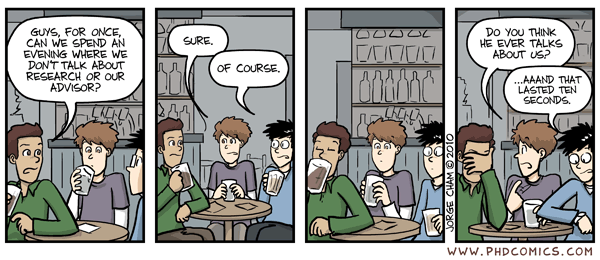
PhD (Piled Higher & Deeper)

Another smart comic that is relevant for anyone that ever went to grad school. It will bring back all of those memories you had about being one of the smartest people you’ve ever know, but still somewhere on the social ladder under the Manager of the local Denny’s (who was making more money than you were… plus he didn’t have $50K in student loans that he had to pay back.)

“Piled Higher and Deeper” by Jorge Cham
www.phdcomics.com

A Softer World

Edgy… funny… and sometime a little confusing. A Softer World takes photos and adds some simple dialog for the humor. If you like your comics with a bit of existentialism, then this one’s for you.

A Softer World by Emily Horne and Joey Comeau
asofterworld.com

Gaping Void


It’s hard to believe how much thought can be drawn on the back of a business card, but Gaping Void proves once and for all that size doesn’t matter (when it comes to comics anyway.) If you follow the latest technology trends, then you’ll probably like the perspective given by Gaping Void.

Gaping Void by Hugh MacLeod
gapingvoid.com

Let me know if you have some favorites of your own that you wouldn’t mind sharing with the rest of us!!

The last one I’m going to mention will probably make you think less of me… because it is base “guy” humor. Sometimes, however, that’s exactly what I need to help me through the day.

Least I Could Do
Judging from the seven plus years of work, I’d say that the writers and illustrators of this comic have a few childhood issues that they are working out. Luckily for them, they are funny, and they’re not afraid to share a few of those issues with us. This isn’t a “check your brain at the door” strip… it definitely has some thought behind it. However, it does track the life of a narcasis single male and the friends and family that seem to love him in spite of it all. Sometimes the language may make this one not suitable for work (if you work at a stodgy place, that is…) —  so make sure language police aren’t around before loading it up in your browser!

Least I Could Do by Ryan Sohmer & Lar Desouza
leasticoulddo.com

Wouldn’t it be great if we could all just sit back and let the world come to us for help? Unfortunately, for most of us, it just isn’t that easy. Proper marketing of departments and individuals can make sure that we show our importance within the firm, and let others know what our strengths are (rather than just handing out busy-work.) So this week we ask the following Elephant Post question:

How do you market your department and yourself within the firm? What works and what doesn’t?

We have some great perspectives from the help desk, library, marketing, competitive intelligence, knowledge management, and alternative fee points of view.

We’ll do this all over again next week with an Elephant Post question that asks about what you like and don’t like about the vendors you deal with (check out the full question at the bottom of this post.)

NOTE: In two weeks (Thanksgiving), we are going to do something fun!! I wanted to give everyone a little more notice because we’re hoping to get a lot of people contributing to that one.

___________________________________
Help Desk Perspective:


Face-to-Face Contact
Gene Hamilton

In point of fact, the world *does* just come to my team for help (we’re the HelpDesk, after all)! That is still a bit simplistic, though – there’s still the question of customer perception. The real trick is not to have folks at your door because they’re a captive audience, but because they really want what you can (and do) deliver.

One of the efforts that my team has been engaging in is incredibly simple and similarly powerful. Show your face!

It’s all too easy for HelpDesk employees to become faceless voices. We take notes of who we’ve talked to through the day, and make a brief personal visit to one of those contacts that we didn’t know previously. That face-to-face contact has been worth its weight in gold for spreading a positive image of our team! When our coworkers consider the HelpDesk, we don’t want them to simply brood about problems and negativity. Instead, they have a recent encounter to consider that was both positive and personal.

Now we’re facing the next challenge; attempting to replicate as much of the benefit of that personal interaction as we can to firm employees in other offices…

___________________________________
Knowledge Management Perspective:

Don’t Be Afraid to Share Your Knowledge
If you have an opportunity to help out someone in another department or practice area, take it. Even if it’s not the main skill you’re paid for, if you know how to help that person, go for it. Share your knowledge.
Until people have direct experience with a particular department or person, they’re unlikely to remember organizational structures or who in what department does what. They will, however, remember characteristics such as helpfulness and ability to answer questions knowledgeably. So if you help solve a colleague’s problem, even if it wasn’t something you’re paid to do, that person will start associating your department with knowledgeable, helpful people, and will start spreading that impression around to the other people they work with, in their own and other departments.

___________________________________
Competitive Intelligence Perspective:

What have I Done For You lately?
Keeping your visibility up within the firm is a never-ending process.
Some ways to get this done:
When visiting a branch office, stick your head in offices and ask people how you can help them succeed. Remind them of the products and services you provide that can help them achieve that success. This also gives them a face to match with a name they have only seen on an email message or voice only heard on the phone.
Ask to present at Practice Group meetings or retreats. This could be as general as a quick overview of your products and services or as specific as a how-to refresher on a practice-specific resource.
Create a brand and place it prominently on briefing packs and market analyses. How else will know where it came from?
Create a list of successes. Make regular reports to management regarding ROI.
The firm won’t know what you do unless you tell them…and then remind them.

___________________________________
Library Perspective:

Never Say “No Problem”
Holly Riccio

One of the greatest pieces of marketing advice I got was one the most straightforward and simple. Whenever you do anything for someone (in my case, usually research of some kind) and they reply with some version of “Thank You,” never ever reply with any variation of “No Problem.” Saying “No Problem” diminishes your value and the value of the work product that you provided. Say something like “You’re welcome. Glad what we provided was helpful to you.” Of course, there are lots of other things I do to market the library, many of which have already been discussed above, but this is a very easy, but effective, one that I think we should all remember.

___________________________________
Library Perspective:


Don’t Be Afraid of Taking Action or Taking Credit
Greg Lambert

There have been many times when I hear librarians at law firms make snide comments about the Marketing department getting credit for the work that the library does. It usually goes something like this: “Of course they’re good at marketing themselves… They’re Marketing!” Although that might be a true statement, it doesn’t mean that Marketing has cornered the market on taking credit for being a valuable asset to the firm.

One of the things I tell librarians is that when someone comes to you for research assistance, they are usually doing so because they absolutely need your help. When you complete that task, they are generally very grateful for the help you gave them. It’s okay to take credit for the work and let them know that they should come back to you next time they need help. In fact, mention that next time… don’t wait until 5:00 PM on Friday to ask for help. The earlier in the process they bring you in, the better the results will be.

___________________________________
Online Marketing Perspective:


Brilliant
Lisa Salazar

My job is to make you look good.

If I have succeeded in making you look brilliant, then you will market for me. And as we all know, third-party endorsements are the best marketing techniques out there.

And my job is to look good.

My hair stylist told me that I was a walking business card. That is something I will never forget. Yes, it is shallow and we all hate it, but we also know it is true.

Dress like a million bucks and you will be treated like a million bucks. If you can’t afford to go to a styling coach, then ask someone who you admire and trust where they shop, where they get their hair done, where they get their facials. Looks matter. Period.

___________________________________
Alternative Fee Perspective:


Listen
Toby Brown

A few years back an associate I was business coaching called me all excited. He had landed an on-site meeting with a client to talk about business opportunities. He called me from his cell phone on the way to the meeting asking what he should sell them. I told him not to sell them anything. Instead, I said he should just listen to them. You want them to talk about their pain points and what they want to buy. At first he thought I was a bit crazy, but fortunately he took my advice. He called me back later that day to say how well it went. Once he got them talking about their needs, he couldn’t get them stop. It resulted in his first ‘billing’ matter.

Even as a teacher in this situation, I learned once again the power of listening. When lawyers call me about AFA opportunities, the first thing I do is listen. When given the chance, they not only tell me about the AFA, they talk about the client dynamic and relationship. Armed with this broader knowledge, I am more fully able to address their needs. They end up happy and very willing to call me the next time, usually sooner in the process and with better results. And they share their success with colleagues, which of course leads to more opportunities to … listen.

___________________________________

Without Naming Names (unless you want to…) What drives you crazy when dealing with vendors? – And/Or – Have you had positive dealings with a vendor that other vendors could learn from?

Dealing with vendors isn’t always a bad experience… but we all have our “horror stories.” Here’s your chance to share those stories. On the other hand, you may want to spin this around and tell about a good experience you had, and how other vendors could take note from that experience.
If you want to contribute, please send me an email or a tweet and I’ll give you the details on the logistics of sharing your perspective with us.
___________________________________

On Thanksgiving, We’re Having Elephant!!
Since we post the Elephant Posts on Thursday, and in a couple of weeks that will fall on Thanksgiving (at least here in the US), we’ll put the Elephant Post out on either Tuesday or Wednesday. To make it more enjoyable, we’re going to go off-script a little and have some fun.
Which Star Trek (or Monty Python or Dr. Who, etc.) Character would you think would be outstanding in your profession?

Off the top of my head, Mr. Data from Star Trek: The Next Generation, would make a great librarian… especially in these days of electronic books, databases and Google searching. Of course, I’d have to teach him a little bit about the “reference interview” technique, but I think he’d catch on after a few months behind the reference desk (especially around 4:50 PM on Friday’s before a three-day weekend.)
Same as above… if you want to contribute, email me or tweet me for the details!

We (IT) are getting more and more pressure to develop systems that enable the client to interact with the Firm in what is being coined as a “real time” or near real time basis.  The technology to communicate in real time has been around for many years, we call that technology a telephone.  You have a phone, pick it up and talk to the client. 
Clearly there is value in extranets that allow a client to track budgets or share documents, but they are allowing lawyers to stray away from one of the most important aspects of their relationship with their client – personal interaction.  
Using technology to stay in touch with your client is like trying to teach your child to drive a car via twitter.  

Parent to child:  Here Johnny, follow this link to understand your blind spots.  

Attorney to client:  Hey client, I just posted a link on your extranet that relates to your case.  Read it at your leisure.  

Talk about a warm fuzzy!  Why not pick up the phone and demonstrate to the client not only your understanding of the law, but your understanding of the client’s business?
Clients want lawyers who understand the client’s business.  I don’t mean understand in the basic sense; I mean know their business like you know the law.  How does a busy lawyer keep current on their client’s business?  You do not want to bug the client to educate you.  You want to impress the client with your understanding.  This is where technology can really help.
You want to impress your clients?  Figure out what technology they use to keep current and use that technology.  Find out if the GC (CEO, CFO, decision makers) for your client uses twitter, reads RSS feeds, subscribes to newspapers, etc. and do the same.  Become an active contributor to areas that the client will read.  Twitter is a great way to do this.  By leveraging twitter, I’m able to keep current with many areas where I would otherwise have no exposure.  And within the twitter world, I’m able to interact with people I would otherwise not know.  These interactions help build stronger business relationships.  It’s important to contribute to the dialog no matter where that dialog is taking place.  If you aren’t part of the conversation, someone else is.  And trust me, your client is listening.
I interact with many people on twitter.  None of those people are going to hire me based solely on my interaction with them on twitter.  The people that would consider hiring me are the people that know me from some other interaction.  However, what I contribute does help shape the way I am known and perceived.  If it comes down to a couple of candidates, one who participates in such a dialog and one who does not, you can bet the participator will get the advantage.  Why?  Because he or she was part of the conversation. 
Does technology help build a bond between client and law firm?  No.  Technology helps deliver information in a timely manner.  You build bonds through personal interaction.
Technology is not your friend, your client is, but technology can be a tipping point.