[Guest Blogger Eric Hunter]

Why Google Apps? Why Not.
I know, it sounds a little nuts, but Google is going to take over the world, our collective consciousness and all of us in it, so we might as well just jump on board! Seriously though, from a strategic investment perspective, there’s a lot to Google Apps and competing collaborative cloud hosted applications that should catch the eye of firms of all sizes.
Consider my firm and our move (leap of faith?!) to the cloud as a decent starting point and case study in what collaborative cloud solutions, in our case Google Apps, can offer as well as what they can’t or shouldn’t provide (silver bullets are still tough to find!).
Technology Outsourcing 
All right, so what happens with your Technology? I was told by a good friend of mine recently, and recognized expert in her field, that “I don’t really do Knowledge Management, that my focus is purely on infrastructure.” I told her my choice is actually to outsource the infrastructure and solely focus on KM! Consider it fact, that the more collaborative cloud platforms like Google Apps evolve, the more technology will be outsourced. Both a portion of the humans in your tech departments, and the applications running wherever you currently have them, will be outsourced to Google in this model.
Behavioral Change? 
Yep. We chose to migrate to Google’s browser hosted web app. We wanted the most dramatic shift for our users possible to ensure they would begin altering their day to day behavior immediately. Google’s platform is built to tie in mail, documents, sites (their sharepoint/extranet equivalant), and messaging in ways completely outside the box from a traditional business perspective. Such a ‘shock and awe’ strategy helps users quickly get out of existing behavioral thinking patterns they take for granted, and to do something different, innovative, and evolve with both the business and consumer market. This is good, because when you move your firm to evolving cloud hosted collaboration, it’s going to change, all the time. Of course, the ability to implement such extreme change is dependent on a lot of factors, some behavioral, some business strategy focused. I firmly believe the concept that “law firms do not embrace change” is something that will change to “our law firm demands continual change to stay ahead of our competition and engage in the most strategic fashion possible with our clients.”
This may seem ludicrous to some, but consider the consumer market, primarily social media. How many of your users use Facebook? How many user Twitter? How often do those platforms change, and how much training do your users need in their personal lives to navigate changes with these evolving platforms? These collaborative cloud hosted solutions, both consumer and business, are built to be intuitive and designed to connect people with people and link information among users, including third parties. The platforms that do it the best, thrive. The ones that do not, fall away. In my opinion, the collaboration features in these knowledge sharing social media markets is merging within cloud hosted applications within the business market. These applications drive behavioral change in the consumer. Why not leverage this?
So how do you stay on top of this evolving platform? 
Training and professional development. Senior Management must embrace this behavioral shift to their business, and stay unified. Ensure your committees, practice groups and mid level managers are all part of continual training sessions on the evolving platform and the new ways your firm is utilizing these features. Some of these training sessions will be ‘target specific’ within your firm, and some of these sessions will target all. Granted, most firms have similar training procedures in place. But with a model like Google, the decentralized nature of the system and the continually evolving product demand these sessions to be consistent and innovative. We’ve found our relative knowledge level has risen across all departments, departments are better connected, we connect more effectively with our clients, and our end users are demanding change, faster than Google’s product is developing.
Speaking of that, is Google as a collaborative cloud provider ready for global law firms heavily invested in alternative systems and third party leveraged integration? No, not yet. But Google’s investment path shows they’re well on their way and will most likely move faster than many think. Third party players may be well advised to adapt their systems to offer integration options, and quickly before new players arrive in town.
What about Microsoft? 
Microsoft’s Business Productivity Online Suite is a great product with considerable cost savings in licensing, and is a collaborative cloud option that competes directly with Google. It’s because of Microsoft’s investment path with this product I think Google is going to continue to innovate in this market. It’s because Microsoft has come out so publicly with their “cloud” offerings, that I think Google will continue to emerge as a player, and Microsoft will continue to refine and offer a better competing product. Bottom line, licensing drops across the industry, cloud hosted collaboration products continually improve, and it’s a win for legal and their clients.
Are law firms defined by the vendors they use?
Ultimately as law firms, it isn’t the name of the vendor we choose that makes the difference, nor even the technology, but the business drivers, behavioral change, and competitive intelligence that benefits our firms, our practice groups and our clients. So much focus is on the ‘Cloud’! When considering cloud hosted collaboration systems, I suggest taking away that ‘cloud’ focus from the analysis for a short time. Focus then on the immediate cost savings in licensing. Focus on the benefits of a hosted collaboration system that evolves and is integrating with consumer driven social media applications and enterprise level applications. Focus on the benefits of an emerging Knowledge Sharing platform, collaboration platform, and unified communications platform, and which existing and emerging third party vendors could best integrate with this platform. Consider how your staffing options will shift, how your client correspondence and extranets will shift, how many alternative staffing models become possible, and how your attorneys will rethink how they think! How will your business model shift in this environment, and how will your firm’s culture evolve? Then put the ‘cloud’ back into play and consider your options.
How will it all play out?
Google is still an emerging player, but they are highly innovative, and we are experiencing daily innovation within our line of business and our forward thinking investment strategy. We’re trusting that Google’s continual investments in improving their search and collaboration features and bridging them across all applications and to as many devices and mediums as possible will not only bring them obscene amounts of ad revenue, but will benefit their clients, like my firm, in a cloud hosted relationship. I’m trusting Microsoft will continue to compete in the business arena to protect their licensing revenue in Office, Sharepoint, and related applications. I’m trusting there is too much of a financial and market incentive for Legal’s third party players in business, financial and competitive intelligence to sit on the sidelines and not integrate in this medium. As you can see, I am very trustworthy (or is it trusting) … Stay tuned to see how it plays out.
About the author: Eric Hunter is the Director of Knowledge Management and Technology at Bradford & Barthel, LLP, where he is currently integrating a cloud-hosted collaboration platform within the firm’s 12 office environment. Eric has spoken on collaborative cloud solutions at ILTA’s Insight in the UK, ILTA’s 2010 Strategic Unity conference, and the Chilli IQ Conference in Australia. He is the recipient of ILTA’s 2010 Knowledge Management Champion Distinguished Peer Award. Eric can be reached at ehunter@bradfordbarthel.com.

As someone that has both attended (2005), and presented (2009) at the Advanced Management for Private Law Librarians (AMPLL) Conference, I encourage anyone that is a manager at a law firm or corporate law department to apply for the upcoming conference. I wrote about how AMPLL recharged my batteries back in 2009 and I still feel that this type of training / social interaction with peers is important for anyone who is a leader in the private law library world.

One suggestion I have on the application is that you pay particular attention to questions 6 (What are your biggest management challenges?) and 7 (What do you hope to gain from attending this conference?) on the application. Those are extremely important when deciding who gets in and who doesn’t. (Come to think of it, they’d also make some pretty good Elephant Post questions!)

Here are the instructions. The deadline is December 31st, so get to work!

The Eighth Advanced Management for Private Law Librarians (AMPLL) Conference, sponsored by the LexisNexis Librarian Relations Group, will be held April 8 – 10, 2011 in Dallas, TX.  Applications due by December 31, 2010.
THE MISSION:
Redefining ourselves in the new law firm landscape: changes, challenges and opportunities.
CONFERENCE OBJECTIVES
  • Our world: appreciate and capitalize on intimate knowledge of the legal industry
  • Our firm: collaborate to create and leverage strategic opportunities
  • Our department: measure and communicate value
  • Our staff: cultivate the staff you want
  • Ourselves: enhance time management, project management and soft skills
Application deadline is December 31, 2010, and all applicants will be informed by February 18, 2011.  Previous applicants who did not attend are encouraged to apply again.
 Additional information can be found at: AMPLL 2011 and the application to attend can be found at: http://www.lexisnexis.com//ampllapp
 If you have any questions about the program, please contact your LexisNexis Librarian Relations Consultant.

[Guest Blogger Ryan McClead brings us part II of the End of Corporate IT]

Despite what may have been a slightly overstated prognosis of doom and gloom, no one has (as of this writing) stepped up to refute my scenario.  We may quibble about the details of the CorpTech-pocalypse (CTP) , but no one has suggested that it won’t happen at all.   So…where do we go from here?

Well, we have two options:

Option 1:  Ignore it, maintain the status quo, stick your fingers in your ears and la la la la…

IT departments that maintain the status quo will be the first to collapse under the weight of the CTP.   Chances are good that a favorite topic of conversation for your CEO is currently “my IT department doesn’t understand what we do.”  I am friends with educators, doctors, accountants, business people, and even a few lawyers, and they have all at one time or another expressed to me their displeasure with their own IT department using a variation on that phrase. It’s probably the most common IT related phrase ever spoken by professionals, with the possible exception of “why do I have to reboot again?”.  Eventually your CEO will be lamenting your general un-helpfulness while seated across the table from a salesperson for a major technology services provider who will helpfully explain that they can offer all of the services that you currently provide for a quarter of the cost.  At that point it’s too late to change.  So, ultimately, option 1 isn’t really an option.

Option 2:  Change the way you operate now, learn the business your company is actually in, prepare your company to transition into the post-IT environment, and develop the skills that will be useful in your next career.

Change the way you operate now.

This is less a practical suggestion, than an exhortation that you need to change sooner rather than later.  Change is never easy, but it’s not going to magically be easier in a few years.  In fact, it’s never going to be easier than it is right now.

Learn the business your company is actually in.  (Hint: it’s probably not IT services.).

IT departments were created because management recognized the need for someone with special knowledge to maintain and support the technology needs of their business.  As technology needs have exploded, IT has too.  IT policies originally set in place to make it easier for IT to provide services, have evolved into de facto Company Policies with IT as the enforcer.  This has created an antagonistic relationship between the IT department and the company at large.  When someone finds a new or better way of using technology to do their job, the last people they want to tell is IT because IT will shut it down. We’ve become obstructionists standing in the way of innovation.  A company within the company, but fundamentally disconnected from the primary business.

Your value as a technologist isn’t in your general understanding of technology, but in your understanding of how technology can improve business practices.  If you don’t understand those business practices, you are providing minimal value to your company.

Prepare your company to transition into the Post-IT environment

First and foremost, stop habitually saying “No” to non-standard technology requests.  If you don’t know about a particular technology that is being requested, ask the user to explain it to you.  How do they want to use it?  What service will it provide them that they don’t currently have?  You may already have a system in place to provide the service the user is looking for and if you don’t it might be a valuable addition to your network.  If you’ve already reviewed, evaluated and rejected the technology, give the user an explanation for why it was rejected in language that they can understand.  Rattling off a string of techno-babble is tantamount to just saying “no”.

Develop processes to quickly review, evaluate and adopt (when possible) popular consumer technologies and services. You should have a small group whose job it is to review new technologies, see how they work in your environment, discuss the value of the service with business management and present a report with risks and benefits clearly defined so that management can weigh the options and make decisions about technologies that will be allowed.

Develop an End Point Agnostic network. Once upon a time, mobile computing devices were the province of corporate IT.  That ship has sailed.  Mobile computing is a wing of the fashion industry, and people are passionate about their fashion accessories.  Let them use whatever device they want.  Blackberries, iPhones, Androids are all capable machines and there are ways to connect them to your network safely.  Experiment and document acceptable usage of all devices,  If you provide an acceptable way to use the devices people want to use, they will most likely use them correctly.  Most people understand the issues of security and compliance.  They will try to comply right up until you tell them they can’t use their pretty pink phone, then they will figure out how to connect said pink phone to your network in a way that isn’t secure.

End Point Agnosticism is a first step toward Cloud Computing, Telecommuting and SaaS adoption.  Each of these become easier if your network is already EPA.

Develop the skills that will be useful in your next career.

This is not to say that your next career will not be in technology, just that it probably won’t be in a non-tech corporation, unless you are consulting on using technology to enhance business practices.  Step 2 above, learn the business your company is actually in, will help your company now and enhance your personal value in the future.

Most of us originally got into corporate IT because we had a deep interest in technology.  Redevelop, or in some cases develop, that interest!  Don’t just know how you do things in your company, study how other companies accomplish the same tasks, learn new technologies, and explore new solutions.  We are living in the most exciting technological period in history, revel in it.

Lastly, throw out old biases.  PC vs. Mac vs. Linux, Blackberry vs. iPhone, Google vs. Yahoo. It doesn’t matter anymore.  You need to know them all.  Embrace it.  The more you know, the more valuable you are.  The more focused you are on a single technology, the more easily you are replaced.

The CorpTechPocalypse is going to happen, but it doesn’t need to be painful for you or for your company.  In the end, you might both be better off going your separate ways and seeing other people, having grown for the experience.  And if you do it right, you can still be friends.

I’ve been a huge fan of a teaching website called Khan Academy for a while now, and have pointed it out to a number of teachers and students to the site who are looking for tutorials on math, science, finance, history and more. One of the ideas that has been mulling around in the back of my head ever since I saw my first Khan’s Academy video on linear equations, was that this simple teaching style could easily be adapted by the law library or legal research and writing community to help students, lawyers and lay people understand some of the basics of legal research citation. 

You should really go and watch this 20-minute video of Salmon Khan explaining how he started the academy and how it works… but, since you probably don’t have 20 minutes, I’ll try to explain it in a few sentences.

Perhaps the best method of tutoring someone is through a one-on-one session where the student sits down with the tutor with a sheet of paper and the tutor talks the student through the process. The session should be short and should be narrowly focused on one topic. If the student gets stuck on something, they should be able to get the tutor to go back to that concept and show it to them again. Unlike a classroom method, the student is focused on the material, and not the professor teaching the subject. Here’s a nine-minute long video of Salmon Khan explaining Dividing Fractions (you don’t have to watch the whole thing… just view it for the process of how a simple blackboard and Khan’s voice explaining the concepts work, and then I’ll explain my idea of how this process could work in legal research and writing.)

In many of his interviews, Salmon Khan explains that this type of instructional method works because the student is focused on the concept being taught and the instructor simply becomes a voice inside the student’s head. Khan even mentions that he’s received comments that when students take a test, it is Khan’s voice they hear when they start recalling rules on how to work the problem on the test.

This same type of method could be used to teach something like The Greenbook (Texas Rules of Form) here in Texas, or The Bluebook (A Uniform System of Citation) for most of the US Courts. These books lay out the rules for citing cases and statutes, but quite frankly, they aren’t exactly the easiest things to follow, and you probably learned how to use these books in a class with a hundred other students, taught by a Teaching Assistant who was a 2L and barely knew it himself.

Here’s the opportunity for some forward-thinking law librarian or legal writing instructor… why not take the concepts that are used in the Khan Academy videos and adapt them to explaining these citation rules? Once you’ve made the video of a specific rule, you can share it forever (or until someone decides to rewrite the rule in a significant way.) Brand these videos with your school or association’s brand and suddenly you’ve got yourself a resource that not only helps researchers understand the rules, you’ve also made yourself or your organization a leader in teaching how to properly cite legal documents.

Adapting this style of teaching isn’t limited to proper citation methods. It can be expanded to other legal concepts such as legal research concepts, cite checking, searching a specific database and more. Now it is just a matter of finding the right people to pull something like this together. 

Any suggestions on who that “someone” might be?? Any suggestions on other topics that could benefit from this style of instruction??

[Guest Blogger – Ryan McClead


I have seen the future and there is no IT. Oh, there will be people called IT personnel and there will be external IT corporations, but the corporate IT operations and development departments as we know them today, will cease to exist…and soon. A few wise souls may realize that the end is out there in some amorphous distant future, but in the meantime they slog away at the daily minutiae, oblivious to the quickly approaching cliff off of which they are about to plummet. I predict it will happen suddenly and within the next few years.
There are a number of factors leading to this inevitable demise of corporate IT, but three in particular will be sufficient to bring on the end:
•             The corporate acceptance of SaaS.
•             The explosion of consumer technology.
•             The US economy.
Software as a Service, or SaaS, is software made available through the web for which corporations or individuals contract with an outside provider. The benefits of this are ease of use, ubiquitous access, continual maintenance and backup, and single, budget-able cost of “ownership”. Most of the concerns against using SaaS can be summed up as Security Fears. Many companies are not ready to put their proprietary data up in the cloud for fear that others will be able to access it. Most SaaS data is fully encrypted and unavailable to anyone other than the contracted company. Encryption schemes are only getting stronger and the security argument will largely fade within a few years. I believe SaaS is now where online banking was in 1995. A few people were starting to do it, but it was not widely adopted due to security fears. Eventually, the cost of not doing it will greatly outweigh the security concerns. Today online banking is a necessity because the cost of not doing it is significantly greater than the risk. This is true to the point that even after a major financial security breach occurs, corporations and consumers might change their methods, but they would never consider discontinuing their usage of online banking altogether.
Consumer technology and services have exploded in recent years. With the development of powerful smart phones and the ubiquity of network access, consumers are now connected to the internet all the time, in a way that they used to be connected only at work. This has given rise to all kinds of tools and services designed for consumers to make their lives easier. Social networking, knowledge transfer, contact management, document management, storage, and backup, are all services that corporations provide to their employees at work, but that employees use for themselves at home without the need of an IT department. Consumer services provide all of these services faster, better and cheaper than corporate IT, meanwhile, corporate IT stands in the way of employees adopting consumer technologies in the enterprise, ostensibly to protect the corporation, but the perception is quickly emerging, that we’re actually protecting ourselves. We are becoming obstructionists, preventing people from using the tools that they are familiar with, and forcing them to use outdated tools that we can control. Furthermore, as the older generation of employees retire, the younger employees will require less assistance with technology, and will insist on using the newer technologies that they already use for their personal information management.
The two factors above will continue apace and eventually lead to the downfall of corporate IT on their own, however, they are being helped along by an increasingly poor US economy, in which corporations are cutting back on every conceivable extraneous expense. Many SaaS providers are currently perceived to be more expensive than their internally hosted counterparts. However, that is only because IT personnel and internal infrastructure are still considered requirements. If you remove those requirements, suddenly SaaS is a bargain. As prices of SaaS come down, this will only become more apparent. Economic pressures also come to bear on the enterprise adoption of consumer technologies. Consumer services like social networking (LinkedIn) are free to use and provide much greater functionality than many similar internal services like contact and relationship management applications (InterAction).

Today the office building pays an electrician to walk around changing light bulbs. That is the future of corporate IT. Gone are the sys admins, help desk personnel, and developers. They will all work for external companies. In the future, the corporate IT department is a guy who unwraps a new interface module when one breaks and plugs it into the network conduit, and if the network goes down, he places the emergency call to the ISP. If he’s lucky he will also serve as an integrator for the corporation, a go-between who can speak techno-babble with the companies who provide the actual services, but eventually even that function will go away, as Google and Amazon and Microsoft all provide their one stop plug-n-play IT solutions for enterprise, fully accessible via consumer devices and integrated with consumer services and all available for the price of a handful of IT personnel.  

Some of the best and brightest people in the legal research world will be presenting a live podcast on the “Future of Interface Design today at 3 PM Eastern Time – oh, and Jason Wilson will be there too.  (Sorry, Jason… couldn’t resist that one!)

So, take a minute and register for the podcast by going to https://www2.gotomeeting.com/register/537047386, while the podcast is going on, you can follow along in the chat room http://lawlibcon.classcaster.net/chat. If, for some reason (like happy hour started at 3:00 and) you can’t make it live, you can listen to the recorded episode through the LawLibCon’s iTunes channel http://u.cali.org/2jwf.

I’ll wait while you go ahead and register…

Back?

Rich Leiter from University of Nebraska Law School is hosting this podcast and has pulled together my fellow Houstonian Jason Wilson, VP at Jones McClure Publishing, along with Loyola Law School, and blogger Tom Boone, and Fastcase’s Ed Walters – both of whom I consider friends (I hope they feel the same about me!!)

This group will cover what they see as the future of how legal research and information products will look, feel, and react to the end-user. To help prep you for the podcast, Jason and Tom have both put out blog posts this week to help get you started on the concepts they’ll discuss today.

Jason put out a post that discusses the future of interface design and breaks it down into:

  • Interactive Search
  • Brief Packaging
  • The Knowledge Network
  • Visuals
  • Adaptive Networks
Tom put out the post entitled From interface to extinction: law school librarians beyond Thunderdome (I felt it should of had a subtitle of “Two Interfaces Enter, One Interface Leaves”), where Tom takes the academic view of interface and talks about the Native App vs. Browser-based future of interface.
Ed Walters also posted his preparatory highlights on his Fastcase Blog with a post titled Discovery Without Search, where he says the interface enhancements and changes in the way we do research is still in its infancy. Ed has discussed innovation and design before. You should go watch a very interesting presentation that Ed did with the DC Law.Gov meeting on how taking a different approach, and think of things in a different way helps shape the future for the better.
If you weren’t swayed by my initial argument to go sign up for today’s podcast, I’m hoping that you have now changed your mind. So, once again:
Follow and Chat along here – http://lawlibcon.classcaster.net/chat
iTunes recording (available sometime next week) here – http://u.cali.org/2jwf
See you there!
Locke Lord Splash Screen

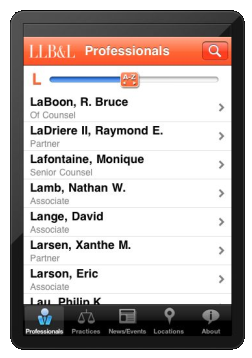
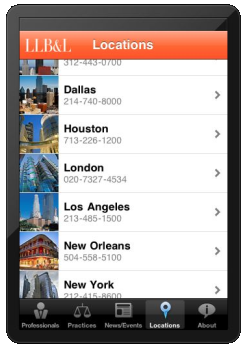
Locke Lord Bissell & Liddell (Locke Lord) released their own iPhone app this week. Although there are only a handful of BigLaw firms that have created iPhone apps, I think that most of “wow” factor faded at this point. These apps are still very useful, but tend to be more of a mobile version of the firm’s website, along with a few bells and whistles that take advantage of things like one-touch phone calls or emails, or GPS tracking of the firm’s locations. Since the “wow” factor has worn off, it is important that firms that create iPhone apps set them up for the convenience of their clients. It looks like that is what Locke Lord is doing with this app.

I downloaded it on my iPad (since I don’t own an iPhone), and here’s what I thought about it.

The Locke Lord app covers the basics that you’d expect in an iPhone app:

  • Roster of Attorneys
    Alphabetical and searchable roster that allows you to see the attorney’s contact information, picture, education, practices, and everything else you expect to find on the roster and bio.
  • List of Practice Areas
    All of the practice groups are listed and you can get some additional information on each of the groups. When I tested out this feature, I found that it was very slow in loading, and the Professional as well as the News/Events tabs were not loading any information. I’m assuming that this is a “feature” and will be fixed at some point.
  • News/Events
    Exactly what you would expect to find. Client Alerts, News and Firm Events listed. You can sign up for one of the events directly from the phone (although, when I tried it, the page wouldn’t load correctly – possibly an AT&T 3G issue and not the app’s.)
  • Location
    Here’s where the convenience of a GPS enabled device comes in handy. Get directions and it will launch your GPS navigation app and show you that it is right across the street!
  • About
    More general information about the firm, including the Executive Team, Mission Statement, etc.
If you’re a client of Locke Lord, then perhaps this would be a very convenient app to have on your phone. Here are some more screenshots of the app. If you want to test it out yourself, then you can visit the Apple App Store. 
Attorney Roster
Practice Groups
News/Events

Location
About – Executive Team

What Surprised You The Most About Your Profession?

Whether you are new to your profession, or are about to retire, there were some expectations you had when you came in that turned out to not be as you thought it would be. For example, I thought that working in a Law School as a law librarian would be free of politics… only to quickly realize that politics ran wild. So, I left that to join a court library… only to find out that it was even more political (the fact that I worked for elected officials should have clued me in.) Luckily, I’m now in BigLaw… oh crap…

Well, enough of my experiences, let’s hear from a number of other that have their own perpectives on what happened when they entered their professions.

Law Librarian Perspective
The Flexibility of My Profession
Pat Orr
Throughout my 30 year career I’ve worked in: high school and elementary school libraries, special / research libraries; academic libraries, and now a law firm library. I’ve had plenty of surprises but two stand out: how flexible my MLS degree from the University of Michigan has been, and that library users share the same basic needs.

Virtual Assistant Perspective
That no one would know what I do 10 years later.
Andrea Cannavina
I have been a Virtual Assistant for almost 10 years. I thought by now everyone would know what a VA is and what we do. Best of both worlds really – someone to help; but no need to provide guaranteed work, physical space, benefits or even coffee.

Law Librarian Perspective
Our cutting edginess
Jeremy Sullivan
I started in the field in 1995, when we were all neck-deep in CD-ROMs and just starting to figure out what this internet thing was all about. In the ensuing 15 years I have been amazed and quite proud at my profession’s ability to identify, evaluate, utilize, champion and even enhance new technologies as they are introduced. There’s this old saw that law firms are late adopters, reluctant to introduce too much change too quickly. However, I have seen countless examples where law librarians have spear-headed new technology initiatives (small-scale as well as firmwide) that have improved legal research AND business efficiencies. True, sometimes we can push a little too hard for a questionable technology – I’m still not convinced that the managing partner will take me more seriously if I have the cartoon, fairy wing-adorned version of me deliver his caselaw. Yet I still think even that points to our eternal desire to innovate for the sake of providing continued exemplary service.

AFA Perspective
Lack of Knowledge About Firm Economics
Toby Brown
Two related items:
1) That law firm partners, who are owners, know so little about the economics of their firm and the industry.
2) That partners don’t seem to care much about the economics of their firm and the industry.
In their defense, until recently their industry was doing so well, why would they ask. But still …

Law Librarian Perspective
Most surprising? Law Students are Fabulous
Cindy Bassett
I have worked in a law school for 3 1/2 years now. I do not have a JD so I didn’t have the law school experience to change my perceptions of what I thought law students would be like. I expected the students to be wealthy, to feel entitled, to be rude, and generally bratty. I was shocked to find them to be extremely polite, funny, humble, and grateful for the help and instruction provided by the librarians. So much for stereotypes!

Lawyer Perspective
Solo Surprises
Chris Hill
When I first got out of law school, I never would have thought I’d end up a construction attorney, much less in solo practice. Through a longer story than this short post can speak of, I started representing contractors and subcontractors and realized I love to do it. I like my clients, and that makes the work worthwhile.
Recently (July 2010) I went solo and was surprised by the positive reaction. I have non0clients letting me know that they’re glad I’m now solo and will be using my services and clients glad to see me on my own. This has been quite a revelation.

Academic Support Professional Perspective
Youth and Technology
Chelsea Baldwin
I assumed that our younger students would be more technology proficient because they’ve grown up with the technology. Instead, they are the students who need the most instruction related to technology while our older students and our faculty are constantly impressing me with the tips and tricks they’ve discovered to use technology in more productive ways.

Knowledge Management
How good are KM people at sharing knowledge?
Mark Gould
I have learned a lot from many great KMers, and they are obviously exempt from this criticism. However, it always puzzles me how cagey many other KM people are about sharing their experiences or insights for the benefit of others.
In part (as with much else) there is a bit of concern about “what’s in it for me?” But I think there is more to it than that. KM tends to be a lonely job, and one can usually learn more from people outside one’s own organisation than from within — that means you have to give as well as take. I think, however, that there is a conservative streak in law firm KMers, which makes them reluctant to expose what they do outside the firm and also reluctant to engage with new technologies (which is where much great knowledge sharing takes place). Conferences and face-to-face meetings are a different matter — I have found people to be much more open in those protected environments.

Law Librarian Perpsective
Good morning and Welcome to Yesterday
Megan Wiseman
In library school, we often talked of how fast technology was changing and how one of the perks about our profession was being on top of such changes. (…how successful we are at that was a different discussion…) Us soon-to-be-librarians sat in lecture and nodded along, talking blogs and Library 2.0 like the geeks we were. Then I hit the real world and *wham* — did I see first-hand how technology is taking off!! Every day I walk into work and everything that was new yesterday is already old news.
Perspective: I did not know what a blog was my first year of grad school. Westlaw has had, I believe, three major interface changes since I first learned it my second year in library school. Smart phones and e-readers, enough said. The hours, the budgeting, the patrons, the fun of it all — pretty much exactly as I expected. The speed of tech changes and making the right calls? — A surprise. Time to get my geek on (and perhaps get some 3-D glasses for my tv.)

Information Technology Perspective
Collegiality
Scott Preston
While there have been many surprises in my profession, the one that surprised me the most is the level of collegiality between law firm IT departments. This is often a point of pride for me. If you have attended an ILTA conference you should know what I’m talking about.

Internet Marketing Perspective
Ground for Creativity
Lisa Salazar

I am learn something new every day. Working with such bright and innovative people in such a new space; we are constantly pushing the envelope to dream up new solutions, new work-arounds, new methods. The web provides all the ability to create and dream up new ways to approach old problems. But the best surprise? Is who teaches me; where I get my best lessons. My sources come from the most unexpected places …

Next Week’s Elephant Post:


How Is Social Media Changing Your Profession… Or, How Should It Be Changing Your Profession?

We’re big fans of social media here at 3 Geeks… blogging, twittering, LinkedIn’ing… all of that. Whether it is making connections, finding information on obscure topics, or keeping up with the latest rumors, social media is one of the best communications tools available today. Let us know how it has helped you in your profession, or how you think it will help someday in the future.

As we did last week, we are making this easy (on my at least) by creating a form which anyone can add their answer.
Go and fill out this form to add your answer.
To see other perspectives, you can go here to see their answers.

We’ve been using Google Docs to collaborate on our weekly Elephant Posts, and the more I use it, the more I love it. With real-time collaboration, combined with easy access to the cloud-based documents platform,  Google Docs is an amazing place to work on projects with others in your office, or across the world.
I’ll give you a couple of examples of projects I have worked on using Google Docs, and then I’ll even show you how you can collaborate with me on this week’s Elephant Post.


Real-Time Collaboration
A couple of weeks ago, I was prepping for a presentation for Ken Adams’ contract drafting class at the University of Pennsylvania Law School. I had a loose draft of what we were going to cover, but I really wanted to flesh it out, so I contacted a couple of friends by phone, and I pointed them to the Google Docs page and gave them both editing rights. We spent about 45 minutes over the phone working out the draft and discussing the different aspects that I should cover. After that 45 minutes, we were done. I had a completed outline, and was ready to go. If I had attempted to do this via email… I’d probably still be working on it and sending the current version back and forth for edits. Because I was able to talk with the collaborators, and actually see what they were writing, in real-time, we were all literally on the same page.

Multi-Part Collaboration
One of the crown-jewels of 3 Geeks is the Elephant Posts we do each Thursday. We ask the readers of this blog, along with our friends and peers (who for some reason, may not read our blog) to help answer a question from their own personal perspectives. The first few weeks, I would have them send me an email with their answer, then I would start piecing those emails together on Wednesday nights and Thursday mornings. It was tedious and easy to make mistakes. There were times when a post would go out, and then I would get an email from someone asking why their answer was left out. Toby suggested that Google Docs might be a better way to compile the Elephant Post, and he was right!

We started drafting a Google Docs page with the following week’s question, and then we opened up the document to allow anyone with the link to that page to edit it. It made it so much easier for me to manage, and prepare for posting. Here’s an example of what one of the collaborative pages looks like.

I loved the way everything flowed together, and it made it very easy for anyone to contribute. It also made it easy for me to make sure I didn’t leave anyone out! The only thing that I didn’t feel comfortable with was the lack of security that was involved in the process. Anyone with the link could edit it. As the popularity of the Elephant Posts grew, the more I was afraid that someone would delete the post (either by accident, or maliciously), or someone might edit another person’s contribution without permission. I thought about restricting the access to the Google Docs page by making everyone sign in to Google Docs, but I wanted to keep things simple. Andrea Cannavina came up with the best suggestion that allowed for openness, security, and the simplicity of Google Docs – using the Google Docs forms.

Multi-Part Collaboration – Using Forms
Andrea showed me a template I could use for the form, and the way that Google Docs placed the results of the form into a spreadsheet. This type of collaborative process allows for others to collaborate very easily – I just give them the link to the form. It keeps the results secure – I lock the editing rights to the spreadsheet containing the answers. It also allows me to get complete answers from the contributors – I can require that fields get filled out and nothing gets left off… like their name.

Here’s Your Chance To Play Contribute
Of course, now that I’ve piqued your interest in collaboration using Google Docs, you’ll now want to see for yourself how it works. Well… I’ve got just the thing for you! We’re still looking for contributors for tomorrow’s (12/9/2010) Elephant Post on the question of “What Surprised You The Most About Your Profession?” The instructions are simple, so I expect a number of you to take a couple of minutes and try it out for yourself. You’ll even get the added bonus of seeing your name tomorrow on the post!

Step One: Fill Out The Form – go to this Google Docs Form page and give us your perspective. Short and sweet answers are the best!
Step Two: See the Results – you can see your answer, along with the other contributors’ answers by going to this Google Docs Spreadsheet page. You won’t be able to edit that page (because I’m the editor!!), but you’ll be able to see what others have contributed to the post.

I think once you start doing collaborative work in Google Docs, you’ll come to appreciate how easy it can be to work on collaborative efforts and wonder how you were ever able to do this type of work before using Google Docs.

The Geeks are always pestering me to post something here and I always weasel out of it claiming I don’t have time or that Mark Gediman can do it instead. Today, however, totally on my own accord, I am writing to ask that you support this wonderful, entertaining and, above all, informative blog by voting for it in the ABA Top Blawgs of 2010 (see story and shameless plug: https://www.geeklawblog.com/2010/12/vote-geek-3-geeks-selected-at-aba.html).

Admit it. You read their tweets and click on the blog posting links. You forward blog postings on to friends or colleagues or both. You take a five minute break with the beverage of your choice to troll the blog for the latest insights and happenings. You secretly wish you’d submitted a blurb about why Bones McCoy from Star Trek would be great in a law firm. Why not show your love by helping the Geeks get the recognition they deserve?

It’s quick and painless. Vote Geek!

“VOTE GEEK” INSTRUCTIONS:
If you have an ABA Journal online account (username/password), you can go here to login:http://www.abajournal.com/login
If you’ve forgotten your password, go here to recover it:http://www.abajournal.com/forgot_password/
If you do not have an ABA Journal online account, you can get one for free here:http://www.abajournal.com/register
After you’ve logged in, you can go here to “Vote Geek” (of course, we’re the 3rd on the list)http://www.abajournal.com/blawg100/2010/lawbiz .