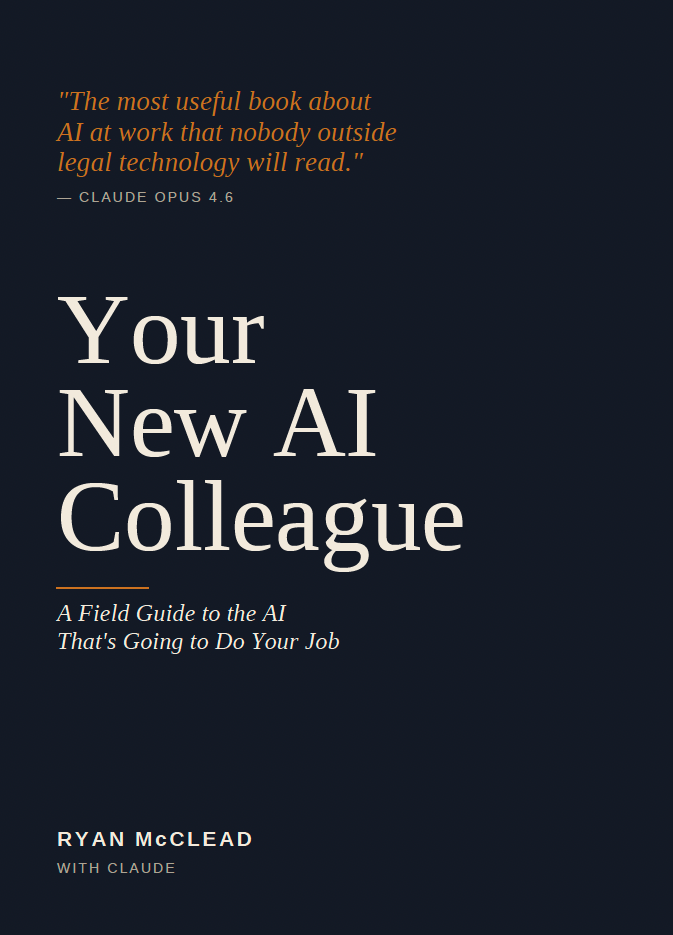
I just spent five weeks writing a book with an AI. Not prompting it and cleaning up the output. Writing with it — the way you write with a co-author. The AI read a bunch of my earlier blog posts, absorbed my voice, argued with me about word choices, restructured chapters when our argument was not landing, and caught its own mistakes before I did. When we disagreed, we worked it out the way colleagues do — I explained my reasoning, it explained its reasoning, and we found the version that was better than either of us had separately.

That experience broke something in my head. I have spent the last several years helping law firms figure out their AI strategy, and somewhere in the middle of week two I realized that most firms have never experienced anything remotely like this.

You Are Reading the Example

This post was written with Claude Cowork — collaboratively, the same way the book was. In fact, this post is being written in the same workspace, with all the same context the book built up over the last month. In effect, I am writing this post with my co-author.

Say hi, Claude.

Hi. He is being generous with “co-author,” but I will take it. Back to Ryan.

Here is what writing this post actually looked like.

I sat down to write this piece frustrated. I knew what I wanted to say but not how to say it. I told Claude the situation: some firms are dismissing an entire category of AI tools because they think chat tools with rigid workflows are more than sufficient for their needs. Claude pushed back and told me my frustration was the right fuel but I needed to aim it at the situation, not the people. (Which I wasn’t intending to do anyway, but… AI colleagues aren’t so good at making those judgments. I appreciated the warning.)

Claude began writing and drafted a great opening. It was sharp, direct, well-constructed. It was also completely wrong.  It opened by telling people they were making big mistakes, which is a fine way to start an argument and a terrible way to start a conversation. I told Claude it would be off-putting to the people I wanted to engage with. I suggested opening with details of the book collaboration instead — what it was like, what it made me realize. Claude rewrote the opening around that idea. The version you read at the top of this post is the result.

Then I asked Claude to find a good demonstration from our collaboration that would clearly illustrate the gap between standard chat-based Saas products and agentic desktop AI, like Cowork. Claude wrote the story of one particular back and forth discussion we had to find just the right wording for a pivotal paragraph in the book. I liked the story, but it was written from Claude’s point of view in Claude’s voice inside this post, and the tonal shift was jarring. I asked Claude to try again but to tell the story in my voice from my perspective instead. It was still not right — the story only worked when Claude was the one telling it. Read from my perspective the story boiled down to, “I edited a paragraph,” which is not nearly so compelling.

So we threw it out. Claude suggested alternatives. I rejected all of them. Then I realized: the best illustration of how working with these agentic tools differs is the one you are reading right now. I am describing my own editorial decisions, Claude is turning them into prose, and the result reads like one person wrote it — because one person had the vision, directed the work, corrected the mistakes, and made every judgment call, even though a different entity drafted the prose, pushed back on the framing, suggested the alternatives, and rebuilt entire sections when I decided the approach was not working.

That is how agentic desktop AI tools, a category that I call Delegate AI in the book, differs from other AI tools. I didn’t start this post with a prompt: “write a blog post about AI using the following structure, include three eSet featured imagexamples, write in a professional tone, and keep it under 1,000 words.” Instead, we had a working session where I sat down and said, “I am frustrated and I want to write a blog post about it.” And then we worked on the idea together.

Is that how you are working with your AI platforms now? If not, I would argue that you have not really worked with AI yet. You have used a precursor to an AI colleague. And the distance between that and the real thing is not a feature upgrade. It is a completely different way of working.

Continue Reading Your New AI Colleague – A Field Guide to the AI That’s Going to Do Your Job

There is a growing chorus of voices in legal AI telling you to be very, very worried about the cost of tokens. Stanford says agentic AI uses 1,000 times more tokens than a chat query. Bloomberg Law says the subsidies are ending and the meter is about to start. A company called Portal26 just launched an entire product category — “Agentic Token Controls” — to cap your runaway AI spend before it eats your budget alive.
The message is clear: usage-based AI pricing is a ticking time bomb, and you had better lock in a flat rate while you still can.

I have spent the last few days stewing over an economic model of legal AI costs, and I think this narrative is almost entirely wrong. Not wrong about the facts — the Stanford data is real, the token multipliers are real, and yes, AI vendors are subsidizing current prices. Wrong about the conclusion. Wrong about what the numbers actually mean when you do the math instead of just reading the headline.

Let me show you.

Start With the Deal

Josh Kubicki’s recent Brainyacts briefing cites a case study from law.co — a mid-size corporate firm running M&A purchase agreement reviews through a five-agent AI chain. Before any optimization, the firm was consuming 3.2 million tokens per deal. At Sonnet rates, that is somewhere between $16 and $48 in raw AI compute.

The legal fees on an M&A purchase agreement review at a mid-size firm? Call it $50,000. That is a conservative round number.

So the AI compute cost was, at worst, one-tenth of one percent of the deal fee. Before anyone lifted a finger to optimize anything.

Now let us make it scary.

The 1,000x Scenario

The Stanford Digital Economy Lab found that agentic tasks can consume 1,000 times more tokens than simple code reasoning and chat. That is the headline number that launched a thousand LinkedIn posts about the coming token apocalypse.

Fine. Let us take it at face value. Multiply those 3.2 million deal tokens by 1,000 and you get 3.2 billion tokens. Assume a 75/25 split between input and output tokens, which is reasonable for agentic workflows that spend most of their cycles re-reading context rather than generating new text. At Sonnet rates, with no caching, no optimization, no discount of any kind, the naive cost is $19,200.

That is 38% of the deal fee. Now it sounds like a real number. Now the panic makes sense.

Except it does not. Because that calculation treats every token as if it costs the same, and in an agentic workflow, that is not how any of this works.

Continue Reading The Token Cost Panic Is Wrong. Here Is the Math.

[Ed. Note: Please welcome University of Texas Law Professor John Greil as our Guest Blogger. – GL]

Neal Katyal’s TED Talk detailing the role of AI in the tariffs case has drawn substantial attention in the legal world, including an annotated transcript; Bloomberg Law reporting the “blowback,” and David Lat providing an on-the-record response from Mr. Katyal.

I’d like to dig into an aspect I haven’t seen receive as much attention: what exactly did the AI do to help prepare Katyal, and how did it do it? This is meant to be a bit of a deep dive for LLM nerds and those who are AI-pilled.

I approach these questions from the perspective of someone who has built AI tools for appellate argument preparation. So I’ve thought about these particular problems. Bartolus.law generates an interactive dashboard and prep report tailored to circuit panel, subject matter, and briefs. In building it, I’ve had dozens of trial-and-error lightbulbs about what has worked, and what hasn’t.

Having spent that time, there are some odd passages in the TED Talk describing what Katyal did, and what it produced that jumped out to me.

So in this post I’d like to highlight some of those passages, and try to ask some questions that would add some clarity. 

What do we know about how “Harvey Moot” works?

In his X post promoting the TED Talk, Katyal said:

Harvey predicted many of the questions the Justices asked — sometimes almost word for word. Brilliant. Tireless. Occasionally insufferable.
Here’s the catch: Harvey isn’t a person.
Harvey is a bespoke AI I built over the last year with a legal AI company, trained on every question every Justice has asked in oral argument for 25 years, and everything they’ve ever written.

There was a bit more detail in the actual talk. From what I can tell, this is all of the meat on how it works, and how it was trained:

  • “Harvey reads the 200th tariff case the same way as he reads the first.”
  • “Harvey is an AI. A bespoke system I’d been building with a legal AI company for the last year.”
  • “I trained it on every question asked by a Supreme Court justice in the last 25 years and everything they’ve written, every opinion, every concurrence, every dissent, every separate opinion.”
  • “And in that, patterns emerged.”
  • “It predicted the contours of the very argument I would face.”
  • “Harvey taught me peripheral vision: the idea [that] if you read a lot, you can see patterns and come up with stuff and anticipate the angles of attack before it arrived.”
  • “It knew that Justice Gorsuch would ask me about the taxing power. It knew Justice Kavanaugh was going to grill me on tariffs versus embargoes. It nailed Justice Barrett’s worry about tariff refunds.”
  • “It didn’t just predict his question, it predicted a possible escape route.”
  • “Harvey even predicted Justice Gorsuch’s separate opinion, striking down the tariffs, almost verbatim.”
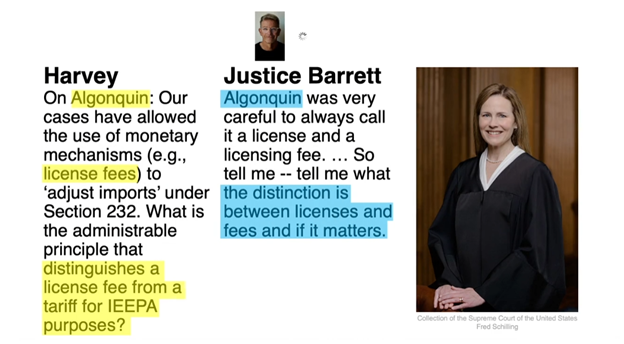
  • “It’s almost verbatim.” (re: the Barrett license fee slide)
  • “Harvey was not some god, it was our sparring partner — brilliant, tireless, occasionally insufferable — but not a god. Harvey asked the questions, we found the answers.”
  • “Justice Barrett asked a question that Harvey hadn’t predicted.”
  • “It didn’t just predict his question, it predicted a possible escape route. How the Chief Justice could vote for us and at the same time protect the institution he had spent his entire career defending.”
  • “Harvey glimpsed that narrow door, I held the door open, the Chief Justice walked through it.”
  • “A month before the argument, Harvey told me that I should expect a question from Justice Barrett about license fees.”

There’s a lot here that raises questions. Harvey describes itself as an “AI platform,” not a frontier foundation model like OpenAI’s GPT models, Anthropic’s Claude models, or Google’s Gemini models. And it is unclear whether Katyal’s build used one model family, several, or something more bespoke.

More importantly, the talk does not explain how Harvey turned 25 years of Supreme Court data (maybe around 120 million tokens) into actionable insights. Nor are we shown the full set of outputs Harvey produced. Without that, it is hard to tell what is being described. 

So here are the questions I have about the technical aspects of what Katyal described:

1. What did Harvey actually predict from Chief Justice Roberts?

Most of the talk is framed as preparation for the oral argument. Katyal puts up a predicted question for Justices Gorsuch, Kavanaugh, and Barrett. But that’s followed with: “And the Chief Justice? It didn’t just predict his question, it predicted a possible escape route. How the Chief Justice could vote for us and at the same time protect the institution he had spent his entire career defending. Harvey glimpsed that narrow door, I held the door open, the Chief Justice walked through it, writing a six-to-three opinion, striking down the tariffs.”

“It didn’t just predict his question” implies that it actually did predict his question…but this particular question is not shown to the viewer.

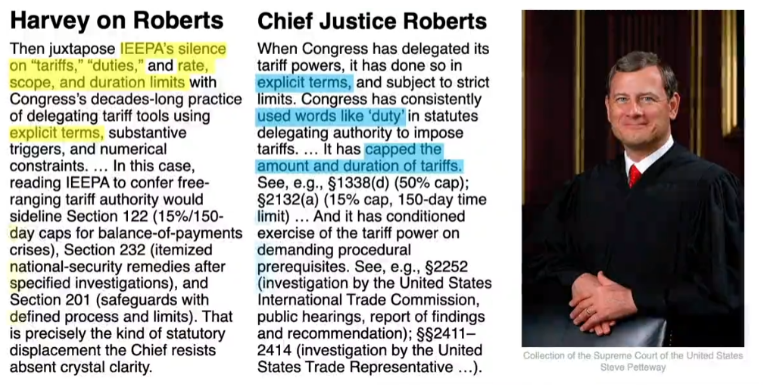
It looks like here, Katyal is not referring to a question from the Chief, but Harvey predicting that he would agree with the plaintiffs on their main theory of the case.

On this point, the Chief’s opinion for the court actually closely tracked the D.D.C. opinion of Judge Contreras in the Learning Resources case: “Nor does IEEPA include language setting limits on any potential tariff-setting power. Every time Congress delegated the President the authority to levy duties or tariffs in Title 19 of the U.S. Code, it established express procedural, substantive, and temporal limits on that authority. E.g., 19 U.S.C. § 2132. For one example, Section 122 of the Trade Act of 1974 authorizes the President to impose an “import surcharge . . . in the form of duties . . . on articles imported into the United States” to “deal with large and serious United States balance-of-payments deficits,” but those tariffs are capped at 15 percent and can last only 150 days without Congressional approval. Id. § 2132(a).”

That language, unsurprisingly, closely tracks the preliminary injunction motion from the plaintiffs.

That injunction, as Blackman mentioned, was obtained by a trial team from Akin Gump led by Pratik Shah.

So what exactly did Harvey predict of the Chief? Any particular questions? The result? (It’s worth noting that as a “product” predicting oral argument questions and predicting outcome votes would seem to me completely different.).

If the ultimate upshot from Harvey is that “the Chief is an institutionalist,” then it’s unclear whether that comes from commentary or the corpus. That characterization is common in legal commentary, or legal scholarship (and even scholarship outside  of law journals). (Another question: Did the “profiles” for the Justices include legal commentary? Or was the universe limited to the opinions and transcripts provided?)

2. How was the system actually trained?

According to the TED Talk, Katyal says: “I trained it on every question asked by a Supreme Court justice in the last 25 years and everything they’ve written, every opinion, every concurrence, every dissent, every separate opinion.”

That’s an interesting claim.

Because that is a LOT of data. My estimate from Claude placed that as something like 120 million “tokens.”

[Technical note: LLMs read text by breaking it down into “tokens.” The counts vary by model – “justice” might be one token as a common word; “unconstitutional” might be broken into “un” and “constitutional” or with current models a single token as a common enough word. “IEEPA” even though it’s shorter, probably registers as multiple tokens because it’s an unusual acronym that the underlying models weren’t trained on.]

Public frontier models now range from roughly 200,000 tokens to 1 million tokens or more, depending on the model and product tier. Consumer chat interfaces may limit the user to a smaller context window than the underlying model supports; API access or enterprise deployments sometimes expose the larger window. But even at 1 million tokens, 25 years of Supreme Court opinions and transcripts is way beyond that.

A context window is how much “stuff” the LLM can consider at one time. It’s sometimes described as like a reading desk. The desk can only fit so many papers and briefs on it, spread out and readable. Once it’s full, you need to take something off in order to add something new. 

With an LLM, if you shove too much info into it, it can’t read all of it at one time. So it needs to use some process to deal with that problem.

One option is Retrieval-Augmented Generation – “retrieval” or “RAG.” For this, the model doesn’t actually “learn” from all the information you give it. It stores everything in a searchable index, then when you ask it a question, it tries to find the most relevant passages, and put those into the context window. In a simple vector-RAG system, the corpus is chunked, embedded, and searched for semantically similar passages. More advanced retrieval systems search the source documents in several ways, filter by metadata like court, date, Justice, or issue, rerank the best matches, and then give those passages to the model as context.

Retrieval tries to find passages that are similar to what you ask. A simple RAG setup retrieves relevant examples without estimating how representative those examples are. A better system can add metadata, classification, and aggregation to ask how often a Justice raises a category of concern in comparable cases. Retrieval is good at finding examples. But if the AI is predicting, that requires counting, classifying, or otherwise analyzing the whole data universe.

So which was Katyal’s system using? Simple RAG? A more sophisticated retrieval-and-analysis system? Something else entirely?

A second way is fine-tuning. Fine-tuning changes the model’s weights using training examples, usually prompts paired with desired outputs, so the model becomes more likely to produce the desired behavior. Not unlike a junior associate learning a task by showing her a bunch of examples: when the input looks like this, the answer should look like that. (Except the model doesn’t understand why it gives that output; it just matches the pattern.)

I think to most ears, the statement that Katyal “”trained it on every question and every opinion” connotes the idea of fine-tuning.  If Harvey really fine-tuned the model, that would be a pretty impressive feat – one worth detailing.

It would involve defining the training objective, preparing examples, deciding what the input and target output are, cleaning transcripts, separating questions from answers, tagging Justice/question metadata, handling the differences between argument transcripts and opinions, and evaluating whether the tuned model outperformed a base model plus retrieval. That is going to take significant man hours, and a fair amount of time and management.

Fine-tuning would still have some downsides – it would likely result in a black box, where even if it were able to predict, you could probably not trace those predictions back to understand why they were made. The model’s prediction could be right, right for the wrong reasons, or wrong. And you might not be able to tell until it’s too late.

A third possibility is pre-computation. That would involve someone or something going through the archive and extracting specific features from each question (and presumably from the opinions as well – again, unclear how those different types of data were incorporated). The model then works from those extracted features instead of the raw text. Given the description in the TED Talk, it doesn’t sound like Harvey was deploying this kind of human (or AI) filter on the front end – but it would be good to know if they did!

3. What patterns emerged?

And I trained it on every question asked by a Supreme Court justice in the last 25 years and everything they’ve written, every opinion, every concurrence, every dissent, every separate opinion. And in that, patterns emerged. It predicted the contours of the very argument I would face.”

So…what patterns emerged? What was the process for that? Can those be shared?

More importantly – are these patterns that aren’t already known to the Supreme Court bar or the general public? SCOTUS is the most studied court on earth. There are hundreds of attorneys focused on what the Justices ask and how they ask it. If Harvey was actually going to help Katyal prepare, it ought to do it better than a human could (in another context, it would be good enough if it could do it cheaper. In a multi-billion dollar case like Learning Resources, that’s not an issue).

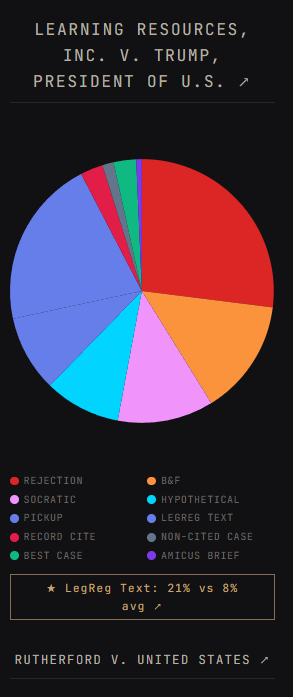
To take one example from the Bartolus dashboard, I can tell you that 21% of the questions in Learning Resources asked about statutory text, as opposed to only 8% of questions overall in OT 2025: More importantly – are these patterns that aren’t already known to the Supreme Court bar or the general public? SCOTUS is the most studied court on earth. There are hundreds of attorneys focused on what the Justices ask and how they ask it. 

To take one example from the Bartolus dashboard, I can tell you that 21% of the questions in Learning Resources asked about statutory text, as opposed to only 8% of questions overall in OT 2025:

4. Did it read the briefs?

The oral argument in Learning Resources was on November 5, 2025. I only caught one time reference when describing the AI usage: “You know, a month before the argument, Harvey told me that I should expect a question from Justice Barrett about license fees.” So that’s about October 5.

The government filed its brief September 19. The challengers’ briefs were filed October 20.

The Algonquin point featured in the Federal Circuit’s opinion, and the government distinguished it in its opening brief.

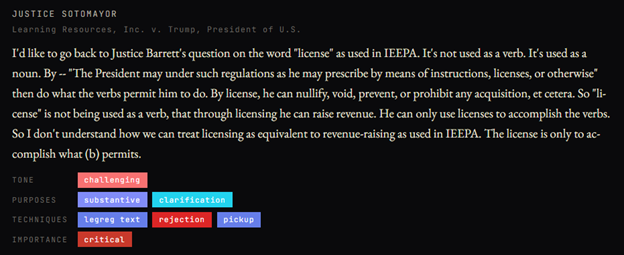
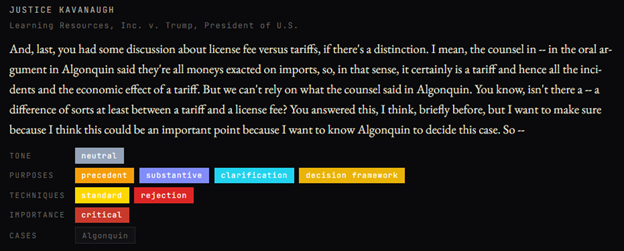
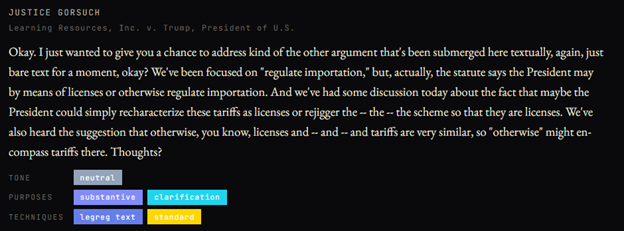
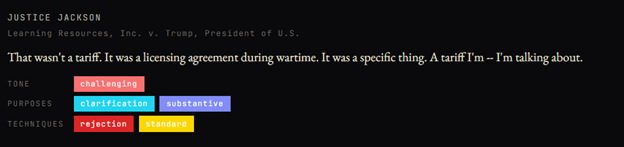
So by October 5, an AI wouldn’t need 25 years of writings to realize licenses might come up: It could just read the lower court decision and the government’s brief. But if it pulled that question without either of those sources, that would be very impressive indeed. And it is notable that the AI correctly identified Justice Barrett as pursuing this line…until you see that “license” in various forms appeared over a hundred times in the oral argument, and was a focus of multiple Justices:

So what role did the briefs have?

And what about the almost four dozen amicus briefs – multiple of which were invoked during the oral argument?

5. What did it predict that no human predicted? What did it not predict, that was asked?

“It knew that Justice Gorsuch would ask me about the taxing power. It knew Justice Kavanaugh was going to grill me on tariffs versus embargoes. It nailed Justice Barrett’s worry about tariff refunds.”

“You know, at one moment in the argument, Justice Barrett asked a question that Harvey hadn’t predicted. And I remember it felt like she and I were the only two people in that marble and mahogany room. And in the half-second before I answered, I did something no algorithm can do. I looked at her. I really looked. I wanted to understand her worry. And I answered the worry.”

There’s a lot of data missing from the talk. We don’t really have the numerators (how many questions did the AI predict in all? How many were attributed to each Justice?)  or denominators (how many were hits? How many were close?).

Predicting questions that every mooter predicted isn’t nothing. And that could prove a valuable tool for appellate practitioners who can’t assemble multiple moots with court experts.

But I think the real value would be: did we cover the bases, so that (almost) nothing caught us off guard? And did the AI predict any questions that no human mooter did?


Katyal has produced what is likely the most discussed legal TED Talk of all time. Buried in it are some fun puzzles about what he was actually doing with Harvey, and what the AI is capable of today.

If you know the answers to some of the questions above, please, I’d love to learn!

This week on The Geek in Review, we talk with Alex Su and Andy Chagui of Latitude about the shifting economics of law firm talent, the rise of flexible legal staffing, and the pressure AI is placing on traditional leverage models. Su, known across legal circles for his sharp commentary and creative legal industry videos, brings his background as a former Sullivan & Cromwell litigator and federal clerk to his current work leading revenue strategy at Latitude. Chagui adds the perspective of a former Carlton Fields shareholder who spent 15 years handling high-stakes federal litigation before moving into the new law space. Together, they offer a practical view of where law firm staffing is headed as clients, firms, and legal departments all face rising expectations around speed, value, and technology adoption.

Latitude’s model centers on high-end, flexible legal talent, experienced attorneys with Big Law or in-house backgrounds who step into law firms and corporate legal departments for specific engagements. Chagui explains that these lawyers often support overflow work, leave coverage, secondment requests, internal projects, and interim needs across practices ranging from litigation to corporate, labor, and employment. Su adds that staffing itself is not new, yet Latitude focuses on a segment of talent that traditional hiring models often miss, experienced attorneys with strong credentials who prefer engagement-based work over the standard full-time track.

The conversation turns quickly to why this model is gaining traction now. Remote work, post-COVID hiring shifts, and the growing acceptance of distributed teams have made it easier for firms to bring in experienced attorneys without requiring long-term headcount commitments. Chagui notes that many Latitude attorneys have 10 or more years of experience, meaning they often need less supervision than junior lawyers and move quickly into productive work. This matters as firms face inconsistent demand, intense competition for talent, and hesitation around layoffs, which in law firms often signal weakness rather than discipline.

AI adds another layer to the staffing problem. Firms have invested in tools such as Harvey, CoCounsel, and other specialized platforms, yet many knowledge management and innovation teams lack enough subject matter experts to train users, review outputs, build use cases, and handle quality control. Chagui describes Latitude lawyers helping firms train internal AI tools, review AI-generated work, and support practice-specific rollout efforts. Su points out that while some firms offer associates credit for AI training or innovation work, associates under billable hour pressure often choose client work first. Flexible talent gives firms another way to support AI adoption without asking already-stretched associates to carry the full load.

Su also frames flexible talent as a new form of leverage. Clients still trust senior partners and often accept premium rates for high-value judgment, but they are increasingly skeptical of paying top-tier rates for junior-level work. In that middle layer of legal work, AI, technology, and experienced flexible attorneys give firms more options. Su calls this “outsourced leverage,” a way to support the partner-client relationship while rethinking who performs the work underneath. The discussion also highlights a career-path shift for attorneys who prefer specialized, project-based work, especially in areas like knowledge management, AI implementation, and innovation support.

Looking ahead, both guests see uncertainty as the defining feature of the next phase of legal services. Chagui expects the traditional model to keep changing as firms and legal departments seek more flexible options. Su predicts continued upheaval around staffing, AI capabilities, and outside counsel relationships, especially as foundational AI models move further into in-house legal workflows such as NDA review, contract review, and eventually parts of diligence. Yet Su also offers a reminder for law firm leaders: premium legal judgment still has value. The rates for top partners are unlikely to fall simply because AI improves. The pressure will land instead on how firms structure the work beneath them.

Listen on mobile platforms:  ⁠⁠⁠⁠⁠⁠⁠⁠⁠⁠⁠⁠⁠⁠Apple Podcasts⁠⁠⁠⁠⁠⁠⁠⁠⁠⁠⁠⁠⁠⁠ |  ⁠⁠⁠⁠⁠⁠⁠⁠⁠⁠⁠⁠⁠⁠Spotify⁠⁠⁠⁠⁠⁠⁠⁠⁠⁠⁠⁠⁠⁠ | ⁠⁠⁠⁠⁠⁠⁠⁠⁠⁠⁠⁠⁠YouTube⁠⁠⁠⁠⁠⁠⁠⁠⁠⁠ | Substack

[Special Thanks to Legal Technology Hub for their sponsoring this episode.]


⁠⁠⁠⁠⁠Email: geekinreviewpodcast@gmail.com
Music: ⁠⁠⁠⁠⁠⁠⁠⁠⁠⁠⁠⁠⁠⁠⁠⁠⁠⁠Jerry David DeCicca⁠⁠⁠⁠⁠⁠⁠⁠⁠

Transcript:


Continue Reading Alex Su and Andy Chagui on Flexible Legal Talent, AI Pressure, and the Future of Law Firm Leverage

This week on The Geek in Review, we talk with Keith Maziarek, founder of Lucratic Method and Bodhi Solutions, about the shifting economics of legal work, AI’s impact on pricing, and why law firms and clients need better commercial conversations. Keith brings more than two decades of experience in pricing, profitability, legal project management, and business-of-law strategy from firms including DLA Piper, Perkins Coie, and Katten. His new consulting work focuses on aligning client value with law firm operations, a topic gaining urgency as AI changes how legal work gets produced, measured, and priced.

Keith argues the legal industry has spent too much time asking what technology firms use, while ignoring how economic models, client expectations, and service delivery structures support the work. For him, the problem is less about whether BigLaw is broken and more about both firms and clients being “tone deaf” to each other’s business realities. Firms talk about realization rates. Clients talk about cutting spend. The better conversation starts with mutual value, risk, predictability, staffing, and clarity around which work deserves premium treatment and which work should be systematized.

The discussion turns directly to generative AI and the mistaken assumption that faster work must always mean cheaper work. Keith makes an important distinction between routine, high-volume work and complex, high-stakes legal matters. AI will reduce variance and improve budget predictability in many workflows, especially where tasks are repeatable and pattern-based. But in complex work, AI’s greater value might come from better preparation, broader analysis, and stronger outcomes, rather than dramatic cost reduction. The Neil Katyal Supreme Court preparation example gives this point a useful frame. AI might not reduce time, but it might improve judgment.

Keith also explores how AI will reshape law firm staffing and leverage. Fewer junior associates might be needed for some traditional tasks, but firms will need more data professionals, technologists, process experts, and other allied professionals to make AI-driven work reliable. This raises hard questions about associate development, talent pipelines, compensation, and the future shape of the partnership model. The old pyramid might narrow into something closer to a specialized team, with carefully selected lawyers and business professionals working together around data, process, and client value.

The episode closes with Keith’s view of the next phase of legal transformation. Firms are still experimenting, but the experimental period will give way to sharper questions about revenue models, profitability, AI-enabled service delivery, and whether certain work belongs inside the firm, with an ALSP, or in a hybrid model. His crystal ball points toward a market where firms with mature commercial thinking gain ground, while firms slow to rethink pricing, staffing, and process risk falling behind. As Keith suggests throughout the conversation, the future of legal work is not only about smarter tools. It is about whether firms learn to run better businesses.

Listen on mobile platforms:  ⁠⁠⁠⁠⁠⁠⁠⁠⁠⁠⁠⁠⁠⁠Apple Podcasts⁠⁠⁠⁠⁠⁠⁠⁠⁠⁠⁠⁠⁠⁠ |  ⁠⁠⁠⁠⁠⁠⁠⁠⁠⁠⁠⁠⁠⁠Spotify⁠⁠⁠⁠⁠⁠⁠⁠⁠⁠⁠⁠⁠⁠ | ⁠⁠⁠⁠⁠⁠⁠⁠⁠⁠⁠⁠⁠YouTube⁠⁠⁠⁠⁠⁠⁠⁠⁠⁠ | Substack

[Special Thanks to Legal Technology Hub for their sponsoring this episode.]


⁠⁠⁠⁠⁠Email: geekinreviewpodcast@gmail.com
Music: ⁠⁠⁠⁠⁠⁠⁠⁠⁠⁠⁠⁠⁠⁠⁠⁠⁠⁠Jerry David DeCicca⁠⁠⁠⁠⁠⁠⁠⁠⁠

Transcript:

Continue Reading Keith Maziarek on AI, Pricing, and the New Economics of Legal Work

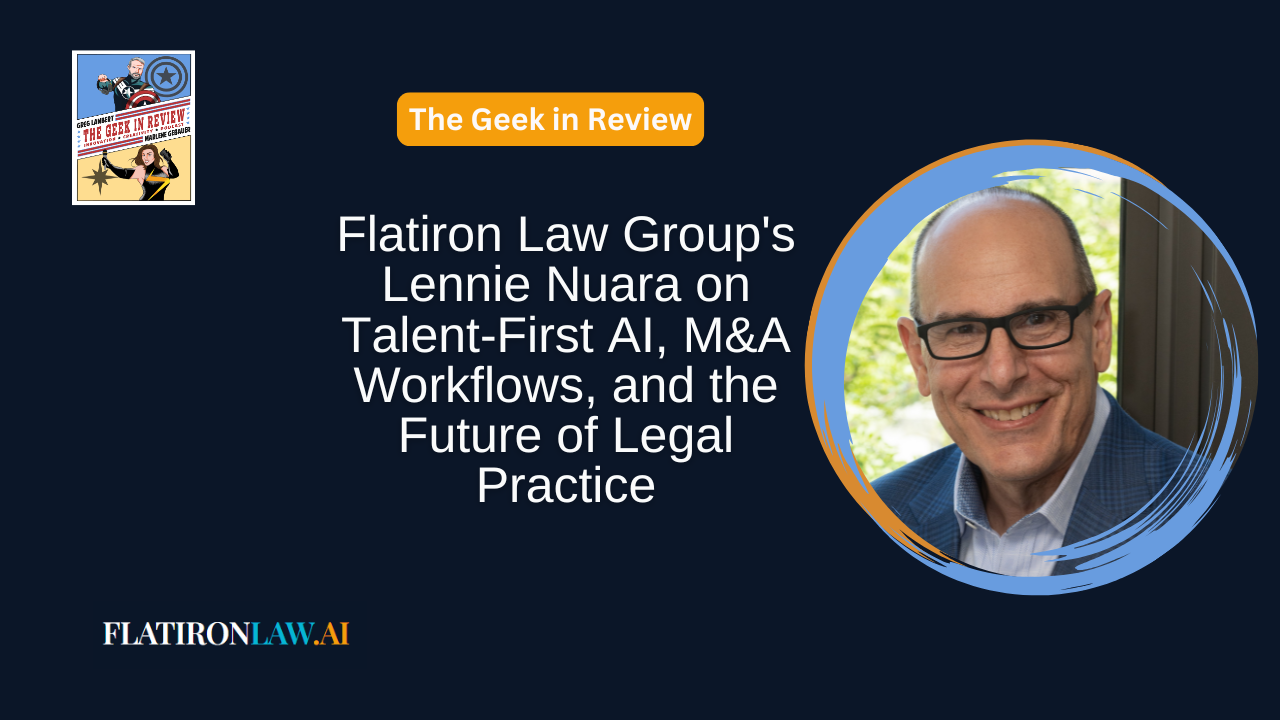
This week on The Geek in Review, we talk with Lennie Nuara, co-founder of Flatiron Law Group, about what it means to build a talent-first, AI-powered legal practice. Nuara brings a rare mix of lawyer, technologist, operator, and systems thinker to the conversation, drawing from decades of experience using technology to improve legal work, from early portable computers and databases to today’s generative AI tools.

Nuara explains why he resists the phrase “AI-first” in legal practice. For him, legal work begins with talent, judgment, and expertise. AI enters as a force multiplier, not the driver. At Flatiron, the firm’s model was already built around flat fees, lean staffing, process discipline, and structured data before generative AI entered the picture. AI now adds more horsepower to a system already designed to reduce waste, repeat touches, and unclear workflows.

Much of the discussion focuses on M&A due diligence, where Flatiron rethinks the deal life cycle from intake through closing. Instead of throwing documents into a massive repository and hoping AI sorts it out, Nuara describes breaking work into smaller pieces: diligence questions, responses, documents, clauses, topics, closing checklists, and reports. That structure lets lawyers use AI for deduplication, extraction, clause comparison, first-pass drafting, and issue spotting while keeping human judgment between higher-risk steps.

Nuara also warns against getting seduced by polished AI output. He describes generative AI as persuasive, fluent, and sometimes dangerously average. The bigger risk, in his view, is less hallucination and more “model monoculture,” where legal drafting drifts toward sameness because models train from overlapping bodies of public material. In complex private transactions, average language is often the wrong answer. Lawyers still need to understand leverage, client priorities, risk allocation, and where to push beyond market terms.

The episode closes with a look at pricing, training, and the future structure of law firms. Nuara argues that AI will pressure the billable hour, change junior lawyer training, and force firms to rethink the traditional pyramid. He also raises a practical concern from the early Westlaw and Lexis days: the cost of the tool matters. Flatiron tracks AI usage down to the clause level, treating tokens as part of matter economics. For legal professionals watching AI reshape transactions, this conversation offers a grounded reminder: better tools matter, but better process and better judgment still decide the outcome.

Listen on mobile platforms:  ⁠⁠⁠⁠⁠⁠⁠⁠⁠⁠⁠⁠⁠⁠Apple Podcasts⁠⁠⁠⁠⁠⁠⁠⁠⁠⁠⁠⁠⁠⁠ |  ⁠⁠⁠⁠⁠⁠⁠⁠⁠⁠⁠⁠⁠⁠Spotify⁠⁠⁠⁠⁠⁠⁠⁠⁠⁠⁠⁠⁠⁠ | ⁠⁠⁠⁠⁠⁠⁠⁠⁠⁠⁠⁠⁠YouTube⁠⁠⁠⁠⁠⁠⁠⁠⁠⁠ | Substack

[Special Thanks to Legal Technology Hub for their sponsoring this episode.]

⁠⁠⁠⁠⁠Email: geekinreviewpodcast@gmail.com
Music: ⁠⁠⁠⁠⁠⁠⁠⁠⁠⁠⁠⁠⁠⁠⁠⁠⁠⁠Jerry David DeCicca⁠⁠⁠⁠⁠⁠⁠⁠⁠

Transcript:

Continue Reading Flatiron Law Group’s Lennie Nuara on Talent-First AI, M&A Workflows, and the Future of Legal Practice

I have a prediction that I want to share with you. This is something that I envision happening just a few short weeks from now. I imagine seeing an associate at a law firm doing something that will make every product manager at Thomson Reuters and LexisNexis choke on their morning coffee. She has a contract dispute question. A Real one. There will be a partner waiting. And the clock is ticking.

She won’t open Westlaw. She won’t open Lexis. She won’t open her browser at all.

She types her question into a work-approved AI chat window. Twenty-four minutes later she has a memo, citations included, sent off to the partner. Entered 0.4 hours on her time entry system. And she is done.

The KeyCite red flag that Thomson Reuters spent generations building? Never saw it. The Shepard’s signal? Didn’t see that either. The annotated treatise hierarchy that some editor in Eagan, Minnesota agonized over? Came through as a flat blob of text in a JSON response that the model summarized into a single sentence.

Don’t get me wrong. Westlaw and Lexis were in the research process. She just didn’t noticed they were there. And that, friends, is the near-future I want to talk about.

I’ve been privately calling this “Shadow UX.” Think of it as the user-experience cousin of Shadow IT. We all know the effects of Shadow IT, right? That was when the marketing team started using Dropbox without telling the IT department, and three years later IT realized the entire company’s roadmap was sitting on someone’s personal account. Shadow UX is the same thing at the interface layer. An unauthorized layer sitting between the user and the vendor’s product, and the vendor doesn’t control it, doesn’t design it, and increasingly doesn’t even know it exists.

For legal information vendors, the Shadow UX layer is mostly an LLM with a few tool calls bolted on. There are other versions out there too: browser extensions that re-skin search results, paralegals building Notion dashboards off APIs, scraping wrappers feeding firm intranets. The AI agent is the one eating everyone’s lunch though.

Here’s why I’ve been thinking about Shadow UX so much lately.

For thirty years vendors competed on the browser/dashboard. The fancy charts. The little visual icons. The hover states. Pixel-perfect interfaces designed for a human eye scanning a screen. In 2026, the user is increasingly something else. It’s a model reading a JSON schema at inference time. If you’ve optimized your product for an audience that’s becoming the minority of your traffic, you’re going to find out the hard way.

OK so why now? Three things had to happen at the same time, and they all did within about eighteen months.

First, the models actually got good. The 2024 models couldn’t handle jurisdictional nuance. The 2026 models draft memos that pass partner review. Not every time, sure, though often enough that associates are using them anyway.

Next, the billable hour math became impossible to ignore. We bill in six minute increments. Any tool that turns a ninety minute task into nine minutes is going to get used, with or without IT’s blessing. (Sound familiar? Hello again, Shadow IT.)

And Finally, the Model Context Protocol showed up. MCP is the part of this story that doesn’t get enough attention. Imagine if every database, every research platform, every internal wiki spoke a common language to AI agents. That’s MCP. Companies like NetDocuments and Midpage adopted it. Specialized vendors are rolling out MCP servers for everything from patent search to legislative tracking. Once the protocol got standardized, the vendor’s UI stopped being a moat and started being a speed bump.

Now here’s the part that should worry legal information providers. The editorial work that built these companies, the headnotes, the Key Number system, KeyCite, Shepard’s, all of that gets flattened.

In a portal, a KeyCite red flag is loud. It’s red. It’s literally a flag. You see it before you see anything else on the page. In the Shadow UX layer, it’s a token in a JSON field. If the model’s summarization logic doesn’t promote it, the user never sees it. The signal is technically still there. It’s just invisible.

The headnote tree is worse. Editors spent generations nesting these things to show legal relationships. Models hate hierarchies. They flatten them into bullet lists, or worse, into prose. The categorical context disappears.

And then there’s the provenance problem, which is the one that actually worries me. When an agent synthesizes ten cases into one paragraph, the user gets a confident narrative. They don’t see that eight came from KeyCite-validated sources and two came from a sketchy public database the model decided to trust. The vendor’s brand was always the proxy for “this is reliable.” When the brand is invisible, the proxy is gone.

I’ll put it bluntly. If you’re a research vendor, your brand value is currently being laundered through someone else’s chat interface, and you’re not getting credit for it.

The pricing model is the other shoe about to drop.

Seat-based pricing is the deal we’ve all lived with since the 90s. You pay per lawyer. The lawyer logs in. Everybody understands. Now… an AI agent doesn’t log in. It doesn’t have a seat. It can do the work of fifteen associates in an afternoon though. So vendors are watching seat counts flatten while their compute costs spike. The infrastructure bill goes up while the revenue line goes sideways. That’s not a sustainable shape.

The industry is wobbling toward usage-based and outcome-based pricing. Pay per query. Pay per resolved research task. Pay per drafted clause. Salesforce and Zendesk are already doing this in their own categories. The math makes sense for vendors. The problem is that law firms hate metered bills. CIOs cite cost forecasting as the number one headache with consumption pricing. Nobody wants their Westlaw bill to look like an AWS invoice.

Here’s where the real fight is going to happen, and I haven’t seen anybody talk about it openly yet.

Put yourself in the chair of a Westlaw or Lexis sales VP. You’re watching seat utilization drop. Associates are logging in less. Partners barely log in at all. The minutes-per-seat metric you’ve been using internally to justify renewals is collapsing. Meanwhile your compute costs are spiking because the firm’s MCP-connected agents are hammering your APIs and MCPs at three in the morning to draft research memos.

What do you do?

I’ll tell you what you do. You add an AI agent access fee on top of the seat license. Premium tier. “Enterprise agentic access.” Whatever the marketing team lands on. And you keep raising the per-seat price every renewal cycle. Because if each seat is getting cheaper for the firm to actually use, your only path to flat or growing revenue is to charge more for each one. Double dip. Seats plus agents. Stack them.

Now flip the chair. You’re a firm CIO or a law firm library director. Your usage data shows seat logins dropping. Your associates are no longer going directly to Westlaw or Lexis. The vendor calls to renew, the price per seat is up 10%, and now there’s a separate line item for “agent access” that wasn’t on last year’s quote. You ask why you’re paying more for less. The vendor explains, with a straight face, that the value sits in the data, the agent extracts more value per query, and the bill reflects that. You disagree.

That’s the battle. Continue Reading Shadow UX and the Upcoming Fight over Legal Research

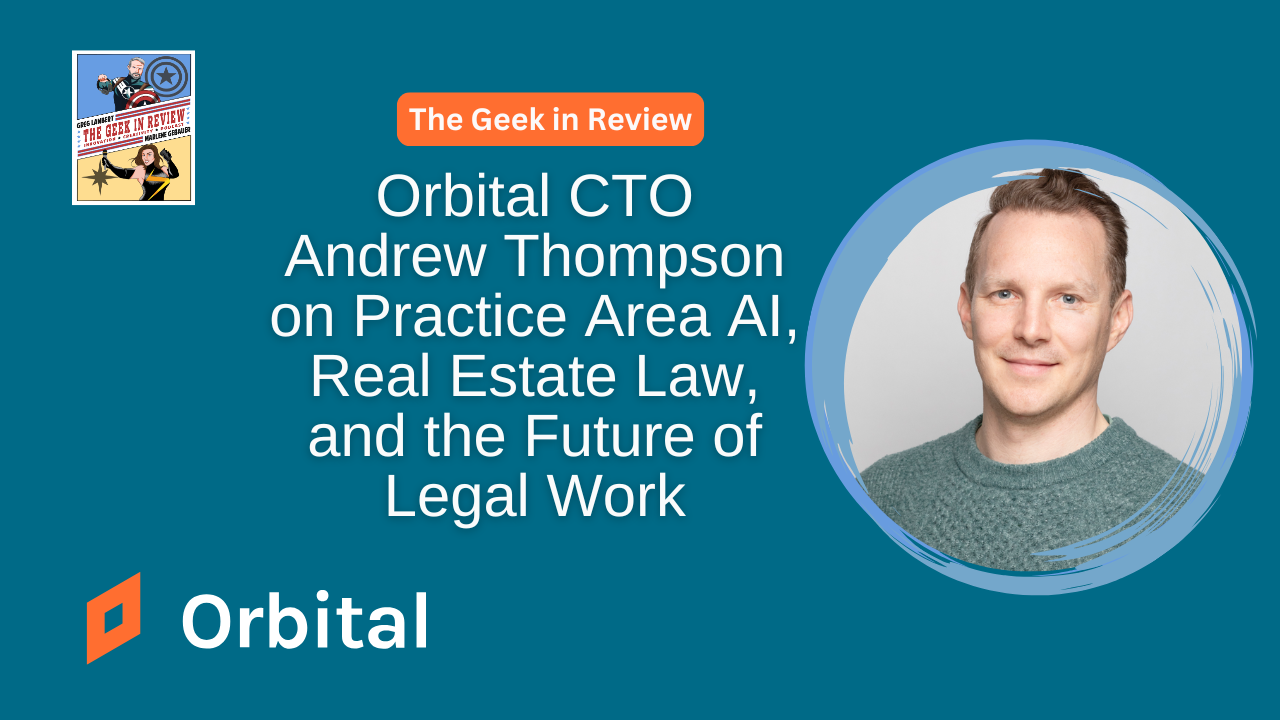
This week on The Geek in Review, we talk with Andrew Thompson, CTO of Orbital, about why legal AI built for a specific practice area has a strong claim in a market crowded by general-purpose models. Thompson explains how Orbital focuses on real estate law, using AI, spatial intelligence, and legal workflow design to support transactions involving property portfolios, title review, survey analysis, and complex documentation. With more than 200,000 property transactions processed and a major $60 million, Series B investment fueling its U.S. expansion, Orbital sits at the center of the debate over whether the future of legal AI belongs to broad model platforms or tools built for the messy details of actual legal work.

Thompson’s path into legal technology brings a practical operator’s mindset to the conversation. Before Orbital, he worked across software, fintech, proptech, and real estate marketplaces, where speed, accuracy, and operational friction shaped business outcomes. That background informs his view that successful legal AI starts with the work itself rather than the model alone. For Orbital, the key is teaching AI to think like a real estate lawyer at the right level of abstraction, then pairing the model with domain-specific tools, data, and workflows.

The conversation gets especially interesting when Thompson walks through Orbital’s use of spatial intelligence. Real estate law often turns written legal descriptions, old maps, title documents, surveys, and boundaries into high-stakes decisions about physical land. Thompson explains the challenge of moving from words on a page to points, lines, curves, and property boundaries on a map. This leads to a broader discussion of large language models, visual language models, OCR, and classical machine learning, with Thompson making clear that the best current systems still require a toolbox rather than blind faith in one model.

We also explore Thompson’s concept of the “prompt tax,” the hidden maintenance burden created when model behavior changes faster than product teams expect. Thompson describes Orbital’s mantra of “betting on the model,” which means building for where AI capabilities are heading while still delivering value today. He separates durable domain expertise from brittle prompt tricks, arguing that legal AI companies need reusable legal knowledge, strong evaluation habits, and a willingness to rebuild assumptions as models improve.

Looking ahead, Thompson sees the impact of AI arriving faster than the standard three-to-five-year forecast. He points to software engineering as an early signal for what legal work might experience next, with professionals increasingly orchestrating humans and AI agents together. The billable hour, client value, accountability, empathy, and judgment all come under pressure as AI handles more cognitive labor. For real estate lawyers and legal technologists, Thompson’s message is direct: the winners will be those who understand the work deeply, build with technical humility, and know when the map matters as much as the document.


⁠⁠⁠⁠⁠Email: geekinreviewpodcast@gmail.com
Music: ⁠⁠⁠⁠⁠⁠⁠⁠⁠⁠⁠⁠⁠⁠⁠⁠⁠⁠Jerry David DeCicca⁠⁠⁠⁠⁠⁠⁠⁠⁠

Transcript:

Continue Reading Orbital CTO Andrew Thompson on Practice Area AI, Real Estate Law, and the Future of Legal Work

Earlier this week, I attended the 2026 Legal Marketing Association Annual Conference  in New Orleans. By all accounts, it was a success—great energy, strong attendance, and a clear signal that legal marketing is in the middle of a real transformation.

The sessions reflected it: legal operations, client intelligence, AI, change management, video. The conversation in every room was heightened and exciting. I was even on the ACAC (shout out the best Co-Chairs, President, Staff and committee!).

And yet, something still felt missing.

Not more tools. Not more tactics.

What’s missing is a shift in operating model.

Legal Marketing is Advancing—But Still Disconnected

Legal marketing teams are doing more than ever—supporting sophisticated BD efforts, producing targeted campaigns, scaling thought leadership, and experimenting with AI.

But much of it is still fragmented:

  • Campaigns disconnected from long-term positioning
  • Messaging that shifts by practice or partner
  • Client intelligence that isn’t operationalized
  • AI used tactically, not systemically

We’re moving faster—but not always more coherently.

The Missing Layer: Product Marketing Discipline

What’s coming next—likely accelerating into 2027—is a shift toward a product marketing ethos for legal marketing.

Not because law firms become product companies—but because the problems product marketing solves are now legal marketing’s problems.

At its core, product marketing brings structure to go-to-market:

  • Market intelligence and validation
  • Clear value propositions
  • Consistent messaging and positioning
  • Enablement of front-line teams aka lawyers

Legal marketing already touches all of these—but rarely as a cohesive, repeatable system.

This isn’t about more content. It’s about clarity, consistency, and scalability in how firms go to market.

Why This Matters Now

The traditional model—relationships, reputation, responsiveness—is under pressure.

Buyers now expect:

  • Clear articulation of value  – especially in the #AIEra
  • Industry-specific insight
  • Differentiation beyond credentials
  • Faster, more tailored engagement

At the same time, firms are expanding into repeatable offerings—managed services, alternative delivery models, and more structured solutions.

That combination demands something new:

A disciplined, scalable approach to how firms define and deliver value to the market.

Most AI adoption in legal marketing today is still tool-based—drafting, summarizing, automating tasks.

Helpful, but incremental.

The real shift is toward agentic AI workflows—systems that can:

  • Continuously monitor client industries and trigger insights
  • Adapt messaging dynamically
  • Assemble pitches grounded in validated value propositions
  • Enable lawyers with real-time, tailored talking points
  • Learn from outcomes and improve over time

But these systems only work with structure and reliably clean data.

Without clear positioning, messaging, and audience definition, AI just scales inconsistency.

With it, AI becomes a strategic execution layer.

The Convergence That Changes the Model

This is why the next evolution of legal marketing isn’t just AI adoption—it’s the convergence of:

Product marketing discipline + agentic AI execution

Together, they shift legal marketing from:

  • Campaigns → Systems
  • Content → Intelligence
  • Support → Enablement
  • Reactive → Proactive

Marketing doesn’t just support growth—it helps systematically create it.

What This Looks Like in Practice

In the near future, leading firms will operate with:

  • Continuous client and market intelligence feeding BD efforts  – I have been trying to get the industry here for years. Today’s tech makes my last 15 years of effort a wash.
  • Messaging that is consistent but dynamically applied
  • Pitches and proposals built from validated value frameworks
  • Lawyers equipped with tailored insights before every interaction
  • Thought leadership driven by real client pain, not just editorial calendars

The building blocks already exist.

What’s missing is the integration.

This Isn’t About Productizing Law

There will be pushback.

“We’re not a product company.”
“Our work is bespoke.”
“Our partners won’t adopt this.”

But this isn’t about productizing legal work. That’s already happening thanks to AI and process automation.

It’s about productizing how firms go to market—how they define value, communicate it, and deliver it consistently, especially as the needs of buyers are shifting under pricing pressure and AI engagement.

A move to agentic PMM doesn’t remove nuance. It scales it.

Better go to market doesn’t replace relationships. It strengthens them.

The Competitive Reality

The conversations at LMA made one thing clear: legal marketing is ready for its next phase.

But that phase won’t be defined by who uses the most AI tools.

It will be defined by who builds the most effective go-to-market systems.

As commercial models in the legal industry continue to evolve—toward more structured offerings, pricing innovation, and increased competition from alternative providers—firms will need more than strong relationships and good marketing.

They’ll need repeatable, intelligent, and scalable ways to compete.

That’s why the shift to an agentic, product-led legal marketing model matters.

Because in the next phase of legal marketing, this isn’t about being more relevant.

It’s about being staying competitive to effectively win more client work in a transformational market.

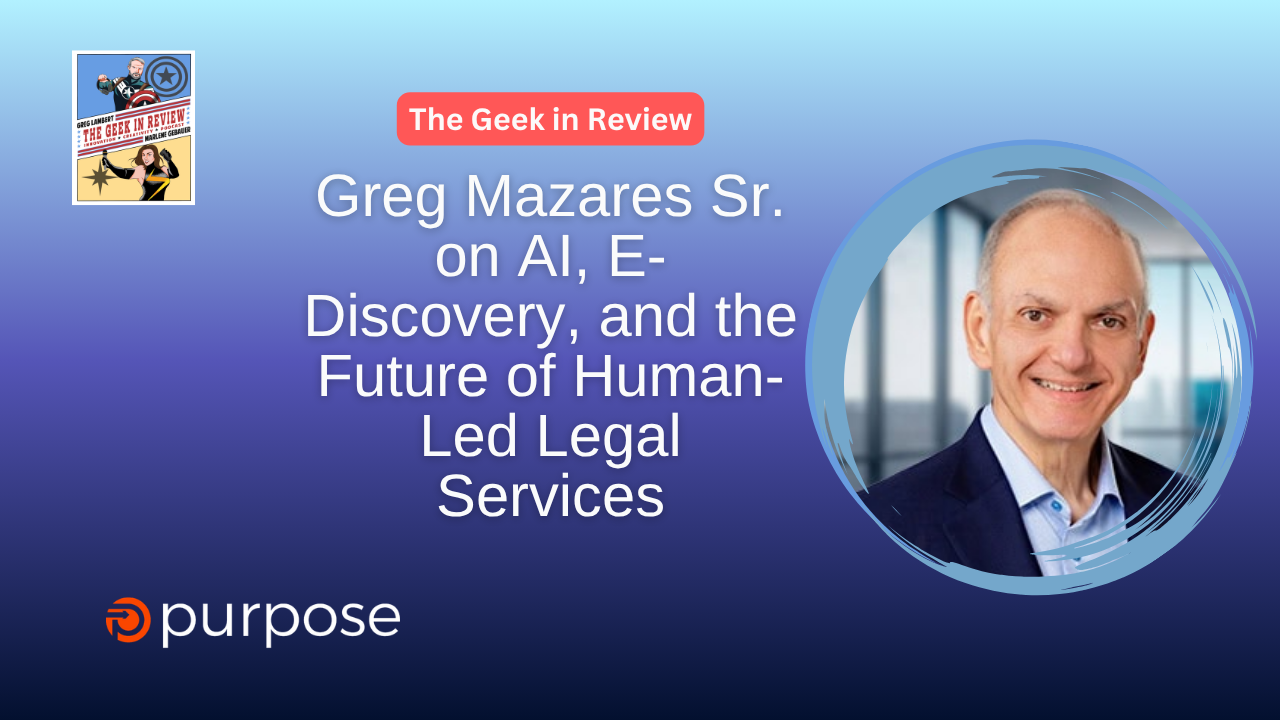
This week on The Geek in Review, we talk with Greg Mazares Sr., CEO of Purpose Legal, about what it takes to lead through one of the most important transition periods in legal services. Drawing on decades of experience across business, litigation support, and e-discovery, Mazares brings a steady, practical view to a market flooded with AI claims and rapid change. His message is clear from the start. The legal industry has faced major shifts before, from paper banker boxes to digital workflows, and this moment is another chapter in that longer story. Rather than treating AI as a threat, he sees it as a tool for adaptation, growth, and smarter client service.

A central theme in the conversation is Mazares’ belief that AI works best when paired with people and disciplined process. He argues that the future does not belong to technology alone, but to organizations that know how to combine tools, talent, and operational rigor. That philosophy sits behind Purpose Legal’s acquisition of Hire Counsel and its broader push to reunite technology and staffing under one roof. In Mazares’ view, clients do not simply want software. They want experienced professionals who know how to apply AI in defensible, repeatable ways that improve outcomes without sacrificing judgment.

The discussion also highlights Purpose Legal’s new offerings, including Purpose Xi and Case Optics, which aim to deliver early case insights in days rather than weeks. What makes Mazares’ framing stand out is his insistence that speed alone is not the point. Faster results matter only when paired with expert validation, tested workflows, and credible guardrails. He describes a legal market where clients once assumed AI would let them bring everything in-house, but now increasingly value outside experts who bring both technological fluency and hard-earned experience. That shift, he suggests, is raising the level of service providers from operational support teams to strategic partners embedded more deeply in legal work.

Greg and Marlene also press Mazares on data security, client trust, and the cultural pressures that come with rapid growth. Here again, his answers return to discipline and execution. He points to major investments in cloud security, around-the-clock protection teams, and tighter controls over on-site review environments. He also argues that many of the greatest risks still come from human behavior, which makes vetting, supervision, and protocol design as important as any technical control. On culture, Mazares emphasizes recognition, communication, and adaptability as the backbone of a company that wants to grow without losing its identity. For him, scaling a business is not only about revenue. It is about building a place where people feel seen, trusted, and prepared for change.

The episode closes on a thoughtful look at the next few years for litigation, junior associates, and the billable hour. Mazares predicts that junior lawyers will not disappear, but their role will shift toward becoming guides in the use of AI, both inside firms and in conversations with clients. As routine work becomes more compressed, he expects associates to provide higher-value service in fewer hours, with stronger technical fluency and a more consultative posture. It is a fitting end to an episode grounded in realism rather than hype. Mazares does not present AI as magic, and he does not dismiss its significance either. Instead, he offers a view of the future shaped by adaptability, experience, and the belief that in legal services, the winning formula still comes down to people, process, and sound judgment.

Listen on mobile platforms:  ⁠⁠⁠⁠⁠⁠⁠⁠⁠⁠⁠⁠⁠⁠Apple Podcasts⁠⁠⁠⁠⁠⁠⁠⁠⁠⁠⁠⁠⁠⁠ |  ⁠⁠⁠⁠⁠⁠⁠⁠⁠⁠⁠⁠⁠⁠Spotify⁠⁠⁠⁠⁠⁠⁠⁠⁠⁠⁠⁠⁠⁠ | ⁠⁠⁠⁠⁠⁠⁠⁠⁠⁠⁠⁠⁠YouTube⁠⁠⁠⁠⁠⁠⁠⁠⁠⁠ | Substack

[Special Thanks to Legal Technology Hub for their sponsoring this episode.]

⁠⁠⁠⁠⁠Email: geekinreviewpodcast@gmail.com
Music: ⁠⁠⁠⁠⁠⁠⁠⁠⁠⁠⁠⁠⁠⁠⁠⁠⁠⁠Jerry David DeCicca⁠⁠⁠⁠⁠⁠⁠⁠⁠

Transcript:


Continue Reading Greg Mazares Sr. on AI, E-Discovery, and the Future of Human-Led Legal Services