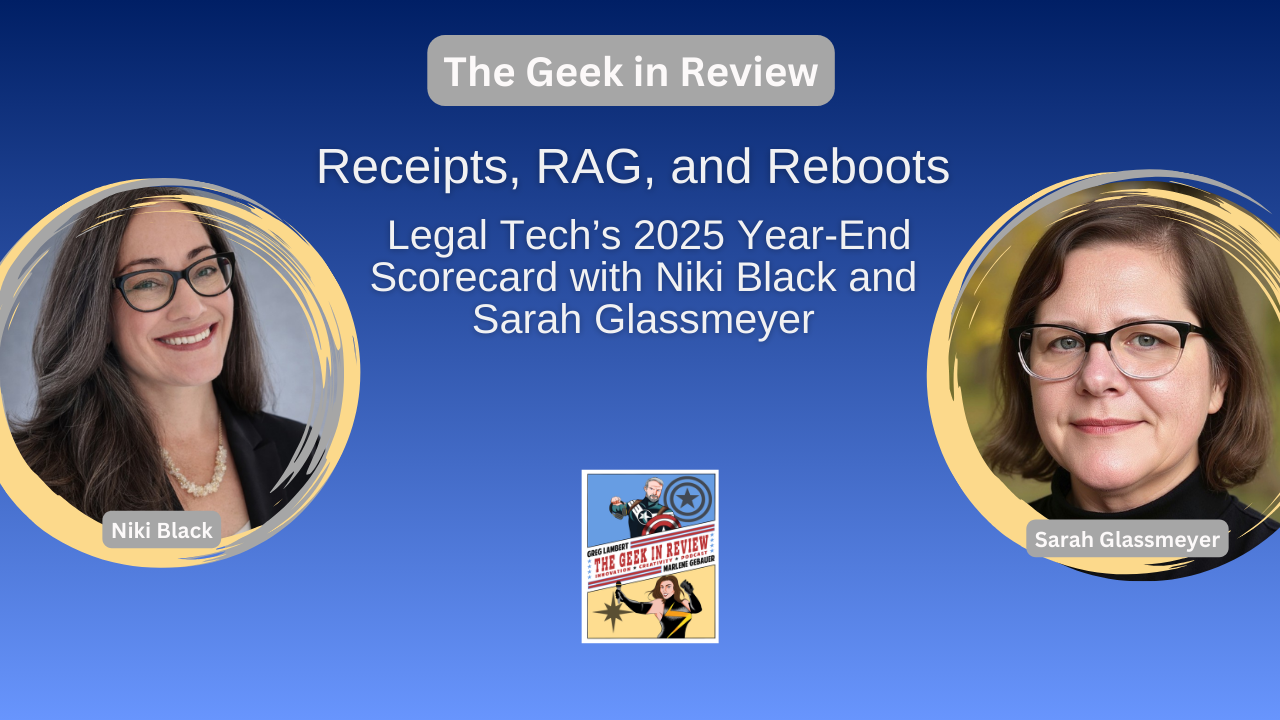
The Geek in Review closes 2025 with Greg Lambert and Marlene Gebauer welcoming back Sarah Glassmeyer and Niki Black for round two of the annual scorecard, equal parts receipts, reality check, and forward look into 2026. The conversation opens with a heartfelt remembrance of Kim Stein, a beloved KM community builder whose generosity showed up in conference dinners, happy hours, and day to day support across vendors and firms. With Kim’s spirit in mind, the panel steps into the year-end ritual: name the surprises, own the misses, and offer a few grounded bets for what comes next.

Last year’s thesis predicted a shift from novelty to utility, yet 2025 felt closer to a rolling hype loop. Glassmeyer frames generative AI as a multi-purpose knife dropped on every desk at once, which left many teams unsure where to start, even when budgets already committed. Black brings the data lens: general-purpose gen AI use surged among lawyers, especially solos and small firms, while law firm adoption rose fast compared with earlier waves such as cloud computing, which crawled for years before pandemic pressure moved the needle. The group also flags a new social dynamic, status-driven tool chasing, plus a quiet trend toward business-tier ChatGPT, Gemini, and Claude as practical options for many matters when price tags for legal-only platforms sit out of reach for smaller shops.

Hallucinations stay on the agenda, with the panel resisting both extremes: doom posts and fan club hype. Glassmeyer recounts a founder’s quip, “hallucinations are a feature, not a bug,” then pivots to an older lesson from KeyCite and Shepard’s training: verification never goes away, and lawyers always owed diligence, even before LLMs. Black adds a cautionary tale from recent sanctions, where a lawyer ran the same research through a stack of tools, creating a telephone effect and a document nobody fully controlled. Lambert notes a bright spot from the past six months: legal research outputs improved as vendors paired vector retrieval with legal hierarchy data, including court relationships and citation treatment, reducing off-target answers even while perfection stays out of reach.

From there, the conversation turns to mashups across the market. Clio’s acquisition of vLex becomes a headline example, raising questions about platform ecosystems, pricing power, and whether law drifts toward an Apple versus Android split. Black predicts integration work across billing, practice management, and research will matter as much as M&A, with general tech giants looming behind the scenes. Glassmeyer cheers broader access for smaller firms, while still warning about consolidation scars from legal publishing history and the risk of feature decay once startups enter corporate layers. The panel lands on a simple preference: interoperability, standards, and clean APIs beat a future where a handful of owners dictate terms.

On governance, Black rejects surveillance fantasies and argues for damage control, strong training, and safe experimentation spaces, since shadow usage already happens on personal devices. Gebauer pushes for clearer value stories, and the guests agree early ROI shows up first in back office workflows, with longer-run upside tied to pricing models, AFAs, and buyer pushback on inflated hours. For staying oriented amid fractured social channels, the crew trades resources: AI Law Librarians, Legal Tech Week, Carolyn Elefant’s how-to posts, Moonshots, Nate B. Jones, plus Ed Zitron’s newsletter for a wider business lens. The crystal ball segment closes with a shared unease around AI finance, a likely shakeout among thinly funded tools, and a reminder to keep the human network strong as 2026 arrives.

Sarah Glassmeyer

Niki Black

Marlene Gebauer

Greg Lambert

Transcript

Continue Reading Receipts, RAG, and Reboots: Legal Tech’s 2025 Year-End Scorecard with Niki Black and Sarah Glassmeyer

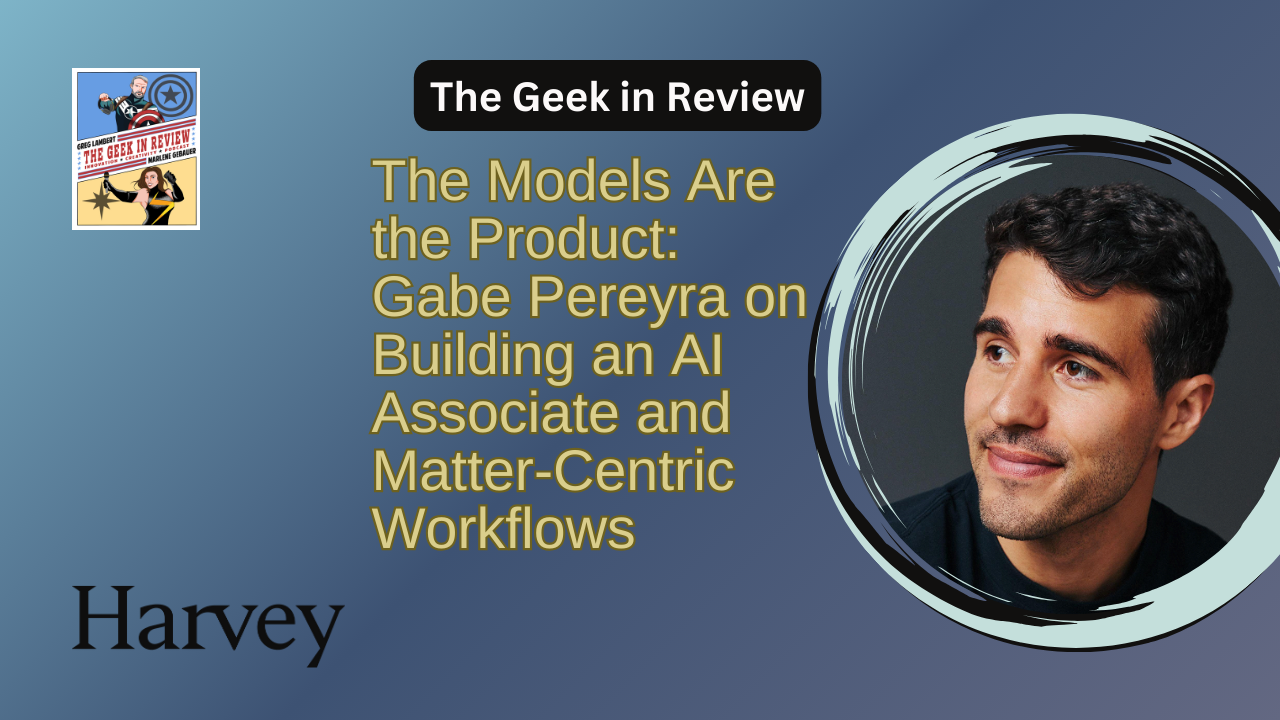
This week, we talk with Gabe Pereyra, President and co-founder at Harvey, about his path from DeepMind and Google Brain to launching Harvey with Winston Weinberg; how a roommate’s real-world legal workflows met early GPT-4 access and OpenAI backing; why legal emerged as the right domain for large models; and how personal ties to the profession plus a desire to tackle big societal problems shaped a mission to apply advanced AI where language and law intersect.

Gabe’s core thesis lands hard, “the models are the product.” Rather than narrow tools for single tasks, Harvey opted for a broad assistant approach. Lawyers live in text and email, so dialog becomes the control surface, an “AI associate” supporting partners and teams. Early demos showed useful output across many tasks, which reinforced a generalist design, then productized connections into Outlook and Word, plus a no-code Workflow Builder.

Go-to-market strategy flipped the usual script. Instead of starting small, Harvey partnered early with Allen & Overy and leaders like David Wakeling. Large firms supplied layered review, which reduced risk from model errors and increased learning velocity. From there the build list grew, security and data privacy, dedicated capacity, links to firm systems, case law, DMS, data rooms, and eDiscovery. A matter workspace sits at the center. Adoption rises with surface area, with daily activity approaching seventy percent where four or more product surfaces see regular use. ROI work now includes analysis of write-offs and specialized workflows co-built with firms and clients, for example Orrick, A&O, and PwC.

Talent, training, and experience value come next. Firms worry about job paths, and Gabe does not duck that concern. Models handle complex work, which raises anxiety, yet also shortens learning curves. Harvey collaborates on curricula using past deals, plus partnerships with law schools. Return on experience shows up in recruiting, PwC reports stronger appeal among early-career talent, and quality-of-life gains matter. On litigation use cases, chronology builders require firm expertise and guardrails, with evaluation methods that mirror how senior associates review junior output. Frequent use builds a mental model for where errors tend to appear.

Partnerships round out the strategy. Research content from LexisNexis and Wolters Kluwer, work product in iManage and NetDocuments, CLM workflows via Ironclad, with plans for data rooms, eDiscovery, and billing. Vision extends to a complete matter management service, emails, documents, prior work, evaluation, billing links, and strict ethical walls, all organized by client-matter. Global requirements drive multi-region storage and controls, including Australia’s residency rules. The forward look centers on differentiation through customization, firms encode expertise into models, workflows, and agents, then deliver outcomes faster and at software margins. “The value sits in your people,” Gabe says, and firms that convert know-how into systems will lead the pack.

Listen on mobile platforms:  ⁠⁠⁠⁠⁠⁠⁠⁠⁠⁠⁠⁠⁠⁠Apple Podcasts⁠⁠⁠⁠⁠⁠⁠⁠⁠⁠⁠⁠⁠⁠ |  ⁠⁠⁠⁠⁠⁠⁠⁠⁠⁠⁠⁠⁠⁠Spotify⁠⁠⁠⁠⁠⁠⁠⁠⁠⁠⁠⁠⁠⁠ | ⁠⁠⁠⁠⁠⁠⁠⁠⁠⁠⁠⁠⁠YouTube⁠⁠⁠⁠⁠⁠⁠⁠⁠⁠

[Special Thanks to Legal Technology Hub for their sponsoring this episode.]

⁠⁠⁠Email: geekinreviewpodcast@gmail.com
Music: ⁠⁠⁠⁠⁠⁠⁠⁠⁠⁠⁠⁠⁠⁠⁠⁠⁠Jerry David DeCicca⁠⁠⁠⁠⁠⁠⁠⁠⁠

Transcript

Continue Reading The Models Are the Product: Gabe Pereyra on Building an AI Associate and Matter-Centric Workflows

In this episode, we welcome Matthew Dickinson, CEO and founder of Vable, to discuss the rapidly changing landscape of legal information and current awareness. Matthew reflects on how, until recently, current awareness in law firms relied heavily on manual curation, Boolean searches, and email alerts—often resulting in information overload and a lack of personalization. With the advent of generative AI, expectations have shifted dramatically. Lawyers now want more than just a flood of articles; they expect relevant, actionable insights delivered seamlessly and intuitively, tailored to their specific needs and workflows.

Matthew explains how Vable and similar platforms are moving beyond simply delivering news. The goal is to provide context-rich, actionable intelligence that integrates with other firm systems, such as CRM platforms. Instead of sending a list of articles about data breaches, for example, the new approach is to alert lawyers when a top client is affected, summarize the implications, and identify who else in the firm needs to know. This shift requires a blend of robust technology, thoughtful workflow design, and a deep understanding of the different roles within a law firm.

A significant portion of the conversation centers on the ethical boundaries of using AI in legal information services. Matthew outlines four pillars for ethical current awareness: trust, transparency, accuracy, and inclusion. He emphasizes the importance of clear labeling when AI is used, maintaining high standards for accuracy (especially for client-facing content), and ensuring a diversity of sources to avoid echo chambers. Vable’s approach includes strong relationships with publishers, transparent rights management, and tools that allow human review and curation before information is distributed.

Matthew discuss best practices for using news and current awareness to support practice development and client engagement. While many firms still rely on newsletters and headlines, there is a growing trend toward more personalized, branded, and interactive content—such as Vable Connect, which allows firms to deliver tailored digests to clients. Automation is on the rise, but the human element remains crucial: lawyers use curated content as a springboard for client conversations, and AI is seen as a tool to empower, not replace, professional judgment.

As the episode wraps up, Matthew shares his perspective on the future of legal information services. He predicts that the next wave of innovation will bring even more personalization, prediction, and integration—potentially leading to “personalized current awareness bots” for every lawyer. However, he cautions that while AI can supercharge productivity, humans must remain in control, especially in high-stakes legal environments. The unique culture and high standards of law firms mean that technology providers must deeply understand their clients’ needs to build trust and deliver real value.

Listen on mobile platforms:  ⁠⁠⁠⁠⁠⁠⁠⁠⁠⁠⁠⁠⁠⁠Apple Podcasts⁠⁠⁠⁠⁠⁠⁠⁠⁠⁠⁠⁠⁠⁠ |  ⁠⁠⁠⁠⁠⁠⁠⁠⁠⁠⁠⁠⁠⁠Spotify⁠⁠⁠⁠⁠⁠⁠⁠⁠⁠⁠⁠⁠⁠ | ⁠⁠⁠⁠⁠⁠⁠⁠⁠⁠⁠⁠⁠YouTube⁠⁠⁠⁠⁠⁠⁠⁠⁠⁠

[Special Thanks to Legal Technology Hub for their sponsoring this episode.]

Blue Sky: ⁠@geeklawblog.com⁠ ⁠@marlgeb⁠
⁠⁠⁠⁠⁠Email: geekinreviewpodcast@gmail.com
Music: ⁠⁠⁠⁠⁠⁠⁠⁠⁠⁠⁠⁠⁠⁠⁠⁠⁠Jerry David DeCicca⁠⁠⁠⁠⁠⁠⁠⁠⁠

Transcript

Continue Reading Vable’s Matthew Dickinson on Current Awareness in the Age of GenAI

This week, Greg Lambert sits down with Tom Dunlop, CEO and founder of Summize, and Laura Proctor, Chief Marketing Officer, to explore the evolution and impact of Summize in the contract lifecycle management (CLM) space. From its innovative beginnings to its strategic positioning in a competitive market, this discussion unveils the strategies, challenges, and future trends shaping legal technology.

Tom Dunlop shares the frustrations that sparked the idea for Summize, recounting his days as an in-house lawyer overwhelmed by the manual review of locked PDF contracts during due diligence. “It was painstaking,” Tom recalls, “I knew there had to be a better way.” Teaming up with a software engineer, he sought to create a tool that could generate instant, usable summaries of contracts. Thus, Summize was born, tackling not only legal pain points but also bridging communication gaps between legal teams and broader business units.

Laura Proctor highlights Summize’s unique approach to embedding its tools within widely used platforms like Microsoft Word, Slack, and Teams. This strategy ensures lawyers and business users can collaborate seamlessly without leaving their existing workflows. “Why ask lawyers to leave Word when they already love working there?” Laura explains, emphasizing Summize’s commitment to user-centric design. This integration not only enhances efficiency but also shifts the perception of legal teams from bottlenecks to enablers.

Central to Summize’s implementation is their “Hero Framework,” a three-step process designed to reduce legal bottlenecks, enhance efficiency, and track progress with actionable analytics. Tom explains, “We focus on reducing low-value, high-volume tasks, enabling self-service for the business, and then optimizing legal workflows.” This framework has even led to unexpected benefits, such as elevating the “personal brand” of legal teams within organizations.

Laura delves into the differences between US and UK markets, noting that US buyers often have prior experience with CLM tools, while UK customers may be making their first purchase. This distinction shapes Summize’s marketing and implementation strategies, with a focus on ensuring rapid time-to-value and addressing previous pain points. “In the US, it’s about reassurance and quick wins,” she explains, highlighting the importance of tailoring approaches to meet varying customer needs.

Looking ahead, Tom envisions a future where AI moves beyond single tasks to orchestrate complex workflows, potentially disrupting the billable hour model and democratizing access to legal knowledge. “If we can monetize legal knowledge rather than time, we could 10x the market,” he predicts. Laura adds that Summize will continue leaning into creativity and differentiation in an increasingly crowded market, ensuring their solutions remain bold and memorable.

This episode is a deep dive into the innovative strategies that are redefining CLM and the broader legal tech landscape. From the practical application of AI to enhancing legal collaboration, Summize offers a glimpse into the transformative potential of technology in the legal world.

Listen on mobile platforms:  ⁠⁠⁠⁠⁠⁠⁠⁠⁠⁠⁠⁠Apple Podcasts⁠⁠⁠⁠⁠⁠⁠⁠⁠⁠⁠⁠ |  ⁠⁠⁠⁠⁠⁠⁠⁠⁠⁠⁠⁠Spotify⁠⁠⁠⁠⁠⁠⁠⁠⁠⁠⁠⁠ | ⁠⁠⁠⁠⁠⁠⁠⁠⁠⁠⁠YouTube⁠⁠⁠⁠⁠⁠⁠⁠⁠

Blue Sky: @glambertpod @marlgeb
⁠⁠⁠⁠⁠Email: geekinreviewpodcast@gmail.com
Music: ⁠⁠⁠⁠⁠⁠⁠⁠⁠⁠⁠⁠⁠⁠⁠Jerry David DeCicca⁠⁠⁠⁠⁠⁠⁠⁠

TRANSCRIPT

Continue Reading Summarizing Success with Summize’s Tom Dunlop and Laura Proctor

[Ed Note: We were holding off on publishing this episode because we were waiting on the official announcement that Kara Peterson and Rich DiBona of Descrybe.ai were the Silver Anthem Award winners in Best Use of AI from the International Academy of Digital Arts & Sciences! Congratulations to Kara and Rich for the prestigious award! – GL]

In this episode of “The Geek in Review,” we welcome Kara Peterson and Richard DiBona, the dynamic married duo behind Descrybe.ai. Descrybe is an AI-powered legal tool aimed at democratizing access to legal information, particularly by providing summarized legal decisions that make case law more accessible to everyone. The conversation centers around how Descrybe was created, its mission, and the challenges and opportunities involved in developing a legal tech tool that truly serves its users.

Kara and Rich share the story of how Descrybe began as a personal project sparked by a challenging legal issue they faced themselves. Rich, a software engineer, started experimenting with AI summarization of judicial opinions and was struck by how well it worked. Over time, this experiment evolved into Descrybe—a platform that not only delivers quick case law summaries but also enhances accessibility through simplified language and multilingual support. They delve into the technical challenges of managing massive datasets of judicial opinions and ensuring that their platform remains accurate and reliable.

The development of Descrybe has been heavily influenced by user feedback, which Kara and Rich emphasize throughout the episode. They explain how advisory feedback has been instrumental in shaping key features, such as Spanish translations and simplified summaries, which make the platform more accessible to non-native English speakers and those with varying levels of reading proficiency. Their genuine commitment to evolving the product based on user needs is a core aspect of Descrybe’s mission to democratize legal information.

A particularly intriguing segment of the episode focuses on Rich’s perspective on the legal tech market and his skepticism regarding companies that label their offerings as “LLMs” (large language models) without meeting the threshold of a true LLM. Kara adds her insights on the broader mission of Descrybe: not only to innovate within legal tech but also to address access to justice as a public health issue. They both underscore the importance of responsible AI development, ensuring that new technology genuinely benefits society rather than exacerbating existing inequalities.

Towards the end of the episode, Kara and Rich discuss the future of AI in the legal industry and the role Descrybe aims to play. They express optimism that AI can be a powerful force for improving the legal system, especially if it is used to automate lower-level tasks and free up lawyers to focus on more impactful work. They also highlight the potential for AI to facilitate alternative dispute resolutions, diverting some cases from the courts altogether. Kara concludes on a hopeful note, emphasizing that if the right choices are made now, AI could be a driving force for positive systemic change within the legal field.

This conversation with Kara Peterson and Richard DiBona offers a candid, behind-the-scenes look at building Descrybe—a legal tech solution driven by a mission to improve access to justice. Their commitment to making complex legal information understandable for everyone shines through, making this episode a must-listen for anyone interested in the intersection of technology, law, and social good.

Listen on mobile platforms:  ⁠⁠⁠⁠⁠⁠⁠⁠⁠⁠⁠⁠Apple Podcasts⁠⁠⁠⁠⁠⁠⁠⁠⁠⁠⁠⁠ |  ⁠⁠⁠⁠⁠⁠⁠⁠⁠⁠⁠⁠Spotify⁠⁠⁠⁠⁠⁠⁠⁠⁠⁠⁠⁠ | ⁠⁠⁠⁠⁠⁠⁠⁠⁠⁠⁠YouTube⁠⁠⁠⁠⁠⁠⁠⁠⁠

Twitter: ⁠⁠⁠⁠⁠@gebauerm⁠⁠⁠⁠⁠, or ⁠⁠⁠⁠⁠@glambert
⁠⁠⁠⁠⁠Email: geekinreviewpodcast@gmail.com
Music: ⁠⁠⁠⁠⁠⁠⁠⁠⁠⁠⁠⁠⁠⁠⁠Jerry David DeCicca⁠⁠⁠⁠⁠⁠⁠⁠

TRANSCRIPT

Continue Reading Democratizing Law with Descrybe.ai’s Kara Peterson and Rich DiBona

This week, we have a lively discussion with June Liebert and Cornell Winston, President and President-Elect, respectively, for the American Association of Law Libraries (AALL). The conversation centers around the upcoming AALL annual conference, scheduled for July 20-23, 2024, at the Hyatt Regency in Chicago. 

June Liebert, Director of Information Services at O’Melveny & Myers LLP, kicks off the discussion by diving into the conference theme. She emphasizes the importance of librarians taking proactive leadership roles, particularly in the context of the rapidly evolving landscape influenced by Generative AI. June highlights the concept of “innovation intermediaries,” individuals who not only generate innovative ideas but also ensure these ideas are implemented effectively. This theme resonates with the need for transformative thinking, urging librarians to embrace significant changes rather than settling for incremental improvements.

This year’s keynote speaker is Cory Doctorow, a renowned sci-fi author and advocate for digital rights, Doctorow’s presence promises to bring a unique perspective on the intersection of technology and societal impact. June shares her enthusiasm for Doctorow, whose work with the Electronic Frontier Foundation (EFF) and writings on “enshittification” – the degradation of online platforms over time – provide critical insights into the ethical implications of technological advancements. Doctorow’s focus on the human impact of technology, rather than just the technology itself, offers valuable reflections for the legal information profession.

Cornell Winston, law librarian at the United States Attorney’s Office, provides a comprehensive overview of what attendees can expect from the conference. With over 60 educational programs, including a pre-conference workshop on AI strategy, the event promises rich learning opportunities. Cornell underscores the value of networking and connecting with peers, highlighting the inclusive environment fostered by the Host Program for first-time attendees. His advice to explore sessions outside one’s usual domain and to meet new people each day encapsulates the spirit of professional growth and community building.

As the conversation unfolds, the trio touches on the broader theme of innovation and technology within law libraries. June and Cornell discuss the shift from physical books to digital resources, reflecting on how generative AI and other technologies are reshaping the profession. June mentions the implementation of live closed captioning for sessions, a first for the conference, enhancing accessibility and providing real-time transcripts for attendees.

June shares her experiences as the first Asian American president of the association, highlighting her efforts to promote diversity, equity, and inclusion. Cornell, looking ahead to his presidency, discusses plans to review AALL’s governance structure and explore the future of law libraries in an increasingly digital world. The episode wraps up with a preview of the 2024 conference in Portland, Oregon, promising another enriching experience for the legal information community.

Listen on mobile platforms:  ⁠⁠⁠⁠⁠⁠Apple Podcasts⁠⁠⁠⁠⁠⁠ |  ⁠⁠⁠⁠⁠⁠Spotify⁠⁠⁠⁠⁠⁠ | ⁠⁠⁠⁠⁠YouTube⁠⁠⁠⁠

Contact Us: 
Twitter: ⁠⁠⁠⁠⁠@gebauerm⁠⁠⁠⁠⁠, or ⁠⁠⁠⁠⁠@glambert⁠⁠⁠⁠⁠
Email: geekinreviewpodcast@gmail.com
Music: ⁠⁠⁠⁠⁠⁠⁠⁠⁠Jerry David DeCicca⁠⁠⁠⁠⁠

Transcript

Continue Reading Leading, Innovating, and Transforming: Insights for the 2024 AALL Annual Conference – June Liebert and Cornell Winston

The International Legal Technology Association (ILTA) is launching a new conference called EVOLVE, which will focus on the rapidly evolving topics of generative AI and cybersecurity in the legal industry. Ken Jones, Principal Consultant at Xerdict Group LLC, and Josh Smith, Information Security Manager at Ogletree Deakins, join the podcast to discuss the conference and the challenges and opportunities presented by these cutting-edge technologies.

ILTA EVOLVE is designed to be a more intimate event compared to the larger ILTACON conference, with an expected attendance of 300-500 people. This smaller scale allows for deeper technical discussions, more personal interactions, and easier access to experts and speakers. The conference will feature a keynote speaker, a roundtable discussion, and 20 educational sessions led by a diverse group of talented speakers.

One of the key challenges faced by legal technology professionals is the need to balance the potential benefits of generative AI with the responsibility to protect client data. Law firms have a fiduciary duty to be strong stewards of their clients’ information, and the use of AI models that rely on vast amounts of data can create conflicts of interest. The conference will explore ways to make these models secure and compliant while still leveraging their capabilities to enhance legal services.

The keynote speaker for ILTA EVOLVE will be Joe Sullivan, former CSO of Facebook, accompanied by Lily Yeoh, founder and president of C1 Risk. Their presentation will focus on the legal issues faced by law firms in the event of a cybersecurity incident and how to respond effectively. The conference will also provide ample networking opportunities, including evening events, coffee breaks, and a business partner display area where attendees can engage with vendors and learn about the latest solutions.

Looking to the future, the co-chairs predict that both cybersecurity and generative AI will continue to evolve rapidly, becoming more sophisticated and valuable to the legal profession. In the realm of cybersecurity, the battle between attackers and defenders will likely be ongoing, requiring constant vigilance and adaptation. For AI, the application of best practices and methodologies from software development will be crucial in ensuring that these powerful technologies are deployed effectively and responsibly within law firms. ILTA EVOLVE aims to provide attendees with the knowledge and tools they need to navigate this complex landscape and harness the potential of these transformative technologies.

Listen on mobile platforms:  ⁠⁠⁠Apple Podcasts⁠⁠⁠ |  ⁠⁠⁠Spotify⁠⁠⁠ | ⁠⁠YouTube⁠⁠

Contact Us: 

Twitter: ⁠⁠⁠⁠⁠@gebauerm⁠⁠⁠⁠⁠, or ⁠⁠⁠⁠⁠@glambert
⁠⁠⁠⁠⁠Threads: @glambertpod or @gebauerm66
Email: geekinreviewpodcast@gmail.com
Music: ⁠⁠⁠⁠⁠⁠⁠Jerry David DeCicca⁠⁠⁠⁠ and Eve Searls

⁠Transcript

Continue Reading Exploring the Intersection of Generative AI and Cybersecurity at ILTA EVOLVE – Ken Jones and Josh Smith

In this episode of The Geek in Review podcast, hosts Marlene Gebauer and Greg Lambert wrap up their series of interviews from the LegalWeek 2024 conference in New York with a conversation with Kelly Griswold, CEO of Onna. Kelly shares her objectives for attending the conference, which include interacting with customers and partners, staying on top of industry trends and innovations, and bringing her remote team together to build community.

Kelly provides an overview of Onna, explaining that the company primarily serves enterprise and corporate clients by managing their unstructured data with a focus on internal collaboration apps. Onna collects and integrates with various data sources to establish live connectivity and data transformation, making the data ready for searching and discovery to power downstream workflows such as litigation requests, early case assessment, and investigations. Kelly emphasizes the importance of data management as a necessary enabler for future innovations in the legal tech space.

The conversation touches on the challenges of managing data in the enterprise and how Onna helps clients improve their processes. Kelly explains that Onna’s approach involves helping enterprises build a data foundation that is accessible when needed, allowing them to skip several steps in the traditional linear workflow. This value proposition is particularly appealing to enterprises looking to avoid downstream costs by having better visibility and control over their data.

Kelly also discusses the impact of generative AI on the legal industry, noting that while there is a lot of buzz around the technology, companies are realizing the importance of getting their data in order before diving into experimentation and implementation. She believes that the awareness brought by the hype around generative AI is driving companies to make fundamental investments in data management.

Looking to the future, Kelly shares her crystal ball prediction for the next 5-10 years, envisioning a world where natural language communication and automation will transform the way legal workflows are handled. She imagines a scenario where drafting a contract could be done through verbal communication and a system that asks questions and generates the agreement, reducing the need for manual, hands-on work.

Listen on mobile platforms:  ⁠⁠⁠⁠Apple Podcasts⁠⁠⁠⁠ |  ⁠⁠⁠⁠Spotify⁠⁠⁠⁠ | ⁠⁠⁠YouTube⁠⁠ 

Contact Us: 

Twitter: ⁠⁠⁠⁠⁠@gebauerm⁠⁠⁠⁠⁠, or ⁠⁠⁠⁠⁠@glambert
⁠⁠⁠⁠⁠Threads: @glambertpod or @gebauerm66
Email: geekinreviewpodcast@gmail.com
Music: ⁠⁠⁠⁠⁠⁠⁠⁠Jerry David DeCicca

Transcript

Continue Reading Kelly Griswold of Onna on the Fundamental Investments Needed in Data Management

In this week’s episode of “The Geek in Review” podcast, co-hosts Greg Lambert and Marlene Gebauer interview Michael Bommarito and Jill Bommarito, the CEO and Chief Risk Officer of 273 Ventures, respectively. The couple, who have been together since high school, share their experiences working together in the legal technology space.

Michael and Jill discuss the advantages and challenges of working closely together in the same organization. They highlight the benefits of being able to bounce ideas off each other in real-time and the ability to seamlessly cover for one another when family responsibilities arise. However, they also acknowledge the lack of boundaries between work and home life, which can be both a blessing and a curse.

The Bommaritos also detail their work at 273 Ventures, particularly their focus on developing Large Language Models (LLMs) with a clean data approach. Jill, one of the world’s first certified AI auditors, brings her expertise in compliance and risk management to ensure that the models are built ethically and in accordance with legal standards. Michael shares his excitement about the potential applications of their LLMs, such as automating due diligence processes and drafting contract revisions based on identified risks.

When asked about the reactions they receive from others regarding working together, the couple admits that most people express sympathy and curiosity about how they manage to do it successfully. They attribute their success to their long history together and the shared experiences they have had, both personally and professionally.

Finally, the Bommaritos offer advice to other couples considering working in the same field or business. They emphasize the importance of being certain that both partners are fully committed to the idea, as it can be an all-consuming experience. They also stress the significance of knowing each other well before embarking on such a venture, as a strong foundation is crucial for navigating the challenges that come with working closely together.

Listen on mobile platforms:  ⁠⁠⁠Apple Podcasts⁠⁠⁠ |  ⁠⁠⁠Spotify⁠⁠⁠ | ⁠⁠YouTube⁠⁠

Contact Us: 

Twitter: ⁠⁠⁠⁠⁠@gebauerm⁠⁠⁠⁠⁠, or ⁠⁠⁠⁠⁠@glambert
⁠⁠⁠⁠⁠Threads: @glambertpod or @gebauerm66
Email: geekinreviewpodcast@gmail.com
Music: ⁠⁠⁠⁠⁠⁠⁠Jerry David DeCicca⁠⁠⁠⁠ and Eve Searls

⁠Transcript

Continue Reading Love and Legal Tech – Jillian Bommarito and Michael Bommarito of 273 Ventures

In this episode of “The Geek in Review,” hosts Greg Lambert and Marlene Gebauer celebrate the one-year anniversary of CoCounsel, the pioneering Generative AI Legal Research Tool launched by CaseText. They are joined by Pablo Arredondo, Vice President of CoCounsel at Thomson Reuters and co-founder of CaseText, to discuss the significant strides and challenges faced in developing and implementing generative AI in legal research. Pablo shares insights into the early days of exploring generative AI and the transformative potential it held for overcoming the limitations of traditional keyword-based search methods in legal research.

The conversation delves into the technical and strategic journey of bringing CoCounsel to market, highlighting the team’s rapid pivot to leverage GPT-4 technology and the collaborative effort that ensured its successful launch. Pablo emphasizes the importance of quality control, trust, and addressing the nuanced requirements of legal research to ensure that CoCounsel met the high expectations of its users, including law librarians and legal professionals.

Pablo also reflects on the broader implications of generative AI for the legal industry, including the rapid adoption by law firms and legal departments seeking to leverage this technology to enhance their research capabilities and workflow efficiencies. The discussion touches on the ongoing challenges and opportunities presented by generative AI, such as regulatory considerations, ethical concerns, and the need for continuous education and adaptation within the legal profession.

The acquisition of CaseText by Thomson Reuters is discussed, with Pablo sharing his perspective on the strategic move and its potential to further expand and enhance CoCounsel’s capabilities and reach. He highlights the synergy between CaseText’s innovative approach and Thomson Reuters’ extensive resources and market presence, which together aim to drive the next wave of advancements in legal technology and research tools.

Finally, the episode explores future directions for generative AI in legal research, including the expansion of CoCounsel’s capabilities to encompass a wider range of legal tasks and its potential to transform the practice of law. Pablo’s enthusiasm for the possibilities ahead underscores the significant impact that generative AI is set to have on the legal industry, promising to revolutionize how legal professionals interact with information and conduct research.

Listen on mobile platforms:  ⁠⁠⁠Apple Podcasts⁠⁠⁠ |  ⁠⁠⁠Spotify⁠⁠⁠ | ⁠⁠YouTube⁠⁠

Contact Us: 

Twitter: ⁠⁠⁠⁠⁠@gebauerm⁠⁠⁠⁠⁠, or ⁠⁠⁠⁠⁠@glambert
⁠⁠⁠⁠⁠Threads: @glambertpod or @gebauerm66
Email: geekinreviewpodcast@gmail.com
Music: ⁠⁠⁠⁠⁠⁠⁠Jerry David DeCicca⁠⁠⁠⁠ and Eve Searls

⁠Transcript

Continue Reading Pablo Arredondo on the One-Year Anniversary of CoCounsel