
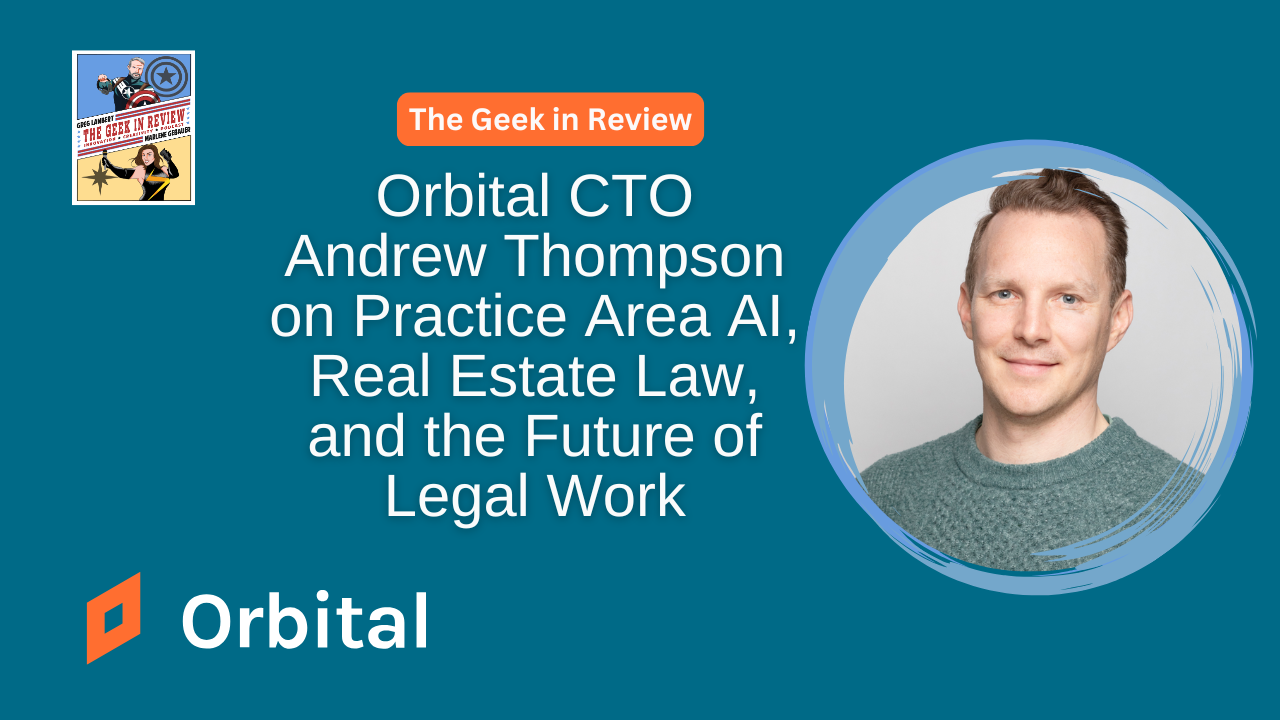
This week on The Geek in Review, we talk with Andrew Thompson, CTO of Orbital, about why legal AI built for a specific practice area has a strong claim in a market crowded by general-purpose models. Thompson explains how Orbital focuses on real estate law, using AI, spatial intelligence, and legal workflow design to support transactions involving property portfolios, title review, survey analysis, and complex documentation. With more than 200,000 property transactions processed and a major $60 million, Series B investment fueling its U.S. expansion, Orbital sits at the center of the debate over whether the future of legal AI belongs to broad model platforms or tools built for the messy details of actual legal work.
Thompson’s path into legal technology brings a practical operator’s mindset to the conversation. Before Orbital, he worked across software, fintech, proptech, and real estate marketplaces, where speed, accuracy, and operational friction shaped business outcomes. That background informs his view that successful legal AI starts with the work itself rather than the model alone. For Orbital, the key is teaching AI to think like a real estate lawyer at the right level of abstraction, then pairing the model with domain-specific tools, data, and workflows.
The conversation gets especially interesting when Thompson walks through Orbital’s use of spatial intelligence. Real estate law often turns written legal descriptions, old maps, title documents, surveys, and boundaries into high-stakes decisions about physical land. Thompson explains the challenge of moving from words on a page to points, lines, curves, and property boundaries on a map. This leads to a broader discussion of large language models, visual language models, OCR, and classical machine learning, with Thompson making clear that the best current systems still require a toolbox rather than blind faith in one model.
We also explore Thompson’s concept of the “prompt tax,” the hidden maintenance burden created when model behavior changes faster than product teams expect. Thompson describes Orbital’s mantra of “betting on the model,” which means building for where AI capabilities are heading while still delivering value today. He separates durable domain expertise from brittle prompt tricks, arguing that legal AI companies need reusable legal knowledge, strong evaluation habits, and a willingness to rebuild assumptions as models improve.
Looking ahead, Thompson sees the impact of AI arriving faster than the standard three-to-five-year forecast. He points to software engineering as an early signal for what legal work might experience next, with professionals increasingly orchestrating humans and AI agents together. The billable hour, client value, accountability, empathy, and judgment all come under pressure as AI handles more cognitive labor. For real estate lawyers and legal technologists, Thompson’s message is direct: the winners will be those who understand the work deeply, build with technical humility, and know when the map matters as much as the document.
Listen on mobile platforms: Apple Podcasts | Spotify | YouTube | Substack
[Special Thanks to Legal Technology Hub for their sponsoring this episode.]
Email: geekinreviewpodcast@gmail.com
Music: Jerry David DeCicca