
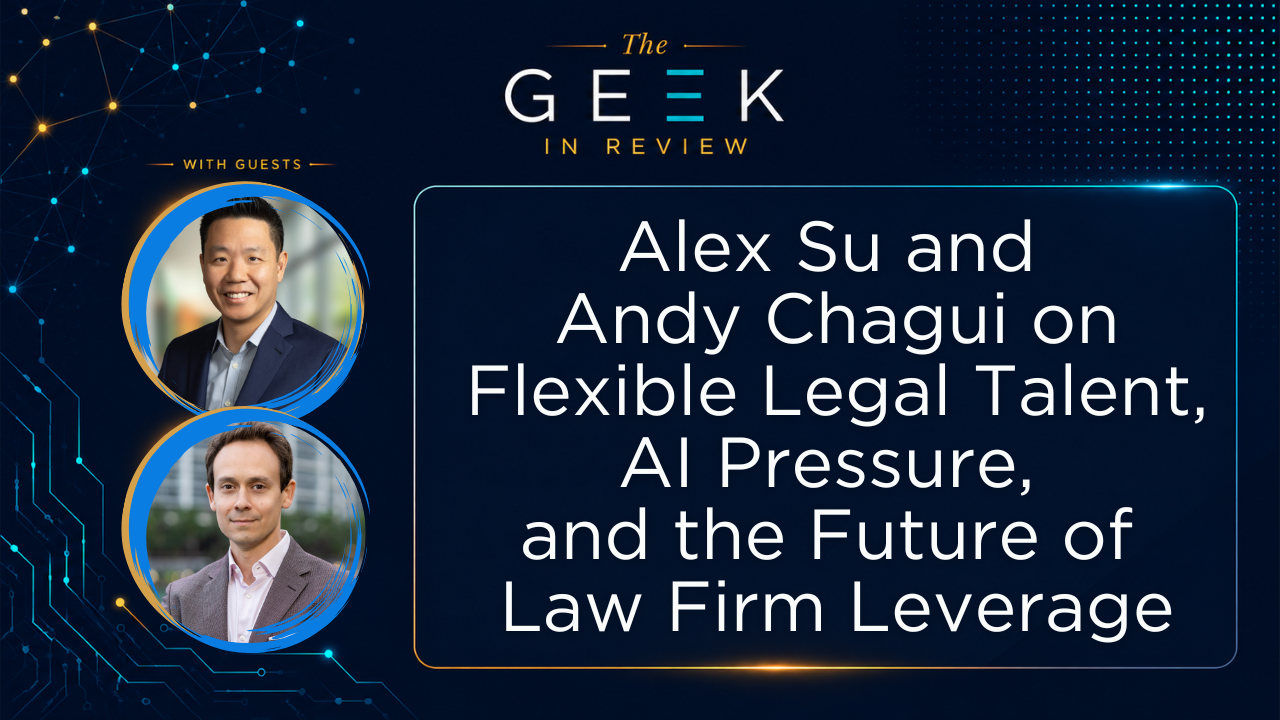
This week on The Geek in Review, we talk with Alex Su and Andy Chagui of Latitude about the shifting economics of law firm talent, the rise of flexible legal staffing, and the pressure AI is placing on traditional leverage models. Su, known across legal circles for his sharp commentary and creative legal industry videos, brings his background as a former Sullivan & Cromwell litigator and federal clerk to his current work leading revenue strategy at Latitude. Chagui adds the perspective of a former Carlton Fields shareholder who spent 15 years handling high-stakes federal litigation before moving into the new law space. Together, they offer a practical view of where law firm staffing is headed as clients, firms, and legal departments all face rising expectations around speed, value, and technology adoption.
Latitude’s model centers on high-end, flexible legal talent, experienced attorneys with Big Law or in-house backgrounds who step into law firms and corporate legal departments for specific engagements. Chagui explains that these lawyers often support overflow work, leave coverage, secondment requests, internal projects, and interim needs across practices ranging from litigation to corporate, labor, and employment. Su adds that staffing itself is not new, yet Latitude focuses on a segment of talent that traditional hiring models often miss, experienced attorneys with strong credentials who prefer engagement-based work over the standard full-time track.
The conversation turns quickly to why this model is gaining traction now. Remote work, post-COVID hiring shifts, and the growing acceptance of distributed teams have made it easier for firms to bring in experienced attorneys without requiring long-term headcount commitments. Chagui notes that many Latitude attorneys have 10 or more years of experience, meaning they often need less supervision than junior lawyers and move quickly into productive work. This matters as firms face inconsistent demand, intense competition for talent, and hesitation around layoffs, which in law firms often signal weakness rather than discipline.
AI adds another layer to the staffing problem. Firms have invested in tools such as Harvey, CoCounsel, and other specialized platforms, yet many knowledge management and innovation teams lack enough subject matter experts to train users, review outputs, build use cases, and handle quality control. Chagui describes Latitude lawyers helping firms train internal AI tools, review AI-generated work, and support practice-specific rollout efforts. Su points out that while some firms offer associates credit for AI training or innovation work, associates under billable hour pressure often choose client work first. Flexible talent gives firms another way to support AI adoption without asking already-stretched associates to carry the full load.
Su also frames flexible talent as a new form of leverage. Clients still trust senior partners and often accept premium rates for high-value judgment, but they are increasingly skeptical of paying top-tier rates for junior-level work. In that middle layer of legal work, AI, technology, and experienced flexible attorneys give firms more options. Su calls this “outsourced leverage,” a way to support the partner-client relationship while rethinking who performs the work underneath. The discussion also highlights a career-path shift for attorneys who prefer specialized, project-based work, especially in areas like knowledge management, AI implementation, and innovation support.
Looking ahead, both guests see uncertainty as the defining feature of the next phase of legal services. Chagui expects the traditional model to keep changing as firms and legal departments seek more flexible options. Su predicts continued upheaval around staffing, AI capabilities, and outside counsel relationships, especially as foundational AI models move further into in-house legal workflows such as NDA review, contract review, and eventually parts of diligence. Yet Su also offers a reminder for law firm leaders: premium legal judgment still has value. The rates for top partners are unlikely to fall simply because AI improves. The pressure will land instead on how firms structure the work beneath them.
Listen on mobile platforms: Apple Podcasts | Spotify | YouTube | Substack
[Special Thanks to Legal Technology Hub for their sponsoring this episode.]
Email: geekinreviewpodcast@gmail.com
Music: Jerry David DeCicca