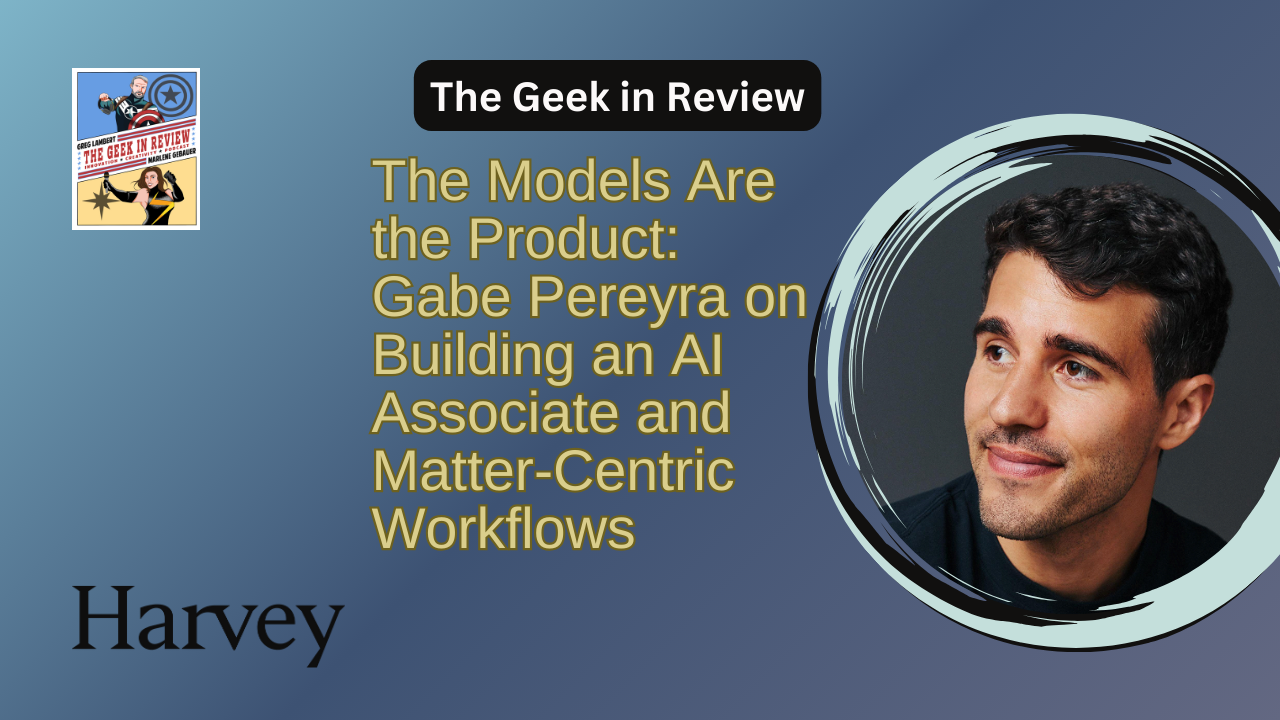
This week, we talk with Gabe Pereyra, President and co-founder at Harvey, about his path from DeepMind and Google Brain to launching Harvey with Winston Weinberg; how a roommate’s real-world legal workflows met early GPT-4 access and OpenAI backing; why legal emerged as the right domain for large models; and how personal ties to the profession plus a desire to tackle big societal problems shaped a mission to apply advanced AI where language and law intersect.

Gabe’s core thesis lands hard, “the models are the product.” Rather than narrow tools for single tasks, Harvey opted for a broad assistant approach. Lawyers live in text and email, so dialog becomes the control surface, an “AI associate” supporting partners and teams. Early demos showed useful output across many tasks, which reinforced a generalist design, then productized connections into Outlook and Word, plus a no-code Workflow Builder.

Go-to-market strategy flipped the usual script. Instead of starting small, Harvey partnered early with Allen & Overy and leaders like David Wakeling. Large firms supplied layered review, which reduced risk from model errors and increased learning velocity. From there the build list grew, security and data privacy, dedicated capacity, links to firm systems, case law, DMS, data rooms, and eDiscovery. A matter workspace sits at the center. Adoption rises with surface area, with daily activity approaching seventy percent where four or more product surfaces see regular use. ROI work now includes analysis of write-offs and specialized workflows co-built with firms and clients, for example Orrick, A&O, and PwC.

Talent, training, and experience value come next. Firms worry about job paths, and Gabe does not duck that concern. Models handle complex work, which raises anxiety, yet also shortens learning curves. Harvey collaborates on curricula using past deals, plus partnerships with law schools. Return on experience shows up in recruiting, PwC reports stronger appeal among early-career talent, and quality-of-life gains matter. On litigation use cases, chronology builders require firm expertise and guardrails, with evaluation methods that mirror how senior associates review junior output. Frequent use builds a mental model for where errors tend to appear.

Partnerships round out the strategy. Research content from LexisNexis and Wolters Kluwer, work product in iManage and NetDocuments, CLM workflows via Ironclad, with plans for data rooms, eDiscovery, and billing. Vision extends to a complete matter management service, emails, documents, prior work, evaluation, billing links, and strict ethical walls, all organized by client-matter. Global requirements drive multi-region storage and controls, including Australia’s residency rules. The forward look centers on differentiation through customization, firms encode expertise into models, workflows, and agents, then deliver outcomes faster and at software margins. “The value sits in your people,” Gabe says, and firms that convert know-how into systems will lead the pack.

Listen on mobile platforms:  ⁠⁠⁠⁠⁠⁠⁠⁠⁠⁠⁠⁠⁠⁠Apple Podcasts⁠⁠⁠⁠⁠⁠⁠⁠⁠⁠⁠⁠⁠⁠ |  ⁠⁠⁠⁠⁠⁠⁠⁠⁠⁠⁠⁠⁠⁠Spotify⁠⁠⁠⁠⁠⁠⁠⁠⁠⁠⁠⁠⁠⁠ | ⁠⁠⁠⁠⁠⁠⁠⁠⁠⁠⁠⁠⁠YouTube⁠⁠⁠⁠⁠⁠⁠⁠⁠⁠

[Special Thanks to Legal Technology Hub for their sponsoring this episode.]

⁠⁠⁠Email: geekinreviewpodcast@gmail.com
Music: ⁠⁠⁠⁠⁠⁠⁠⁠⁠⁠⁠⁠⁠⁠⁠⁠⁠Jerry David DeCicca⁠⁠⁠⁠⁠⁠⁠⁠⁠

Transcript

Continue Reading The Models Are the Product: Gabe Pereyra on Building an AI Associate and Matter-Centric Workflows

This week we sit down with Suzanne Konstance, Vice-President and General Manager for Legal and Regulatory US at Wolters Kluwer. She outlines how the company supports professionals in highly regulated fields with software and authoritative content. Operations span multiple countries with a deliberately local approach, where teams design solutions for each market. Listeners get a clear view of scope, from enterprise legal management to recent additions such as Brightflag, alongside deep subject expertise.

Konstance explains a core focus on regulatory compliance across securities, tax, IP, and employment. The aim is simple, help clients stay out of court. Continuous change drives editorial work, with authors and editors tracking shifts, executive orders, and practical effects. Provenance, version history, and context matter, supported by structured meta tagging which helps search and AI retrieve the right source every time.

In a segment on trust, the conversation moves to standards for accuracy and auditability. Clients tell Wolters Kluwer quality outranks speed for research, so the team emphasizes authoritative sources and transparent sourcing. Konstance walks through a recent non-exclusive content license with Harvey for primary law from US and German collections, part of a broader collaboration strategy which also includes VitalLaw AI and new cross-border features. The goal is a reliable workflow where answers cite sources, show currency, and fit real practice.

Real user labs reinforce these priorities. At AALL, librarians worked hands-on in a sandbox session with no guided prompts, pushing tools to limits and asking tough questions. One theme dominated, transparency, with live citations and source trails visible during use. Editors remain in the loop to curate likely questions, collect feedback, and refine outputs, while openness about progress helps teams separate market sizzle from dependable results.

Looking ahead, Konstance expects roles to shift toward managing agents and setting clear instructions, similar to supervising a room full of interns, with strong expertise still required for oversight. Teams will need to train newcomers on fundamentals, auditing, and controls, so technology serves professionals, not the reverse. She also shares sources she follows, industry conversations with customers, conferences, LinkedIn, X, plus guidance from a long-standing internal Center of Excellence for AI. For more on Wolters Kluwer initiatives, listeners can visit wolterskluwer.com and explore the Legal and Regulatory section along with the AI hub.

Also, check out Jerry David DeCicca and his new album, Cardiac Country.

Links:

Listen on mobile platforms:  ⁠⁠⁠⁠⁠⁠⁠⁠⁠⁠⁠⁠⁠⁠Apple Podcasts⁠⁠⁠⁠⁠⁠⁠⁠⁠⁠⁠⁠⁠⁠ |  ⁠⁠⁠⁠⁠⁠⁠⁠⁠⁠⁠⁠⁠⁠Spotify⁠⁠⁠⁠⁠⁠⁠⁠⁠⁠⁠⁠⁠⁠ | ⁠⁠⁠⁠⁠⁠⁠⁠⁠⁠⁠⁠⁠YouTube⁠⁠⁠⁠⁠⁠⁠⁠⁠⁠

[Special Thanks to Legal Technology Hub for their sponsoring this episode.]

Blue Sky: ⁠@geeklawblog.com⁠ ⁠@marlgeb⁠
⁠⁠⁠⁠⁠Email: geekinreviewpodcast@gmail.com
Music: ⁠⁠⁠⁠⁠⁠⁠⁠⁠⁠⁠⁠⁠⁠⁠⁠⁠Jerry David DeCicca⁠⁠⁠⁠⁠⁠⁠⁠⁠

Transcript:

Continue Reading Wolters Kluwer’s Suzanne Konstance on Trust, Compliance, and the Next Phase of Legal AI

In this week’s episode of The Geek in Review, Greg Lambert flies solo while co-host Marlene Gebauer enjoys some well-deserved relaxation. Greg welcomes Trevor Quick, Strategic Business Development lead at Harvey.ai, to discuss one of the most talked-about companies in legal tech today. With a staggering $300 million Series E funding round and a $5 billion valuation, Harvey is rewriting the narrative of what legal AI can be, as well as who it is for. Trevor, a longtime listener turned guest, brings an insider’s view of the company’s evolution and its ambitions for reshaping the legal services ecosystem.

Trevor provides behind-the-scenes insight into how Harvey has become such a magnet for both capital and attention. He attributes the rapid growth to the company’s structure—where legal expertise and AI engineering are in constant collaboration. From founder Winston Weinberg’s legal acumen to co-founder Gabe Pereyra’s technical leadership, Harvey’s DNA has always been rooted in practical use cases for lawyers. The company’s commitment to building with, not just for, the legal community has led to the development of a GTM team composed of practicing attorneys who work directly with law firms and corporate legal departments to customize AI solutions that align with real workflows.

One of the most talked-about moves is Harvey’s deepening partnership with LexisNexis. Trevor explains how integrating Lexis’s data directly into Harvey’s platform removes the friction lawyers face when juggling multiple research tools. With access to Shepard’s citations and native case law lookup, attorneys can now verify and trust the results Harvey generates—turning it from a generative assistant into a full-fledged research companion. This update not only boosts confidence but also meets the rigorous standards legal professionals demand, especially those skeptical of AI’s early stumbles.

The conversation also touches on Harvey’s new functionalities like the Workflow Builder, Vault document review enhancements, and Deep Research Mode. Trevor likens these innovations to “agentic” workflows that let users build custom solutions with low or no code. Whether it’s KM teams building tailored research processes, or attorneys streamlining diligence reviews, Harvey is giving legal professionals the ability to shape how AI works with them, not around them. Trevor emphasizes that Harvey’s success comes from its honesty, adaptability, and the trust it has earned by meeting lawyers where they are—not forcing them to change how they work overnight.

In closing, Greg asks Trevor to gaze into the crystal ball, and while Trevor jokingly admits that predicting the future in AI is a fool’s errand, he offers a vision rooted in intuition, collaboration, and democratized access to justice. From expanding into tax, compliance, and marketing workflows, to becoming a central hub for legal and adjacent industries, Harvey is on a path to not only augment what lawyers do, but to enhance how they feel about the work itself. With world-class partnerships and a relentless pace of innovation, Trevor makes a compelling case that Harvey isn’t just a tool—it might just be the toolbelt.

Listen on mobile platforms:  ⁠⁠⁠⁠⁠⁠⁠⁠⁠⁠⁠⁠⁠⁠Apple Podcasts⁠⁠⁠⁠⁠⁠⁠⁠⁠⁠⁠⁠⁠⁠ |  ⁠⁠⁠⁠⁠⁠⁠⁠⁠⁠⁠⁠⁠⁠Spotify⁠⁠⁠⁠⁠⁠⁠⁠⁠⁠⁠⁠⁠⁠ | ⁠⁠⁠⁠⁠⁠⁠⁠⁠⁠⁠⁠⁠YouTube⁠⁠⁠⁠⁠⁠⁠⁠⁠⁠

[Special Thanks to Legal Technology Hub for their sponsoring this episode.]

Blue Sky: ⁠@geeklawblog.com⁠ ⁠@marlgeb⁠
⁠⁠⁠⁠⁠Email: geekinreviewpodcast@gmail.com
Music: ⁠⁠⁠⁠⁠⁠⁠⁠⁠⁠⁠⁠⁠⁠⁠⁠⁠Jerry David DeCicca⁠⁠⁠⁠⁠⁠⁠⁠⁠

Transcript

Continue Reading Trevor Quick on Harvey.ai as the Utility Belt for Lawyers

[Note: Please welcome Laurent Wiesel, Principal at Justly Consulting. This article was originally published in LinkedIn. – GL]

Harvey AI bills its platform as providing a suite of products tailored to lawyers and law firms across all practice areas and workflows.

Harvey’s debut product video released on June 28, clocking in at 1:44, plays to a background of Mozart’s Piano Sonata No. 11 and no further audio. While light on explanation, the video introduces several features along with some interesting bells and whistles.

Harvey’s features, presented here in the order they appear in the left nav:

1. Client-Matter Number Integration

  • Critical feature for law firm operations
  • Helps enforce client policies and avoid data blending
  • Similar to established platforms like Lexis and Westlaw
  • Potential benefits for billing and ethical wall enforcement
  • Modal alert indicates ability to attach client-matter numbers to individual queries
Assistant feature with prompt loading and “save example”

2. Assistant

  • Offers chat and document Q&A capabilities
  • Currently provides single responses, no interactive chat yet
  • Prompt limit: 100,000 characters, which appears to reduce to 4,000 when even a single documents is added
  • Feature to save and load prompts, separated into Private, Team (collaboration), and Harvey (pre-built) varieties
  • Unexplained “Save Example” feature (briefly visible at the 0:18 mark)
  • Citations in assistant and research responses for quick verification

Continue Reading Let’s Breakdown Harvey.AI’s Video of Features (Guest Post)