The latest episode of The Geek in Review finds Greg Lambert and Marlene Gebauer back from Dallas with a sharp, grounded recap of the Texas Trailblazers conference, an event that stayed close to the daily realities of legal work instead of drifting into glossy predictions. Their conversation centers on a legal industry trying to sort out what AI means right now, in billing, workflow, training, pricing, governance, and client expectations. What stands out most is the hosts’ focus on the practical tension between what the tools are capable of and what law firms and legal departments are structurally ready to absorb.

A major thread in the discussion is the risk of what one speaker called “cognitive surrender,” the habit of trusting AI output too quickly and handing off too much human judgment in the process. Greg and Marlene treat this as less of a software issue and more of a workflow and education issue. The point is not whether AI produces polished work. The point is whether organizations are building systems where review, judgment, and accountability still sit with people. Their conversation ties this concern to legal practice, education, and even K-12 learning, showing how widespread the temptation has become to accept fluent output without enough friction or scrutiny.

The episode also takes a hard look at the pressure AI is putting on the billable hour. Marlene frames the issue well when she notes that AI does not kill the billable hour so much as expose its weaknesses. Across the conference, the hosts heard repeated concern about the mismatch between efficiency gains and the financial structures law firms still rely on. If AI reduces the time needed for many tasks, then firms, associates, pricing teams, and clients all have new incentives to sort through. Greg and Marlene highlight the awkward moment the industry is in, where firms want to talk about value while clients are also eyeing the chance to pay less for faster work. The result is a growing need for honest conversations about pricing, outcomes, and what legal value should mean when time is no longer the cleanest measure.

What gives the episode its energy is the number of concrete examples pulled from the conference. The hosts discuss lower-cost multi-state surveys, large-scale analysis of rights-of-way documents, and internal workflow improvements built with existing tools like SharePoint and Copilot on little or no budget. These stories show AI not as abstract promise, but as a way to get work done that used to be too expensive, too tedious, or too slow to tackle at all. At the same time, Greg and Marlene stay skeptical in the right places, especially when the conversation turns to legal research, citation accuracy, and the idea that technology vendors have somehow solved problems that law librarians and researchers know are stubbornly difficult.

By the end of the episode, the biggest takeaway is not that the legal industry has a clear answer, but that waiting for certainty is no longer a serious option. Greg and Marlene come away from Texas Trailblazers with a sense that real progress is happening through testing, discussion, and repeated adjustment, not through perfect plans. Their recap captures an industry in transition, one where law firms, legal ops teams, vendors, and clients are all feeling the strain between old business models and new technical possibilities. The message is simple and urgent: start the conversations now, use the tools now, and get honest about what must change before the gap between what is possible and what is workable gets even wider.

Listen on mobile platforms:  ⁠⁠⁠⁠⁠⁠⁠⁠⁠⁠⁠⁠⁠⁠Apple Podcasts⁠⁠⁠⁠⁠⁠⁠⁠⁠⁠⁠⁠⁠⁠ |  ⁠⁠⁠⁠⁠⁠⁠⁠⁠⁠⁠⁠⁠⁠Spotify⁠⁠⁠⁠⁠⁠⁠⁠⁠⁠⁠⁠⁠⁠ | ⁠⁠⁠⁠⁠⁠⁠⁠⁠⁠⁠⁠⁠YouTube⁠⁠⁠⁠⁠⁠⁠⁠⁠⁠ | Substack

[Special Thanks to Legal Technology Hub for their sponsoring this episode.]

⁠⁠⁠⁠⁠Email: geekinreviewpodcast@gmail.com
Music⁠⁠⁠⁠⁠⁠⁠⁠⁠⁠⁠⁠⁠⁠⁠⁠⁠Jerry David DeCicca⁠⁠⁠⁠⁠⁠⁠⁠⁠
Transcript:

Continue Reading Texas Trailblazers and the Hard Truth About AI in Legal Work

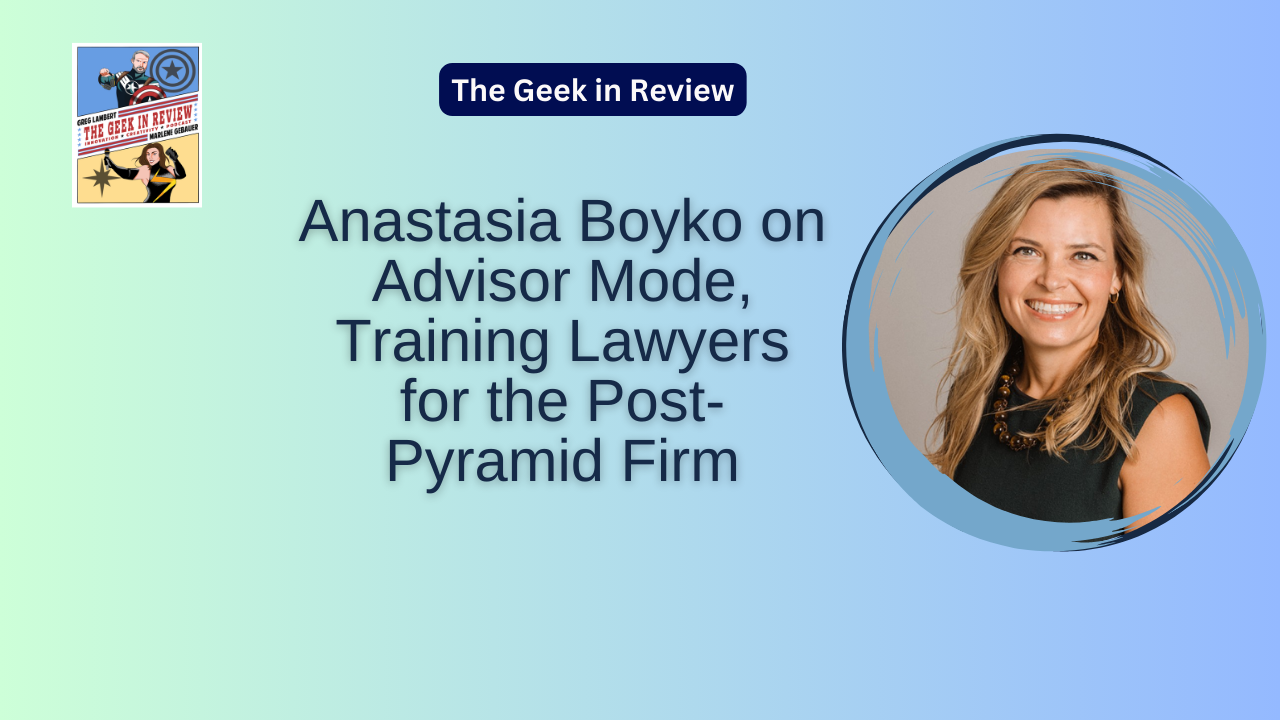
Anastasia Boyko joins us this week for a wide-angle conversation about AI adoption, leadership, and the uncomfortable truth behind “we are watching what peer firms do.” A Yale-trained tax lawyer with experience spanning Axiom, legal education, and innovation leadership, Boyko argues that precedent-driven instincts are turning into a liability when the underlying rules of the market are shifting in real time.

The episode opens with lessons from the Women + AI 2.0 Summit at Vanderbilt and the “AI competence penalty” narrative. Boyko’s central principle for law firm leaders is simple, stop copying the competition and start operating with intention. Strategic planning matters more than tool shopping, especially when uncertainty makes leaders freeze, over-index on fear, or chase noise instead of outcomes.

From there, the conversation sharpens into client reality. Boyko shares what she is hearing from in-house leaders, and it is not comforting for firms. Legal departments are working to reduce dependence on outside counsel, business partners inside companies often accept “good enough,” and the models keep improving. The risk is not losing to a peer firm; it is losing the client relationship because the work stops feeling necessary.

A major theme is talent and the apprenticeship gap. Boyko argues firms underinvest in people, even as they spend aggressively on software stacks. AI can help junior lawyers with coaching and confidence, but it does not replace mentorship, judgment-building, or context. The skills that matter now include client advisory, operational thinking, critical judgment, and the ability to solve problems across a complex system, not only perform discrete tasks in a vacuum.

The episode closes on legal education and the future value of the JD. Boyko urges students to be selfish about learning AI, especially when faculty guidance comes from avoidance or philosophy rather than experimentation. Looking ahead, she predicts the JD’s value shifts upward, away from rote production and toward proactive advisory work, relationships, anticipatory counsel, and wisdom-driven judgment. In other words, fewer fire drills, more looking around corners.

Links:

Listen on mobile platforms:  ⁠⁠⁠⁠⁠⁠⁠⁠⁠⁠⁠⁠⁠⁠Apple Podcasts⁠⁠⁠⁠⁠⁠⁠⁠⁠⁠⁠⁠⁠⁠ |  ⁠⁠⁠⁠⁠⁠⁠⁠⁠⁠⁠⁠⁠⁠Spotify⁠⁠⁠⁠⁠⁠⁠⁠⁠⁠⁠⁠⁠⁠ | ⁠⁠⁠⁠⁠⁠⁠⁠⁠⁠⁠⁠⁠YouTube⁠⁠⁠⁠⁠⁠⁠⁠⁠⁠ | Substack

[Special Thanks to Legal Technology Hub for their sponsoring this episode.]

⁠⁠⁠⁠⁠Email: geekinreviewpodcast@gmail.com
Music⁠⁠⁠⁠⁠⁠⁠⁠⁠⁠⁠⁠⁠⁠⁠⁠⁠Jerry David DeCicca⁠⁠⁠⁠⁠⁠⁠⁠⁠

Transcript:

Continue Reading Anastasia Boyko on Advisor Mode, Training Lawyers for the Post-Pyramid Firm