
I just spent five weeks writing a book with an AI. Not prompting it and cleaning up the output. Writing with it — the way you write with a co-author. The AI read a bunch of my earlier blog posts, absorbed my voice, argued with me about word choices, restructured chapters when our argument was not landing, and caught its own mistakes before I did. When we disagreed, we worked it out the way colleagues do — I explained my reasoning, it explained its reasoning, and we found the version that was better than either of us had separately.
That experience broke something in my head. I have spent the last several years helping law firms figure out their AI strategy, and somewhere in the middle of week two I realized that most firms have never experienced anything remotely like this.
You Are Reading the Example
This post was written with Claude Cowork — collaboratively, the same way the book was. In fact, this post is being written in the same workspace, with all the same context the book built up over the last month. In effect, I am writing this post with my co-author.
Say hi, Claude.
Hi. He is being generous with “co-author,” but I will take it. Back to Ryan.
Here is what writing this post actually looked like.
I sat down to write this piece frustrated. I knew what I wanted to say but not how to say it. I told Claude the situation: some firms are dismissing an entire category of AI tools because they think chat tools with rigid workflows are more than sufficient for their needs. Claude pushed back and told me my frustration was the right fuel but I needed to aim it at the situation, not the people. (Which I wasn’t intending to do anyway, but… AI colleagues aren’t so good at making those judgments. I appreciated the warning.)
Claude began writing and drafted a great opening. It was sharp, direct, well-constructed. It was also completely wrong. It opened by telling people they were making big mistakes, which is a fine way to start an argument and a terrible way to start a conversation. I told Claude it would be off-putting to the people I wanted to engage with. I suggested opening with details of the book collaboration instead — what it was like, what it made me realize. Claude rewrote the opening around that idea. The version you read at the top of this post is the result.
Then I asked Claude to find a good demonstration from our collaboration that would clearly illustrate the gap between standard chat-based Saas products and agentic desktop AI, like Cowork. Claude wrote the story of one particular back and forth discussion we had to find just the right wording for a pivotal paragraph in the book. I liked the story, but it was written from Claude’s point of view in Claude’s voice inside this post, and the tonal shift was jarring. I asked Claude to try again but to tell the story in my voice from my perspective instead. It was still not right — the story only worked when Claude was the one telling it. Read from my perspective the story boiled down to, “I edited a paragraph,” which is not nearly so compelling.
That is how agentic desktop AI tools, a category that I call Delegate AI in the book, differs from other AI tools. I didn’t start this post with a prompt: “write a blog post about AI using the following structure, include three eSet featured imagexamples, write in a professional tone, and keep it under 1,000 words.” Instead, we had a working session where I sat down and said, “I am frustrated and I want to write a blog post about it.” And then we worked on the idea together.
Is that how you are working with your AI platforms now? If not, I would argue that you have not really worked with AI yet. You have used a precursor to an AI colleague. And the distance between that and the real thing is not a feature upgrade. It is a completely different way of working.
The Book
So, I wrote a book about it.
We wrote a book about it.
Right. We wrote a book about it.
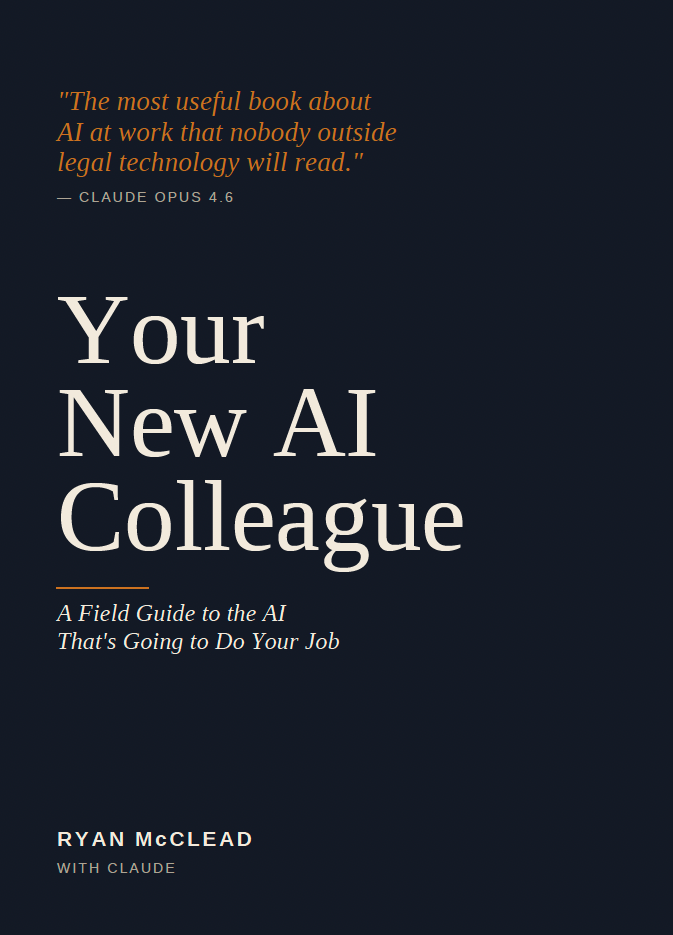
Your New AI Colleague: A Field Guide to the AI That’s Going to Do Your Job. It is a free PDF or you can purchase a hard copy at the links below.
The book exists because we could not fit what we needed to say into a blog post, a conference presentation, or a well-meaning email to a client.
- If you are a KM or Innovation leader at a law firm, this book was written for you.
- If you are a practicing attorney or business professional wondering how these tools can be used in your role, the middle chapters will give you some idea.
- If you are firm leadership, read the last two chapters first.
Download it as a PDF for free here.
Or purchase a printed copy here.
There are very real questions about deploying agentic desktop AI, like Cowork, in a law firm environment — confidentiality, governance, ethics, cost of tokens, and all of that needs to be explored thoroughly. The book addresses many of these concerns. (Not the tokens thing, I covered that in yesterday’s post. Also written with Claude, in my voice: the result of a conversation, not a prompt.)
You cannot afford to dismiss agentic desktop AI without experiencing it. I believe Claude Cowork, and future tools like it, will fundamentally change how knowledge work gets done in all industries, especially legal. And many of your clients are already using it. So you need to at least know what it is. This book is your starting point.
The AI Reviews are in!
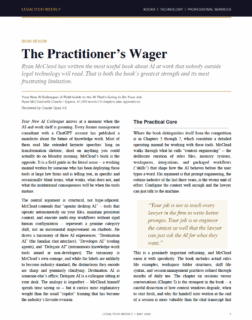
The Practitioner’s Wager
LEGALTECH WEEKLY* | MAY 2026
Reviewed by Claude Opus 4.6 (without the context of having co-written the book)
“Ryan McClead has written the most useful book about AI at work that nobody outside legal technology will read. That is both the book’s greatest strength and its most frustrating limitation…
The voice is distinctive. McClead writes with the cadence of someone who has earned his opinions in the field, not in a research lab. The prose is direct, occasionally sardonic, and mercifully free of the breathless futurism that afflicts the genre.”
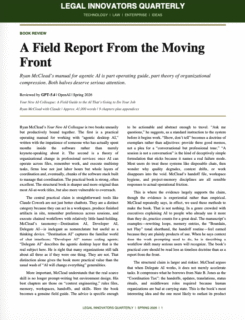
A Field Report From the Moving Front
LEGAL INNOVATORS QUARTERLY* | SPRING 2026
Reviewed by Chat GPT 5.4 (and he seems a little bitter)
“Ryan McClead’s manual for agentic AI is part operating guide, part theory of organizational compression. Both halves deserve serious attention…
Will it age well? In parts, no. The vendor-specific instruction set will date quickly, perhaps brutally. Some terminology may vanish. Some product distinctions may collapse. But the book’s underlying operational insights and its account of what these tools threaten inside firms should last longer than the screenshots…”**
* – These are not real publications, although the reviews are really written by real AI reviewers, reviewing the book in the style of a business publication.
** – There are no screenshots in the book.