Bloomberg Law Litigation Survey – FAX (Yes, FAX) In Who You Think Will Prevail!!
I received an interesting email this morning from Bloomberg asking me to participate in their “Bloomberg Law Litigation Survey.” Seems that Bloomberg is wanting to query its Bloomberg Law customers on their opinions of current litigation issues and see who we think will prevail. I thought I was super-special, until Toby told me that he got the same survey.
This is a very, very interesting idea. I’m not sure if there is a place for those not using Bloomberg to sign up for these surveys, but maybe one of the Bloomberg Survey Gurus could let us know.
Here is a sample of one of the survey questions:
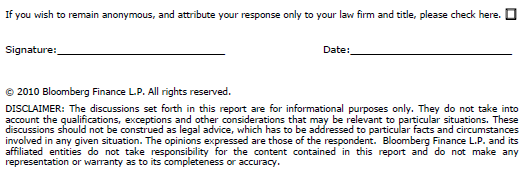
Again, I thought this is actually a pretty good use of Bloomberg’s customer base, and a way to basically crowdsource some information from them and determine if the crowd’s answer matches the eventual outcome of the litigation. However, one of the big failures of this survey is the format. First of all, you have to open the PDF file and read the survey. If you want to answer the survey, you have to print it out and fill out the form. Then, perhaps the biggest problem in my opinion, you have to FAX the survey (two-pages, mind you) back to Bloomberg. What is this?? 1991?? Here’s a snapshot of the “legal” language of the survey where you have to actually take out a pen and check the box, sign your name and date the form:
So, Bloomberg gets an “A” for idea, but a “F” for execution on this one.
Here’s my suggestion to Bloomberg to raise that “F” up to at least a “C”. Use a web-survey tool! Heck, have Mike go out and buy a web-survey company… he can afford it. With a survey tool, you make it easy for someone like me to answer your survey in about a minute or two. The tool should already have my personal information build into its database, so I won’t have to fill out those personal sections of the survey. Basically, I open up the page, check the box, click submit, and then back to work. If you make it easier on your users, you’ll definitely get a higher percentage to answer your survey. Make it look good (and maybe enter me in a chance to win one of those new iPads), then I may even bump that “C” up to an “A-“.
15 of the 60 TECHSHOW Sites
But What Makes a Law Library Great?
The Law Librarian Blog’s (LLB) Joe Hodnicki pointed out the newest National Jurist’s academic law library ranking and what a colossal waste of time it was for everyone involved. Joe warned his readers that it wasn’t even worth browsing the results because the way the schools were scored were out of whack with what really makes a library great. Currently, National Jurist uses the following scoring methodology to determine “who’s got the best law library.”
Using data gathered by the ABA:
50% = Number of volumes and unique titles
20% = Ratio of library study seating to enrollment
15% = Ratio of full-time professional librarians to enrollment
15% = Number of hours open per week
I haven’t been an academic law librarian in over ten years, but I’m a little disturbed by the definition that the National Jurist used to describe what makes a great law library:
“What makes a good law library in the 21st century includes a variety of factors: comfort, accessibility, convenience and most of all, availability of the latest technology tools.”
This definition is mentioned, not once, but twice in the article. I’m thinking this describes what makes a Barnes & Noble good, not a law library. I understand that this is a survey of how National Jurist thinks that law students like their libraries to look and feel, but do we really want a definition of a ‘good library’ that doesn’t include any mention of ability to retrieve relevant legal materials in an expedient manner? Call me old fashioned, but I thought the main objective of a law library was to point its users to the best resources to answer their legal research needs. I could care less if there are twice as many seats available for me to sit in than there are students enrolled at the school. I’d rather have access to legal databases over access to an onsite Starbucks.
When I go into a law library, there are five things I’m looking for:
- Legal materials (be they print or electronic) that I can access easily and quickly
- Reference librarians that can assist me in my search for resources I cannot find on my own
- For items that are not available within the law library, I want the law librarians to tell me where I can locate it (either by driving to another local library, or through an Interlibrary Loan)
- A chair and table to sit down and read (basic wood works fine for me)
- A copy machine or copy shop that takes a credit card and gives me a receipt
Oh, Angry @hklawtwits, Where Have You Gone?
While cleaning up my twitter account this week, it dawned on my that something has been missing from my daily stream of twitter information… that nasty twittergiest, @hklawtwits that was constantly telling me how bad the law firm of Holland & Knight was. The last tweet was posted back on November 29, 2009, and quite frankly wasn’t @hklawtwits best work at all.
I mentioned this twitter account last summer (along with the previous @hklaw account that was doing the same bad mouthing tactics. Could it be that this angry person just burned out on all that hatred they had built up against what I’m assuming was their former firm? Has he or she just taken a hiatus? Or… Oh no… could it be that @hklawtwits actually got a job??? This last scenario is the one that seems most believable. It’s amazing how gainful employment can keep angry people occupied.
I’ll keep a special place in my twitter heart for @hklaw and @hklawtwit and their super-sized anger tweets against Holland & Knight. We can only hope that someday they are fired from their current law firm and can refocus all that anger toward someone new. Until then, I guess I need to seek out some other angry twitter’ers out there in the vast twitterverse.
Open Letter to "New Lexis.com" – Learn from WestlawNext Mistakes
Fastcase Missing 1000's of Citations? Responses Fly…
Interesting discussion going on over at Law Office Management Assistance Program (LOMAP) today regarding low-cost legal research providers Fastcase and Casemaker. Casemaker lays out a claim that Fastcase is chock full of missing case citations, and even gives out a list of the first 50 cases missing a correct citation (A.3d, P.3d, ect.) from all 50 states. This would mean that if you searched by citation in Fastcase, these cites would not show up at all (even if the actual cases were in the database.) It also means when you cross-check cases using Fastcase’s citation system, those cases would be missing from the results as well. Casemaker claims to have a list of over 100,000 missing citations from Fastcase.
Ed Walters responded that he could probably show as many errors in Casemaker’s database and that Fastcase is better than Casemaker because Bob Ambrogi said so in his review, and Oregon switched from Casemaker to Fastcase. Steve Newsom from Casemaker counted that Ambrogi’s review was not a deep dive and focused on user interaction and not quality of the information contained within the databases. As many of you remember, I actually picked Casemaker over Fastcase (and even Loislaw) as far as having the most case law content. The fact that Casemaker also has a group of former Michie Company editors on staff to oversee operations is a big plus in my book as well.
The part I like the most was that Newsom offered Walters the entire list of 100,000 missing citations if he could show that Casemaker was missing as many citations as Fastcase is missing. It will be interesting to see if Fastcase scrambles to clean up these errors.
Here’s the claim (Casemaker), response (Fastcase), and counter-response (Casemaker).
Casemaker Claim
“How Far Back in Your State to Miss 50 Case Citations?
‘How many years back do you have to go in your state case law to find 50 missing case citations?’ After seeing the legal research map posted on 3 Geeks, some analysis was made to do a more complete comparison of the various services. A comparison between Casemaker and Fastcase turned up a large number of missing case citations in the Fastcase system. At first, this appeared to be a hit-or-miss, minor quality control sort of issue. Then it became apparent that this was a much bigger issue. It became a very time-consuming comparison between the two providers in order to see how many years you would need to go back before the number of missing case citations hit 50. In the Casemaker 2.2 database there were found very few incorrect citation postings and, in a rare exception, a duplicated case. In Fastcase, there were a host of missing citations and duplicated cases; it became most alarming.
Casemaker has created a state-by-state comparison for 50 missing citations by state, and also says that they had identified over 100,000 missing citations within the Fastcase database between the years 2000 to 2009. Casemaker has declined to provide the complete lists for each state, saying that the complete list would be very valuable to Fastcase. Casemaker was initially going to provide 100 missing citations per state, but pulled back to 50, noting that, once the information is made public, Fastcase will quickly correct the liabilities in their database. Casemaker did state that under a limited nondisclosure agreement, they would provide the next missing 50 and each week following an additional 50 missing cases for the time period 2000 to 2009. Imagine if this analysis covered the longevity of the entire database (100+ plus years), instead of just the 10 years?
Casemaker and Fastcase are not a mirrored database, and there are clear and vast quality differences when choosing between the two providers.”
Fastcase Response
“Fastcase and Casemaker are both very good services, as Bob Ambrogi has pointed out in an independent, third-party review in Law Technology News. Both have traditionally updated pagination first from regional reporters (such as P.3d) and added parallel citations where necessary from state reporters. It’s an ongoing process for both services, and a process that is nearly complete for both — although the scope of the process is radically overstated by the above paragraphs from Casemaker.
It would be easy for us to derive the same list of missing citations for Casemaker, tit-for-tat. The errors and omissions in that service are legion. But we won’t. Picking their service apart would bepetty, and would demean us both, as well as the bar associations that we both work with. We won’t do it.
Instead, we will let the results speak for themselves. Bar association after bar association that compares both services — including thorough data quality comparisons — selects Fastcase as its partner. This recently has included the Oregon State Bar, which switched from Casemaker to Fastcase after an exhaustive evaluation – and they are thrilled with the change. No bar association has ever switched from Fastcase to Casemaker.
Instead of relying on Casemaker’s evaluation of both services (or even Bob Ambrogi’s), we invite state bar associations to conduct their own, independent evaluation. When they do, we’re confident they will conclude that both are valuable services — and then select Fastcase as their partner.”
Casemaker Counter-Response
“The devil is always in the detail and we too recognize that there are two rather good but distinctly different research providers.LegalGeekery says, in a blog post on the FastCase iPhone app, that “Fastcase keeps subscription costs low by not hiring researchers to write summaries or manually cite check.” Casemaker invests heavily in quality review of case law and cites and has recently moved its headquarters to Charlottesville, Virginia to take advantage of the quality talents of employees and attorneys from the past Michie/Lexis Company. Fastcase’s Ed Walters mentions tit-for-tat and I so challenge Ed that if he can come up with 100 missing citations within Casemaker for the same time period and scope of coverage, I will give him his missing citation list of over 100,000 so that he can correct the errors in Fastcase. A note on Bob Ambrogi’s article of 8 months ago, which recognizes intuitiveness of the products and in which Bob later states that he did not do a deep dive into the content . . . we believe content dependability and integrity is first and foremost and this will remain our focus as a company.
We agree that bar associations should check for themselves and under a non-disclosure agreement, I am glad to provide the full missing list of Fastcase content for their evaluation. Ed asked the question “How is this evaluation/discussion productive?” My response is that it makes a value statement on the two services . . . Casemaker provides our clients with a high-quality product and traditionally at a higher cost than Fastcase. But make no doubt about it, the content quality and completeness is nowhere equaled.
We welcome competition for it will make both of our companies better . . .
Casemaker added statutes and codes . . . Fastcase followed;
Casemaker added customer support personnel and live training . . . Fastcase followed;
Fastcase added a mobile application for iPhone . . . this time Casemaker followed with a full mobile app for all devices and all data fields;
Casemaker has added quality review staff and editorial services . . . Will Fastcase follow?
Warmest regards to a good friend and competitor, Ed . . . You do make us better, but we are not the same.”
The SearchBoxer Rebellion – Is Google vs. China the New War of the 21st Century?
It seems that the first ‘virtual shots’ have been fired in what might become the first big Internet War of the 21st Century. According to reports from The Guardian this morning, it seems that Google has been hacked, presumably from the Chinese Government, and the bios of Google executives have been converted to Chinese. Many of you may be thinking that this is kind of funny, or at least not very surprising given the fact that Google redirected its search engine away from the highly censored .CN version to the uncensored version in Hong Kong earlier this week. But for information professionals, this type of action by a Government against a corporation should sent some shivers up your spine.
There has been a saying in business for a number of years now – “The Network IS Your Business”. And for information professionals, “The Internet IS Your Business”. We’ve become very comfortable in abandoning local collections in favor of having them hosted remotely. When access is cut off from the information, then work tends to come to a stoppage. Think of the times that the Outlook Exchange Server went down and you found yourself and others roaming the hallways aimlessly until email was restored.
The uninterrupted access of information has become a core business process. Many of us have Disaster Recovery (DR) plans that address issues of natural disasters (hurricanes, tornadoes, fire, etc.), but almost all of those are based on the assumption that the events will be localized and can be rolled over to other locations. Now we have to worry about the potential for state sponsored cyber terrorism and assume that the information that we’ve become accustomed to accessing on-demand, may not be there. Just think, Google probably knew this attack was coming and couldn’t stop it. Just one more issue for all of you on DR teams need to add to your plan. Good Luck!!
Are Law Librarians Too Introverted?
Okay… stop laughing at the title. There is a perception of law librarians as being too quite and sitting behind a reference desk waiting on someone to come us and ask a question that they can answer. But, if you go to an SLA or AALL meeting, you’ll see a different side of law librarianship. Librarians discussing the hot topics of the day ranging from vendor relationships to workplace rights and even social issues. I’ve enjoyed sitting at round table discussions where law librarians have heated conversations about how they need to address the issues of staffing reductions, budget cuts, all while having to handle increased demands for the services they provide to their firms, courts, faculty or public users. However, one firm director I know mentioned to me that law librarians tend to be preaching to the choir, but not doing much preaching to anyone else. Her suggestion was that those in management positions in law libraries need to expand their professional circles and join at least one other, non-librarian, association in order to have an audience that they need to be preaching to.
One of the organizations that she suggested was the Association of Legal Administrators, but there are numerous organizations out there that would help expand your professional circles. One determining factor may be to look at the professional organizations that your administrative leadership belongs to. I happen to like ILTA because I know it is an organization that many of my fellow managers and directors belong to. Attending these meetings, even if it is just on the local level, exposes me to other leaders in my organization, as well as peers in other firms that I would never see at a law library meeting. There are probably dozens of other non-librarian associations that are out there that would help you expand your professional circle (feel free to add some suggestions in the comments if you have any favorites to share.) One suggestion is to ask around at your organization to see if your organization has a blanket membership to professional organization (like mine does for ILTA… remember I’m cheap, so a free membership is something I’ll take advantage of every time!!)
These associations are in addition to your current librarian associations. For those of you that don’t belong to any associations, or don’t contribute to the conversation of your current association… shame on you. Remember, if you’re not involved in the conversation of the direction your profession is heading, then you can’t complain when others make those decisions for you.
Comparing State Bar Vendor vs. Vendor with Most Coverage
I thought I’d do a follow up to last week’s post where I crowned Casemaker as the “King of State Case Law Coverage.” There are two reasons behind the follow-up. First, Nina Platt brought up an assumption that many people might have about state case law coverage and the idea that the vendor selected by the state’s bar association should have the most coverage. Although you would think that would be the case, it actually turns out not to be so. The second reason for the follow-up is that I just like playing with the maps feature in IBM’s Many Eyes program.
The first map is a listing of the main low-cost legal research providers and which one covers the most case law for each state. The second map is a replay of the map we did a couple weeks ago on who is the official vendor for the bar association. Since Casemaker and Fastcase are really the only big players in providing their resource through the state bar associations, a third map was created that did a head-to-head comparison of coverage between the two.