Brian Harley, LLM at Columbia, is writing an interesting multi-part article entitled “Semantic Lawyering: How the Semantic Web Will Transform the Practice of Law“, where he discusses the potential to use advanced and emerging technology to analyze information in order to create “smarter information” that assists lawyers in how they conduct legal research and thusly how they practice law.

The idea of using the concept of Semantic Web technology (which Harley defines as “a way of making data smart”) isn’t new, even in the legal field.  However, with the massive amount of information that exists, combined with the additional information that is created over time, many believe that there needs to be an automated method that makes the information more understandable by “computers” and in return, makes relevant information easier to find by the “human.”

Semantic Web technologies are already being looked at by companies such as New York Times, recovery.gov, BBC, and Thomson Reuters. Harley attempts to take us in the future of how legal information is created, stored, tagged, queried, analyzed and formalized into a ‘set of machine-readable rules’.  Harley even ponders that in such a future “would we even need lawyers and judges, or could they be replaced with computers and Semantic engineers of the law?”  Since practicing law is more of an art than a science, the Semantic Web may not replace those lawyers and judges, but it might make them much better at practicing their craft.

Although Harley’s article begins with Richard Susskind’s quote of “predicting the future is a hazardous business”, it is interesting to read a practical application of how the Semantic Web might affect the practice of law. I look forward to seeing part four of Harley’s vision of the future.

Semantic Lawyering: How the Semantic Web Will Transform the Practice of Law:
Part 1 – The problem: too much data
Part 2 – What is the Semantic Web?
Part 3 – A Machine Readable Version of the Law?
Part 4 – Smart documents and semantic contracts (coming soon)

I started bouncing an idea around in my head this weekend while all of the Sunday Morning news shows were discussing Justice Stevens’ retirement. “If I had to replace Justice Stevens with a law librarian… who would I pick?” Now, you may chuckle about the idea of having a law librarian as Supreme Court Justice, but it may not be that far of a stretch to think of someone with the skills of a law librarian to put on the black robes and write judicial opinions.  In October of 2008, US News and World Report said that the “Best Nonpolitical Job” for a political junkie was a librarian. The US Supreme Court is supposed to rise above the fray of politics, so who better to do that than a law librarian?

If I weren’t limited by the fact that serving on the Court requires you to be alive, my choices would have immediately gone to two personal legends in the field;  Roy Mersky (1925-2008) of the University of Texas or Bob Oakley (1945-2007) of Georgetown University.  Both were known as “giants” in the field of law librarianship and deeply respected for their leadership.  Although I’d only met Roy Mersky a few times, it was clear that he commanded whatever room he was in.  I had the pleasure of serving with Bob Oakley on the American Association of Law Libraries’ (AALL) Future of Law Libraries in the Digital Age special committee, where Bob made sure that all of the committee members stayed on task. However, since Merksy and Oakley are no longer around, who are the giants of the law library field that we could nominate today?

We could look at the list of past presidents from AALL for names of leaders within the field.  Cornell’s Claire Germain (2005-2006) jumped off the list as someone that commands a room like a Roy Mersky.  Claire would most likely make a great Justice, but her French accent may not play well on some of those cable news networks. Another great choice might be Barbara Bintliff (2001-2002) who was just announced as the new law library director for the University of Texas.  I’m not sure if Barbara is willing to give up a great position in the capital of Texas to take up one in Washington, DC at this moment.  How about someone like Mark Estes (1992-1993) from the Alameda County law library?  Mark and I have made some appearances lately on Rich Leiter’s Law Librarian Conversation podcasts, so I hope I haven’t diminished his chances for nomination.

How about someone that is not on the AALL past president’s list?  There are a few names out there that always seem to be discussed in law librarian circles.  Jim Milles from the University of Buffalo would be a good choice.  Although, anyone that knows Jim might think that his trail of blog posts might make him a target of some within the Senate confirmation hearings.  Tom Bruce of Cornell’s Legal Information Institute (LII), might be another law librarian to consider (note: although, not officially a law librarian, his work with LII earns him an honorary title).  Tom’s work with LII, and his current affiliation with Carl Malamud’s LAW.gov effort might also make for some interesting Senate hearing discussions.

With the exception of Mark Estes, it seems that the picks for law librarians to replace Justice Stevens have an academic bias. So, let’s pick a couple of names from law firms.  There’s Bob Oaks from Latham and Watkins.  That would be an easy choice since he’s already right there in Washington, DC.  There’s also the famous “Al of Cleveland” Podboy from Baker Hostetler.  However, I just don’t think that Al Podboy would want to give up the comforts of Cleveland and move to Washington.  My personal favorite in the law firm category would be Steven Lastres of Debevoise and Plimpton.  Anyone that can master libraries, knowledge management, and records management (and I’m sure a few more departments on top of those) should be able to step right in to the Court without blinking an eye.

[Note:  It was pointed out to me that I did not list any women law firm librarians on this list despite the fact that probably 80% or more of the AmLaw 100 library directors are women.  I apologize, for there are a number of qualified women that make the list with Jean O’Grady from DLA Piper being one, and Gitelle Seer from Dewey & LeBoeuf being another of a long list.]

I’m sure there are a number of well qualified law librarians I missed on my very short list of potential replacements for Justice Stevens.  So, if I missed your name, or someone that you would like to see nominated for the high court, chime in below.

Texas resident Karen McPeters has brought a class action lawsuit against Montgomery County Judge Fredrick E. Edwards, Montgomery County Court Clerk Barbara Gladden Adamick, and LexisNexis claiming that requiring her to exclusively file documents through LexisNexis’ FileandServe product is a violation of US and Texas laws, and that the county and LexisNexis are engaged in RICO violations with their exclusive agreement.  McPeters, through her San Antonio attorney, Robert L. Mays, Jr., has filed the class action suit in the US District Court Southern District of Texas in Houston (Civil Action No. 4:10-CV-1103).

McPeters’ claim states that Court Clerk Adamick requires all of Judge Edwards civil cases to go through LexisNexis FileandServe, and will stamp any documents filed directly with the Court Clerks office with a “VOID” stamp and return the documents unfiled.  In her complaint, McPeters states that Adamick is relying upon an unsigned order from Judge Edwards from February 10, 2003, and there “is no standing order, signed by all of the District Judges in Montgomery County, establishing e-filing requirements for one, or more, of the courts of Montgomery County.”  According to the 2003 Judge Edwards order, only civil litigants are required to file through FileandServe and that criminal defendants are not required to use FileandServe.  Judge Edwards also excluded the following from the same requirement:

  • The State of Texas
  • Child Protective Services
  • Adoption Agencies, and
  • New divorce and annulment cases that are resolved within 90 days.
McPeters claims that the agreement between the courts and LexisNexis is a RICO violation through what she calls the “Plan” between the court and LexisNexis that requires her and other litigants “to pay filing fees, service charges and taxes that are no authorized by statute, and that exceed the amounts required by statute.” She believes that the “Plan” also financially benefits the county and that Judge Edwards and Court Clerk Adamick have gone beyond their official powers to require electronic filing and refusing to accept or file any documents presented directly to the Court Clerk’s office.  
The claim goes on to add that the exclusive agreement violates McPeters’ and other litigants’ due process rights, equal protection under the US Constitution as well as the open courts and due course of law rights under the Texas Constitution.  McPeters is seeking exemplary damages and wants the County enjoined from requiring that the court documents be filed exclusively through FileandServe.
It is always interesting when courts get into these agreements with private vendors where the court gives the vendor the exclusive rights to something like electronic filing. Yes, it does make things convenient for many of us who file regularly with the court, but what is convenient for some may not be for all litigants.  Requiring someone to only use a private vendor to file court documents, while at the same time refusing to accept the physical documents through the Court Clerk’s office seems like one of those situations where a Draconian Rule overrode common sense. It will be interesting to see how this suit takes shape over the next few months and what affect it will have over other courts that have exclusive contracts with vendors for e-filing, and if they can force everyone to use (and pay) that vendor while the court clerk refuses to accept any documents filed directly with his or her office. 
Thoughts??

“The days of sitting in our rooms as marketers — defining our message — pushing it out there — are over.  Now your brand is the sum conversations about it….  This changes entirely the rules of engagement.” — Marcel Lebrun, Radian6 CEO 

While going over a Fulbright Forum PDF Presentation called “MySpace Is Everyone’s Space“, I saw a mention of Radian6, which was defined as a “platform to help companies listen to the social web to know what is being said about [their] company.”  I jumped over to Radian6 website and started looking around (and watching videos) to see what they, and their motto of “The Engaged Brand” were all about.

Radian6 makes its money through a social web monitoring software with their pricing starting “at $500 per month, per profile for up to 10,000 new monthly results… and $100 per month, per user ID.”  There is a great write-up on Radian6 and their new console over at TechCrunch— pay particular attention to the comments after the review and notice how Radian6’s customers rave about the product.  Even if you’re not interested in the software, there is tons of information resources available at Radian6’s website.  If you scroll down to the bottom of the Radian6 home page, there is a list of resources that would help those trying to understand the social media impact on their business… all the way up to Case Studies of how companies like Pepsi, UPS, and even Cirque du Soleil are monitoring, listening and engaging in the ‘sum conversations’ about their brand.  So, even if you’re not ready to plunk down the cash for the Radian6 product, there is still a lot that they are offering to help educate a marketer understand, plan, engage, and evaluate how the company brand is being discussed in the social network community.

One example that I liked was the PDF presentation called “The Why and How of Social Media Participation” where they laid out the reasons that social media participation matters and the need to have a plan for building a listening strategy and engaging the social community.  I especially enjoyed the section on building awareness of who your company is, and what you do.  On the social web, the factors that help build that lasting awareness are:

  • Relevance: How what you’re doing aligns with what someone needs or is interested in
  • Context: Whether you’re present and engaged when and where your audience needs you to be
  • Resonance: How much your presence and solution endures and stays relevant over time
  • Accessibility: How well you provide your community access to the people behind your brand
No longer will the “one-size-fits-all marketing” approach work.  With the social web there is an expectation of “a more shared, human approach.” 

For a marketer, or anyone that is looking for information on how to get started in social media, monitor social media, or show others the importance of engaging in social media, then I suggest going to Radian6’s website… scroll down to the bottom of the screen, and read the case studies, presentations, white papers, and blogs that are Radian6 has put out there for you.  You’ll learn a lot, even if you don’t spend a penny.

After watching the latest TED Talk by Derek Sivers on “how movements really get started“, I recalled how I understood how to leverage Twitter. Derek talks about how movements start not with a leader but with its first follower. For what is a leader but a nut case until he is followed?

As you might remember, I am a big fan of Ashton Kutchner. I think he is completely under-estimated as a marketer. In fact, I think that is probably his biggest strength: he is willing to act a fool in order to laugh all the way to the bank.

When I first started on Twitter, I watched him and Demi interact with each other. And I realized something: they had a tacit agreement to retweet each other’s tweets. Of course, we all know that when you retweet something your exponentially exposing someone else’s work to your followers. But what if you had an agreement between three people to retweet each other’s tweets?

Yeah, you got it. When 3 gee–errr–people retweet each other’s tweets, it just takes off like a whirlwind.

Just one more reason to encourage companies to embrace social media–the whole is oh so much more than the sum of its parts.

I am happy just be a lowly follower … 😉

My good friend, Mark Gediman told me many times that he designs his competitive intelligence (CI) reports like a children’s book.  A big picture… and a little bit of text.  It seems that attorneys have about the attention span of a child when it comes to reading CI reports, so this makes perfect sense to me.  So, when I saw a review of “How to Publish a Children’s Book with StoryJumper” on makeuseof.com, I thought I’d uncovered the motherload of CI reporting tools, and immediately had to test it out.  As luck would have it, I listened to the podcast interview this morning of Mark Medice explaining the Hildebrandt Baker Robbins Q4 Peer Monitor Index (PMI) and definitely thought this, of course, would make a great children’s book!!

With my idea in my head, a PDF of the report in hand, a free account to StoryJumper.com, and a CD-ROM full of clipart I bought at a used book store, I was ready to make my first children’s attorney’s book!

The process wasn’t entirely smooth, but for something that I really only spend about 90 minutes on total (if that…) it was a lot of fun to do.  I showed the finished product to Mark Gediman and he seemed to like the fact that it was only a 15 page children’s book that wouldn’t tax most attorneys he knows. I’m sure that there are a lot better story writers out there than me… so, next time you have to give a report to a group of attorneys, give this a try. It might get them to pay attention and even learn a thing or two to take back to their office and share with the other children attorneys. Click on one of the images to see my masterpiece!!

In the past 25+ years, there have basically been three types of electronic legal publishing. First there was the “terminal” publishing, where the print material was transcribed into a vendor locked format that could only be accessed through a specific machine that you purchased directly from the publisher. Next, the vendor “program” publishing where the resource was no longer locked into a specific machine, but rather ran on your personal computer through a vendor supplied program and accessed the information through an Internet connection or through locally based CD-ROM resources. Finally came what we know refer to as the “Cloud” computing model, which is simply the latest buzz word for accessing the information with a standard Internet browser through a secured connection. Many of us think that the first two methods of publishing have gone away, but if you think about it, both seem to be finding a resurgence in popularity, and publishers are wondering if they can exclusively move some of their products away from print and survive solely on a vendor locked format like the iPad.

Like it or not, it does seem that the idea e-publishing finally reached a tipping point with the Amazon Kindle where people (including myself) finally bought into the idea that they could actually read an entire book in electronic format. In my opinion, there were three or four reasons behind the Kindle succeeding where other e-publishing formats failed.

  1. E-ink made the text readable
  2. Having the support and backing of Amazon made me comfortable
  3. Downloading books wirelessly made it easy
  4. No monthly fees to maintain the Kindle satisfied my ‘cheap’ side
Let’s face it, the Kindle represents a paradigm shift in how readers view the traditional publishing world, but it was simply the first transition in what will probably be a decade’s long shift.
The biggest complaints I’ve heard about the Kindle is the fact that there is no backlighting, the e-ink is black and white only, the size is too small (Kindle I and II) or too bulky (Kindle DX), and that although the text looks like the print in a book, the “look and feel” of the book is just not there. Now with the iPad, it seems that all of those issues are answered. So was the Kindle simply an opening act, simply warming up the crowd so that Steve Jobs could swoop in with his iPad and wow the crowd with what they really paid to see? Probably… but it is too early in the game to know for sure.
How about on the publisher’s side of the issue? Does the iPad give them something that the Kindle, or PDF, or other forms of electronic publishing not offer? If you think about it, most legal publishers completely ignored the Kindle publishing phenomenon. Why was that?? What exactly does a legal publisher need from an e-publishing format in order to be comfortable putting their material out there? My basic knowledge tells me that they want the following things.
  1. E-publishing should be cheaper than print publishing.
  2. The publisher must be able to set the price.
  3. E-publishing should allow me to protect the Intellectual Property of the publisher’s work.
  4. There has to be a public acceptance of the e-publishing format.
  5. There has to be a de facto publishing standard that all legal publishers adopt.
For legal publishing, the Kindle probably came up short in all of these topics; maybe with the exception of number one (cheaper to publish). How many of these do the iPad answer?? Perhaps all of them… although it may be too early to tell on number four’s public acceptance issue and number five’s vendor format adoption.
The biggest problem with legal publishers relying on the iPad as their platform for electronic publishing is that they are really locking themselves into a partnership with a company that is extremely proprietary —closed systems vs. open. There is also such a cult of personality surrounding Steve Jobs, which you have to wonder what will happen to it once he is no longer around to guide it. Legal publishers also have to consider what to do when the next big product is released… say the HP Slate. Pretty much all of that work that was put into making the publication work in the iPad format will have to be done all over again to make it work in the ‘next big thing.’ Same as with all those companies that created iPhone apps who then wanted to make it available in other formats. They basically had to start from scratch to make it work for a Blackberry or Android or Palm. Most didn’t even bother to convert it, thus locked themselves into a single vendor format with a small but vocal user base. If legal publishers go with the iPad, will they find themselves locked into a closed format and simply not port their product over to other formats simply because doing so creates tips the scale of issue number one above? It’s definitely something they’ll need to think about. The e-publishing revolution has definitely begun… it will be interesting to see which side the legal publishing world decides to join.

Well, we weren’t the only ones having some April Fool’s Day fun yesterday.  In fact, there was so much tomfoolery going around that no one could tell what was real and what was a joke.  I’m really hoping that the iPad/Donkey Kong console is true!!  That’s a much better use of an iPad than reading boring US Supreme Court cases on it.  Here are a few of our favorite April Fool’s Day posts from some of the legal bloggers we follow:

We had a couple other ideas on a good April Fool’s Day post (anyone remember last year’s where we posted that all attorneys at a BigLaw firm were getting Kindles preloaded with case law and statutes?)  One idea I had was to say that the Texas Board of Education was setting standards for legal publishing in Texas, and would be removing any decisions written by Justices Marshall and Brennan along with ‘select’ other major decisions, however Bush v. Gore would still be included.

The other thought was that we were entertaining the offer to sell the blog to WestlawNext and would only be available through the “Used to be Free Blogs” Database at $3400.00 an hour.  But that LexisNexis, Bloomberg and Wolters Kluwer were making counteroffers and it was becoming a bidding war on who would buy-out the 3 Geeks.  Actually, if anyone at WestlawNext, LexisNexis, Bloomberg or Wolters Kluwer is reading this…  think about it (we still all want to retire to some small Caribbean island… see #10 of my 2010 projections.)  We decided not to run with that story since the “we’ve been bought by Google” was making its rounds about the blogosphere yesterday, so we thought it had been overdone.

Now it’s Good Friday and some of us have to ask for forgiveness for our Thursday follies.  For all those partners at a Houston firm that saw my post yesterday about SCOTUS adopting iPad formatting (and buying it hook, line and sinker…  I’m sorry.)  For those single attorneys that were really hoping that AVVO Singles was finally your path to true happiness…  well… I’m sorry… but for a completely different reason.

For all of you poor souls that have to work today (myself included), I’ll be doing a live Webinar/Podcast later today with some other poor law librarians that also didn’t get the day off.  We’ll cover how budget cuts are impacting law school’s ability to teach and train students legal research skills and what that means for those baby lawyers that are coming your way.

Until then…  I’m going to go order this…

Toby and I were having lunch with Jason Wilson this week and I brought up the fun contest that Daniel Schwartz was conducting for the Connecticut Bar Foundation’s Technology Symposium.  The contest was to ‘Tweet” your favorite US Supreme Court case in 140 characters or less (actually, if you take away the #cbftech you’re left with about 131 characters or less.)  The contest sounded like fun, so I thought I’d contribute by tweeting one of the cases I remembered from my first semester of law school, Worldwide Volkswagen v. Woodson.  But, in doing a quick Google search to refresh my memory of a case I hadn’t read in 16 years, I discovered something that I hadn’t even considered before (although Toby did kind of mention it in his TECHSHOW 15 Sites.)  Many of the cases taught in law school classes are already briefed and ready on sites like Wikipedia.  Take a look at Worldwide Volkswagen’s Wikipedia entry as a sample:

Wikipedia Entry:

Background

Accident

Harry and Kay Robinson purchased a new Audi 100 LS automobile from Seaway Volkswagen, Inc. in MassenaNew York, in 1976.[1] The following year, as Kay Robinson passed through Oklahoma on Interstate 44 en route to the Robinsons’ new home in Arizona, the Audi was struck from the rear by a drunk driver in a 1971 Ford Torino. The impact of the collision itself did not directly injure any of the Robinsons, but the crash resulted in the Audi’s doors jamming shut and a puncture in the car’s gas tank. A fire then severely burned the trapped Kay Robinson and her two children riding in the Audi, Eva and Sam.[1]

Lawsuit

The Robinsons did not bring a suit against Lloyd Hull, the drunk driver. He had no insurance or assets and was therefore judgment proof. The Robinsons claimed that a product defect in the car led to the injuries they sustained…

This is a C-Student’s dream!!  Not to mention a Cheap C-Student’s dream because now they don’t have to go out and buy one of those briefing supplement books (I assume they are still being sold at the off-campus books stores, right??)

I dug a little deeper (which translated, means I did another Google search) and found that there are tons of briefed cases out there for mediocre, or time-constrained law students to use.  The document repository site called .docstoc has almost a hundred briefed cases ready for the taking.  In addition, it also has a number of study aids, bar review notes, and past exams that others have uploaded.  So, if I wanted to see the USC Law Schools Torts I exam from Fall 2008, it’s there!  I wanted to get a checklist of analyzing double jeopardy questions for a CrimPro class??  It’s there.
I don’t know if law students of today know this, but we used to have to go to a little slimy bookstore/copyshop/pawnshop to copy class notes from someone that took Prof. C’s CrimLaw II class two years ago, and had to pay 10¢ a page!!  That’s if Prof. C hadn’t already gone down to the bookstore/copyshop/pawnshop and walked out with the original copy telling the owner to ‘sue him’ if he wanted to.  (Prof. C was one bad MoFo… and I don’t mean the law firm.)
I stopped my research (in other words, no more Google searching) at this point, but I did wonder if there were more ‘advanced’ cites out there for C students that were aspiring to become B- students.  Someone let me know if there are online social communities that allow you to correspond with other law students to discuss these cases.  If there isn’t, I may have found my new path to riches and fame.  I’ll have to do some more ‘research’ on that subject.
Although many law students may be disheartened by how much law school costs, that they’ll have thirty years of student loans to pay back, and they’re entering what could be the darkest time in the history of law firm hiring… at least they can sleep well knowing that they can at least show up to their CivPro II class in the morning with a fully briefed case and the hope that the Prof will call on someone else that day.

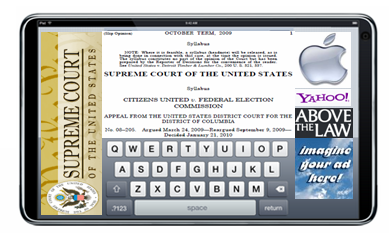
This morning, William Knott, a spokesman for the US Supreme Court, made a surprise announcement that the US Supreme Court will phase out releasing court opinions in PDF format and will begin releasing all Court materials to fit Apple’s new iPad format.  The multi-million dollar agreement between SCOTUS and Apple launches a new approach for the Court to push information to the public and at the same time generating much needed revenue to support the Federal Court System.  Knott justified the move by saying, “With the downturn in the economy, and the legislature’s refusal to adequately fund the Federal Courts, we’ve decided to look for additional funding through corporate sponsorships.”
Back in January, the Court handed down the Citizen United decision (Knott apologized that the decision is currently only available in the Court’s old PDF format), which ruled that corporations and labor unions could contribute to political campaigns.  Apparently, the Court has interpreted that decision not only for campaigns, but also for other governmental contributions, including itself.  “Hey, why should some schmoe congressman from New Jersey be able to take money from corporations or unions and the highest court in the land cannot?” asks William Knott.  “We’d be hypocrites if we said it was okay to contribute to politicians, and then tell those same corporations and unions that their ‘free speech rights’ end at the steps of this courthouse.”
In addition to the agreement with Apple, Knott also hinted that for the right price, the Court would be willing to sell ad space within the opinions themselves.  “My God, look at all the white-space that will be available in the iPad format,” Knott adds.  “I’m not saying it’s a done deal, but we are looking into the option of monetizing the Court’s opinions.  We’re just keeping our options open at this time.”  Knott assured us that the ads would be “tasteful” and would have absolutely no influence on the Court should any of the advertisers have matters brought before them. The ads, tentatively referred to as “CourtSense”, will be similar to the Google Adsense model in order to sell contextual ads within the opinions based not only on keywords within the opinions but the user’s own browsing habits and email content.  
When I asked William Knott why the Court thought that the public would not find the idea of the US Supreme Court taking money directly from corporations and unions as a “payoff”, Knott stood up and poked me in the chest and screamed, “Google does the same thing with its new Scholar website, and they don’t need to take taxpayer money to support their operations, do they??  Americans should be happy that their justice system doesn’t need to ask them anymore to shell out their hard-earned tax dollars to support the Courts.  By opening the Court to corporate money, tax dollars can be reallocated to building what Americans really want, and that’s more prisons!  So for America, it is a tremendous win-win.”
The new format should be rolled to Apple Retail Stores or decisions can be downloaded directly from iTunes at about the time we release our April Fool’s Day post in 2011.
[note: April Fools!]