Image [cc] mandiberg

I usually read articles written by vendors with a grain of salt, but I think that Thomson Reuter’s Dave Whiteside’s article, “Stop Doing the Legal Limbo” has some good food for thought in it, and it plays into what we discuss here on this blog when it comes to Librarians playing a bigger role in Business Development.

My suggestion is to read the article first and then come back to this part that I think helps explain it in the Librarian/Marketing/KM/BizDev environment.

… okay… I assume you’ve read it.

I’ll reword some key pieces of what Dave Whiteside wrote just a little bit to fit the concept of a law firm’s ability to research, market and sell it services:

  • How do we help attorneys get to know the potential client before they meet?
  • Are we preparing the attorney to better understand the potential client’s business?
  • What do we do to help the attorney understand the client’s industry and competitors?
  • How do we get current awareness information to the attorneys to help them keep up with upcoming issues and trends that impact the potential client’s business?
  • Do we have an comprehensive method of clearly explaining the relevant experiences that the attorney and/or the firm has that will guide the potential client who faces the same problem?
  • What type of training do we give to our attorneys to help them explain how our services don’t just help with short term needs, but we are also there to advise in ways that help General Counsel better direct their company in avoiding future legal issues?

Whiteside hands out a laundry list of Thomson Reuters products that can help, but I wanted to be more generic and think of the process instead of the specific products and see if there are things we already have in place that we could leverage to get to the goals listed above:

  • What do we use to organize our collective experiences and help attorneys explain how those previous experiences are specifically why the client should hire us?
  • How do we determine where we stand in these issues compared to our peers?
  • Where do we find our individual relationships between members of the firm and the potential client. How do we present this in an actionable way to the attorney?
  • What type of controls do we have in place that helps manage matters as well as helps quickly identify inefficient or unprofitable work?

I’ll add one more to this list that I think is very important:

  • What processes do we have in place that reviews matters once they are over and helps better prepare other attorneys in the firm for the next time?

There are a number of opportunities here for Librarians, Marketing, KM, Biz Dev, Client Development, and many others on the Administrative side of the law firm. I bet that almost all of you have some, but not all, of resources already in place at your firms. The key with something like this is that there has to be a process started of getting the right people, information, resources, and tools aligned so that it becomes a standard at your firm, and not just a one-off project that only comes into play when an attorney comes in with an “emergency” request because they are meeting with the potential client in 30 minutes.

Our very own Geek, Zena Applebaum, has been elected to the Strategic and Competitive Intelligence Professionals (SCIP) Board of Directors! Zena has contributed to 3 Geeks for many years now and is also a full-fledged member of our internal clique known to us as “The Bradys.” Of course, Zena writes about Competitive Intelligence and Business Development issues and brings in the Canadian perspective on a number of issues. If you don’t have Zena’s book on “Business Intelligence for Law Firm,” then you need to go check it out. So, congrats to you Zena!

Here is the press release that SCIP put out about the election and more information about the organization:

Zena Applebaum of Bennett Jones LLP Elected to SCIP Board

The SCIP membership elected Zena Applebaum, Manager of Intelligence & Intranet at Bennett Jones LLP, a leading international law firm based in Canada. Her board term will run 2013 through 2015.


FOR IMMEDIATE RELEASE


PRLog (Press Release) – Dec. 13, 2012 – Elected by the SCIP membership, Zena Applebaum will join the 2013 Board of the Strategic and Competitive Intelligence Professionals (SCIP). A regular speaker and writer on market and competitive intelligence topics in Canada and abroad, most recently she is the author of “Business Intelligence for Law Firms” published in November 2012 by The Ark Group in association with Managing Partner.  She will be the first law firm individual to serve on a SCIP board.

“It’s an honor to be elected to the SCIP Board”, says Ms. Applebaum. “The election of a Canadian competitive intelligence practitioner from the legal industry is evidence of the international growth and breadth of intelligence work within organizations. I look forward to serving the intelligence community and building on the strength and momentum of the organization.”

“We are thrilled to have someone of Zena’s caliber joining the Board of Directors” added Michel Bernaiche, SCIP Board Chair.  “Zena’s functional and industry background will bring significant perspective to future areas that SCIP should and will capitalize on in the future.  She consistently brings ideas to the table and can always be counted on to contribute in an effort implement change.”

Zena Applebaum is the Manager of Intelligence & Intranet at Bennett Jones LLP, a leading International law firm based in Canada. With 10 years experience in the legal industry, her primary responsibilities include conducting analysis of market and competitor performance to inform the firm’s practice development, client relationship management, counter-intelligence and marketing.

Ms Applebaum brings a unique perspective to intelligence and the dynamics of market and industry issues as a result her broad business development, data management, marketing, and corporate research experience in a variety of sectors including technology, healthcare and the professional services. She has a joint academic and applied Master of Arts degree in Communication and Culture from York and Ryerson Universities.

About Strategic and Competitive Intelligence Professionals (SCIP)

With members in over 70 countries, SCIP is a 3000-member global non-profit membership organization for everyone involved in creating and managing strategic and competitive intelligence. Education and training have been a critical component of SCIP’s member services since the Society’s founding in 1986, 1986 and SCIP provides its global membership access to the world’s most admired certification program. In addition to articles and books, SCIP provides networking opportunities at its annual conferences in the US, Europe, Brazil and Singapore, and through chapter meetings and webinars. The Society supports everyone involved in creating and managing strategic and competitive intelligence, and many members have backgrounds in market research, strategic analysis, science and technology.

— End —

So I’ve been more or less random in my posting on 3 Geeks lately. Preoccupied by work–I know, I know, why should I let that get in the way?–I have taken on quite a bit these past couple of years. Between going more digital and an expanding global footprint things have been rather hectic!

But even in my personal life, between volunteer gigs and speaking engagements and, well, doing the same old desultory chores that everyone else has to take care of while not working, I have spent less and less time on my own social media. Heck, I barely have time to respond to the onslaught of emails.

I rationalized that social media was just taking up too much of my own head time. I had a enough going on managing work and home to take the time to participate in the Twitter stream. I barely had enough time to check for DMs, Facebook notices, LinkedIn mail and scan a few Pinterest posts. But to sit down and write a cohesive sentence on what I really thought about it all? Nope. Not happening this year.

Don’t get me wrong. I still love social media. I still think it is the most exciting place to be. I still love hanging out online and getting into a good chat-fest. But the real life stream swept me away for awhile.

But I need to remember that my friends on here are just as valuable and real as my friends off-line. I can get too wrapped up in the minutia of life and miss the opportunities to connect, share and bond. I have met so many great people online through my professional and personal blogs and accounts–I don’t want to lose that.

So time. It all comes down to time. Should I spend 20 minutes shopping for shoes? Or 20 minutes writing a blog post? Should I spend 15 minutes perusing Pinterest recipes or 15 minutes on Facebook to touch base with my cousins in New Mexico? What really matters most?

It just reminds me of a song we used to sing in Girl Scouts, “Make new friends, but keep the old, One is silver and the other gold.”

I can’t forget where it all started. Thanks Geeks.

Image (cc) Ashish T

Recently I read a report entitled: Legal Process Outsourcing: LPO Provider Landscape. The report was released in September, but just came to my attention recently. I recommend it as required reading for anyone following the market for legal services.

I have previously commented on how LPOs are coming after law firm market share. This report confirms that and even includes a section called, “LPO Providers Will Move Up the Value Chain.”

To demonstrate the impact of LPOs on the legal market, I thought I would share a few statistics from the report. Emphasis added is mine.

– The global LPO market was estimated to be worth $2.4 billion in 2012.

– The estimate of 28% annual growth rate may be more realistic [versus some reports of 60%].

– India-based providers are the leaders in the offshore LPO space, with more than one million lawyers and 128 LPO providers exporting legal services worth $640 million in 2010.

– The US market [for legal services] is highly fragmented, with 50 of the largest firms generating only 15% of the revenue.

– Prices [for legal services in the US] have increased by 75% (compared to 20% for non-legal business services) in the past decade.

– Microsoft reports that Integreon (an LPO) increased contract turnaround by 20% and increased on-time delivery of contracts to 99.5%.

– As a group, the 27 LPO providers [in the survey] employ a total of 10,858 LPO workers.

– The overall turnover rate [for LPOs] is 15% (Turnover being the percentage of employees who leave each year.).

The average team composition is 22% onshore and 78% offshore.

Is the wake-up bell ringing loud enough yet?

“Business Development Coaching for Lawyers (“BDCL”) leverages a proprietary coaching structure that optimizes solutions-based tactics intended to catapult your practice to the next level. We partner with you, our clients, in pursuit of shared goals and strategic alliances. Simply put, our services at BDCL exceed the expectations of legal leaders who recognize the value of purposeful investments in human capital as a means of preparing and aligning people and systems in pursuit of growth.” 

Say what?Why does corporate America speak this way? What is the origin of this weird language?

Maybe it began in George Orwell’s classic political and science fiction novel Nineteen Eighty-Four, set in a future dystopian society where ideas explore the concept of humans coping, or more accurately, the inability to effectively cope with, technology that has progressed far more rapidly than humanity’s spiritual evolution. The fictional language of that society, “Newspeak”, attempts to influence thought via how we express our language.Written during the Cold War, the novel Nineteen Eighty-Four is a bleak commentary on the human race and a warning against the dangerous probabilities of communism.

Today in 2012, after the fall of communism and the Berlin Wall, Nineteen Eighty-Four is now a haunting reflection of mass media, data mining, and its consequences.

One consequence is a modern language whose quality is lamentable, one that overflows with pretention and euphemism– all of which contributes to fuzzy ideas and a lack of logical thinking. While Orwell’s Newspeak was fictional, our modern day language is all too real.When hearing the jargon we’ve adopted that is so prolific in business, I cringe. Yet, it is easy enough to slip into the temptation to use hackneyed phrases and clichés and it is  frequently too great to overcome.

Admittedly, I have unintentionally violated my own conviction using phrases that are vacuous and just plain embarrassing. Groping with an insecure, or more accurately, an insincere moment wanting to appear “important,” I’ve mumbled something about “shifting paradigms” a time or two and then winced at my infraction. Fortunately, no one noticed because they were deeply sheltered under their own overarching concepts taking shape out-of-the-box to drive initiatives. I’m just saying…Challenging the current business lexicon while my contemporaries seemingly embraced the new language has been a solitary journey until recently. After attending a writing workshop entitled “Avoid Meaningless Clichés,” I realized that maybe I wasn’t so alone after all.

Finally, someone else was spotlighting this dilemma. The presenter emphasized that when writing, every word must be chosen judicially and applied intentionally. “It is not enough to write so that you can be understood; you must write so clearly that you cannot be misunderstood.” – Ralph Waldo Emerson.”Yes, yes, yes,” I wanted to shout! Elated, I Google searched, hungry for more evidence that there was a in fact, a tribe emerging who longed for straight talk.

Then in an issue of Entrepreneur magazine, Erika Napoletano of Redhead Writing further emphasized the impact that language can have on business and dubbed the term “buzzspeak” in her article Big think, small movement.

She asks, “Are nonsensical and annoying words sucking the soul of your business?” Napoletano contends that buzzwords are an excuse to talk around what we really mean to say and that to use them is lazy and disrespectful to our audience. She asks that we respect our audience enough to tell it to them straight.As law firm marketers, we know clients are hungry for solutions to problems; they want them fixed quickly. So skip the buzzwords and don’t give them any “bandwidth” (another one of my favorite words). Listen instead of talking their ear off.

Napoletano cites four useful tips when communicating:

Simplicity: If you want them to buy what you’re selling, don’t make them learn a new language or feel inadequate when they don’t understand what you’re selling. They will shut down and buy from someone else. Don’t we see this every day when trying to convey our message to lawyers? Lawyers generally hate marketing jargon.

Brilliance: True brilliance reveals itself in what you offer to your clients. Your solution makes THEM look brilliant. You don’t need buzzwords to make you look brilliant.

Time: Your solution should save them time whenever possible; don’t waste it, just get to the point.

Usability: Respect your audience by offering easy-to-use solutions that make sense for how they operate. Asking them to change their day-to-day routine won’t get you the yeses you crave.

Avoid these overused phrases whenever possible: Bandwidth, gravitas, bottom line, kicking the can down the road, drill down, on boarding, core competencies, value-added proposition, low-hanging fruit, going forward, take it to the next level, at the end of the day, and any other annoying phrases you hear every day, sometimes multiple times.

Finally, the folks at FightTheBull.com, and authors of the book Why Business People Speak Like Idiots, have developed a piece of software called Bullfighter that scans your writing for BS. I’m not kidding.

The software measures three things: Bull Composite Index (BCI), which is your total score on a scale of 1 -10; Bull Index (BI), the number of jargon and corporate speak terms you use on a scale of 1-100; and the Flesch Reading Level (FRL), the “grade reading level” on a scale of 1-100.
For all three scores, higher numbers are better. I’m definitely going to buy Bullfighter to test my own writing
It’s the least I can do to support the straight talk revolution and put my money where my mouth is.

Editor’s Note: Susan Baldwin is a guest blogger and legal marketing manager at a top AmLaw 100 law firm.

Image [cc] loungerie

I have previously called out 2012 as The Year of Pain for law firms. The basic premise is that market demand is flat (per the many market reports) and that firms have run out of cost cutting ideas, such that costs are rising (also per the many market reports). The result will be a drop in profit for firms across the market.
But equally interesting is that the pain will not be felt the same across all firms. Another recent market phenomenon is dispersion. In the good-ole days, law firm profitability moved in a group-like fashion. All boats generally moved up with the tide. However, the market is now experiencing more dispersion, in that some boats are sinking while others may be rising. So then the question becomes: Why?

Why are some firms succeeding in this challenging market while others are struggling? Here is my hunch. A number of articles and posts might suggest it is superior management or leadership. That may play some small role, but it is my sense most firms are run as true partnerships. With consensus building and various other efforts, law firm leadership has to please its partners. So unlike a traditional business, leadership does not make such direct strategy decisions and thus have less impact on the success of the enterprise.

Absent that factor, I think there will be two other factors that determine which firms rise and which take the other road.

#1 – Types of Practices and Clients

Less by strategy and more by chance, some firms have less price sensitive practices. Most large firms have always had a mix of practices with varying levels of profitability, however now that fact is becoming much more apparent. So if a firm has a substantial practice or set of practices with rates clients still pay, then they will likely be on the rise. Although I would add – don’t expect this advantage to sustain. For the most part, these profitable practices will feel the pain soon enough. Pricing pressures are sweeping through the market. It’s just that some practices are feeling the effects sooner than others.

On the other side of this coin, there are clients from certain industries putting more fee pressure on law firms. So more by luck (although some may claim leadership and ability to know the future), certain firms who don’t represent such client markets will prosper above others.

#2 – Location

A number of firms are relocating back-office functions to lower rent locations. The idea here is pursuing long-term overhead cost reductions. Well guess what? Some firms are already located in these lower rent locations. So they already have the advantage of lower rent, and lower pay for both staff and lawyers.

As I note, these are hunches. I have not seen any market surveys yet that would direct;y confirm or dispute these factors as true drivers.

Come 2013, I guess we will all find out.

Image [cc] Indiaedu.com

There are a couple of trends that I’ve seen when talking with other law librarians about e-books. First, legal publishing vendors don’t seem to have a plan on what to do about e-books. Second, law librarians don’t seem to know what to do about e-books, either. My suggestions to the law librarian community has been to start figuring it out, quickly, or we are going to be stuck with whatever the vendors eventually come up with. Of course, even that could still be years away.

It seems that no one want to be the first to jump into the fray and define exactly how we want to organize, sell and collect e-book collections. Add to this the fact that there is very little demand by our attorneys to have e-books readily available in the law firm’s collection. To modify what my good friend Toby says, “find out what’s keeping your attorneys up at night… and it isn’t e-books.” That’s good news for the law librarian world, but it is a temporary stay at most. Eventually, new lawyers, and lawyers that get more familiar with their mobile and tablet devices will figure out the advantages of having an e-book library at the ready. However, if law librarians wait that long to prepare, then we fall into reactionary mode. If we start now, we can be better prepared for that tipping point.

So, back to the title of this post. The vendors could actually start the ball rolling on this demand piece of the e-book equation. Just like with online research, get the students hooked on the idea early, and then they will drive demand when they make it to the firms. I’ve ranted before that in the age of the iPad, why in the world should a 1L lug around a 50 lbs. backpack full of books? It makes very little sense, and it shows the lack of forward thinking by the legal publishers. My suggestion to the legal publishers is that you should look at the law book industry as your gateway to the e-book collection of the future. Work out the arrangements with the law schools so that they benefit by moving away from traditional print course books to an e-book model.

I’m sure there are a thousand reasons that the legal publisher could think of on why this wouldn’t work. However, that is hanging on to a dying publication model. The longer the traditional legal publisher waits to jump in this new model, the more likely a young, fresh, start-up will jump in there and fill the void. If that happens, then the cost of entry into that market skyrockets for the traditional legal textbook publishers (and, they’ll eventually acquire the startups at a premium price.)

The over-simplistic idea here is this: Placing e-books in law students’ hands now will result in selling e-book collections to these lawyers (and their firms) later. It’s coming, so either get in front and drive it, or stand back and wait for the chaos of customers telling you what to do.

Now, back to the law librarians. E-books are coming, make no mistake about it. I’ve laid out one possible scenario, but there are many others that you can imagine. Now, get in front of this shift in customer demand, or sit back and wait for the chaos of the lawyers and the vendors telling you what to do.

Image [cc] mattlary

It was a rough time for the Empire. 

Online case services were multiplying fast and furious.  Yes, even their vaunted reporter system had been compromised.  The beginning of the end began in the late 1990’s, when even the Courts had ruled against them.  It became more important than ever to just hold on, to jealously guard what was left from the encroaching armies of Competition. 

First, a little background:  This is about the use of parallel citations.  Legal documents, in my experience, use case law to support arguments made and positions taken.  And it’s important that the case is properly cited to both point to the source of the discussion and provide a way for the reader of the document to confirm (or deny) the reasoning made by the author.  In most cases, the author will add parallel or additional citations from non-official sources as a courtesy for their readers.  There are some judges that do require these to be included but I believe it is done for the reasons outlined above. Online services also routinely include citations to other services as well as their own without regard for the effect it may have on their own business, a practice that can only be described as extending this courtesy.

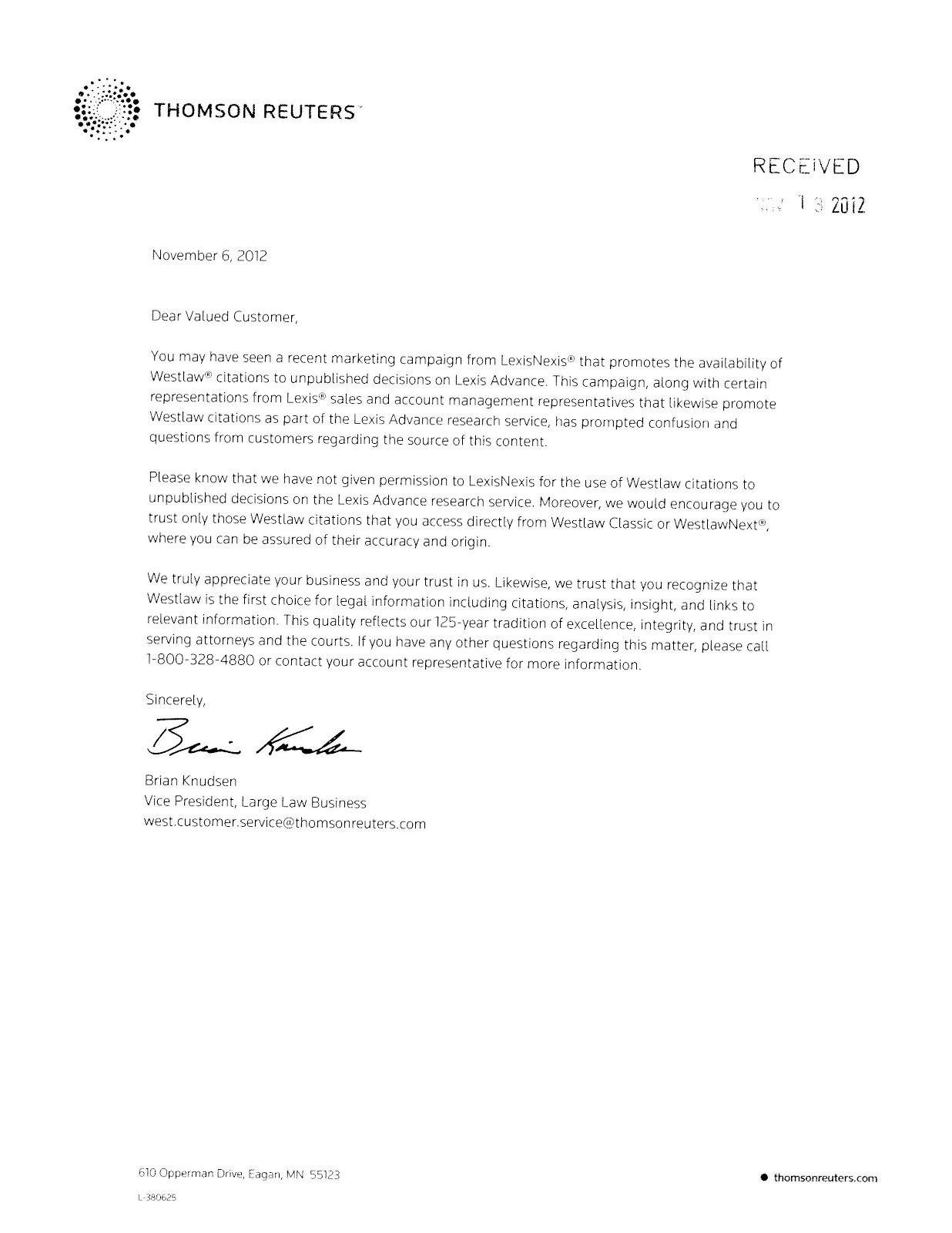
Now to the event that prompted this posting.  A letter recently obtained by 3Geeks was sent out by Westlaw outlining the possible issues surrounding the use of their WL cite for unpublished decisions by Lexis Nexis  as part of displaying the various parallell citations associated with a particular opinon.  The letter references an advertising campaign trumpeting the availability of parallel citations, with this one spotlighted, for unpublished opinons.  They also imply that these cites can only be presumed to be accurate only on their platform (Westlaw).  Frankly, I’m not sure why they weren’t flattered by the tacit acknowledgement of their competitor that their brand was respected enough to reference.

Parallel citations from other publishers have been routinely used by both Westlaw and LexisNexis for several decades.  Both have made a name for themselves as an accurate purveyor of legal information (including citations) that set them apart from such services as Google Scholar.  Although I am sure that Westlaw feels that this response is justified, I think that to respond to what is really a common industry practice indicates a surprising degree of desperation.  When asked by 3Geeks to respond, Lexis stated simply that these “parallel citations are lawfully obtained from reliable and accurate sources and are subjected to the same high quality editorial processes used for all of our case law collection.”  The Westlaw letter reminds me of the Daffy Duck/Bugs Bunny cartoon where Daffy must have the entire treasure of Ali Baba to himself and literally shows how small he is as a result.

As a research professional,  I find it difficult to understand how, or why, there would be any limitations on the use of parallel citations from any source.

Both the Westlaw letter and the Lexis response are included for your reference below:
Last week, I had the privilege of presenting on “How Intelligence Accelerates New Client Acquisitions for Law Firms” as a part of the Intelligence Collaborative ( #intelcollab), an Aurora WDC project.  The presentation focused on how firms can leverage all of the intelligence floating around in firms to retain existing clients, get more work out of them, target and pitch new clients and embrace big data and all that it has to offer.  As always, the content delivered was only half of the presentation and the real value came from the question and answer period where I was asked and hopefully answered some very salient questions.  One of the questions I was asked was how sole practitioners can employ some of the tactics and strategies discussed in the presentation.  Sole practitioners are uniquely positioned in that they can to be more nimble than their counter parts in large law firms in responding to market conditions and opportunities, but are hindered in that resources, especially time to practice law and develop business at the same time without a full administrative staff can be a significant challenge. 

Yesterday, I saw a demo of a product that can make the life of a sole practitioner, whether as a legal professional, a librarian, an intelligence professional –  competitive, market or business, they are all the same to me, check out the recording of the IntelCollab presentation for a more fulsome explanation –  or other informational services provider that much easier.  The fact that the company is Canadian is just a colourful feather in its cap.  The product is called Spundge (@spundge) and it positions itself as having “Smarter Curation, Awesome Content”, which to me is just a fantastic tag line.  Similar to other aggregators of content I have reviewed here, I would describe Spundge from my vantage point as primarily a social and public media listening tool.   The curator allows you collect media across various platforms, and then for a tiny monthly subscription fee, create newsletters or in “stories” in Spudge language with that content once you have filtered it for your specific needs. The stories can then be syndicated and pushed out to clients as a value added service (using Spundge Pro), a business development tool and/or even to other Spundge subscribers. The product is terrific for the sole or solo practitioner for a variety of reasons including its low subscription fee, easy to navigate, low barrier to use.  Imagine, you are a solo librarian or intelligence professional, supporting a series of sole practitioner lawyers or small offices as a consultant.  You could log into Spundge, create customized notebooks for each of your lawyer clients, and publish a story to each of them with ease on a daily basis. Or if you were a sole practitioner lawyer, you could create a notebook for each client or industry you were covering, scan the headlines without the need for expensive subscriptions since arguably, social media often reports on events before traditional media and be up-to-date on targeted current awareness as it happens. If a new publicly available source needs to be added, you just log into your settings add the RSS feed and away you go.

Oh, and if you had social interests on top of your work interests, you could track those too in private notebooks and read them in all your spare time. 

Image [cc] genvessel

The recent dialog about Procurement’s role in the purchasing of legal services has been nagging at my brain. I wrote a piece for a book on the subject and basically suggested in-house lawyers beat Procurement to the punch. The fallout of that effort was my series on the subject.

But the nagging continued. Over the long weekend the incessant nagging finally triggered a repressed memory. Back in the day when I worked for the Utah State Bar, I would regularly receive calls from friends looking for lawyers. They called me instead of lawyer referral because they wanted a lawyer that came with a personal recommendation. Of course, since most of these were personal and not business related, most of these were for divorces.
I would usually give my friends two or three names, along with my thoughts on why they might chose one lawyer over another. That advice was typically tied to strategy. Did they want a quick and less contentious divorce? Or did they want a pound of flesh from the Ex (a very expensive option)?
The referrals I gave each friend were tied to their situation, but I always ended these conversations with the same advice: “It’s all about Trust.” I suggested they talk with each lawyer and decide how they felt about that person. Of course I was giving them names of people I trusted, but my advice centered on the issue of their trust with a lawyer. Ending a marriage is a very important decision. So each person needs to chose a lawyer they can trust to represent them in this effort. I would repeat my advice, “It’s all about Trust” when ending the call.
So … where is the trust in today’s legal market?
It’s my sense that clients feel the trust was broken. Right or wrong, they feel law firms took advantage of them by raising rates and paying first year associates so much. Since these are two of the primary financial stats they see in the market, they have become a central target of their feelings. One might argue that clients were part of the team that built the escalating rate system. But regardless if that is true, they now harbor feelings of broken trust. So now we see RFPs as a manifestation of those feelings. Rather than directly resolving trust issues, many clients are allowing Procurement to stand-in for them and either drive or significantly influence how legal services are purchased.
Of course it is not fair to focus exclusively on the client-side of the trust equation. Law firms have not only played a primary role, but benefited greatly from the rate escalation world.
Going back to my Utah Bar analogy, the real problem facing the profession is trust. When a client hires a lawyer or firm to represent them, in the great majority of situations, they are placing a significant trust in the lawyers involved to resolve or handle their legal matter.
My point: Procurement is not the best way to address the lack-of-trust issue. Having a third party with its own agenda interrupt the relationship between client and lawyer will only lead to more distrust.
Which brings us back to one of my perennial themes: The Conversation. Trust will be rebuilt when client and lawyer sit down and talk. In those situations trust is almost a by-product. When people meet and share what is really important to them. Each side becomes vested in the other’s success.
So clients – I share with you the advice I gave all of my divorcing friends: It’s all about Trust. If you want good results, including the result of cost savings, you need to make sure you have relationships of trust with your lawyers. Otherwise, you are entrusting ‘just another vendor’ with some of the most important decisions you make for your company.
Go ahead – sit down and talk.