The first principle is that you must not fool yourself—and you are the easiest person to fool.

Richard Feynman

We deal in deception here. What we do not deal with is self-deception.”

— Captain Oliver Queenan

Change is happening. It is good.

I am not really one for New Year’s resolutions. But I do make a point to be reflective on my birthday, which, being a week later, amounts to almost the same thing. This year, in particular, I find myself inspired by Mark Cohen’s meditation on the “failure” of Clearspire. Mark is an eternal must-read. But never more so.

Mark highlights the distance between the way things are and the way things ought to be with a powerful narrative about confusing the two. I’ve made the same mistake. Like Mark, I have been seduced by the seemingly loud, prominent voices calling for immediate change. The resonance to me of this passage is hard to overstate:

The Founders believed that by creating what the marketplace said it wanted—and then some—it would be a huge success. Intrigued as the marketplace was with the vision, the Founders soon learned that “if you build it, they will not necessarily come.” There is a big difference between expressing admiration for a model and becoming a paying client. Clearspire’s Founders had not anticipated the size of that delta.

The Sirens’ call of confirmation bias is a constant source of danger in my world. I’m not immune to bullshit, especially my own. In trying to maintain perspective, I vacillate between rank cynicism and unbridled optimism. The optimism almost always wins. I need no convincing that the legal ecosystem is evolving. I’ve bet my legal career that being an agent of change will keep me gainfully employed.

So far, I’ve been right. But not nearly as right as I predicted. And certainly not right in the way I predicted.

Change is happening. It is slow, uneven, and intermittent.


My most obvious error has been predicting the pace of change. While there is sufficient demand for change to keep me and a cadre of fellow travelers occupied [though I did just complete a project that went live January 1 and have one client slot currently open], the overall pace of change keeps being far slower than I imagine even when I update my priors to incorporate the observation that the pace of change is far slower than I imagine.

This should not surprise me.

Massive passive resistance. Agency dilemmas. Institutional inertiaStatus quo bias. Loss aversion. Endowment effects. Lack of urgency. KAP gaps. The Chasm. System justification. Institutional isomorphism. Reams of academic literature explain the Planckian notion that progress does not occur when its opponents see the light but only when they lose their power to oppose—that is, funeral by funeral. I’ve not only read my Rogers, I’ve read Bill Henderson’s masterful series applying the Rogers Diffusion Curve to innovation, or lack thereof, in the legal ecosystem.

This should not surprise me. Yet it does.

Keeping with current fashion, I blame the news. Legal industry news (different than legal news) is not fake. But where mainstream news is dominated by negativity bias, legal industry news has a pronounced novelty bias. I exacerbate this novelty bias by spending a fair amount of time in the New Normal echo chamber.

We talk about what’s new, different, and interesting rather than what’s established, stable, and enduring. This coverage, while accurate in the particular, can be misleading in the aggregate, especially because of a proclivity to focus on well-articulated intentions (what we’re trying/hoping to do) rather than messy outcomes (what we’ve done). Emphasis on promising outliers suggests a pace, breadth, and depth of change that belies our creeping incrementalism.

I also blame myself. I can be too easily taken by the simple logic of immediate change. This makes sense to me. So this makes sense to everyone. Thus, this will happen. Soon.

If I had been a lawyer in 1989, I probably would have convinced myself that, in the not-too-distant future, in-house counsel would be ascendant, alternative fees would displace the billable hour, and large law firms would transform into multi-disciplinary law companies.

Because change has occurred (and will continue), by 2018, I would have been quite right on insourcing, somewhat right on alternative fees, and witnessing the the nascent rise of the multi-disciplinary law company. Which is another way of saying I would still be mostly wrong almost 30 years later. Yet less wrong than I would have been in 1999, when, a decade into my prediction of major structural changes, I would have been really, really, spectacularly wrong and, most likely, insolvent.

But pace is not the only area where I’ve been wrong. I’ve also been wrong about the types of changes that would appeal to market participants in the near term.

Change is happening. But I’m not good at this game.


Since I left my in-house gig, I’ve been able to feed my family in spite of myself. My sources of income are different than expected. In many respects, my clients have exceeded my expectations. In almost all respects, I misjudged the market.

On the consulting front, I’ve been humbled to be involved in massive, impactful projects like creating a legal operations department for a Global 20 company and overseeing convergence initiatives involving hundreds of law firms. I didn’t expect that clients would trust me with so much so soon. And I’m grateful for what they’ve permitted me to help them accomplish.

With training, I’ve been genuinely surprised by the number of law departments and law firms that have taken it upon themselves to do the necessary work of getting serious about improving proficiency in core office technology. And I’ve been especially heartened by the number of law schools that have been willing to add training in practical technology skills to their curriculum, in addition to the forward-thinking state bars we are working with to develop competence-based CLE content.

I saw none of that coming.

When I left my in-house gig, I had a very specific reputation: the Word guy.

I was the guy who had gotten too literal in bringing supply-chain management practices to legal. My approach was site visits in support of structured dialogue, continuous improvement, and deep supplier relationships. Yet the pursuit of win-win collaborations to change legal service delivery did not garner the headlines. The headlines were all about me kicking the crap out of law firms for being terrible when I audited on them on using Word properly (which isn’t exactly how it happened).

We’d love to be able to do that. While I was still in-house, a few people called me an idiot to my face. In almost all cases, I offered to buy them a cocktail and provide a broader perspective (y’all know I love writing and speaking the words) than was afforded by their headline skimming. In all instances where we had the discussion, we parted on good terms having identified considerable common ground.

But more than a few people had the opposite reaction. They thought what I was doing was fantastic. At least, that is what they told me. They explained that they would be keenly interested in doing the same thing.

Until, of course, I offered to send them my audit materials. When they realized that conducting a service delivery review requires sustained attention, they were out. They would explain they didn’t have time for all that and, really, they were mostly interested in the technology competence piece that got the publicity. They just wished they had quick access to tech competence scores from their law firms.

I believed them. I automated my legal technology assessment convinced that large corporate law departments would ask their law firms for scores.

That’s not a priority right now. I was wrong. It happened. But it happened far less than I predicted. When it actually came time to pull the trigger, law departments who had told me requesting scores was a no-brainer decided more reflection was necessary.

Often times, the ultimate revelation was that the person I was engaging did not have the authority. They may have thought it was a good idea. But it was one good idea among many, and they were not well positioned to fight the internal battle. They had more urgent and expedient places to spend their political capital.

ASIDE: this speaks to one of the extant dangers of attempts to co-opt the vital legal operations movement—a challenge that CLOC and ACC Legal Ops are working hard to address. Personnel with fancy titles at fancy companies don’t necessarily have the attendant authority to fulfill their purported mandate for change. Functionally, they are administrators, not executives, with the power only to maintain current systems, not construct new ones. In this way, many corporate law departments consider themselves ‘doing legal ops’ when all they are really doing is creating one more position designed to cement the status quo (law firms have not secured monopolies on the caste system or innovation illusion).

But the discussion was rarely explicit about the internal politics of change. Rather, I was routed to someone else to make my pitch. They would react with tempered positivity but eventually explain that their firms’ core tech proficiency was not their top priority. They were quite interested in seeing their firms’ scores if their firms were “proactive” but, they explained, when it came to actually making demands of their firms, they were more interested in project management or metrics or knowledge management or…..too bad I didn’t have scores for that.

I believed them. I believed them, in part, because I agreed. Basic tech proficiency is not the biggest problem in legal service delivery. It is a problem well worth addressing. And it is low-hanging fruit—that is, among the simplest problems to solve. But I could not fault anyone for having alternative priorities.

I believed them, in part, because they were saying exactly what I wanted to hear. For me, tech competence was one piece of a more comprehensive program to improve legal service delivery. I wanted so bad for there to be a significant market for people who could address the entire legal value chain by operating at the mesh point between law departments, law firms, and law companies. Because that was precisely what I wanted to do.

I did not leave my day job when the LTA launched. I left when conversations around the LTA convinced me I could sustain myself doing service delivery reviews.

Not that. Not here. Not yet. I was wrong, again. I have been hired to conduct service delivery reviews, but they represent a small percentage of my income. If I had not also been wrong, in a good way, about the other consulting opportunities available to me, the Flaherty Family would be in a bad way.

Discussions about service delivery reviews go much the same way as the dialogue surrounding requests for LTA scores. There is general agreement that problems exist and should be remedied. But, ultimately, there is no appetite to address them in any meaningful way.

The conversation is rarely explicit. Still, my takeaway is that I am among an exceedingly small group (as a percentage) of people who genuinely take the relational view of the legal value chain. In my world, law departments are channel captains and urgency drivers. They must play an active role in integrating processes with their external suppliers in order to create “seamless, cost effective, higher quality workflows.

By contrast, the people I pitch mostly implicitly subscribe to the lawyer theory of value, which Bill Henderson summarized far better than me: “Because in-house and law firm lawyers are the same people, they have the same go-to move — stand back and let me lawyer….The lawyer theory of value — solving legal problems one at a time with smart lawyers — is an unstated and unexamined preference of lawyers, not a viable long-term solution for the clients they serve.”

I’ve had the same conversation many times. In a variety of ways, in-house departments explain that, with respect to outside counsel, (a) the most important thing is to hire smart lawyers and (b) they already do this exceedingly well. When pressed, they mostly extol the amazing job they’ve done securing discounts. When asked specifically about service delivery—leveraging expertise through process and technology—they mostly abdicate responsibility, falling back on “our firms should do that anyway” regardless of what “that” happens to be.

I’ve had the same conversation so many times that the guidebook I wrote for the ACC has a FAQ responding to the common variants of the above, including:

  • Shouldn’t we be focused on finding great lawyers?
  • Should we really have to ask our firms to do things they should already be doing?
  • Aren’t we too busy to run someone else’s business for them?
  • Wouldn’t much of this be addressed by a transition to AFAs?
  • Shouldn’t we use our leverage to ask our firms for deeper discounts on billable rates?
Writing and releasing the guidebook only reinforced, for me, the delta between stated and revealed preference—what we say vs what we do. My biggest fear was that no one would read what I wrote. In competition with that fear, was the horror that everyone would read and hate it. What I should have feared is that people would read it, agree, and then return to doing exactly what they’d always done.I’ve received all sorts of positive feedback. I’ve had law departments send the guidebook to their law firms. I had law firms send it to their law departments. Not trying to sell anything beyond ideas I was sharing for free, it seemed like I was making real progress in conditioning the market.

Except, of course, when I dig below the surface. People volunteer how much they agree with and appreciate what I’ve written. So I ask them how it has changed their organization’s behavior. They mostly respond with a blink/blank stare combination that tells me I have breached social decorum.

They politely explain that they are an outlier within their organization. They only have so much unilateral authority. They have to deal with the less enlightened. Also resource constraints. And finite time. And other priorities. And delicate equilibria….

Change is happening. But how much, really?

I’m pretty easy to dismiss. So was Clearspire.

Mark and I operate outside the window of discourse. Maybe we were both just wrong. Maybe we were both too early (a specific type of wrongness). While ideas once thought extreme are constantly becoming part of the mainstream, most ideas thought extreme remain so. Jeff Carr has a phrase I always butcher about the subsequent course of events being the only thing that separates the visionary from the madman.

But this was an, admittedly, self-indulgent entry in my bullshit arc (1, 2, 3, 4, 5, 6). In a post to come, I’ll tell essentially the same story about alternative fees and diversity, two ‘priorities’ that went mainstream decades ago, boast all-star rosters of prominent outliers, and have yet to move the needle anywhere near anticipated.

What we say is not what we do. Isn’t the notion that we confuse bullshit for action the most generous explanation?

Change is happening. It is good.

My answers are at odds with the market. Yet I persist in believing I am right despite a track record of being wrong. And not just right in the abstract. I trust that reality will continue to conform to my expectations, even if it is slower than I would prefer. I am increasingly convinced that I’ve made a good bet. I may be wrong about the timing and even the particulars, but I have fewer doubts than ever about the direction (see escalation of commitment).

I am choosing anecdotes over data. I, too, extrapolate from outliers, especially since I’ve been fortunate to be one. I’ve been wrong repeatedly and yet, on net, everything has worked out better than I anticipated.

I’ve been afforded the opportunity to do too many cool things. I’ve encountered too many inspiring fellow travelers. I’ve had a front-row seat to too many important trends—legal operations, law companies, strategic sourcing, data science, even robot magic. And, frankly, I am simply not ready to turn in my optimist card and resign myself to the eternal reign of a status quo I consider unacceptable (and which I have convinced myself is therefore unsustainable).

Even the bullshit bolsters my sense of purpose. Many people went to law school because they like to argue. Yet there is little argument about where we are headed. There is plenty of resistance in the particular—not that, not here, not yet. But the resistors dissemble precisely because there seems to be a general acceptance that things will never go back to the way they were. That the New Normal will become simply normal. When, not if, is the question.

Which is an extremely long way of saying, please don’t read me as a cynic. I don’t merely believe we can do better, I believe we are doing better. My reflections on failure and the maddeningly slow pace of change are attempts at tempering my own optimism. The more we see the world for what it is, the more we are capable of steering it toward what it should be.

The full bullshit arc:

______________________________________

D. Casey Flaherty is a legal operations consultant and the founder of Procertas. He serves on the advisory board of Nextlaw Labs. He is the author of Unless You Ask: A Guide for Law Departments to Get More from External Relationships, written and published in partnership with the ACC Legal Operations Section, and the Service Delivery Review Primer, written for the Buying Legal Council. Find more of his writing here. Connect with Casey on Twitter and LinkedIn. Or email casey@procertas.com.
While some law schools in the US
are closing
, in Canada, a prospective new one received
preliminary approval in late December 2017  by The Federation of Law Societies of Canada, Canadian Common Law
Program Approval Committee on its application to create a new law school.  This is the
next step in the school’s bid to establish a law school. What is interesting
and unique about this school, is that they are not exclusively focused on the
letter of the law nor traditional legal studies as with other law schools. Instead
they are taking a more progressive applied, approach to the discipline as has become a hallmark
of the Ryerson University brand.  

In describing its program,
Ryerson proposes to create a “different kind of law school that trains lawyers differently”. It
emphasizes a program that has an “innovation-focused approach”that will equip graduates with
real-world skills and competencies required to meet the present and future needs of consumers of
legal services.

The courses that students will be
required (my emphasis not theirs) to take include:

  • The Business of
    Lawyering
  • Legal Innovation
  • Social
    Innovation and the Law
  • Access to
    Justice Solutions

The courses will be taught by
professors of course, but also include an element of practical experience and
working with mentors from within the program itself. Courses are described in the application as:

“the course-based component is
divided between a morning session in traditional lecture format, and an afternoon session
where students will be separated into seven-member “student law firms” where they will engage
in practice-based assignments. The afternoon sessions will be overseen by mentors.”

Also contemplated are three one
week workshops in each of the three years of law school, I’ve pulled the descriptions here from the application documents:

  • Ryerson Law
    School Bootcamp:
    focuses
    on career planning, networking, mentoring, leadership
    and personal development [Mandatory 1L]
  • Technology
    Innovation Bootcamp:
    focuses
    on the current edge of legal technology,including
    data analytics, artificial intelligence, and quantitative legal prediction,
    etc. [Mandatory 2L
  • Financial
    Bootcamp:
    focuses
    on accounting, taxation and financial analysis [Optional 3L]
  • Coding Bootcamp:
    introduces
    students to HTML, cascading style sheet computing and Python, while requiring them to
    apply data analytics to devise a solution to a specific legal problem. [Optional 3L]
  • Emotional
    Quotient/Cultural Quotient (EQ/CQ) Bootcamp:
    includes an implementation project that aligns with recent
    shifts in thinking about the core competencies required of licensees in Ontario. [Optional
    3L]
The school’s proposed curriculum is
exciting and refreshing while also scary. It points to a very deliberate shift
in what practising law can and should be about in the future – a future that can start with mandatory shifts in education in the next couple of years if not sooner. We have certainly been
talking about this impending “future of the legal profession” for long enough. 

Last week on 3 Geeks, Greg
blogged about the importance of Professional
Development
for library and research staff, in firms. I think learning
some of the non-legal skills Ryerson wants to introduce in law school, can and
should be sought out by lawyers, not just admin staff in firms.   Lawyers
and not just the student kind, need to be thinking about the business of law
and the practice of law right from school and otherwise.  Lawyers and law students, along with law firm administrators need to
attend the very conferences Greg suggests are important to learn about everything
law school doesn’t teach or is just beginning to teach as mandatory. 

While legal industry commentators are making predictions this month on the state of the legal industry in
2018, I would like to do something different, and make a wish for the industry
instead.   I wish that 2018 be the year
of the business-of-law tipping point. I wish for the coming year to be the one
where we finally “get it” , where clients push firms of all sizes to act like
businesses, where lawyers of all practices, years of call and diverse of
backgrounds begin the slow but necessary step of getting trained on new ways of
thinking about practising law with a robust business acumen either from formal
education, continuing education/professional development or industry conferences.  I wish that
Ryerson’s law school (if it gets final approval), and other similar mandatory and elective
courses at all law schools is just the beginning of what’s to come for
the future of the profession and that 2018 ushers in a new wave of legal professionals who have the skills and abilities to integrate legal know-how with
business, technology, and access to justice  – with a smile. 

Best wishes for a successful 2018!

Robert Ambrogi did me a kindness by including me in his post, The Year of Women in Legal Tech.

I’ve been working in legal technology before it was even a thing.

Over the past 20 years, the field of legal digital marketing has taken off and become a legitimate business need.

A legal digital marketer as a young woman

As the legal world has become more competitive, the need to keep pace the business world requires law firms to have strong digital marketing talent.

The business of law

To put myself through law school, I worked weekends at large law firm handling every job imaginable: filing, moving offices, answering phones, researching, and delivering mail along with lunch.

Plus, during one spring break, I spent the entire week dinking around on Prodigy–I was fascinated. I know I’m dating myself but it gives you a sense where the industry was when I was in law school.

While I was studying for the bar and waiting on my results, I helped the firm to build their first electronic filing system. I wasn’t yet a programmer but worked closely with the developer to design the system. I soon realized I needed to learn code so I wouldn’t get the wool pulled over my eyes.

It was also during this time was when I learned to run a business and realized that I preferred the “business of law” rather than the practice of law.

E-discovery, chat rooms and server rooms

After passing the bar, I practiced family law then expanded into plaintiffs law. Leaps in technology saw the advent of using technology to perform discovery and document production. I was also considering the impact of the ethics rules on AOL chat rooms.

Then life veered again when I moved directly into technology. Cloistered in a server room, I developed training and marketing material for an e-commerce site. Mostly, I remember how cold the room was and that no one had any pens or pencils at their desk. Why would they–I was surrounded by programmers.

Graphic, digital and web design

At that time, few people knew how to use PhotoShop, Illustrator or PowerPoint, which made me more marketable.

Lured back into law to work as a graphics designer, I worked at a white shoe firm. Not only handling their graphics, I designed their intranet and built their web site. The developer hired to build the site disagreed with the design and refused to build it. So I learned how to code and built it myself, winning a nice award in the process.

Project management, social media and online advertising

Websites, microsites, blogs, online advertising, social media are just the front-end of the projects that I’ve managed. Yes, graphics are a part of the project but the most enjoyable part of my job is the intricacy of navigating through the multiple systems that drive the sites.

Like embroidery, websites are beautifully patterned images made from thousands of multicolored strands of code. The front is beautiful. The back-end; well, I strive for neatness.

I enjoy my job immensely and think I have the best of several worlds: the law, technology and marketing.

Who would have imagined I would have ended up here?

Thanks again, Robert, and kudos to all women who work in legal.

We’ve all probably heard some variation of the following two business quotes:

Prepare your staff so they can leave and go anywhere… treat them well enough so they don’t want to leave.

Q: What if I train them, and they leave?
A: What if you don’t train them and they stay?

I thought about both of these a couple weeks ago when I had to go in and justify my budget for 2018. One of the first questions that came up was why my professional development budget was (percentage-wise) so much larger than other departments. I responded with a variation of the two quotes listed above. Professional development is one of the most important benefits I think a department can offer. It is especially important when the department has a variety of legal topics which it must research and master.

When interviewing candidates for research positions, I stress the importance of professional development, and sell that as a reason to come work for me. When I do annual reviews of employees, professional development for the upcoming year is always included in the discussion, and we toss ideas back and forth on what is important to the individual employee to learn, as well as what the different practice areas and industry practices need us to know. When I need to cut budgets, professional development is the last place I look, not the first. And, when employees decide it is time to move on in their careers, I want them to stress to potential employers that professional development support is one of the factors they are looking when making the decision to come work for them.

Most law firms do not lack from training and professional development opportunities. We have arrangements and subscriptions from the local and state bar associations. Subscriptions and memberships to the American Bar Association, and other professional associations such as the American Association of Law Libraries, ILTA, the Legal Marketing Association, professional industry associations, and subscriptions to online, on-demand, and in-person classes through publishers and professional development companies, such as West LegalEdCenter, ARK or PLI. Some of these are unlimited subscriptions to any of the offered courses. The key to making the most of these training opportunities is stressing the importance of professional development to those in the department, and providing them the time and resources needed to attend the courses.

I’m also a big believer in letting people attend these courses and educational conferences in person. It costs more, but there are direct and indirect benefits from actually sitting in a room with others that make up for those costs. It shows the importance you place on professional development. It shows the trust you have in that person to be away from the office, hopefully in a place that is fun to visit, and that you see and treat them as a professional. It gives them an opportunity to meet others who have similar interests, and potentially build a professional peer group to reach out to after the courses or conferences are over. When professional development is organized correctly, it is a win for everyone in the organization.

We take a break from Casey’s BS series and point you to a historical review of the “cutthroat” legal research industry as it moved from print, hardbound reporter sets, to the online legal research systems which we know today. Whenever an industry is disrupted by a new technology, the players within the industry can play hardball with each other, and that typically leads to litigation as everyone scrambles to protect their stake in that industry. Legal publishing was completely disrupted in the 1990s, and Alan Sugarman from HyperLaw was on the front lines of this battle. Sugarman tells his story to Sam Glover, over at The Lawyerist, and it is definitely worth a listen.

Sugarman describes the history of his battle with Westlaw and their claim to copyright on a number of issues, but primarily Sugarman’s discusses his suit against Westlaw’s claims of copyright on the text and the citation of court opinions. It’s a fascinating listen on how the legal research industry shifted to online research and the different issues surrounding the transformation.

It reminds me of my days with the Oklahoma State Court Network (OSCN.net) and when we adopted the vendor-neutral citation system we adopted and made official in the 90s. Sugarman talks about the vendor-neutral system and his stress on including the docket number of the court decisions within the vendor-neutral cites.

Hat’s off to Alan Sugarman for his rebellion in the 1990s. Take a listen to “The Lawyerist Podcast #151: How Westlaw Lost its Copyright, with Alan Sugarman.” Without the likes of Sugarman and others who challenged the behemoths of the legal publishing world, we wouldn’t have products like Google Scholar, Fastcase, and other legal research resources today.

My friend John Grant made a mistake.

Many moons ago he was consulting on process improvement for a large law department. He surveyed in-house counsel on their biggest complaints about outside counsel. The response was that outside counsel:

  • Don’t understand my business
  • Can’t tell me how long anything will take
  • Overwork a problem/introduce complexity
  • Don’t give me output in a format I can use 

Familiar enough. And so far so good. John’s misstep is that he put the same question to internal clients of the law department. The response was that in-house counsel:

  • Don’t understand my business
  • Can’t tell me how long anything will take
  • Overwork a problem/introduce complexity
  • Don’t give me output in a format I can use 

This result was not well received by the law department.

The Lawyer Theory of Value

Law departments face a principal-agent problem that I covered in a piece with the subtle title What’s The Matter With Inside Counsel.

There are few discernible differences between the modal in-house lawyer and the modal law-firm lawyer. They are the same people. Ultimately, they value the same thing: lawyering

The lawyer theory of value states that the key to value is having smart lawyers. Lawyer time is the primary resource and the primary unit of measure even in law departments that have no compensable time sheets.

The lawyer theory of value tends towards the transactional and discrete. Resources (lawyer time) allocated to sequential, individual legal tasks: this question, this contract, this motion. Systems thinking and relative reductions in demand for legal labor (prevention, Lean, #DoLessLaw) are ancillary concerns to be addressed when convenient or absolutely necessary (that is to say rarely).

Given their lawyer-on-task orientation, ask most lawyers what they need to be more effective, and the first answer is more time in their own day. The second answer is more time from other skilled lawyers they already work with. The third answer is more budget to hire additional skilled lawyers. Maybe somewhere in there is a paralegal who is “just as smart, if not smarter, than most lawyers” (because lawyer is the measuring stick). That’s how it all gets done. Smart people working hard.

Dedication to their craft does not make lawyers bad at their jobs:

Most lawyers don’t pay a penalty for their acute focus. When they do, it is usually not obvious, especially to them. They can still make valuable contributions to client success and be well regarded in their profession. Lack of broader interest in the process, technology, and business of law (T-shaped) rarely makes them bad lawyers. It just limits their effectiveness when more lawyering is not the optimal solution to a particular problem.

Sometimes, they may actually volunteer “technology” as a catch-all and panacea. But peel that onion just a layer or two, and you soon realize they want magic. They expect a black box that produces superior outputs from the same inputs. And the urgency driver for finding magic is to free up time to do more lawyering. Once you start impinging on that time and their comfort zone—process redesign, training, change management—you trigger the defense mechanisms of professional issue spotters.

The threat of an implementation dip does not eradicate the faith in tech-centric improvement. But the “we” in we should be using technology more no longer includes “me” but rather transforms into more a generalized “we” encompassing other people in the department and outside counsel. Innovation continues. But without buy-in and participation from key stakeholders, much of it ends up being only skin deep. Meanwhile, the perception that innovation is happening elsewhere feeds the accountability-reducing innovation illusion.

There is, however, an important distinction between being (a) an enemy of progress and (b) a barrier to innovation. I encounter very few lawyers who actively oppose innovation. I find lawyers who support it in theory and simply don’t have time for it in their personal practice. They don’t have time for it because they are extremely busy with mission-critical work.

This has become a go-to cartoon in my echo chamber because it is funny in a way that resonates with outsiders and prospective change agents interested in more systemic innovation:

But from the perspective of the modal member of an in-house team, reality feels much more like:

This time pressure buttresses inherent status quo bias. When you view yourself as operating in a delicate equilibrium, you have a much lower risk tolerance. Different is risky. Different demands time and attention, both of which are in short supply.

Importantly, the lawyer theory of value is not without merit. It is incorporated into my personal worldview. I am convinced that legal guidance is only growing in importance to business outcomes. But assumptions, especially when implicit, can have a constraining effect when they go unexamined.

The constraints of the lawyer theory of value have trapped us into a local optimum for an extended period. The only conceivable solution to the interlocking challenges of scale and complexity was to throw bodies at them.

Faced with the legal cost disease and the more-for-less conundrum, in-house departments have been on a two-decade hiring binge. In the United States, there are now more lawyers working in-house than in the AmLaw 200. How much of the supposed disruption in corporate legal services is attributable to the simple redistribution of labor?

My take: there is a continuum. In-house growth was necessary and good for a variety of reasons, including specialization and the attendant sophistication. But too much is too much. We’re pursuing a path of diminishing returns. The continued overhiring is justified by an oversimplified ‘savings’ calculation. When you move lawyers in-house, you get them at a discount and on a fixed fee. But the math ignores the overhead costs (management, infrastructure, flexibility) of operating an in-house function at scale.

Finding a different avenue to hire the same lawyers to do the same work the same way is implicitly premised on the lawyer theory of value—we are replacing extremely expensive external labor with moderately less expensive internal labor while embedding a chorus of high-status, autonomy-seeking stakeholders who stand ready to proclaim “but we’ve always done it this way.” When it avoids the fundamental demand driver—the relationship between legal labor and business outcomes—insourcing is not a sustainable approach to bending the legal cost curve.

The result is that we have law departments that suffer from the same pathologies as the law firms to which they were supposed to be the cost-effective alternative. When it comes to true alternatives to lawyer time, most law departments still need to overcome the stifling persistence of not here, not yet.


Outliers and Outsized Expectations 

Most. Not all. Before you @ me with #NotAllLawyers and #NotAllDepts campaigns listing prominent counterexamples that confound my narrative, ask yourself, “Is my counterexample prominent because they are an outlier?” If the answer is in the negative, then I welcome the spirited debate about how the landscape has evolved quicker than I realized (which would be great). If the answer is in the affirmative, we are in agreement. There are prominent, praiseworthy counterexamples.

But there is also a genre of writing predicated on these outliers that tends to imply that law departments have it all figured out, unlike scleoritic law firms. Admittedly, I’ve fallen into this trap myself. You pair opinion data (clients are not happy) with empirical trends (stagnation) and cite to prominent outliers (exampleexampleexample). Then extrapolate.

Extrapolation is fine for futurism. But where I and others have steered wrong is when the predictive gets muddled with the descriptive. We create the impression that, instead of harbingers of the future, the outliers are representative of broader trends that are already ‘disrupting’ the status quo. Which they are. But not nearly to the degree or at the rate we may seem to suggest.

There is nothing new except what has been forgotten

There have been prominent outliers for a very long time (hereherehere). Yet like the decades of deaths of the billable hour, systemic change has not quite followed individual experimentation (and the attendant industry expressions of support/interest/intent) at the anticipated pace. I say this from a place of optimism. Not only do I think we can do better, I believe we are doing better. I have bet my career that this time is different—that the combination of trailblazers and structural forces are coalescing to put change on an accelerated trajectory.

I may be wrong (I don’t think I am). I have certainly put too much stock in outliers before.

First, I’ve taken in-house counsel at their word. I’ve relied on stated rather than revealed preference. The delta between public pronouncements and actual practice is not all virtue signaling. Rather, absent context, we have no way to gauge relative importance and intensity of preference. The desire to change may be genuine. But that in and of itself does not make change a priority.

As a result, I’ve assumed change efforts are more appealing and durable than they have proven so far. I expected more law departments to be fast followers. Instead, we’ve repeatedly witnessed innovations by prominent law departments remain outliers. Meanwhile, among the outliers, there is churn rather than accretion. Once the awards are won and the principal champion of change moves on, the jungle swiftly retakes civilization. The progressive GC/CLO gets replaced by a more traditionally minded lieutenant or outsider. Years of change efforts get reverted to the status quo ante at an astonishing clip.

Second, I’ve imagined change efforts that are deeper and more transformative than they turn out to be. I’ve taken the highlight reel and mentally filled in the gaps to be equally spectacular. I have yet to encounter in-house vaporware. But the more details I uncover about about some prominent in-house program, process, or tech, the more it usually disappoints.

This is inevitable. For the sake of effective communication, we all (me included) describe our successes in ways that appear more coherent, consistent, and comprehensive than they are. Even when we caveat like crazy, audiences (me included) take away a smooth, pretty picture that doesn’t do justice to messy reality [by the same token, I think we tend to underappreciate the Herculean efforts of true change agents].

Third, I’ve observed success in one area and mentally grafted it onto others. I’ve unconsciously assumed that the department that wins awards for contract management is similarly savvy at overseeing litigation. I’ve assumed the department that leads on diversity is also progressive on using alternative legal service providers. I’ve assumed the department that has cut external spend demonstrates the same kind of internal discipline.

Yet, in many respects, this assumption has it backwards. In-house departments are resource constrained. With finite resources, the essence of strategy is choosing what not to do. It stands to reason that law departments that excel in a few areas are mostly maintaining the status quo in others. They can’t do it all at once (nor can I when I am in their shoes).

Fourth, and relatedly, I’ve treated in-house departments as monoliths. Because the legal ops head and one AGC have stood up something cutting-edge, I’ve implicitly assumed that the remainder of the department shares their innovative fervor.

But politics is the art of the possible. More often than not, I find that the politics of change even in forward-leaning departments substantially circumscribe the prevalence of innovative behavior. While innovation may be embraced and effected by a few, the many view it with suspicion and annoyance. To them, legal ops is still not ‘real lawyering‘.

What most in-house stakeholders want is more budget, more headcount, and to be left alone. Give me more lawyers and let me do legal work. This comes from a genuine dedication to delivering value. Most law department personnel take pride in applying their prodigious talents to the client’s mission-critical legal problems and, through acumen and hard work, providing high-quality work product on tight deadlines. To them, this is real value. And they deliver it.

Time to Pay Up

Everything I just wrote about law departments could have also been written about most law firms. The symmetry that comes from the shared lawyer theory of value is foundational to the relationship dynamic.

While they share assumptions, the modal in-house lawyer and the modal law-firm lawyer do have one crucial difference: positional authority. Like the Supreme Court, inside counsel are not final because they are infallible, they are treated as infallible because they are final.

What do you get when in-house counsel who make retention decisions think they want different, but, at the end of the day, really want a vaguely ‘better’ version of the same? You get law firm marketing bullshit.

Three months ago, I laid down a marker:

Bullshit begets bullshit.

There was an overwhelming response to my last post on law firm marketing bullshit. So here I am writing an entire series. That’s how it works.

If you reward bullshit, you get more bullshit

Which also happens to be my rejoinder to my sole (known) critic. While most commentary was positive, a friend chided me for ultimately making clients responsible for the surfeit of bullshit.

Bullshit is bad and, ipso facto, law firms should not traffic in bullshit whether or not bullshit is effective was my friend’s line of reasoning. Fair enough. But that’s hope, not a plan. I will respond to my friend at length (argument by attrition) in another [a series of] bullshit post [posts] about how the legal market is not a morality play.

This post is my down payment.

While I have touched on clients’ contribution to the perpetuating the bullshit cycle in every single post in this arc, I have not given clients my undivided attention at extraordinary length. I wouldn’t want them to feel neglected. More to come.

The full bullshit arc:

______________________________________
D. Casey Flaherty is a legal operations consultant and the founder of Procertas. He serves on the advisory board of Nextlaw Labs. He is the author of Unless You Ask: A Guide for Law Departments to Get More from External Relationships, written and published in partnership with the ACC Legal Operations Section, and the Service Delivery Review Primer, written for the Buying Legal Council. Find more of his writing here. Connect with Casey on Twitter and LinkedIn. Or email casey@procertas.com.


It’s that time of year: time for top 10 lists for 2017.

What is your favorite top 10 list for 2017? Top movies? Top books? Top cars?

Well, here’s one more: our top ten 3 Geeks blog posts for 2017 in true Letterman style.

Top 10 3 Geeks blog posts for 2017 - Lihsa at 3 Geeks and a Law Blog

No. 10
Legal News Publishers: Stop Using the Term “Non-Lawyer”

No. 9
The Best Law Firm Marketing Bullshit — Tier 1

No. 8
“Do You Miss Me Yet?” – Reestablishing the Corporate Librarians

No. 7
My Remarks and Highlights from the AALL 2017 Conference

No. 6
One more time: law firm libraries are not about space

No. 5
Law Firm BS – Tier 3

No. 4
Who leads the law library? How about law librarians?

No. 3
Why sole provider isn’t really a thing and I’m not going to say it anymore

No. 2
Why now? The rise of alternative legal service providers

No. 1
On Law Firm Marketing Bullshit

And  that’s it, folks–happy holidays!

So, it was snowing in Houston today. My sister texted a photo full of snow at 6:30 am–a neighborhood once covered in Harvey now covered in snowflakes.

Just finished my analytics reports. Not sure how many of you use Google Analytics. It has changed a lot since I first started using it back in the good old days. Analytics is the favorite aspects of my job, probably because I like using Excel and running calculations.

Analytics are an important part of of monitoring a site to ensure that you are still on target and achieving your goals. Benchmarking–before and after shots prior to a launch–will help you better tell your success stories.

Google Analytics

I use GA to track web site and blog traffic, looking at visitors, sessions and pageviews over time. I’m able to tell what countries are viewing the site, what language they speak and even their age.

For social media, I usually prefer to go straight to the source. There are several tools that are available to help with this, like HootSuite, but I really do prefer digging through the data.

Why analytics?

Twitter analytics

Twitter Analytics, I think, does the best job of providing user analytics. Facebook comes in next, with LinkedIn next.

If you aren’t aware, Twitter provides every user with analytics on their account’s performance.

To access,  click on your Twitter profile pic and select analytics.

Twitter analytics top mentions

The Twitter Analytics landing page for your analytics page will display a monthly summary, in reverse chronological order, of your top tweet, follower, mention and media tweet. It also shows the total number of tweets, profile visits, followers, impressions and mentions for the month.

Twitter activity analytics

Behind sub pages include a full analysis of tweets, your account’s audience, events, conversion tracking and, soon, video analytics.
You can export all the metrics from your Twitter analytics, which provides a full list of all your tweets, the number of impressions, engagements and the engagement rate. You can download your Twitter data for a day, month, or a specific data range.

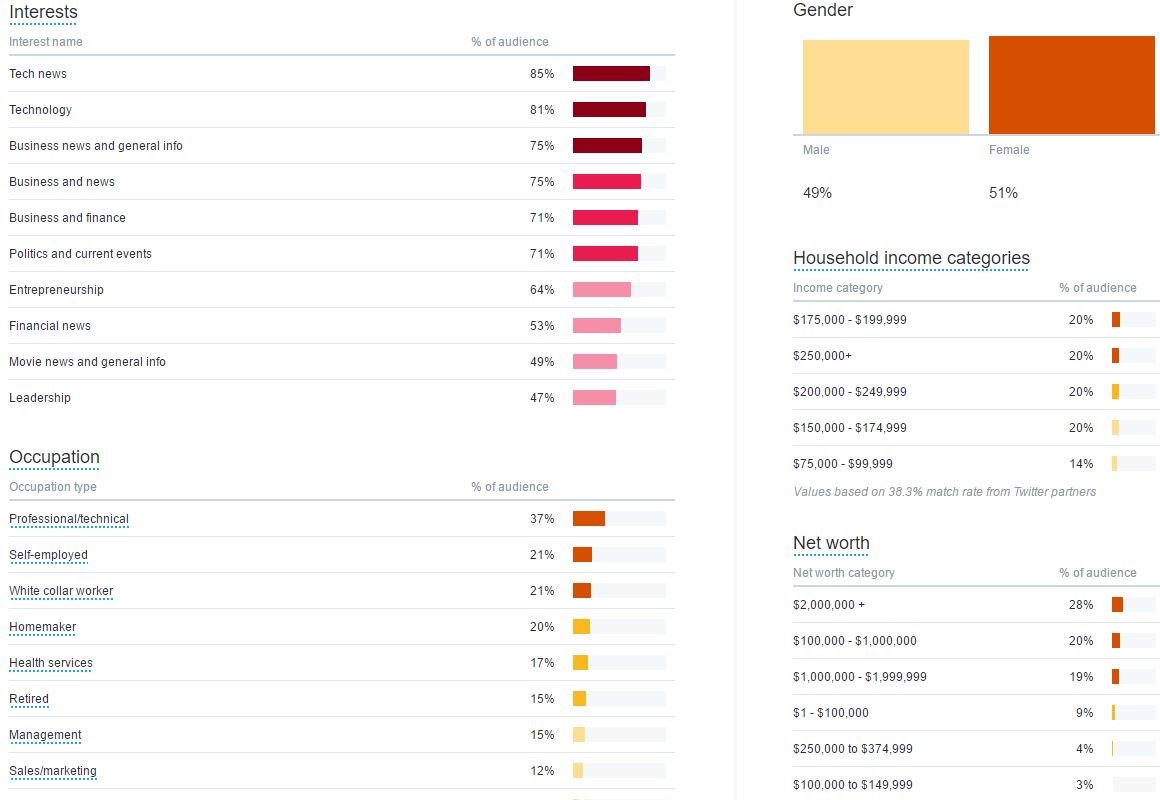
Twitter audience analytics

Your audience analytics will give you an idea of who is reading your tweets. I’m pleased to see that I am followed by whom I intended to be  followed: techie nerds, both male and female.
Analytics reports are like checking your pulse. You want to make sure your sites are still up and running.

Watching YouTube with purpose by Lihsa

How many of you out there regularly watch YouTube videos? Mostly people randomly watch videos. But it is possible to follow YouTube in much the same way you follow a podcast.

I’ve been a YouTube subscriber for about 7 years and really active for the last 4 – 5 years.

It is a great way to learn the learn new skills, follow a hobby or even catch up with cable TV shows. Many times, I’ll go straight to the government agency to watch speeches that I might have missed on TV.

How to subscribe to YouTube videos for CLE self-study, watch news and learn new skills

Not to mention that if you really get into YouTube, you can opt into YouTube Red for $9.99 a month and have an ad-free experience.

YouTube perks and channels

Another perk is that any movies that you bought through GooglePlay for Android will be accessible through your YouTube account.

I am currently subscribed to around 50 channels like the New York TimesVanity Fair, BookTVMayor Sylvester TurnerFood WishesTexas State BarHarris County Law LibraryThe Financial Diet, Last Week Tonight, ExcelIsFun and car mechanic Chris Fix. I also have a lot of guilty pleasures that I won’t divulge here (did anyone say make-up or home decor?).

UPDATE: Since posting this blog, @NYT notified me of a new Museum of Modern Art docu-series, At The Museum. At this time, it is only available for streaming on YouTube.

How to subscribe to a YouTube channel

Let me show you how to subscribe to a channel. You want to subscribe to at least 20 because not everyone consistently produces content and there can be large gaps between videos.

To subscribe, search for the channel in the YouTube search box, then hit the red “Subscribe” button either to the right of the channel search result or underneath the channel’s masthead. There is also a similar button within every video.

How to subscribe to YouTube videos to earn CLE self-study, watch news and learn new skills

Now, when you log into YouTube, you can access your subscriptions and watch the latest videos by moving into the left navigation and select “Subscription.” Plus, the latest videos will display in the center pane.

How to subscribe to YouTube videos to earn CLE self-study, watch news and learn new skills

How to get notified of new YouTube videos

If you want to be notified more quickly when your subscribed channel posts its latest videos, you can opt to get “notified.” Within a selected video, click on the bell icon to the right of the “Subscribe” button  on the YouTube video. The bell icon also appears next to the subscribe button in a YouTube channel search result.

Channel listing in a search result:

Video display:

How to subscribe to YouTube videos to earn CLE self-study, watch news and learn new skills

This will then push a notification via YouTube or, if you opt in, via email. To set this, go to “Settings” > “Notifications” and then scroll down to “Channel subscriptions” and select “Occasionally notify me … .” You can then choose to either get a push notification or an email notification.

How to subscribe to YouTube videos to earn CLE self-study, watch news and learn new skills

YouTube subscriptions and auto-play

The biggest drawback I have with YouTube subscriptions is that YouTube subscriptions don’t autoplay one right after the other. I have to actively go in and select the next video.

The only way I can get my subscriptions to auto-run is if I am watching a savvy YouTuber who has playlisted his/her videos. But even this is quite right–what happens is that if I am watching a Food Wishes post roast video, the next auto-play video will be another Food Wish’s beef recipe from his beef recipes playlist.

However, I’m confident that YouTube will soon fix this glitch.

Let me know if you are as avid as YouTuber as I am and if you have any favorite channels that you enjoy watching.

Photo by Annie Spratt on Unsplash

In 1995, a law firm was approached by one of its major clients to open an office in the city where the client’s headquarters was located. The law firm really didn’t want to expand into a new region of the country, where it had no other significant clients, so it politely refused the clients request. The client, however, was very persistent, and continued to press the law firm to open a new office in order for their joint legal teams to work closer to one another. The client would not back down, but then neither did the law firm. In a last-ditch effort to entice the law firm over, the client offered to donate its entire law library collection to the law firm; thousands of linear feet, worth hundreds of thousands of dollars of reporters, treatises, and specialty collections were offered in order to convince the law firm to open a new office. The law firm was stunned by the offer and immediately agreed to open the office. Twenty-Two years later, the law office thrives… and the law library collection that sealed the deal? It barely exists today.

True story.

On the surface, this sounds like a sad story for law libraries in law firms. Once the centerpiece of a law firm, the law library now inhabits a small fraction of the space it once did. Does this mean that the law firm no longer has a library? If all you think about is the space a law library takes up, then yes. If, however, you think of the library as the information and knowledge needed to effectively practice law, then the law library is as important now as it has ever been… perhaps more important than it has ever been.

I talked with a reporter a few weeks ago about another firm that actually re-purposed their old library space and sublet that space to a start-up company. The reporter found it to be telling that the traditional book law library was literally losing ground to a modern start-up company. What the reporter didn’t realize is that the law library actually became its own little start-up and had already reinvented itself. The traditional law library was about space, size, beauty, and being a showpiece. The modern law library is about function, ease of use, portability, and just-in-time availability. This isn’t a paradigm shift that suddenly appeared in 2017. This has been a gradual shift that has occurred over the past twenty-five years or more.

Law firm libraries occupy less space than ever, yet contain more information than ever. Saying that a law firm library has lost its importance because it has a smaller physical footprint is like saying that today’s laptop or tablet is less important because it doesn’t take up as much desktop space as an IBM Selectric typewriter. It’s actually quite a silly notion once you really think about it.

The modern law librarian has taken advantage of the paradigm shift and has reinvented themselves away from maintaining and updating a physical collection toward developing and training the members of the firm to understand which tool is the most valuable at the appropriate time. Very few firms lack for resources. The problem is that we have so many resources that we become overwhelmed by them. The law librarian’s skill at helping others find the right resource for the task is more important than ever. Moving the idea of the law library away from the physical and focusing on the actual information available has opened up opportunities for innovated law librarians.

So when you think back on the “good ol’ days” of the law firm library being the centerpiece of the office, don’t be sad for the law librarian that it has faded away. Be grateful that the law librarian is now offering you more information than ever before, and will gladly help you understand how to use it effectively.