Last post, I got distracted by silly claims about AI lawyer robot magic. The post before that I focused on an issue of genuine moment and merit. I cited a study on the surge in spending on alternative legal service providers (ALSPs) in the context of the stagnation in spend on law firms. I also set for myself the task of trying to explain why ALSPs seem to finally be hitting an inflection point given that their value proposition has been obvious for years.

To summarize my thoughts:

Change is hard and intermittent. Law departments needed to graduate from simplistic insourcing to an ops-oriented mindset (relational view) and act accordingly.

If you need more than that, a long post follows. Read at your own peril.

An Overly Simplified Model of Evolution of Corporate Legal Services

Initially, the path of least resistance is to pay the premium for white-glove service. Toss it over the wall. Let the prestigious law firm deploy as many expensive bodies as they deem fit. Pay the bill.

Eventually, fiscal reality sets in. The distance between the client organization and the law firm also creates frictions. Beyond just increased costs, the challenges of communication, alignment, and our-business acumen undermine execution and outcomes.

It is often better and cheaper to bring the work in-house. Until it isn’t. Eventually, in-house departments run into all the standard diseconomies of scale while still encountering many of the peak-load issues that originally caused them to rely on outside counsel (demand for whom flattens rather than declines). That is, law departments import many of the problems of managing lawyers/matters and do not eradicate the external challenges that prompted their insourcing.

At this point (the point we’re at now), the search for substitutes begins in earnest. The growth in demand for legal services substantially outpaces the resources available to pay for them (more for less). So attempts are made to improve operations subject to constraints (run legal like a business). That means systems. Technology and outsourcing are pieces of this systems puzzle that enable a legal function to operate at scale without sacrificing quality.

Unfortunately, integration of technology and ALSPs prove not to be quick fixes (hint: there is no such thing). The law departments want it to be one way. But it’s the other way. They want it to be easy. They want it to be magic. They want technology or managed services to be similar to white-glove law firms: the client’s obligations mostly begin and end at paying the monetary cost. Once the enchanted system is in place, it is supposed to deliver superior outputs from the same inputs—i.e., no one has to materially change their behavior. The faith in immaculate, organic improvement is part of the legal profession’s “last mile problem.”

It is never that painless. On this point, I love the graph below, except for the minor problem that it is wrong.
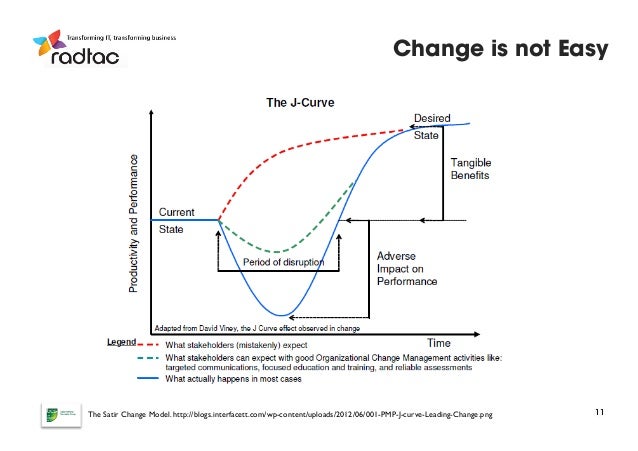
The implementation dip is real and wildly underrated. The gap between stakeholder expectations and experience is also accurate and too often ignored. But the chart goes awry by implying that all improvement projects succeed eventually. In the real world, 70% of improvement initiatives fail (and lawyers, in particular, are allergic to failure). This chart provides a dose of reality:
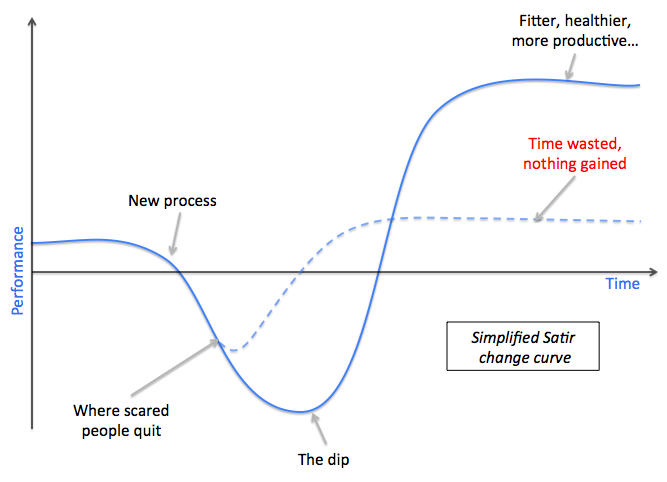
Except I would replace “scared people” with busy people under intense pressure to immediately deliver flawless, mission-critical work.

Systems are hard, take time, and demand constant care and feeding. Compared to systems, highly trained professionals are relatively self-starting, self-integrating, and self-regulating. Bring in a new-but-service-ready body and give them some of the load to carry. It is as close to plug-and-play as it gets

There is a compelling logic to most in-house hiring binges. But the logic only extends so far. Almost any law department with substantial external spend can demonstrate immediate ROI by bringing work in-house. But what to do when there is a hiring freeze? What to do when your department is responsible for cutting spend like every other department? One of the many dirty secrets about regularly paying exorbitant sums to external counsel is that it makes intermittent cost-cutting mandates relatively simple to satisfy. Internal headcount does not exhibit the same flexibility. And there are limits to what can be achieved, long term, by merely replacing expensive external headcount with moderately less expensive internal headcount.

Moreover—and this is important—every hire is someone who a few years down the line can join the risk-averse chorus: “But we’ve always done it this way.” Onboarding lawyers means managing lawyers. Insourcing law-firm lawyers also imports law-firm culture. Slow to change but quick to question, in-house counsel remain highly trained, autonomy-seeking issue spotters who will immediately identify the genuine pain of transitioning to a more systematic approach and then cite the inevitable implementation dip as evidence supporting their implicit position that maintaining the status quo is optimal.

One leadership failure is to succumb to the sniping and griping. But the leadership failure that most concerns me is pretending like these prognoses of pain lack merit. While the motivations to resist change may not always be righteous, the pain is real. Proceeding on the presumption that pain is avoidable is a recipe for failure.

The Pain of Managed Services

There are absolutely law departments who have successfully incorporated managed services into legal service delivery. There are also law departments who have tried and failed. What is disorienting is how similar their stories are.

The failures will generally tell you that they tried outsourcing but were displeased with the results. They put in the same kind of due diligence that would go into selecting a law firm. They sent the work to the chosen provider. What came back was unsatisfactory. They didn’t have the time or resources to train the provider to the point where the output would be acceptable. So they abandoned the initiative.

Most of the successes will tell you that they tried managed services and were initially displeased with the results. They had put in considerably more due diligence than would go into a selecting a law firm. They sent the work to the chosen provider. At first, what came back was unsatisfactory. But the department expended the time and toil to train the provider. And the provider reciprocated. Those efforts are ongoing. The initiative shows spectacular returns on investment but will never be fire-and-forget. There is constant monitoring, feedback, dialogue, experimentation, iteration…

As with most enterprise-level technology, enterprise-level managed services require a program/system administrator. I know this runs counter to most advertising pitches. I recognize everything is supposed to be self-driving these days. But I have yet to encounter a successful managed-service relationship at scale that is fly-by-wire from takeoff through landing. The people in charge of the successful relationships spend much of their time on the relationships. It is not another responsibility you just pile onto someone who is already operating at capacity.

This is not a jeremiad against managed services. I’m a strong proponent of managed services. I consider them essential to ecosystem and predict they will only grow in importance. But before embarking on a managed-services initiative, most of the future failures are living in a fantasy world about the total cost of ownership. They are focused the enormous savings potential (quite real) and ignore just how much work they are going to have to put in to realize and maintain those savings.

The Missed Opportunity (a digression)

What is true of managed services is, as I mentioned, true of technology. We believe in miracles (robot magic) to our detriment.

It is also true of law firms (and in-house teams, a topic for another day). A systems-oriented approach to outside counsel management could increase yield considerably. But it will not happen by accident. It is not automatic, let alone inevitable. It is a series of deliberate decisions full of tradeoffs followed first by the pain of implementation and then resource-intensive monitoring/management/iteration. In short, it won’t happen unless you ask and act. Even then, not every firm will prove a willing partner.

Ron Friedmann recently posted a fabulous round-up entitled Large Law Firms Must Improve Client Service Delivery. I concur with the premise, the analysis, and the conclusion. But there is something amiss with the following chart Ron cited from BTI:
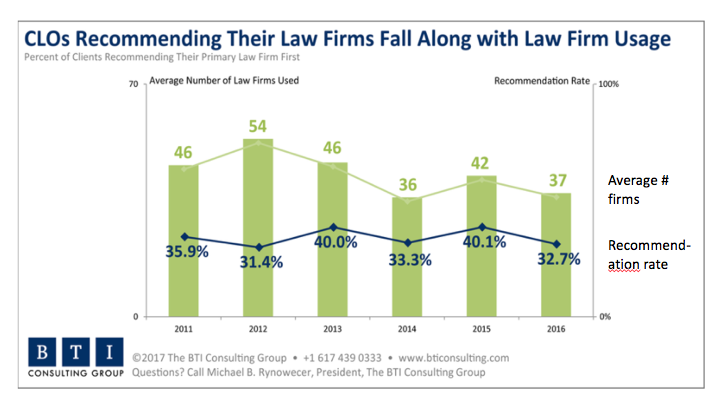
Not only have clients been displeased with their law firms for years, they have been expressing this dissatisfaction in publicly available surveys. And they’ve been shedding firms. But nothing has changed. Law is a buyer’s market and has been for a decade. If the market is not changing to the buyer’s satisfaction, we have to inquire what the buyers are doing wrong. Yet what more can buyers do than voice their discontent and exit when their needs are not satisfied? Quite a bit.

Vague expressions of dissatisfaction are a poor guide to action. Even the seemingly concrete step of firing a few firms is a fairly weak signal. I promote this insane idea, captured in my writing on deep supplier relationships and strategic sourcing, that clients should have regular structured dialogue with their firms about continuously improving legal service delivery. But, per usual, the irreplaceable Ken Grady has said it infinitely better:

Clients need to get serious about understanding their supply chain and how to structure it. We hear that clients use alternative legal services providers more frequently and pull more work in-house. Those changes don’t show supply chain understanding and remodeling. They show clients swapping higher cost for lower cost in an existing supply chain.

The suppliers in the legal industry may change, but the supply change structure remains the same. A client hires a law firm. Everything is transactional, with little or no integration. Even when that client goes back to the law firm for help, each matter is transactional without integration. This is an old supply chain model. To the client’s detriment, it favors the supplier, not the buyer.

In 1980, Harvard Business School professor Michael E. Porter published the Five Factors Model. We use it to analyze an industry’s structure. We consider: 1) bargaining power of suppliers, 2) bargaining power of buyers, 3) threat of new entrants, 4) threat of substitutes, and 5) industry rivalry. Based on the analysis, we can measure the intensity of competition in an industry. Intense competition means suppliers earn lower profits.

When we look at the legal industry, the model shows low competition. Suppliers can earn outsized rewards at the expense of buyers. As competitors have entered the legal industry, the results shift a bit. But, the structure favors suppliers earning outsized rewards. This is one reason law firms can raise rates each year.

The structural shift that makes sense for the legal industry goes counter to the direction clients have taken. Jeffrey Dyer and Harbir Singh call it the “relational view”and described it in a 1998 article.

Under the relational view, suppliers and buyers integrate processes. This creates seamless, cost effective, higher quality workflows. The automotive industry is a visible example of this approach. An assembler integrates with Tier 1 suppliers, who integrate with Tier 2 suppliers, and so on. Before you say “lawyers don’t assemble cars,” I’ll point out that some clients and law firms use this same approach. The supplier and buyer work for mutual advantage rather than winner takes all.

How does this work? The supplier and buyer think long term. Working together, they set a goal. Then, they examine and integrate their existing processes. They design a value stream that flows through the entities. Value streams in the old model start and stop at each entity’s door. They build and invest in a relationship and in each other. They develop trust and expect the relationship to continue.

That relationship means the supplier will invest in innovation that benefits both it and the buyer. It means it won’t try to maximize the return on each matter. Instead, it will maximize the return on the relationship. It means the buyer will return to the supplier rather than shop every matter. The buyer invests in the supplier. Studies show that using the relational view, suppliers and buyers both do well. The supplier has a continued relationship at lower profit per transaction. But, that is better than higher profit per transaction and constant churn.

Finally, external competition keeps the parties on their toes. If a buyer stops investing, innovation will drop off. That in-house law department will be less competitive than departments in other companies. The corporation has a competitive disadvantage. If a supplier stops investing, the buyer will leave for a stronger relationship. We see that today. Buyers report they already have dropped many firms and plan to continue the trend.

Today, corporate law departments still use the transaction view for supply chain structure. They do not build competitive advantages, just temporary cost benefits. Law firms do not invest, because they have no incentives to do so. The transaction view drives low innovation, higher cost for the buyer, and higher revenue for the supplier.

Back To Managed Services


I’m going to do something ill-advised and disagree with Ken, slightly. Everything Ken wrote is gospel. If law departments treat ALSPs (or in-house teams) as lower cost substitutes for traditional law firms, they will encounter most of the same issues that engender their dissatisfaction with traditional law firms—and, likely, additional issues since the ALSPs are not designed to fill the law-firm role. My section above on failed attempts at managed services confirms that I’ve seen that movie more than once.

But I think there are material differences that favor ALSPs in the medium term. The obvious ones are that ALSP’s value proposition, culture, and corporate structure make them more cost-effective, flexible, and willing partners than most (all?) traditional law firms. In this regard, I cannot recommend enough Bill Henderson’s latest ABA Journal cover story on managed services.

I want to emphasize, however, the less obvious (but, possibly, more important) underlying shift in mindset in that law departments are more inclined (it isn’t automatic) to take the relational view with ALSPs.

Legal work is necessary. Legal work is important. Legal work is done by lawyers. The better the lawyers, the better the legal work product. Get the best lawyers you can afford. Then leave the lawyers alone to do what they do best.

This is the anti-relational view. It is not natural, but it is so ingrained that it feels natural. If it is high-end legal work, it should go to a high-end lawyer. And high-end lawyers have earned their autonomy.

The anti-relational view was great for law firms as long as everything was viewed as high-end legal work. The moat was definitional. It was high-end legal work because high-end lawyers had traditionally done it. But there is a negative pregnant: high-end lawyers don’t do low-end legal work.

And times are changing. Law firms are not changing with it. Work is being unbundled. We are recognizing that much of ‘what lawyers do’ is necessary but low-value add. It is amenable to systematization. It is amenable to managed services and automation. I’ve enthusiastically stolen this chart from Bill’s article:
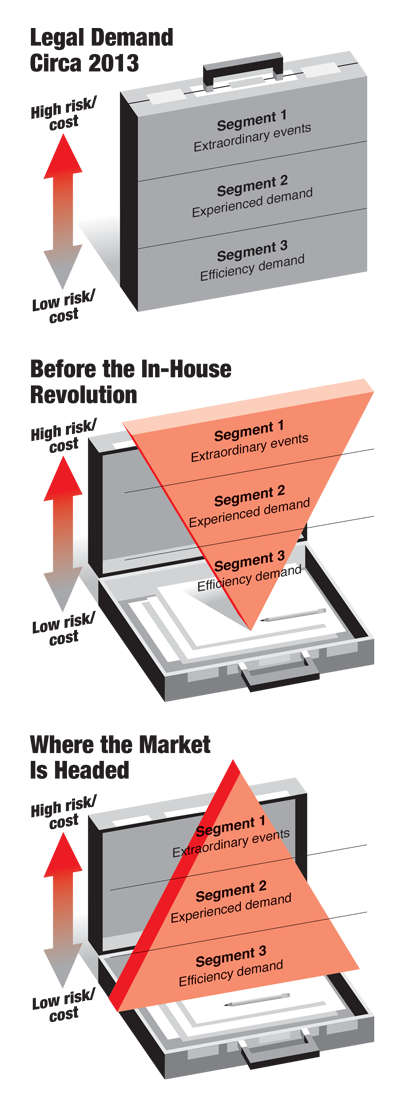
Segments 1 (extraordinary events) and 2 (experience demand) were very valuable real estate for law firms to own. That remains true. But work is increasingly being moved to Segment 3 (efficiency demand). Not all work. Law firms will not disappear anytime soon. In raw numbers, many law firms will continue to thrive. But, in percentage terms, many law firms will struggle as they are stuck in the mushy middle between the true high-end of the market and low-cost, low-margin volume players (i.e., ALSPs). We’re already seeing it

Unbundled work is being sent to ALSPs for many reasons. But an important one is the mental categorization:

High-end, bespoke legal work to high-end lawyers with hands off (anti-relational view)

Systematized legal work to ALSPs with hands on (relational view) 

Like Bill, I consider the in-house revolution instrumental to the rise of ALSPs. Size can support specialization. Specialization can breed sophistication. 

In part, this means law departments have enough internal expertise to call bullsh#t. That is, they have sufficient domain expertise to identify the low-value work amenable to managed services. But that’s generally only applicable to moving work from law firms to ALSPs. What about moving work from in-house (where half of spend now resides) to ALSPs? Who calls bullsh#t on in-house counsel exclaiming that “we’ve always done it this way”?

The functional head of legal* and her legal ops lead** are the people generally charged with change management. The head of legal provides the vision and authority. Legal ops executes and maintains. Indeed, many of these managed-service relationships get moved under legal ops. Why? Because ops-oriented professionals are more likely to take the relational view. Because line lawyers who started at law firms and who were brought in-house in order to oversee law firms are predisposed to treat ALSPs just like law firms (which, to return to the digression, is one reason why the law firm relationships are so hard to change; law firms do not have a monopoly on status quo bias). Conversely, it is rare (though it does happen) for legal ops to be given sufficient dominion over existing law firm relationships. So legal ops have more of an opportunity to make an impact with ALSPs, and ALSP initiatives are more likely to be successful under legal ops. It makes sense to me that the maturation of ALSPs and legal ops are happening simultaneously.

That’s my long answer. Despite the value proposition being evident for years, ALSPs are only now reaching the inflection point because change is hard and intermittent. Law departments needed to graduate from simplistic insourcing to an ops-oriented mindset (relational view) and act accordingly.

_______________________________________
D. Casey Flaherty is a legal operations consultant and the founder of Procertas. He is Of Counsel and Director of Client Value at Haight Brown & Bonesteel. He serves on the advisory board of Nextlaw Labs. He is the primary author of Unless You Ask: A Guide for Law Departments to Get More from External Relationships, written and published in partnership with the ACC Legal Operations Section. Find more of his writing here. Connect with Casey on Twitter and LinkedIn. Or email casey@procertas.com.

* I use “functional head of legal” because I’ve come to appreciate that sometimes the GC/CLO is pretty far removed from the operations of the legal department. They are busy with the C-suite, board, major deals, investor relations, etc. They still provide invaluable service to the company. But they are not involved in the day-to-day operations of the department they putatively run. Instead, department leadership is delegated to one or more VP/AGC types. 

**I use “legal ops lead” because titles are all over the map. I meet people who do not have the word “operations” anywhere in their title but who dedicate much, if not all, of their time to operations. Likewise, I meet people whose titles are something like “Head of Legal Operations” and quickly discover they are a glorified billing administrator. Law departments can have legal ops without a formal legal ops role. And law departments can have a legal ops role without any real legal ops. 


Couldn’t help myself. I encountered a tweet about a “robot lawyer” and took the bait. I’m a moron.

An unwise decision. Silliness promptly followed. To preview, Robot Lawyer LISA is just another document assembly tool with a single mediocre form (an NDA). For what it is—consumer-facing doc assembly—the concept and content are fine relative to what else is available. The claims to be something more—an  AI robot lawyer—are absurd. The hyperbole, however, is effective (here I am writing about it like a sucker) and unsurprising given that we (hopefully) just passed the peak of another hype cycle.

As document assembly tools go, the Robot Lawyer LISA’s UI and UX are reasonably slick if slightly buggy.* It’s built on Neota Logic, a platform I like. With respect to the content, I outsource the analysis to the incomparable Mr. Contract, Ken Adams (see my previous post on Ken and online legal forms):

I had a look at the fruits of your dalliance with LISA the AI Lawyer. The best I can say is that someone who fraternizes with LISA might well end up with something more suitable than if they had grabbed an NDA at random from the great online junkyard.

The questionnaire offered is basic. The annotations offered are rudimentary. The guidance mostly comes in the form of an AI-free PDF. But that’s probably OK—LISA is aiming for the unsophisticated end of the market.

The language in the output document is Clunky Traditional, English Division. I could write a book about its shortcomings. In fact, I already have. That said, it would be delusional of me to fault the language because it doesn’t comply with my guidelines, given that my guidelines are still, uh, pioneering, particularly in England.

In the two minutes—really—I devoted to substance, I spotted two issues. A recital refers to information that might be “confidential or proprietary in nature.” The word proprietary doesn’t make sense in this context, as I discussed in this 2010 blog post. It’s an unnecessary mistake for LISA to make, given that the word doesn’t occur in the body of the contract. But it doesn’t bode particularly well.

And I noticed this sentence in the PDF: “The main reason and benefit of using a deed rather than a simple agreement is that confidential documents or information provided BEFORE the NDA is signed will be covered by the deed.” That strikes me as debatable: if as part of getting more confidential information I agree to keep confidential any information disclosed previously, my promise is supported by consideration without my having to resort to the magic-words contrivance of describing the contract as a deed.

Further rooting around would likely raise further issues. That said, the substance is likely treated no worse than it is in the mass of stuff out there.

I realize I’m setting the bar low, but we’re dealing with business contracts, where dysfunction is the norm, so you can set the bar low and conceivably still be useful. But don’t expect me to applaud. Given the brave-new-tech-world trappings, I would have expected something a bit more ambitious, in terms of technology and content, from LISA the AI Lawyer.

I didn’t share Ken’s expectations. Vain hope, sure. But no room for genuine disappointment. Grandiose claims about “robot lawyers” put my BS detector on high alert. “Artificially intelligent”, “robot”, and “lawyer” are vague terms that continue to be stripped of meaning by overuse. Robot Lawyer LISA takes this vacuousness to new heights.

AI is a broad field. I’m comfortable with expert system platforms like Neota Logic being considered a form of AI. I don’t have the chops to argue otherwise. Still, I doubt it conforms to what most people today think of when they hear the term “artificial intelligence.” We constantly move that goal post: “It’s only AI when you don’t know how it works; once it works, it’s just software.

At a recent conference, I presented with co-Geek Ryan McClead, a VP at Neota, who recounted many debates about whether his product qualifies as AI. His killer rejoinder (paraphrasing) is that it doesn’t matter if the technology conforms to someone’s subjective definition of AI, what matters is whether it solves a real problem better than what is currently available. Hear, hear!

The reason I had to try Robot Lawyer LISA for myself is because I could not elicit a coherent answer on what made it superior to the available alternatives. Like Ken, I found it, at best, comparable to what has been around for years. If Robot Lawyer LISA is AI, so are all the other consumer-facing dynamic document assembly platforms. Which is to say the AI label is not a useful distinguishing factor.

I made a good decision in staying out of the argument about what constitutes AI. Instead, I stupidly plunged into the “robot lawyer” abyss:

As the person behind the account surely knows, the definitions of “robot” are broad. Most people probably think of these:


But there are software robots. So I guess, technically, we can take the broadest definition and call any form of software automation a “robot”, just as we can call it all “AI.” This, however, makes AI robot both redundant and virtually meaningless as a descriptor.

There seems to be no statutory definition of “lawyer” in the UK (happy to be corrected on that). Yet Robot Lawyer LISA does not satisfy any of the plausible candidates I located:

From The Law Society:

Lawyer – a member of one of the following professions, entitled to practise as such:
the profession of solicitor, barrister or advocate of the UK

  • a profession whose members are authorised to carry on legal activities by an approved regulator other than the Solicitors Regulation Authority (SRA)
  • an Establishment Directive profession other than a UK profession
  • a legal profession which has been approved by the SRA for the purpose of recognised bodies in England and Wales, and
  • any other regulated legal profession specified by the SRA for the purpose of this definition.

From Slater and Gordon:

The term Lawyer is a generic term used to describe anyone who is a Licensed Legal Practitioner qualified to give legal advice in one or more areas of law.

From Oxford Dictionaries:

A person who practises or studies law, especially (in the UK) a solicitor or a barrister or (in the US) an attorney.

Best I can tell, Robot Lawyer LISA is not a member of any profession, not entitled to practise, not licensed, not qualified to give legal advice, and not a person, let alone a person who practises law. Indeed, the site delivers the disclaimers you would expect from an ordinary online document assembly service:

this App is made available to you strictly on an ‘as-is’ basis and we give you no warranty, guarantee or assurance of any kind about this App.

In particular, the information provided may be incorrect or out of date, and may not constitute a definitive or complete statement of the law or practice in any area and the output of the App may not be suited to your particular purpose.

The information provided is not intended as, and does not constitute, legal advice in respect of any specific situation or for any particular purpose. You should take your own legal advice in respect of specific situations and conduct your own research into the suitability of lawyers before appointing them.

So Robot Lawyer LISA does not give legal advice. Instead, it counsels lay consumers to take their own legal advice (huh?) and do their own research before appointing a lawyer (and here I thought I already had a robot lawyer in LISA). Weak sauce.

I am sure someone from the Robot Lawyer LISA team can point me to a nebulous definition of “lawyer” that encompasses their app. But that will only prove that words have no meaning, and we are all living in the fever dream of a stoned college sophomore who is encountering Wittgenstein for the first time.

Whether there is some tortured, technical sense in which LISA can be called an AI Robot Lawyer is irrelevant (to me). What matters (to me) is that labeling LISA an AI Robot Lawyer does not convey any useful information to the consuming public.

This prompts two questions that share an answer:

1. Why do damage to the English language in order to call LISA an AI Robot Lawyer?

2. Why do I care?

Because it works. At least in the short term. These days, it would be hard to garner press coverage for launching yet another doc assembly app for basic contracts. You won’t be invited to keynote any conferences for providing lay consumers a single mediocre form to fill out online. But put “AI” or “robot” in the press release, and the near-term coverage will be considerable. So you should probably use both. And it isn’t just chumps like me who read everything. It is the headline skimmers in positions of power.

I run into too many legal operations folks in corporations and firms suffering from hype fatigue. They never bought into the hype themselves. But their superiors see so many article about AI and robot lawyers that orders come down from on high to investigate this promising new frontier. The superiors are expecting robot magic. The operations folks come back with a smattering of point solutions, most of which are useful, but none of which live up to the hype. This exercise in chasing shiny objects wastes everyone’s time, including the providers, who actually have worthwhile, if narrow, products to offer.

Likewise, I’ve endured too many god awful keynotes where people run through some back issues of Wired and then conclude with “and it’s coming to law”, as in:

Watson won Jeopardy! And now he’s not only curing cancer but also making gourmet meals. yada yada yada. Moore’s law. yada yada yada. Alexa. Siri. yada yada yada. Augmented reality. People are controlling drones with their brains. yada yada yada. Blockchain. IoT. 3D printing. Quantified Self. Chatbots. Self-driving cars. Machine learning. Quantum computing. Cold fusion. Red mercury. yada yada yada. And it’s coming to law.

I am so tired of sitting through these insufferable, interminable fluff parades. It’s novelty porn. It’s distraction. Yet it has a real cost. Attention is finite. The operations folks dispatched to uncover the dark mysteries of robot magic are not devoting their limited research time to solving actual problems. The vendors who have to entertain these fishing expeditions get derailed from speaking to legitimate prospects or from coming to terms with immediate market needs.

Despite my deep annoyance at Robot Lawyer LISA and my even deeper disappointment in myself for taking the bait, this is where I have to give the usual caveat that it is not all fluff. Document assembly and automation are still, decades later, underutilized in the legal space. Consumer-facing forms fill a genuine void. Neota Logic is a great platform that underpins all sorts of interesting offerings (e.g., the Akerman Data Center). There are other solid companies out there using various forms of AI to introduce needed tools to the legal market. And some of the best keynotes I’ve ever had the pleasure of attending have AI as a core theme (e.g., I witnessed Dan Katz’s phenomenal ILTA keynote live and then watched it again online).

There is real innovation happening in legal that is well worth paying attention to. But this ain’t it. This just adds to the deafening cacophony of hype-driven noise. Yet I can’t blame the folks running Robot Lawyer LISA. Start-ups are hard. The legal market is an especially tough nut to crack. They found a way to get noticed. That their marketing annoys a curmudgeon like me is, for them, probably just an added bonus. Ultimately, I have to score this round for Robot Lawyer LISA because I just wrote a long post about a vanilla doc assembly offering with only one form.

_______________________________________
D. Casey Flaherty is a legal operations consultant and the founder of Procertas. He is Of Counsel and Director of Client Value at Haight Brown & Bonesteel. He serves on the advisory board of Nextlaw Labs. He is the primary author of Unless You Ask: A Guide for Law Departments to Get More from External Relationships, written and published in partnership with the ACC Legal Operations Section. Find more of his writing here. Connect with Casey on Twitter and LinkedIn. Or email casey@procertas.com.

*Robot Lawyer LISA’s UI and UX are solid. But, despite selecting the United States as my jurisdiction, I could not move forward without a “Company Number.” I’m assuming this refers to a CRN. The U.S. has no meaningful analogue (I’m not going to put my EIN in an NDA). My text response—”don’t have one”—made it into the assembled document.

In addition, I was required to provide a backup email for me and my counterparty. It is rare that I have a second email address for someone I am just starting to do business with.

I also did not see any esignature functionality, which, to me, is a key feature in the contract space.

Finally, I should probably mention that Robot Lawyer LISA’s other differentiator is supposed to be impartiality. Instead of guiding only the author through the document assembly process, the counterparty can opt to walk through the same guided process. I’m unmoved. I don’t know if its novel in this space. I’ve definitely encountered bilateral contract collaboration platforms on the corporate side. But maybe it really is some sort of gamechanger that I am too jaded to appreciate. If it ever gets to the place where it can help creatively resolve disagreements about contractual content (e.g., combining Ken’s insights on contract language with, say, the choiceboxing techniques of Marc Lauritsen, who happens to also be the godfather of legal document assembly), then I will revise my opinion and apologize for my rank cynicism.

[Ed. Note: Please welcome guest blogger, Steve Nelson, Managing Principal, Law & Government Affairs, The McCormick Group. – GL]

One of the big topics discussed recently in the legal press is how the very large firms continue to separate themselves from the rest of the AmLaw 200. In an article accompanying the American Lawyer’s financial disclosure reports for the AmLaw 100, the magazine revealed some pretty shocking statistics; while the top 50 firms reporting significant increases in revenue per lawyer, profit per partner and profit per lawyer, the next 50 firms reporting decreases in all of these statistical categories.

This is not a new phenomenon. Over the past few years, many observers have been writing about how the mega-firms are pulling away from the pack. You would think that a large number of midsize firms would be responding by illustrating how they are more efficient and provide very value to clients.  But a recent study performed by The McCormick Group seems to show otherwise.

Since around 2000, and particularly since the advent of the Great Recession of 2008, firms have responded to calls for efficiency by hiring three types of professionals, those handling practice group management so that each practice area can be run more efficiently and more profitability, pricing professionals to respond to corporate calls for alternative fee arrangements, and legal project managers to work directly on engagements to provide value to the clients and efficiency to the firm.

Of those three, one—pricing professionals, have become virtually de rigueur in the AmLaw 200.

Largely because the firm needs to have someone with a financial background respond to requests for proposals and other demands for alternative pricing, more than 80 percent of the AmLaw 200 have at least one professional focused on pricing.  And that has run the gamut from the very large firms down to the bottom of the AmLaw 200.

But the acceptance of practice group management and legal project management is much more uneven.  On the one hand, 60 percent of the AmLaw 50 firms have professionals handling each role, and 76 percent have one or the other.  And when one considers that nearly half of those who have not instituted such programs are either big New York-based firms or large one-practice specialty firms, the adoption rate among large multifaceted law firms is higher.

But as the accompanying chart shows, the percentage of firms having those professionals in place drops dramatically throughout the rest of the AmLaw 200; only 19 percent of the Second Hundred have practice group management professionals, and even less (13 percent) have LPM specialists.

Firms PG Mgt. LP Mgt. Both Either
Top 50 30 30 22 38
51-100 18 26 13 31
101-150 12 10 4 18
151-200 7 3 1 9

A few notes about methodology:

  • Firms were included as having these functions if they have professional personnel (not practicing lawyers) with identifiable responsibility over these functions, whether or not they included the words “practice group” or “legal project management.”
  • Professionals with a pricing or similar title were not included as having LPM responsibilities unless their title or profile included discussion of LPM. (At many firms, pricing personnel are supported by other professionals in the finance department who play a broader role within the firm.) 
  • On the practice management side, firms in some instances have designated just one practice (often IP) as having a practice group manager or business manager.  Those were included nonetheless, so the statistics may overstate a bit the number of firms having full-scale practice management programs. 
  • Of the firms in the top 100 that had no practice group management or LPM function, about half were either New York-based firms or were one-practice specialty firms.

The conventional wisdom among law firm experts is that the firms at the top are doing well because they often do bet-the-company work which commands whatever rates they wish to charge, and that alternative fee billing often works to those law firms’ advantage in terms of success fees on major transactions.  But according to Susan Raridon Lambreth, Principal with the Law Vision Group, while the largest firms do bet-the-company work, many of them also do a lot of other work that is increasingly fee pressured by major clients.  Many of the largest firms in the US are actually facing more pressure from clients on rates and efficiency than the mid-sized firms — by the size of the matters they handle and the nature of their client base.

“It’s the clients with sophisticated law departments that are putting the heavier pressure on firms when it comes to providing client value and the vast majority of their outside counsel are in fact at large firms.  As a result, large firms have significant pressure to provide volume discounts, detailed budgets or caps even on multi-year, complex matters and more. This has resulted in write-offs or downs in the tens of millions to over $100 million in many of the AmLaw 100 firms.”  

On the other hand, many mid-sized firms have a larger percentage of their client base with smaller or more middle market companies, she says, where there is less pressure to provide fee alternatives or budgeting, so the smaller firms aren’t really feeling as much pressure to change their approaches.  Another law firm consultant Timothy Corcoran of the Corcoran Consulting Group, puts it more bluntly.  “There are still a fair number of law departments doing a poor job of managing outside counsel.”

According to some industry surveys, resistance to industry change has been greater among the smaller and mid-sized firms.  Lambreth says that law firm leaders in those firms often want to institute changes, but they don’t have the partner buy-in.  There are a large number of partners that simply don’t see any need to change and it can be harder to make the business case for change short-term, even when there are long-term warning signs.

Indeed, instituting a PGM or an LPM program will often add up to between 5-10 new professional positions, which will often have a material impact to those firms which are already under pressure just to keep up with the previous year’s financial results.  That, Corcoran believes, is exacerbated to the fact that a number of smaller firms are laboring under a false impression about their standing in the market. “They have spent the last few years convincing themselves that clients have determined they’re just as good as the big firms and so now their philosophy is something along the lines of  ‘just as good as the big firms, but cheaper.’ ”  As a result, he says “they’re not doing anything particularly creative, such as embracing LPM to prove they’re just as good (or better).” Inevitably, they run the risk that another firm will come along that looks just as good and is another level cheaper and the client buys from them instead. Or the big firms that are embracing LPM and finding ways to generate higher profits at lower prices can now claim that they are in fact less expensive.”  So, says Corcoran, midsize firms are facing pressure “from above and below.”

So we seem to be at a crossroads:  the large firms that are doing the best economically have invested heavily in creating more value to their clients, while the midsize firms that are facing a more uncertain future are unwilling or unable to make changes so that they become more efficient.  That’s certainly not the narrative we tend to hear.

The talent at Columbia Law School apparently doesn’t limit itself to legal scholarship. The Law Revue put together a musical rendition of which online legal resource is the best “to cite… to cite.”

Whether it is the bribery of using Lexis, the snobbery of using Westlaw, or the lone man that uses Bloomberg, the Law Revue walks you through the law students’ night of deciding which resource is best.

So pick up your Lexis/Westlaw/Bloomberg coffee cup and sit back and enjoy the show.

Recently, I had the pleasure of speaking with Nancy
Jessen
, SVP at Legal Business Solutions at UnitedLex about a survey recently
completed with ALM on legal department insourcing, entitled “Build or Buy? The Evolution of Law Department
Sourcing”. Our chat was really interesting, different
than what I expected. Here’s what I learned.

We are all too familiar with the challenges facing law
firms – the rise of competitive pressure, rate 
squeezing, the need for better project management so as to be able to
not only price and staff matters effectively but also turn a profit.  We also know of the impact of legal
technology in the e-discovery space, in contract drafting etc. and all of the
many AI applications that are threatening to take jobs away from lawyers. We
think of these issues and many others as law firm issues rather than legal industry
issues and look to the alternative model law firms, and outsourcing as the
answer or at least on the path to legal market euphoria.  Nancy, and some of the ALM survey findings,
point out, however, that legal departments face many of the same issues. 
For many years, law departments were immune from
pressures and expectations that almost every other corporate function faced — cost
management, return on investment, justification for new resources, and
technology-driven efficiency to name a few.  Then, 2008 hit and everything changed. Not
just for firms, but for in-house departments, too. In-house teams were also
being forced to demonstrate value, provide legal recommendations that supported
business objectives, create internally efficiencies AND strategically direct external
counsel.  A difficult task for
in-house counsel, just as it is for law firms trying to make sense of the new
world order in legal.
Today, in 2017, managing e-discovery and other
litigation software, supervising external counsel and overall legal spend is
table stakes for in-house departments. Like their firm counterparts, today,
almost 10 years later, General Counsels are focused (or trying to focus) on
demonstrating value by increasing operational efficiency of the in-house team,
from balancing high-cost/low-value staff against low-cost, inexperienced staff;
dealing with the constant fear of the next budget cut  – something Nancy referred to as “death
by a thousand cuts;” or the hardest part of it all, insourcing/staffing
strategic lawyers who can sit with the C-Suite, make business decisions, help
the company grow, avoid risk and support initiatives with the highest and best
business impact.
The survey results, which include data from the ALM
Intelligence 2016 Corporate Counsel Insourcing and Outsourcing Survey, highlight
some of these moving parts:
·      
In 2017, only
26% of law departments expect their annual operating budgets to decrease, while
32% expect an increase, and 42% expect it will stay the same.
·      
In 2016, 34%
of respondents said the number of full-time, in-house lawyers stayed the same,
and 52% plan on maintaining that level in the next 12 months, indicating that
increased insourcing within law departments may be slowing down.
·      
In 2016, 39%
of legal departments surveyed decreased their overall use of outside counsel,
and 43% estimate they will do the same in 2017. Similarly, those who said their
utilization of outside counsel would not change increased from 43% in 2016 to a
projected 47% in 2017. Only 4% said they would increase the use of outside
counsel in 2017.
·      
Regarding
Alternative Service Providers, 57% of respondents send work to ASPs. Of those,
25% said they plan on increasing the number of ASPs they use in the next 12
months, and 28% said the amount paid to ASPs will increase in the next 12
months.
In-house counsel, too, are subjected to shrinking
budgets, doing more with less, engaging technology, and resourcing efficiently.
Just as many are calling on firms to radically change
their paradigms, it seems the in-house departments are also looking to shift
the paradigm. We see this in some small ways, with bold statements from in-house
departments wanting firms to increase diversity. In-house departments can do
more to change the archetype, but whereas firms have to deal with the
complexity of the partnership models, in-house teams face obstacles around
C-Suite buy-in, and personal reputation. 
GCs and firms both know they need to change. The
question is, how can you best be strategic, deliver value, increase
efficiencies AND operationalize all of it? 
Would you buy it, or build it?


One of the best things I get to do as the incoming President of the American Association of Law Libraries (AALL), is reach out to new members that have joined the association and talk with them on the phone. I find that the new members genuinely appreciate that someone has reach out to them, and took the time to welcome them to AALL. I have found that I, too, get a benefit from talking to the newer members because they give me some insights that I might otherwise never encounter. One such event happened to me recently and it helped me understand what we should be pushing as the real narrative of law librarianship and legal information professionals.

The person I was talking to was a Research Attorney (JD w/license, but no MLIS, so not a librarian.) We were discussing the overall structure of the departments, and how her role fit in with the librarians and other professionals on the team. We talked about the reaction from the attorneys and others within the firm, and she said something that caught my attention.

She mentioned that the lawyers would make comments about how “nice” and “helpful” the librarians and other researchers are. She said she commented back that that’s completely missing the point of the true value. These law librarians and other professionals are smart, curious, creative, intuitive, and brilliant in the work they do. They do not waste your time. They are efficient and effective in finding the correct answers, finding it quickly, and making sure that it doesn’t cost you more than is reasonable for the issue at hand. Yes, we can do that with a smile, but that’s the icing on the cake. The real value is that we do what we do better than anyone else. That’s what we need to push as the real narrative. Of course, we can still do that with a smile.

This discussion left me with a smile on my face as well. Even better, it left me with a clear narrative to make sure that smart, curious, creative, intuitive, and brilliant are included in that discussion.

Years ago I got into the legal speaking circuit after presenting on the future of the legal profession to a group of bar leaders. I called the presentation “Staying Relevant.” I credit this moment with pushing me into the spotlight of change in the legal profession since it lead to a slew of speaking invites and for me becoming known for driving change in the legal market.

This was 1999.
A lot has happened since then – but somethings from my presentation have yet to materialize. On one level, I should have published a book based on that presentation. That, along with a British accent, would have lead to much greater fame and fortune. But such was not to be.
The presentation covered a broad range of trends, from the incursions of technology to the emergence of alternative providers. At the end of the presentation I commented on the need for the profession to “stay relevant.” My catch phrase which I still use today is the “Paradigm of Precedence.” This label is meant to highlight how the profession is indoctrinated from an early age to look backwards – not forwards. At the center of that paradigm is that the courts look to the past for direction on today’s needs. This approach is bedrock to the judicial branch of government.
However, this thinking has spilled into every corner of the profession. Thus my recommendation to stop driving the boat by watching the wake.
Last week I presented at a courts and technology conference. I actually used my paradigm of precedence phrase as it was very applicable. What caught my eye at the conference was another session on the vanishing trial. The session noted how only a few cases ever go to trial anymore. 1 in 100 was the stat quoted. This is not new news. However, the session went on to talk about how the rule of law is threatened since without trials, the courts are no longer setting precedence. Instead, settlements, arbitrations and the like are where disputes are resolve: in private where they do not impact the law … or set precedence.
The punch line of my 1999 presentation was that lawyers can sit back and watch change, or they can engage and shape it. I noted that the three letters that should scare lawyers the most were H.M.O. – referring to the fact that when doctors sat back, there were real consequences for their profession. At the core of that concern for lawyers, I suggested, sits the Rule of Law. Back then I noted that if disputes were no longer resolved in public, by the courts, then the rule of law would be up for sale. So it should be of paramount concern to lawyers that the courts retain a viable place at the center of legal ecosystem.
A mere 18 years later the courts noticed – sort of.
This makes me take stock of all of my current thinking about change in the legal market and how it will be relevant in 18 years. And it gives me an idea for the title of my new book: Timing is Everything.

There are two standard answers to questions asked in a law firm setting.

  1. Well… it depends.
  2. You have to understand, we’re unique.

Both of them drive us nuts, but we get used to them and adjust or responses over time to limit the eye-roll and shaking of the head to a minimum.

When it comes to where a law firm library falls in the structure of law firm administration, both answers tend to get applied. If you were to look at the AmLaw200 firms, you will find that the law library function falls under many different types of leaders.

  1. Library Directors who report to:
    – COO
    – CMO
    – CIO
    – CKO (non-librarian)
    – (I’ll group these as CxO from this point)
    – Managing Partner
  2. Library Managers who report to:
    – KM Directors
    – CxO
  3. CKO (librarian C-Level) who report to:
    – COO
    – Managing Partner
By my count, there are approximately 7 CKO where they are Librarians in the AmLaw 200. (Or some variation, like me, where I am a Chief Knowledge Services Officer) As you might think, I have a bias toward this style of management. I’ve stressed the ability for law librarians to direct their own fates for nearly the entire decade I’ve written this blog, and will continue to do so as I take on a President role in the American Association of Law Libraries in July, and well beyond that. 

I mentioned in a post last year that if Law Librarians don’t find themselves a seat at the table, they will find themselves on the menu. When I tell other law librarians this, they agree, but then they look at me and say, “Greg, you have to understand, we’re unique at my firm.” What this typically means is that their firm doesn’t want to challenge the status quo, and likes things to stay as they are. There are firms with Library Directors that are much more progressive and forward thinking than me, yet there is no path to a C-Level for them at their firm. That’s a shame. The Law Library and its functions of compiling, analyzing, filtering, and producing legal and other information is one of the most important administrative functions that a law firm has. It keeps attorneys practice ready and up to speed on the very functions that drive the legal industry. We do the due diligence necessary to keep our attorneys informed and prepared. In the Information Age, we are the Information Professionals.

BloombergBNA President, Scott Mozarsky, penned a recent Above the Law article where he stressed the importance of what law firm libraries and librarians do to drive business in the door at law firms. He mentions that law librarians and legal marketers are teaming up and becoming a powerhouse within the firm to help drive business development and client awareness of the firm’s abilities. He mentions that this is a great collaboration, and that he is seeing more firms adopt the Researcher/Marketer team approach. I’ve seen this exact scenario going on in law firms for nearly two decades, and I’m sure it preceded my entry into the market. Mozarsky is correct in that this makes perfect sense to team up the analytical skills of the law library researcher, and the business and marketing skills of the law firm marketer. It’s a perfect match of strategy put into action.

The one area that I have to alternate from the path with Mozarsky suggests, is that this means that it makes perfect sense to place the library under the CMO. To that, I would have to answer, well… it depends.

In my personal experience, and from the anecdotes I’ve heard from my peers over the past twenty years, it was the librarians that have been pushing for the teaming up of marketing and research, and the CMOs have been very reluctant to adopt this strategy. I know… I know… ever firm is unique, so this may not apply to you. However, I would go out on a limb here and say that most firms that have this type of collaboration, the idea was pitched by the library staff and the marketing department had to be won over to try it out. That’s not to say that CMOs are anti-library, but it does say that librarians tend to be very good and leveraging the existing tools, resources, and people to augment the overall strategy of the firm. We understand that driving new business, or expanding existing business is a strategy that all firms have, and we know that we can contribute to that goal. Because we sometimes lack the seat at the table, the idea of leveraging this wealth of resources already at the disposal of the firm may have been overlooked.

The law library at most firms contain the most credentialed staff in that firm. The fact that the most credentialed staff in the firm doesn’t have a Chief voice speaking directly for them is a lost opportunity for those firms who ignore them. I am quite proud to talk with others and tell them that they need to understand, my firm’s unique. We have a voice at the table, and we are heard.

All too often in law firms when we talk about marketing failures or look for new marketing successes, we look to see how “other industries” are doing it. We look at the marketing spend of consumer goods companies which make our budgets look like a small child’s allowance.  We bemoan not having enough money to really make a difference or we lament the time and energy spent on directory submissions for minimal tangible ROI, yet we still participate in these things marketing activities since we are bound by the street rules of the legal marketing game.  When we think about legal marketing, I think we would all agree, that despite the smaller budgets that our B2C counter parts, we have evolved beyond pricey tickets to sporting events, and are focused on content or account marketing. Yet, despite the laser  focus on true client development we still struggle.

We struggle to make the impact on our firms that we believe marketing is having in other industries.  Lately, I can’t help but think the answer (or part of it anyway, but this is a blog, so let me think big and unrealistic), lies not on the marketing communications side of the equation, not even in the traditional business development side either, but in the CRM or sales cycle part. The part with the dirty word (sales) and the acronym most people still struggle to really understand outside of “invite list” or “mailing list”.  I have written before about how I think CI is really or should really be about CRM+. More and more, I am starting to see how these two functions, that are often behind the scenes – the introverts next to their extrovert MarCom buddies, the strong silent types that comb through data, deserve more attention in the client conversion or retention conversation.  

Regardless of what CRM system a firm is using or even more to the point where there is no formal CRM system in place, there is often resistance to having contacts and related activities shared within a firm. Whether owing  to the law firm as hotel-for-lawyers mentality, privacy issues, fear that others will ruin the relationship, lack of trust among partners or some other reason lawyers generally don’t want to share their contacts and firm’s have yet to find a good way to change that behaviour en masse.  There are always exceptions to the rules, but if you talk to your friends at sales organizations, the CRM system if the life blood of the organization and those that don’t share are the exception.  Not only are contacts shared but client touches are also shared – who has had dinner with whom, who sent pricing information and when, responses to pitches are recorded and client lessons are shared on the go through the CRM system. Occasionally, I am a the target of these sales pitches and for a moment I am always surprised that a new, or new-to-me sales person knows so much about me and my relationship to the organization.  Then I remember I am but a record in the company’s CRM system and a smart sales person will look me up before making contact and will therefore intimately know my history of engagement, how I feel about a product or service, who my account reps is and so forth before even picking up a phone. They may even know some personal details about me to help break the ice. Combine this knowledge with sales training or soft skills around appropriate communication so as not to come off creepy or stalker-like and imagine what you can do.  What if you had the ability to call a client on any given day, and say something like “Hi, I see you are subscribed to our X Practice newsletter and received our most recent update on issue  Y, I know you had lunch with Partner W last week, but I still wanted to follow up to see if you had any questions and to invite you to an event we are hosting on related topic Z. I believe partner W and some of his clients you might want to meet will also be there ”  There is real value in that for clients, instead of waiting for the phone to ring with a retainer, lawyers can be proactive in providing client service that is tailored, builds the firm’s and the lawyer’s relationship, engenders trust and requires very little effort other than consistent recording and reporting on the part of the lawyers and the CRM professionals.  All you need to know who is subscribed to what, who is reading what and who is taking whom for lunch or to a golf tournament. Being able to connect those internal dots, along with knowing is what happening in the client’s organization or industry so you can help your clients avoid surprises or capitalize on market activity – including your firm’s own bespoke networking events, is client service euphoria. 
Data is driving insights across all kinds of disciplines from healthcare to retail, data is also driving revenue for all kinds of B2C companies, culture is the only thing standing in the way of making data driven client service a reality for law firms as well. Its a simple methodology that does take some data clean up and data strategy, along with a workflow assessment, but with the right people in place and a culture that supports client service above all else it can happen.  CRM and CI might not have all of the glitz and glamour you associate with legal marketing, branding and social media buzz, but I do believe that partnered together and used effectively as in the example above, these two strong silent types can effect real and tangible change for firms. 

Last post, I offered some skepticism about one conclusion–the billable hour is already dead–in the annual Report on the State of the Legal Market from The Center for the Study of the Legal Profession at Georgetown University Law Center and Thomson Reuters Legal Executive Institute. I tried to be emphatic that this minor point of incredulity did not take away from the overall brilliance or usefulness of the Report. Yet I spent an entire post on the subject.

I have fallen into the same trap. I once opened a piece with the premise that the billable hour is not the sole topic worthy of discussion:

The billable hour is not the immediate cause of all that ails the legal industry. Freedom from the tyranny of the billable hour would be a fine start. But there is much more to do and discuss. For proof, look no further than law departments. Many corporate law departments suffer from the same pathologies as law firms despite having cast off the perverse incentives of compensable time sheets.

We have a culture challenge that is more than a matter of modifying a single incentive. My piece focused on the rise of legal operations and procurement. It cited massive increases in in-house staffing and technology spend, as well as tipping points in the use of metrics and RFPs. I touched on the BigLaw caste system, along with the rigidity and fragility of the traditional law-firm partner and compensation models. I used cybersecurity as an example of why law departments and law firms need to engage in data-driven dialogue on topics not taught in law school—e.g., the integration of process and technology into the delivery of legal services.

Naturally, since the thesis was that there are many topics to discuss beyond the billable hour, the comments section quickly devolved into a forum solely to debate the merits of the billable hour. It is my own fault. The billable hour is catnip to the kind of legal professional inclined to take part in an online discussion (including me). Like Antwan Rockamora, I had to expect a reaction.

Whenever I try to not talk about the billable hour, I am reminded of this take from the phenomenal Kevin Colangelo. As one of the primary forces behind Panagea3, Kevin experienced first hand the staying power of the billable hour:

Despite our best efforts to be “innovative” in terms of how we priced our services, clients and prospective clients always found shelter in the billable hour. Offers of unitized rates for drafting and negotiating contracts were always met with something like “And how many hours of work does that represent?” It quickly became clear that although we were doing what the market had asked us to do (i.e., offer fixed, unitized and other alternative fee arrangements), the only way that the market could understand the value of our pricing was to stack it against the only measure of value on which we’ve all been conditioned to rely: time.

Vince Cordo of Shell and I discussed this dynamic at length in the ACC Docket. We tired to explain why a law department that had moved exclusively to AFAs would bother with a reverse rate auction (we also tackled ‘shadow billing’ here). And that is at a company that successfully transitioned to AFAs. You get story after story from Toby and his compatriots in pricing who regularly respond to client demands for innovative fee arrangements only to find that, in the end, many clients opt for a slightly deeper discount on the traditional billable hour.

Again, the billable hour is not the only piece of the puzzle. The value proposition Colangelo was selling was not predicated solely on the fee arrangement. Whether they are for or against alternative legal service providers, I suspect there are very few participants in the legal marketplace who would take the position that moving business from a traditional law firm to TR Legal Managed Services (what Pangea3 became) or Elevate (a subsequent Colangelo company) or [pick favored provider] has no impact unless accompanied by abandonment of the billable hour.

And that’s the topic I want to discuss: Alternative Legal Service Providers

“Oh, that’s just labor arbitrage” is sometimes deployed by people like me to sound dismissive of a particular cost-saving measure. We’re not saying the savings aren’t real. We’re just saying that it is not all that interesting. Using an alternative provider, however, can be just labor arbitrage and also the first step on the path to interesting.

To take extreme examples that some people believe have been eradicated (nope, not yet, not even close), there are too many clients out there who could quickly save millions by finding alternative means to accomplish tasks that keep (much diminished) armies of junior associates in hours. Due diligence, document review, routine contracts, low-level fact investigation and organization, etc. They could cut costs dramatically through simple substitution of hours charged at between a third and a tenth the billed law firm rate.

The substitution need not even be 1:1. With rates being a fraction of what they were, the transition costs and subsequent friction introduced by collaboration across multiple organizations can increase inefficiency, add hours, and still produce significant savings. The bottom line is that if you can get the same quality at lower cost, you should do it. Labor arbitrage is a perfectly valid path to cost savings. It is just not that intellectually interesting.

But what can become interesting is that moving work to an alternative provider is an admission that the work is not the exclusive domain of high-cost, high-status experts. Once you’ve done that, a world of possibilities opens up.

This is the thing that scares so many lawyers. Much of what we do could be handled by an ambitious high school sophomore. Much. Not all. The abstract legal insights and the articulating thereof can generate immense business value. It is also hard to replicate. But executing on those insights—i.e., converting them into concrete deliverables like contracts and motions—while absolutely necessary is often more labor intensive than skill intensive. It is the advocacy/counsel/production/content matrix that I long ago appropriated from Jeff Carr. The genuine value of the advocacy and counsel has served to excuse our awfulness at production and content.

Yet the disaggregation movement has been slow. The multi-sourcing of legal work has taken time. That it did not happen overnight was often cited as evidence that it would/could never happen, that outsourcing would remain a “gnat in an elephant’s ear.” Well, that gnat is starting to buzz awful loud.

Because alternative providers can be the harbinger of alternative methods for delivering legal services, the pace at which alternative providers are growing is an indicator (leading? lagging?) of how the market is changing. In addition to the Report, The Center for the Study of the Legal Profession at Georgetown University Law Center and Thomson Reuters Legal Executive Institute also released The 2017 Alternative Legal Service Study, which pegs the alternative provider market at $8.4 billion. I remember a few years ago when it was controversial to suggest it was a $1 billion market. That’s considerable growth, especially compared to law firms that have seen flat demand this entire decade. The $8.4B looms even larger if you account for the displacement effect, i.e., law firms losing $4 for every $1 paid to alternative providers.

But the Study isn’t all about law firms losing. Law firms are setting up alternative providers. Law firms are integrating alternative providers into their own delivery of legal services. Where 60% of corporate clients are using some form of alternative provider, law firms aren’t far behind at 51%. The Study also suggests that “many firms are exploring the idea of serving as a ‘general contractor’ for matters where ALSPs are leveraged to maintain or increase margins while maintaining or expanding service offerings and staying competitive.”

The Report further explores this concept:

Opportunity for a New Focus on Supply Chain Management. In response to the growing influx of nontraditional competitors in service areas historically dominated by lawyers, many law firms – in addition to focusing on their core practices – have chosen to expand their service offerings into other related areas that complement the firms’ existing legal expertise but are beyond the scope of traditional law firm services. While these ventures currently constitute a very small part of the legal market, there has been a noticeable increase in the number of firms willing to experiment with such approaches.

One particularly intriguing opportunity for such expanded services responds to the growing client willingness to disaggregate work among many providers by reimagining a new role of the law firm as the overall coordinator for all of the services being provided to the client. In this supply chain management role, the law firm would offer not only the core services that only lawyers can provide but also the overall supervisory function that would ensure that all of the work of various vendors providing services to the client is consistent with the needs of the project, delivered in an efficient and cost-effective way, and acceptable against agreed upon standards of quality.

And here is where it gets truly interesting for me. Now we are talking about integrated systems for delivering legal services. While it can start out as just labor arbitrage, there should be returns to scale as dedicated alternative providers gain institutional experience and insights at delivering types of services that were previously doled out to a rotating cast of law firms and matriculating junior associates. Since we’ve already conceded that the work does not demand a high-skill, high-status expert, there should be opportunities to introduce automation and other forms of technology into the service delivery process. While transitioning to an alternative providers may have upfront costs and introduce some frictions, in the long run their capital structure and culture should be better suited to innovation.

It is also a replicable type of success that can build on itself and move up the value chain. The Study observes that, “the most common use of ALSPs is low-risk or standardized, high-volume tasks” but “corporate law departments were more likely than law firms to say that they would look to alternative providers in situations where specialized expertise was required, indicating some willingness to allow ALSPs to play at least some role in more bespoke tasks.”

We’re transitioning to a multi-polar world. Customers, law departments, law firms, alternative legal service providers, legal technology companies, etc. But the logic of the multi-polar world has been evident for a long time. Why do we just now seem to finally be moving in that direction? Why do clients need a general contractor or supply-chain manager? Good questions. I’ll try to tackle at least one of them in my next post.

_______________________________________
D. Casey Flaherty is a legal operations consultant and the founder of Procertas. He is Of Counsel and Director of Client Value at Haight Brown & Bonesteel. He serves on the advisory board of Nextlaw Labs. He is the primary author of Unless You Ask: A Guide for Law Departments to Get More from External Relationships, written and published in partnership with the ACC Legal Operations Section. Find more of his writing here. Connect with Casey on Twitter and LinkedIn. Or email casey@procertas.com.