What do you think is going to be the next legal work process that will get ‘efficiencied’? 

We are “borrowing” this question from a comment that Ayelette Robinson made on a previous elephant post. We warned Ayelette that we were doing this and she stepped up this week to answer her own question.  
Meaning as we look to make thing more efficient (in the aspirations of making them effective…), are there certain things that you just know are in the cross hairs of the efficiency rifle?

We have three contributors this week that give us a perspective from the Knowledge Management, Information Technology, and Alternative Fees areas.  We’re especially happy that all are guest bloggers (less work for the geeks that way…)  

Next week’s Elephant Post question is listed below this week’s answers, so don’t forget to take a look at it and see if it is something that you want to share your answers with the rest of us.

The Knowledge Management Perspective

The Next Efficiency Frontier
Ayelette Robinson

Increasing efficiency is a hot button in the legal industry today. Article after article, blog after blog, and tweet after tweet describe how increasing efficiency is the key to maintaining profits and impressing clients with our effectiveness. But what exactly are the legal processes that we can transform and make more efficient?
Document drafting is certainly one. Anything that can be input into a database is ripe for automation. Machines can process data, analyze patterns, and highlight inconsistencies far more quickly than humans can.

The next one is… what? Analyzing case law? Negotiating with an opposing party? Arguing in front of a judge? Advising a client? Once you move past the easy topic of document automation, it’s not at all clear what the next legal process is to be ‘efficiencied.’

Legal project management plays a significant role in smoothing out the process between and around the core legal activities, and in helping to monitor activities in terms of duration and cost to inform future estimates for clients. But it doesn’t address the more fundamental question of how exactly are we going to make legal practice itself more efficient.
Traditional content, information, and knowledge management also streamline legal practice. But while these help you get to the data you need more quickly, once you get that data you likely return to a perfectly mundane pace to analyze it, negotiate it, or argue it.

So what is our next efficiency frontier?

I posit that it’s the wild wild west of collaboration. So long as lawyers continue to practice on their own, nothing is really going to change. Even in the multi-lawyer organization, lawyers typically spend a requisite amount of alone time in their offices, thinking, pondering, modifying those auto-generated documents. And there is only so efficient an individual can be.

Enter Legal Practice 2.0, founded by our newest generation of lawyers who grew up facebooking, tweeting, and living each step of their lives enveloped in the social web. As they begin to be the attorneys responsible for matters, the world of legal practice will change – they will depend on the company and knowledge of their peers to arrive at the best analyses, arguments, and negotiating tactics. That new cultural model, of lawyers leveraging collaboration even to support individual goals, will fundamentally change the way we practice and will make us more efficient and effective professionals.

Imagine a world (and a compensation structure) where it doesn’t dawn on you to save that document on your local desktop. You naturally save it to the collabo-sphere because you know that while you grab lunch, a peer will see the document and comment on the clause that needs updating. While you’re on the phone with a client, you can tweet the client’s new question, and know that a colleague will instantly see that question in the twitter-feed along the right side of her monitor and reply to you in real-time, while you’re still on the phone. Before negotiating with opposing counsel, you can search historical status updates of your colleagues to find out who faced the same counsel within the last year.

A culture of open communication and collaboration deeply embedded into the way we practice is not as far off as we might think. And it will truly change practice as we know it, making us impressively more efficient and effective.

The IT Perspective

Document Creation and Automation Makes Workers More Efficient
Scott Preston

The next legal process to gain efficiency will be the area of document creation.  We have had document assembly capabilities for many years, but what was lacking was an ability to test the documents against a set of golden or known good documents.  The next generation of document creation tools are smart tools that not only help you assemble the documents, but also tell you whether or not you have achieved your goals.  By analyzing and comparing your documents to a set of known good documents, these tools determine whether you have included all of the necessary clauses.  Given the ever increasing pressure on rates, tools like these are providing a way for law firms to continue to produce quality work product with greater efficiency.
 
One such tool is kiiac from kiiac llc.  This product can analyze documents in very short order, condensing what would typically take many days of attorney review time into an hour or two.  

While kiiac is not the only example of advancement in the area of document creation, it demonstrates creative thinking on how to leverage technology in order to provide tools that really improve on the document creation and document vetting process.  It will be interesting over the next year or two to see how we can use similar concepts to solve other issues plaguing law firms today.

The Alternative Fees Perpective

Structural Change is Requiring Everything to Become More Efficient
Angel Garcia-Manso

Six Sigma, Strategic project management for attorneys, matter based budgeting, alternative staffing models, business process management, compensation structure, legal project planning, profitability, cost analysis …. These are some of the topics explored over and over again by the speakers at the ILTA conference sessions this past August in Las Vegas. They represent our combined response to the new pressures that the clients are putting in our industry to provide more cost predictability and service value

I believe that we all agree at this point that we are undergoing a structural change that is challenging the legal industry to become more efficient. The recession helped accelerate what otherwise would have been a certain but slowly transition away from the hourly pricing model. As a result, we have been forced to confront a new arena and what was clear to me at ILTA is that we, as part of this industry, are putting a lot of energy on trying to figure out how to improve efficiency.

Our firms are looking at any known way used by other industries to overcome their call to become more efficient. Motorola, as an example, was able to improve its product defect rate with Six Sigma, manufacturers have exploited for decades the benefits of process management to increase efficiency and engineers and the military are expert project managers and so go the examples… It is our turn now to find what it is that will make us more efficient and as it has occurred in other industries, those who are able to innovate and find the right set of processes and tools that match the culture and environment of their firm will ripe and benefit from being ahead of the curve.

With this in mind, I cannot point to any single target to efficiency. We all are targeting at a number of areas to improve efficiency and only time will be able to tell who started walking on the right direction. These are certainly challenging but exciting times for all of us.

Next Week’s Elephant Question:

Tell us something that you spent a lot of money on, support and promote, but just isn’t worth all the money, time and effort?

This question popped up at one of our “Curry and a Pint Nights” and the group started calling out programs, technology, outsourced materials, and even people as examples. So, if you have an example of something that just wasn’t worth the investment you put in it, send me an email to let me know you’re up for the challenge.

In what has to be the most brilliant idea to come out of a university law library since the “library coffee shop”, the smart folks up at Yale Law Library are checking out a cute wire-haired terrier named Monty. I love the idea!!  But, what about those of us (especially librarians) that are cat people? Bird people? Fish people? Turtle or reptilian people??  Where’s the love and diversity for those of us that don’t like dogs??

I think it is a great idea to bring in animals to check out for stress relief.  Imagine a partner is having a hard time with one of the clients… come on down to the library and pet Kikki the Cat, or watch the goldfish swim around, or take Fido out for a walk (we’ll even supply the plastic baggies!!)

I’m going to check with the powers-that-be around here and see if we can start a collection project to diversify stress-relieving animals in our library. I’ve got a request out to my sister-in-law to see if she’ll let me have the adorable fluffy little chicken she’s raising. Even if it doesn’t relieve stress levels, at least we’ll have eggs to help us to eat away the stress.

If we can’t get the diverse livestock in our library to help relieve stress and increase the amount of traffic in the law library, then I’m going back to my “Girl Band” idea.

Twitter co-founder Evan Williams is trying to woo people back to Twitter’s Website (yes, the one that you probably only go to in order to change your password). It seems that it is an attempt to make the website do some of the cool things that the iPad app and other third party apps are already doing. Here are some of the improvements that @ev put out today:

  • New design. The site has a cleaner timeline and a rich details pane that instantly adds more impact to individual Tweets while still maintaining the simplicity of the timeline. And, experience infinite scroll — you no longer have to click “more” to view additional Tweets.
  • Media. Now, it’s easy to see embedded photos and videos directly on Twitter, thanks to partnerships with DailyBooth, DeviantART, Etsy, Flickr, Justin.TV, Kickstarter, Kiva, Photozou, Plixi, Twitgoo, TwitPic, TwitVid, USTREAM, Vimeo, yfrog, and YouTube.
  • Related content. When you click a Tweet, the details pane shows additional information related to the author or subject. Depending on the Tweet’s content, you may see: @replies, other Tweets by that user, a map of where a geotagged Tweet was sent from, and more.
  • Mini profiles. Click a @username to see a mini profile without navigating from the page, which provides quick access to account information, including bio and recent Tweets.

Here’s the “feel good” video that shows some of the new features. Note: No fail whales appear in this video… so does that mean they fixed that??

I’ll take a look at it as it is rolled out to the general public (apparently I wasn’t popular enough to get into the initial test group.) I’m just hoping that Twitter has worked on all those “Fail Whale” problems and that this doesn’t just make that issue worse. Otherwise, a big night with a series of down time, simply makes for more fail whale jokes.

If you like downloading e-books from the public library, it looks like you’re going to need to buy a Barnes & Noble Nook or a Sony E-Reader to do it. According to Vince Horiuchi of the Salt Lake City Tribune, the Amazon Kindle doesn’t support the digital rights management (DRM) files that public libraries use for their downloadable PDF versions.

Houriuchi interviewed Greg Near of the Salt Lake County Public Library about the reasoning behind Amazon not supporting the DRM files and Near’s reaction was that the compatibility issue was a Kindle problem and it “is entirely up to Amazon [to make] the Kindle protected-files compatible” with the library’s DRM files. It seems that Sony’s E-Reader and the Barnes & Noble Nook are already compliant with the DRM files… so why is Amazon dragging its feet on this one??  I guess only the developers at Amazon know the answer to that one, but Near has a guess that the big boys of e-readers want Kindle and iPad users to “purchase the files — hence, not making them available from their local library.”

I’ll have to test Greg Near’s assumption that the iPad doesn’t allow for public library access using the B&N Nook app (anyone had luck using Nook + Public Library??)

I agree with Horiuchi that the Kindle is the best reader out there on the market today and it would be great if Amazon expanded it to support downloads from the public library. We’ll have to see if that ever happens.

Hat tip to David Dillard from Temple for pointing out the SLC Tribune article.

This question springs from a basic question that I ask every vendor that is trying to sell me their product. I always ask “What is one of the best things that your product does, and your clients don’t seem take advantage of it?” It usually stumps them for a moment, but then a light bulb goes on and they suddenly point out a feature that is build in that would help the end user out, but they can’t seem to get the end user to take the time to use it. It also shows me if the person selling the product actually uses it. Think about what it is that you or the group you represent has a talent for, but you just can’t seem to get the rest of your firm to see that they need. Is it because it isn’t as great a service as you think, or it needs to be marketed better, or is it that it is over the heads of those that would benefit from this service?

We have answers from the Alternative Fee, Competitive Intelligence, Information Technology, Internet Marketing, and Law Library perspectives this week. Below this week’s answers is next week’s question that deals with what will be the next thing that will get “efficiencied”.
The Alternative Fee Perspective

It’s not just the thing I do very well, it’s my highest and best use
Toby Brown

Most lawyers come to me as the AFA guy asking for the “silver bullet” AFA they can put in an email and fire off to clients. I always tell them there is no magic AFA and that the real magic comes from talking to clients about fees. My highest and best use is helping them understand this magic and then assist them in sharing it with clients.

I understand lawyers’ resistance to talking with clients about fees. Talking about price is the most challenging part of any sale. And for a technician it is very intimidating, especially a technician with core skills in representing a client’s best interest and not their own. Price conversations and negotiations feel too much like representing their own interest against a client’s. In reality, discovering the right type of AFA at the right number IS representing the client’s best interest – and your own.

This resistance means lawyers will go to great lengths to avoid talking about fees. It means that instead of helping them with this task, they ask me to create spreadsheets, analyze past billings and draft RFP response language. All of these efforts have value, but nowhere near the value of talking to clients directly about fees.

To make matters worse, the clients are too often cut from the same cloth and take the same path. This is something new and different for them and outside their comfort zone.

Getting my clients to see the value in this skill remains my highest focus. So keep your fingers crossed for me.
The Competitive Intelligence Perspective

If an Unmarketed CI Analyst Falls in the Woods… Does He Make a Sound?
Mark Gediman

I find that most of the services we provide no one asks for, due mostly to the fact they don’t know we can do it. This is a key reason why we find it necessary to continually market our services. A great example of this is Competitive Intelligence (CI).

For many reasons, I find that law firm librarians are uniquely suited to CI. We know our audience (the Attorneys), which makes it easier to target the information they need and present it in a way that they are used to. We do analysis on a daily basis (“this case is on point because…”). Putting the two together should be easy, and it is.

Before we rolled this out as formal Library service, I offered it to our marketing director and any attorney I could. When asked to do a background or news search on a prospective client, I would ask if the attorney would like a briefing pack done. When they gave me a blank stare, I would show them a sample briefing pack. 6 times out of 10, they would opt for the pack. Then, over time, I would start to get calls from Attorneys who wanted what I gave to So-and-so. I also would bring it up whenever I was found myself with the elevator with a partner or presenting in an new attorney orientation. After the requests reached a certain critical mass, I met with our Executive Committee about making this a formal institutional process. I still present on this at practice group retreats. I reinforced this with regular reports on the types of requests coming in and the success rate for new clients we assisted with.

No matter how well you do something, no one will ask you to do it if they don’t know about it. This is a principle firms live by and is equally applicable to your clients inside the firm. Market yourself and market your department’s services if you want people to see the value in what you do. They will never “just know.”
The IT Perspective

Dancing Geek to Geek!
Scott Preston

One thing that provides value to the firm but is rarely utilized is having the firm’s IT leaders sit down with the client or potential client’s IT leaders to discuss how best to leverage technology.

Looking for opportunities to differentiate one law firm from another is becoming more important as we see continued pressure on pricing and we hear more and more about the commoditization of many types of legal work.

“Being able to demonstrate efficiencies like improving work flows, streamlining processes, better leveraging institutional knowledge and demonstrating to the client that your firm has the technical prowess to bring this all together in an effective manner is going to become a key differentiator among law firms.”

What better way to demonstrate such prowess than to have your IT leaders sit with the client’s IT leaders to discuss how technology can be used to improve the relationship? I have had the privilege to do this on a few occasions and it has always been very enlightening and useful to both sides of the conversation. Generally speaking, most of the clients are very impressed with the level of detail and understanding that law firm IT leaders (and their organizations) possess. In the e-discovery practice, we do this quite frequently as we help guide the client through the hurdles and pitfalls of e-discovery, but those are limited engagements and usually very targeted on collecting information.

“By aligning the law firm’s IT leaders with a client’s IT leaders you are building a bridge by which the two entities become more closely tied, creating a more effective relationship.”

We have known for a long time that attorneys do not feel comfortable talking about technology with their clients. We know that clients are focused on improving legal processes or at the very least controlling their legal spending. And we know how much Geeks like to be Geeks, so why not bring this full circle and let the Geeks demonstrate how in tune they really are to the business needs. Your client will thank you, the attorney will thank you and hopefully you will learn something along the way.

The Internet Marketing Perspective

Surfing on the Edge
Lisa Salazar

Internet marketing can do a whiz-bang job at competitive intelligence. With handy little web tools and savvy spreadsheet skills, we can make short work of analyzing our competitors’ strengths and weaknesses.

And because we spend so much time surveying the webscape, we are experts at developing strong User Experience Design. In the business since its inception, we know what works and doesn’t work on the web and are always looking for the next new thing. It was funny–yesterday Google had a fun, playful logo that swung around with the movement of your mouse. None of my Facebook friends knew what to make of it until I explained how HTML5 worked.

The web has grown so fast and so hard over the last fifteen years that it is a constant challenge to stay out front. One of our team’s strengths as leaders in technology is to educate others on all the cool tools that can be adapted for business purposes.

The Law Library Perspective

In Need of a Search Expert? Who You Gonna Call?
Greg Lambert
It may sound obvious, but one of the best things that librarians and legal researchers are good at is effective search strategies. We really own anything related to Boolean searching, and understand proximity searching perhaps better than any other profession. We know how to adjust words and phrases based on the information provided, and tend to notice when results don’t look ‘quite right’, and adjust the search strategy to fit the structure of the data we are culling. Despite all of this expertise, where is the librarian or legal researcher when lawyers, clients and electronic discovery professionals are meeting to discuss how they are going to find those “smoking gun” documents? Usually sitting in the library blue-booking a brief.

Until someone waves an “e-discovery magic wand” and designs a better way to search documents, we’re still relying upon text and phrase searching to help identify potential documents to be used in litigation. Although the attorneys may understand the legal concepts — the clients may understand the business language involved — and the e-discovery consultants may understand the process of getting everything ready for review — none of them bring the understanding of effective search strategies like a librarian researcher does.

When it comes to searching for needles in haystacks, no one beats the skill of a librarian researcher. So the next time you’re going through your third strategy session on how to cull those documents… why not give that librarian or legal research down the hall a call?

Next Week’s Elephant Question:

What do you think is going to be the next legal work process that will get ‘efficiencied’?

Meaning as we look to make thing more efficient (in the aspirations of making them effective…), are there certain things that you just know are in the cross hairs of the efficiency rifle?

We are “borrowing” this question from a comment that Ayelette Robinson made on a last week’s elephant post (she was warned we were doing it!!) 
 
Do you think you’re up for the challenge? If you want to contribute to next week’s post, just shoot me an email and we’ll work out the arrangements.

Ron Baker left one of his usual insightful comments on the 3 Geeks blog this week, so I wanted to address some of the issues he raised in relation to the concept of Efficiency.

Ron notes: “There’s a fundamental problem with this relentless focus on efficiency. A business isn’t paid to be efficient; it’s paid to create wealth for its customers.” He goes on: “Excellent customer service is not efficient–ask Nordstrom or Disney. These companies sacrifice efficiency for effectiveness, the true source of all competitive advantage …”

Ron’s point is that efficiency is doing the same thing better, which is not a true source of competitive advantage. Effectiveness is a better goal to have for remaining competitive.
In essence, I agreed with Ron’s comment via my post on Legal Project Management. I feel this approach is truly doing things the same way only better, and will only get you so far. All that being said, I still see significant value in a focus on efficiency, especially in the short-run.
  1. For Clients. They serve up repeated messages on wanting to see efficiency gains. For them this means getting the same service at a lower price. Having engaged in direct conversations with GCs, my attempts to redirect the dialogue to value and effectiveness fall on deaf ears. So for now, efficiency is perceived as a differentiator by the customer.
  2. For Law Firms. With market prices dropping, efficiency means profits. In the short-run, cutting the cost of delivering the same service means maintaining profit margins. From the law firm perspective this is not about competitive advantage, but plain ole being competitive.
Back to Ron’s point – every business should have an on-going and “relentless focus on efficiency.” As Ron points out, “Any efficiency gain will be copied rapidly by all players.” This means that market players who don’t maintain this focus, drop out. I believe the reason efficiency is such a compelling topic in the legal market today is that it is a relatively new concept. In turn this means there are likely numerous inefficiencies that currently exist in the business model. So significant reductions in cost (for clients) and measurable gains and/or maintenance of profit margins for law firms will result from new efficiencies.
In the long-run, Ron’s view must rule. Competitive markets drive down margins which incentivizes innovative behavior.
Which brings us back to the value of KIIAC and technologies like it. These technologies are about being more effective. Lawyer time is not spent reviewing and regurgitating content. Instead, time is spent on higher-value efforts.
I understand and fully appreciate Ron’s POV and frustration with this short-term thinking. However given our market’s upheaval and transition, this short-term behavior will drive a more rapid movement to understanding and ultimately embracing the concept of Effectiveness.

I’ve been using Sunlight Labs’ “Congress” app for the Android phone for a couple of months now and still enjoy the amount of information I am able to get from it. The idea is simple, but extremely useful if you want to track what your federal representative or Senator is doing back in D.C.

QR Code for Congress

With this one app, you can track the following information on any member of the U.S. Congress:

  • Read the latest bills, laws, and see what bills were recently voted on.
  • Find members of Congress by using your phone’s location, a zipcode, a last name, or a state.
  • Read tweets and watch videos from members’ Twitter and YouTube accounts.
  • Reply to a member of Congress on Twitter from within the app, using your own account.
  • Read the latest news about them, using the Yahoo News API.
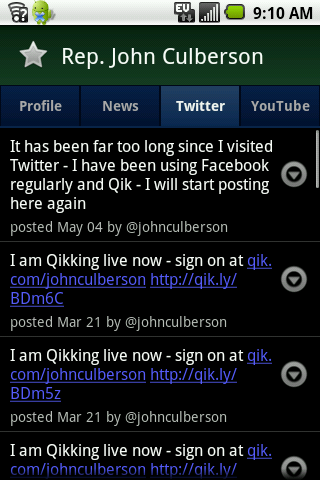
I took the liberty of taking some screenshots on my local congressman, John Culberson, of Texas. I quickly learned that Rep. Culberson needs to update his Twitter status, as he hasn’t updated it in over four months now (come on John… you got 13,000+ followers!!  Keep ’em updated!!)  Although, to be fair, Rep. Culberson does a pretty good job of keeping his Facebook activity updated. Perhaps the Congress App could add that little feature in the future?
Here are some screenshots of the free Android Phone app, Congress. I think it does a great job of tracking information on members of Congress and think it is definitely worth a look.  
Basic Info on Representative Culberson
Latest Bills by Rep. Culberson
Twitter Information
Latest Voting Information

You have to admire the punishment that Judge Diane Druzinski handed down to a juror that updated her Facebook status to say that it was “gonna be fun to tell the defendant they’re GUILTY.” Apparently, Judge Druzinski doesn’t like it when a juror posts a verdict on a case that was STILL BEING TRIED.  The son of the defendant’s attorney found the post (kids are always good to have around for these things.) Unfortunately, the defendant was still found GUILTY and I assume all the rest of the jurors had fun telling her that…. (just an assumption on my part.)

So, although all her friends “liked” Ms. Hadley Jons updated status to her stint as a juror, the little post got Ms. Jons a lecture from the judge about violating her oath as a juror, asked to leave a check in the amount of $250.00 at the Court Clerk’s office, and told to go home and write a five-page essay on the importance of the Sixth Amendment and bring it back to Judge Druzinski by October 1st.

Although Ms. Jons hasn’t commented on how her essay is coming along, her lawyer stated that everyone seemed to think the punishment was appropriate and let it go at that.

If Ms. Jons wants to publish her essay here on 3 Geeks, she has an open offer. We’re always looking for interesting guest bloggers.

At ILTA, my “aha” session was “How KM Supports AFAs.” During this session, Peter Krakaur, CKO for Orrick, showed some screen shots from the KIIAC application. I have previously commented on this application and how it rests in the ‘analysis’ layer of KM.
Before I get to the “aha” moment, here’s some background on the ILTA Conference.
At the ILTA Conference THE topics were AFAs and Legal Project Management. A theme tied up in all of the presentations on these topics was: Efficiency. As in, how can lawyers drive down the cost of their service through more efficient service methods? A great number of ideas and systems were shown that offered incremental efficiencies in the legal service delivery model. And of course these increments can add up to measurable gains.
However, the efficiency gains demonstrated by Peter were a qualitative leap. Peter showed a model agreement which was generated in just 2 days and 45 minutes – something that takes weeks or months for humans to accomplish. There was a noticeable gasp in the room as people reacted to what he had just said. Mary Abraham interrupted the presentation and asked for a moment of silence for all the PSLs who had just been put out of work. What followed was a lively discussion on the value of this approach and its impact on the profession. At the end of the dialog everyone in the room turned to Kingsley Martin, the founder and CEO of KIIAC, and gave him a round of applause. Not something you typically see during a presentation.
KIIAC, through its analysis of large volumes of content, is a nice example of the next generation of KM that goes beyond search and collaboration. This truly disruptive technology is (IMHO) the vanguard of what’s next.
With systems like KIIAC entering the legal profession, significant segments of the practice of law are queuing up in the obsolescence line. Where will you be in this line?