A couple weeks ago I mentioned that “the more I know… the more I know I don’t know.” Apparently, I could use that quote on just about anything I post on this blog. Over the weekend I was catching up on some reading when I found a reference to something called the Public Library of Law (PLoL), powered by Fastcase. After a few emails back and forth between myself and Fastcase’s Ed Walters, I found out that this free resource has been out since the first quarter of 2008. I’m not sure how I’ve missed it for so long, but it just proves the first sentence above!

Ed Walters gave me a brief explanation of why Fastcase launched this service:

We launched PLoL in February 2008 as a resource for non-lawyer researchers.  We saw lots of journalists, business owners, students, and pro se litigants signing up for free trials of Fastcase, and thought there should be a simple, free resource for them that fit their needs.
The idea was to empower people to educate themselves as best they could — not in place of a lawyer, but more likely before or in conjunction with professional legal help.
We wanted to build a library for law like WebMD was for medicine.
Nobody uses WebMD instead of going to a doctor, but it can empower people to take better care of themselves in conjunction with their doctor.
At its launch, it was the biggest free law library on the Web (a claim we need to update with the launch of the terrific material on Google Scholar).

After signing up for a free account and playing around with PLoL for a while, I found it to be pretty straight-forward, and I liked the format of both the search results, and the layout of the text of the case, especially when compared to Google Scholar. (I still don’t like how you cannot do a specific citation search on Google Scholar, but I might be ‘unique’ in using that feature to pull cases.)

The Public Library of Law hosts the cases through the Fastcase database, but the statutes, regulatory and other materials pass you through to the state or federal websites which host those individual materials. According to the site, here is a list of what you can find on PLoL:

  • Cases from the U.S. Supreme Court and Courts of Appeals [hosted on PLoL]
  • Cases from all 50 states back to 1997 [hosted on PLoL]
  • Federal statutory law and codes from all 50 states [via State or Federal websites]
  • Regulations, court rules, constitutions, and more! [via State or Federal websites]

PLoL is also a way to promote the main product in the stable and that’s Fastcase. When you click on links to material that is outside of this range, you get a pop-up message pointing you to the Fastcase “pay service”.
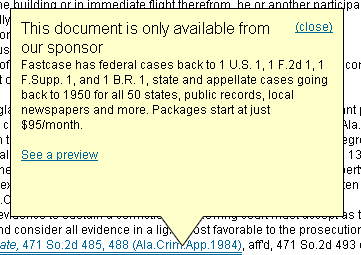
Also, when you do a search on the database, it will bring you back a message of how many results are available on PLoL, and an additional message that lets you know that there are a lot more results available if you move up to the full Fastcase subscription.

One of the features that I saw on PLoL that I think would be very valuable is an RSS feed of new decisions for each state, federal district, or US Supreme Court. Many of us would like to know when new decisions are handed down, and putting that in my RSS reader is a giant plus in my book.

The Public Library of Law isn’t something that you’d want to hang your legal research hat on, but for a freebie product, it isn’t half-bad. Like Ed told me, PLoL isn’t really set up for lawyers or power-user legal researcher types… but rather for non-lawyers to get a streamlined view of cases and access to other primary legal resources. For someone that may not have access to research tools like Fastcase or Casemaker through their bar associations, and Google Scholar doesn’t really do the trick, then having a product like PLoL out there can be a useful legal resource.

________________
Post Links:
Public Library of Law (PLoL)
RSS Feed for PLoL
Fastcase
Google Scholar
Casemaker

[Note: Jason Wilson from rethinc.k talked with me last night about ‘delinkification’ (the placing of links at the bottom of a blog post rather than linking directly within the post itself. I told him I would try it here and see what the overall reaction is to this format.]
________________
Post Links to the Post Script:
Jason Wilson’s rethinc.k
Nicholas Carr’s Experiment in Delinkification


Over the last three and a half years after my divorce, I haven’t gone out much: no bars, no happy hours, no mixers. Lots of week-ends at home and working at my career. And watching lots of YouTube.

A few months ago one Sunday, I spent about 3 hours watching some YouTube videos on how to flirt by Dating Coach Dave Wygant. Seriously, you can find anything on YouTube.

Last week, I was able to put his advice to the test: a friend dragged me out to a Happy Hour. So I decided to experiment with my newly learned skills. Amazingly, despite the fact that this man was talking to two different women, at the end of the evening, he came over and asked for my number instead of theirs. Why? Because after 48 years of being alive as a female, I have finally learned how to flirt.

SO. Why should you care about this?

It is my professional opinion, after working at three of the largest law firms in Houston and with some of the most renowned lawyers in Texas, that lawyers are of a general type: nerdy.

We were the smartest kids in class–outliers. So we never learned how to talk to people (or maybe we talked too much). Some of us lawyers are better at it then others; others are naturally gregarious. Some of us are natural marketers.

But for the most part, most of us have ABSOLUTELY no social skills. Meaning, we have no idea how to begin and maintain a relationship.

So give David Wygant a listen. You might learn something.

Just tell him I sent you.

I was sitting at home reading the bios on my twitter followers when one of them caught my eye and made me want to learn more about her and the story she is trying to tell via twitter and blogging. Her story isn’t all that novel … she has an altercation with a neighbor, is assaulted, asks for justice, and finds that the justice system doesn’t want to take her case – something similar has probably happened to you or someone you know. What is interesting is that instead of throwing up her hands at the situation and waiting until her broken jaw and torn ear heals; she is going online and telling her story to anyone that will listen. Why? I can only take an existentialist guess at this point, but I imagine that she is using these social media tools as a way to deal with her anger and frustration, and in the slim hopes that someone will come across her story and help her find the justice she desires.

NOTE: As I am writing this blog, I have reached out to her to discuss her blog, but have not heard back from her yet.  Everything that I am writing today is based solely on what I have read from her blog, and found out about her through her social media postings before and after the incident. Until I hear directly from her, I’m keeping everything as vague as I can.

From reading the blog posts about the assault, I can see from the writings that this is someone who is very passionate about life. She writes her posts in a very, very personal manner, and give almost a frame-by-frame account of what she experienced (both physically and mentally). I immediately assumed that she is an artist of some type, so as I do a simple Google search to see if there is more, I’m not surprised to find out that she’s a chef, trained in New York City, but originally from the Southwest United States. However, as I peel more of the layers away on her “online biography” of social media information, I find more than just a person that is telling a single story about her life. I suddenly find myself getting to know the person behind this story through all of the bits of information that has been left online.

No longer is she merely an assault victim trying to get me to read her story through connecting with me via Twitter. Now she is someone that studied abroad; graduated with honors from a top US business school; worked as an Investment Banking Analyst before the financial meltdown pushed her out of one profession and into another, and; has somehow made it through life without ever owning a television. Although I have only just learned this person even exists, within a few minutes I feel as though I already know more about her than I do some of the people I work with in my office. I find myself wanting her to succeed in either getting the District Attorney to take up her case, or at least find some comfort in knowing that people are reading her story and understand her frustration.

At this point, I am feeling as though I may be crossing a line. Am I being emphatic or am I being a voyeur? I’m so interested in learning more about the person behind the story and the researcher in me takes over. There is so much information out there on that is not related to initial story that caught my eye, but it is all the background information that I am finding that makes me want her to find the justice she desires. No longer is she just a blog… now I see her as a real person… but, I’m wondering if I ethically crossed a line in my desire to learn more about her, and scared by the fact that the information was so easy to find. I sat down with my wife, tell her this story, and ask her if I am being a too much of a voyeur. Without hesitation, she tells me that I am, but that she loves me anyway. Then she quickly pulled up her Facebook account and un-friended me.

There is just so much personal information that we leave out on the Internet. A little bit here (twitter), a little bit here (blogs), some more here (LinkedIn), and a pinch more here (Facebook or Google yourself). Put it all together and without ever meeting someone you can piece together enough information that you feel as if you have already met. So I sit here on Memorial Day, coming to grips with the ethical issues of researching social media information while at the same time hoping that someone I have never met finds the justice she desires or at least some type of solace through the telling of her story.

I read a great quote that explained the difference between a Librarian and an Archivist while reading Marilyn Johnson’s book This Book is Overdue.

Q: How can you tell the Archivists from the Librarians?
A: Different Gang Colors.

So, with that little joke aside, I have to tell you that my heart warmed a bit yesterday when I read the Washington Post article on David S. Ferriero, the 10th Archivist of the United States (AOTUS) and the very first to actually be a professional librarian!! And, on top of being a real librarian… he also blogs!! See Ferriero’s blog “AOTUS: Collector in Chief” where he details some of the projects going on at the National Archives. And, in case David happens to read this post, there is an open invitation to guest blog on 3 Geeks anytime you want!!

There has been a lot of discussion lately about the value that a professional librarian (one with a Masters Degree in Library and Information Science), or whether the phrase “Professional Librarian” is an oxymoron. It was nice to run across this interview with the AOTUS where he specifically states why he thinks being a librarian brings value to the position he hold. Ferriero being a professional librarian “has provided me with a certain set of technical competencies around organization of information, but more importantly, thinking about an experience with users and how users interact with information. I’ve been in libraries through the introduction of technology up until current time — with the Internet digitization and creating digital content — and thinking about how we exploit technology for the same purposes and the user environment.”

Ferriero talks about what librarians are best at… and that is not just focusing on technology or just focusing on information, but rather finding that balance between the technology and information based upon the needs of the users. In addition, because Ferriero is an archivist, he is bringing the history of the United States out of the storerooms and basements across the country out into the public in a way that preserves our history and through the use of technology, digitization and user environment allowing not just a few select Historians access, but rather allowing nearly unlimited access to all. I really enjoyed reading Ferriero’s speech at his swearing in ceremony where he promised to work to make the National Archives “the best Agency in government.” Librarians of the world should sleep well knowing that one of our own is heading up the massive collection and directing the future of the US National Archives.

I just finished reading Jason Wilson’s one act screenplay “parody” called “Two Sisters” that he posted on his blog (now titled “rethinc.k“. I give it “two thumbs up… waaaay up!!”

The story follows Westie and her little sister Lexi as Lexi finds herself out on the town after a few too many drinks. Westie gives Lexi a few “life lesson” tips but in the end, they both learn they are linked together more than either of them would like to admit. So, go over to Jason’s blog and read the “Two Sisters” screenplay. (Note: it is “R” rated for language and one very suggestive picture.)

I’d like to make my suggestions on who should play the roles in the movie based on the “Two Sisters” screenplay:

Two Sisters – Suggested Cast Members:


Westie – Megan Fox
Lexi – Lindsey Lohan (might have to wait until ankle monitor comes off, but would be a great comeback role!!)
Policeman – Jason Segal
Lois – Tila Tequila
Microsoft – Jon Favreau
Fastcase* – John C. Reilly
Casemaker* – Will Ferrell


*I’ve suggested a re-write that Jason change the roles of Fastcase and Casemaker to male roles.

Many of us have repetitive tasks that we do each day. Whether it is entering standard cataloging data, research collection language, or updating client records data, many times the information has to be typed in by hand. I’ve been using a product called Macro Express for over ten years now to help with those projects that call for repetitive data entry.
Here’s one example of a project I worked on recently where Macro Express cut my overall time to complete the project by about a factor of five.

We had a brand new practice group join us, and brought with them about 60,000 files that had to be entered into our records management system. The only thing we had to help us was a spreadsheet with the basic information on the files that the former firm graciously provided to us. As many of us know, the life cycle of client matters begins and ends in the Records Department. So, we had to open the matters, have the matters assigned a matter number, and then input the records information to begin the life cycle of the matter. It would be great if we could just dump the spreadsheet into the records system, but after evaluating the process, it was determined that there were too many issues and potential problems that came along with messing with the back-end of the records system. So, it was determined that the safest way of doing this was to enter the information, one at a time, by hand. We were looking at a two or three week project, and the potential for numerous hours of overtime to get the information loaded and the matters opened.

Enter Macro Express….

Macro Express allowed us to set up a “routine” of copying and pasting information directly from the spreadsheet into the records system. After tweaking the process a little, we were able to automate the process and speed up the data entry to about five times the normal process. The project was finished in a little over a week, using just one person and no overtime was needed. Because the process was automated it meant that error rates like typos or missed fields were cut to nearly zero. Occasionally we’d loose our network connection to the records system, but we put in a ‘check’ for that in Macro Express to stop until the connection was re-established.

I estimated that Macro Express saved about 80 hours of hourly employee time, and probably 20 hours of overtime. All for the total price of about $40.00 for the standard version. So, if you’re looking for a product that can really have a positive return on investment, then Macro Express is the tool to look at. You can see some other features that Macro Express offers by viewing some of the video tutorials. There are a lot of advanced features that can also be created using Macro Express if you have a techie person on staff that likes to tinker around with Macros and has some basic programming knowledge. Even at the basic level, there are a number of things that Macro Express can help automate and streamline some of those repetitive processes that you or others in your department have to do.

Give Macro Express a try. There’s a 30-day evaluation period where you can try it for free. This is one of those products where you will have wished you would have had on previous projects.

Yesterday, I relayed a message from Tamara Acevedo from Moore & VanAllen where she was told by a Thomson Reuters representative that the June 1st roll out of the OnePassID system would mean her attorneys would automatically have access to WestlawNext (even without a contract). However, it seems that perhaps there was some “misinformation” about the tie-in of the two products.

Anne Ellis from Thomson Reuters responded to Tamara’s comments about WestlawNext and OnePassID tie-in. Seems that there is not an automatic entry into WestlawNext with the June 1st roll out of the OnePassID requirement. Here’s what Anne said:
Hi, Tamara
I read your post and thought I’d write a short comment to try to set the record straight on a couple points. I hope I can clear this up.
We are not turning WestlawNext on for all accounts on June 1. I’m sorry you heard otherwise. We will continue to work with librarians and together we will manage trials and access to WestlawNext for their firms.
The link you described does indeed take users to a pay trial for WestlawNext. This is one of several opportunities we have created for end users to see the new service.
We’re really excited about WestlawNext and what it offers legal researchers, but please don’t interpret our efforts to showcase the new service as an attempt to do an end-around to librarians. We will continue to work with firms and their librarians on the best approach for trialing WestlawNext, account by account.
I hope this is helpful. Thanks again, Tamara.
Anne Ellis
Senior Director, Librarian Relations
Thomson Reuters, Legal

I know that Thomson Reuters is plugging WestlawNext on almost any stable surface that can accept an advertisement (blogs, newspapers, magazines, heck, even wrapping buildings and making ice sculptures), but let’s remember what the ad was that was questioned by Tamara:

 “Search WestlawNext Now: Improve your research efficiency by 64% with WestlawNext. Your organization has access to the advanced search engine and improved design of Westlaw Next. Go there now and begin increasing your productivity!”. 

The last two sentences aren’t just “showcasing” the product, they are saying that “Your organizations has access” and “Go there now and begin increasing your productivity!” If an attorney sees this, he or she would probably assume that the firm’s “access” means that they can go ahead and trial the new product. I appreciate what Anne is trying to do here, but the promotions smack of putting the product in front of the attorney, not of working “with firms and their librarians.”

Let me state once more than I think that WestlawNext may be one of the best legal research products ever created, and I think that there is a lot of opportunities for improving research and efficiency by using WestlawNext. I also want to repeat that I think that within a couple of years that every firm that has Westlaw will migrate to WestlawNext. The product is not the problem… the aggressive promotion of the product is the problem. Librarians are having to balance budgets during a downturn in the economy, and handle the aggressive campaign to bring WestlawNext in contract (read: Increase In Contract Price). When you see ads like the one above that suggest that the firm already has access to WestlawNext, it makes the librarian’s job a little harder, and makes them a little more skeptical of dealing with the reps on moving forward with WestlawNext. Like I said yesterday, bring the WestlawNext ad campaign down a notch… everyone is moving toward bringing it into the firms… there’s no need to start shoving them in that direction.

This past week-end, the Houston Chronicle released its Chronicle 100–a list of the top 100 businesses in the city.

Apart from the Chron 100 list, there are news items that feature various industries. One of them included “the law”.

Well, I am pleased to inform you that little old me was featured in the story, “Lawyers Use Web to Stand Out”.

We work hard to make things happen here and it is no small feat. Lots of hands and eyes.

And, no, I’m not giving away my secrets 😉

But Toby and Greg asked me to post, so here it is!

Tamara Acevedo from Moore & VanAllen alerted the law-lib listserv about a new ‘feature’ that will be available to everyone with a OnePassID starting June 1, 2010.

Good morning,
I am writing this message to give a heads up for those who may not be aware of what Thomson Reuters is now doing with WestlawNext.  I attended a First Look session in Eagan this past March and was told there that our attorneys would not have access unless we agreed to let them have access.  On Friday I spoke with a representative and was informed that everyone with Westlaw.com access would also have access to WestlawNext with their One Pass ID starting on June 1st.
Last week our users logged on and saw this “gem”:

 “Search WestlawNext Now: Improve your research efficiency by 64% with WestlawNext. Your organization has access to the advanced search engine and improved design of Westlaw Next. Go there now and begin increasing your productivity!”.  (emphases added)

At my request, they have removed the “gem”.
Clicking on that link took the user seamlessly into WestlawNext.  Great huh?  I guess it is if you do not mind your attorneys knocking around in WestlawNext without a contract.   Once I attempted to run a search, I did receive a message that WestlawNext was not included in our Westlaw.com subscription and there would be extra charges if I choose to continue, etc.  It is great that they have warnings, but I believe this is different than going outside of our contract from within Westlaw.com.  After speaking to my local rep, I was informed that my thinking was not correct.  They will treat WestlawNext usage as “auxiliary” and charge as such.  I was also told that subscribing to WestlawNext would be no different than adding a database and would be done with an LOU [Letter of Understanding].  That’s weird because at every other turn, I had been told it is a seperate contract.
After expressing that I would like all access to WestlawNext blocked, I was told there is no way that it can be done because the two products link in together.
Now that the “gem” is gone, I realize it is unlikely that any of my attorneys will stumble upon the fact that they have access but, at this point, it’s really more about the principle.  I really wish they would pick a story and stick to it.

I know that the WestlawNext folks view librarians as the gatekeepers that are preventing them from pushing this product to the desktops of the attorneys, but this type of end-run tactic causes much more problems in the long-term than it solves for WestlawNext in the short-term. Remember that most of the law libraries have already budgeted for 2010, so there’s not a lot of options for them this year. All of the sales and marketing folks at Thomson Reuters need to just throttle this campaign back a few notches. WestlawNext is eventually going to go in to most (if not all) of the firms over the next couple of years. Why in the world is there such a big push right now to shove the new platform down the throats of every user this year?? Perhaps to offset those 33% decreases in revenue the first quarter of 2010?
Unfortunately, this is probably not the last time that you’ll find the little “gem” of accessing WestlawNext without a contract… so stay vigilant, my friends!!
