You’ve probably been seeing a whole lot of blog posts and tweets about the upcoming #ILTA11 Conference, and that’s for good reason — the conference is unsurpassed in its ability to combine actionable education with memorable relationship-building opportunities. In addition, one of the unique aspects of the event is its tailoring of certain sessions to different sizes of organizations, recognizing that the needs, resources, and challenges of a law firm with 1000 attorneys are not necessarily the same as those of a law firm with 50.
So here’s a shout out to those of you at small- and mid-sized law firms — ILTA11 has a host of sessions devoted just to you:
Sunday, 4:00 pm, Ryman Studio G
Begin your Conference experience by meeting other Small Firm attendees who are interested in talking about whatever Small Firm topics come to mind. Sodas provided. Conference Badge required.
Monday, 11:00 am, Governor’s B
We’ll examine the tactics that technology partners, firm administrators and IT directors at firms with fewer than 200 attorneys can use to be successful in improving both the value of IT investments and how IT is perceived by the firm.
This session is crowdsourcing! Tweet your questions for the panelists and your topic ideas by using the #ORG1 hashtag.
Tuesday, 9:15 am, Delta C
Ethical walls were once exclusively the concern of large firms, but no more. Smaller and mid-sized firms increasingly must implement ethical walls on a limited budget. We’ll look at the tools available that work with a firm’s ECM system, how to design a matter-centric structure to support ethical walls and the resources required to successfully implement these solutions.
Wednesday, 11:30 am, Governor’s D
Calling all small firms! Come join your small firm peers in a very interactive discussion that will be driven in part by topics you suggest in the Small Firm Listserv prior to conference. Other discussion topics will include cloud computing, SAAS, disaster recovery planning, backups, remote computing, training and helpdesk –– ALL as they relate to small firms. (Part 1)
Thursday, 3:30 pm, Canal C
The conversation continues as you join your small firm peers in a very interactive discussion that will be driven in part by topics you suggest in the Small Firm Listserv prior to conference. Other discussion topics will include cloud computing, SAAS, disaster recovery planning, backups, remote computing, training and helpdesk –– ALL as they relate to small firms. (Part 2)
Image [cc] Cody Simms

It seems that every day for the past month I’ve had someone that I really admire ask me “Are you going to be at ILTA?” Sadly, I will not be traveling to Nashville to partake in the activities, social gatherings, and general awesomeness that looks like will be the case at ILTA 2011. However, I thought that I would at least see which of the talks that others are attending or presenting, and give them a chance to tout them here for this week’s Elephant Post. We had a lucky number of 13 contributions this week. I’ve also notice that others are posting on their own blogs about some of the ILTA sessions that they are presenting as well (so be on the lookout for those as well!)

Take a look at all of the great presentations that are going on and hopefully this will give you the motivation to attend a few listed below. While you are there (you lucky dogs!!), take some notes, and be prepared to answer another Elephant Post in a couple of weeks that explains what you learned at ILTA.

In the meantime, we are posting another Elephant Post question for next week. So, if you are attending ILTA, you better go ahead and fill out the form below before you head off to the airport. Thanks again to all who contributed. Enjoy Nashville!

Anatoly Soyfer
Marketing

Business Integrity, that’s who I work for, Has a kick-ass emerging technology track session on Document Assembly!   We’re actually going to show you how our clients have profited from implementing our ContractExpress products and how EASY it is to author templates right inside Word for attorneys. No template programmers required!!

John Gillies
KM lawyer

The key to success for any KM initiative is having a strategic plan. With one in hand (approved by senior management), whenever someone comes up with what seems (to them) like a brilliant idea, you go back to plan with them and see where it fits with the priorities that are set out there. So, the one session you MUST attend is Creating an Optimal KM Value Strategy.   The panel moderator is Mara Nickerson, and the panelists are Steven Lastres, Patrick DiDomenico, Sally Gonzalez, and myself.

Julia Montgomery
Knowledge Management/Project Management

First, a full disclosure: I am a member of this year’s Conference planning committee.  Now, with that out of the way…  I think it’s a great lineup this year, but I’m especially excited about three sessions which are exploring a non-traditional format. This year, ILTA will offer two half-day Bar Camp sessions — one on Law 2020 and the other on Information Management. Each Bar Camp will focus on six topics, and generate crowdsourced content to be shared.   In addition, the “What Your Attorneys Want You to Tell Them About Social Media” session (#INFO13) will use a “modified  Bar Camp” format which will give attendees a chance for small-group interaction with an all-star lineup of social media pros: Bill Caraher (@WilliamCaraher), Adrian Dayton (@AdrianDayton), Natalie Huha (@legalerswelcome), Scott Preston (@sapreston) and Tony Hartsfield (@tlhartsfield).  I’m genuinely excited to take part in these sessions, and think they’ll deliver some of the most engaging, interactive and high-energy experiences we’ve seen at ILTA.

Carlos Rodriguez
Network Manager

ILTA’s Servers Operations and Security PG is delivering six amazing sessions as part of the Technology Operations track. These are very technical sessions. There are two must see sessions: 1. Deploying Virtual Desktops, #SOSPG5, where you will see how a large firm has successfully deployed over 700 VDs globally, and how two 300+ attorneys firms are using this technology to deliver client facing collaboration & products. 2. Law 2020: A Technology Operations Forecast #SOSPG2. A group of respected Legal Technology leaders will discuss how your firm can prepare for the future of technology operations and gain technology advantage. A brief description of all sessions can be found in ILTA’s website and also this blog post.

Danny Johnson
Law Student – 1L

Tuesday’s 11:30am session on “Mobile Access can Drive Successful ECM Initiatives” featuring a panel with Leonard of NetDocuments and others. Mobile is the next wave in legal technology and this session should get people thinking forward.

Ben Wightwick
IT

I’m not attending ILTA (not through not wanting to) but my good friend and former colleague will be on the panel of ‘SharePoint as a DM/ECM System: Early Adopters Tell All’. Grant is very knowledgeable in this area and candid with it. I’d love to attend this session purely to just to keep him on his toes.!

Chris Hunt
IT Director, ILTA Conference Attendee + Speaker

CTPG5 – Smartphone Shootout. Should be a lively and informative look at the popular smartphone platforms available today, pros and cons of using each one in a corporate environment, along with some discussion about how to manage and secure them without frustrating the users too much. And I’m a speaker (well, that may not be a plus).

Heather Colman
KM Specialist

I am a panellist for the Next Generation Intranets session along with Brian Bawden from Bennett Jones LLP and Joshua Fireman from ii3 and moderated by Deborah Panella from Cravath, Swaine and Moore LLP.    Attend our session to see highlights from Bennett Jone’s award winning intranet and Hicks Morley’s social intranet and their use of employee profiles, blogs, wikis, tags, comments to address Knowledge Management and Information Management challenges.   The session will also include a riveting discussion led by Joshua on the future of intranets including personalization, web applications, mobile access and the semantic web.

Sean Luman
Director, Knowledge Management

As with Julia M., I must admit to being an ILTA2011 (#ILTA11) conference committee member.  The Information Management track has fantastic topics around law firm/law department IM– including Knowledge Mgmt, Risk Mgmt, Records Mgmt, Enterprise Content Mgmt, Business Process Mgmt, and MORE–see for yourself.
If you’re not going this year, go next year–we’re back in DC (Gaylord National).

Toby Brown
AFA

Future-Proofing Your Law Firm on Monday at 11:00 #INFO1. Brought back by popular demand from last year, this sessions takes an interesting and comprehensive look at how firms might re-shape themselves in order to survive.  The All-star panel includes: Michael Mills – Kraft & Kennedy, Inc., Gerard Neiditsch – Mallesons Stephen Jaques, Jeffrey S. Rovner – O’Melveny & Myers LLP and Ron Friedmann – Integreon.

Ron Friedmann
Improving and transforming law practice and business

I am a panelist for Future-Proofing Your Law Firm on Monday at 11:00   #INFO1.   Description below.   I speak for my fellow panelists in encouraging (1) folks to attend and (2) then PARTICIPATE.   We had a great, lively session last year thanks to the audience.   Brought back by popular demand from last year, this sessions takes an interesting and comprehensive look at how firms might re-shape themselves in order to survive.  The All-star panel includes: Michael Mills – Kraft & Kennedy, Inc., Gerard Neiditsch – Mallesons Stephen Jaques, Jeffrey S. Rovner – O’Melveny & Myers LLP and Ron Friedmann – Integreon.

Jeff Fehrman
eDiscovery Consulting and Forensics

I am a panelist for Controlling Litigation Support Costs on Monday at 1:00 PM #LPSPG2. We’ll be covering methods and best practices for controlling the costs of litigation support, including considerations for targeted collection and preservation during discovery, approaches to outsourcing and more.    Moderated by Scott Cohen (Winston & Strawn LLP), panelists include Eric Lieber (Toyota Motor Sales), Dan Regard (iDiscovery Solutions, Inc.), Kevin Behan (Winston & Strawn LLP), and Jeff Fehrman (Integreon).

George Farrall
Discovery Consultant

I am a panelist on LexisNexis: Gaining a Competitive Edge and Economic Advantage in E-Discovery on Thursday at 3:30 PM #LEX3. I’ll be joined by fellow panelists Jennifer Stevenson (LexisNexis) and Miklos Wenczl (Skadden, Arps, Slate, Meagher & Flom, LLP) to discuss new strategies and best practices for leveraging internal and external teams to efficiently manage the discovery process, as well as considerations for the use of  e-discovery and litigation management technology. Hope you can join us for what is sure to be an informative session at the conference.

Next Week’s Elephant Post:

What is the Best “Conference City”?? What Makes It So Special?

I think this one should be a pretty easy one to answer. We all have certain places that we like to go for conferences. If you’re like me, most of your conferences are in the heat of the Summer, so I tend to go for some of those “cooler” towns like Seattle, San Francisco, San Diego, or Boston. Many folks like the bright lights of Las Vegas or New York. While some like the convenience of those “East Coast” venues like Washington, DC or Philadelphia. Tell us which is your favorite, and why you like it so much.

I have to admit that I usually think that many of the articles that AALL puts out in its Law Library Journal tend to be too rigid and too academic in style, but the Summer 2011 issue is actually chock full of interesting articles ranging from Ron Wheeler’s Does WestlawNext Really Change Everything? to Gail M. Daily’s tribute to Earl C. Borgeson’s Ten Rules for Law Library Management. However, the article that is near and dear to my heart (and also mentions me a few times) is a joint effort from DALIC (Digital Access to Legal Information Committee) called, Universal Citation and the American Association of Law Libraries: A White Paper. With its introduction by Oklahoma Supreme Court Justice, Yvonne Kauger, this article rehashes the history of the Universal Citation effort in the State Court system of the United States.

As many of you know, I was knee-deep in the movement back in the late 1990’s and early 2000’s, and I have to say that it was probably the job that I loved the most because we all felt like we were doing something special, and that we were making a difference to the public we served. Although, it also felt good that we were snipping the strings of control that big legal publishers had on the core legal research materials… especially the silliness over Westlaw’s pinpoint citations and their claim that those were copyright protected and that no one could use those without paying a royalty to Westlaw first. I had visions in the late 90’s that every court in the nation would adopt this simple, yet so effective, method of vendor-neutral citation. After all, if a state like Oklahoma could do it, it seemed that any state could. Unfortunately, it seems that something happened in the early 2000’s that caused the movement to fail.

The promise, and subsequent failure is stated eloquently in the White Paper:

¶12 Unfortunately, the wave of citation reform crested in 1998. Courts in Arizona, Louisiana, Maine, Mississippi, Montana, New Mexico, North Dakota, Ohio, Oklahoma, Pennsylvania, South Dakota, Tennessee, Utah, Vermont, Wisconsin, and Wyoming, as well as Guam, the Northern Mariana Islands, and the U.S. Court of Appeals for the Sixth Circuit, adopted elements of universal citation. However, no jurisdictions, other than Arkansas in 2009 and Illinois in 2011, have moved to do so since the early 1990s. The ABA has regularly reaffirmed its support for universal citation in a resolution, but no other major organization has joined AALL’s efforts with additional support.

While I was moderating a panel at this year’s AALL conference in Philadelphia, all of the emotion that I felt while building a vendor-neutral citation system, and making all of that information available to the members of the Oklahoma Bar, the citizens of Oklahoma, and to anyone else that needed access to the judicial decisions of the State of Oklahoma, came back to me in a rush. There are very few times that those within the legal community can make a true difference in how the public access justice, but this was one of those times. I told the audience that those states that didn’t jump on the band wagon of Universal Citation have let their citizens down, and continue to enable the legal publishing giants to control access to justice. In my opinion, the judicial leaders of those states did not stand up for the people they represent, and have shown a lack of leadership and vision found in the now 18 states that have adopted the system.

I also lashed out somewhat against AALL and its Citation Committee for planting a flag in the early 2000’s, claiming victory, and then moving on to other things. There should have been a major push by the organization to push adoption in other states, especially larger, more affluent states, like California, Texas and New York. I know that those states are difficult to deal with, and tend to not like changing the status quo of their legal systems, but the mission of Universal Citation was not accomplished, and as we can see now, the claim of victory was far too premature.

Can the idea of Universal Citation, free from the grasps of the legal publishers, be resurrected? I have to say that at this point in time, I really don’t know. It takes strong leadership on the state court level; it takes strong advocacy from the ABA, AALL and other organizations to push for reform, and; it will take outside help from the legal publishing community, especially non-Wexis vendors, to step up and help those states willing to take on such reform, just as the (pre-Wolters Kluwer) Loislaw people did for Oklahoma. That’s a lot of ships that have to adjust course in order to change the direction of the Universal Citation movement. It can be done, but it will take a great effort on many parts to breathe life back into such a worthwhile reform.

Read: Universal Citation and the American Association of Law Libraries: A White Paper

NOTE: Also take a look at the new effort from http://www.universalcitation.org — plus, a video of the meeting of this group at Rutgers last month is available at http://camlaw.rutgers.edu/av-request/10711/77aeade1b0

Although we know that many of you 3Geek readers are extremely shy about expressing your opinions, we invite you to share your thoughts, visions, and suggestions here to help shape one of the BarCamp sessions at the upcoming ILTA Conference. Note that we encourage you to comment whether or not you’re planning to attend the conference. The session, entitled Making an Impossible Engagement Possible, will be led by John Alber, Rudy DeFelice and yours truly, and will take a crowdsourcing approach to solving a business problem that is becoming more and more prevalent in today’s legal world. The problem statement is described below — please read it, and comment on this post to tell us how YOU would address this issue. No holds barred. Let your creativity shine. Your suggestions here will provide the fodder we need to jumpstart discussion and brainstorming at the live session. Here’s the problem statement:

Your firm has had a long relationship with a major financial institution–Mega Mega Bank. As a consequence of the housing bubble bursting and the ensuing recession, the bank is dealing with a number of defaulted consumer and business loans. It’s facing hundreds or even thousands of lawsuits. Each suit is, on average, not a major matter, ranging from a few thousand to a few hundreds of thousands of dollars at risk. But collectively, they pose a significant expense to Mega Mega Bank. Rather than asking the law firms that serve it for price estimates to do the lawsuits, the bank has set a not-to-exceed price for each suit. That price is extraordinarily aggressive. It is a fraction of the average your firm has been charging for such suits to date, and you regard your teams working on the suits as already quite lean, leveraged and efficient. Your firm views the business with Mega Mega Bank as strategic and it has decided to do a portfolio of some hundreds of cases at the price proposed by the bank. The lawyers, project managers and technologists who will assist in handling these matters do not, at present, have any firm ideas how they will do the work to a high quality standard while, at the same time, controlling costs so as to make the engagements economically feasible. Your job is to work with others on the team to find a way, or many ways, to accomplish high quality work at a much lower cost than has previously been possible. The firm will invest as necessary to preserve the relationship–within reason. But time is of the essence. The longer the team does business the old way, the more money the firm will lose.

What steps can the firm take immediately to meet its goals here? What steps can it take over the medium term? What technologies and process improvements can be brought to bear? What can the firm do to increase the likelihood of success? In thinking about this, don’t limit yourself to your area of expertise. Cross boundaries. And don’t limit yourself to conventional solutions. If a conventional solution worked already, the client wouldn’t be pressuring your firm for radical innovations. We’re eager to hear your thoughts and suggestions for solving this problem. Provide your input in the Comments section here, or via Twitter by including #ILTA11 #ORG2 in your tweet. If you’d like to see how others have reacted, check out the comments on our cross-posting on ILTA’s KM blog.

My name is Ryan and I am a sarcastic person. I have a very dry sense of humor and I tease people that I like. A lot. This is simply who I am. My tongue is almost always planted firmly in my cheek. In person, this may endear me to you, or it may make you think I’m a complete SOB, but most of the time there will be little doubt that I am joking. Unfortunately, my sense of humor does not translate well online. Oh, I can fake it on the blog. (You do think I’m funny, right?) I can use parentheticals, punctuation, and over the top satire to make my points. I have plenty of time to craft my humor, to think about what I’m saying before I say it, and to try to be humorous without being misinterpreted. Many times I have written a passage that I thought was hysterically funny, then cut it the next morning because I realized that I could be interpreted as insulting Greg Lambert’s intelligence. (Actually I would have probably left that joke in, but you get the idea.) But the rest of the online world is rough for people like me. The number of times that I have typed a response to a tweet with a brilliant quick witted reply, only to delete it when I realize that I can’t say that in 140 characters without sounding cruel, is only surpassed by the number of times I’ve hit the Tweet button before I realized it. This morning, Matt Levy (@MattLevyIP) tweeted the following: I don’t buy this at all. #DoINeedToSaySarcasm? RT @abajournal: People Who Are Less Agreeable Get Higher Paychecks, Study Finds I thoroughly identify with his dilemma, but #DoINeedToSaySarcasm is 20 characters! That’s a seventh of my allotted space. I can’t type that hash tag every time I want people to know I’m being silly. In the real world sarcasm is subtle. It’s a raised eyebrow, or tone of voice. It’s the way you lift your drink to toast as you say, “Now you know what an elephant feels like.” We use emoticons to replace inflection and tone, but is there anything worse than someone telling you, “I’m just kidding” over and over again. You want to strangle that person. I don’t want to be the kind of person you want to strangle, but I also want you to know I’m probably kidding. This morning on Twitter, I asked for suggestions for a sarcasm emoticon. I suggested :-S , Lisa Salazar suggested :)~ , and Scott Preston suggested $;-) . But Scott also suggested “If you need to explain sarcasm, don’t use it.” He’s right, of course. That’s the advice given by Social Media Gurus everywhere. But they also say you should be yourself online. Well, I’m sarcastic, darn it! I’ve spent a lifetime honing my sarcasm, so that only 7 in 12 people find me completely annoying. I can’t just throw that away. It’s who I am. Today, I’m calling for online amnesty for sarcastic people everywhere. We need to create a Sarcasm Day. One day per year when I can just be myself and type furiously, witty responses, to every stupid thing I read online without worrying about how I’ll be perceived. Otherwise, I’ll have to settle for being staid, boring, humorless, and factual online, and if I wanted to be like that, I would have gone to law school. :)~

I don’t totally hate my Gmail anymore.
My Gmail account and I have been together for at least 4 years. Probably longer.
But I tolerated it. I thought it was slow, pedantic and not nearly as slick as my Yahoo! email account.
My Yahoo! email and I have been together for a long time–since the 90s. I keep my Yahoo! around because it is dependable, reliable and always remembers to take out the trash. And its great at keeping spam away. It takes care of the shoes, make-up, books, movies and clothes that I buy.
But then I wanted another email for more personal relationships. So I picked up a Gmail account. All my friends like Gmail. Before I knew it, five years had passed.
Functional and straight-forward, my Gmail still drove me crazy.
Until now.
After reading an SAI blog, I went to the Gmail Labs (hit the cog in the right-hand corner of your Gmail account and then drop down and hit “Labs”) and downloaded a few of its latest features:
  1. A Preview Pane: Alleluia! That in itself was worth the price of admission. Geesh. Why do they hide this stuff???
  2. Email Count Icon: This little doo-hickey slaps the number of unopened emails into the tab bar.
  3. Auto-Advance: The thing I hated most about Gmail? Every time I deleted a message it threw me back to the main in-box instead of the next message. Now, with this thing-a-ma-jig, I can set Gmail to focus on the next, or older, email. Be still my heart!
  4. Preview Inbox: This feature really set me spinning in my happy chair. It used to be that it seemed to take forEVer–ok, really, just 1-20 seconds–for my Gmail to load. But with the Preview Inbox, I immediately get to see what’s in my inbox before my box is available. It is the little things, isn’t it?
Those are just of a few of the features available and the only ones I picked.
But let me tell you: I don’t hate my Gmail anymore. In fact, I might kinda like it now. Who knows, with time, maybe I could grow to love it.
What can I say? In my life time I have learned that some eMails are just more evolved than others . . .
And maybe I did a little changing too. 😉

The annual ILTA conference, coming up next week, is one of the best educational and networking opportunities out there. The program offerings are overwhelming, both in number and quality. The topics, although grounded in technology, reach out into almost every corner of law firm functions. This results in a great environment for sharing ideas, getting to know your peers and learning from the best-of-the-best.
I highly encourage you to check out the program to see the scale and range of topics. You will find the biggest challenge is choosing which session to attend during a given time slot.
Now … if you looked over the program and found the best sessions to attend, I also suggest you take an extra minute and check out a couple of “other” programs on the schedule.
Offshoring and Outsourcing: What It Means for Your Firm and Your Job.
This session explores the impact of outsourcing various law firm function, both front and back office, to the emerging Legal Process Outsourcing companies. This will be a lively discussion of how you and your firm might integrate and respond to these encroaching services. Twitter hashtag: #INFO2.
This session will walk through the AFA process and identify how IT, KM, records, finance and other firm functions can support and drive successful AFAs. Twitter hashtag #KMPG3.
Acknowledging these may be fallback options, you may want to attend for “other” reasons; those being the ability to heckle and generally make fun of me as I ramble through my portions of each one.
I know Greg would enjoy that.
Look forward to seeing many of you at ILTA!

As I may have mentioned before, I’ve been working on a county law library project lately. One of the details of that project is looking for a new County Law Library Director for Harris County Texas.

Here’s the job description and contact information for the Director’s Job:

Position:               Director of Harris County Law Library
Salary:             Depending on experience and qualifications. Includes standard Harris County employee  benefits.
Closing Date:       Open until filled
                              To ensure consideration, submit resume by September 15, 2011
Harris County Law Library:  The Director of the Harris County Law Library is responsible for the administration of the Harris County Law Library which is located at 1019 Congress in downtown Houston, Texas. It serves the judges, attorneys, and litigants of Harris County, Texas. Harris County is the third largest county in the United States. The Law Library has a current staff of eight, and a current annual budget of about $1.5 million. It is a division of the Harris County Attorney’s Office, which provides general oversight and interaction with other county departments including the Budget Office and Commissioners Court. The Director is a practice group level manager in the Office of the County Attorney, participates in County Attorney manager meetings, and reports to the Chief of Staff for the County Attorney.
Duties:  Responsibilities include, but are not limited to, managing the overall operation of the Harris County Law Library, long-range strategic planning, budget development and implementation, acquisition of legal subscriptions and new technologies, supervision of the library staff, and management of the day-to-day operations of the Law Library.
The Director will be expected to:
  • Develop and facilitate relationships between relevant stakeholders, including government officials, other law libraries, and local bar associations;
  • Maintain a modern, high quality library that serves both lawyers and non-lawyers with a proper balance between electronic and non-electronic resources;
  • Publicize and promote the Law Library;
  • Oversee training programs for the public, including lawyers and non-lawyers.
Qualifications:  Applicants should have a Masters Degree in Information or Library Science from an ALA accredited graduate school and a J.D. Degree from an ABA accredited law school. Excellent analytical, organizational, interpersonal, oral and written communication skills, a customer-service orientation, and strong people-skills in interacting both with patrons and staff are essential to be successful on the job.
Application Procedure: Please submit your resume via email to:
Robert W. Soard
Chief of Staff/ Executive Assistant County Attorney
Office of Vince Ryan
Harris County Attorney
1019 Congress, 15th Floor
Houston, Texas 77002
Phone: (713) 755-3489
Fax: (713) 755-1553
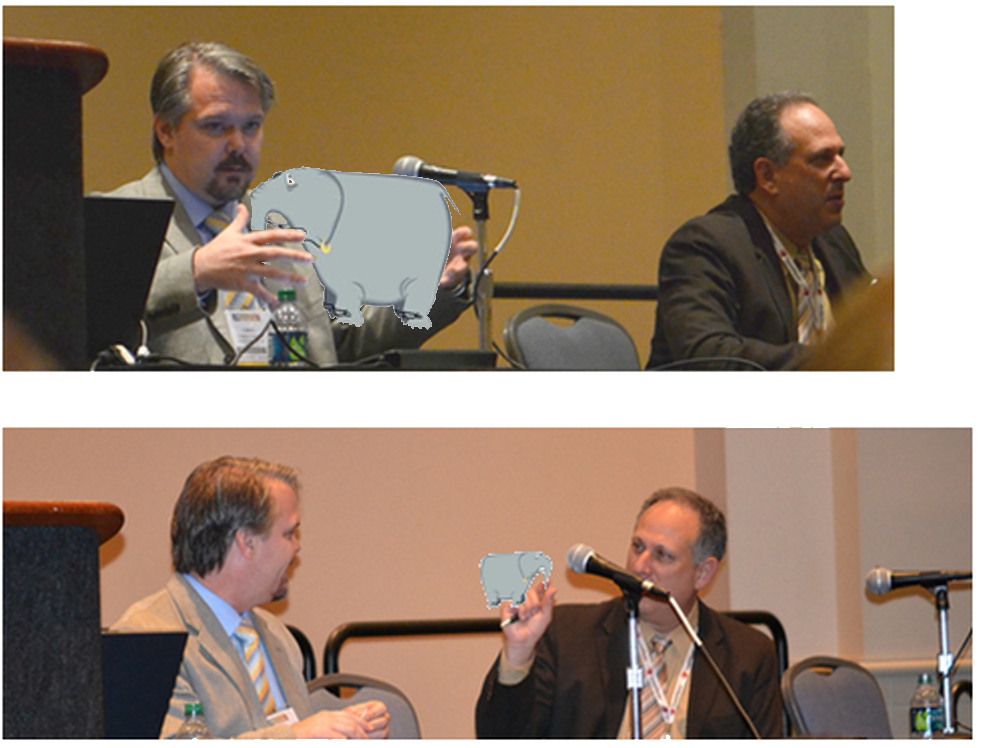
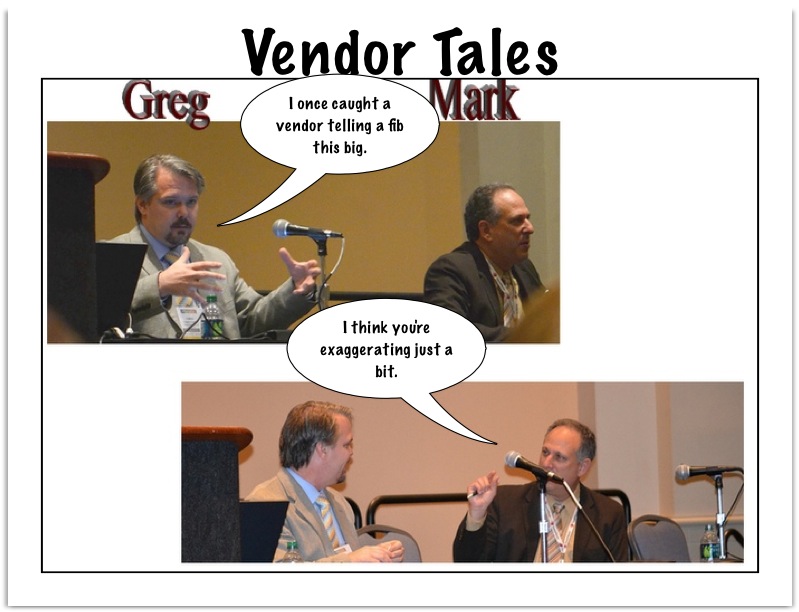
Mark & Greg compare Elephants

We’re not all about BigLaw pricing, and Vendor bashing here at 3 Geeks. Sometimes we like to let our hair down and have a little fun. This week’s Elephant Post was set up to allow you to have a little fun (at Mark Gediman’s and my expense.) I also had a little fun with my iPad putting the captions on this with a new app I downloaded called Strip Designer.

Thanks to everyone for contributing and having some fun!

So have a chuckle or two on us, then scroll on down and answer next week’s Elephant Post on what ILTA session you think is a “must attend” (even if you, like me, aren’t actually going to go to ILTA… )

Alison P
Louis Abramovitz


Scott Preston

Ayelette Robinson

The PIC Coordinator!

Holly Pinto

Lisa Gianakos

Jeff Ward

John Gilies
Carol Bredemeyer

Greg Lambert

Terry Psarras

Martha Goldman

Margie Maes

Mark Gediman
Someone who has seen Toby’s HS Band Photos!

Next Week’s Elephant Post:

What ILTA Conference Session Is A “MUST ATTEND”? Why??


Everybody who is anybody seems to be attending the ILTA conference in Nashville in a couple of weeks. I’m not going (so I guess that means I’m a nobody), but I really, really wanted to go because there are some great people attending, and some great sessions going on. I know Toby has a post or two about his sessions queued up over the next couple of days, but he better be bringing his A-Game because I believe there are some presentations lined up for ILTA that are going to rock.

Let us know some of the sessions you are looking forward to. Also, don’t be afraid to “pimp your own session” if you are presenting at ILTA. After all, Toby pimps his stuff all the time!!

While lunching with new friend and social media guru @apudave yesterday, our conversation turned to grammar.

I was so happy.
The topic? Ellipses.
You know . . . those little dot-dot-dots?
We had quite divergent views on spacing, appropriate usage, surrounding punctuation and why, oh, why, lawyers ALWAYS have to be different.
After promising to look into the entire matter, here is my synopsis.
  1. Treat ellipses as missing words. That way, the grammar and punctuation rules make more sense. If you are collapsing two sentences and removing words from the beginning of the second sentence, that means that you retain the period from the first sentence and add the ellipsis afterwards. So your quote would look like this: “@glambert is a fine fellow. . . . and that is all that I have to say about @gnawledge.”
  2. Spacing is optional, but desirable. I know, in this Twitter-infested world, spaces are throw-aways. But it does make for a more eye-pleasing read . . . don’t you think?
  3. Punctuation should be retained. If you are quoting a paragraph and parsing out a sentence, you should include the quote’s punctuation. Grammar Girl gives some great examples of usage with other punctuation: “Aardvark went home . . . ; Squiggly would meet him later.” [Note the space between the ellipsis and the semicolon.]
  4. Use ellipses sparingly. Ellipses can be used to either indicate missing words, trailing thoughts or separate disconnected phrases. The first type is a grammar choice, the other two or style choices. Any way you do it, just don’t over do it.
  5. Lawyers use ellipses in weird ways. I could regurgitate the rules but will instead point you to The Bluebook §§ 5.3-5.4. Basically? Don’t start or end a quote with an ellipsis. And if you are skipping one or more paragraphs, do a hard return, indent, then place four periods (“. . . .”) on its own line.
You gotta love those lawyers; only they would quote entire PARAGRAPHS of text.
As an added bonus for sticking with me through this oh so interesting post, here’s a little PC shortcut for you: when you type 3 periods in a row, the spacing will create automatically. Alternately, if press Ctrl+Alt and a period, it will create the ellipsis too.
Who knew grammar could be so controversial . . . ?