In Part 2 of this series we explored the impact of Rates and Realization on law firm profits. In Part 3 we look at the other two drivers: Productivity and Leverage.

The Profit Drivers:

Productivity (a.k.a. Utilization)

Productivity is the number of billed hours per timekeeper  Most firms will have a benchmark productivity of 1800 or 1900 billable hours per year, driving an expectation of a certain baseline level of productivity. For profitability, this comes into play on cost rates.

Each time keeper has a cost per year. There are two components: Compensation and Overhead. These are commonly referred to as Direct (compensation) and Indirect (overhead) costs. The indirect costs are usually a hot-button issue for firms as everyone wants to argue about where various administrative costs should be applied. Side-stepping that issue, firms decide on reasonable numbers based on the level of the time keepers. Partners, for instance, may have higher overhead costs allocations as they use more resources within a firm. Once a firm agrees on these costs, then you divide the overall cost number by the benchmark number of hours to get a cost rate per hour.

The punch line on productivity: When productivity goes down, cost rates go up. If you have a lawyer who costs $500,000 per year working 1900 hours, her cost is $263 per hour. If her productivity drops to 1700 hours, her cost rates increases to $294 per hour.

The impact of cost rate changes on profit is typically half that of realization. Of course that depends on the differential between the cost rate and the realized rate. The closer they are, the bigger the impact and it becomes just like the point-of-no-return seen in realization.

Caveat: Lawyers tend to manage profit by focusing on costs. This is the least effective way to enhance profitability. Most costs are relatively fixed on an annual basis. Salaries, rent, insurance, technology and the like are consistent costs year-to-year. Firms wanting to enhance profitability should focus their energies on the revenue side of the equation.

Tangent: We’ll take a small detour here to differentiate between profitability on the client and matter level versus profitability on the practice group or firm level. For example, when looking at the profitability of a matter, productivity should be neutralized. If a firm has under-utilized lawyers, it should not count that factor when evaluating the profits for a matter or a client. Under-utilization or low productivity could be used to show increased cost rates on the client level. The real problem with low productivity though is not in how a specific matter is being staffed, but instead is a firm management problem. Under-utilized lawyers are a symptom of over-capacity (i.e. a firm has more lawyers than work). At the client and matter level, the issue is using the proper level of staffing. If you factor in higher cost rates for underutilized lawyers, you are motivating partners to use busy associates instead of those with capacity. This is not a behavior you want to encourage.

Leverage – The Great Equalizer

The last driver of profit is leverage. This is the amount of non-partner work versus partner work performed. Or from another angle, the percentage of partner time worked per matter or per client.

We took that tangent for an important reason. Leverage is the highest impact profit driver. And firms looking to enhance their profitability will want to encourage the best use of leverage and not let low productivity encourage counter-productive behavior.

The basic economic concept of leverage is that the more workers work, the more owners (partners) benefit. Workers generate the profits that pay partners. Therefore, the more work is push downed to them, the better leverage you have and the more profit is generated.

Of course caveats apply. Partner level work should be done by a partner. The mantra here is: push work down to its lowest cost, appropriate labor source. This sounds obvious and reasonable; however, until recently, firms have profited from pushing work up to the highest rate source, which was a great idea when competition was low.

Further, and taken to a logical extreme, you could make the argument that partners should do no work to maximize profits. Technically you would be correct. If partners spent all of their time getting business in the door and workers provided all the effort, you would maximize profit. However, as mentioned above, partners are also workers. Clients expect the high-expertise of partners on their work and in fact make many purchasing decisions with this in mind.

Another point to consider, partner work also generates revenue. In a situation where 25% of the work is performed by partners, about a third of the revenue comes from their time. The bottom-line is that work should be allocated to the right resources. Firms should make every effort to move the work down and ensure the timekeepers involved are constantly improving their skills so they can continually take on higher levels of work.

And a final important point on leverage: When it improves, the fee to clients goes down. As work is pushed to lower cost resources, the overall fee for a given piece of work should go down. I say “should” since this is dependent on the work being performed at competent lawyer levels. If work is pushed down to timekeepers who take too much time to complete the tasks, the reasonable leverage line has been crossed. Staying on the right side of that line essentially means higher profits for firms and lower fees for clients. Truly the win-win result the market is begging for.

In Part 4 we tie the four drivers into a single picture and talk about the effect of market forces on the group of drivers.

In Part 1 of this series, we introduced the concept of tying Legal KM (LKM) closer to a law firm’s bottom line  We also introduced the concept of law firm profitability  In Part 2 we explore the first 2 (of 4) profit drivers for firms: Rates and Realization

The Profit Drivers:

Rates

Although obvious, the point needs to be made. Billing Rates are the core pricing structure used in the industry and the level of a firm’s rates are key in determining its level of profitability. As a rule-of-thumb, a 1 point increase in rates leads to 2 points increase in profit. The reverse applies as well. In my experience, there might be a range of 1% to 3% increase in profit for each point of rate change. The range exists since it depends on the specific time keepers involved and the relationship between the billing rates and the time keepers’ cost rates (more on that later).

Realization

Realization is the percentage of money collected versus the standard rate. Once you have a standard rate there are three basic ‘events’ that drive down the actual dollars collected against that rate.

#1) Discounts

Discounts are the market (via specific clients) telling a firm their prices are too high for a piece of work. One might think firms should lower their prices in response to his information, however, that could be a mistake. Sometimes clients shop price by the level of discounts. They are not concerned with the actual price but instead focused on the amount of discount they are extracting. Whether this is rational behavior in an economic sense is not relevant. Firms need to adjust their pricing and pricing strategies in response to the market, but need to do so in smart ways.

#2) Write-Downs

These are reductions from a bill before it goes to the client. This reduction signals the firm / partner deciding certain effort had no value. This becomes important as firms look for ways to lower the cost of delivery of a service. By identifying recurring types of write-downs and eliminating the effort before it is done, a firm will lower the costs of the service.

#3) Write-offs

These are reductions requested by the client after they have seen the bill. This client signal says they did not see value in some effort. This may occur because a firm did not communicate the value of the effort properly or it may just be that work should not have been done. It should be noted that in some cases, write-offs are just good ole fashion flakey clients who don’t pay their bills. For this discussion, we will treat that as a cost of doing business.

Adding these three elements, gives you total realization. The final number is important, but the three components are instructive as to what is driving a level of realization.

The impact of realization is much the same as that of rates. A 1% drop in realization will, on average, result in a 2% drop in profitability. Well, at least it does when you are relatively close to 100% realization. As that realization number drops, the impact magnifies. As you approach 60-70% realization, it becomes infinite. This is the case since you are approaching the cost rate levels of most time keepers. This means you are reaching the point where your margin goes to zero and when you pass that point it goes to negative. At a general level, this point-of-no-return is about 67% percent. However, it can vary based on the mix of timekeepers involved in a given piece of work. Some time keepers cost rates can be 50% of billing rates, whereas others may be closer to 80%.


In Part 3, we will take on the other two profit drivers: Productivity (a.k.a. utilization) and Leverage.

For my role in the 2012 Ark-group KM Conference, I am talking about the economics of the practice of law to set the stage for how KM can better align itself with the bottom line. This series is from my materials for that conference. The first part describes the challenge for Legal KM and then moves to the economics – specifically talking about the meaning of profitability for law firms.

The days of just pursuing traditional Legal Knowledge Management (LKM) projects like enterprise search and CRM are numbered. Although these systems have value to a firm, they are not addressing the intense pain points law firms currently feel. Law firm leadership does not spend time debating the merits of these types of systems and rarely even gives them a thought. This is a strong message for LKM leaders. What exactly is your firm leadership focused on? Find out and shift your LKM strategy to answer those needs.

The issues keeping most law firm leaders up at night are centered on economics. It is well known that law firms are now in a highly competitive market. And this competition is driving a keen focus on profitability and a better understanding of the core economic forces in both the market and within each firm. LKM needs to establish a firm connection to this type of economics.

To better connect LKM and law firm economics we need to first have a better understanding of what makes law firms profitable. Such an understanding should light the way to helping LKM stay relevant to law firm leadership.

Beyond the immediate concerns for LKM, law firms will benefit from shifting their conversations from hours and revenue to revenue and profit. Until recently, law firm profits were built in to their pricing model. The billable hour was enough to cover cost and a rising profit margin. No longer. A new model is emerging wherein profits are derived from the margin between revenue and cost. Therefore the factors that drive that difference are now moving front-and-center on the stage of law firm leadership.

Law Firm Profitability

What makes law firms profitable? There are four primary profit drivers for law firms. These drivers apply whether a firm uses billable hours or any other type of fee arrangements. Each driver has a different level of impact on profits and some drivers are losing their influence.

Profitability?

Before we dive in to drivers, we should briefly tackle the term: Profitability. What appears to be a simple concept becomes complex. For law firms the challenge arises since partners serve as both owners and workers. Traditionally their incomes have been treated as purely profits, which tends to skew “true” profit based on the level of compensation of a partner or group of partners performing a given piece of work. Firms are now beginning to embrace new definitions of profit that enable the creation of a more classic profit margin. The basic idea is treating a portion of partner income as ‘wage’ leaving the rest as profit. Firms determine a method for separating those two segments either by setting some common standard or by establishing levels of “wage” for various levels of partners. The resulting profit margin then becomes a means of bench-marking performance over time.

Another profitability method used isolates partner compensation on work to calculate a “Profit Per Partner (PPP) number. In this model a PPP calculation for a given piece of work shows whether the matter is driving PPP up or down. The model assumes a standard level of productivity within a firm. More simply, this model states that if all work at a firm looked like a given example, then the firm’s average PPP would be that number.

As we move through the drivers of profit, we may reference one or the other methods. The two do not move in lock-step fashion since they are different mathematical approaches. However, they generally trend in the same direction when any of the drivers change.

In Part 2 of this series, we will explore the first to profit drivers: Rates and Realization. These two drivers were major forces in the past, but are losing influence in the new normal.

Links to:
Part 1 – the challenge for Legal KM 
Part 2 – profit drivers for firms: Rates and Realization
Part 3 – profit drivers for firms: Productivity and Leverage
Part 4 – the market’s impact
Part 5 – how Legal KM can re-focus its efforts

Ah, October.  A chill is in the air (somewhere I’m sure, it’s still in the upper 80s here).  The talk turns from the beach to carving pumpkins.  In the Library (or Research Services as we call it), the Librarian’s thoughts focus on Budgets and Desk References.  Desk References are a challenging part of the Budget process.  Not only do you have to account for additions to the firm’s Professional Staff, but you have to juggle the differing demands for how you deliver the product; do you provide the books in print or ebook format or both?  Which format do you use for ebooks? And then there are the big questions:  What is a reasonable price for an electronic book?  Should it be different from a print book?  If so, should it be higher or lower?  Let’s focus on the price questions and leave the format discussion for another day.
I believe the price should be different.  Tina Brown, on MSNBC’s Morning Joe this morning, justified the decision to make Newsweek a digital-only publication by referring to cost of $43 million to print, manufacture and distribute the publication.  Now, I’m not suggesting that this is the magnitude of savings that any publisher going digital will realize but it is indicative that there are substantial savings that occur when a book is published digitally rather than physically.  And I don’t claim to be an expert on the costs inherent in producing books.  However, it seems reasonable to conclude that the result should be a decrease in the price reflecting the lower cost to produce and deliver each unit.  At worse, the price point for an ebook shouldn’t be different from the print. 
However, it appears that one legal publisher (located in Eagan, MN) has a different view of the economics involved.  I have been told by their representative to expect to pay a premium of at least of 20% above the print price to purchase an ebook edition.  I’m not sure how they can justify this kind of an adjustment, especially in light of the discussion above.  And to do this in the current economic climate doesn’t seem to be good business. 
I don’t know of many (if any) Library Managers that rubber stamp purchases without looking at the costs involved.  And we understand the economics of publishing well enough to know that prices should reflect when costs go down.  Other companies are offering ebooks for the same price as the print as well as offering bulk purchase discounts.  With this in mind, why would anyone want to raise prices?
The company referenced above may be trying to accomplish one of two things:  (1) Taking advantage of the ebook demand to increase revenue or (2) trying to chill demand for ebooks to prop up the legacy print business.  If it is (1), they are making a mistake.  Desk References are, for the most part, compilations of the code sections the attorney often refers to in his/her practice. As such, these are published by multiple vendors which means we have a choice when purchasing these.   Since price is the main driver in these types of products, this will only result in a loss of revenue (and market share).  And, as the Borg said, “Resistance is futile.”  Change will continue to occur and it will be this company that will be on the losing end.


One of my favorite news aggregation resources is InfoNgen (pronounced: “Info-Engine”). I’ve been using it now for almost two years, and have found it to be an extremely useful tool in tracking current news on companies, topics, industries, and more. Recently, InfoNgen added a couple of features that improve the resulting newsletters as well as making access to existing newsletters and alerts easier for the end users. I don’t want to say that I deserve all the credit for these additions, but I will say that I did suggest they add these features a while back. Regardless of who deserves the credit (me)… it really makes it a better product.

Meta-Tags In Your Newsletter

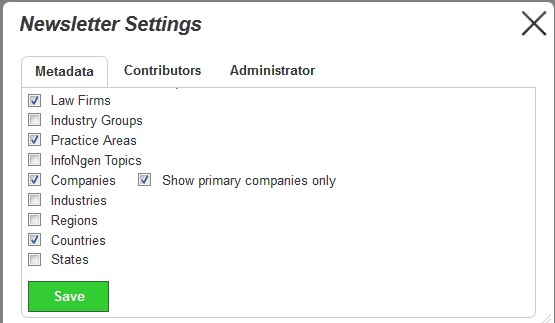
The reason I asked that meta-tags be added to the newsletters was so that the reader could get more information about the story before he or she clicked any further. For many of the readers, it might be that they are looking for information on a specific company/client and finding that information listed as part of the synopsis of the story would influence their decision to click through and go to the actual story. The folks at InfoNgen added the feature to include selecting all or none of the meta-tags available, ranging from internal meta-tags that you’ve set up, to the basic company, industries, regions, countries, and states tags.

This is a nice feature that allows for additional information to come through the newsletters without any additional manual effort on my part, and at the same time, it doesn’t clutter up the newsletter. The end results are clean and effective.

Self Sign-Up

The next feature added to InfoNgen lately is the self sign-up option for anyone in your network to add or remove themselves from existing Alerts and Newsletters that you’ve set up to share. They call it the Self-Service Portal, or SSP. So, anyone with your company or firm’s email address can register with InfoNgen and set up an end-user account. They will then see a list of all the Newsletters and Alerts that you’ve made available (you select which ones they can see, and which ones they cannot see), and they can sign themselves up for the alert or newsletter. For the alerts, they can even set their own times for the alerts to be delivered. For the newsletter, it adds them to the regular distribution time.

This is another nice feature to add to the product for a couple of reasons. First, it gives the end-user more flexibility in what types of alerts or newsletters they are receiving. Second, it helps promote the service that the library or marketing departments are offering in setting up current information awareness resources. To further this goal, I suggest that when you notify the end users that they can sign themselves up for newsletters or alerts, also let them know that if there is a topic that they do not see on the newsletter or alerts page, that one could be set up for them.

InfoNgen is a subscription based product, and we’ve talked about them and their competitors before. Whether you call them news aggregators, discovery engines, or listening platforms, these resources are extremely helpful in pushing current awareness information in front of your end users. Many law firms are evaluating these products and finding unique ways of setting up results ranging from broad topics down to individually specialized results, librarians and marketing teams are leveraging these tools to push current, relevant information to others within their firms or companies.

Image [cc] fraggy

We live in a time where most people are not only doing their job, but they are also doing the job of someone that retired, got laid off, left and that position was never filled. Many of us talk about this as “the other hat that I wear at work.” Some would describe this as efficiency or increased worker productivity, and that’s true… to a point. In reality, what it means is that people are multitasking their work, and the typical results are that both jobs get half the attention they really need, and efficiency and productivity actually take a hit.

Training is probably one of the biggest victims in this environment. Go ahead and schedule a voluntary training session on a new resource and see who shows up, who leaves early, and who cancels at the last minute because “an emergency” project just landed on their desks. Send out an email with information on a new product that is available to your firm, and ask people to test it out and give you feedback. If you get more than the sound of crickets chirping in the background, you are doing well.

When people finally need something that you’ve been asking them to use, review, or get training on, you usually get a look from them like they’ve no idea what you’re talking about, or give you that “It’s an Emergency!!” plea, along with the “I’ll take a look at it when I have time” answer.

It’s enough to make you want to post this sign outside your door:

Of course, you can’t do that… otherwise you’ll be let go and one of your poor co-workers will have to take on the two jobs you are currently handling.

So how do you handle the issue of creating an environment where workers are better prepared, trained, and understand how to use the right resources for the project at hand? It’s a frustratingly hard question to answer. For most of us, we keep slogging through and take our victories where we can get them. We find opportunities to plant the seeds of telling people in the hallways, break rooms and elevators by saying to them, “you know, we have a resource that would make that project go a lot easier… how about I come by your office and show you.”

There is low-hanging fruit to gather in this environment, but there’s not a lot of it. At some point you have to step back and realize that you simply cannot reach everyone. It’s probably the hardest decision that many of us have to make, and that is, when do you stop? When do you tell yourself that some people simply won’t take the time to break away from their “emergency projects” to learn of a new (or existing) resource that would end up saving them time and effort? Unfortunately, we can’t keep banging our heads against the wall and expect that it will do any good. Strike a balance of gathering the low-hanging fruit, and the occasional victories of pulling in those hard to reach people. Don’t give up on trying to reach people, but don’t waste your time and efforts on those that ignore you time and time again, either.

The American Association of Law Libraries (AALL) and the International Legal Technology Association (ILTA) has collaborated to create a white paper on the set of skills needed for today’s librarian and information services professionals. Whether it is Knowledge Management, working with Practice Groups, Competitive Intelligence, Electronic Books, or the evolving trends within Legal Research or Emerging Technology, “The New Librarian,” as this white paper is entitled, discusses some of the challenges facing the law library profession and how librarians are confronting those challenges head on. There should be some familiar names listed as authors in this publication (including bloggers here at 3 Geeks) Here’s a list from the table of contents:

When I saw this tweet from Jason Wilson about the Legal Marketing Associations Technology conference hashtag #LMATech being hijacked, I had a pretty good idea who a couple of the folks were that were doing the hijacking. If any of you ever follow the discussion of Social Media, Marketing and Law Firms, there are those on the Marketing side… and there are those on the “I Call BS” side. Needless to say, they don’t get along very well.

Whenever you have a conference, and you promote a hashtag on Twitter to promote the conference, you take a risk of someone coming in and using that hashtag for unintended reasons. Usually when we talk about “hijacking” hashtags, you think about what happened to MacDonald’s earlier this year. That is a case where people put up false testimonies to embarrass the organization running the hashtag campaign. In the #LMATech situation, that’s not really what happened. Instead, you have a different type of hashtag situation that looks very similar to having a heckler (or hecklers) in the audience. Think of Micheal Richards’ meltdown during his stand-up routine back in 2006. I think that some on the Marketer side are coming close to taking the meltdown approach… one which feels good now, but when reviewed by the public will not put them in the best of light. (By the way, Michael Richards hasn’t done any live shows since his meltdown, and he talks about it with Jerry Seinfeld.)

The hashtag hecklers on the other hand, aren’t exactly coming to this with clean hands either. They are not doing anything illegal in their heckling, and in fact, they feel as though they are actually giving the LMATech conference a dissenting view from what is being tweeted from the conference. Ken, from Popehat, lays out a number of arguments about the risks that LMA takes when opening up a hashtag, and that he and others are simply dissenters voicing their honest opinion about what they think about what’s coming out of the LMATech conference. However, it is heckling, and not just dissent that is being voiced by those calling BS on the LMA. It’s pretty clear that the dissent is out to discredit the message and the messengers, and when it becomes personal like that, it takes on a mudslinging effect that suddenly gets very nasty. It gives those of us outside the argument something that amounts to entertainment, but not really anything of real value comes out of these types of arguments.

Here’s my advice to LMA on how to handle the situation. First, accept the fact that there are those out there that simply don’t believe in the message you are giving. Don’t take it personally, every organization that puts on a conference and promotes a message will have its dissenters. Second, if I wasn’t surprised that this happened, then you shouldn’t have been caught off guard either. Next time, have a better plan in place on how to address a situation like this. You’re Marketing people, after all, you handle bad press all the time, it’s just that this time, it’s directed at you and not your firm. Third, either ignore the heckling, appease the hecklers, or put the ball in the heckler’s court. Invite one or more of them to a conference to speak to the group and have them tell you, as a professional, and an adult, to lay out all the issues that they have with what you are preaching. It seems that at least one person is willing to talk to the group.

Hecklers are going to continue to be out there, telling you that you are awful. Granted, you would think that respected lawyers would find more adult ways to discuss the topic, but I don’t see that happening. The worst thing you can do is overreact. If you watch the interview with Michael Richards, he admits that he completely screwed up the situation by overreacting. Go check out the video (around the 14:00 mark) and listen to how taking something too personally has eaten away at Richards. Take his advice, acknowledge that there are those that are going to heckle you, let it roll off your back, and then go home and work on your material some more.

The week of October 22nd has a couple of excellent conference opportunities for the legal community. Both of these will have great content on adapting to change for the legal professions.

KM in the Legal Profession – Runs on the 24th and 25th in NY and is produced by the Ark-group.

Strangely, I will be leading off this program and moderating the first day. I say ‘strangely’ since I do not seem a logical choice to be talking about and promoting KM in law firms. When asked to participate, I suggested I might not be a good choice. My views on traditional law firm KM can be, at times, unpopular within the KM community. When I speak of KM, I usually preface my remarks with something like “Does enterprise search keep your Managing Partner up at night?” The obvious answer is no, suggesting KM has been playing too far from the bottom line.

As a consequence of my participation, the conference is focusing more on how KM can be tied to the bottom line – where it should be. Find out more about this conference, here.

The COLPM Futures Conference – Runs the 26th and 27th in D.C.

The College of Law Practice Management (COLPM) established this annual conference to focus on cutting edge challenges for legal professionals. As usual the program includes an impressive list of speakers (except me of course) and topics. As well the 2012 InnovAction Awards will be presented. To find out more about this conference and to register, go here.

Both of these will be excellent opportunities to learn more and get great ideas for managing the dynamic changes in the legal market. If you make either of these, make sure you say hi.

I’m going to make this post, short and sweet. If you have a social media account that represents your company’s (or law firm’s) brand… safeguard it like it is important. Because it is.

For the second time in a few days, a company’s Twitter account posted inappropriate content under the company’s brand name. The reason this happened is actually quite simple, and we’ve all seen it happen on much smaller scales. The person responsible for the “Company Twitter” account simply forgot that he or she was logged in to that account and fired off a personal message thinking that they were on their own account. The result was most likely that both of these folks no longer have to worry about the confusion, because they have lost their jobs.

There are a few simple guidelines that every company needs to put into practice to make sure this doesn’t happen:

  • The People Part: Train Your People and keep the number of employees that have access to these accounts to an absolute minimum. Set up strict rules, and make sure they understand the top two rules of social media when it comes to representing your brand:
    Rule 1: Don’t post anything stupid
    Rule 2: DON’T POST ANYTHING STUPID!!!
  • The Technology Part: If someone is going to post on behalf of your company’s brand, set up a computer that where the only thing that computer is used for is updating social media sites related to your brand. Under no circumstances, ever, should anyone log into a personal account on those computers, and if necessary, set up scripts to block employees from logging out of the company account, or set up monitoring software to alert you if they log in to any account other than the company account. Do not mix personal and company accounts (which can happen very easily if you use things like HootSuite or TweetDeck that allow for multiple log ins at the same time.)
When it comes to social media, your brand is only as valuable as the weakest link in your chain. Kitchen Aid and StubHub learned the hard way that allowing their social media representatives to mix business and personal accounts on the same computer costs them dearly, and made them scramble to shore up the damage caused. If you are in charge of your company’s social media brand, take advantage of Kitchen Aid’s and StubHub’s errors to prevent your employees from breaking any of the top two rules of social media and your brand.