I’m just getting back from by extended conference / vacation in Denver, where I enjoyed the AALL conference, and especially enjoyed the Private Law Libraries Summit (pre-conference). I know there was a lot of fuss about the amount and types of programming that was scheduled for private law librarians at the conference (including guest posts on this blog), but I have to say that I wasn’t really all that disappointed. I’ll also go out on a limb and say that I thought that the PLL-Summit was one of the best day and a half seminars that I’ve ever attended on the topic of law firm libraries. Of course, since I presented, I may be a little biased.

I hope that there is a pre-conference again next year. If there is, I’m going to encourage a number of folks that I know that usually don’t go to AALL conference to at least attend the pre-conference. I found that the presenters were great, and that the audience was much more engaged in the topic than you get in a normal session. The fact that the room was entirely private law librarians also helped focus the talks and even have lively arguments when we disagreed.  After all, we were all there to think… not think alike.

Here’s an email that Jennifer Berman (PLL-SIS Education Chair) sent out to the list last week explaining the steps you need to take in order to submit a program for the general sessions of the 2011 AALL Conference in Philadelphia. I also have a couple of suggestions:

My Suggestions:

  1. Don’t submit a 3-part program. Do one topic, in one session, and do it well.
  2. Don’t submit a program where you want to learn a topic… See if an expert on that topic will do it, and help them submit the program. 
  3. Encourage new people to contribute. We all see a lot of the same faces presenting each year. Be a ‘mentor’ and get some new blood in front of an audience.
Berman Message:

Congratulations to us all. Our programs at AALL – Denver, CO were well attended, discussed, and received good reviews. In short, SUCCESS!! Thank you to all of the coordinators, moderators, and presenters. It was evident that a good deal of hard work went into the endeavor.
Now, we can’t sit on our laurels. Preparation for the 104th AALL Annual Meeting in Philadelphia, PA is well under way and proposals for presentations must be submitted by September 15, 2010.
There is no real theme to the 2011 conference. Programs are to parallel the competencies required for librarianship. If you have an idea for a presentation, please don’t hesitate. Put together a proposal and send it in, but please make sure to indicate that you would like PLL to sponsor the program.
A few helping details. Start by reading the short proposal description on the AALL website (http//:proposals.aallnet.org). It will link you to the Programmer Planner’s Handbook, (http://www.aallnet.org/events/ProgramPlannersHandbook.pdf), which will guide you through the process. Included in the Handbook are suggestions of how to write the proposal, wording to use that will catch the eye of the members of the Annual Meeting Program Committee (AMPC) and others. One hint we received is not to use the word “competency”. It’s the conference’s theme, so the idea should be inherent in your presentation. Overplay, and it may backfire.
As members of the PLL-SIS Education Committee, we review each proposal that is sponsored by PLL. There may be suggestions we would like to make that would give your presentation heavier weight with AMPC members, so sometimes we may request a small re-write. In order to assure that your program proposal is formally submitted by the September 15th deadline , we have implemented the following time schedule for sending in your proposal:

  • Aug 30 (noon CDT) – Submission of your program proposal to the members of the PLL Education Committee (names and contacts below). Page 43 of the Planners Handbook indicates how to share the program with us. When you share the program with us please DO NOT click the submission button or your program proposal will be submitted and there will be no opportunity to revise the proposal.
  • Sept 8 – You will have received a phone by a committee member to discuss your proposal. We will discuss recommended revisions, if needed, or suggest to submit as is.
  • Sept 15 – Final date for submission to AALL.

Remember, the earlier the better. If editing is required, we want to make sure that you’ve the needed time to do it to get it in on time and have it accepted.
If you have any questions or need any help, please call any one of us at any time. We are here to help you and make it as easy as possible to get through the process.
To jump start a little bit of thinking – the following three ideas were proposed. If you would want to flesh it out and write up a proposal for it, we can assist you with the process.

  1. The future of legal research 18 months later (Law firm librarians and academic librarians talking about what’s happened with respect to adoption or nonadoption of WestlawNext, Lexis for Microsoft Office, New Lexis, Mobile Apps, etc.
  2. Conversations with legal news reporters (what is happening in the legal world)
  3. Summit on Training Part 2 (continuation of “Mile High Summit in Training: Are things coming to a peak?”, a very well attended session). Discussion with law firm deans, managing partners, and students about training)

Enjoy, have fun and good luck to us all!

Alright, you can now stop calling the forthcoming Lexis platform “New Lexis” or “LexisNext”. I learned this morning that the folks over at LexisNexis have named their new platform “Lexis Advance”. Toby got an advanced peek at the product a couple of months back and seemed to be impressed. Here is a snippet of the notice I received this morning announcing the baby’s, er, the product’s name:

We recently announced to our employees that our new legal information platform will be named “Lexis® Advance” when it goes to market.
To be clear, Lexis Advance is not available yet. It will be rolled out in phases for different segments of the market over an extended period of time starting later this year and moving forward into next year. That’s when legal professionals will start seeing the product and name.
Meanwhile, the name “New Lexis” continues on internally at our company as the moniker for our broad investment and invention program to create the next generation of innovative solutions with and for our customers. Another example of a new solution from this overall program is Lexis® for Microsoft® Office, which as you know, was announced earlier this year.

I’ve already stumbled over this name a couple of times (including typing it here), because it is very similar to another LexisNexis product called “Lexis atVantage“. Now, let’s see if the sales and marketing team at LexisNexis have learned from their counterparts over at Thomson Reuters on setting a clear price on their new baby. They can always look back on my open letter to remind them of how well “modest premium pricing” went over at law firms. (Hint: Don’t start off the conversation with “Lexis Advance comes with an advance pricing model.”)

Last year I had the pleasure of attending a presentation made by Don Schultz, professor emeritus at Northwestern. I left the presentation with a key insight about how Web 2.0 has changed the landscape of marketing. As a consequence, I follow Don’s writings. In this month’s AMA Marketing News, Don’s column provided another layer of insight.
In the presentation Don gave, he had talked about how marketing was built on a ‘push messages to the masses’ foundation (think Mad Men). And that marketing continues to hold to these methods, even though the world has changed. Push is losing it’s ability to persuade as consumers take an active role in the marketing space. Web 2.0, a.k.a. Social Media, allows the customers to take part in the conversation. Push is out – participation is in.
Don’s article took this insight to a deeper layer. Based on a conversation with a colleague from China, he came to appreciate the different marketing and advertising methodology used there. In China, marketing is not about persuasion. Instead it’s about negotiation. The purpose in marketing there is “to create situations to be considered, thought about, bargained for and haggled over.”
If this concept sounds familiar – it should. This is how Web 2.0 works. So Don’s epiphany is that in the US in addition to holding on to the ‘push’ world, we still subscribe to the persuasion model of marketing and advertising. This is problematic since our venues for marketing are quickly becoming negotiation platforms.
The moral of this story: We need to shift our entire marketing philosophy from a persuasion based approach to the Chinese model of negotiation. Persuasion messages fall dead in the negotiation space. When people find no reason to engage with your marketing messages, the messages will never make it past the door and never even make it in to the market.

[We’re please to have Jill Strand as a guest-blogger]


So do you want to be transformed or help direct the transformation? This was my primary thought after reading “Law Libraries Transformed” on LLRX by Eleanor Windsor and Ron Friedmann are executives with Integreon, a legal process outsourcing firm with offices around the world. The title intrigued me yet in reading the article I was surprised to realize that the innovation they were advocating was outsourcing of law firm library services. Basically,  they seem to suggest that since law libraries have become less about the physical space and collection and more about the research and online resources, outsourcing is an ideal and possibly inevitable solution. While they do note that librarians are more important than ever in filtering the information overload, I have to confess feeling my feathers ruffle a bit at their general assumption that a “library as service” model will always offer greater cost savings and efficiencies. Rather than hide inside my personal closet of law librarian anxieties, I’m going to try and consider the bigger picture. So before you hit your own panic button, take a deep breath, read the full article for yourself and join me.

Outsourcing library services isn’t anything new – it first hit my radar a few years ago while working on a legal process outsourcing research project at my previous firm. Nor is it surprising, particularly in the current economy, to hear that we might be on the cusp of a trend. And when you stop to think about it, this is a pretty timely issue given the ongoing discussions in the blogosphere and within SLA and AALL about what we need to do to survive, thrive and advance to the C-level. Heck, I’ve been listening to and taking part in these discussions since my first information interview with an advertising firm librarian ten years ago. Call it alignment, advancement or whatever you want, but we are probably better served being pro-active about possible solutions rather than just reacting negatively to this news.

So what do we do? I’m sure many of you have some fabulous ideas which you’ll hopefully comment on here. A good starting place could be to think about how we could work with this trend (if it is really a trend yet) and turn it to our advantage. Do we set out to completely disprove it as a valid solution or do we find a way to take part in or take charge of it so that we have some say or control over what library functions should or shouldn’t be out-sourced? While the article does mention having skilled specialists with advanced degrees in law and business, it isn’t clear whether Integreon actively recruits librarians with MLS degrees and library experience – how can we use that to position ourselves as their perfect in-house partners? For example, I’m taking the time to sit down with each attorney at my firm to learn more about their practice, key clients and research needs – the insights gained from these meetings have helped us to tailor our services and pro-actively provide current awareness and education about available resources. How could this knowledge be used to work successfully with an outsourcing firm?

While it does seem like Integreon understands the value of law librarians and what we do, I hope that they aren’t too quick to see themselves as an ideal one-size-fits all replacement for most law firm libraries or legal departments. It would be a mistake to assume that the strategic knowledge and relationships we’ve built over the years within our firms wouldn’t be critical for any successful information services solution. No matter what type of vendor we work with, there should be a way to customize contracted services to enhance what we already offer without having to throw the librarian (or library) out with the bath water.

[Please Welcome Guest Blogger Scott Preston]

Convergence – the approach toward a definite value, a definite point, a common view or opinion.
Over ten years ago we, in IT, talked about convergence. Back then, convergence often referred to the merging of data and telephone infrastructures, and when first introduced, this idea was taboo (this always struck me as odd, there is very little difference between the data and telephone worlds). The telecom folks didn’t feel comfortable with data and the data folks didn’t feel comfortable in the telecom world.

Here we are again, only now we are talking about who owns the data and how information flows; about how the information stewards relate to the structure of a law firm. In an interesting dialog with Greg and Toby, I suggested that the CIO is the obvious point of information convergence. Greg was convinced the point of information convergence belonged within Library Services. Toby purchased another round of beers and encouraged us to dig a little deeper. In the end, we agreed to disagree on reporting structure. We did agree that IT and LS are complimentary departments, IT being more interested in system design/maintenance and LS being more interested in information research/consumption. Without good system design, it is difficult to get the information you need and without an understanding of the information needed, it is difficult to design efficient systems.

Information convergence is going to happen whether we like it or not. It must happen, the lack of convergence creates inefficiencies.

We have these issues now. Contract negotiation – in many firms IT and Library Services negotiate contracts independently. The vendors love this, but it is inefficient and costly for the firm. Information sources – often times each group uses different data sources to obtain the same or similar information. Again, the vendors love this, but it is expensive and lacks efficiency. Without communication between departments, vendors are selected for the wrong reasons and projects often started but never finished. Lack of agreement about direction and duplicated efforts between departments has a big impact on finances as well as resources. Worst of all, we continue to send a mixed message to our clients.

The solution probably varies as much as a law firm’s culture, but at the heart of the solution must be leaders who are more interested in change and less interested in puffery.

Can we just get along?

We need to:

  • Trust the intention of others.
  • Spend more time learning about the other discipline and less time talking about why it makes no sense to have them manage information.
  • Stop giving the vendors the advantage.
  • Do what is right for the client.

I’m reaching across the aisle hoping to see a similar response from the other side.

This morning I had the pleasure of participating in a Houston Chapter AMA sponsored roundtable presentation with Larry Heard, the President & CEO of Transwestern. He gave a brief and engaging talk on leadership and then opened the floor for questions. My $64 dollar questions was: Given the economic reset, what sort of fundamental shift are you making in your market strategy?
He had a very simple answer: Do things differently.
He went on to describer how when you are in an ‘up’ market and every one is well capitalized and confident you can only make gains at the margin. But after a significant downturn there are tremendous opportunities to gain market share and profit from bold moves. The alternative to being bold was obvious – and left unspoken.
I liked the message in part due to its economics approach. He went on to say how in this emerging upturn the stakes are even higher. The rapid changes in technology and global competition have upped the ante on this proposition. The market is rife with opportunity, but also treacherous for those who do not act.
I would add another level of urgency for law firms. With the guild broken and a competitive market (or call it a buyer’s market if you like) in place, law firms have an even bigger reason to “do things differently.”
The Reality: Not many law firms are doing this (and I’m being generous).
The Future: The vast majority of law firms do not have the institutional will to engage in such an approach. A major reason is the Paradigm of Precedence they live in.
The Result: We may be removing the question mark from the title of Richard Susskind’s book – The End of Lawyers?

Over a year ago I mentioned that the Gartner Blog Network gave law firms a model to use (along with specific instructions and guidelines) to set up a firm-wide blog network for your firm. Since that time, I’ve talked with individual bloggers at firms and the answer has always been that their firms don’t want to take the risk of allowing their lawyers to blog on a firm-wide platform. Of course, the number one reason that was mentioned time and time again was the fact that they didn’t want some lawyer giving legal advice through a blog. My answer to that is, if you can’t trust your lawyers to follow rules of ethical conduct on a blog, then why give them email, or a telephone, or let them ride up the elevator with non-firm people?

Well, just to embarrass you once again, it seems that another group of professionals that lawyers listen to have started a blog platform for their attorneys to contribute. Westlaw’s Reference Attorneys have set up their own blog where they focus on the needs of Summer Associates and produce blog posts that point out some of the needs expressed by Summer Associates and relay that to others. The bloggers share information that comes in from Summer Associate calls in order to identify trends (such as issues on the gulf oil spill), and get someone to blog about how they’ve handled the issues so that others can benefit from the experience. Mike Carlson, Reference Attorney with Westlaw, talks about the reason for setting up the blog as a way to enter the space that a segment of their customer base is using. In fact, Mike mentions that they see a number of attorneys (not just Summer Associates) that are Googling on legal topics and find their blog in their Google results. Once they find the blog, they also give the West Reference Attorneys a call.

Let’s think about this for a minute. West Reference Attorneys have a common blog where they discuss trends they are seeing in legal research; their customers find them through searching legal topics; their customers are then reading the blog, and some even make a follow-up call to the reference attorneys to get more information. Seems like a decent business idea to me.

I suggest going back and taking a look at my post on the way Gartner established guidelines for its bloggers and see if it couldn’t be adapted to your firm or practice group. Blogs and social media are all about discussion and interaction. If you’re not doing something in the social media world, you’re missing out on that conversation.

I got things stared off with a bang yesterday when I discussed a couple of blog posts where I said that the status of law firm librarians has diminished over the past 15 years or so. In those posts, I laid the blame at the feet of the current leadership (AKA “baby-boomers”) and the law library professional organizations. As you might image, the conversation after my talk was quite lively, and the room (which was filled with baby-boomers’ of course) was very happy to point out where they thought I was wrong (a lot), and where they thought I was right (a little).

I was very happy that the conversation included ideas on what could be done through organizations like AALL or SLA, or even through external entities like the ABA, ALM, or NLJ. At the same time, I was a little disappointed with those in the audience that thought that because they were content with their individual situation, and that the status-quo of self-promotion will work fine for the profession (because it has worked for them). My discussion is focused on the profession as a whole… not individual pockets of success. For those that think that things are fine just the way they are, or that law firm librarians are merely feeling the effects of a down economy and that as the economy bounces back, so will the library profession, then I suggest that you answer the following survey:

Rank how the following law firm departments’ status has changed over the past 10 years, where 1 is “fallen significantly”, 3 is “the same”, and 5 is “increased significantly”.

Business Development ____
Information Technology ____
Knowledge Management ____
Library Services ____
Marketing ____
Recruiting ____
Secretarial Services ____

You can keep your answers to yourself, or share them with the rest of us in by leaving a comment.

The point of my talk was not to insult the current leaders, but rather to get the discussion going on what we need to do to go forward and improve the status of the profession. If it means that we need to poke a few bears along the way in order to get them engaged in the conversation, then so be it.

To borrow from the AALL keynote speaker, R. David Lankes, “the future for librarianship is bright, but not if we continue to see our value in our collections and resources — instead of in ourselves…. The future of librarianship is in our hands and we must be ready to fight for it.”

Since my presentation with Kingsley Martin at TECHSHOW 2010, I have been giving more and more thought to the evolution and future of KM. Previously we have posted on 3 Geeks about the impact of AFAs on KM, but I think there is a bigger under-current that will drive the next generation of KM. That under-current comes in the shape of massive amounts of data.
In May of this year, predictions were the world will soon pass the zettabyte threshold for the amount of data in existence (think 1 billion terrabytes). As the e-discovery world has already learned – humans are unable to deal with large quantities of data in a meaningful way. The obvious answer to this question has been technology. But so far that technology has focused on search and collaboration (Web 2.0 included). Most KM systems are focused on better-faster-cheaper search and retrieval systems. This approach will suffice to a point. Crossing the zettabyte threshold may be the metaphorical line-in-the-sand where search falls apart.
What is needed now is technology that analyzes our data/information/knowledge for us. Our reservoir of knowledge has become like the oceans. We can’t understand the vastness and nature of them while standing on the shore. The resulting inability to ask the right questions limits the advance of our knowledge.
So now we need our technology to take on this new role. I recall a conversation with a data miner a few years back that illustrates this point. He was analyzing (in 3 dimensions – whatever that is) 911 call data. He was able to determine where and when police should be deployed based on this analysis. 911 call centers were not originally designed with this question in mind. The data revealed the question as a result of the analysis.
KM 3.0, as a set of analysis systems, will be the kind of tool best situated to address this challenge of oceanic volumes of knowledge. I have seen a few emerging tools heading in this direction (e.g. Lexis for MS Office), but will be keeping my eye on the horizon for more examples to appear.

Thanks to Ed Walters at Fastcase for letting us actually install their new iPad application while it is awaiting final authority from Steve Jobs to be released through the Apps Store. I’ve been playing with it for the past hour or so and have taken a lot of screenshots from the iPad, and so far, it has been pretty easy to use and takes advantage of the iPad’s larger screen format. Most of all, this is another marketing coup for Fastcase (just do a Google search for Fastcase and iPad and see the number of blogs, press releases and news articles from yesterday and today announcing the launch!!)

When Fastcase released the iPhone app, I gave it a luke-warm reception because the iPhone app seemed to be more of a novelty than something that someone would actually use. The iPad app, however, is something that people would use to conduct legal research, as it has a bigger screen, and is much easier to use than the smaller iPhone format. You still can’t print (not a Fastcase app issue, but rather an iPad issue), but you can save documents, and if you know what you’re doing, you can email documents to yourself and print them out at your PC or Mac.

Here are some ‘real’ screenshots that I took (not those canned ones you’ve been seeing on all the other blogs!!) along with some comments I have on the usability of the app.

Splash Screen:
This appears for a few seconds while the app launches.

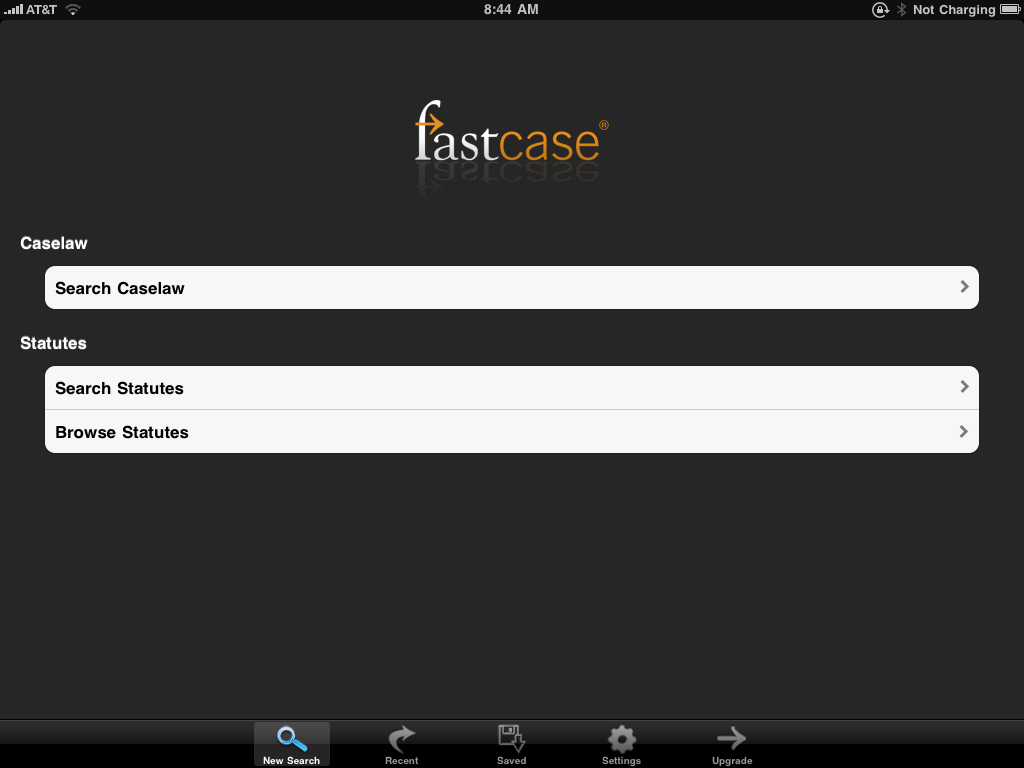
Start Screen (Select what you want to search)
Select the database you want to search (you cannot search both cases and statutes at the same time). You can also browse statutes (any statutes that are not in the Fastcase databank, such as Colorado, will give you an option to launch the iPad browser to go to the official state statute site.)

“Search Caselaw” Screen
Seems to be basic Boolean searching or you can look up by citation.

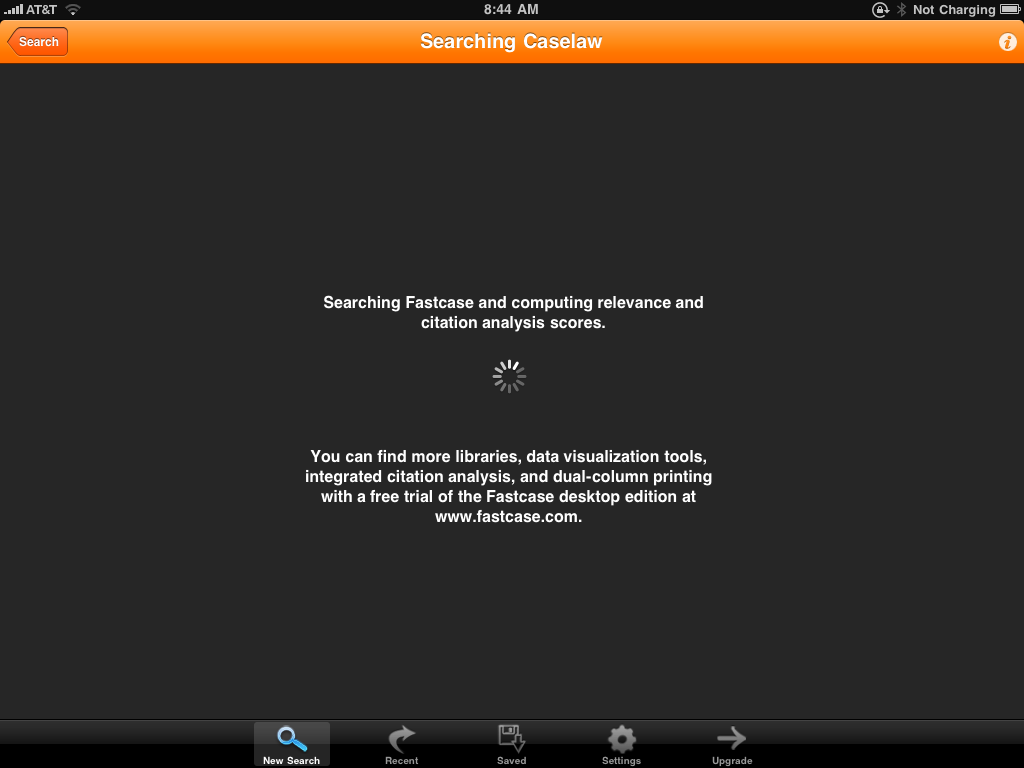
The Conducting Search Screen (AKA “Hey, why don’t you upgrade to our full version” Screen)
If ‘free’ is nice, the premium version must be better, right??
The searches I conducted took anywhere from three seconds to about fifteen seconds… depending upon the databases selected and the search terms used.

Caselaw Search Result Screen
You can set the display options in the “settings” area. This shows the top results by relevance and gives you the name of the case, decision date, and the number of times this case has been cited.

Caselaw Reading Pane View
The reading pane is nice and clean. You can also ‘swipe’ to the next result by swiping left, and the previous page by swiping right. This was actually backward from how most other iPad apps work, but I adjusted quickly to the way it works here.

Authority Check Report Page
Although it is not quite a KeyCite or Shepards’ results page, it is helpful to have the ability to see cases that have cited this case. It would be even better if Fastcase did this for statutes and other primary law material as well.

Statute Search Results Page
Here’s the results page for a statute search with the short name and citation to the statute listed.

Statute Reading Pane
Reading pane for statutes is similar to the caselaw reading screen.

Increase Font Size Option
There is a slider bar that allows you to increase the size of the font. In the next version, it would be nice to allow you to adjust the font through the ‘pinching’ or ‘expanding’ the screen by using two fingers.

Save Document Option
You can save documents to read later.


Saved Document Screen
The saved document screen will display all of the documents you’ve saved. A nice addition to this would be to allow the user to add folders so that documents could be saved to specific research projects.


Recent Searches Page
Past few (default is 10, but you can increase in the settings page) searches are displayed and can be re-run from here.


Settings Page
Adjust the look and feel of the results, display and storage of the app.


The Upgrade to Full Fastcase Version Page
Again… if free is good, premium is better!!


Option for Getting Around the iPad’s Printing Issue
Step 1: Press and hold your finger at the top of the screen (somewhere with “white space”) until the blue “copy” highlight covers the entire text.

Step 2: Press Copy
Step 3: Open your email program and paste the document into the body of the email. You could also push the text to something like Evernote if you use that.

Step 4: Print the email from your PC or Mac when you get back to your office.

Until Steve Jobs seems to think it is okay for you to print directly from your iPad, this type of work around will have to do.

I’ve had no problems navigating or searching around the iPad version of Fastcase. It is pretty straight forward and easy to use. It doesn’t take advantage of all of the bells and whistles that the iPad offers, but I’m sure that over time it will. I’m looking forward to showing this around to my peers at the AALL conference this weekend (since I know that most won’t even have an iPad… and none will have the Fastcase iPad App!!)