The Elephant Series Brainstorming over beer – we came up with a new blog concept and we’re calling it The Elephant. The concept is tackling a topic from multiple points of view. On the first pass, these POVs will come from our stable of bloggers. But then the real fun will come engaging others POVs for the dialogue. Too often in our industry these dialogues appear in separate venues and never cross paths. We want to force that path crossing in a grand way. We are calling it The Elephant for two reason:

  1. The Elephant in the Room
  2. The Story of the Blind Men and the Elephant

Which means we’ll get to hear from each blind man and/or woman and hopefully end up with the complete picture. And we hope to pull the covers off of many elephants in the room that have been standing there far too long – un-noticed. Participation is key to this dialogue, so please provide your POV on the topic. You can do so via the comments section. Let the games begin! First Elephant Question: Is It Better To Get It Right Or Do It Right? This question is really founded in the value of process. Should we follow a process to insure the right or best result, or is the right result good enough on its own? The Alternative Fee Arrangement (AFA) Perspective Pricing as an Art and Science – Where’s the Line? Toby Brown From my perspective running alternative fee deals – ‘getting it right’ weighs in at 90% in this debate. But right now I appear to be living in the wild wild west. Too much order in terms of process would leave me behind. In my role, I need to deliver answers now, not after driving requests through a drawn-out formal process. I do need access to the right information at the right time. But following a rigid schema right now would lead to getting it wrong. Not something I have time or the patience for. However … the writing on the wall has “Process” in bold letters. My biggest challenge is finding any tools or system around to handle any process. Normally I’m the guy who chafes at random spreadsheets, used to avoid a database. But in this world I am forced to use them. My bottom-line: Getting it Right is all that counts right now. But vendors …. please, please, please – I am begging you to get some reasonable AFA and LPM process tools on the market soon. The Information Technology Perspective Process with Schmucks Scott Preston Measure twice and cut once – is this process or knowledge? It takes longer, but the results are consistently better and consistently better results is what process is all about, but caution is based on knowledge and experience. The typical IT person is process oriented, this is very important when you are maintaining complex systems, especially as IT is being asked to do more with less. But doing more with less often calls for creative thinking, and focus on process can fly in the face of creative thinking. When looking for a new solution, ask this question. Is this a one off solution or one that will happen again? The more the solution needs to be repeated the more time needs to be spent on automation (repeatable process). When working on new solutions you will frequently hear me talk about “turning the problem on its side” – meaning, let’s look at this from another angle or approach the problem in a new way. This concept is part of my nature. I’m a jazz musician by training and jazz musicians are all about learning the rules and then breaking them. So, don’t let process stunt your creative thinking, break a few rules and learn from your mistakes. The Library & Information Services Perspective Process, Schmocess!! Question Asked… Question Answered is the new process! Greg Lambert In these times of running a research shop with bare-bones operations, researchers don’t have time to “teach a man to fish” anymore. These days it is a process of question-in… answer-out rather than going through the process and explaining to the person where the resources are located, how to navigate or search that resource, and what alternatives are out there that may also hold the answer to the question being asked. It makes for job security for librarians and researchers, but it also creates a terrible process and is counter to what librarians and researchers are really good at… and that’s teaching others how to find answers, while at the same time providing them the answers they need. The process definitely isn’t where it needs to be, but bare-bones operations call for bare-bones processes. The Competitive Intelligence (CI) Perspective Dealing with Cloudy Crystal Balls and Out of Date Tarot Cards Zena Applebaum Good competitive intelligence (CI) is in itself a process that is constantly evolving in an effort to get it right while doing it right. Taking the time to do it right only works in cases of extreme clairvoyance, where you know what the answer to the business problem is going to be so you can design a process around finding that answer. Unfortunately, CI doesn’t really work that way and most of CI practitioners’ crystal balls are cloudy and our tarot cards are out of date. So we have no choice but to dive in and try to get it right first; allowing the process to form in the background. As each new question or assignment is taken on, the process gets refined to become more “right” often resulting in greater efficiently and a better understanding of the scope of the problem/solution. Interestingly, the process that will be used to answer the question can often inform the intelligence that will come out. For example, using an environmental scan (the process) to identify a key competitor (the answer) in a market place may actually create several more questions requiring a different set of processes and still not lead to a “right” answer. But you wouldn’t have known to ask those new questions if you had not first jumped right in. So for CI people, the answer is first attempt to get it right, and then attempt to nail down a process. Which works until a new question comes along and the now refined process doesn’t work…. The Internet Marketing (IM) PerspectiveIt’s Big Picture, BabyLisa SalazarIM is all about process. We design, post, link, count, analyze, go back to the design, refine, post, …You see where I am going. IM is all about metrics. Lots of folks get stuck at the design phase and get hung up on the little picture (pun intended). What many folks fail to see is that IM should be a process if it is done well and it is done right.

While flipping through some of my daily BigLaw news feeds, I noticed a free service that Latham & Watkins offers all of us — The Books of Jargon on Corporate & Bank Finance, and Project Finance. So, if you need to know that in Project Finance, the term “LAER” actually stands for “Lowest Achievable Emission Rate”, or if your just learning some Bank Finance Slang and need to look competent when someone says something about a “Left-Side Arranger”, then L&W has come to your rescue. I also like the fact that the Finance ‘nerds’ at L&W are proud of what they’ve produced.  Here’s what they say about the Books of Jargon:

The attorneys at Latham & Watkins have authored multiple Books of Jargon which are intended to assist the newest members of the financial community in learning to ‘talk the talk’ of banking, capital markets and project finance. If you are a recent business or law school graduate or perhaps a not-so recent graduate, this on-line portal is for you. We love this stuff!

I didn’t emphasis that last sentence… they did!

Both books are written from a U.S. practice perspective, and of course, shouldn’t be construed as legal advice (you’ll need to pay them their hourly rate to get that benefit.) If you’re a want-to-be finance nerd, too, then go over at check out the sweet little freebie that the attorneys at Latham & Watkins have designed in their Books of Jargon.

I hear many law librarians complain that the foot traffic in a library has shrunk to that one guy that grabs the morning paper… heads out to the bathroom… then brings the paper back a few minutes later. (Does that guy even work here??) Anyway…  I found this little tidbit from a “60’s Girl Group/Beat Combo” band called The Like and their new song “He’s Not A Boy“. Although there’s not a lot of legal research going on in this video, there is definitely a lot of foot traffic.

I’m going to contact them and ask if they can do a tour of law libraries around the U.S. to help us get more people in the door!! Let me know if you want me to put your library on the LawLibraryPalooza Tour.

Obviously, everything we need is on the Internet, right??

That’s what Josie D. Schoolcraft wrote to the Editor of the Bullard Banner Newspaper. Ms. Schoolcraft believes that Cherokee County Texas is wasting the $4,176 in annual salary that goes to the person that maintains the books in the county’s law library. Is she right? Is it a waste to update those books when everything the courts and the public need from its law library can be accessed via the Internet, and I’m assuming through the magic of Google?

We hear it all the time that everything we need is on the Internet. What do you say when someone walks into a county law library and complains that all these books are a waste of honest working taxpayers’ money?? Here’s a snippet of Ms. Schoolcraft’s letter to the editor. Perhaps it might be a great idea for someone in AALL’s State, Court and County Special Interest Section to email the Bullard Banner News Editor, Don Treul (editor@bullardnews.com) with a response?

Did you know Cherokee County pays for a library of hardbound books and also pays for internet access to the same resources? Why are commissioners wasting our money by paying for the same information from two sources? We also have an employee who is paid an additional yearly salary of $4,176. for maintaining the books in Cherokee County’s law library as well as a regular salary for being an indigent health clerk. Why are commissioners paying a person to maintain a law library when the internet access is all that is needed? You can see this salary for yourself on Cherokee County’s Web site at www.co.cherokee.tx.us, then Budgets on left side of screen.

Got an answer for Ms. Schoolcraft?? I’m not sure her local county officials are giving her an adequate answer to her question.

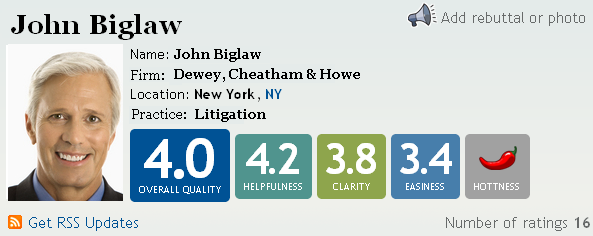
Perhaps one of the scariest “crowd sourcing” websites I’ve seen lately is the “Rate My Professor” site that allows anyone to register (for free) and comment on and rate their college professors. I’ve gone in and looked at some of my old college professors and others that I know from other law schools and the ratings are pretty interesting to read (to say the least). So when I read about the ongoing saga of the upcoming U.S. News & World Report’s rankings of “America’s Best Law Firms“, I think that we should just skip out on the formalities of filling out questionnaires and just put up a website that allows Corporate Counsels to create anonymous names and rank those attorneys at BigLaw firms. It has to be about as good a way to rank law firms as the U.S. News rankings will turn out.

Forget about diversity, pro-bono hours and boring statistics and metrics… skip right to the juicy stuff about your attorney’s overall quality, helpfulness, clarity, easiness, and whether he or she is “hot”. That’s what we all really want to know. Take notes Martindale-Hubbell. This kind of “Client Review & Rankings” system might not be the most professional… but it would sure be popular!!

I thought I misread the LexBlog “New Blogs” post this morning when it said that Fox Rothschild just launched its twenty-sixth (that’s 26!!) blog this week. Holy crap!!  Twenty-Six Blogs from a BigLaw Firm??? That is completely amazing. Not only that, but in my quick scan of the blogs, it seems that there is current content (no older than two or three weeks at most) on each of the blogs.

In an age where many firms are still struggling to come to grips with social media, it seems that Fox Rothschild has grabbed social media by the horns and is showing everyone else how to ride it. As Mark Silow, Fox Rothschild Administrative Partner, puts it:

“Clients depend on communication from counsel to keep track of the legal changes that affect their business. That’s why we speak with our clients on every level — including using innovative communications like Blogs.”   

It is good to have trailblazers out there for the rest of the flock to follow.  Keep up the great work!!  One hint to the webmaster at FR, though… go ahead and link to the actual blog page… and skip the intermediate page that doesn’t have any content!! Here’s a list of all of the blogs:

Art Law
Attorneys Gary Moriwaki, Daniel Schnapp and John Wait cover issues relating to art litigation and finance, specifically art recovery, art preservation, art as collateral and valuation of art. They also discuss recent trends in the art market.
View Blog
California Employment Law Blog
Labor and Employment attorneys Keith Chrestionson, Alex Hernaez and Jeff Polsky discuss a wide variety of legal challenges faced by California employers, including class actions, wage and hour, overtime, discrimination, harassment and privacy issues.
View Blog
Condemnation & Eminent Domain
Fox Rothschild has one of the leading eminent domain and real estate litigation practices in the country. Join David Snyder, co-chair of the firm’s Condemnation Practice Group, as he provides useful information and commentary regarding developments in the law, updates on projects and helpful tips regarding eminent domain and other real estate litigation related topics. This is an excellent resource for real estate professionals, property owners and condemnors who may be embarking upon a new project.
View Blog
Delaware Bankruptcy Litigation
Join attorney Jason Cornell, whose practice includes representing a broad range of clients in bankruptcy matters before the U.S. Bankruptcy Court, District Court and the Third Circuit, as he offers his take on corporate bankruptcy proceedings in Delaware and throughout the United States.
View Blog
Delaware Intellectual Property Litigation
Wilmington Office Managing Partner Gregory B. Williams explores the decisions issued by the U.S. District Court of Delaware in the areas of antitrust and intellectual property law.
View Blog
Education Law
Timothy Gilsbach, Mark Fitzgerald, A. Kyle Berman and Jeffrey T. Sultanik maintain a blog about education law, highlighting the statutory and regulatory changes and offering observations about the educational society and the impact that society has on educational institutions. Topics covered include gender discrimination, special education, parental rights, higher education, student speech and services and Title IX.
View Blog
Employee Benefits
This blog provides updates and commentary on various topics specific to the interaction between employee benefits and human resources, with an eye toward topics salient to the administration of employee benefit programs in conjunction with employment concerns. It is essential to keep current on the changes in the law (and, in some instances, case decisions) that directly impact benefits plan administration – including the ever-changing “reasonable person” standard under ERISA. Any professional who actively participates in the administration of plans and has questions regarding the current state of the law and the interaction of the law with human resource obligations will find this forum helpful.
View Blog
Employment Discrimination Blog
The firm’s Employment Discrimination Blog covers all aspects of employment discrimination and harassment, including new court decisions and legislation, compliance, best practices, interesting trends in workplace relations and employment-related issues affecting employers.
View Blog
Fair Housing Defense
Join Fox Rothschild attorneys Scott Badami, Karin Corbett and Christian Moffitt as they provide insight and information on and compliance with the Fair Housing Act and its state and local counterparts. The blog provides a forum for issues of interest to apartment owners and management companies as well as professional management employees.
View Blog
Family and Medical Leave Act
With new regulations regarding the Family and Medical Leave Act (FMLA) on the horizon, and requests for FMLA leave on the rise, employers need to be aware of new developments in FMLA case law and regulations. Join Catherine Barbieri, a partner in Fox Rothschild’s Labor & Employment Department and the firm’s Hiring Partner as she discusses changes to FMLA, what employers need to know and how to respond on the FMLA Blog.
View Blog
Fashion Law Blog
Staci Riordan, chair of the firm’s Fashion Law practice, covers a wide variety of business issues faced by the fashion industry, including strategic planning, licensing, trademark and copyright infringement, the Design Piracy Prohibition Act, employee issues and much more, in the firm’s Fashion Law blog.
View Blog
Federal Taxation Developments
Join nationally recognized tax attorney Jerald David August as he discusses recent tax legislation, regulations, rulings and case law developments have resulted in a significant amount of new information that can substantially impact taxpayers.
View Blog
Getting Funded Law Blog
Looking for financing for a project or business in the current economic climate? Attorneys Gregory Kleiber, Michael Maransky, Megan Duryea Santana and Robert Walper cover a wide variety of topics pertaining to getting loans and funding, including traditional bank financing, sale-leaseback arrangements, public-private partnerships and much more.
View Blog
HIPAA, HITECH and Health Information Technology
Need information about the legal developments, issues, and other pertinent information relating the creation, use, and exchange of health information? Look to Fox’s HIPAA, HITECH and Health Information Technology blog. Join our multidisciplinary team of Fox attorneys as they discuss topics such as EHRs and PHRs; HIEs, RHIOs, and EHR networks; privacy and security; breaches; recent legislation; intellectual property issues; physician perspectives; litigation risks, among other related topics.
View Blog
IP Legal Watch
The IP Legal Watch Blog analyzes issues of interest concerning patent, copyright, trademark and related litigation, with an emphasis on recent court decisions and breaking news.
View Blog
New Jersey Family Law
Fox Rothschild’s New Jersey Family Legal Blog provides practical information and useful tips related to such topics as alimony, child support, custody, parenting time, divorce, equitable distribution, prenuptial agreements, domestic violence and grandparent visitation. This blog is an excellent resource for individuals with New Jersey specific family law questions and advisors whose clients may encounter family law issues.
View Blog
New Jersey Real Estate
The New Jersey Real Estate Blog, authored by Fox Rothschild attorneys Jeffrey Hall, Jack Plackter, Alexander Wixted and Andrea Tompkins Wright, serves as a source of information on topics related to New Jersey real estate property law and development. The blog provides information on topics such as land use and zoning, green building and tax appeals. It also provides new case law as well as legislative and regulatory updates. The blog is intended to be a resource for multifamily, industrial, mixed use and commercial property owners and developers.
View Blog
PA Brownfields & Environmental Law
Join M. Joel Bolstein as he offers his thoughts about information and developments in Pennsylvania brownfields and environmental law. Topics Joel has discussed include low risk sites, SIA agreements, the Hazardous Site Clean-up Act (HSCA), and more.
View Blog
Pennsylvania Family Law
The Pennsylvania Family Law Blog provides readers with information on and insight into Pennsylvania Family Law issues, including divorce, equitable distribution, alimony, child support, spousal support, alimony pendente lite, and custody.
View Blog
Physician Law
For those seeking current news and updates on legal issues affecting physicians and non-institutional providers in both their personal and professional lives, Fox’s Physician Law blog is for you. Attorney Todd A. Rodriguez offers his insights and tips on new legislation and legal issues relating to practice management, billing and coding, ancillary services, malpractice insurance, fraud and abuse developments, and other important legal issues.
View Blog
Privacy Compliance & Data Security
Privacy compliance and electronic data security affect almost every business. Data breach prevention is essential. Fox Rothschild’s Privacy Compliance & Data Security Blog will help readers navigate through the policies and best practices of data breach response. The Blog covers topics including compliance with data protection laws and regulatory enforcement and litigation as well.
View Blog
Sports Law Scoreboard
Jeffrey Kravitz, Ismael Bautista, Jr. and Edward Hayes are dedicated sports fans and practicing attorneys. Their blog highlights current news in sports and discusses the associated legal implications in a manner designed to entertain and inform the sports community, fellow fans and casual observers.
View Blog
Wage & Hour — Developments & Highlights
Members of Fox Rothschild’s Labor & Employment team provide the latest information and commentary on developments in wage and hour law, including classification of employees as exempt/nonexempt, class action issues and cases, independent contractor developments and cases, what does and does not constitute “working hours” and much more.
View Blog
White Collar Defense & Compliance
Fox Rothschild’s White Collar Defense & Compliance blog includes articles of interest to both practioners and corporate counsel in the areas of criminal defense, regulatory compliance, and internal investigations. Our objective is to identify new cases and developments, as well as statutory/regulatory enactments of note, and to spot emerging trends in these practice areas. Your comments, including suggestions concerning other content which may be of interest, are always welcome.
View Blog

Here are the two launched this week:

Life Science Blog
Fox Rothschild’s Life Science Blog focus their posts on pharmaceuticals, medical devices, biologics, foods, dietary supplements, cosmetics, animal feed and Drugs, radiation-emitting Products and nanotechnology.

Franchise Law Update Blog
In Fox Rothschild’s Franchise Law Update you won’t find only a discussion of the regulatory aspects of franchising, but diverse topics including business finance, employment, litigation, and the protection of intellectual property like trademarks and copyrights.

Last week I spent some time meeting with a legal vendor. We covered a variety of subjects. At the end of the discussions we picked up the topic of selling technology and services to law firms. The vendor commented on how that has become a challenge because the point of contact for the sale is shifting. It is no longer clear who is the right point of contact to get to (when it’s not clearly the CIO). The problem vendors have is figuring out who the new person is. They asked me where this shift was headed.
After thinking about it, I suggested that they really need to reach out to the business side of the law firm. That is where very interesting and important problems are arising for firms – where they can use some help. Things such as AFAs and LPM are front and center for firms.
Then THE question came.
Where is the business side of the law firm?
I told them I would only answer one question a day – since I didn’t have an answer – since law firms don’t really have a business side.
Kidding aside – this is a real problem for … Law Firms. Who is driving the business? The Executive Director runs operations. The CFO runs the numbers. The Managing Partner (MP) runs the partnership. But with few exceptions, I do not see a defined business-driver type of position for law firms.
I did come up with an indicator for the vendor for the type of firm that will more likely have some sort of business side. Look for a younger MP.

We keep hearing reports on how the economic upswing is slow and we might even be in for a double dip. Depressing news to say the least.
So here’s some counter-news on that subject to cheer up your Friday.
I have the privilege of serving on the Board for AMA Houston and we held our August Board meeting yesterday. Perhaps the most anticipated report at the Board meeting over the past year has been on the Jobs List. AMA Houston runs the top job list for marketing positions in the Houston area. On a weekly basis new jobs are posted up – first for members, then the general public. At yesterday’s meeting Robert Melvin, who runs the job board, reported that job listings are back up to their pre-2008 numbers.
To me this means the recovery is happening – at a minimum here in Houston. Marketing is typically the first department cut in a down-turn. But then at the first whiff of recovery, money pours back in to this department. I will set aside the comment of how counter-intuitive this reaction is and focus on the meaning of this stat.
Increased hiring in marketing is a bell-weather indicator of economic growth. In Houston, that trend appears to be in full-swing.

[We’re happy to have Ed Walters, CEO of Fastcase, as our guest blogger]

Greg Lambert issued a dire proclamation here the other day: If Law.Gov remains an exercise in Academia . . . It Will Die.  His post noted that there were no government officials in Law.Gov’s initial list of 33 co-convenors, and that their buy-in would be key to moving from principles to action.  Although Greg is almost certainly right about the conclusion, the diagnosis is premature.

First, these are just the signatories to the Law.gov statement of principles, not the full list of supporters.  As Joe Hodnicki and others have pointed out, even though the list of co-convenors includes some very prestigious names, it is much smaller than the list of people supporting the effort.  As a small example, Law.Gov workshop participants included:

Preeta Bansal, General Counsel and Senior Policy Advisor to the Office of Management and Budget
Debra Bowen, California Secretary of State
David Mao, the Deputy Law Librarian of Congress,
Vivek Kundra, The White House Chief Information Officer
Ray Mosley, Director of the Office of the Federal Register
Beth Noveck, Deputy Chief Technology Officer for The White House
Laurence Tribe, Senior Counselor for Access to Justice from the Department of Justice
Paul Verkuil, the Chairman of the Administrative Conference of the United States
Michael Wash, Chief Information Officer of the Government Printing Office

Although many of these participants spoke for themselves and not their respective agencies, the process of winning buy-in from key government officials is well under way.

Second, although buy-in is key, courts and government officials will likely be later-adopters.  And that’s okay.

If you look at the history of liberating government data, many times (but not always) it’s private industry and entrepreneurial individuals who move first and show the government what’s possible.  Then enlightened individuals within the government re-structure their data feeds or their own sites to make the jobs of entrepreneurs easier (and get some tech cred for their agency at the same time).

One good example of this is the way Carl Malamud worked to put SEC filings online in the 1990s.  It was much easier for him as an individual to put the filings online himself as a proof of concept than it was for the SEC to find the financial and human resources internally to do that work.  Once Carl proved that it was possible, he was able to hand the database and its maintenance off to the SEC (which still successfully runs it today).

Recent examples abound.  Harlan Yu, a grad student at Princeton’s CTIP built FedThread.org, and a small group of developers built govpulse.us, each a cool, innovative way to look at the Federal Register.  So now Ray Mosley, the Director of the Office of the Federal Register, is working closely with both groups and has just launched Federal Register 2.0.  Innovators start the process, but the government can often use their momentum and vision to innovate as well.

The key next steps for Law.Gov will come from entrepreneurs who inventory public law and who build tools that make that law more publically available.  And there is no shortage of innovative personnel here, either in the co-convenors list, the list of participants, or the list of supporters.  When innovators such as Tom Bruce and Peter Martin at LII, Paul Lomio and Erika Wayne at Stanford Law School, Tim Stanley at Justia, the team at Princeton’s CTIP (like Ed Felten, Harlan Yu and Steve Schultze), and maybe some of the more entrepreneurial publishers like our team at Fastcase can agree on standards, we can start organizing parts of the collection, and opening them up online.  (By the way, there’s a lot of firepower in that paragraph, folks.)

Heck, even traditional publishers have a part to play.  LexisNexis participated in many of the Law.Gov workshops, including CEO Mike Walsh.  Imagine the impact LexisNexis could have in this effort by, for example, disclaiming copyright in state statutes for the eight-or-so states where they claim it.  (Don’t be surprised if the traditional publishers get involved. As I’ve pointed out elsewhere, better access to public law should be market-enhancing for existing publishers.)  This is a case where private industry involvement early on can be even more influential than the involvement of some state governments.

So although it’s correct to note that the effort will need buy-in from the government, that buy-in might not be as necessary at this stage.  Now is the time for smart people in the open government movement, law schools, law libraries, state bar associations, and law firms to inventory the state of our public law.  Now is the time for innovators to begin publishing, repurposing, and mashing up government data in new and interesting ways.  In the next stages, I’m confident that the smart people at GPO, The White House, the Law Library of Congress, in state courts, legislatures, and elsewhere, will pick up the ball and run with it.

As Greg points out, the Law.Gov statement of principles is a good start that needs buy-in from the government.  Although I’m not surprised that government officials aren’t early signatories, I will be very surprised if we don’t see a lot of innovation (private, then public) in the Law.Gov movement.

Flipboard’s “Cover” Is Visually Stimulating

With Google’s announcement yesterday that it is going to wind down Google Wave at the end of the year and move the pieces around to other products, the blogosphere and twitterverse have been full of “Ha!! You early adopters can suck it!!” comments. There’s also a lot of discussion of what’s early adopter product can we expect to fail next? One product that I’ve seen mentioned is the iPad social media viewer Flipboard. I’m going to stick my neck out on this one and say that it will not fail like Google Wave did, and that I find it to be both a useful and a fascinating resource to use to keep up with news, social media, and other forms of media and entertainment.

Here are a few of the reasons that I think that Flipboard will not become the next Google Wave.

  1. It is visually stimulating.
  2. It is very easy to use.
  3. It is a fast way to get information.
  4. It is on a platform filled with early adopters and early majority users.
  5. It is an enhancement of… not replacement of other social media tools.
  6. It stands in a space all to itself.

A few days ago, Scott Preston asked if there was a Windows product that rivaled Flipboard. No one could come up with anything that they could point to that would be a direct competitor to Flipboard (especially in the Windows market.) Perhaps as other tablet devices are released, the competition will grow.

I saw some comments this morning that people are abandoning Flipboard because it is not an RSS feed reader like Google Reader. That is true, and if you’re looking for an RSS reader, then there are a number of products out there (I primarily use Google Reader… but I hear there are other good products.) However, if you absolutely won’t use Flipboard because it doesn’t work as an RSS reader, then here is a workaround that I found from a Flipboard community bulletin board:
  • Make a folder in gReader and fill it with feeds you want Flipboard to have.
  • Make the folder public.
  • Create a new Twitter account.
  • Use an RSS to Twitter service to spit the feed from the public folder into the new Twitter account.
  • Follow that account with Flipboard.

I haven’t tried this yet, but I do like how you can follow Twitter Lists that you or others have set up. We still get a lot of hits on our “convert your Twitter Lists to RSS feeds” post that we did last year, so I know that people are still hungry for this type of information. Putting those lists in the Flipboard platform really makes it pop out at you, too!  The picture to the right is an example of taking @lawshucks/aba100 twitter list and turning it into content on Flipboard. I would have completely missed @corporette’s tweet on appropriate one-piece dresses for the workplace had it not been for Flipboard… and that would have been sad.

Flipboard is a fast way to get information from many different sources (twitter, facebook, news/entertainment feeds, etc.) However, it is not a one-stop, everything-you-could-ever-want resource. I follow 2,700+ people on Twitter, so even with Tweetdeck and other resources, I miss a lot of things. I’m okay with that. Using Flipboard… in addition to Tweetdeck… I get more of a chance to catch things as they swim by in the twitter stream of information. 

Google Wave failed primarily because it was a confusing tool to use. It looked cool in the demo, but once you jumped in, it was a monster to navigate and use effectively. Not so with Flipboard. My pre-teen daughters could set this thing up in a few minutes and start flipping through the content. Even better, my 72 year old Dad could also be flipping through the content and not blink an eye. It is easy to use, easy to set up, and easy to navigate. I’ve always loved the quote I used to get from when I was working in a mainframe shop at the University of Oklahoma – “Making something is pretty easy…. Making something easy is pretty difficult.” Flipboard developers have definitely made something easy.

Finally, I love the look and feel of the product. When I’m drinking coffee in the morning, I flip through the content and find all kinds of relevant and interesting things to read, watch and look at. It’s become my morning newpaper (and I haven’t had a morning newspaper delivered to my house in 10+ years.) Unless Flipboard starts charging for content, or gets shutdown for legal reasons, I don’t see any reason why I would stop using it.