First of all, I need to apologize for the technical difficulties. I attempted to live stream the Houston Area Law Libraries panel on Alternatives to Westlaw and Lexis, but the results were horrible. The audio from one of the speakers was too garbled to understand, and I was too busy moving back and forth from the computer to the podium that I didn’t see the stream of complaints coming in about the audio. Chalk it up as “lesson learned.” Next time, I think I’ll just record the presentations on a real camera and then transfer it over to the web for later viewing. Again, my apologies! Now, for what you missed.

The idea behind the panel discussion was to get an overview of a few legal research products that are outside the large Westlaw and Lexis wings of the industry. We had Sharon Kube and Karen Ditsch from Loislaw (Wolters Kluwer), Ed Walters from Fastcase, and Dave Harriman from Casemaker. It wasn’t set up as a bash Wexis session, but rather to highlight what’s good about the alternatives, and what factors may exists that would encourage law firms, law schools, and court law libraries to use these products. The format was pretty straight forward; five-minutes each on discussing the products, followed by a scenario, then field questions from the crowd.

Product Intros
Sharon and Karen discussed the value of Loislaw as a flat-rate subscription with a wealth of primary law material, but also highlighted the ability to add in up to 200 treatises from the Wolters Kluwer collection, that integrates the Loislaw collection through hyperlinking of caselaw and statutes. Loislaw has a citation system that allows you to see the cases cited and any cases that cite to this case. There is also a find and print type option in Loislaw that allows you to pull all the citations out of a brief or document and then read or print any of those cases or statutes.

Ed Walters of Fastcase took a broader method with his five-minutes of discussion of his product. He discussed the issues of having large conglomerates of Thomson Reuters and Reed Elsevier controlling such a large percentage of the legal publishing market. Walters says one of the biggest problems is that law firms and law librarians are not speaking the “corporate” language of the big vendors. If you complain about the service and products, but re-up your subscriptions at a 12% increase, the message that the vendors hear is “they are willing to re-up at 12%.” A combined tweet from Carl Malumud and David Curle, may have said it best on what Walters was doing:

RT @davidcurle: @EJWalters is holding up a mirror to the audience. #alt2wexis [they have met the enemy and they are them!]

The answer, according to Walters, was that if the community wanted to really change the way things are with Wexis, then “you got to build it… you got to invest in it.… Complaining on the [law library] listservs is not going to do it.” Walters did go on to talk about Fastcase and the way they are building the interface to be “easy, powerful, compelling, beautiful.” They are building iPad and iPhone apps; building free access to limited portions of the collection through the Public Library of Law; and, the Forecite tool built in to Fastcase to point out cases that might be overlooked through traditional search methods.

Dave Harriman from Casemaker took a much more traditional approach of explaining his product by talking about his background of 40 years of legal editing while he was at Michie, and was the President of Michie Publishing when he left after Lexis acquired Michie. Harriman pointed out that when it comes to primary law, Casemaker compares very well to products like Lexis. Harriman’s biggest point of why Casemaker is a great product is that they are focused on the editorial process. Casemaker also has a citator system, called CaseCheck+, for some states that works like a Shepards or Keycite. They also have a case summary resource that produces summaries for newly released cases in some states. Of course, the biggest draw is that Casemaker is free for those states where the bar has purchased licenses for the members of those bars.

Scenario
I had given each of the panelist the scenario I was going to ask previous to them appearing on the panel. The scenario was this:

My boss came to me and said that they were looking to reduce our current Westlaw and Lexis subscriptions down to one vendor only. I was given the names of the three vendors (Fastcase, Casemaker and Loislaw) and was told to investigate if any of these would be a good alternative to the product we are dropping. The panelists’ should give me some good talking points to take back to my boss on why we should bring in their product as an alternative to the product we are dropping.

Loislaw’s panelists went first and explained that Loislaw is a flat-fee product, so you pay one price, and no surprises. One benefit of Loislaw, over some of the other non-Wexis products, is that all the materials are housed within the Loislaw databases. This means that their citation system, Global Cite, (which is not a Shepards or KeyCite replacement) works extremely well because all the material is there. If portions of the state statues are not housed within the system, then a citator system like this is basically useless. Sharon Kube also mentioned the ability to pull all of the cites out of a brief or document, and the ability to add in treatise materials that integrate into Loislaw (at an additional fee.) The biggest pitch was that Loislaw is affordable when compared to Wexis.

Once again, Ed Walters took a unique approach to answering the scenario. I think Jason Wilson may have said it best in his tweet about Walter’s opening remarks:

Smart approach by @ejwalters. It’s the ol’ Macy’s/Gimbles approach. “Hey, we may not be right for you.” #alt2wexis

Walters started discussing the user experience that Fastcase brings, more than how it battles head-to-head with the Wexis products. Fastcase is designed to get researchers focused on the tools, and not attempting to get bogged down in the different databases. This is done, according to Walters, through smart sorting tools, research options, data visualization tools, and through new search results options that Fastcase’s “ForeCite” brings to the final results. The pitch for Fastcase was what Walters mentioned in his introduction; Fastcase is “easy, powerful, compelling, beautiful.”

Dave Harriman from Casemaker finished up the scenario by focusing on Casemaker’s content, and editorial production team. Casemaker uses a combination of editorial staffers based in Mumbai, India (Indian based lawyers) and Charlottesville, Virginia (former Michie editors.) Whereas, Fastcase discussed its interface, Harriman talked about Casemaker’s content, and the ability to keep things like state and federal statutes updated as soon as laws are signed. Since Casemaker is only available through the state bar, if your state bar has an agreement (the Texas Bar does, by the way) then members of the bar can have access for free. So, if cost is a factor, and your bar has an agreement, then that may be the big selling point to take back to your boss.

Are the non-Wexis products viewed by Courts as a “trusted source?”
This question actually came in from an academic law librarian, but it really had a Court librarian angle. The vendors talked about how they work very hard to make their products dependable and trustworthy. Loislaw pointed out that they include pagination on all of their resources; Fastcase talked about the fact that over 500K lawyers had access to Fastcase; and, Casemaker said that they are a trusted sources because they supply the material to the state bar associations.

What about proprietary citations that Westlaw and Lexis use when citing to new decisions? Will an increase in non-Wexis provider usage break the court’s reliance upon these? 
This was an interesting question on the issue of those ____ WL ____ or ___ LEXIS ____ cites that go up on new cases until a print version of that case appears in the National Reporter System (sometimes months later.) This question got Ed Walters back up on his soapbox about how there is a need for libraries, librarians, researchers, lawyers, and the associations that represent them to stand up and demand a neutral citation system. No one said that the “WL” or “LEXIS” cites were going away anytime soon, however.

The conversation did expand to include the issue of the copyrighting of the “catchlines” (titles) of state statues. In some states, the actual title of a statute is copyrighted by the vendor that prints the official state statutes. I ran into this problem in Oklahoma when it came to Westlaw claiming copyright. Ed Walters discussed this about Lexis owning the copyright to the Georgia state codes. Walters said he was stunned that when he asked Lexis to license the catchlines to the statutes, he was told that they would never do that… at any price. Casemaker’s Harriman added that when Michie was publisher of the state codes, they gave the copyright of those catchlines back to the 26 states that they covered. Harriman explained that publishers had to create those catchlines, and thus claimed copyright on them, but in Michie’s case, they wanted to give that back to the states to build goodwill. Walters said that the copyright should be viewed as a “work for hire” and should never go to the publisher. I think that everyone in the room agreed that the issue of catchline copyrighting is one that no one (except the vendors that hold that right) view favorably.

How about mobile versions of your products?
I think this question may have made Ed Walters squeak out a little cheer of joy. Walters jumped in and discussed the free iPad and iPhone versions of Fastcase (both the app and the content are free.) Harriman was not sure of the mobile apps that Casemaker offers, but since I had written about this before on this blog, I mentioned that Casemaker’s approach was to build a mobile web version of their product that would work on any mobile device, not just the iPad or iPhone. Kube from Loislaw said that they were about to beta-test a new mobile version in the next few months and something should be out later this year.

What about court briefs? Are you going to offer those?
Casemaker works with specific attorneys to put their briefs on their system, but is not working directly with the courts to pull that information. Ed Walters mentioned that Fastcase is working with the Law.gov folks on the 9th Circuit briefs. Loislaw (from what I remember) didn’t have any plans to put those on because of the issue of trying to obtain them from the courts. The issue of copyright was brought up again by Walters about the use of these briefs without getting permission from the lawyers that actually wrote the briefs. Harriman said that all of the copyrights of the briefs on Casemaker were cleared by the authors directly. There was also some murmuring about the coziness that courts have with the Wexis vendors on briefs, especially from courts where you cannot get access to the briefs online from the court themselves, but you can through the paid services of Wexis. We left it an open issue.

Any chance for International Materials?
Kube and Deitch from Loislaw said that international materials are part of the overall Wolters Kluwer collection, but currently not available directly from Loislaw. Casemaker is currently discussing the idea of adding international and foreign materials, but does not have any at the moment. My notes actually fail me on what Fastcase’s answer was to this. I don’t believe they currently have foreign or international materials, but Ed Walters may clarify that with me if I am mistaken.

End of Panel
It was a great panel discussion, and I was glad that Ed, Dave, Karen and Sharon took the time to talk with us. I wished that the audio on the livestreaming wasn’t garbled… but hopefully, this round-up of what was discussed makes up a little for that technical difficulty.

I’d love to see something like this as a discussion at AALL or at other local events. In fact, discussions like this shouldn’t be limited to the law library world. Legal research, its costs and contents, are issues that effect everyone that faces a legal issue. That includes lawyers, paralegals, legal administrators, corporate counsel, clients, all the way down to the Pro Se client. I’d really love to see this discussion happening outside the law librarian world. If you’re a member of an organization that has to deal with the cost and effectiveness of legal research, then I think having a panel discussion like this would be of value to the members you serve.

We have some interesting contributions this week on what the legal industry needs more of right now. I was a little disappointed that my friend Emily didn’t follow through on her dibs on “cowbell” – just because I really wanted her to say something like “The legal industry’s got a fever and the only prescription is more cowbell!” Since she didn’t, I thought I’d just toss it in there for kicks.

Just a reminder of why we have the Elephant Posts each week. The idea is that we all have different perspectives when it comes to what we do in the legal profession. Kind of like the story of the blind men describing an elephant by the part of the elephant they are touching. So, although some out there feel that we are asking insipid questions, instead of giving you our original thoughts, we feel that we are expanding our perspectives by asking you to share your own with us.

Next week’s Elephant Post question is listed at the bottom. If you like the post earlier this week about turning an iPad into a mobile phone, then I think you’ll like what we’re asking (and hopefully will contribute one or two apps that you use.)

Juggler of Cats Perspective

Management Training

In a profession where leaders are delegated and not created, few are actually trained in the art of management.
Managing people and their projects takes a special skillset. Talking a good talk is not enough. Managing people takes dedication.
Some people are naturally good at it. But most are not. To be a good manager takes effort, selflessness, and an understanding of all the parts of a business.
I would love to see more management training at the law school level and more cooperation between law schools and business schools. Columbia’s law school is moving in this direction. I am anxious to see how this works out for them.

Law student in waiting Perspective
Cloud

Reason 1: Picture a line graph. Now picture the x axis as servers and the Y axis as problems. Now picture a diagonal line going from left to right. Get it? Mo’ servers, Mo’ Problems. – Notorious B.I.G (Loosely Quoted)
Reason 2: 1992 called, it wants its servers back
Reason 3: “I got 99 problems but a server ain’t one” – Jay-Z (loosely quoted)

Law librarian Perspective
Consumer advocacy

See “Why The Largest Publishers Require Us To Unite Efforts In Consumer Advocacy

Lawyer Perspective
Business Sense

Too many of us still fail to recognize the “practice” of law as a business.  Professionalism is important, but does not conflict with commonly accepted business practices.

Legal Blogger Perspective
Guts

I had to laugh when I saw that one firm was creating a floor for the amount of legal spend that clients must spend each year, or be cut loose as a client. The issue here is that the firm has turned the responsibility of client-firm relations on its head. Instead of telling the attorneys that their clients have to show profitability, and hold them responsible for cutting unprofitable clients off… the firm has wimped out and created a rule that basically says “Dear Client: You must spend $X per year, or we will unfortunately need to stop doing work for you.” The problem is going to come when the partner comes back to whatever committee established this “line in the sand” rule and says that he or she wants to keep the client because they have a longstanding relationship with them that will pay off down the road. I’m assuming that this committee will fold like a cheap suit and move the line in the sand to a different point whenever someone wants to ignore it.

Knowledge Management Perspective
Elephants

That’s right. Elephants. What the legal industry needs more of is:  elephants.
For those of you who have been reading these Elephant Posts for a while now, you know that elephant is another way of saying transparency. From sharing how law firms work, to how clients work, to how client development works, to how billing works, to how evaluations work, to how partnership paths work, to how negotiations work, to how leverage works, you get the idea.
The more educated junior associates and staff are about the business of law, the better they can support the business, and the better partners and senior management they will become.”

Intelligence and Other Things Perspective
Self-Reflexivity

Self reflexivity.
Is it a business? It is a practice?  There are those who, in the ruthless pursuit of pure academia, see the legal industry as being fundamentally and only about practicing law.  Others, likely those who are more inclined to bow-at-the-feet-of-the-all-mighty-billable-hour, focus on the legal industry as a business. As a result, there is infinite chatter surrounding the profession and what it should do, how it should look and what it should be about – from  legal process outsourcing, to knowledge management, to how and when to recruit to alternative fee arrangements. No other profession I can think of discusses its insecurities quite as openly. Ultimately, what the legal profession really needs is more self reflexivity about who and what lawyers and law firm are in the world and how that plays out in a social or business context. It is time to take a good long look at what the industry is really all about…

Next Week’s Elephant Post

What Mobile App Do You Use For Work?

There was a lot of interest in my post this week about turning my iPad into a Phone, so I thought that this questions would dovetail perfectly. We’ve all probably sat through those “60 Apps in 60 Minutes” programs at a conference and watched as a bevy of applications flew past us on the screen. Those are cool, but what how many of those do we actually use when we get back to our office? So, share with us any apps you use for work and why it helps you do your job. As usual, we try to make this as easy as we can for you to contribute, so you can fill out the form below, or if you want, you can DM me on Twitter, or email me directly with your answer. Remember, it is hard to describe “The Elephant” if you don’t share your perspective.

Hello??

I have to say that since I got my iPad, I’ve used my smart phone less and less for its “smart features” and normally just use it as a cell phone. Well, as of yesterday, I might not need to use my smart phone to make calls either. I installed the Whistle Phone app on the iPad and can now call anyone in the continental US (sorry Alaska and Hawaii) for free! Actually, I do have to listen to a 15-20 second commercial whenever I dial out, but for a free service, I can deal with that. You can remove the ads by paying a per minute charge of 1.7¢… but, I’m cheap, so I just listen to the 20 second commercial.

Here’s how it works. You can sign up for a free account after you download the free app. With Whistle Phone, you get an actual US Phone number (I chose the 281 Houston Area Code.) You can call anyone with a US number (again, sorry Alaska (a little high at 33.2¢ per minute and Hawaii a bargain at 2.6¢ per minute) from anywhere in the world, and you can receive calls as well. It will work off of both a WiFi connection and the 3G connection – which must be a little annoying to AT&T. I’ve been testing it out with my friends and family, and so far, it has worked like a charm.

Mac, PC, iPhone and iPod Touch users can also download the Whistle Phone app as well. As with many of these VOIP applications, you can also buy minutes for international calling from your iPad. Whistle Phone also offers a “Follow Me” option for all accounts where you can have your Whistle Phone calls forwarded to up to five different lines, and if you don’t answer any of these lines, it will leave a voice mail on the last line in your list. That’s a pretty cool feature. You can also dial other Whistle Phone numbers, anywhere in the world, for free – also a cool feature! Your contacts from your email are automatically loaded into the Whistle Phone contacts list, and you can conference in up to two different numbers at the same time (as well as a call waiting feature that allows you to answer a second incoming call.)

I’ve really just started playing with all the features, but so far, it has been easy, fun, and cheap. I’m thinking that my children may have to just get an iPod Touch instead of a cell phone now and I can save on those monthly fees… hmmm…

Go check out Whistle Phone and let me know if you think about it.

I’m very excited to be moderating a panel of legal research providers that are outside of the big two powerhouses. This Wednesday (2/9/11) at 11:45, at the South Texas College of Law here in beautiful downtown Houston, I’ll lead the discussion on Alternatives to Westlaw and Lexis. The panelists are Matt Woods & Kirk Sims, Loislaw; Christi Villarreal, Bloomberg; Dave Harriman & Jim Carder, Casemaker; Ed Walters & Chuck Lowry, Fastcase. I think it will be a great discussion, and one that I’ll report back on after the session.

We discussed the topic of alternatives to Westlaw and LexisNexis last year and got quite a number of comments when I asked “Can Attorneys Practice Law Without Westlaw or LexisNexis?” I’ll be going back through those comments (and checking my email archives for all those “off the blog” questions and comments that were sent to me as well) and see what the panelists have to say on that issue. Of course, if there is anything that you think I should specifically ask the panel, feel free to comment or contact me and I’ll pass that along to the panel.

The session is hosted by the Houston Area Law Librarians chapter of AALL. I’m hoping that we’ll be able to record the session and share it with those of you outside of Houston.

[Guest Blogger: Mary Anne Fry]


One of the songs in the play Rent is the “Seasons of Love.”

In the song we are asked how we measure a year in our life…  Five hundred, twenty five thousand, six hundred (525,600) minutes in a year. ..Do you measure a year in daylights, in sunsets, , in laughter?

How about: In words?

How do we value 525,600 minutes of words?  We use words, stumble over them, misuse them and they are a seemingly free commodity. You recall the childhood taunt: “Sticks and Stone can break my bones, but words will never hurt me”  Wrong…. Words have lasting power. They are essential building blocks of human interactions… of communication.

As I was reviewing some leadership values and standards I was looking for common threads. One that especially stands out is that good communication is critical to the success of any project.

Part of communication is words, but effective communication is not just words.

A study on communication pioneered by Professor Albert Mehrabian  proposed that the meaning of words could be divided into 3 parts:

  • 7% on the word itself
  • 38% on the way the word is spoken
  • 55% (over half!) on body language and primarily facial expression

It is also interesting to note that there have been several studies offering evidence that people retain only 25% of text read online.

To be really powerful, words need to be teamed with body language and voice. And yet our opportunities to communicate verbally or in person are diminishing daily. We live in that 7% zone where it is necessary to communicate electronically… by the word itself.

Even with just a 7% power supply each of us still have the ability to drive our words in a positive direction to support our goals. We just have to keep in mind the limitations of the word alone when drafting the message and accept when it is better to pick up the phone or have a meeting.

How do you measure a year? 525,600 minutes of powerful positive words and hopefully a few amazing sunsets and lots of laughter.

If you’re like me, you probably read more blogs than you do magazines or maybe even newspapers. It’s a great platform that allows anyone (good or bad) to write about the topics that are interesting to them. I remember my boss back in 2003 talk about blogging, and I thought it sounded like the craziest thing I’d ever heard. However, after a few years of writing and reading blogs about law, technologies, libraries and many other topics, I’ve really come to appreciate a well-written blog.

Therefore, this week’s Elephant Post allows our contributors to share one or two of their favorites. We hope there are a couple on here that you haven’t read, or don’t have in your handy-dandy RSS feed, yet. Enjoy, and don’t forget that you can contribute to our Elephant Post each Thursday. After you read these perspectives, scroll to the bottom of the post and take a look at next week’s Elephant Post question. All you have to do is put your perspective in the form. It’s very easy!

Lawyer Perspective
Big Legal Brain
C. Hank Peters

First, I write it. And third, it adheres to the Daily Show approach to news, but this time the focus is on law practice management and how best to structure an efficient practice. Fifth, it’s pretty funny and occasionally offensive, two attributes most legal blogs lack.
Marketing Perspective
Harvard Business Review
Sophia Lisa Salazar

Let’s face it: not all of us could get into Harvard.
But that doesn’t mean we can’t audit the courses.
I was always a big fan of the magazine so, naturally, when they started up with the blogs it was the first one that I added to my google reader.
Giving me a heads up on the thought leadership in our country, giving sage business and management advice and keeping me in touch with the latest trends in the economy, it is a must read for me.
It helps me keep a broader perspective on my job. I’m not just a marketer, I’m a business woman.
Marketing Perspective
Brain Pickings
Sophia Lisa Salazar

Brain Pickings is to blogs what Picasso is to paintings.
An edgy hodge-podge of art, illustration, design and graphics, reviews and culture, I look and read and admire it every day.
It inspires me, pushes me and taunts me, like a demented running coach to do better, imagine bigger and race for that shiny star.
Knowledge Management Perspective
A2Z
Ayelette Robinson

A2Z is a blog written by Sarah Zearfoss, the Assistant Dean for Admissions at the University of Michigan Law School. Her posts are smart, insightful, wonderfully written, and remind me about aspects of the legal profession and about being a lawyer that I’ve either forgotten or never took the time to explore. Her musings are (not surprisingly) typically spun off of law school admissions stories, but those stories are just the triggers for more universal thoughts and reflections. I could have listed here any number of KM- or legal-IT-related blogs, but I’m highlighting Sarah’s because it’s off the beaten path and honestly, it’s just plain good.
Knowledge Management Perspective
Above and Beyond KM
Janis Croft

Well written musings that touch a variety of topics. Enjoyable reading.
Law Librarian Perspective
AOTUS: Collector In Chief
Greg Lambert

David S. Ferriero is the Archivist of the United States, and his blog shows the importance of how government officials can embrace the public they serve by creative use of social media.  Ferriero discusses everything from his ideas of what the future will look like to specifically how his organization is saving the treasures of the past. The stories are from his own special point of view, and show his passion for what he does. I think that all government officials… from the freshmen members of congress, to the senior members of the administration, all the way to the members of the US Supreme Court could learn a thing or two about how the AOTUS shares his message with the public.
Law Librarian Perspective
Jason Wilson’s – “Rethinck”
Greg Lambert

Anyone that knows Jason Wilson (via Twitter, his blog, or as the VP for Jones McClure Publishing) knows that “pulling punches” isn’t in his lexicon. If you want to read about the legal publishing industry from a point of view that says “things shouldn’t be this screwed up” and goes on to explain what could be done to “unscrew” it… then Rethinck is a must read blog.
Information Technology Perspective
LeadershipFreak
Scott Preston

This  is a well written, concise blog on improving leadership skills.  Dan Rockwell does a great job of distilling leadership concepts into simple, easily digestible ideas.  His blog is recognized as a top site for leadership learning and career advocacy.
Information Technology Perspective
knoco stories from the knowledge management front-line
Scott Preston

Nick Milton has a great deal of KM experience and does a good job of sharing what he has learned.  This is a great site for understanding the challenges with KM as well as good ideas and exercises on improving KM.
Knowledge Management Perspective
Work Awesome
Patrick DiDomenico

Great, fresh ideas about productivity, apps, and general awesomeness.

Next Week’s Elephant Post (2/10/2011)

What the legal industry needs right now is more _________!

This question was suggested by my good friend Emily Rushing (who has already called dibs on more “cowbell”! Because more cowbell makes everything better.)

So, what do you think the legal industry needs more of?? Why?? Contribute your perspective by filling out this easy form, or click on the link if for some reason you can’t see the form.

It’s been a very interesting year for Thomson Reuters and their WestlawNext product. This week, the folks at WestlawNext returned to LegalTech in New York to mark the anniversary (and for many of us law librarians, remind us that they still wish to get around us to sell this to your organization.) So, besides what I think is a great product that suffered from a bad marketing and sales plan, what has WLN accomplished this year?? Here’s the rundown from the WLN press release:

In the year since its launch, more than 15,000 law firms; corporate law departments; and law departments in federal, state and local government organizations have upgraded to WestlawNext, including 33 percent of Am Law 100 law firms. Also, more than 1,400 corporate law departments have upgraded to WestlawNext, including those from 20 percent of Fortune 100 companies, and WestlawNext is available in 97 percent of ABA-accredited law schools as well.

I think that many of the readers of this blog can probably read these stats and see “creative marketing” written all over it. I wonder how many of those 33% of AmLaw 100 firms were offered free upgrades to WLN, or other incentives to move over to the new product? I know I heard horror story after horror story of the significant price increases (or as WLN put it last year, “modest premium” increases) that prevented many large law firms to switch to WLN, even when their existing contract was expiring.

Again, I’ve said this before, and I’ll say it again. WestlawNext is a great product and offers a lot of features that make legal research easier and better. However, I will also say this again. Attempting to go around law librarians (who have to account for the cost of these services), coupled with the increase in pricing for the service, will make the transition to WLN much slower, and will leave a bad taste in the mouths of those responsible for making the upgrade to WLN. Whoever at Thomson Reuters that decided to turn the salespeople loose on the firms with a “get what you can get” approach to selling this product, needs to be fired. As I told Lexis last year, we don’t want to feel like we’re buying a used car from a sleazy salesman in a polyester suit. At this time, it appears that 67% of the AmLaw 100 firms agree with me.

Pricing Exposed to Academics
Last week, I was listening in on Rich Leiter’s podcast when he started discussing how he (as the Director of the University of Nebraska Law Library) is a huge fan of WLN and loves what it can do. However, even Rich was stunned when he saw the pricing sheet of WLN if you get access to information outside what is allowed in your contract. I wanted to jump in on the call and shout – “Welcome to my world, Rich!!”

The WestlawNext Academic platform now shows the students (and the faculty) of law schools, exactly how much the “street value” of WLN costs, and why law firm librarians always tell Summer Associates the stories of how past Summers’ were stupid enough to get into databases outside the firm’s contract and rack up $30K bills for looking at things like 50-state surveys. $3,400/hr databases is an old story in law firms, but I am happy that WLN is showing the pricing sheets to law students. It is also good for academics to understand that what they pay for Westlaw or WestlawNext is a fraction of what law firms with a similar number of users pays… a very small fraction. So, kudos to WLN for putting that information in front of them.

I still think that most firms will upgrade to WLN over the next two-three years. However, those firms that stuck with the basic Westlaw instead of upgrading aren’t exactly loosing sleep over it. The final move will come when Thomson Reuters announces that it is shutting down the Westlaw.com platform and forcing its users to either upgrade, or move to a different provider. It’s a shame that the last year has been a battle between firms and Thomson Reuters over the WLN product. I hope that Thomson Reuters has learned some lessons on how to release new products like this in the future… I can hope any way.

Here’s a snapshot of the WLN pricing sheet that students and faculty can now see. (Click to enlarge)

Chalk up another bar association for Fastcase… and a big one at that. Starting tomorrow, Fastcase will be a free service to all members of the Washington D.C. Bar Association. With the addition of the 70,000 D.C. bar members, that brings Fastcase’s total subscriber base to more than a half-million lawyers.

Fastcase has been very busy in the past few months having secured new bar agreements like Georgia and Washington, DC. They’ve also enhanced the interface (which my “user experience” librarians love to talk about), and agreed to support the Law.Gov project. Of course, all this movement with gaining new bar associations means that I’m going to have to update my map of free legal research providers through state bar associations!

Congrats to Fastcase and to the members of the D.C. bar.
Here’s the press release that’s going out about it tomorrow:

D.C. Bar Partners With Fastcase to Provide Free Legal Research
Members Gain Free Access to Nation’s Smartest Legal Research Tools
Media Contact: Jennifer Brand
202.731.2114
Washington, DC (February 1, 2011) — Legal publisher Fastcase and the District of Columbia Bar Association today announced a partnership that will provide all active and judicial members of the D.C. Bar with free access to the Washington, D.C. libraries in Fastcase’s comprehensive online legal research system.
Beginning February 1, 2011, more than 70,000 attorneys will receive free and unlimited access to one of the nation’s largest law libraries through the D.C. Bar website, www.dcbar.org. The service is unrestricted by time or number of transactions, and unlimited printing, reference assistance, and customer service are included for free.
The D.C. Bar is one of the nation’s largest bar associations, representing almost 10 percent of all attorneys in the United States. Its partnership with Fastcase reflects the Bar’s commitment to providing its members with outstanding services that enhance their practice.
“The D.C. Bar is excited to announce this new benefit and free resource for our members,” said Katherine Mazzaferri, Chief Executive Officer of the D.C. Bar. “Our members range from local solo and small firm attorneys to global law firm leaders, so offering free access to Fastcase is a valuable benefit that our entire membership can appreciate.”
Members will get free access to Fastcase’s D.C. law libraries, as well as the ability to subscribe individually to the Fastcase nationwide Premium subscription for $195 per member per year (the service normally costs $1,140 per year). Law firms can get even larger discounts by subscribing to Fastcase’s Enterprise Edition.
“A member benefit like this is difficult to value, but comparable services cost at least $2,000 per attorney per year, making the Fastcase worth more than $140 million per year to members of the D.C. Bar,” said Ed Walters, Fastcase CEO. “Fastcase’s approach to research harnesses the power of smarter research tools. We can provide better service at high volumes, which makes partnerships like the D.C. Bar such an effective win-win proposition.”
With the addition of the D.C. Bar partnership, Fastcase now provides free premium legal research to more than 500,000 subscribers, in dozens of AmLaw 200 law firms, 20 state bar associations and dozens of voluntary bar associations and law schools.
“That makes Fastcase by far the largest legal research service outside of Westlaw and LexisNexis,” said Phil Rosenthal, Fastcase President. “Fastcase is larger than Loislaw and Bloomberg Law combined. And those numbers are paid subscribers only — they don’t include users of Fastcase’s award-winning, free mobile apps.”
Fastcase was founded 11 years ago by two attorneys seeking to democratize the law and build smarter tools for legal research. Fastcase has gained overwhelming support from state bar associations, many of which have upgraded to Fastcase from LexisNexis, Casemaker, and Versuslaw in the last year.
“We’re excited to work with the D.C. Bar,” said Rosenthal. “We are a D.C.-based company, and have spent countless hours practicing law on the same side of the desk as many of the D.C. Bar members, so we understand the importance of saving time, keeping costs competitive, and using the right tool for the job.”
Fastcase has gained very strong momentum in the legal research market in 2010. Fastcase was voted #1 in Law Technology News’s inaugural Customer Satisfaction Survey, finishing first in 7 out of 10 categories over traditional research providers Westlaw and LexisNexis. Fastcase’s free apps for iPhone and iPad have dominated the category, winning the prestigious New Product of the Year award from the American Association of Law Libraries. And Fastcase joined Apple, Google, Twitter, and others in the prestigious EContent 100 listing of companies that matter most in the digital economy.
About Fastcase
As the smarter alternative for legal research, Fastcase democratizes the law, making it more accessible to more people. Using patented software that combines the best of legal research with the best of Web search, Fastcase helps busy users sift through the clutter, ranking the best cases first and enabling the re-sorting of results to find answers fast. Founded in 1999, Fastcase has more than 500,000 subscribers from around the world. Fastcase is an American company based in Washington, D.C. For more information, visit www.fastcase.com.
About The District of Columbia Bar
Created by the District of Columbia Court of Appeals in 1972, the District of Columbia Bar is the second largest unified bar association in the United States. The D.C. Bar’s core functions, supported by member dues, are the registration of lawyers, operation of a lawyer disciplinary system, maintenance of a Clients’ Security Fund, and certain other administrative operations. The D.C. Bar serves over 95,000 member attorneys, which represents nearly 10 percent of all attorneys in the United States. For more information, visit www.dcbar.org.
# # #
Jennifer Brand
Brand Solutions Group, LLC
(202) 621-8123 Phone
(202) 731-2114 Cell
jbrand@brandsolutionsgroup.com

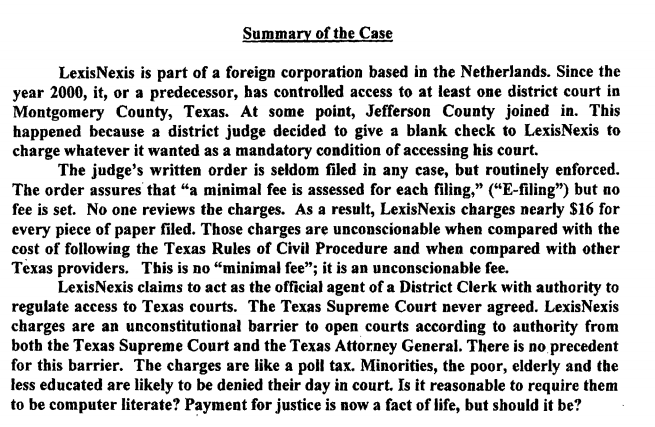
Big tip-o-the-hat to Courthouse News Service for following up on the class action suit brought by Texas resident Karen McPeters against Montgomery County’s (Texas) mandatory use of LexisNexis for electronic filing of court documents. We discussed the Federal class action lawsuit brought by McPeters back in April, but it appears that the Federal Judge was showing some doubt about the standing of the case in federal court on the issue of filing fees preventing due process or equal access to the law.
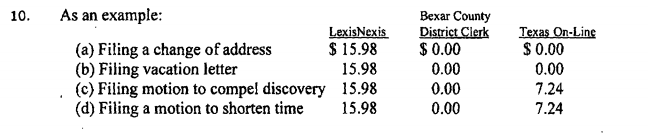
Cameron Langford at CNS gives a great “blow-by-blow” of the case, where McPeters equates the fee to a poll tax that is discriminatory to the public that can’t afford the fee… and essentially equivalent to a literacy test for those that are not computer literate enough to understand how to file document electronically. Those are interesting arguments, however, I did find one statement in the complaint that stood out for a much more practical reason. According to the complaint, LexisNexis charges over twice as much for filing over other e-filing services that serve Texas Courts.

Very interesting…(oh, and for you non-Texans… Bexar County is pronounced similarly to “Bear”… if you say Bex-ar County, they’ll know you’re not from around here.)

Here’s the synopsis of the complaint. It is definitely worth a read.

At the beginning of January, we decided to run an experiment where we’d offer free advertising space on our blog. As we end the first full month of the experiment, we think we’ve had a pretty good start to the experiment, and would like to share some of the details on what’s happened so far.

First of all, we had to actually take the idea of running free ads, and turn it into something we could manage easily. We decided that for the format of our blog, we asked that the advertisers get us a web-friendly image that was 167 pixels high by 200 pixels wide. They would also need to get us a link to the website they wanted to direct the reader to. On our side, we needed to find a way that would rotate through the ads and make it fair for all of the advertisers. After scouring the Interwebs for a few minutes, I found a couple of scripts that would work on our  Blogger site. One was a rotating script that would run the ads in order, but would change the ad every 10 seconds or so. The other script was one that would randomly pick the ad whenever a page was loaded. I decided to go with the random script over the rotating script because it seemed to be the “fairest” way to run the ads. The rotating script didn’t go to waste, however, as we used it to run some of our kudos for the blog (see the rotating images on the right-hand part of the page below the “Follow Us on Twitter” links.

I would have thought that we would have about a dozen or so potential advertisers right off the bat. And, we did have bites from about that many within the first week of the experiment. What was interesting, was that we had about half of those that were really interested, not get back with us once we said get us a link and an image and we’ll post it. I found that to be interesting. I also found it interesting that some of the advertisers’ links were directly to a site, while a couple of them had set up the links to track the amount of traffic coming from these specific ads.

Now that we’re stepping into month two of the experiment, we’re looking to bring in some new advertisers. If you’re interested in free ad space on 3 Geeks, then contact me about it (I’ll probably just tell you to get me a 167 x 200 ad and a link.) As with January, we’re looking to encourage the growth of smaller, local or regional providers… but, we’re pretty open minded, so even if you’re a huge corporation, but are running something unique that would be of interest to those that read this blog, we’ll talk with you about that, too.

I want to really thank the five inaugural advertisers (slash guinea pigs) in this experiment. Onit, PLI, Jones McClure Publishing, Kiiac, and CALI were all brave enough to trust us with their brand, and I hope that our little experiment has sent some new folks their way. Hopefully, we’ll get a chance to put them back in the rotation later in the year.