I know that I should always remember this, but there are times when I start talking to someone proficient in technology about social media, and I can watch as a their eyes gloss over when I ask about integrating social media resources into existing technology. Now, to be quite fair, I get the same effect when I start talking to those proficient in social media about the steps it takes to integrate social media tools into the current technology.

So, just off the top of my head, here’s some signs to watch out for to determine if you’re talking to someone that is a technology person versus a social media person:

  • If you say “RSS” and they correct you to tell you it is “CSS” – Tech person
  • If you mention “Facebook” and they tell you how they are promoting their firm’s Facebook page – Social Media person
  • If you mention “Facebook” and they say “My Mom keeps trying to get me to join” – Tech person
  • If you mention “Twitter” and you get a five-minute commentary on its value – Social Media person
  • If you mention “Twitter” and you get a 140 character response on how who cares if you’re eating lunch?? – Tech person
  • If they say “Quora” is a great community Q&A site – Social Media person
  • If they reminiscent about how CompuServe BBS was a great Q&A site – Tech person
I’m sure there are a hundred different ways to tell the difference, but I have to tell you that sometimes I just forget. Now I have to go back and write “I must remember to not confuse “tech” skills with “social media” skills… and vice-versa” one-hundred more times on the blackboard.

An unspoken, unasked question of the Howrey dissolution is: Who will be left holding the bag? It’s the old “last one out, turn off the lights” situation. Only in this scenario, the last ones out also get stuck with a very expensive light bill.
There has been of a feeding frenzy by other law firms to swoop in and scoop up the best lawyers from Howrey. And by best, I mean those with profitable practices. Even Winston & Strawn did not appear willing to take on the whole Howrey package (although some of that was related to conflicts).
My counsel to any firms that were looking at lateral groups from Howrey would have fallen right on this approach.
The result of all this activity is that the partners with no “books of business” will not be courted much by other firms. Acquiring firms likely already have an existing contingency of “Service Partners” who may be great at practicing law, but have no substantial clients of their own. These partners have value in firms, but nowhere near the value of rainmaker partners with transportable books of business.
So what is very likely, is that these partner are in trouble. Two to three years ago they were riding high, with excellent incomes and no worries. Now, with few suitors in the market, they will struggle to find a place to land.
The lesson here for service partners is: Don’t get too comfortable. If your fortunes are dependent on another rainmaker partner or on the benevolence of your firm’s management, it’s time to pay attention. More firms will follow in Howrey’s footsteps. Better to be doing something about your role as a service partner now, than when your firm closes its doors or gets acquired by another firm and you get stuck with the bill.

Mary Abraham at Above and Beyond KM suggests that “the current approach to legal research is fundamentally flawed”, and should be turned on its head. While lawyers skills rests within their ability to negotiate, write, analyse and advise, the way Westlaw and Lexis (Wexis) research is conducted, it turns the process in to “a frustrating game of ‘find the needle in the haystack.’”

The approach that Abraham suggests is that Wexis should basically do a reference interview of the researcher before asking the researcher to start entering in his or her queries. Such things as:

  • what are the pertinent facts of the case?
  • what jurisdiction?
  • what procedural approaches?
The idea (which hopefully Mary Abraham is apply for a patent as we speak) shifts the idea that the lawyers should change the way they work to fit the way Wexis databases are structured in an attempt to devise the best query search language. Since research these days is set up much more “Fact Specific” (as was stressed in Law Librarian of Congress, Roberta Shaffer’s talk at the AALL Colloquium), it make sense that legal research tools adjust to that style of research, rather than making attorneys fit inside the four-walls of the data structure in “hit-or-miss”… “needle in the haystack” method currently conducted in generic search technology found today in Wexis databases.
It is good for someone like Abraham to come in from time to time and ask the essential question of “why are we doing it this way?” I’d like to see some of the vendors take a look at these suggestions and see if research could be turned inside out and upside down in order to fit the natural skills of the researcher. I’ve had conversations with people like Jason Wilson about the idea that vendors should start taking into consideration things like geo-location for things like pushing court rules to lawyers who walk into a courthouse with their iPads, laptops or smart phones. Or, leveraging the work of a group of lawyers working on the same matter so that duplication is reduced, and that one researcher can perhaps see a different strategy of researching a topic by evaluating the strategies of his or her peers. 
I’m also sure that some of the vendors have probably started implementing some of these ideas. If they have, then it would be nice to have those pointed out to us. Maybe this is where a Fastcase or a Casemaker could come in and fill the need. Of course, if the vendors build upon Mary Abraham’s suggestions, I wish her the best of luck in getting those royalty checks!

Toby Brown and I presented at the joint Houston Association of Law Libraries (HALL) and the Southwestern Association of Law Libraries (SWALL) on mobile and tablet apps. This is an update of a presentation that Barbara Fullerton, Scott Riggins and I did last October at the Texas SLA program. I promised the group that I’d post the slides on the blog, so here they are.

“Build it and they will come” is the classic line from Field of Dreams. “Don’t build it, because THEY will come after you” is the idea that Sarah Glassmeyer is bucking in setting up the LisVendor.Info wiki of law librarian / legal publishing vendor relations.

The initial organization of the website is as follows. Feel free to add to it or move things around. Like all wikis, this site is what you make of it. Just so everyone feels right at home, let’s even have a discussion page for people to hash out ideas. You can pretend it’s a committee if that makes you feel better.

Anyone that has sat in the same room with me at a conference may have heard me use the following phrase: “All problems are Communication problems.” And it looks like Glassmeyer is working to create a communication platform where anyone can share information (including vendors) about the state of relations between the librarians and the vendors.

From and idea that started with the thought of “Someone oughta set up a wikileaks for library contracts,” it has evolved into what Glassmeyer describes as simply “a wiki where librarians and other interested parties can share information about all aspects of the library/vendor relationship.” A more defined definition of intent is found on the LisVendor.Info homepage:

This wiki was created to fill a simple need – the need for a place for librarians to communicate and otherwise share information about our interactions and business dealings with library vendors: complaints and compliments about customer service, problems with products, pricing information, etc. The Librarian Blogosphere, twitterati and other social networks are already a great resource for sharing this type of information. However, that is a limited number of voices and there’s nowhere for these conversations to be collected so that long term perspective can be gained. It is also hoped that this wiki becomes a place to learn the necessary business skills – such as contract negotiation – that we may not have learned in library school.

Sarah Glassmeyer has set up the platform, and is stepping back to let the community do the work (in a combination of what she calls as a mix of her “own greed and laziness” (I completely know what you mean, Sarah!!)  As with most wikis, it allows anyone to register and edit as they choose, but those edits are also visible, and trackable… so know your comfort level before jumping in with both feet. Glassmeyer also lets everyone know that she’s not going to be the Big Brother of this wiki and that she is trusting “that the community will be self-policing.”

I have to be the first to admit that I’m not much of a “wiki” person, and that I’ll need to bone up on my wiki editing skills if I decide to contribute to the LisVendor.info platform. It will be interesting to see if anyone bites and contributes, or if everyone just takes the simple approach of posting their librarian/vendor horror stories on the law-lib listserv and then going back to business as usual (assuming that it is now someone else’s problem to solve.)

On Monday I blogged about “UK Law Firms Becoming Businesses.” The thrust of that post was on how the UK is enabling their law firms to compete globally by removing the restrictions on non-lawyer ownership in law firms.
Apparently North Carolina (NC) is considering a similar path. A Senate Bill introduced recently proposes they “Allow Nonattorney Ownership of PC Law Firms. … (S)ubject to certain requirements.”
Unlike the UK Legal Services Act, NC limits nonattorney (is that really a word?) ownership to 49%. I assume this is meant to insure that “nonattornies” don’t put undue pressure on lawyers to make money without regard for ethics. This is evidenced by the language: “The duty to the client shall prevail over the duty to shareholders.”
Even with the 49% restriction – I gotta say I am impressed with NC. This idea was floated in Utah 15 or so years ago and went down in flames. So it’s good to see someone willing to pick up the ball and run with it. I’m not sure how likely it is the NC bill will pass, but if it does it may be bellwether for other states.
US law firms may have a chance to compete after all.

iPads, iPad2, Xoom, Playbook, Galaxy… the ever increasing list of tablet devices that are either on the market or soon to hit the market seem to be all some of us can talk about this year. Everyone is determining how these devices can be used in their profession, and the legal industry is no exception. So with all the hype surrounding the tablets, we asked if you were going to jump in with both feet and integrate these tablets into your work process, or if you were just going to sit this one out and stick with your traditional devices (PC’s, laptops, legal pads and pencils…)

Seems that the couple of folks that chimed in this week are sticking to their traditional methods. I also ran across something this week that makes the geek in me interested, and the “cheapness” in me even more happy. There’s a cool way to turn a Barnes & Noble e-reader (Nook-Color) into an Android Tablet. The way this guy does it is simple, no “hacking” or “rooting” necessary, and I don’t think it would even void your warranty with B&N (but, that’s just my opinion and not any type of legal advice… as I may be completely wrong.

Thanks to this week’s contributors. We’ve set up another question at the bottom of this post, so go check it out and feel free to share you perspective with us.

Steven B. Levy
Author, Legal Project Management

You have a false assumption in the subtitle of the question: “”Are you going to be cutting edge…”” Tablets are interesting, but they were cutting edge ten years ago. Apple has made them cool, as is their wont, but they haven’t invented anything new.

I’ll stick to my three-pound netbook, which does most of the real stuff the iPad does — and a lot more, for less money. It’s not as cool, but then again, neither am I. (Just ask my kids!) Long battery life, read books or watch videos, do mail — except ten times as fast, surf the web, etc. Oh, and also run full versions of PowerPoint, Word, Outlook, and the essential OneNote.

I like touching stuff to make it happen, but most of what I do involves words, and keyboards are the right tool for “”wording.”” In a few years, when speech-to-text really, really works, maybe I’ll ditch the keyboard — except when I’m working around other people who aren’t paying me to talk and would probably prefer that I didn’t.
Riva Laughlin
Librarian


I’ll be sitting this craze out. I have a netbook and an ereader, and can’t figure out what a tablet would do for me that these devices don’t already handle. Besides, think of the fingerprints!
Of course, if someone wanted to give me one . . .
Greg Lambert
Cheap Geek


I love my iPad (version 1) and use it for work (mostly email) every day. However, I think I want to try out the Android platform, but don’t want to spend $800 to get one of the fancy models. I may have to try out this way of converting a Nook-Color e-reader into a Honeycomb 3.0 Android Tablet. Looks cool, and doesn’t seem to destroy the Nook-Color’s base e-reader operating system as it boots off a flashdrive.

Next Week’s Elephant Post Question:

Will “Change” Kill More Law Firms This Year?

The BigLaw firm, Howrey, announced today that it will dissolve on March 15th (that’s before the next Elephant Post even goes out!!) In an interesting interview, Howrey’s CEO, Robert Ruyak, mentioned that BigLaw Partners have very little tolerance for “change” and that some of the new ways of conducting business (Client push back on billable hours through Alternative Fee Arrangements, outsourcing of e-discovery to cheaper vendors) led to the reduction in profits for Howrey, which lead to partner’s jumping ship (free agency), and the vicious circle continued until Howrey could no longer survive.

Howrey’s tale isn’t necessarily all that unusual for BigLaw firms. So our question this week is whether you think the Howrey tale is going to stop here, or is this a sign of how firms that don’t adapt are going to end up with the same result. Are there other issues of “change” that are occurring in the market that may cause additional pains for BigLaw? Let us know what you think!

I’m still cleaning out my in-box at my day job after a week of traveling between New York and Chicago for a couple of great law firm library meetings/conferences. I was going over some of my notes from the Ark Group conference on Best Practices & Management Strategies for Law Firm Libraries & Information Service Centers (which might be one of the longest titles for a conference I’ve ever seen…), and was enjoying reviewing the session on law firm library outsourcing. Ron Friedman of Integreon, and Jean O’Grady of DLA Piper gave a great talk on the topic, each with their own points of view, but both of them seem to have a lot of common ground on how they see outsourcing becoming more and more common within a law firm, and specifically within the law firm library.

Besides the fact that I consider both Ron and Jean to be friends, they are also both very good bloggers, and of course, like any good blogger, they didn’t let an opportunity of converting a conference presentation into a blog post. Ron’s post, Defining Good Support for Lawyers, and Jean’s post, Outsourcing, Outrage or Opportunity? What is Core?, both flesh out some of the items they discussed at the Ark Group conference. Steven Levy of Lexican also added in a great response (Outsourcing: Bad Word or Wrong Word) to Ron’s initial post, which led to a follow-up post from Ron on Is Offshoring the Same as Delegation?

I think all of these discuss the issues very well, but I thought I’d just like to toss out some of the notes I took while Ron and Jean were presenting in New York. Anyone that has to answer questions about why functions within a law library should, or should not be outsourced would hopefully find the notes helpful in addressing the issues. I think eventually, every law firm librarian will have to answer these questions.

  • The view of Outsourcing should be viewed from the angle of the CEO, COO of your firm, and not simply from the lens of the library
  • Outsourcing is nothing new to the law library world. Many of us have been outsourcing things like loose-leaf filing for more than two decades now.
  • Of course the famous law library outsourcing was the Baker & McKenzie experiment, and now the CMS Cameron McKenna outsourcing in the UK.
  • Outsourcing isn’t a fix for a problem situation. One outsourcing consultant put it more bluntly, “You can’t outsource a mess.”
  • The problem with bad processes is that outsourcing bad processes is not the right way to look at the problem. There are many solutions that are technology based, many that are tactically based (improve or eliminate processes), and some that are outsourcing based.
  • Unless you are creating metrics and showing how you are creating effective processes and procedures, then you have no credibility with the decision makers at your firm.
  • In many firms, the process of centralizing what tasks are already being done across the multiple offices is one of the easiest way to improve efficiency without the direct need to outsource those tasks.
  • Centralization is something that causes resistance with staff because many of them are very proud of the processes they conduct, and they may be unwilling to give those us as they feel that without those processes, their jobs will be eliminated.
  • Some firms have already begun a centralization process of back office processes (think of the Wheeling, WV (Orrick) or Dayton, OH (Wilmer Hale), or Baltimore, MD (DLA Piper) model where back office staff are placed in low-rent buildings and tasks that may have taken place within each individual office is now conducted in one office (which may not be an office that houses attorneys at all.)
  • For libraries, one of the first processes to be centralized is the technical services aspect of running a firm library.
  • Vendor-Sourcing: The amount of money that many firms spend on some of the upkeep of legal materials is not a small amount. Updates on loose-leaf filing, organizing and coding bills from vendors, and resolving billing issues can take up 25% of staffing time. The tolerance of inefficiency is too high from vendors and needs to change.
  • It is important to look at what processes are really important (rank them according to the value they bring to your firm, the lawyers within the firm, and to the library services as a whole.)
  • Another metric is making sure that you monitor what amount of staff billable time is not only written off by the partners, but also determine how much of the time has been written off once the bill is paid by the client. The piece that is written off by the partner is usually one of the areas that many law firm librarians need to fight for. Of course, getting the information out of finance may be your biggest battle.
  • If your COO comes to you and lays out a list of processes that the firm has already outsourced, and asks what law library services/processes can you outsource right now, how do you answer that question? They will eventually come to you and ask, you know…

Thanks to Ron and Jean for their insights into the issues of outsourcing in law firm libraries.

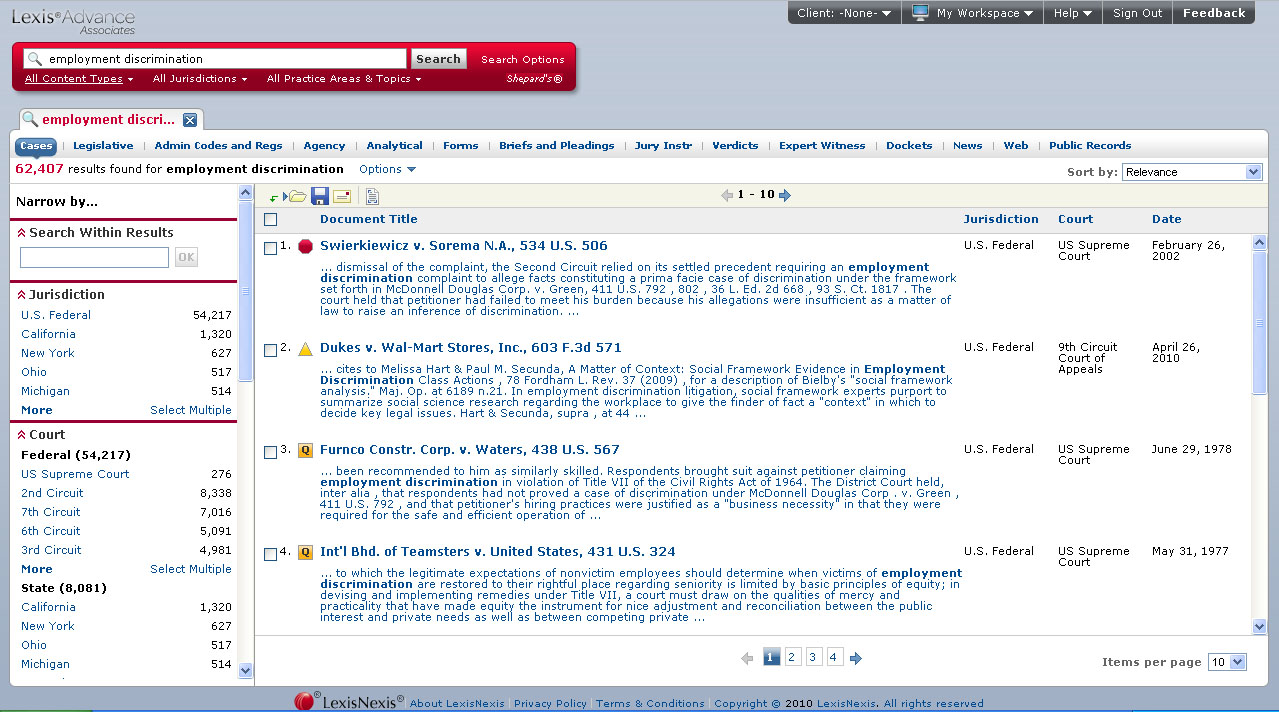
On Friday, Toby and I got to get a sneak peak at the second release of the New Lexis product that is focused on the way that Associates conduct legal research. Since the first release was focused on solo and small firm attorneys (Lexis Advance for Solos – see our review), it makes sense that the name for the version that focuses on Associates would be aptly named Lexis Advance for Associates. The idea behind the focus on Associates is that it is reasonable to assume that somewhere in the area of 80% of legal research is conducted by Associates, and those types of researchers need a product that fits the way they work. We ran through a demo of the product with Lexis’ Marty Kilmer and Clemens Ceipek, and here are the details about the product that we learned.

When?


Lexis Advance for Associates is slated to be released in the Fall of 2011.

Price: No Charge for Current Users

The solo project was an unusual approach as the Lexis sales team was focused solely on new users to the product. However, the Lexis Advance for Associates sales angle is going to be completely different and will focus on the existing customer base as an updated product, without any additional cost. There will, however, need to be a small addendum added to your contract, but it will be a short addendum that states that Lexis Advance for Associates is added to your existing product. There will be no “forced migration” to Lexis Advance for Associates, but Lexis will work to identify who, within the firm, would be best suited to migrate to the new platform.

There may be “additional services” that are developed later that may have a pricetag added to it, but for right now, if you already subscribe to it, and it is in Lexis Advance for Associates, then you can use it at no additional charge. Any new innovations will be announced before they are launched along with the prices for those innovations, and customers will not required to add any additional services.

Ceipek stressed that customers mentioned that they want predictability in pricing, and want to understand when they are going to be charged additional fees outside of their contractual obligations. Therefore, Lexis Advance for Associates, just like the feature in WestlawNext, will allow you to search all information within the platform as an in-contract search (even if the information returned is outside of contract.) The only time that an additional fee would be charged would be if you opened a document that is outside of your contract. However, you would see a red (out of plan) notice on the result, and once you clicked on the document, you would first see a snippet of what’s in the document (to determine if it is relevant to your research), along with a specific price of how much it would cost to download the document. You would also be given the opportunity to place the search result into a personal folder for retrieval later… only incurring a charge once you opened the actual document.

What’s In It? Core Offering

Lexis Advance for Associates will be set up to focus on the needs of associates and will expand beyond the materials offered in the Lexis Advance for Solo (primary law, Shepards, secondary resources), and offer things like agency and administrative materials, expert witness information, recent news (top sources for the past two-years), and public records access.

The Lexis Carousel will be available and offer Alert capability (including on-screen update alerts), Foldering, History, and Recent Filtering options. According to Lexis’ study groups, Associates are heavy users of these types of services and tend to return to similar pre and post filters when conducting legal research. Lexis Advance for Associates will offer “live support” including chat support available 24/7.

Lexis Advance for Associates also includes the “word wheel” functionality that is found in the Solo product, and has been updated to include the helpful “did you mean” capability when you misspell something in your search. Searches will be compared to the Lexis word wheel and legal dictionary to look for helpful suggestions when conducting searches.

Post-search filtering is structured to leverage Lexis’ legal taxonomy against the search results to help narrow the focus of the results based upon what documents are brought back. There will be more depth available here (granularity of taxonomy) than is found in the Solo product due to the complexity of research that associates conduct, as well as helping identify the correct synonyms within legal topics based upon the Lexis Taxonomy. Also, the idea is to help identify additional practice areas that may be covered within the taxonomies covered in the specific search results. For those associates that may not be familiar with a particular legal topic, the Lexis Advance for Associates taxonomy structure is designed to give that associate a lot more usable information to help get them to the answer they are looking for.

Delivery of Information Improvement

The ability to print, email and download documents has been improved in Lexis Advance for Associates. Again, any documents that are outside of contract will be clearly labeled as such, and you will have the opportunity to see a short preview of that document, along with the ability to folder that information for later purchase. The price of the document will also be displayed before the purchase is made. Additional delivery features like “copy with cite” and multiple document print will also be available in this release.

Folders are available for individual use, but at this time, there is no sharing feature available. That feature is in the works, but Lexis is working on issues of folder sharing and the hope is that it will be available soon.

Shepards Integration

Shepards is completely into Lexis Advance for Associates, and resources like citing reference signals are included in results. Any changes in those reference signals (for results residing in the personal folders) will show up in your Alerts page should any changes in the Shepards signals occur. Updating is conducted at your request and the changes would show up at that time. This was a conscious decision on the part of Lexis Advance for Associates, as the thought was that by making it a manual process, the researcher would then be made aware of the change, whereas an automate update may not be as apparent. (I’m not sure I agree with this 100%, and hope that they rethink this process before it goes live in the Fall. Perhaps integrate it with the “Alerts” function that will flag any changes in status of documents held in the folders.)

Legal Issue Trail


Legal Issue Trail allows the researcher to take language plus citation and find additional reference within the corpus of content that is specific to that language and citation. This is viewed to be a more precise tool than Shepards alone. This enhancement is built into the core Lexis Advance for Associates product, but there may be further enhancements to the product that may become a premium enhancement (read: cost more) at some later point in time. Lexis is looking to make this resource more advance and become an analytical and trending based product in future releases.

Not All Content Will Be In Lexis Advance for Associates When It Is Released


Because the Lexis Advance for Associates sits on the New Lexis technology platform, not all databases will be available at launch. So, there will still be a need to go back to Lexis.com for a while.

More Functionality, Features and Content Later…


There is a focus to built in more functionality, more features and more content into Lexis Advance for Associates, along with additional pricing when those are rolled out. We were told that any add-in features, functionality and content will be clearly laid out and won’t be a surprise to existing customer. Toby and I specifically asked about bringing in non-legal material (for example, Lexis brings in some business databases or scientific databases.) The “hope” is that eventually everything within the stable of LexisNexis and its parent company, Reed Elsevier, can be used on the New Lexis technology platform.

Set Up for Associates… But, Not Limited To Associates


The idea behind this product is to work the way associates work. However, if a Partner wants to use Lexis Advance for Associates, he or she can… same with librarians or research attorney staff. It is assumed that partners and research staff use the product differently, but they are free to use Lexis Advance for Associates at no additional charge.

Once Again… Pricing


I do have to mention that Toby and I asked about a dozen times about the pricing model for this product. The answer was always the same, but apparently was hard for both of us to digest. If you have an existing contract with Lexis, then Lexis Advance for Associates is accessible for free.

So, What’s Next??


Of course, we’re still months out from the actual release of Lexis Advance for Associates, it seems that Lexis’ model for new releases on the Lexis Advance platform is focused on specific types of users. Neither Jorge nor Marty mentioned what is next in the Advance platform. Perhaps there’s a “Lexis Advance for Librarians” or “Lexis Advance for Partners” or “Lexis Advance for Business Development” or “Lexis Advance for Law Students” on the horizon. I guess we’ll have to wait until 2012 to find out what that product will be.

Lexis Advance for Associates: Press Release


Here is a copy of the actual press release that is going out today:

LexisNexis AnnouncesLexis Advance for Associates
as the Next Release onits New Lexis Platform
The solution is the latest in a seriesof online legal research innovations from LexisNexis that help legalprofessionals drive better outcomes for their business and their clients
NEW YORK, March 8, 2011 LexisNexis, (www.lexisnexis.com) a leading globalprovider of content-enabled workflow solutions, today announced Lexis®Advance for Associates will be thenext tool released on the company’s NewLexis® technology platform.
“Lexis Advance for Associates is the continuation of our strategy to provideprofessionals with tools that are specifically designed for them,” said BobRomeo, chief executive officer of Research and Litigation Solutions atLexisNexis. “Through close collaborationwith our customers across all sectors of the legal industry, we know those who routinelyconduct legal research want new innovations to help them build their expertise tobecome even more valuable to their organizations, so they are more efficientand better organized, and to demonstrate their ability to drive better outcomesfor their own clients.”
Lexis Advance for Associates is aimed at serving primary users of online legalresearch such as associates at law firms and staff attorneys at corporationsand in government. Core elements of the product deliver a number of easy to usefeatures for them, including an intuitive single search interface thateliminates the need to select sources before searching and cuts out multiplesteps in the search process. It also offers users the control to find relevantsearch results faster and more confidently with pre- and post- search filters.Furthermore, work folders allow for easy storage and access to previouswork.
In addition to these capabilities,LexisNexis has developed other ground breaking tools core to the product anddesigned specifically for associates. With these, users are able to conduct amore holistic and efficient research process than ever before. They are alsoable to view, manage and act upon results directly within the context of theireveryday work. The innovations include:
· Integrated results from LexisNexis® and the open Web: Allows users to search the openWeb via Lexis® Web along with premium LexisNexis contentsimultaneously in a single step, efficiently delivering a single set of searchresults organized by content type.
· Legal Issue Trail: Uses LexisNexis intelligence to find and cite connections between casesthat may not be obvious – ensuring that research is complete.
· Transactional Notices: To help ensure transparency, usersare notified on screen if they are about to access content that is outside oftheir subscription.
Lexis Advance for Associates also includes valued content used most byassociates, including:
· Comprehensive and fully enhancedprimary law from all states – all available LexisNexis case law (Federal and State), including allLexisNexis headnotes and case summaries. All available statutes and constitutions (Federal and State) from all 50states and US territories – including administrative codes, and agencymaterials.
· News – top titles from the mostcomprehensive collection of news sources in the industry.
· Shepard’s® Citations Service – the LexisNexis exclusive citator allows associates to quickly check ifa case is good law.
· Matthew Bender® – a wide range of industry-leadingtreatises and expert legal analysis.
· The industry-leading collection ofLexisNexis jury verdicts, briefs, pleadings and motions.
· LexisNexis® CourtLink® content: Includes the full collection ofdockets.
· Expert witness transcripts,depositions, and curricula vitae.
Customers of lexis.com® will be able to use the core functionality ofLexis Advance for Associatesdescribed above as part of their lexis.comsubscription. They may also add premium innovations such as use of Lexis®for Microsoft® Office inconjunction with Lexis Advance forAssociates plus other new capabilities as they are launched later this yearand going forward.
Scheduled for release later this year,Lexis Advance for Associates is thelatest in a series of innovative solutions for legal professionals fromLexisNexis. Other recently launched solutions include Lexis for Microsoft Office and LexisNexis®Verdict & Settlement Analyzer in summer 2010, Lexis Advance for Solos and its application for iPhone®in fall 2010, and LexisNexis® Profile Suite and LexisNexis®Firm Manager™ in February 2011.
Moreinformation about Lexis Advance forAssociates is available at: www.lexisnexis.com/advance .
AboutLexisNexis
LexisNexis®(www.lexisnexis.com) is a leading global provider ofcontent-enabled workflow solutions designed specifically for professionals inthe legal, risk management, corporate, government, law enforcement, accounting,and academic markets. LexisNexis originally pioneered online information withits Lexis® and Nexis® services. A member of Reed Elsevier[NYSE: ENL; NYSE: RUK] (www.reedelsevier.com), LexisNexisserves customers in more than 100 countries with 15,000 employees worldwide.
###
Media Contact:
Jorge Martinez
LexisNexis
(202) 857-9120

The Law Society Gazette reports that 30% of UK solicitor firms have already talked to potential investors about investing in their firms come October. Some additional stats from the article:
“65% said they were ‘comfortable securing external investment from a non-legal investor”
“Some 65% of solicitors said they would consider doing work with a non-legal brand such as a supermarket …”
I have had my eye on the Legal Services Act (LSA) for some time now. Allowing law firms to take on capital investments is a very powerful idea. It’s challenging for any business to prosper, let alone survive in a competitive market without access to capital. Law firms have been bound by ethical rules that haven’t allow outside, non-lawyer investment in their firms. This limits their capital raising ability to whatever the lawyers could shoulder personally. With the LSA, law firms can make large scale investments in their businesses, upping the ante in order to remain competitive. This article predicts that firms will respond proactively to a more open capital market. Personally, I think this is a very positive step and a smart strategy by the UK to dominate the legal industry on a global scale.
Since US firms are not able to access this level of capital, they will be at a distinct disadvantage in the global market. Their UK counter-part firms can now start investing in strategic technology and more professional marketing and sales organizations in a much more aggressive way.
The outcome of all this is yet-to-be-seen. My 2 cents: the market for legal services IS becoming a fully competitive market. Market players with access to capital will absolutely have an advantage in the market. US firms who compete internationally would be wise to keep a close eye on this new approach as it evolves.