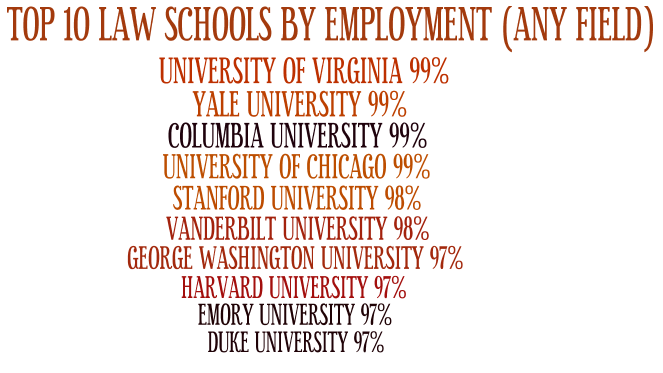
After discussing the sad ABA’s Law School Graduate Employment Data with Toby yesterday, he mentioned that it would be kind of cool to see some of the stats broken out into a Wordle to see which schools stood out in a “visual” way. So, just for fun, I started playing around with some of the good and bad stats based on number of graduates and the type of employment those graduates reported have. One of the things that I kept noticing as I went through the “good” numbers, was how often the University of Virginia (UVA) kept ranking near the top. Of course, these are very generic statistics (and we all know the issues surrounding the ‘fudging’ of stats by schools lately), but just looking at these, it was pretty clear that if you want to jump out of law school and have a job, UVA is one of the best options for you. Just in case you were wondering… the University of Puerto Rico, and Whittier College consistently hold down the bottom of most of the statistics.

Here’s some of the stats that I compiled out of the data and formatted into a Wordle… enjoy.

Full-Time Employment that requires a JD


Any Employment that requires a JD


NON-JD EMPLOYMENT


(AKA – “Screw it… I gotta get a job!”)


UNEMPLOYMENT


EMPLOYMENT (ALL FIELDS)


BEST CHANCE FOR 


BIGLAW EMPLOYMENT



Image [cc] MyTudut

I always enjoy an interesting convergence of ideas. Recently three news items hit my radar that appeared unrelated, until I gave them each a second look and more thought. The first item was the release of the whitepaper from Reuters (of Thomson / Westlaw and Pangea3, the LPO). The paper is entitled, LPO 2.0: the Next Phase of Legal Process Outsourcing Industry. I have previously noted the risk that LPOs will take business from law firms. This was validated in the whitepaper, by this money-shot quote:

Since 2005, the breadth of the services that have been performed and offered offshore has increased dramatically as the industry has become more sophisticated, especially in the areas of litigation, corporate transactional work, and governance, risk management and compliance. Not only are services growing in number, but services that have long been offered by LPO providers are growing to encompass more, and are being packaged as end-to-end solutions.

My prior post on this threat to firms noted the ethics police are apparently not seeing this as a clear ethics or UPL issue, so the door is wide open for this type of competitor. And from the looks of the whitepaper, the LPOs are kicking it open even wider.

Item #2 – “In Washington State, ‘Legal Technicians’ Will Be Allowed to Help Civil Litigants” The Supreme Court there is making this change to enable better access to justice. Here’s the money-shot quote:

“But there are people who need only limited levels of assistance that can be provided by nonlawyers trained and overseen within the frameworks of the regulator system. … This assistance should be available and affordable. Our system of justice requires it. The court acknowledged concerns that the plan poses a threat to the practicing family law bar. But ‘protecting the monopoly status of attorneys in any practice area is not a legitimate objective,’”

And what do these two things have in common? Both are reactions to the failure of lawyers to meet market needs. LPOs sit at the top of the market. These new “Legal Technician” will sit at the bottom. 

Greg (a.k.a. #1) brought home the all of this with a comment he made about the article “Only 55 percent of law grads found full-time law jobs.” He wondered why so many lawyers can’t find jobs when there is so much need for them.

So at both the top and bottom of the legal market, non-lawyers are filling needs. Meanwhile lawyers can’t find jobs. What is wrong with this picture? Where is the invisible hand of Adam Smith when we need it?

My read on this: High demand existing alongside over-supply brings further evidence that lawyers lack a basic understanding of market forces. The days of lawyers getting work because they are good lawyers are over. Lawyers need to embrace a market driven view of the world and focus on meeting the needs of clients. It’s either that or get out of the way and let the market do its thing.

I ran across a fun blog run by a Brooklyn, New York public librarian called Screwy Decimal, where Rita Meade has a number of tongue-in-cheek posts about her life in the library and her constant struggle to fight Mayor Bloomberg’s efforts to cut public library funding. It’s a fun, award winning, blog with a solid message… sprinkled with posts of kids saying the darnedest things, and tricking her into saying “underwear.” There was one post that I read that really caught my attention, and made me wonder if I, as a law librarian at a law firm, would be brave enough to ask the same question.

In her post Where Would You Be Without Your Library?, Meade discusses their Summer Reading Kickoff event where they created a sheet that they handed out to all the kids to fill out that asked the question “Where would you be without Brooklyn Public Library” and started off the answer with “Without my Library I ….”  The answers were wonderful, and some would make my wife start crying (she says I’m hollow inside, so such honest responses would be wasted on an emotional black hole such as myself… okay, I might have sniffled at a couple of them.)

Between sniffles, however, I started wondering if someone like me would be brave enough to ask the users of my library the same question?? It is a scary thought to think that some lawyer might answer in a negative way. “Without my law library I could convert that space into a corner office with the best view in the firm!” However, I think asking just this question may help expose some of the honest answers that the public library received. We may even be surprised by the answers that we get, in that they expose a value that the attorney gets from us that we may never have guessed on our own.

Exposing yourself and your library like this is scary to think about. Would you be willing to put a form like this out to your firm??
[note: Beth Holmes made a great suggestion that this should be modified to say “Without my Law Library/Librarian I …]

If there is one consistent theme that comes from the folks at Fastcase, it is that they are not afraid to challenge the status quo. This time around, Fastcase is putting fresh spin on the old idea of providing advanced sheet of court opinions in a compiled format. The format this time around, is eBooks via Kindle, Android and Nook. To make things really interesting, Fastcase is providing these eBook Advance Sheets for free.

Fastcase CEO, Ed Walters gives a great overview of what they are doing below. I’ve tested out a few of these via my iPad and Kindle (Ed sent me some .mobi and .epub examples), and they have a nice clean look and feel about them. The idea of replacing those heavy paperback advanced sheets with a eBook version is something that should appeal to those that continue to get Advanced Sheets.

I had a brief conversation with Jason Wilson about the usage of Advance Sheets in the age of Westlaw/Lexis/Bloomberg, and we both came to the consensus that Advance Sheets aren’t as heavily used as they were a few years ago. However, the idea of being able to download them onto a convenient platform like an iPad or Kindle Fire, may make a number of attorneys bring back that experience.

The other shortcoming that we could think of in this example is that there is not synopsis provided by Fastcase for the Advance Sheets. Granted, that would be a big investment for Fastcase, and perhaps in the age of electronic data, a synopsis isn’t necessarily as important as it used to be.

Here is Ed Walters’ introduction to Fastcase Advance Sheets. The Advance Sheets themselves will be downloadable through iTunes, Amazon and Google Play, as well as directly from Fastcase at their eBooks page.

Today we’re excited to share a glimpse of the future — a pre-release version of Fastcase Advance Sheets, a series of eBooks available this week for free on iPad, Kindle, Android, and Nook devices.

Fastcase Advance Sheets give lawyers a first look at judicial opinions from around the country in eBook format, replacing printed law books.  They are the first of five Fastcase eBook products that will be released this year to disrupt the $5 billion legal publishing market.

Background

The term “advance sheet” has been used for more than a hundred years to describe the paperback drafts mailed to lawyers and libraries before the printing of paper books. Subscriptions to the advance sheets alone cost upwards of $850 per year, for each of nine or ten series of reporters – the final books cost even more.  Lawyers in years past would thumb through advance sheets from their jurisdiction, looking for decisions of interest in their field.

But with the proliferation of judicial opinions, nobody can carry around all the paper books, much less scan through them for important rulings.  Even though the volume of decisions has dramatically increased, nobody has really re-thought the way we publish caselaw reporters since the late 1800s, when John B. West created the regional reporter system that became West Publishing Company.

Nobody until now.  The companies that print paper books can’t or won’t re-invent the industry, but Fastcase can and will.

Fastcase Advance Sheets

Fastcase has replaced the heavy, voluminous, redundant caselaw reporter with modern eBooks that are slim, light, and beautiful.  Fastcase’s Advance Sheets are more comprehensive than traditional paper tomes, because they include all decided cases – even “unpublished” opinions that won’t be printed in the books (but which are precedential in many courts, and often contain persuasive authority).

And because the Fastcase collection is in eBook format, it will work on most e-readers, including iPad, Kindle, Nook, and Android tablets.  That also means that text can be highlighted, copied, shared, annotated, rotated, read on an airplane or train, or even on a beach.  And instead of reading an entire paper advance sheet, Fastcase’s eBooks can be searched for key terms, and they include introductory summaries highlighting the issues in each case.

Unlike their paper counterparts, Fastcase Advance Sheets will be free.

Because Fastcase already collects these opinions for its desktop legal research service, publishing them in eBook format is simple, and the marginal cost is low.  So Fastcase offers them for free, consistent with our mission of democratizing the law and building smarter tools for legal research.  Fastcase also will introduce a series of paid eBooks later in the year, with advanced features and highlighting particular subject areas – so lawyers can follow the latest cases in their chosen field.  But the Advance Sheets will continue as a free product, under a Creative Commons license.

About Fastcase Advance Sheets for eBooks:

  • Each book publishes one month’s judicial opinions (designated as published and unpublished) for specific states or courts
  • Available for iPad, Kindle, Android, Nook, and other e-readers
  • 40 volumes published this week, approximately 300 more by the end of the month
  • Advance sheets for each state, federal circuit, and U.S. Supreme Court
  • Volumes begin with summaries of opinions included
  • Fully searchable, with highlights, annotations, bookmarks, and other key features
  • Free, and licensed under Creative Commons BY-SA license.

About Fastcase:

  • Disrupting the legal publishing market with smarter tools for legal research since 1999
  • More than 500,000 subscribers from around the world
  • Affiliated with 22 state bar associations and dozens of voluntary bar associations
  • Market leader in mobile research according to 2011 ABA Technology Survey, with apps for iOS and Android devices

Awards:

Image [cc] tracktwentynine

I have read Mia Breitkopf’s article on Roy Tennant’s Wake-Up Call to Academic Librarians multiple times over the past few days and continue to think of parallels that run between what Tennant warned the Academic Librarians Conference attendees, and the red flags that private law firm librarians should see in our environments. The academic librarians (University librarians, not Law School librarians) face what Tennant labeled “The Four Horsemen of the Library Apocalypse,” and to many of you that are in law firm libraries, these will look very familiar:

  • Unsustainable Costs
  • Viable Alternatives
  • Declining Usage
  • New Patron Demands
Breitkopf broke down Tennant’s arguments in four topics, and my brain started altering these to fit what we face in law firms:
  • Law Firm Libraries Face Big Challenges
  • What the Law Firm Librarian Should Provide for Attorneys/Clients
  • What the Law Firm Librarians Should Provide for Administration
  • Tugging Your Law Firm Library Into the Future
The challenges are huge for law firm libraries. Perhaps never before has the traditional library looked as obsolete as it does now… and holding on to traditional services essentially means slowly killing the library altogether. 

What we provide to attorneys and clients is far different that what we provided five or ten years ago. The traditional usage (think reference desk) has declined, but the demands on a quality reference librarian have never been as complicated as they are at this very moment. Whether the librarians are embedded into practice areas, or make themselves de facto members of the practice groups by keeping their ears opened to understand the needs of the team and proactively fulfill those needs even before the attorneys realize their needs, the opportunities are there for librarians to step up, think differently and active aggressively to being part of the overall process.
It’s great seeing these types of discussion and realizing that our struggles are not unique. This has been a topic that we’ve discussed on this blog ad nauseum. However, there are many more parallels in Tennant’s arguments. I highly suggest that you check out Breitkopf’s post and start thinking of your own parallels and how you are defining the future of your library.
Image [cc] wikimedia

On Wednesday I had the pleasure of meeting with Tom Baldwin and Scott Preston to discuss LPM and general law firm challenges. One subject came up that triggered a repressed memory. Tom mentioned the importance of the users’ experience  – UX or UI (user interface) depending on your perspective – when seeking adoption of new technologies. Having a proper UI expert has proven to be so important that he has contracted to have some work not only on upcoming projects, but also review a few of their existing custom developed apps.

This comment triggered the release of a repressed memory from a recent software training I ‘experienced.’ The software in question is actually very functional. It may be the most functional in its class. However, the user interface is from 1990. One might argue that functionality reigns supreme, since that is what users really need form technology. But at a point in the training all of my frustrations came in to focus. For the umpteenth time, I watched the trainer go through the same 10 or so clicks to initiate a ‘new file.’ That task should really be one click. For the first portion of the training I was excusing the UI’s ancient look and feel, but then it occurred to me bad UI is also a significant productivity issue.

Add on top of that Tom’s note that user adoption rates are strongly impacted by UX and you have a compelling reason to employ a UI expert for every software project. I implore IT professionals to always make UI / UX a priority in your development efforts, even if it’s just a SharePoint update.

With that off my chest – I will re-engage my memory suppression efforts.

Image [cc] MysteryStevenson1

I ran across a summarizing tool that I think all of you would enjoy testing out. I found it through the Tools 4 Noobs website which focuses on PHP resources, but this can be used specifically from their “Summarize” tab on the website (no coding required… but, more on that below.)

I’ve run through a number of different web pages and copied PDF texts from Court filings, and found this summarizer to be pretty good.

Here’s the basic principles of what it does:

  1. Extract sentences from the text given.
  2. Identify the keywords in the text and count each word’s relevance.
  3. Identify the sentences with most relevant keywords and output them based on the options selected.

It also gives you some options to play around with to improve your results.

I took this PDF of a Plaintiff’s Original Complaint (7 pages), and got this as the summary:

Summary:

PRAYER For the reasons set forth above, Plaintiff respectfully prays that Defendants be cited to appear and answer herein, and for the following relief: a. that the Court enter an order allowing this action to proceed as a collective action under the FLSA and directing notice to the Workers; b. judgment awarding Plaintiff and the Workers all unpaid wages and unpaid overtime pay, liquidated damages, and attorneys’ fees and costs under the FLSA; c. an award of pre-judgment and post-judgment interest on all amounts awarded at the highest rate allowable by law; and d. all such other and further relief to which Plaintiff and similarly-situated employees may show themselves to be justly entitled.
Defendants failed to pay Plaintiff at the minimum wage and failed to pay Plaintiff at one and one-half time his regular rate of pay for hours worked in excess of forty (40) hours per each seven (7) day workweek.
Defendants’ practices of not paying Plaintiff and similarly-situated employees at the minimum wage and failing to pay at one and one-half times the regular rate of pay for all hours worked in excess of forty (40) hours per each seven (7) day workweek are direct violations of the FLSA.
Plaintiff and similarly-situated employees were entitled to overtime pay at one and one-half times their regular rates of pay for all hours worked in excess of forty (40) in a workweek.

For the IT folks, apparently you can purchase the coding for this ($60.00 for developer license or $15 for personal) and integrate it into the enterprise.

Looks pretty cool to me. Any ideas on what could be done with a product like this?? I was thinking how it could improve newsletters that Library staff create, or how about putting a summary like this in the DMS that allow us to see a summary of documents at a glance, rather than having to scroll through the preview (or worse, actually having to open the documents.)

Image [cc] David Ortez

The consumerization of technology is a hot topic in the legal market. But one overlooked corner of the market also experiencing this trend is the courts. Today’s guest post comes from inside the courts to examine the same phenomenon there. Judge David Nuffer, of the Federal District Court in Utah, offers this insider’s view of how federal judges are embracing consumer technology. Judge Nuffer is also a past-president of the Utah State Bar and just generally a nice guy.
According to a recent report, 58% of Federal Judges use an iPad for their court work.  Two-thirds of the iPads in use are iPad2s.  As expected, the tech-savvy (and tech-dependent) community of bankruptcy judges leads with a 70% use rate.  For a device introduced only two years ago, and a very conservative user base, this is a remarkable rate of market penetration.

The iPads have replaced laptops for many judges.  Judges find the iPad very intuitive and less daunting than a laptop, and IT staff finds the iPad easier to support and less prone to technical issues.

According to surveys, federal judges use the iPad most for email, where the iPad’s large screen beats smaller mobile devices for easy reading of emails and attachments.  Most judges also use an iPad for general reading because electronically filed documents are all PDF format.  Apps such as PDF Expert, iAnnotate and Goodreader work well with these PDF documents.  The documents can be annotated while reading and the annotations persist when the document is returned to chambers storage servers.  Judges appreciate the ability to take voluminous documents with them in the same device they use for email.  This results in less printing of electronically filed papers.

iPads, using the native keyboard or Apple’s quiet Bluetooth keyboard, are often used for courtroom notetaking.  Judges also use the iPad to refer to checklists and guides while on the bench.

Some judges use remote desktop control apps to gain access to full features of their court computers.  The Federal Judicial Center, the educational arm of the federal courts, makes podcasts of judicial conferences and seminars available for download to the iPad. The speech-to-text dictation feature of the new iPad holds promise for judges.  Unfortunately, this feature won’t work with earlier models.

Challenges with iPad include the courts’ continued use of WordPerfect, which has no editor for the iPad.  While WordPerfect documents may be read on the iPad, they cannot be effectively edited.  Those chambers which have moved to use Microsoft Word have several editor options on the iPad but none as robust as are needed for complicated documents with footnotes and tables of contents.  Another challenge for judges is the concern about security of documents “in the cloud” and the peer-to-peer nature of many cloud storage applications.

Counsel submitting documents in the federal electronic filing system can make documents friendly for the iPad by ensuring that text-based PDF documents are filed – or if a scanned exhibit must be filed, run OCR on it before filing.  These text based PDF documents are much easier to search and annotate.  Also, bookmarks (automatically generated by most word processors and preserved in PDF conversion) make PDF documents easy to navigate.  Finally, knowing a judge may read on the iPad could motivate wise use of color and inclusion of graphics.

Thomson Reuters announced last Friday that it is acquiring the London-based mobile platform developer Apsmart for an undisclosed amount. Apsmart founder Rahul Powar was the creator of the first Shazam iPhone app that is recognized by many as one of the top innovative mobile apps created for the mobile industry. So, what does this mean for Thomson Reuters? It means more innovation for WestlawNext and the ProView eReader platform for starters, and it would appear that the company is very serious about investing in the “small screen” world of mobile technology.

In the press release, Powar sounds as if he is being given some “artistic license” to bring in some new ideas to what Thomson Reuters can do in the mobile environment:

The team at Apsmart is excited about the opportunity to apply our diverse mix of skills to the large Thomson Reuters customer base. We look forward to helping drive the strategy and creation of significant new experiences in mobile across the organization.

Let’s hope that Thomson Reuters lets Powar and his team run with limited oversight and introduce products that are creative and allow for the freedom users expect with mobile devices. My concern whenever ingenuity meets established business models is that the culture of the business trumps the fresh ideas of the developers. We’ll have to see how this all works out. I’d be really interested to see if Powar stays on for any length of time, or if the culture of the giant Thomson Reuters world runs him back to the more flexible world of mobile app start ups.

In light of the recent LinkedIn password debacle, I thought I would share a password secret I’ve been using for a while now, client side password hashing. 

Password hashing takes a simple password, runs it through an algorithm and spits out a more complex password.  Stanford University researchers developed an algorithm for passwords that uses the domain of the site you’re logging into and your simple password to create a unique and more complex password for every site you log into, even if you use the same password for each site.

You can find out more about the Stanford project here.

On the right side of the pwdhash.com page, you’ll see a box (like the one above) with fields for Site Address, Site Password, and Hashed Password.  Enter the domain of the site you’re logging into in the Site Address field (geeklawblog.com), enter the same silly password you use for every single site you log into in the Site Password field (for me, it’s greglambert. Shhh!), press the Generate button and voila!, out pops your hashed password.  Ts7ZoXk8Nqj6d is my official password for 3 Geeks.

When I go to log into Facebook, I enter facebook.com, greglambert as my password, and my official password for Facebook becomes bmQHlmV4bWUEu.

This way I can continue to use 2 or 3 relatively simple passwords and still have complex and unique passwords for every site.

I know what you’re thinking.  “I don’t want to have to go to pwdhash.com every time I need to get my password!”  You don’t have to.  Cynix.org has created bookmarklets that you can save to your browser favorites.  When you go to a site that needs a password, click on the bookmarklet, a java window pops up asking for your Master/simple password, it takes the current domain from the page you’re on and runs the Stanford algorithm spitting out your unique password for that domain.  On some browsers it even enters the new password in the password field when you place your cursor there.  (Warning: I haven’t had a lot of luck with the bookmarklets in versions of IE. Stick with Chrome, Firefox, or Safari.)

But what about on my iPhone or iPad?  The bookmarket works in mobile safari.

But what about signing into Apps on my iPhone or iPad?  There’s an app for that too.  KeyGrinder uses the same algorithm to return the same password every time.  You enter the domain and password and then tap on the Create button, the hashed password is automatically saved to your clipboard.  Just go to the App, enter your username, tap in the password field and select paste.

The benefits of hashed passwords are many.

  • I can remember only my simple master passwords and still have unique complex passwords for every site.
  • If a website (like LinkedIn) is compromised, the attackers only have my password for that one site, not for every other site I go to.  
  • Since I’m never actually typing the hashed password in anywhere, keyloggers don’t capture my passwords.
  • Since the typed master passwords and hashed passwords are hidden (******) in the bookmarklet, someone standing over my shoulder or viewing my screen still wouldn’t get my password.
  • Since I’m only remembering my master passwords, I couldn’t reveal my actual passwords even if I was being tortured.  

On second thought, that last one might be a bad thing.

**************

UPDATE:  Added the words Client Side to the title to differentiate from the standard server side password hashing that LinkedIn is accused of doing poorly in the Computer World article linked at the top.

UPDATE 2: You can check here to see if your old LinkedIn password was confirmed as cracked.  Please change your password first!  Another benefit to client side password hashing, the server side hash is much harder to crack because it bears no relation to a dictionary word.  In case you’re wondering, my original password is not currently on the list of cracked passwords.  Glad I changed it anyway.