[Ed. Note: Please welcome guest-blogger, and fellow law-librarian, Marcia Burris. Marcia is currently a Senior Consultant with HBR Consulting. – GL]

While the rate of change in the legal industry seems to be accelerating, change is not new to law librarians. In fact, those of us who have been around long enough have been hearing for the past 20 years or so that the days of the law library are numbered. It is certainly true that the use of books has declined in recent years, and the focus of librarians has shifted away from traditional print maintenance roles toward supporting attorneys through the delivery of information in increasingly digital environments. However, this article is not about the decline of print. We’ve already been there, done that, and it’s time to move on to a new topic.

But change continues, and so do concerns about the role of law librarians. In recent years, the “new” role of librarians as expert online researchers and content managers seems to be threatened again, this time by the trend toward creation of self-service research environments in which content is served up so conveniently and intuitively, that even the busiest attorneys (who necessarily have other things to do besides learn new search platforms) can find useful, on-point information without the guidance of an expert to lead them through the digital maze. The well-recognized expertise of librarians in organizing and directing users to content seems likely, in the view of some observers, to be supplanted by newer expert systems.

As the culture of attorney self-service expands, the question is circulating again about what the future of law librarians will look like – if we have a future.

Of course, smart information delivery systems must be built by experts, and customized to the needs of specific firms by professionals who understand their legal practice areas and unique firm cultures and deployed to end-users whose interest and comfort with change vary widely. Law librarians are uniquely suited to roles in developing and deploying new resources through their combination of legal knowledge, technology skills, and emotional intelligence.

Even after the new tools have been deployed and attorneys trained in how to use them, librarians continue to play a role in delivering service through these platforms, including performing on-demand research and providing alerts, platform customizations and other services to support end-users. For example, although push technologies for current awareness are typically customizable by individual end users, and some attorneys like to be hands-on with these tasks, more often the creation and curation of alerts falls to library professionals who can do so efficiently and accurately, saving attorney time for other work – such as, well, practicing law.

While librarians are invaluable to developing and supporting self-service technologies, that is not the only role in which they are proving their value.

During the recent SLA Webinar on Evolving Libraries, Kris Martin, one of my co-workers at HBR, discussed an evolution of library services that we have been tracking along two distinct paths, toward either a User-leveraged service model, such as the primarily self-service environment described above, or an Expert-leveraged model.

While the User-leveraged model is characterized by increased investment in new technologies and librarian support for user-enabling applications, with a subsequent decrease in direct research, the role of librarians as researchers continues strong in firms where an Expert-leveraged service model has evolved. In these firms, the research skills of librarians are increasingly utilized as library professionals are embedded within practice groups and other administrative departments, where their familiarity with a wide range of resources and subject-specific knowledge combine to create competitive advantage. In legal practice groups, embedded librarians enjoy inclusion on client teams where they contribute research efficiency and value to client matters. In administrative teams, librarians work closely with marketing and others to provide research and analysis in support of their firm’s strategic business objectives. In addition to providing traditional research expertise, embedded librarians are frequently called upon to provide more sophisticated information analysis.
Both user-leveraged and expert-leveraged service models change the role of the librarian, demanding greater expertise and a pro-active approach to meeting firm information needs.

And there is one more high-value librarian role overarching both models, that of the Generalist/Knower of Many Things. While generalist researcher positions are declining as firms move toward user-leveraged or expert-leveraged service models, the individual with knowledge and experience across a variety of legal subjects, technology, and research functions continues to play an essential role in developing library and information services which support law practice efficiency and innovation. The true generalist who is involved in many areas of research work and engaged in conversations throughout the firm is uniquely positioned to identify opportunities. If innovation is about connecting dots, who is better positioned to deliver value than the individual whose vantage point includes multiple dots?

Firm leaders who empower their librarians to contribute value through support of user-leveraged or expert-leveraged service models and through direct involvement in the creation of systems to support practice and efficiency efforts, will find the “library” to be a valuable asset for many years to come.
I entitled an ACC guidebook Unless You Ask. The title refers to a finding from a series of Altman Weil surveys on why law firms aren’t doing more to change the way they deliver legal services. “Client’s aren’t asking for it” is always a top response from the managing partners. My impression is that the managing partners are correct in their observation that most clients don’t ask. I am working to change that.

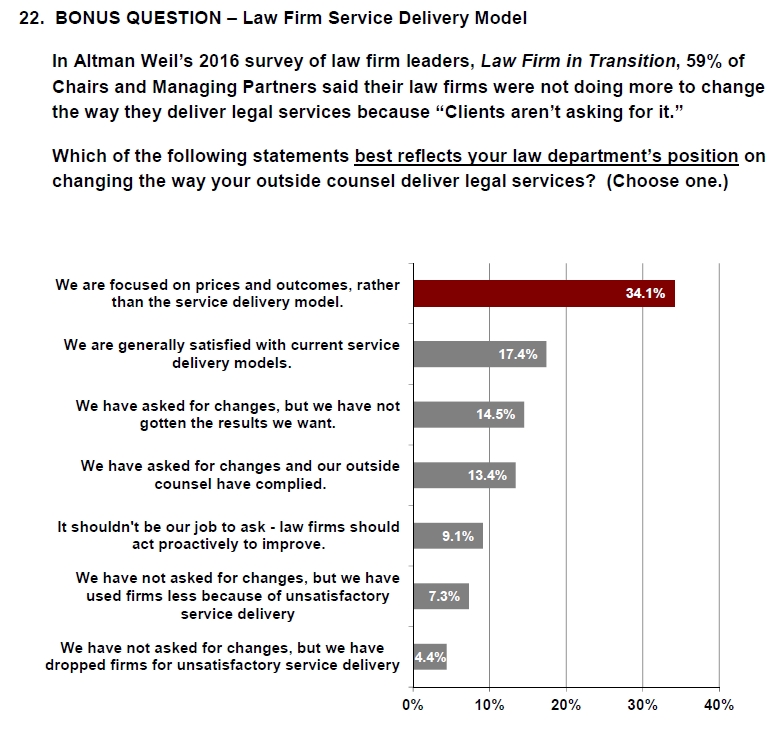
So kudos to Altman Weil for confirming with the clients themselves. Their 2016 Chief Legal Officer Survey included a stellar bonus question:

Reorganizing those numbers a bit, only 30.8% of CLOs rate themselves satisfied because they generally are (17.4%) or because they are pleased with their results from asking for change (13.4%). Of 69.2% who are not satisfied, the vast majority have not exercised their inherent authority to ask for change because they are focused only on outcomes/don’t think it is their job to ask (43.2%) or have simply taken their business elsewhere (11.7%). The remaining 14.5% asked for change but did not get it.

This is what one might call an impasse:

  • Law firms are waiting on clients to make them change
  • Clients are waiting on law firms to be proactive or change in response to market pressure

In the long run, market pressure should prevail with client exit playing an important signaling role. But you know what they say about the long run. As discussed previously, the pace of exit is slow, and there is a lot of noise obscuring its signaling function. That is, to return to a framework I deployed in a prior post, loyalty continues to dominate (repackaging the numbers above):

The Voice share is higher than I would have predicted. Though it is about where I would have guessed (10-15%) with the success rate factored in. That 13.4% of in-house departments are effecting change in the way outside counsel deliver legal services seems about right to me.

I am unsurprised by the failure rate. It is innovation. Innovation means different. Different entails risk. My fear, however, is that not much of anything was actually tried by those who now may be discouraged.

My friend Jeff Carr often refers to “massive passive resistance.” Jeff was in the subset of GCs who regularly made public pronouncements of the need for the legal market to fundamentally change (i.e., discounts don’t count). While that chorus became louder after the Great Recession, Jeff was still in the vanguard of an elite subgroup: those GCs who genuinely meant it.

We are all tempted to engage in virtue signaling—saying that which makes us appear virtuous without any real intention of attendant action. As in-house counsel, you may feel compelled to say you are interested in, for example, controlling costs. But, depending on the environment, you may not be compelled to actually pursue cost control. Instead, you focus exclusively on the substantive legal matters in your portfolio (the stuff you went to law school for). There is not necessarily a tradeoff between cost and quality. But there could be. And you’d rather direct your finite attention to your area of interest and accountability. This acute focus also leaves your powder dry for when the real dictate to cut costs arrives. The loosely run law department has a much easier time finding savings than the already lean machine.

As a result, GCs say many things that their departments do not take seriously. Law departments and their individual constituents say much that their law firms can dismiss as theater. Managing partners say all sorts of things that….Well, all of us are more talk than action (though degrees vary). A key to survival is knowing when people with power are serious. The remainder is subject to passive resistance.

I am not surprised then that some law firms were less than responsive to some law departments. Moreover, I suspect that some law departments had a hard time communicating what they wanted. It is reasonable to want your law firms to be more effective, cost conscious, innovative, efficient, etc. But these are nebulous demands. The conversation around service delivery is relatively new. Most in-house teams aren’t quite sure what they want. They are just want more of it. And knowing what you want differs from articulating it in a way that is digestible by someone who has no frame of reference. Someone really ought to write a guide to such conversations.

And even if the communication from the law department was crystal clear, change is still hard and takes time. Maybe the law firm didn’t know how to change. Maybe the client didn’t have enough leverage with the subject firm. Maybe the person to whom the request was communicated did not have the authority/pull to make it happen.

Law departments should pursue concentrated, calculated, and and clearly articulated change initiatives supported by sustained attention (not the same as constant attention). Even then, some efforts will still fail. Such is the nature of experimentation. If guaranteed results are more important to you than improved results, keep doing the same thing you’ve always done for as long as it is sustainable, at which point you will have no option but to experiment and far less room for error.

The Exit share in the chart above is much lower than I would have anticipated. Moreover, the results of the bonus question above do not seem to square with other data in the report:

So 53% of clients have switched firms on the basis of “client service” while only 4.4% of clients have dropped firms due to “unsatisfactory service delivery?” There must be some critical semantic distinction I am missing. The higher exit number is consistent with general industry trends, including the survey’s own findings on insourcing (which still remains less prevalent than discounts and AFAs):

I am fine with exit as a general concept/approach. But I continue to wonder how well it alone addresses the problem. What makes a law department believe that switching firms will fix the client service problem as opposed to just relocate it? The answer I usually get (anecdote warning) is that service delivery is explicitly included in the dialogue with the new firm as part of the retention process. That is, the law department is combining exit with voice.

This prompts the question as to why they didn’t try voice with their existing firm first. Responses tend to suggest that it is easier to shape a new dynamic than reform an existing one. This strikes me as a fair point. But it becomes problematic when path dependence makes exit really hard.

The best read of the data tends to suggest that a majority of clients switch firms. But it does not follow that a majority of their firms feel the impact (only 13.7% instituted a convergence program). Most incumbents retain their privileged status while insulated from the voice of the customer.

Loyalty. I don’t know how I feel about 17.4% of chief legal officers reporting satisfaction.
There is nothing wrong with being “generally satisfied.” While I am a continuous improvement zealot (never totally satisfied), I had the pleasure of working with phenomenal outside counsel. I always wanted them (and us and me) to get better. But this desire did not obscure the fact that they were already exceptionally good. As strange as it may seem, I would have likely ended up in the “generally satisfied” or “got the changes we asked for” buckets.

Likewise, I am sympathetic to those CLOs who are outcome oriented or feel law firms should be proactive. Few CLOs have the time to worry about service delivery. And law firms should be proactive.

That said, I submit that it is the responsibility of the legal department as a whole to behave like sophisticated consumers of legal services. The fact remains that ours is a buyers’ market, and the buyers cannot abdicate responsibility for how legal services are delivered. Silence is taken as assent to the status quo.

Accepting that the CLOs do not have time for the details is different than thinking that service delivery should not fall within the ambit of someone’s (or someones’) job description. For me, this responsibility grows with the size of the department.

A solo GC or a few lawyers just trying to keep their head above water absolutely need to triage. But specialization accompanies scale, as does the professionalization of management. In the survey, 77.6% of law departments with 50 lawyers or more report having one or more people dedicated to “law department administration” with 15.9% of their time (6 weeks per year) focused on outside counsel spend tracking and analysis. Since service delivery has an appreciable impact on spend (as well as quality and speed), it seems reasonable to suggest that a few of those days should be directed towards the subject.

Frankly, I’ve probably spent too much time thinking about legal supply chains. To me, the law department is not the retail customer (end user of the car, phone, etc.) but the manufacturer/distributor who should absolutely take an interest in how component parts are produced (i.e., responsibility for the entire value chain). Deep supplier relationships are central to my worldview. And I am probably missing something about what seems to me a facile approach to driving change—i.e., expecting instead of demanding.

It would be a completely different story if most in-house counsel were satisfied with their outside counsel. They aren’t. It would be a completely different story if the pace of exit were enough to cause immediate modifications in behavior. It isn’t. It would be a completely different story if the outcomes-only mindset were enough to close the gap between expectations and performance. It isn’t.

We now have years of data on the CLOs’ perception of how much pressure they believe they are putting on law firms and how serious they believe the law firms are about changing. There has been essentially no movement. In particular, the delta between the two has returned to pre-Recession levels:

I would wager that the gap will never fully disappear. Law departments are never going to believe that law firms are as serious about change as they should be. But look at what a low opinion corporate clients have of themselves. They only cracked six on the pressure scale once in last eight years. Clients seem to know that the outcomes-only mindset is not getting them the outcomes they want. Why not try a different approach? If it fails, the status quo continues just as it would have under the current regime. If it works….well, that’s when things become really interesting.

Full Arc: Law Firm Resistance to Change and Law Department Responsibility

_______________________________________
D. Casey Flaherty is a legal operations consultant and the founder of Procertas. He is Of Counsel and Director of Client Value at Haight Brown & Bonesteel. He serves on the advisory board of Nextlaw Labs. He is the primary author of Unless You Ask: A Guide for Law Departments to Get More from External Relationships, written and published in partnership with the ACC Legal Operations Section. Find more of his writing here. Connect with Casey on Twitter and LinkedIn. Or email casey@procertas.com.

Ed. Note: Please welcome our guest blogger, Susan Kostal, San Francisco based legal affairs journalist and consultant.
________________________

One of the most fascinating ideas out of this year’s LMA Legal Tech West conference was a workshop on design thinking.

Design thinking has taken the corporate world by storm. Intended to build a culture of free exchange of ideas, constant iteration and learning from failure, it is sacred credo in Silicon Valley and at the heart of almost all innovation.

Law is one of the slowest, if not the slowest, industry to evolve, but design thinking has a good chance of changing that.

Design thinking has many definitions, but at its core, whether designing a product or business process, it comes down this: instead of a designer-led process, it’s a user-led process. This concept comes out of the Institute for Design at Stanford (d.school), and launched its most popular course, Designing Your Life.

Mark Beese of Leadership for Lawyers led attendees, myself included, in a design-thinking exercise to improve the onboarding process for lawyers and staff at a law firm. We were paired in teams and assigned to learn as much about our partner’s onboarding process, what they liked, what they didn’t, and then in rapid-fire mode come up with as many ideas as possible to solve their issues, whether they seemed feasible or not.

We were instructed to sketch these out, which, for someone used to working with words like me, unleashed a creativity and excitement about solving the problem that felt fresh and new.

Pipe Cleaner Breakthrough

With 10+ ideas in hand, we went back to interviewing, really digging into our partner’s experience, and then narrowed down our solutions to three. Then, we were given Post-Its, pipe cleaners, rubber bands, paper clips, markers, paper tubes, etc., and asked to build a prototype.

My partner was overwhelmed with the amount of information thrown at her on her first day, and wanted more personal, warmer touch points. One of the offerings I came up with was a branded mug. Sure, lots of people give out branded material to new hires. But along with my mug came a supply of coffee or tea—whichever beverage the new hire had accepted when offered a hot beverage in the interview process. I’m not sure that would have occurred to me absent me taking the time to craft a mug from pipe cleaners. My onboarding solution, while small, told my partner she was welcomed, that the firm wanted her to be happy at work. More importantly, it told her she was valued, and that her needs were noticed and were as important as corporate goals.

Some teams had unworkable ideas, such as a corporate jet to squire new hires for a tour of the firm’s offices. But that prompted me to think about giving each new employee a modest transit or parking voucher. The message the employee gets is that we are so excited you’ve joined us that we want to pay for your commute for your first few days with us.

How It Works In The Real World

Davis Wright Tremaine has embraced design thinking, is using it with clients to find legal process solutions, and has created DWT De Novo, an internal consulting firm to help its lawyers develop more client-centric ways of solving problems.

Jay Hull, DWT’s Chief Innovation Partner, told me that there are about 20 DWT staff and lawyers actively involved and 10 full-time people dedicated to the initiative. Hull, a former transactional lawyer, said the key is multi-disciplinary teams that feel free to pitch ideas, can iterate quickly, and who are confident enough to show clients prototyped options that aren’t yet fully baked, so team members can learn during the design process what features appeal to the client and which aren’t working and need improvement.

“To me, it starts with empathy for the client,” Hull said “and burrowing into what it’s like for them to engage with the product or process.”

Hull’s time in-house helped tremendously, he said, where he struggled with existing processes. “There was a huge transaction, and on the 42nd draft of the agreement, it hit me. What were we thinking? Couldn’t we have done this in 20 revisions? There has got to be a better way.”

Studying the Giants of Customer Service

At the launch of the effort, two DWT professionals participated in a two-day design-thinking workshop hosted by Nordstrom, well known for its top-notch customer service. Then several lawyers, Hull included, visited the dSchool and met with Margaret Hagan, a fellow at Stanford Law’s Center on the Legal Profession. She launched the Legal Design Lab, experimenting in how design can make legal services more usable, useful and engaging.

DWT debuted the concept with a large public company. “They needed thousands of documents reviewed, knew they couldn’t do it efficiently in-house, and didn’t want to pay for a traditional review by a law firm,” Hull said.

Using software DWT already owned, the firm conducted an automated review of the contracts, with human beings doing post-automation quality control, for a fixed set-up fee of $15,000. The audit singled out several hundred contracts that needed further review, for which DWT charged a per-contract flat rate.

Note that this is a process- and solution-oriented approach, rather than a pricing- model approach, although the firm billed the client on a flat-fee basis. It hatched a single-point solution and provided the model for other contract review projects.

Clients “Want a Different Model”

Microsoft, a longtime client, is a big proponent of design thinking. In-house lawyer Lucy Bassli needed thousands of procurement contracts reviewed so she could free up her department’s lawyers for higher-level work. She wanted it structured as an annual flat-fee engagement. She asked for RFPs and “made it clear she wanted a different model,” Hull said.

DWT more directly applied design thinking principles, including empathizing with the client and crafting an MVP (minimum viable product) with rapid iterations based on client feedback. The process analysis included details I’ve heard many in-house counsel complain about, such as how documents are managed, how communication with the client and related firms should be structured, and how projects will be assigned.

“We are ‘all in’ on this concept, and the firm is behind it,” Hull said. Now, DWT partners are coming to Hull and his team for help. “I’ve had lawyers come up to me and say, ‘Hey, I’m not exactly sure what you guys are doing, but the client says it takes way too long and costs too much. Can you help me?’”

Design thinking “opens up pathways to better solutions, where there isn’t this constraint so common in the legal industry that everything that comes out of your mouth better be perfect, and you better be prepared to defend it at all costs,” Hull said.

“That’s just dumb, and very self-limiting.”

—————
Susan Kostal is a legal affairs PR, marketing and business development consultant based in San Francisco. She covered legal affairs as a journalist for nearly three decades. You can follow her on Twitter at @skostal and view more of her content at www.susankostal.com.

As the Vice-President/President-Elect of the American Association of Law Libraries (AALL), I wanted to tell our 3 Geeks’ readers about the new visual identity and tagline that AALL officially rolled out last night. Leaders within the organization worked on this rebranding effort for nearly two years, and displayed the new logo back at the annual meeting in Chicago last July. I, for one, like the new logo, and the tagline that goes along with it. I applaud those that worked on the rebranding effort and I hope that members of AALL, as well as those that benefit from the work that law librarians, legal information professionals, take a moment to look at the new branding and take a moment to think about all the good work that the Association, its members, and staff provide to the legal industry.

I wanted to focus on the tagline, and the two meanings that it represents.


Your Legal Knowledge Network


Internal Meaning: To members of AALL the tagline represents the community of knowledgeable law librarians and other legal information professionals who identify with the ideals of access to justice, the dissemination of legal information, and the ability to reach out to that community in a way that adds value to the service we provide for our individual organizations. To me, the best thing about AALL is its members. It is your legal knowledge network because we learn from each other, and we form bonds that unite us and allow us to leverage the knowledge of the entire association, regardless of the type of work we perform, or the organization which we work. This is your legal knolwedge network of highly-educated and forward-thinking professionals are willing to give their time and experiences to help others within AALL and beyond is a valuable professional development tool which all law librarians and legal information professionals should feel proud to belong.

External Meaning: For the legal industry, AALL members represent some of the most educated, connected, and resourceful employees of your organization. AALL becomes your legal knowledge network and exposes your organization to advanced educational opportunities to keep your law librarians ahead of the curve for changes in the legal environment. AALL is your legal knowledge network to discover new legal information resources and provide access and understanding of how these resources may bring value to your practices within your organization. AALL is your legal knowledge network to fight and lobby for legal information to be open and available and not locked behind a government or corporate wall. AALL is your legal knowledge network that multiplies the talents and skills of your legal information professional by the diverse talent and skills of thousands of other law librarians and legal information professionals.

I may be biased in my appreciation for AALL and what it does for me, my organization, my profession, and the legal profession as a whole… but I am not wrong. I have written and talked about the value of law librarianship ever since former AALL President and Georgetown University Law Library Director, Bob Oakley, reached out to a very green law librarians some sixteen years ago and asked me to write about where he thought I believed the profession was going. AALL gave me a voice and an opportunity to leverage its members and resources to expand my own career. I hope that in the course of my journey I return the favor to another member of my network.

I think our current President, Ron Wheeler says it best. “AALL’s new brand honors our past, embraces our present, and emboldens our future as legal information professionals. The knowledge and talent of our members, combined with their unrivaled dedication to service, make our whole legal system stronger. I have never been more proud to be a law librarian.”

For those current members of AALL, thanks for being a part of this network. For those that have lapsed in the past few years, I encourage you to come back. If you’re a law librarian or someone who works in the legal information profession, I invite you to come join and make this network your own. For those who employ law librarians and legal information professionals, encourage them to join and leverage this network. After all, AALL is your legal knowledge network.


Technology is cool. There is no disputing that fact. Last month, while travelling for work, I had a video conversation with my kid, while I was 3500 kms away in a relatively remote mountain resort, and he was in a moving vehicle. Last week, while doing some research I came across a data visualization of all of the spells used in all seven books of Harry Potter on a scatter chart, and when you hovered over the data points you learned when the spell was used, by whom and why. That’s cool, that’s technology. Whether we are looking at the vast amounts of data in the world and how we can use that data, make it visible, pretty and useful, or whether we are talking about “smart” technology, machine learning or artificial intelligence as it applies to daily work tasks that can be automated, made better and or make our work lives and products more efficient.

And yet, as I sit here at ARK KM 2016, in NYC, the themes I keep hearing coming out of every session, are around audience engagement, adoption, clarity of purpose, how do we encourage people to share, and clear or shared communication. Fundamentally “soft skills” that technology can’t really impact have been a part of every presentation. Like it or not, while some of us may prefer to engage with robots, as people working in law firms for legal clients, we are dealing with people, clients are people. Implementation of strategically sound KM programs, social for enterprise, efficiency in data visualization, noise reduction, cross firm collaboration, data integrity, whatever it is – people are at the centre and people are necessarily complex. When we talk about getting people to collaborate, share data, engage on client matters together and so forth, we are discussing changing cultures with in individual firms and within the legal industry as a whole. Changing legal and law firm culture, (and related initiatives such as KM – however you define it) start, in my opinion with putting clients first.

I have written here and else where about how clients are or should be at the centre of any significant initiative by firms. Putting clients first to my mind means using a design thinking approach to new initiatives. Design thinking as explained in a recent Lexpert article is “also known as “human-centred design” — an approach that, at its core, is about structured problem-solving with a design flair.” The first step in design thinking that runs through every stage of the process is empathy. Empathy is knowing how someone else feels, whether as a lawyer knowing how a client feels or as an allied professional in a firm knowing how your lawyers feel. Feelings are not always used in the same discussion as law firms or lawyers, but therein, lies the change that needs to happen. In order to successfully innovate and move culturally sensitive initiatives forward we need to think like our clients, we need to feel like our clients. We need to understand our clients pain – their difficulty in solving problems and then very quickly try various solutions in solving those problems or assuage any ill feelings.

Technology can be a tool in helping to achieve resolution, but the tech itself could never replace empathy. The ability to think like others, to feel what they feel and to really understand their challenges and how to address those challenges is really about people connecting with people regardless of roles or capabilities. This is the heart of design thinking – the human element. The EI or emotional intelligence that is required to make AI, KM, BD/Marketing and other projects a success. On the surface it seems simple, and maybe it is, but all too often we are distracted by the technology and the crazy capabilities they afford us. Blinded by the possibilities of the technology, we present solutions to problems people don’t have or we aggregate data sets and taxonomies that make sense to only a few and confuse everyone else. We then push these technology solutions on a varied group of people and expect them to be as excited and ready for the impact of the technology as we are. Who wouldn’t want to know every spell Harry and his friends ever used to defeat He-Who-Should-Not-Be-Named. But if those capabilities add nothing productive to my day, or solve no real world issues, then any real value the technology tools provide gets lost. Tie solutions back people. Start prototying solutions only after actually talking to people, all the people, with all the same problems. Use technology to aid in solving real world issues or frustrations and eliminate the pain that real people are feeling. To do that, we need to be sensitive to the human element every step of the way. Once you can do that, the prototyping and ideation gets far easier, but empathy especially in law firm processes can be a fickle friend.

Who wants to take on that session at ARK KM next year???

If I am in a room with an academic law librarian for more than five minutes, I almost always get some form of this question:

What are the tech skills I should be teaching law students to better prepare them for working in the ‘real world?’

My answer is a pretty standard one. “Make sure they know the basics… then we can teach them the unique skills needed for our particular firm.” The same question came up last Friday when I was on the Law Librarians Conversation podcast with Rich Leiter, Roger Skalbeck, Elizabeth Farrell, Ken Hirsh, Darin Fox, and Michael Robak. Knowing the cool stuff is secondary to knowing the basics.

What are the basics? My guess is that you already know (especially if you’ve read any of my co-geek, Casey Flaherty, posts.)

  • MS Word – especially style sheets and any basic tasks that are automated rather than manual.
  • MS Excel – with some basic understandings of formulas, especially simple math formulas, sorting and filtering.
  • Adobe PDF – Focus on how to effectively use PDF and exporting from other programs like Word.
  • MS PowerPoint – pretty much Google “Death by PowerPoint” and learn the what not to do lessons.
  • MS Outlook – learn rules and foldering. Once you’re at your firm, learn how Outlook interacts with your document management system (DMS) and be an avid filer and rule follower for the DMS standards of your firm. 
It is amazing how many Associates show up at their firms, having attended seven  years of higher education, and do not have these basic skills mastered. According to Casey Flaherty and Darth Vaughn’s ABA Journal article, “Tech comes naturally to ‘digital native’ millennials? That’s a myth” only about a third law law students get these tasks right on the first try:

  • Accept/Turn-off track changes.
  • Cut & Paste.
  • Replace text.
  • Format font and paragraph.
  • Fix footers.
  • Insert hyperlink.
  • Apply/Modify style.
  • Insert/Update cross-references.
  • Insert page break.
  • Insert non-breaking space.
  • Clean document properties.
  • Create comparison document (i.e., a redline). 
That’s not to say that Millennials don’t have tech skills, it just shows that there is a difference in being a consumer of technology and mastering technology needed for the practice of law.  
I commonly say that learning these basic tasks isn’t sexy, but it is necessary to understand before you can really get to the “sexy” technology later. Darin Fox, Law Library Director from the University of Oklahoma, corrected me on the Podcast and said that when his law students see what happens when they apply style sheets to documents, they light up, and think it is very sexy. I have forgotten how exciting it was when I first learned how to create a non-breaking space, and what affect that had on my documents, or the time I read Typography for Lawyers and finally understood why the old standard of double-spacing after a period was no longer the way to draft a document. There is a certain sexiness in creating a document that looks good, and does some “magical” formatting, or a spreadsheet with a built-in formula that displays information compiled from multiple locations. 
Even if you don’t find the basic skills as sexy as some of us do, it is still necessary. When I talk to law students, I usually tell them that if they want to get into the really advanced technology and be seen as a tech guru at their firm (small or large), then learn the basic stuff first, show everyone that you’ve got that down, and then you’ll be the first person on the list when it comes time to try out the newest innovations. There’s so much going on in the legal tech world right now, that I think it is rivaling the dot com era. Artificial Intelligence is such a buzz right now, that I think we may be on the cusp of an AI boom/bust in legal. High tech courtrooms are more and more common, and I even got a peak at the Virtual Reality station in Darin Fox’s library. 
With so many new and exciting tools coming on the market, law firms need help understanding which tools actually work best with the way the law firm works and practices law. We need attorneys to step up and test these exciting tools, and if you want to be that cutting edge attorney, then position yourself early by mastering those basic skills.

Craig Ball wrote a great article yesterday on “Six Powerful Points for Better Presentations” where he give some great tips on presenting information in PowerPoint. At the very end, under his “But, Wait! There’s More” section, he mentioned that he also uses PowerPoint as a “powerful screen capture and video editing” tool. I thought I’d have a little Friday fun post to show you one of my favorite image editing features of PowerPoint of removing the background from an image.

I have to admit that 99% of the time that I do this is to pull a prank on a friend, usually by editing something they posted on Facebook. It’s fast and easy to do once you know where and how to use the tool. Much to the chagrin of my Facebook friend (and Austin rocker), Adrian Conner, I’m going to use her as an example of how to edit a picture in PowerPoint (MS Word also has similar tools.)

Step One: Grab the Picture and paste it into a blank PowerPoint slide. (I think we all know how to copy and paste)


Step Two: Resize the photo (if it is too big or small) so that it fits on the slide, and then double-click the image to bring up the “Picture tools – Format” tab on PowerPoint’s menu bar.

Step Three: Click the “Remove Background” icon on the Picture Tools menu tab. This will create a ‘box’ around a portion of the image and PowerPoint will attempt to automatically remove the background of the image. The part that is to be removed will be displayed in a purplish color.

Step Four:  Move the outline box around until it is a close to the part you want to keep as possible. In this case we’re removing the boxing bear and just keeping serious looking Adrian. PowerPoint does a pretty good job here of getting most of Adrian’s serious stare, while removing the boxing bear. However, despite the glare, some of Adrian’s hair is not there. Also the knit-toboggan is missing from her wild-haired noggin. Not to sweat it… we can edit… it.  (And this is the reason I’m a blogger and not a famous lyricist.)

Step Five: To edit the parts you want to keep or delete, there is now a “Background Removal” tab that appears on the menu bar. In this case, we have areas we want to mark to keep. When you click on the “Mark Areas to Keep” tab, your mouse will turn into a pencil and you can click parts of the picture you want to keep. My suggestion is that you click around the very edges to do this. If you click outside the area, you can hit CTRL-Z to undo your click and try again, or you can press the “Delete Mark button and remove them that way. If there are areas you want to remove, you can do the same with the “Mark Areas to Remove.” Again, stay around the edges until you get where you have removed (or added) everything you want to keep.

Step Six: Once you’ve got all the areas you want, click the “Keep Changes” button on the menu. This will remove all of the picture that is currently in that purplish hue. If it doesn’t quite look right, you can click CTRL-Z again and add/remove more areas until you get it where you want it.

Step Seven: Crop the image around what is left. I usually do this because PowerPoint will keep the image the same size as the original, and if there is a much smaller area remaining, I want to crop that out. Use the “Crop” tab on the menu and pull the outline around the part you want to keep. Then press “Crop” again to remove the rest of the image.

If this is all you want to do, you can stop here, and right click on the image and “Save as Picture.” However, if you want to have some fun, then follow the next steps.

Step Eight: I like to overlay these images over something outrageous. To do that, I have to make the background of the remaining picture as transparent. This will allow me to place this image on top of another image and make it look like it is a part of the picture. To do this, click on the “Color” button on the menu, and select “Set Transparent Color.”
Click anywhere on the white portion of the background of the remaining picture, and it will become transparent.

Step Nine: I usually find a Google Image or a Flickr Image (make sure it is creative commons or not copyright protected if you’re going to use it outside of your own personal enjoyment, e.g., post it on a Facebook.)

Paste the picture in the same slide as the one you  edited, and right click on the image and click on “Send to Back.” This will put your edited photo in front of the image you now want in the background. Align your picture the way you want it by making it smaller/larger so that it begins to look like it is part of the new background. If you’re like me, it make take a few tries and different backgrounds to get the effect you want.

Step Ten: You can edit the color of each of the individual images, and play around with the corrections, color, and artistic effects buttons on the Format menu. Once you have it where you like it, you’ll want to merge the two images together so you’ll have a single final image. You can do this by selecting both images (CTRL-A works, or you can click on each and use the CTRL button as you click), and then press the “Group” button on the menu, and select “Group” from the drop down. You can then right-click and “Save as Picture” to save your final result.

It takes me about five minutes to do all the editing. It takes longer to find a good background to use than it does to actually do the editing. I find it to be very easy, and a lot of fun. Since many of us don’t have editing tools like Photoshop, this is an inexpensive way to have some fun editing pictures.

Hypocrisy is the tribute vice pays to virtue. As such, it is a venal sin. But I’m thin skinned and easily goaded. I couldn’t take it when my best friend called me out for being a hypocrite. And so I have found my way back to a law firm, Haight Brown & Bonesteel, on a part-time basis despite thinking that my law firm days were over.

NOTE: still running Procertas, consulting, writing, speaking, Nextlaw Labs, etc. the rest of the time.

Me = Hypocrite

My original image was as a scourge of law firms. But I didn’t write the headlines. As regular readers have come to learn, my actual message, best captured in my ACC guidebook, is focused on deepening relationships between law departments and law firms. My thesis is that there are win-win improvement initiatives that can come from data-driven law department/firm collaboration. As such, I have staked out the position that law firms are redeemable. I’ve stated repeatedly that law firms are capable of real, positive change.

But I could not be more cognizant of the fact that real change is hard. It is easy to write about change. It is relatively easy to advise large law departments to talk to their law firms about change. It is a genuine challenge to drive change in a law firm, especially absent explicit client mandates. So while I have accepted speaking gigs from law firms and discussed consulting engagements with defined objectives, I have shied away from nebulous commitments to assist firms with general improvement. Until now.

I feared failure. More specifically, I feared that I would be regarded with the same Easy-button mentality as a technology purchase. That is, they would see their commitment to pay the sticker price as their primary obligation. Then I, like technology, would be expected to work some magic in background. Make everything better but don’t make us do anything different. People are all for progress, but they sure hate change.

I don’t have easy answers. Some behavioral changes may be simple (stopping doing X; get better at Y). Few are easy (we’ve always done X; it will take time/effort to get better at Y). So I had an expectation of being completely ignored.

What I had to get over is that this did not make me special. Someone has to do the hard work eventually. I had no excuse for refusing to get my hands dirty.


The Best Friend

Darth Vaughn was born before the movie. Mom wanted to name him Darryl. Dad wanted to name him Garth. Darth struck them as a better compromise than Garryl (no offense to the Garryl’s out there). A few years later this happened.


Rather than slaughter Jedi younglings, Darth Vaughn got a B.S. and a Masters in Regional Planning (with a specialty in geographic information systems) from Cornell, where he also played basketball for the Big Red and was the Ivy League high jump champion. He then worked as business technology consultant at Accenture before decamping to USC for a J.D. and second Masters in Real Estate Development. He’s now a successful trial attorney handling all manner of business litigation. Classic underachiever

Three important points on Darth:

  • Until his daughter Alanna blessed this world, the best thing Darth had going for him was being Lael’s husband. Lael, my law school classmate, is too good for him in every way. Though I still strongly disagree with her veto of “Leah” when baby names were being debated (somehow, I had no vote).
  • For those conferences that encounter difficulties finding diverse speakers, Darth is a master presenter with absurd PowerPoint skills. He presents on presenting (e.g., trial graphics), process, technology, and elimination of bias among many other topics. He’ll be on stage at Clio Cloud Conference tomorrow.
  • Darth is, and will remain, a principal in Procertas

Given my affinity for process and technology, you’d think Darth and I connected at USC Law (he was a year ahead of Lael and me) and bonded over what he’d done while at Accenture. To be honest, it was mostly the bourbon. We met through a mutual friend after graduation and found in one another a reliable drinking companion. Conversations about the lackluster state of affairs in law only came later. And then we never shut up about it.

Despite doing quite well at a large, prestigious firm, Darth considered it too big to change. He had been hunting for a place where he could both practice law and have a firm-wide impact on the way legal services are delivered. He found it in Haight.

Haight offered to bring him in as a partner and the Director of Legal Process Services. It was an almost ideal situation. Almost. The problem was time. He is an attorney with cases to run. Giving him the title does not magically provide the necessary resources, especially time, to affect change. So he put on a charm offensive, convincing them to talk to me about spending two weeks per month dedicated to process improvement.

Me, he called names. In some creative but grossly offensive ways, he suggested that I lacked the intestinal fortitude to execute on my ideas. He seemed to think that my ego was so fragile that I would respond to childish taunts. He was right.

The Managing Partner Who Abolished Committees

But I was still dubious. Then Darth told me the story of Haight’s managing partner, Chris Stouder. Chris is a Haight lifer who loves the firm and therefore made it a condition of his ascension that all power be vested in him so he could actually execute. The first thing he did with that authority was abolish committees. Since then, he has been on a mission to remake the firm.

“Because we’ve always done it that way” is the phrase most likely to set Chris off. He is extremely proud that the firm is about to celebrate its 80th year. History is important to him. But legacy more so. Chris’s mission is to ensure that the firm is around and thriving for another 80 years. He is intimately familiar with changes in the legal landscape and knows that simply being a loose collection of supremely skilled lawyers will not be enough to sustain the firm over the long haul. For Chris, improvement is not an indictment of the past, it is a way to honor the past by building upon it.

Chris has already introduced massive overhauls of governance and compensation even though it resulted in some well-established partners leaving the firm. He has the interest, the authority, and the resolve to pursue real change.

The External COO

While Chris assuaged doubts about the willingness of the firm to actually change, I still had hesitations about the arrangement. I wasn’t going full time. I wasn’t abandoning my other endeavors. I wasn’t moving back to California. Anthony Forde took care of those concerns.

The breadth and depth of Tony’s knowledge is breathtaking. He is as comfortable talking about server upgrades as about utilization rates. He can masterfully move from matter-level profitability to dashboards to record taxonomies in the space of a single thought without any drop off in insight from one topic to the next. He is Haight’s COO and superb at his job. But Haight is not his only gig.

Tony is also the founder and president of Vendor Direct Solutions, one of California’s largest business process outsourcers. While there is definite overlap between the roles, the fact that he can do them both at the same time speaks volumes to how well firm handles part-time employees in prominent positions. It evinces a flexibility that I simply did not expect to find in a law firm.

The Plan

As a proud proponent of legal technology, I came in with a lengthy list of tech solutions the firm would need to purchase before I could get started. The complete list is below:

1. Sticky Notes

The initial plan is simply to listen and learn. I have many general ideas. Trying to implement them all at once would be an unmitigated disaster. Trying to implement any single one of them without stakeholder buy-in and taking into account actual conditions on the ground would be a waste of effort. I don’t know where the chokepoints are. I don’t know what firm clients are requesting. Basically, I’m a far less attractive/brooding version of this guy:

After getting a general overview of the firm, the first thing we (Darth and I) would like to do is sit with one practice group and begin to map their process for a particular case type. Then go from there with a bias towards finding ways to do less (waste elimination) rather than more (additional processes). The hope—because it is not concrete enough to be a plan—would be to identify some refinements that can be scaled across the firm. Alternatively, we would work with them on local refinements and move onto addressing another practice group, case type, or constraint. Repeat.

Ultimately, there is little mystery of what we would like to do. We want to work directly with firm clients on sustainable improvement initiatives that better integrate the firm into the clients’ legal value chain. First, however, I should probably figure out where the bathroom is.

The Takeaway

Haight is both an aberration and a harbinger. Darth, Chris, and Tony are a unique collection of co-conspirators who would be hard to replicate. But we’ve reached a point in the evolution of the legal market where a 65-lawyer firm is making a serious, public investment in process improvement without a splashy marketing angle (robot lawyers!). That would have been unthinkable just a few years ago. Now, it is notable but not shocking. In a few years, it might be mundane. Change is hard. And that is precisely why we need to work at it.

_______________________________________
D. Casey Flaherty is a legal operations consultant and the founder of Procertas. He is Of Counsel and Director of Client Value at Haight Brown & Bonesteel. He serves on the advisory board of Nextlaw Labs. He is the primary author of Unless You Ask: A Guide for Law Departments to Get More from External Relationships, written and published in partnership with the ACC Legal Operations Section. Find more of his writing here. Connect with Casey on Twitter and LinkedIn. Or email casey@procertas.com.

Innovation is hard.  Despite how easily the word gets tossed around, like a “bong at a frat party” as a friend likes to say, but to truly innovate, to truly change a process, a culture, a product is one of the most difficult things to do. 

Many legal industry pundits call for law firm innovation, and us non-lawyers have been called out as the gatekeepers of innovation because we are not moving mountains, challenging the status quo faster or with enough chutzpah.  There may be some truth to those claims, we do get frustrated, our ideas can be difficult to implement in the highly matrixed world of law firms and we can get stymied by politics.  Often we give up and retreat into the comfortable,  “we’ve tried that before” type excuses.  But we have to keep trying, use different approaches, find new language and keep repeating the cost benefit of not changing.  If we don’t innovate or transform what and how we do things, we may see more of our roles outsourced or vanish entirely as has been the trend. Today, I pulled out a report I created back in 2008 as an example of what firms could and should be doing for CI and practice strategy.  At the time, the report was shot down for a variety of reasons but as I resurrected it from my “precedents” folder today, and blew off the dust, I still saw its brilliance.  It would have been easy to walk away and not keep trying to innovate in the space given that set back. I was crushed to be honest and wondered why I was working in the industry when what I was hired to do was not welcomed with open arms.    The report was and still is a perfect example of CI innovation in firms. At the time, no one was talking about insights or big data.  But the report pulled together internal insights with external data, it combined form with function. It’s a beautiful report and it lives in my file cabinet to this day.  A pretty picture of what could be. 

I didn’t walk away from the legal industry or my craft, I kept at it and eight years later I have a well respected and culturally ingrained version of that would-be quarterly report going out daily in my firm.  The insights may not be as bold but the delivery is faster and tailored to the individual user.  It’s a baby Pheonix rising from the ashes.  There is still work to be done to truly innovate in the legal space, much of that innovation and change is culturally and client dependant.  But that doesn’t mean that we should give up, walk away or ignore the hard.  Embrace the hard, chip away at it day in and day out.  Instead of focusing on what we can’t do in our firms, finding that report today inspired me to think about what I have accomplished and to change the narrative.  We have to focus on what we can and do change, and keep pushing through the hard to make things happen.  Celebrate the small wins and open the proverbial gates that’s we are accused of keeping closed by finding ways to get through to challenging professionals and business owners, whether on a CI project, a profitability and pricing analysis or a library resource that can increase a firm’s efficacy.  Innovation is about changing a culture, about upending what is into what can be and sticking with it.  Innovation is hard. 

As I drove home tonight thinking about this post, Fleetwood Mac’s Landslide came on the radio and I had to smile.  Time does make you bolder. And time sometimes it is exactly what you need to innovate too.  Its time to be bold. 

 
I was recently asked my opinion on associate salary increases (no, really. It’s not like I have any compunction about foisting my unsolicited opinions on the world). I told the person I would get back to them. That was a couple of weeks ago. And I still don’t have anything resembling a coherent position. I am of many minds:

Tribal affinity. I was a BigLaw associate. I am still drowning in law-school debt. It is hard for me to begrudge associates their first raise in a decade. Inflation-adjusted salaries for associates at top firms have increased about 25% since 1986 (while the cost of living in New York, where the elite firms who started the avalanche are located, increased substantially more). Profits per partner, meanwhile, are up 225% in inflation-adjusted terms over the same period. Making associate salaries the symbol of law-firm profligacy is like foreign aid serving as the rallying cry for fiscal conservatism.

Tribal affinity II. Except it really is a potent symbol. I was also an in-house counsel who occasionally encountered a junior associate of limited value (not their fault) and thought to myself, “This person makes more money than me.” I admit it, I’m petty. Going in-house was a conscious choice. But I’m not alone in my resentment:

The newspaper also spoke with an unnamed chief litigation officer for a Fortune 100 company who also questioned the need for the pay raise. The chief litigation officer said a lawyer in the company’s litigation department with 20 years of experience doesn’t make $180,000. “Why would we ever think a first-year associate is worth that?” the lawyer said.

Quite a way to remind clients of all they fund beyond the mature domain expertise they actually value. It was a move guaranteed to engender client backlash and further fuel some threatening trends in client/firm relations. But firms still fell all over themselves to keep up with Cravath.

Keeping up with Cravath. Cravath, Wachtell, et al. I have cognitive dissonance because I don’t really think of them as part of the general BigLaw market despite the fact that I recognize their role in driving that market (Cravath salary scale, Cravath bonus scale…). I’ve never found fault with the idea that there are elite lawyers and elite firms who are sought after to handle price-insensitive work. Such work exists. Clients pay a premium for it. Cravath, Wachtell, and a few others are undeniably in that class and are in many ways immune from most of the forces I drone on about.

But work is finite, especially price-insensitive work. And clients are getting more discerning about what they put in the price-insensitive bucket. It’s easy to understand why the AmLaw 5 firm thinks they need to keep up with Cravath. But it is hard to understand why the AmLaw 95 firm thinks the same

Or is it. The game is follow the leader. AmLaw 5 is competing with Cravath. AmLaw 10 is competing with AmLaw 5. AmLaw 20 is competing with AmLaw 10. And so it goes down the line. AmLaw 95 is not trying to keep pace with Cravath, they are keeping pace with AmLaw 85.


Keeping up with Cravath II. And while a few law firm partners may be almost as venal and petty as me, it probably isn’t pure ego.

There is client chatter about the New Normal. But many successful partners have not encountered it yet. They still operate in a world where law is a credence good. How much associates are paid is among the many status signifiers (impressive zip codes, lobby art, watermarked business cards) that communicate, “Don’t worry. We got you. No one ever got fired for hiring [prestigious firm].” Not paying associates the going rate might be seen as evidence of diminished stature.

It is easy to imagine associate salary increases coming up as a negative the next time a firm seeks rate increases. “Rule No. 1 of associate raises is that partners do not pay for the raise.” Clients may push back on the basis that they are not going to foot the bill for delusions of grandeur.

But it is just as easy to imagine the mirror-image discussion if the firm declines to increase salaries. A firm that doesn’t raise compensation has less of a claim to ‘market’ rates since they clearly do not consider themselves in the same class as their peers.

Moreover, large, diverse firms are not monoliths. There is plenty of intrafirm variation. You can be AmLaw 150 in profits per partner but still have a viable claim to the best tax or real estate practice around. Which herd is the firm trying to run with?

Clients notice. So do the laterals who might hesitate about moving to a firm perceived as falling behind the pack.

More of the Same. Maybe this is the straw that breaks the camel’s back. More likely, it is just another straw because, well, inertia. Regardless, it is absolutely a sign that law firms expect the status quo to reign for the foreseeable future.

Yet even those of us partially inclined to yawn cannot ignore it. Above the Law’s traffic went through the roof [every associate who got a raise should be sending lavish holiday gifts to Cravath’s Executive Committee and the ATL editorial team]. And the story continues to occupy considerable mindshare.

The big story in law (measured by attention) is therefore something along the lines of: Rich lawyers give slightly more money to not-as-rich lawyers based on belief that other not-as-rich lawyers (inside counsel) will send them high-margin work regardless. 

That the story consumed so much oxygen manifests a lawyers-only view of the world. Obviously, the legal world is, by definition, lawyer centric (though some misguided souls argue it should be client centric). But delivering legal services is increasingly a team sport. The question of how domain expertise is leveraged through process and technology, not just additional expensive bodies, keeps growing in importance. Yet, unsurprisingly, I didn’t hear anyone at ILTAcon discussing commensurate raises for allied professionals. The caste system remains intact.

I have no idea what Perkins Coie pays their associates. But I’d wager that hiring Toby will have a more significant impact on the firm’s cost and performance (and revenue and profitability) in the near, medium, and long term than whatever decision they made on salaries. That the firm has now also lured Keith Maziarek away from DLA Piper is an absolute coup. Add a new, change-agent CIO in Rick Howell, and you can start to tell a story that should be far more important to clients than what associates make. But I doubt an item about a firm assembling a process/pricing/tech nerd dream team among its leadership would get one percent of the client attention or peer-firm mimicry of an elite New York firm marginally increasing salaries of people who already work there.

Likewise, I must have missed the media circus when Christopher Ende left Goodwin Procter to become the Law Firm Pricing, Solutions, and Panel Management Leader at GE. But knowing Chris (from conferences; no intimate knowledge of his role/plans implied) I suspect that his hiring will be more meaningful to the industry than whatever Goodwin pays its associates. If Chris does a quarter of what Vince Cordo has done since he left Reed Smith to join Shell, we’re in for a wild ride.

Which, of course, means I’ve come back to my evergreen themes: (i) clients demanding change and (ii) allied professionals playing a critical role in both making and satisfying those demands. Neither really has much to do with associate salaries.

If clients truly care, then the salary increase is a big deal. If clients don’t really care, then it isn’t. Truly caring would mean changing purchasing behavior.

Referencing associate salary raises to score rhetorical points in the midst of a rate discussion—where negotiating down the size of the annual rate increase has somehow been reframed as getting a ‘discount‘—is not altering behavior. You are still just having a discussion about rates. You might consider a different conversation.

_______________________________________
D. Casey Flaherty is a consultant who worked as both outside and inside counsel and serves on the advisory board of Nextlaw Labs. He is the primary author of Unless You Ask: A Guide for Law Departments to Get More from External Relationships, written and published in partnership with the ACC Legal Operations Section. Find more of his writing here. Connect with Casey on Twitter and LinkedIn. Or email casey@procertas.com.

Some bonus material for those not offended by the length of my posts.

More of the Same II. You get what you reward. We’re rewarding the same things in the same way as before. So behavior is unlikely to change much.

There is a genuine question of whether most firms are even increasing total compensation to their associates. Only after we get through bonus season will we know which firms are actually paying their associates more overall and which firms just moved bonus money into salaries.

Whether or not total pay is actually up, clients should absolutely take an interest in comp structure (and fee structures, governance, succession, process, training, tech, etc). The incentive that clients are rightly worried about is that the perceived increase in fixed costs will drive firms to (a) raise rates and (b) demand more hours from their associates. But these have been the dominant trends since forever. Annual rate increases have come to be regarded as natural law. And most law firm bonuses have been premised on hitting/exceeding hours for decades.

It’s not that incentives don’t matter. I’m just not sure they have shifted in any meaningful way.

Keeping Up With Cravath III: The herd is strangely selective when it comes to mimicking the elite firms. Keeping pace on salaries is relatively easy. But what about lockstep partner compensationRuthless brand discipline? Etc. When you bring those up, you get all kinds of “we’re different”, “they’re different”, “that won’t work here”, “you don’t understand”….which is often true enough. Still, the idea that a firm is keeping up with Cravath or Wachtell because they pay their associates the same salary seems to get the causation backwards (you are not elite because of what you pay your associates; you are able to pay associates because you are elite).

I appropriated this from the estimable Bruce MacEwan:

So what does this putative firm of the future look like?

For as long as I’ve been in and around this industry, I have heard ad nauseum infinitum that firm ABC or XYZ, whether or not they had any remotely plausible aspiration to these leagues, only wants to act on the “highest value,” “price-insensitive,” “bet the company,” “make or break,” “premium work.”

Your day has arrived. You may wish it hadn’t.

Because what is the model I’ve sketched above? It’s a model, as a partner at an AmLaw 10 told me last week, with “clients who are happy to pay $1,100/hour for me but not $400/hour for even a qualified midlevel associate.” What is that model?

Wachtell.

We’re all Wachtell now, if we can pull it off.

But I put this squarely in the category of “be careful what you wish for,” since “being Wachtell” is far more challenging than being a typical AmLaw 50-ish firm—no offense to those of you in that category.

Let’s back up: I have a confession. I used “We’re all Wachtell now” calculatedly. The phrase—the very mention of the firm’s name—can inspire envy in the ranks of those who subscribe to the notion that their firm needs to be in that top right quadrant of the 2 x 2 matrix, the “highest value,” “premium work,” etc., engagements. And of course, who can object to Wachtell staking out its own party-of-one place in the PEP stratosphere?

But that’s not all the Wachtell model is about. There are two other critical elements more challenging to embrace: (1) that 1:1 partner:associate leverage, and (2) their intense focus on highly specialized and narrow lines of business, without deviation.

Achieving (1) is going to require wrenching changes in almost every firm that chooses to go down that path, and it can risk introducing centrifugal forces that can tear the place apart before you can achieve the goal.

And as for (2), it requires saying No relentlessly, and many more times than you’ll ever get to say Yes.

Are you game?

And if not, what’s your plan?