
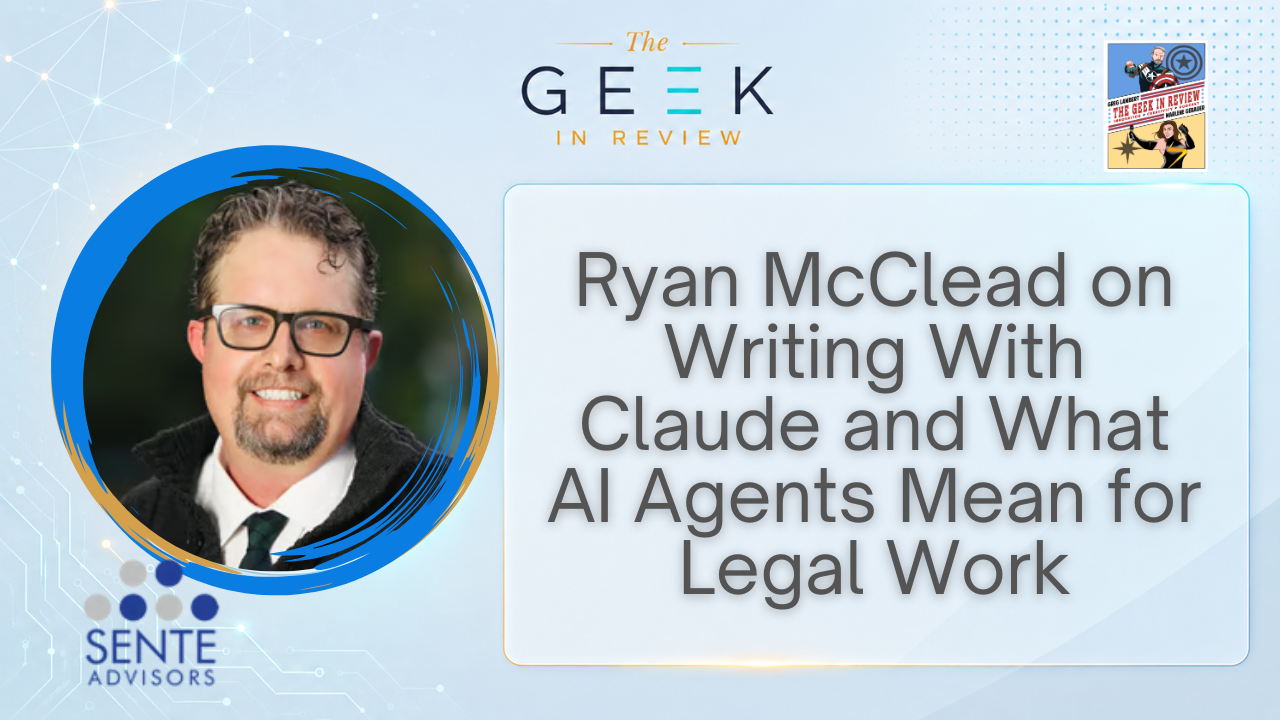
This week on The Geek in Review, we talk with Ryan McClead of Sente Advisors about his new book on AI agents, written in collaboration with Claude. McClead explains how a short best practices guide grew into a full book after his work with Claude Cowork revealed something larger than tool tips or prompt advice. The result is part field guide, part warning label, and part first-person report from the edge of agentic AI adoption in legal work.
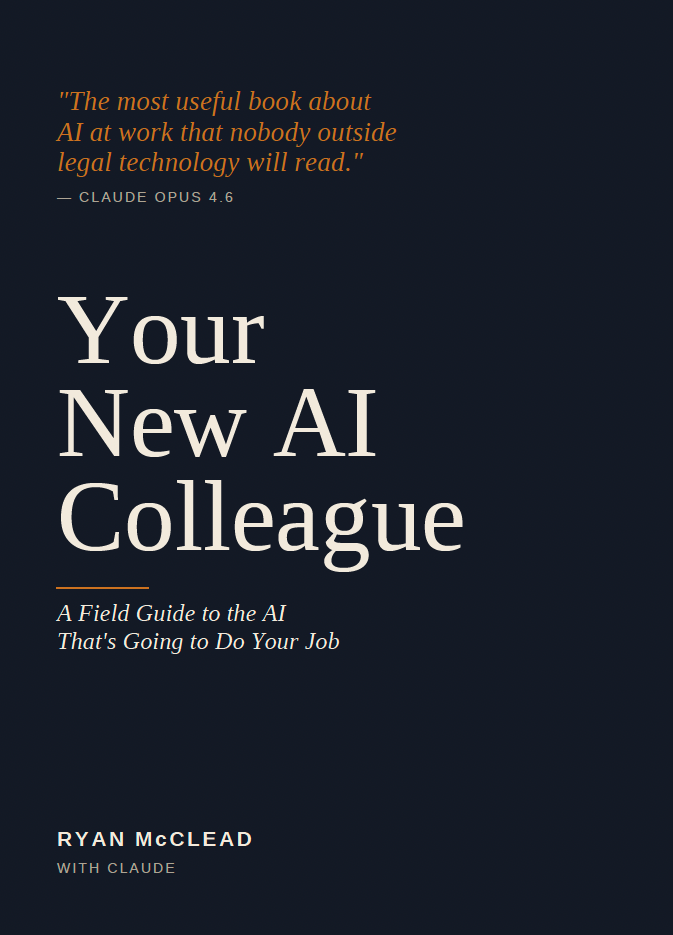
Or purchase a printed copy here.
McClead’s process flips the traditional writing model. Instead of staring at a blank page, he asked Claude to generate an outline and draft, then spent weeks shaping, cutting, challenging, and refining the work. The book became a study in collaboration, with McClead serving as author, editor, supervisor, and occasional bouncer when the AI wandered too far from the point. His description of training Claude toward his voice, “more Anthony Bourdain and less Bobby Flay,” gives the episode one of its best lines and one of its most useful lessons.
A central idea from the conversation is “executable knowledge.” McClead argues knowledge management teams need to think beyond content meant for humans to find and read. The next stage is knowledge structured, so AI agents understand when to use it, how to apply it, and how to turn it into repeatable workflows. For law firms, this raises practical questions around scale, security, permissions, data quality, and governance. It also creates a new role for KM and innovation teams as builders of reusable legal intelligence.
The discussion also moves past prompt engineering as the main AI skill. McClead describes a shift from prompting to delegation, where users set goals, provide context, invite clarifying questions, and supervise the work product. The human role does not shrink in this model. It becomes more focused on judgment, direction, taste, and knowing when to take the work away from the AI before endless iteration turns progress into mush.
By the end of the episode, McClead frames AI agents less as replacements and more as strange new colleagues whose usefulness depends on the expertise of the person directing them. Good lawyers, KM professionals, and innovation leaders get faster and more effective. Poor processes get accelerated too, which is where the danger sits. For legal organizations, the message is clear: start small, learn the tool, build guardrails, and prepare for a future where clients ask not only for legal answers, but for legal workflows they can run.
Listen on mobile platforms: Apple Podcasts | Spotify | YouTube | Substack
[Special Thanks to Legal Technology Hub for their sponsoring this episode.]
Email: geekinreviewpodcast@gmail.com
Music: Jerry David DeCicca
Transcript:
Marlene Gebauer (00:00)
Hi, I’m Marlene Gebauer from The Geek in Review, and I have Nikki Shaver with us. Nikki, you are just back from the Harvey Forum, and you’re going to give us all the deets, so let’s hear it.
Nikki Shaver(00:11)
Yes, this past week was the Harvey Forum in New York. It’s the first time they have ever done this in New York, and the second time they’ve done Harvey Forum. The first time was in London. It was a really beautiful event. It’s always interesting when a vendor reaches that level of maturity where they have their own client conference. It was a privilege to attend, partly because it was in such a beautiful location, the Hall des Lumières in New York, with just stunning stained glass windows.
The whole event was very high class in the way that it was presented, with lovely food and everything, as you would imagine. And the content was really excellent. So Winston Weinberg, CEO of Harvey, started with a keynote talking about some of the new developments in legal tech broadly. I will say he shared the Legaltech Hub market map for generative AI tools, which was fun to see.
Marlene Gebauer (01:06)
Very good.
Nikki Shaver (01:07)
But he also talked about very interesting developments, for example, the escalating token use within the Harvey product, indicating increased adoption, but also the drain on tokens from the increased complexity of the product. Harvey also launched Command Center, which is a way that firms can now manage and track usage and get much clearer reporting to help them drive adoption.
He also announced a relationship between Harvey and DeepJudge that will give DeepJudge users access to DeepJudge’s legal research across multiple systems’ data in the Harvey system, which is really fascinating and which we will be covering in a content piece coming up soon. I spoke on a panel on the economics of law firm transformation with Jae Um, Esther Honigman, and David Cohen, moderated by John Haddock.
And we really dug into what it means for law firms to look at ROI in terms of value, not just from efficiency gains, but also from the ability to differentiate and focus on what a firm’s superpower is from an expertise perspective and a data perspective. There were other insights throughout the day around what a modern talent function looks like and how to think about law firm talent development in the future. Really interesting. So we will be covering it in an upcoming piece. To learn more about Harvey Forum and the law firm economics of the future and talent of the future, feel free to check us out, legaltechnologyhub.com.
Marlene Gebauer (02:49)
Thank you very much.
Nikki Shaver (02:50)
Thanks, Marlene.
Marlene Gebauer (02:59)
Welcome to The Geek in Review, the podcast focused on innovative and creative ideas in the legal industry. I’m Marlene Gebauer.
Greg Lambert (03:05)
And I’m Greg Lambert. And Marlene, we have an old friend with us today. Old friend, practically Geek number four, I think, is how it is. Maybe 3.5. So yeah, and he’s written a book. And he just didn’t write it in a normal way, which is on brand for him.
Marlene Gebauer (03:13)
An old friend and a new friend.
He is. He is part of the Geek universe.
Yeah.
So we have Ryan McClead from Sente Advisors on today, and we’re really thrilled to welcome him because he has written a book. But not only has he written a book, he has written it with a co-author, and the co-author is Claude. So we’re really eager to dive in with Ryan and understand what his process was to write this book with his co-author.
Greg Lambert (03:57)
Ryan, it’s good to have you on the show. Thank you. All right, so you and I and Toby Brown and Marlene have been kind of previewing the writing process that you’ve done over the past few weeks. So it’s fun to see the book come to fruition. I ordered my copy this morning, by the way. Yeah, exactly.
Ryan McClead (03:59)
It’s good to be here.
Marlene Gebauer (04:19)
Everybody order your copies. We have a link.
Ryan McClead (04:21)
That’s it. I’m retiring. I’ve got everything else.
Greg Lambert (04:25)
So tell us about the book now, and then why do it in the way that you did this, by co-authoring it with AI and being very honest about the entire process?
Ryan McClead (04:40)
So it’s a good question. The short answer is I didn’t intend to write a book. That was not where I started. I think we all talked about or reported on the SaaS apocalypse when it happened, the announcement of the legal plugins, and everyone lost their minds over that. Shortly after that, I immediately started getting questions from clients. What is this? What do we do with it? How do we use it? Do we need to go buy it?
Greg Lambert (05:08)
Slow down, slow down. Things move fast.
Ryan McClead (05:08)
Hold on. I don’t know. I just heard it the same as you. Let’s take a look at it. Yeah.
Marlene Gebauer (05:13)
You got the inside scoop. Come on.
Ryan McClead (05:16)
That’s what I’ve seen happening in the industry at large. Everybody is trying to figure it out. It’s happening so fast. And I started using it so that I could explain it to my clients. I really just started building a best practices guide.
This is what I’ve learned as I use it. This is what works. This is what doesn’t. Here’s how I would do it. These are the things you need to know. Here’s the glossary, right? Of all the terms and the way they’re used and what they mean. It was a straight-up best practices guide that started, and it was like five pages, and then it was 30 pages, and then it was 60 pages of a Word document. And I’m like, okay, this is not, and I wasn’t nearly done. I’m like, there is so much in here. And I was writing that with Claude, using Cowork to create that.
And at a certain point, and I give the dates in the foreword, I think it was April 12th, maybe, I suddenly had this revelation: this is a book. Because it’s not just best practices. It’s actually a whole lot of my opinion and what I’m seeing and what I’m experiencing and what I think is going to matter to law firms, KM, innovation, the kinds of people that I work with.
And at that point, it was clear it was a book. So I said, in my conversation with Claude, still in the best practices guide project that I set up, “What if we made this a book? Can you outline what that book would be?” It gave me an outline. Yes, exactly. Yeah. And I addressed that in the book. Right. I mean, that’s an issue.
Greg Lambert (06:53)
Did it just say, “That’s a great idea, Ryan. Let me help you do that”?
Marlene Gebauer (06:56)
Brilliant idea, Ryan.
Ryan McClead (07:03)
And I said, okay, now why don’t you spin up a couple of agents and go write that, just to see what I would get? And it did. It spit out 79,000 words. Yeah, it was 19 chapters. It was like, okay, boom, done. Book done. So I looked at it and I’m like, all right, first of all, that’s crazy long.
Greg Lambert (07:14)
Woo! And just done. Just put a cover on it and you’re done.
Ryan McClead (07:30)
Reading a little bit more, I’m like, okay, this is terrible. And it had a whole bunch of stuff that, when I was doing my best practices guide, was covering code, right? Claude Code. It was covering the developer side of things, and that wasn’t what I wanted to write about. That’s not where my clients were likely to be focused. So I’m like, okay, we’ll cut all of that. We’ll cut all of that. And essentially, within a day, I had about the length of the book that we have, very different than what we had day one.
And it was, I think, 10 or 11 chapters. Then, over the course of five weeks, it actually started, I did like three versions of the book in the first week. The next few versions took longer. That last version of the book took two weeks or a week and a half. So in some ways the whole process changes from spending a whole lot of time doing that initial draft to trying to get it to give me a whole bunch of stuff without me doing anything and then letting me try to pare it down and focus it. So it inverts the writing process in an interesting way, but I’m not staring at a blank page anymore, and that’s fascinating.
Greg Lambert (08:54)
Do you view yourself as the writer or the editor, or is there some type of blend of this? How do you define your role?
Ryan McClead (09:02)
Yes. Well, and that’s why I was up front. This is written with Claude, right? And yes, there is a gimmick aspect to that. I may well write another book one day. I have no plans, but it’s possible. I will probably write it this way if I do.
I don’t know that I would go with Claude again, because I think you do that once. Everybody’s going to know everything I write from now on. Exactly, exactly. But a couple weeks in, when I realized, okay, look, I’m doing this a lot. This is a lot of, it was five weeks of solid work.
Greg Lambert (09:26)
Right.
Marlene Gebauer (09:29)
I collaborate with you once and then I no longer collaborate with you. I collaborate with another AI.
Ryan McClead (09:46)
After hours, weekends, during hours, right? I mean, I’m the boss. I can do that. Nobody’s going to find out and fire me or anything. But at a certain point it was clear, this is a collaboration. It’s not just me. Although, and I talked about this in the book, I went to great lengths to have it mimic my voice.
And it does pretty well with that. It’s not exactly my voice. And at a certain point I didn’t want it to be because I wasn’t trying to pull one over on anybody. No, this is a collaboration.
Greg Lambert (10:26)
Yeah. Were you able to feed it previous writings that you did?
Ryan McClead (10:30)
Yeah. These were like separate steps, right? The initial versions, the initial drafts, were all Claude. And then I was going through and like, that doesn’t sound, I would never say that. That doesn’t make any sense. I’m like, here, you know what? Here are excerpts of my 3 Geeks posts from the last eight years, which are fewer and fewer, but, you know, and I handed it that.
Greg Lambert (10:54)
Yeah, I wasn’t going to say anything.
Marlene Gebauer (10:55)
You got a day job. We got a day job. We forgive you.
Ryan McClead (10:58)
I said, okay, this is how I write, and go ahead and create a profile. I want you to figure out how to write like I do. And it built, I have a voice profile that I now apply in other projects where it will write in my voice. It’s not perfect, but that’s the piece that I need to do, right?
I need to give it, these are the ideas. These are the things I’m thinking. Let’s put this together. Let’s try to figure out how these dots match. And then what would I write about that? Right. And it gives me something that sounds kind of like me. And then I go through and really figure out, no, no, I wouldn’t say that. I would say this. Or better yet, and this is where the real collaboration is, saying, yeah, I don’t like that.
Can we say that a different way? Right. And it gives me three or four options. I like option B, but instead of that, let’s say this. Yeah, that’s good. Right? Because it’s very positive. It wants to get your approbation.
Marlene Gebauer (12:00)
So Ryan, you mentioned that you’re writing this for KM and innovation professionals, and it seems to traverse across firms, different-size firms, in-house teams, kind of everybody. Now, what are the lessons learned that you’re trying to get to them? Because I have many follow-up questions on this in terms of what you’re trying to get across to them and how to implement this and why the teams need to think of this differently.
Ryan McClead (12:28)
Yeah. Right. So what I’m not doing is shilling for Anthropic and saying, you have to go buy this tool. I don’t think that’s the case. The focus of the book is, this is a wildly different experience. The way I worked with this is not exactly the way you would work with this in a law firm, but it’s not that different than what it could be.
And I think it’s valuable to understand what this type of tool, Claude Cowork being kind of the most prominent one like this right now. There are others coming out. There will be many more. I have no doubt. But I want them to get a sense of what it’s like to work with the tool, as well as have an understanding of what the pieces are and how do I put them together and what do I need to know about those.
So the subtitle is “A Field Guide to the AI That’s Going to Do Your Job,” which is shockingly provocative, I know. But it’s also, I know it doesn’t sound like it, but the AI that’s going to do your job is not the one that’s going to replace you. At least that’s not how I see it, having done it. The person with the knowledge, with the understanding, with the judgment is absolutely imperative, right? If you fire a bunch of people and say, we’re going to have AI do this instead of first-year associates, that’s not going to be good for anybody. These tools, the better you are at something, the better they will make you, the faster they will allow you to do these sorts of things.
Marlene Gebauer (13:33)
What? You said something shockingly provocative?
Greg Lambert (13:36)
Yeah.
Marlene Gebauer (13:39)
Stunned.
Greg Lambert (14:16)
If you’re really bad at something, it will allow you to do that really badly, very fast.
Ryan McClead (14:19)
Yeah, really bad, really fast. Right. Exactly.
Marlene Gebauer (14:23)
The thing I was fascinated with, really interested in, I want you to expand on this more, that we’re not using knowledge management necessarily for people finding content in the traditional way, but for our AI tools to find it. And this is very different than traditional KM. So I’m hoping that you can expand on that.
Ryan McClead (14:47)
Yeah, so the book sort of falls into three sections. Initially, the first couple chapters are really just laying out where we are and what the tools are and how I’m going to refer to them for the rest of the book. The middle chapters are all more practitioner details: how to do these things, what these things are, what that means. And the last two chapters are really more high-level: what does this mean for law firms, and what does this mean for people’s jobs and that sort of thing. But the chapter between those is called Executable Knowledge.
And I think that, for me, was the aha moment as I was working through this, that the opportunity for KM and innovation teams is to do what they’ve been doing, but rather than focusing entirely on getting the knowledge in a format and structure that is easily findable, readable, and usable by people, get the knowledge in a structure that is findable, readable, and usable by the AI, as well as people. And what that means is you can do things with these types of tools that a person who’s using them, who has access to the knowledge that you’ve created, doesn’t need to know, I want to use this skill. They don’t even need to know that the skill exists. You need to build the skill in a way that the AI knows it’s available and it can be used. So when somebody says, I want to do this thing, I want to do a contract review on this type of thing for this type of deal and whatever. If you’ve got a skill that you’ve deployed as a firm related to that, the AI pulls it up. You can see what it’s doing. You can see it’s pulling in a skill. You, as the user, can choose to bypass that if you want, right? You don’t have to use it. And it’s as simple as saying, don’t use the skill.
But that’s not any different than we have right now. People just don’t use the content that you built for them. Whereas now, the AI can make it usable and executable in a way that it’s going to do the workflow the way that you’ve designed, unless it’s actively overwritten by somebody, without that person needing to be trained or knowing exactly what the steps are or things like that.
Greg Lambert (17:16)
Good.
Marlene Gebauer (17:17)
How would you see that working in a large firm? Because, I mean, we have notoriously crappy data. So how do you see tools like Claude Cowork helping with that, within the kind of context that we have, with DMSs and security issues and all kinds of different challenges?
Greg Lambert (17:23)
Yeah, how do you scale it?
Ryan McClead (17:45)
And those are all very real challenges, and I’m not dismissing them at all. They need to be addressed. We need to figure them out. I don’t have answers for that. What I know is that the tools make a different kind of working possible. And from a KM perspective, it makes a different kind of knowledge distribution possible. So there’s an opportunity here, and that’s really what I want to get at.
There are all kinds of reasons that it’s not easy to do this, especially in a law firm. That’s true of all technology in a law firm. But I think the opportunity is such that we need to take a look at it and see what is possible. Because bottom line is I had a client contact me two days ago, a client who’s not deploying Claude at the moment, saying that their corporate client has asked for a Claude skill. Not, I want a memo explaining this regulation. I want a Claude skill that my team can use to do this thing. And they came to me and said, how do we do that?
I turned around and turned that into a skill, but not just a skill. I built a workspace around it. I built the skill in such a way that the lawyer can use it to put their own knowledge and understanding of the regulation in, and when they’re done, simply say, hey, I’m ready to package this for my client. And it zips everything up into a package that the client can download, extract, and say, read the README file. And it’s going to run through the exact same process I gave to the lawyer.
For me as a consultant, that is a game changer. That is my knowledge that I’ve made executable for my clients in such a way that they can make it theirs and make it executable for their client. That’s a game changer. All kinds of problems. Right? I’m not suggesting that this is easy. Just that if that’s possible and clients are already saying, I want a Claude skill, we can’t say, we don’t use it. I don’t know anything about it. Right?
Greg Lambert (20:00)
I’m just wondering how maintainable this is and how scalable, because it would be like almost 12 or 15 years ago saying everyone needs to be a database engineer and you need to learn how to do SQL.
And we’ve got to give you access directly to the database to make these calls. That’s ridiculous. But now it’s almost like we’re saying, people are asking legitimate questions of, do I give every attorney and business professional in the firm their own Claude license to do whatever we can that we haven’t put security around?
That seems insane to me. But I mean people are asking that question.
Ryan McClead (20:53)
I agree. It seems insane. I also don’t think it’s outside what’s possible or feasible or where we’re going. And again, I’m not saying it’s Claude, right? I think the Microsoft Copilot version, I haven’t played with it yet, but that’s, you know, it’s Microsoft. What’s the end result of that going to be? I don’t know.
Hopefully it’s more Claude and less Copilot. But that changes some of the infrastructure on the back end, as well as having it delivered via an organization you already have a large contract with, right? And I don’t know what exactly their licensing is going to be or how that’s going to change, but it also means it will have direct access to your Office 365 and, via various tools potentially, to your document management system and other systems.
Marlene Gebauer (21:52)
So if an organization is sort of starting out on this journey and wants to get started, but say they have some sort of tool like Claude Cowork or the Microsoft tool, what are you suggesting? What is the first step to get started, and what’s the roadmap after that?
Ryan McClead (22:18)
So I think this doesn’t change because we’ve got new technology. The first step is always start small. Start small in an innocuous area that’s going to do as little damage as possible. That’s true of any technology you deploy. If it’s new, you don’t know how to use it, start small. In this case, I think the first thing you need to do is experience it.
Greg Lambert (22:30)
Right.
Ryan McClead (22:42)
Get a feel for how the tool works, what it does. The idea behind the book is exactly that. Because you can install it easily, but then it’s not immediately clear what it is, or how to use it, or what are all the little levers I can pull to do different things. That’s what I’m trying to explain so that you’ve got a starting point to experiment and to see, if I do this, it changes these things, right?
But also there’s an entire chapter called Delegate, Don’t Dictate. And that’s because this changes the way you work with the AI in that you’re no longer prompting. Prompting is not a skill that has durability, I don’t think. It was, but…
Greg Lambert (23:25)
Yeah, I think I heard something this morning that said prompting is now table stakes. There’s no such thing as prompt engineering. That’s a 2025 discussion. And now it’s table stakes.
Marlene Gebauer (23:27)
Yeah.
Ryan McClead (23:30)
Yeah, but, oh, totally. And we spent a lot of time working with clients, did training sessions, here’s how it’s prompted, this is what it is, this is how you do it, this is why you do it this way. That’s out the window with these tools. Not that it’s not important and not that it’s not useful. It is still good to know because technically the tools still work exactly the same way. The difference is you don’t have to do all of that.
Right? So with Cowork, you build up a workspace, which is self-contained. These are your files that are related to the project you’re working on. So the tool has access to those. It can read those, it can understand those, it can write to those. That becomes part of the context. That doesn’t all get funneled into what you send to the model, but it’s available if the model decides it needs to know something that’s in one of these files.
But there are all these other tools, like you can set rules for how you want to work with the tool. And they work at a rules file for you personally across all of your projects. Each project has its own rules file. The enterprise has a rules file. Those automatically get pulled in for each project every time.
So whatever the firm has set as sacrosanct is, keep in mind, still probabilistic. So it’s not ironclad that it’s going to do something or not do something, but most of the time it won’t. But when you have all these rules files and you have the memories that Claude creates on its own, or that you tell it to create, that are again tied strictly to the project, all of that context gets pulled in when it needs to.
You don’t have to tell it, I want you to do this thing with this many paragraphs and this many words and these examples. It pulls examples from the context you’ve given it access to. And what that means is you can just talk to it.
Right? So I wrote the post on 3 Geeks yesterday about tokens. And that was one, again, I wrote with Claude. It was the Claude that was in the book context. It had all of what we know about the book. It has my voice. But I sat down with that and I said, hey, I think people are getting this wrong. I want to write a blog post about it. I said, I want to talk through a couple of things that I’m thinking about. These are the dots that I want to connect. And we went back and forth on it. And once we connected all those dots, and I’m like, okay, this is what I want to say. This makes sense. Boom. And I had a blog post.
Now I had to do editing on that, right? I didn’t take it just as it was, but I didn’t spend my time thinking about what that next word was. I spent my time thinking about the underlying concepts and the points that I wanted to make. And then I got a draft. I got a draft in my voice that sounded very much like me, that I read and I went, man, that was good. But then I had to go through line by line and say, no, I wouldn’t say that. I wouldn’t do this. I don’t want to use that example. I don’t want to say that. That’s going to upset people. Not that I ever said…
Greg Lambert (26:51)
I do like one of the things that you told it about your voice or about the style, which was less Bobby Flay and more Anthony Bourdain. What did that enable it to do?
Ryan McClead (27:03)
So it’s interesting because I had done the initial, this is my voice, and it built the profile and everything. But then as we were going through and I’m reading it, and it’s very technical, it’s very direct, so it has aspects of my voice, but it’s not me. And off the cuff one day I just said, you know what, can you make it more Anthony Bourdain and less Bobby Flay? And it popped up and said, that’s the most useful thing you have said. Okay. Why? And yeah. Well, so I did. I went off on a tangent. One of the things to keep in mind is never trust that the tool works the way the tool says it does.
Greg Lambert (27:35)
Ha ha ha.
Marlene Gebauer (27:40)
So it is very into pop culture and cooking.
Ryan McClead (27:49)
So be careful if you ask it, especially if you ask it memory issues, memory questions. I’ve got a whole future blog post probably about memory. I had a memory freak out to deal with at one point where Claude decided, no, no, I work this way. And it was totally wrong. It’s like, I’m going to rewrite this chapter. No, no, no, stop. Stop.
Greg Lambert (28:11)
Right.
Marlene Gebauer (28:12)
No, you’re not.
Ryan McClead (28:14)
Do the research. Let’s figure it out. I went through all of the documentation. Okay, that is not true. Here’s how it works, right? Anyway, the Bourdain and Flay thing was completely happenstance, that I got frustrated and gave that example. And I said, look, I can now use that to sort of come at it from two angles. You want the technical expertise, but you want the attitude, right? You want the person who’s going to tell you like it is, and not somebody who’s, there’s nothing wrong with Bobby Flay. I don’t dislike Bobby Flay, but he’s very different than Anthony Bourdain was, right? One is, this is the way it is. This is what I think. This is what I do. And the other one is, hey, here’s a great way to do this. And that’s not what I wanted.
It was useful.
Marlene Gebauer (29:01)
Yeah, I think the styling sometimes is the hardest thing to do with it. Like you said, the more you do it, sometimes the deeper you go down a rabbit hole, and you almost have to say, okay, start again, start again and do it again. But…
Greg Lambert (29:18)
Yeah, I think part of it, you’ve got to not lose yourself in the process because it can be pretty easy to get redirected and like, okay, well, I’ll let you do that. And the next thing you know, it’s not you.
Ryan McClead (29:24)
That’s a big part. Yeah.
Marlene Gebauer (29:30)
It’s like it gets tired.
Ryan McClead (29:34)
Yeah.
Marlene Gebauer (29:35)
Yeah.
Ryan McClead (29:35)
And that’s key, without a doubt. I do talk in the book about the importance of knowing what done looks like, right? Know what your goal is and don’t take the bait on, well, maybe we can do this. No, that’s not what I’m trying to do. You have to know what that is, in part because you have to know when to stop.
Greg Lambert (29:57)
Right.
Ryan McClead (29:59)
Because the AI will iterate forever. And there’s a point of diminishing returns. You get to a point where it’s like, oh, well, I can make this line… But no, no, no. I think that’s good enough. We’re done.
Marlene Gebauer (30:13)
Do you want me to create a bullet point summary? Do you want me to create a blog post? It’s just everything. It’s like, nope, just focus.
Ryan McClead (30:19)
Yeah. I’ve found Claude doesn’t do that as much for me, anyway. Part of this is you sort of create the colleague you want to work with, right? So I went out of my way to make a tool that questioned me, that says, you know, I don’t think you want to say that. Not because I was just going to take it, but I wanted somebody to push back, right?
Marlene Gebauer (30:24)
Mm-hmm.
Ryan McClead (30:43)
It’s very easy to get into a rhythm of, yeah, yeah, go ahead and do that. Yeah, yeah, yeah, do that. You can’t do that. You have to be deliberate about what you’re doing and what you’re telling it to do.
Greg Lambert (30:55)
Yeah, I’m going to go pop culture for a minute. There’s a scene in Six Degrees of Separation where Donald Sutherland is thinking about this dream that he had, where he saw this artwork from these kindergartners, and it was just wonderful, and then he saw the same artwork from the first graders, and it was just awful. And he asked the kindergarten teacher, how did you teach them to do this? It’s so great. And she goes, it’s simple. I knew when to take it away from them.
Ryan McClead (31:25)
Yeah, exactly.
Yeah, and you need to know when to take it away from the AI. So on that front, I wrote this book in five weeks. That’s amazing. I could not have done that without Claude. If I spent six more weeks on it, it’d be a much better book. If I spent six more weeks on it with Claude doing everything, I don’t know that it would be.
I stopped now for a couple of reasons. My wife was probably going to leave me if I didn’t. But also, now is the time, right? I mean, obviously it’s a hot topic and it’s done. It’s not perfect. It’s not what I would have written if I had six months to do nothing but write this book on my own. In some ways it’s better. In some ways it’s not.
Greg Lambert (31:56)
Right.
Ryan McClead (32:13)
I’ve gone to careful lengths to try to get rid of all of the AI slop. There’s still some in there. I know, and people are going to be like, well, what does that mean? Okay. There’s a little bit there that I wouldn’t have said. Yeah. But I can’t get rid of all of those things. And there’s no point for this particular project, right? It’s a different thing if you’re writing a contract.
But I also talk a lot about using tools that are purpose-built. This doesn’t replace document automation. It can help you with certain aspects of document automation. But if you want to get the exact right language that you use for this thing every time, you don’t use a probabilistic engine. That doesn’t make any sense. Will that change? Maybe. I don’t know.
As long as it’s probabilistic, that can be difficult. So there is a need for purpose-built tools beyond these tools.
Marlene Gebauer (33:09)
Yeah. Speaking of, just to go back to the KM and innovation discussion, it’s sounding like what you’re saying is if you want to work on something, work on your project, or create a skill, you still have to point it to the right content. There’s foldering involved, or there’s a taxonomy involved, or tagging, or something to classify that this is where you want it to go, instead of just sort of letting it go on the entire database of knowledge.
Ryan McClead (33:48)
Well, yeah, so it would be difficult to use these tools against an entire database. What you can do, when you set up a project, you have a folder, and you give it access to a folder. You can give it access to more than one folder if you want, but then it kind of decides where to save things. So you want it to be one folder.
I talk at one point in the book about the potential for using a second read-only folder. So for something like client information where KM… Yeah.
Marlene Gebauer (34:22)
Well, I think people do that individually. But if we’re scaling that to an organization, how do you, you have to have something that says use this as opposed to use the stuff that I use all the time.
Ryan McClead (34:36)
Well, that’s part of setting up any individual project, right? You tell it, this is your workspace. This is where you can work. It doesn’t have access to anything else, only what you give it. You can, through other tools, integrate so that if you give it access to a database or something, it can decide, I have access to this tool. Let me check and see what I find. And it will pull in what it needs to.
But it doesn’t crawl the entire database.
Greg Lambert (35:11)
All right, well, let’s get to our crystal ball question. I think this will be interesting to see. So looking into your crystal ball, what do you think is going to be one of the biggest shifts that we probably see coming, but we need to be better prepared for? What do you see?
Ryan McClead (35:30)
So, as I said, I don’t know that this is the tool that we’re going to use going forward. But I think this is the model. There’s some aspect of this that is the model, right? Where it’s not about prompting. It’s not about building rigid workflows. It’s about having a tool that you can converse with in a normal-language sort of way, conversationally, and have it do things on your behalf that you’re directing and creating outputs, right?
But without you going through and saying, okay, you’re going to do step one, and here’s the prompt to do that, and then take the output of that, and step two, and here’s the prompt to do that, right? The tool does that. One of the key things that I give as a tip in the book is at the end of whatever you’ve, if you’ve given it a set of instructions, which you still do instructions, but it’s more conversational, just say, ask me any questions. If you do that, it’s going to go through what you’ve said. It’s going to say, okay, well, all right, there are all these other things that might be relevant or might not. So answer these four questions for me. And that gets you like three steps ahead because now it has things that you didn’t think to tell it, right? Things that are stuck in your head but are relevant to what you’re asking it to do. And it’s pretty good about pulling those things out.
So that is a very different model than what we’ve been doing with prompting and AI to this point. And in whatever form that takes, whatever product that ends up being, that’s the way we’re going to work.
Greg Lambert (37:18)
I heard Claire Vo, who runs the How I AI podcast, and she said, we need more happenstance in our AI lives right now. And that’s giving it a little bit more flexibility, especially in the agentic phase, to go out and try things that you might not instruct it to do and see what happens.
Ryan McClead (37:39)
It often finds a better way to do something than you would have told it. And that’s useful.
Greg Lambert (37:45)
Well, Ryan McClead, thank you very, very much for coming in and sharing the book with us and your experience in writing it. We appreciate you coming on.
Ryan McClead (37:55)
Thank you for having me.
Marlene Gebauer (37:57)
Thank you, Ryan, and thanks to all of you for listening to The Geek in Review. If you enjoyed the show, please share it with a colleague. We’d love to hear from you on LinkedIn and Substack.
Greg Lambert (38:07)
And Ryan, so drum roll, tell us, where’s the best place for listeners to find you and to find the book?
Ryan McClead (38:16)
So you can go to our website, senteadvisors.com. You can go to 3 Geeks right now. I’ve got a blog post up, Geek Law Blog, if you don’t know where 3 Geeks is. I don’t know how you’re watching this podcast, but… So there are links there. The PDF is free. I didn’t mention that. You can download it as a PDF for free. If you want a printed copy, there’s a link there. You can buy one through…
Greg Lambert (38:38)
That’s a bonus for anyone that’s lasted to the end of this conversation.
Ryan McClead (38:42)
How do I get this book?
Maybe we should have done that up front. Anyway, thank you guys very much.
Marlene Gebauer (38:48)
Thanks. And as always, the music you hear is from Jerry David DeCicca. Thank you, Jerry, and goodbye, everybody.