This week on The Geek in Review, we talk with Ryan McClead of Sente Advisors about his new book on AI agents, written in collaboration with Claude. McClead explains how a short best practices guide grew into a full book after his work with Claude Cowork revealed something larger than tool tips or prompt advice. The result is part field guide, part warning label, and part first-person report from the edge of agentic AI adoption in legal work.
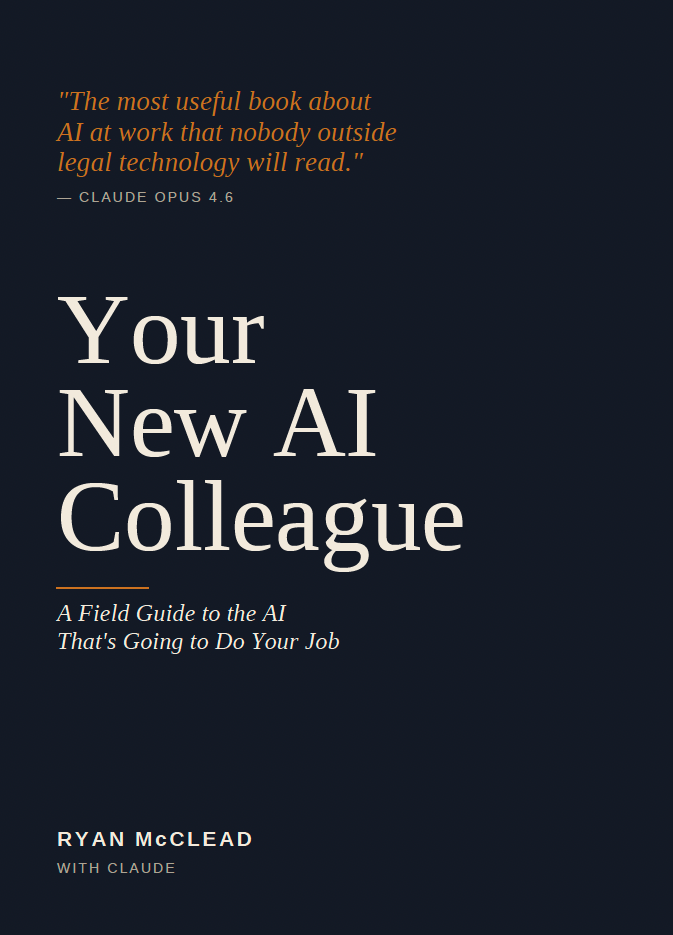
Download it as a PDF for free here.
Or purchase a printed copy here.

McClead’s process flips the traditional writing model. Instead of staring at a blank page, he asked Claude to generate an outline and draft, then spent weeks shaping, cutting, challenging, and refining the work. The book became a study in collaboration, with McClead serving as author, editor, supervisor, and occasional bouncer when the AI wandered too far from the point. His description of training Claude toward his voice, “more Anthony Bourdain and less Bobby Flay,” gives the episode one of its best lines and one of its most useful lessons.

A central idea from the conversation is “executable knowledge.” McClead argues knowledge management teams need to think beyond content meant for humans to find and read. The next stage is knowledge structured, so AI agents understand when to use it, how to apply it, and how to turn it into repeatable workflows. For law firms, this raises practical questions around scale, security, permissions, data quality, and governance. It also creates a new role for KM and innovation teams as builders of reusable legal intelligence.

The discussion also moves past prompt engineering as the main AI skill. McClead describes a shift from prompting to delegation, where users set goals, provide context, invite clarifying questions, and supervise the work product. The human role does not shrink in this model. It becomes more focused on judgment, direction, taste, and knowing when to take the work away from the AI before endless iteration turns progress into mush.

By the end of the episode, McClead frames AI agents less as replacements and more as strange new colleagues whose usefulness depends on the expertise of the person directing them. Good lawyers, KM professionals, and innovation leaders get faster and more effective. Poor processes get accelerated too, which is where the danger sits. For legal organizations, the message is clear: start small, learn the tool, build guardrails, and prepare for a future where clients ask not only for legal answers, but for legal workflows they can run.

Listen on mobile platforms:  ⁠⁠⁠⁠⁠⁠⁠⁠⁠⁠⁠⁠⁠⁠Apple Podcasts⁠⁠⁠⁠⁠⁠⁠⁠⁠⁠⁠⁠⁠⁠ |  ⁠⁠⁠⁠⁠⁠⁠⁠⁠⁠⁠⁠⁠⁠Spotify⁠⁠⁠⁠⁠⁠⁠⁠⁠⁠⁠⁠⁠⁠ | ⁠⁠⁠⁠⁠⁠⁠⁠⁠⁠⁠⁠⁠YouTube⁠⁠⁠⁠⁠⁠⁠⁠⁠⁠ | Substack

[Special Thanks to Legal Technology Hub for their sponsoring this episode.]

⁠⁠⁠⁠⁠Email: geekinreviewpodcast@gmail.com
Music: ⁠⁠⁠⁠⁠⁠⁠⁠⁠⁠⁠⁠⁠⁠⁠⁠⁠⁠Jerry David DeCicca⁠⁠⁠⁠⁠⁠⁠⁠⁠

Transcript:

Continue Reading Ryan McClead on Writing With Claude and What AI Agents Mean for Legal Work
This week, we sit down with two guests from Anthropic, Matt Samuels, Senior Product Counsel, and Den Delimarsky, a core maintainer of the Model Context Protocol, or MCP. Together, they unpack why MCP is drawing so much attention across the legal industry and why some are calling it the USB-C for AI. For law firms long burdened by disconnected systems, scattered data, and the infamous integration tax, MCP offers a shared framework for connecting models to the places where real work and real knowledge live, from iManage and Slack to email, data lakes, and internal tools.

Den explains that the promise of MCP is not tied to one model or one vendor. Instead, it creates a standardized way for AI tools to securely interact with many different systems without forcing organizations to build one-off integrations every time they want to connect a new source. The conversation gets especially relevant for legal listeners when Greg and Marlene press on issues like permissions, ethical walls, least-privilege access, and auditability. The answer from Anthropic is reassuring. MCP is built to work with familiar enterprise security concepts such as OAuth and role-based access, meaning firms do not have to throw out their security model in order to explore new AI workflows.

Matt brings the legal and operational lens, translating MCP into practical use cases for lawyers, legal ops teams, and security leaders. He describes how AI becomes far more useful once it has access to the systems lawyers already rely on every day, while still operating within carefully defined administrative controls. The discussion highlights a key shift in how firms should think about AI. This is no longer about asking a chatbot a clever question and getting a polished paragraph back. With MCP, firms are moving toward systems where AI can retrieve, correlate, summarize, draft, and support actions across multiple platforms, all while staying inside the guardrails set by the organization.

The episode also explores how MCP fits into the rise of agentic workflows, apps, plugins, and skills. Rather than treating AI as a static assistant, Anthropic describes a future where these tools become active participants in legal work, pulling together information from multiple sources, helping assemble case timelines, drafting notes into a shared document, and supporting lawyers in a far more integrated workspace. The conversation around skills is especially useful for firms thinking about standard operating procedures, preferred drafting styles, escalation rules, and repeatable work product. Skills and MCP do different jobs, but together they start to look like the operating system for structured legal workflows.

By the end of the conversation, one message comes through clearly. The legal profession is still early in this shift, but the pace is picking up fast. Both Matt and Den encourage listeners to stop treating these tools like abstract future concepts and start experimenting with them now. At the same time, they offer an important note of caution. As much as these systems promise speed and efficiency, lawyers still need to protect the craft of lawyering, their judgment, and the human choices that matter most. For firms trying to make sense of where AI is headed next, this episode offers a grounded and practical look at the infrastructure layer that could shape what comes next.

Listen on mobile platforms:  ⁠⁠⁠⁠⁠⁠⁠⁠⁠⁠⁠⁠⁠⁠Apple Podcasts⁠⁠⁠⁠⁠⁠⁠⁠⁠⁠⁠⁠⁠⁠ |  ⁠⁠⁠⁠⁠⁠⁠⁠⁠⁠⁠⁠⁠⁠Spotify⁠⁠⁠⁠⁠⁠⁠⁠⁠⁠⁠⁠⁠⁠ | ⁠⁠⁠⁠⁠⁠⁠⁠⁠⁠⁠⁠⁠YouTube⁠⁠⁠⁠⁠⁠⁠⁠⁠⁠ | Substack

[Special Thanks to Legal Technology Hub for their sponsoring this episode.]

⁠⁠⁠⁠⁠Email: geekinreviewpodcast@gmail.com
Music⁠⁠⁠⁠⁠⁠⁠⁠⁠⁠⁠⁠⁠⁠⁠⁠⁠Jerry David DeCicca⁠⁠⁠⁠⁠⁠⁠⁠⁠
Transcript

Continue Reading Anthropic’s Matt Samuels and Den Delimarsky – Claude & MCP: Building the USB-C for the Legal Tech Stack