
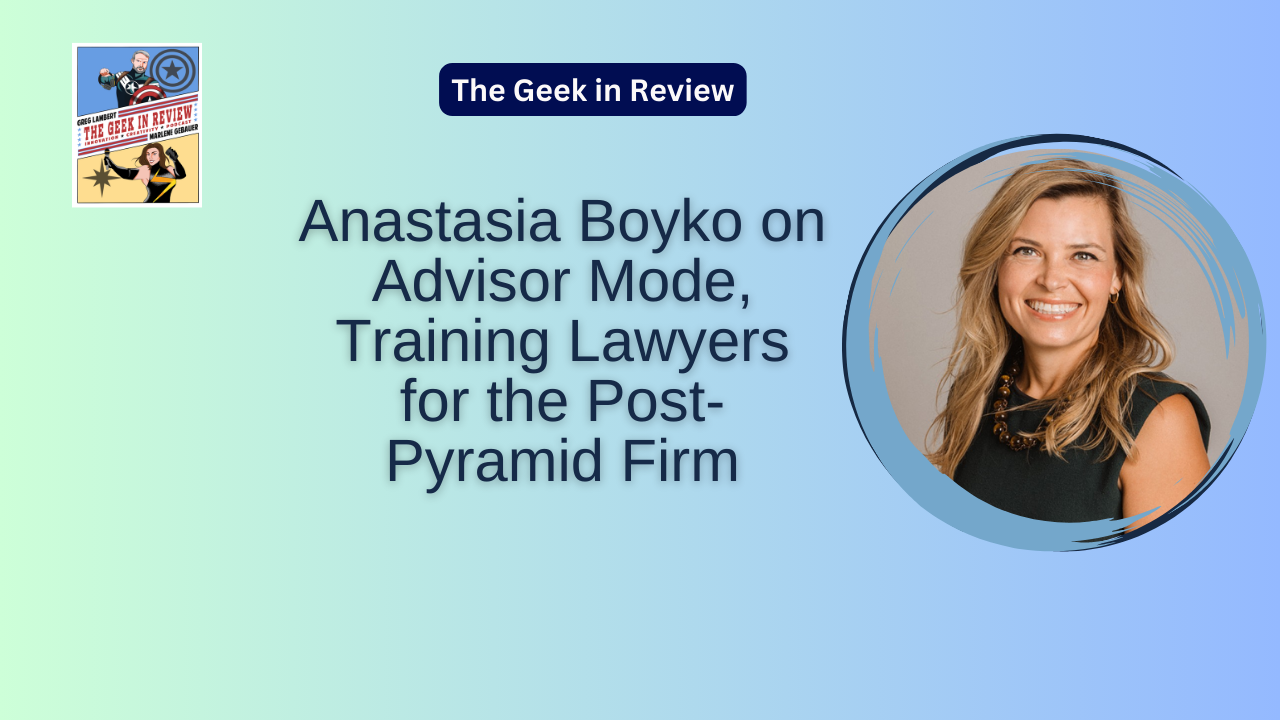
Anastasia Boyko joins us this week for a wide-angle conversation about AI adoption, leadership, and the uncomfortable truth behind “we are watching what peer firms do.” A Yale-trained tax lawyer with experience spanning Axiom, legal education, and innovation leadership, Boyko argues that precedent-driven instincts are turning into a liability when the underlying rules of the market are shifting in real time.
The episode opens with lessons from the Women + AI 2.0 Summit at Vanderbilt and the “AI competence penalty” narrative. Boyko’s central principle for law firm leaders is simple, stop copying the competition and start operating with intention. Strategic planning matters more than tool shopping, especially when uncertainty makes leaders freeze, over-index on fear, or chase noise instead of outcomes.
From there, the conversation sharpens into client reality. Boyko shares what she is hearing from in-house leaders, and it is not comforting for firms. Legal departments are working to reduce dependence on outside counsel, business partners inside companies often accept “good enough,” and the models keep improving. The risk is not losing to a peer firm; it is losing the client relationship because the work stops feeling necessary.
A major theme is talent and the apprenticeship gap. Boyko argues firms underinvest in people, even as they spend aggressively on software stacks. AI can help junior lawyers with coaching and confidence, but it does not replace mentorship, judgment-building, or context. The skills that matter now include client advisory, operational thinking, critical judgment, and the ability to solve problems across a complex system, not only perform discrete tasks in a vacuum.
The episode closes on legal education and the future value of the JD. Boyko urges students to be selfish about learning AI, especially when faculty guidance comes from avoidance or philosophy rather than experimentation. Looking ahead, she predicts the JD’s value shifts upward, away from rote production and toward proactive advisory work, relationships, anticipatory counsel, and wisdom-driven judgment. In other words, fewer fire drills, more looking around corners.
Links:
Listen on mobile platforms: Apple Podcasts | Spotify | YouTube | Substack
[Special Thanks to Legal Technology Hub for their sponsoring this episode.]
Email: geekinreviewpodcast@gmail.com
Music: Jerry David DeCicca
Transcript:
Marlene Gebauer (00:00)
Hi, I’m Marlene Gabauer from The Geek in Review and I have Nikki Shaver at Legal Technology Hub. Nikki, you’re going to tell us about your portfolio management feature, right?
Nikki (00:10)
That’s right, Marlene, it’s a brand new feature. So…
Since 2023, especially, the legal tech market has ballooned in size and complexity. I wonder why. As you know, Marlene, the number of startups entering the market continues to grow at a very consistent pace. From our tracking metrics, we know it’s growing at about 100 new startups a quarter, with a total number of solutions in legal tech now numbering well above 3,000 globally. So it used to be the case that law firms would have a dedicated resource
in their innovation or IT departments whose job was at least partly devoted to tracking the market, mapping new startups, reviewing this against the firm’s own existing portfolio and project goals. But that doesn’t really make sense anymore. Internal teams are already so busy on their own projects and we have a dedicated team that does exactly this. Legal Tech Hub has been dedicated to doing this for over five years now and our new portfolio management feature is
designed to make it easier than ever for buyers to use Legal Tech Hub’s data to manage their own portfolio of legal technology solutions. It allows you to select the solutions in your current tech stack from across the Legal Tech Hub directory and add them to your portfolio management tab which is in your account on Legal Tech Hub. You can also add solutions you’re interested in watching and those you’ve looked at or reviewed
but decided not to proceed with. You can easily move solutions between those categories and add notes like, waiting until this product is SOC 2 certified. Once you add a solution to any of those categories in your portfolio, a bonus is that you will also be notified if the vendor adds an announcement to their listing like, we just got SOC 2 certified. So this feature will make it even easier for firms to manage their tech stack against the market and we’re really excited about it.
Marlene Gebauer (02:14)
Yeah, that sounds like a wonderful tool for very busy professionals trying to keep track of all the changes that are happening in the industry. So thank you.
Nikki (02:24)
Thanks Marlene, we certainly hope so.
Marlene Gebauer (02:31)
Welcome to The Geek in Review, the podcast focused on innovative and creative ideas in the legal industry. I’m Marlene Gabauer.
Greg Lambert (02:38)
And I’m Greg Lambert and this week we are thrilled to welcome someone who’s been a dear friend of mine for many, many years and has, I love how she describes her career path as a.
She has Goldilocks her way through her career here, having tried multiple roles to find exactly what it is that helps her drive change in our profession. And we were talking before, she’s been in academia, she’s been in ⁓ ALSP, she’s been in law firms, she’s been everything. ⁓
Marlene Gebauer (02:53)
You
Done it all. She’s done it all.
Anastasia Boyko, mean, as you said, she has an incredible background. So she’s, she’s a Yale trained tax lawyer. ⁓ she’s managed alternative legal talent at Axiom. She’s served as the inaugural Dean of the Psy Leadership Program at Yale Law School and recently, ⁓ operated as the chief innovation officer at the University of Utah’s S.J. Quinney College of Law.
Greg Lambert (03:15)
Yeah.
Yeah, that just ⁓ scratches the surface here. Anastasia is a legal futurist, ⁓ lawyer sherpa, and is the host of the PLI podcast on how to navigate law school. So Anastasia, thank you very much for being here. It’s good to see you.
Marlene Gebauer (03:37)
I don’t know, we couldn’t fit everything.
Anastasia Boyko (03:53)
Thanks for having me. Podcasters
interviewing podcasters, my favorite.
Greg Lambert (03:57)
It’s very meta.
Marlene Gebauer (04:01)
So Anastasia, like we recently attend, you and I recently attended the, the women plus AI 2.0 summit at Vanderbilt. And you know, one of, one of the core focuses was the trap. the narrative that, you know, women use AI less than men resulting in an AI competence penalty. now we did have breakout groups and, and, the great, the breakout group that you attended, ⁓ basically came up with principles,
in regard to this. so, you you took the initiative to synthesize those from our MaxiSpark session and share them. So for like law firm leaders listening, you know, what’s the most vital principle that emerged from that session? And, you know, how can they actually actualize this on Monday morning so that AI adoption doesn’t exacerbate structural inequalities?
Anastasia Boyko (04:55)
Yeah, I mean, great question. That conference was really, I think, life-changing, which is weird to say, for those of us who attend lots of conferences. I think it was the right group of people. I think it was organized very well. And I think we were discussing the most important parts.
Marlene Gebauer (05:04)
Mm-hmm.
Anastasia Boyko (05:12)
And when I was reflecting on the session that you facilitated, as well as the session that Heidi Brown and I did on how to reimagine the workplace, last night I was thinking about this, and I think a lot of it for law firms is sort of stop doing what everybody else is doing, right? Like that’s the operating principle for many law firms is like. And I understand it, right? A lot.
Greg Lambert (05:30)
now. Sorry, sorry, that’s all we know. That’s all we know what to do.
Marlene Gebauer (05:34)
What’s the competition
doing?
Anastasia Boyko (05:37)
No, but a lot
of our habits are precedent-based, right? We’re trained this way in law school. So not only are we trained to think this way in analysis, but we’re trained to operate this way in our organizations. And I was reflecting on this ⁓ last night, precisely about that, right? Like, why do we keep wanting to do what somebody else is doing in a world where all of the rules are changing? It’s all uncertain right now.
Right, but we still wanna keep going back to the old principles of how law firms run, how law firms make money, how they grow. And that’s just not true. Like the last three years have shown us a great deal of disruption in the old ways of doing things. And so I think my big takeaway from that conference is we really gotta get out of that mindset of how have we always done it before? Who else is doing it that way? And so I think the better operating principle is
What do you wanna do with your firm, right? Like what is the actual future of your firm? What do you want to be doing for your clients? And then structure the activities along that path. And that might be an operational change or that might be a technological change and that could be an AI automation or an upgrade, but really you need to have intention. You need to be deliberate about where it is that you’re going with your firm versus being reactive and operating out of fear.
which is what I think a lot of law firms are doing right now.
Greg Lambert (07:05)
But we love to race for second place, so we like to see what others are doing and then quickly be a fast follower behind that. And it’s, you know, to borrow the old saying, you know, how can you tell millionaires are doing something wrong? You know, just I think how do you approach this to say, hey, look, right now is the absolute best time to get outside your comfort zone and try something new.
Anastasia Boyko (07:32)
Yeah,
I I think that’s that’s part of it. But I think a lot of it is we don’t do really good strategic planning in the law firm setting, right? Like some firms may do it better than others, but we’re not looking out three years. We’re not being necessarily disciplined about the strategies that we’ve committed to. People change directions constantly depending on, again, fear. ⁓ And so I think a lot of this is figuring out how to get out of that mindset and get into a much more strategic
planning one around what you and your firm want to do, including the talent that you’re hiring, right? Like firms are doing the same thing with innovation as they’re hiring into their orgs. What did this person do for a few years at my peer firm? Well, what does that have to do with what your firm wants to do, right? And I think I take your point very valid, right? Like people don’t necessarily feel the pain just yet. I think that’s why there’s been a reticence in the speed of adoption.
You know, as someone who has been in all of these communities at once, right? I have this very weird everything everywhere, all at once kind of mindset when I look at legal. The things I’m hearing from in-house leads terrify me if I was a law firm leader. And they’re not paying enough attention, right? They’ll pick up a few of them and a few articles here and there. But I’m like, your customer is trying very hard to eliminate their dependence on you.
Like that should scare you. They also probably don’t like you that much, right? They’re coming to you out of necessity. No, my friend always says this and it just hits me over the head each and every time. How often are your clients inviting you to play golf, right? Or inviting you to spend time? Like how good are your relationships really? Or are they coming to you and paying your fees because they have to? And when someone is doing that out of necessity, they’re gonna figure out some way to not do it.
Greg Lambert (09:02)
Hahaha
Anastasia Boyko (09:26)
out of necessity when their business teams are pushing them to eliminate that with tools that currently can get them to do that internally, right? So that coupled with clients who aren’t lawyers in legal departments who are comfortable with good enough from what they’re getting from the models and it keeps getting better, like the cliff is coming. And so I don’t wanna operate, don’t wanna get, don’t wanna try to take advantage of that fear, but it’s a very realistic fear. That fear should be happening for you.
when you’re making decisions. Not am I getting left behind with my competition, but are my clients gonna leave me very soon?
Marlene Gebauer (10:01)
Yeah, cause it’s like, keep saying it’s like relationships, relationships, relationships. Like, you know, it’s, it’s really about that because the technology is, just getting that good. you know, I also wonder like how much of this sort of indecision is like the noise, all of the noise that’s, that’s in the market, you know, this from a strategic standpoint, you know, there’s investments of, you know, hundreds of thousands of millions of dollars and, and like, this is all very new for, for most people and
Greg Lambert (10:02)
Bye.
Anastasia Boyko (10:04)
Yes.
Marlene Gebauer (10:32)
Making that wrong step could, could be, you know, it’s seriously problematic. And I think, you know, you have that leadership where it’s just like, is fear, but. You know, is the noise contributing to that and kind of how do they, how can they kind of like block that out?
Anastasia Boyko (10:49)
Yeah, I think there’s a lot of fear around uncertainty. So we don’t do a good job of making decisions in a time of uncertainty. And right now we’re operating by soon to be new principles, right? So we’re watching the old principles go away, the new principles are forming. And so we’re in this really strange time. I ⁓ was doing a guest lecture at Penn Law yesterday and we were talking about access to justice and technology in the future. And the students asked such great questions, right? They were pointing out all of this uncertainty.
all of these issues about access to justice and AI and the challenges there. And I said, yes, right? All of that is true. And you need to figure out how to operate in uncertainty. As the bridge is falling behind you, as you’re running across it, you need to be laser focused on where you’re going, right? Like what is your intentional destination? And then what can you do in the current moment with the ground that is stable underneath you? And these are the same kinds of skills that we developed during
Like I remember organizing a salon of VIPs of our alumni at Yale and talking about decision making in times of uncertainty. Like these were moguls who had been able to build incredible ⁓ businesses and initiatives and they didn’t know what to do, right? There was no playbook during COVID. And so everyone was on equal playing field except.
people who sort of knew how to deal with uncertainty. Like this is why we keep going back to this emotional intelligence. Like you need to build the muscle around how do I deal with situations where I can’t predict what’s going to happen. So people who can get intentional, who can understand the principles by which they want to operate, who know how to treat talent well, who know how to make decisions around like, hey, I’m gonna use my best guess that this is the technology we need because we’ve sat down and figured out what our organization needs.
first, right? And then we’re going to make decisions from that. We might make a mistake. We make mistakes all the time. We hire the wrong people. We use the wrong software. We have to go back, right? Like this isn’t new to us to make mistakes, but fear of making mistakes and not acting from that fear, I think is much more dangerous than trying something out and be like, all right, well, that didn’t work. Let’s try something better. We learned.
Greg Lambert (13:01)
Now I was listening to…
Nate Jones this morning as I was coming into work and he was talking about something I think that runs kind of parallel to what you’re saying is that we’ve gone through these engineering tasks, these technology kind of tasks of bringing in the AI, of the individual level of prompt engineering and then the more wider content engineering that you hear a lot of now. ⁓ But he was saying that
But it’s really about intent and it has to be intent on the organizational level of where are we going, how are we, and it’s, know, saying AI is not an IT issue, it’s an organizational issue and if you don’t think of it as an organizational issue and have that intent and you’re allowing everyone to understand where is it that we’re going,
that it doesn’t matter how much you have AI on your desktop or in your processes, if it’s not coordinated, if it’s not intentional, it’s just not going to work.
Anastasia Boyko (14:16)
Yeah, I think
a lot in systems, right? I’m obsessed about how systems work and how different pieces fit together. And I go back to a lesson I got in college in dysfunctional psychology. And when you’re looking at dysfunctional psychology and dysfunctional social family psychology, you can’t just fix the person, right? Like you have to fix the entire system. And whenever I read AI posts on LinkedIn or somebody’s Substack, I just think like, you’re still stuck in this little rabbit hole of this piece of the system.
And you’re not realizing that all of it is happening all at once, right? Like everything is changing all at once. You have to think about all of the levers all at once. And I think that’s why I love the pieces that you’re doing right now, Greg, because they feel contextual, right? They’re actually looking at a story and a system and how does this fit into a fictionalized firm? And that’s the conversation that we need to be having. Lawyers don’t want to have that conversation, right? We’re in many ways word surgeons.
We come in, we slice this piece, we slice that piece, but the organization or the individual client is a whole person. It’s a human or it’s a big company. We need to think in that sense in the way that we’re trying to find solutions for our clients and our organizations right now. The surgical approach is not working. It sounds really smart, super smart, love it, but you’re very much doing the same.
mistake that many academics make, which is they get very, very narrow and they’re writing to an audience of 12. And they don’t necessarily apply their brilliant ideas, which are brilliant, right, to the bigger system. How does this fix the bigger problem that I’m trying to solve for? And so that’s why I always keep encouraging lawyers, get out of this mindset of what tool do I need? What problem are you solving?
Greg Lambert (16:07)
Yeah, yeah. Well, and I think that’s… ⁓
You’ve mentioned a few things, human in the loop, emotional intelligence, what problem are you solving? ⁓ And right now we’re really kind of thinking of things and what can we throw AI at? What can AI be first? What can be automated? But maybe take a step back here and what do you think that, do you think law firms are investing enough in the humans compared to the software stack?
What is it that you think we just can’t automate?
Anastasia Boyko (16:44)
⁓ No, we’re
not investing in the humans. I remember being an associate and I remember being fully neglected on every single ⁓ level of how you evaluate talent management and talent investment, right? Like it’s the borderline of abuse in many environments. It’s solved. AI will help you.
Greg Lambert (16:59)
Yeah, but we’re throwing AI at that now, so that problem’s fixed. Yeah.
Marlene Gebauer (17:02)
Hahaha.
Anastasia Boyko (17:04)
coach your
associates, right? And there is a piece of that, right? There’s a piece when you’re super lonely and you’re trying to figure something out and you don’t feel confident to go ask a senior lawyer, that AI can help coach you through that. But that doesn’t mean that lawyers should be derelict in their duty to develop and lift up generations after generations, right? And we keep doing it. I saw this when I was on the professional development side at Practical Law, right? I was dealing with all of the AmLaw 200.
I was talking to smaller firms, I was talking to in-house departments. There’s this large gap between leaving law school and then learning how to be a lawyer. And it’s very much a Hunger Games exercise, right? Good luck, I hope you get a good mentor. Otherwise, it’s really your fault that you failed, even though we set you up to fail. And so I think AI bridges some of that gap, but not the entire gap. And especially right now when we realize that the skills needed
to be a good lawyer are no longer those rote skills that AI can now automate. They’re the people skills. They’re the operational skills. They’re the client skills. They’re how do you like critical thinking, judgment, how do you solve a complex matrix problem for your client, which is totally opposite of how we’ve trained associates before, which is here’s a discrete problem, go solve it. No, I won’t explain to you how it fits into the bigger picture. And so again, AI can solve.
that piece, but only for associates who are curious about it. And so the gap needs to be solved both by professional staff who can sort of lean into that and help contextualize that for students and young lawyers, but it also is necessary to have partner involvement. And I understand everyone is busy. We are all busy. We’re all professionals. So like my favorite wasn’t somebody’s, well, I’m very busy. ⁓
Well, I’ve been lounging around doing nothing, right? Like everyone is busy in our own ways of the tasks that are there, but we need to come together and sort of look at the entire flow of it to assign responsibility. And I think the challenge in the current commercial model of the law firm is it allows many senior lawyers to abdicate their duty as mentors, right? And stewards of their firms. And so part of this is,
Lawyers have to have that kind of moment where they look in the mirror and realize, I need to do more because frankly, it actually will make my practice better. You will have more ready people to help you. You will be able to delegate to more people and it won’t be constant running around and busy work. And also, PS, you’ve got agency. I know this is a hard one, but you can decide what to say yes to and what to say no to. It doesn’t feel that way when you’re in the environment of a firm.
but you are a highly trained professional with a lot of skills and then you can decide how to allocate your time to different things.
Greg Lambert (20:01)
Amen. ⁓
Anastasia Boyko (20:05)
And again, look, understand. we’re done. We’re done. We solved it all. We solved it all. No, and I understand it’s hard work. Like, again, I understand it’s hard work. We have a really complex system based on control and codependency and perfectionism. And it’s very hard to get rid of those mindsets in an organization full of those people and full of pressure from clients. But again, you learned how to do law. You can learn organizational management.
Marlene Gebauer (20:05)
All right, that’s it. got, wait, that’s the end. We solved it all.
Anastasia Boyko (20:32)
and all of the rules are changing. So again, you can decide what those rules should be. What does a humane workplace look like that trains lawyers for the future? How are you gonna pass your practice on? How are you gonna make sure your clients are taken care of? Right, like that one, yeah, that topic that’s always at a bar association event. Yeah, exactly, right? So again, there are so many resources within your own firm that I think it begs,
Marlene Gebauer (20:47)
SS session planning. Like what’s that?
Greg Lambert (20:51)
How
do you spell that?
Anastasia Boyko (21:01)
the question for everyone inside of a law firm to ask, how do we do this better in a systemic way? Right? Do I have senior lawyers who have lots of knowledge who would love to be involved in these efforts? How do I involve them to help mentor young lawyers and also learn the technology? Just because they’re at end of their practice doesn’t mean that they’re not curious.
Marlene Gebauer (21:24)
want to dig into this a little bit more, ⁓ about what, you know, the more senior people should and could be doing, ⁓ you know, what the, the juniors can be doing and sort of how AI ties into this. So, you know, we look at so many times I see this, it’s like, it’s, it’s AI has looked at like, you know, this is, it just creates faster horses for, for billing efficiency. And.
Greg Lambert (21:40)
you
Marlene Gebauer (21:49)
You know, that in itself, I think is a stressor for, you know, people who have billable practices, but, you know, can AI be a tool for, ⁓ you know, for junior wellbeing or for these, you know, can it, can it be seen as sort of a way to update your practice, you know, in a way that maybe there’s, there’s sort of less stress that way. you know, if we don’t have an apprenticeship model.
Or we have a revised apprenticeship model and there goes Greg, bye. He doesn’t like what I’m saying. So, you know, if we, if we have, you do we need to modify that apprenticeship model? And again, if, if partners are needed more in terms of being involved, you know, if we use AI to maybe re swizzle, like how, you know, how, how, you know,
Anastasia Boyko (22:25)
No.
Marlene Gebauer (22:50)
whether there’s unbillable time or not, how do we make that happen? How do we get, how do we get partners comfortable with the fact that you could bill a different way, still make money, and then you have time to sort of do this ⁓ operational work?
Anastasia Boyko (23:07)
100%, right? This is the message that I’ve been trying to deliver for two decades. ⁓ It falls ⁓ on deaf ears often. ⁓ I think some of the urgency now, however, is the fact that that leveraged pyramid model is changing. So we’re hiring fewer associates.
Right? Clients are serious about not paying for juniors in a different way. Right? And now they can automate some of that internally as well. ⁓ And so you have to have a real discussion right now with leadership and firms about what does it look like when we’re no longer using the triangle model.
Right? How is it that we’re going to train these lawyers? And it is, it’s a very serious question. So looking at alternative talent models for different kinds of people doing different kinds of tasks. So one thing that I keep suggesting to people is not all law students want to be practicing lawyers. So what if instead of just a rotation around practice groups, you’re going to do a rotation around various roles within a firm?
Marlene Gebauer (23:44)
Mm-hmm.
Anastasia Boyko (24:12)
There are many hybrid opportunities for AI native law students, right, more and more, who want to understand the practice of law, who may want to practice, but may not want to practice, right? So you as a firm have to think about how do I create these opportunities for people who might want to be in knowledge management positions, people who might want to be the bridge between the technology and the practicing lawyers, right? So it ends up creating these hybrid
Marlene Gebauer (24:16)
more more.
Anastasia Boyko (24:39)
kinds of positions, which are very new to a firm. We love silos. We love telling people exactly what they’re doing. Stay in your lane. I remember being told, stay in my lane over and over as a junior associate when I was talking about knowledge management or not having to repeat the same memo over and over or business development opportunities, right? Like stay in your lane. This is not the time to stay in your lane. This is actually a time to rethink people’s different talents and skills and where to put them in your firm.
You’re going to need fewer lawyers to do the traditional lawyer tasks, especially as we figure out what those tasks are going to be in the future. Again, you’re in this change moment, which means you have a lot of opportunity to experiment. This is when you should be experimenting, is when everything is transitioning to the new way of things. So yeah, so bring in junior associates and see if they’re interested in doing some things with your innovation group or with your KM group.
or thinking about how this fits into professional development, ask them how they want to learn. You know, many of them have had to adapt from Zoom school to AI and through that particular ladder, let them help you figure out how this training should go because the old way has some merit, but it currently doesn’t fully apply to what we’re trying to do. And so that’s where I’d like more and more firms to think broadly about
their talent pool beyond professional staff with very specific tasks and lanes, and then practicing lawyers with very specific tasks and lanes, that should begin to come together. And frankly, it makes for better client service when your lawyers understand how your clients operate, but also how the technology works and then opportunities to be able to come together with your clients, teach them some of these things, share how you’re using these tools to deliver better.
client service, back to relationships, right? Like how do I make this relationship better? I show that I’m leveling up, that I care about you, that I care about delivering a better product.
Marlene Gebauer (26:46)
It will be very interesting to see how firms kind of, know, what direction they move in with this. Cause you know, as you said, it’s, it’s, you know, it’s very, it’s, think it’s, very hard for, for many to kind of wrap their heads around that very fluid type of, of model that you’re, you’re talking about. ⁓ you know, people, people like to know what they know. And, and it is, it is very much a mindset shift. You know, you just gotta be able to, to, you know, be okay with that. And.
Anastasia Boyko (27:05)
But it’s a mindset shift, right? It’s a mindset shift.
I would also encourage folks to see what other kinds of firms are doing. I know as lawyers, we love being a little bit snobby about, well, my peer firm isn’t doing this, so I’m not going to do it. Or my firm is bigger and more complex, and I would never do it that way. ⁓
Little humility goes a long way. And so we talked about this earlier, but what are smaller firms doing? What are solo firms doing? What are plaintiffs firms doing? There’s so much innovation happening across the ecosystem that for especially big firms, especially AMLA firms to only focus on what other AMLA firms are doing, you’re missing the opportunity, right? Like you’re trying to get your creative juices flowing. What does this firm do?
How does it solve for something that I also have a problem around? How can I take this learning and apply it to my firm with my scale and my intentional objective, right? Like get excited, start learning and see if there’s a solution out there in a context that maybe you didn’t think was relevant to you because of the nature of your firm. It’s all ideas.
It’s all learning and we forget that. You can apply it in various ways and use that really talented brain you have that you use for your clients for your own firm.
Marlene Gebauer (28:28)
Yeah. And look, you know, look outside your, your little sphere and, and, know, other organizations that are, either kind of have to adapt or that are just doing it and just sort of see if that’s something that you can use. ⁓ okay. So you’ve built the Psy Leadership Program at Yale and now you’re hosting PLI’s how to navigate law school podcast, ⁓ to kind of decompress the unwritten rules of, of legal education.
Anastasia Boyko (28:42)
Yeah.
Marlene Gebauer (28:57)
you’ve noted that law schools, know, still many law schools still rely heavily on the 1970s teaching methods that, know, kind of, well, honestly failed to prepare lawyers for AI driven future. had, and we had like four people on from maybe a couple months ago, from law firm libraries and got a real mix in terms of whether they were even allowing students to use generative AI. And again, the decisions were.
to not to were based on fear. So what’s the single most damaging ⁓ rule that law students are internalizing ⁓ given this? it’s going to prevent them from being more agile and more empathetic practitioners when they do enter firm life.
Anastasia Boyko (29:45)
⁓ I’m sure I’ll get flack for this, but ⁓ don’t follow what your faculty are telling you around this for the most part. If there are people who don’t experiment with AI, who aren’t trying to understand it, and they’re telling you what to do regarding AI, they’re probably not the right person, right? They’re not the right voice if they’re not willing to try to.
understand it. And so I think a lot of academics approach this from a philosophical lens. Many of them approach it from a this is too dangerous lens. Unfortunately, Pandora’s box is open. So it’s not going to get closed. And we have to figure out how to engage with this. And so your school might have someone who’s leading some sort of lab or innovation center or entrepreneurship center. Try to pursue that.
See if there’s something like that that exists on the main campus if you’re associated with a larger university. Look at what other law schools are doing. There are incredible examples from Suffolk to Vanderbilt ⁓ where there’s initiative and there’s information online about those learnings and maybe even opportunities to listen to lectures. So get really selfish around your own education and don’t decide that what your professors say is the word.
I think that part of the struggle of law school, ⁓ I struggled with this, I hear it over and over from law students, is that you are sort of ⁓ forced into this mold. You think broadly and deeply and ⁓ you’re curious before you come to law school and then you come to law school and you’re taught to think one way. And that one way is how your faculty is telling you to think. And then you’re made to feel…
naive or sometimes even stupid for thinking a different way, right? And so I encourage students, you know, don’t lose yourself in the process when you’re trying to be convinced to think one way, ⁓ especially right now where there’s so much information out there and so many thoughtful people talking about these issues. ⁓ It is incumbent upon you to understand these tools. And there are a lot of really smart people thinking out loud.
Greg Lambert (31:52)
you
Anastasia Boyko (31:58)
across law schools about how to do this well. Follow those people, right? Continue to be inspired, even if the people at your law school may not be as imaginative ⁓ as you hope that they were, right? So I do think, I think the biggest struggle in law school is just following the way that like the bigger group think that faculty tend to entrench inside of traditional law school models, especially people who aren’t engaged.
with these tools.
Marlene Gebauer (32:28)
Yeah.
And if you’re in, if you are a student and you’re in a situation like that, I mean, there’s so many free resources out there to be able to sort of try this and experiment with it. And, you know, I’ll tell you, mean, firms, firms are expecting incoming lawyers to, to know these things. You know, I think they’re kind of depending on it quite honestly. So, you know, you, is really imperative that, you know, just
Get out there and try it, like, just try it.
Anastasia Boyko (33:00)
There’s also an opportunity for vendors. And I’ve said this over and over again, for vendors and for law firms to create that bridge, because many schools don’t have the resources or the knowledge to create this kind of training. And so there are a lot of very smart vendors out there who said, we’ll shortcut this, right? Like we’ll offer this to law schools if they want it. If they don’t want it, we’ll offer it to students and they can directly get it. And so play that bridge. Play that bridge if you are someone who has a really good…
Marlene Gebauer (33:03)
Mm-hmm.
Anastasia Boyko (33:28)
resource and you want law student feedback, there are lots of groups of very excited law students who want to learn these things and you don’t have to go through the administrative machine to get them engaged or get their feedback on something. It also behooves law firms to do this. It behooves them to do workshops on AI because it signals to students that they are thinking about this and practicing what they preach.
And it also gets them students who are excited about what they’re excited about as a recruiting pipeline, right? Like this is, it’s a mirroring kind of signaling device. And so when you’re spending millions of dollars on recruiting efforts, wouldn’t you want to be more deliberate in finding people who share your values and share how you think about innovation directly in law school? Like I would think so.
Marlene Gebauer (34:19)
So, ⁓ before we get to the crystal ball question, ⁓ we’d like to know what kind of resources that you rely on to keep up with all the rapid changes, you know, in legal tech and AI and the business of law and all the things we’ve been talking about.
Anastasia Boyko (34:35)
So yes, I have a few things I check regularly. ⁓ I obviously geek and review. ⁓ And I love this podcast. I love Jen Leonard and Bridget McCormack’s podcast for PLI, like very practical. ⁓ I love everything that comes out of Bob Ambrogy. So law sites, ⁓ I love artificial lawyer, right? So.
Greg Lambert (34:40)
Obviously.
Marlene Gebauer (34:48)
Mm-hmm.
Anastasia Boyko (34:56)
I spend a lot of time on LinkedIn. I joke with people. It’s like my sim, right? Like I live in the world of LinkedIn. So there are a lot of really interesting people talking about these concepts there. But those blogs as well as those two podcasts are sort of my core. But yeah, like I would encourage law students and lawyers who don’t spend much time on LinkedIn to start finding the people who are writing about these issues.
Marlene Gebauer (35:01)
You
Anastasia Boyko (35:24)
and follow their ideas because we talked about this before, like many of us who think and live and breathe this just keep throwing out pieces of our thoughts on LinkedIn and LinkedIn is much more fun than it used to be, especially if you can find the corner of your people to engage on these ideas. And so it’s the only way really to keep up with it is to talk to other people who are playing with these things. And there are a few law firm partners who I think now have sub stacks, right?
who talk about their direct experiences with this. And so I always encourage frontline lawyers to see what other frontline lawyers are doing, that it is possible and get excited from that.
Greg Lambert (36:08)
So, Anastasia, we are now at the crystal ball question time and.
I wanted to focus in on your time as chief innovation officer at the University of ⁓ Utah. And being in Utah, it also, you know, they have the regulatory sandbox that they have allowed others to play in with the alternative legal services providers. ⁓ And you’ve noted that, you know, the current legal model is failing the public needs that we have. So pull out your crystal ball.
and look into the future, but think about your past there in Utah. And if generative AI handles this initial triage of the contextual window for the public and sandboxes allow for people that aren’t lawyers to own legal businesses, what exactly is the role and economic value of a traditional JD in, five or 10 years from now?
Anastasia Boyko (37:11)
You know, I love
this question because it gets to the root of lawyer insecurity. Many of us don’t realize just how smart we are and the kinds of skills we’ve accumulated, especially because we work around other lawyers and we’re self-deprecating and we diminish the value and the judgment that we bring to complex problems. Part of that, I think, is because the business model of lawyering has gotten us to do things that are well below our capacity.
Greg Lambert (37:16)
Yeah.
Anastasia Boyko (37:41)
Right? And the level of our intelligence. And so now that we can automate some of those rote things that frankly shouldn’t be done by a highly educated professional, you can focus on the things that should be, right? Which is client relationships, understanding how the pieces fit together with the problems that your clients are coming to you for, anticipating things that are going to happen for them, being a real advisor.
Right? And exercising the judgment and wisdom that you’ve developed from years of practice to help them navigate complex situations. Right? This is now you are the person who’s helping your clients navigate uncertainty without being in the weeds of turning document changes. Right? Or having to go through, how does this update exactly go through? Let’s write a client alert. You know, like you’re not in fire drill mode. You’re in proactive.
advisor mode. You can now think about your client’s industry, your client’s bigger problem, new and nuanced solutions that haven’t existed before. In many ways, I think it allows us to free up the true cognitive abilities for lawyers to focus on real problems and ideally, right, ideally help with the systemic problems. So many public interest lawyers are looking at access to justice and they don’t have the benefit of their private bar.
colleagues because they’re too busy in the weeds of these constantly busy problems. And we need to be together as 1.3 million lawyers in the US. We need to solve these problems together. It can’t just be a handful of lawyers who know there’s an access to justice gap that’s at 92%, know that that’s a problem, but not put their brilliant brains toward it. So back to like systemic thinking, let’s get all of the smart people in a room.
let’s get the helpers together to figure out how to allocate service provision, whether that’s paraprofessionals, whether that is AI and information that’s readily available, right? Or whether that’s a highly sophisticated lawyer who needs to manage a very complex appellate process. So all of that, it’s leveling up to use your highest and best skills, which I think are around advisory work.
anticipatory work looking around corners and the judgment from wisdom.
Greg Lambert (40:08)
And I love how you snuck fire drill mode into the conversation there. Well done. Well, Anastasia Boyko, thank you very much. It’s good to see you again. Thanks for coming in and talking with us about legal practice, well-being, education, so many more things. It’s great to talk to you.
Anastasia Boyko (40:11)
Mm-hmm. Mm-hmm. You’re welcome.
It was a treat.
Marlene Gebauer (40:26)
Thank you.
Anastasia Boyko (40:26)
Thank you.
Marlene Gebauer (40:29)
And thanks to all of you, our listeners, for taking the time to listen to the Geek in Review podcast. If you enjoyed the show, please share it with a colleague. We’d love to hear from you on LinkedIn and Substack.
Greg Lambert (40:39)
And Anastasia, I think I know what the answer is going to be, but if listeners want to learn more or reach out to you, where’s the best place for them to go?
Anastasia Boyko (40:46)
You can find my sim on LinkedIn.
Marlene Gebauer (40:48)
And as always the music here is from Jerry David DeCicca Thank you Jerry and bye everybody.
Greg Lambert (40:56)
Thanks.