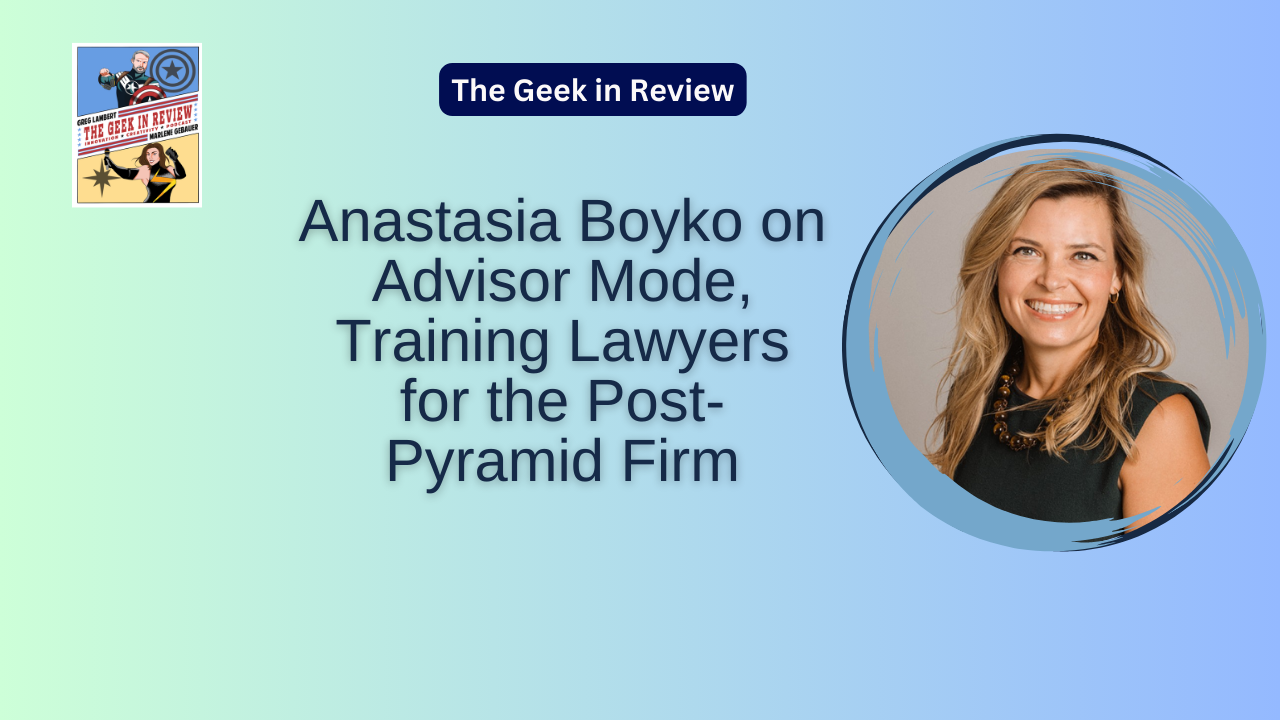
Anastasia Boyko joins us this week for a wide-angle conversation about AI adoption, leadership, and the uncomfortable truth behind “we are watching what peer firms do.” A Yale-trained tax lawyer with experience spanning Axiom, legal education, and innovation leadership, Boyko argues that precedent-driven instincts are turning into a liability when the underlying rules of the market are shifting in real time.

The episode opens with lessons from the Women + AI 2.0 Summit at Vanderbilt and the “AI competence penalty” narrative. Boyko’s central principle for law firm leaders is simple, stop copying the competition and start operating with intention. Strategic planning matters more than tool shopping, especially when uncertainty makes leaders freeze, over-index on fear, or chase noise instead of outcomes.

From there, the conversation sharpens into client reality. Boyko shares what she is hearing from in-house leaders, and it is not comforting for firms. Legal departments are working to reduce dependence on outside counsel, business partners inside companies often accept “good enough,” and the models keep improving. The risk is not losing to a peer firm; it is losing the client relationship because the work stops feeling necessary.

A major theme is talent and the apprenticeship gap. Boyko argues firms underinvest in people, even as they spend aggressively on software stacks. AI can help junior lawyers with coaching and confidence, but it does not replace mentorship, judgment-building, or context. The skills that matter now include client advisory, operational thinking, critical judgment, and the ability to solve problems across a complex system, not only perform discrete tasks in a vacuum.

The episode closes on legal education and the future value of the JD. Boyko urges students to be selfish about learning AI, especially when faculty guidance comes from avoidance or philosophy rather than experimentation. Looking ahead, she predicts the JD’s value shifts upward, away from rote production and toward proactive advisory work, relationships, anticipatory counsel, and wisdom-driven judgment. In other words, fewer fire drills, more looking around corners.

Links:

Listen on mobile platforms:  ⁠⁠⁠⁠⁠⁠⁠⁠⁠⁠⁠⁠⁠⁠Apple Podcasts⁠⁠⁠⁠⁠⁠⁠⁠⁠⁠⁠⁠⁠⁠ |  ⁠⁠⁠⁠⁠⁠⁠⁠⁠⁠⁠⁠⁠⁠Spotify⁠⁠⁠⁠⁠⁠⁠⁠⁠⁠⁠⁠⁠⁠ | ⁠⁠⁠⁠⁠⁠⁠⁠⁠⁠⁠⁠⁠YouTube⁠⁠⁠⁠⁠⁠⁠⁠⁠⁠ | Substack

[Special Thanks to Legal Technology Hub for their sponsoring this episode.]

⁠⁠⁠⁠⁠Email: geekinreviewpodcast@gmail.com
Music⁠⁠⁠⁠⁠⁠⁠⁠⁠⁠⁠⁠⁠⁠⁠⁠⁠Jerry David DeCicca⁠⁠⁠⁠⁠⁠⁠⁠⁠

Transcript:

Continue Reading Anastasia Boyko on Advisor Mode, Training Lawyers for the Post-Pyramid Firm
This week we go “talk show mode” for a special episode where Marlene recaps her trip to the Women + AI 2.0 Summit at Vanderbilt Law, hosted by Cat Moon, and shares why the event felt different from the standard conference grind, more energy, more structure, and yes, a DJ.

The summit’s core focus sits right on a tension point in the wider AI conversation. There’s a persistent narrative that women use AI less than men. Cat Moon’s framing, if it’s true, it’s a problem, and if it’s false, it’s also a problem, sets the tone for a day built around participation and peer connection. The format uses “spark” cards, mini, midi, and maxi prompts, to push attendees into small conversations, deeper reflection, and a final takeaway.

Marlene also highlights sobering research shared during the opening, including an “AI competence penalty” dynamic where identical work is judged differently depending on whether evaluators believe a man or a woman used AI. The discussion lands on why these biases matter inside legal workplaces, and what leaders and peers can do to reduce the social cost of being open about AI usage.

Interspersed throughout are short interviews with attendees and speakers. Nicole Morris (Emory) captures the day’s purpose, expanding AI knowledge, talking risks, and connecting across roles. Sabra Tomb (University of Dayton School of Law) reframes AI as a leadership amplifier, moving from day-to-day management overload toward strategy and vision. Adele Shen (Vanderbilt) offers a funny but sharp taxonomy of AI “experts,” including “technocratic oracles,” “extinction alarmists,” and “touch grass humanists,” which sparks a candid side conversation about self-promotion, authority vibes, and who becomes “the story” in AI discourse.

The episode closes with a look at how education and training can work better. Marlene and Greg lean into peer show-and-tell sessions, leadership modeling, and safe spaces, both governance-safe and learning-safe. A two-person segment from Suffolk Law (Chanal Neves McClain and Dyane O’Leary) adds a teaching twist, integrating AI tools into skills instruction without isolating “AI week” from real lawyering judgment. The final note comes from Stephanie Everett (Lawyerist) on the power of stories, and the reminder that people do not need to internalize the narrative someone else hands them.

Listen on mobile platforms:  ⁠⁠⁠⁠⁠⁠⁠⁠⁠⁠⁠⁠⁠⁠Apple Podcasts⁠⁠⁠⁠⁠⁠⁠⁠⁠⁠⁠⁠⁠⁠ |  ⁠⁠⁠⁠⁠⁠⁠⁠⁠⁠⁠⁠⁠⁠Spotify⁠⁠⁠⁠⁠⁠⁠⁠⁠⁠⁠⁠⁠⁠ | ⁠⁠⁠⁠⁠⁠⁠⁠⁠⁠⁠⁠⁠YouTube⁠⁠⁠⁠⁠⁠⁠⁠⁠⁠ | Substack

[Special Thanks to Legal Technology Hub for their sponsoring this episode.]

⁠⁠⁠⁠⁠Email: geekinreviewpodcast@gmail.com
Music⁠⁠⁠⁠⁠⁠⁠⁠⁠⁠⁠⁠⁠⁠⁠⁠⁠Jerry David DeCicca⁠⁠⁠⁠⁠⁠⁠⁠⁠

Transcript

Continue Reading Women + AI Summit, Real Talk: Leadership, Learning, and Not Letting “The Trap” Write Your Story