
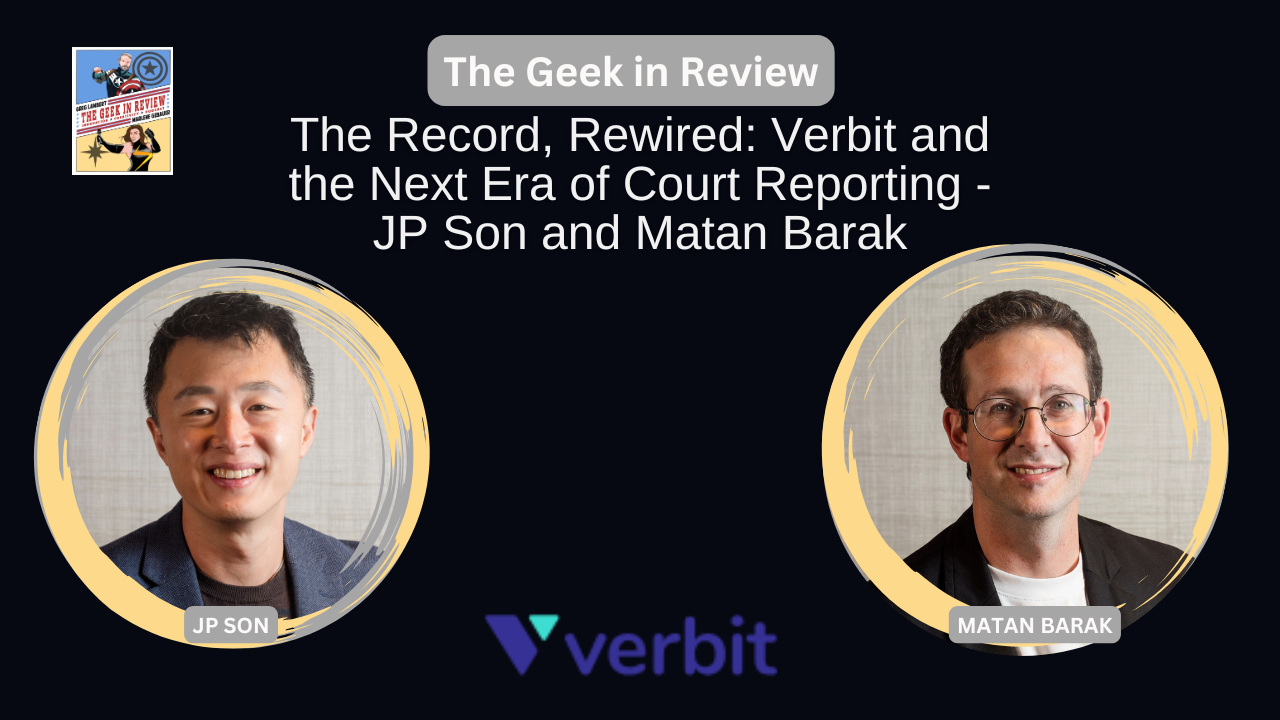
For decades, “the record” has meant one thing: a text transcript built by skilled stenographers, trusted by courts, and treated as the backbone of due process. In this episode of The Geek in Review, Marlene Gebauer and Greg Lambert sit down with JP Son, Verbit’s Chief Legal Officer, and Matan Barak, Head of Legal Product, to talk about what happens when a labor shortage, rising demand, and better speech technology collide. Verbit has been in legal work since day one, supporting court reporting agencies behind the scenes, but their latest push aims to modernize the full arc of proceedings, from depositions through courtroom workflows, with faster turnaround and more usable outputs.
A core tension sits at the center of the conversation: innovation versus legitimacy. Marlene presses on whether digital records carry the same defensibility as stenographic ones, and JP frames Verbit’s posture as support, not replacement. Verbit is not a court reporting agency; their angle is tooling that helps certified professionals and agencies produce better outcomes, including real-time workflows that once required heavy manual effort. The result is less “robots replace reporters” and more “reporters with better gear,” which feels like the only way this transition avoids an industry food fight in every courthouse hallway.
From there, the discussion shifts into the practical, lawyer-facing side: LegalVisor as a “virtual second chair.” JP describes it as distinct from the official transcript, a real-time layer built to surface insights, track progress, and support strategy while the deposition is happening. Matan adds the design story, discovery work, shadowing, and interviews to build for what second chairs are already doing, hunting inconsistencies, chasing exhibits, and keeping the outline on track. A key theme: the transcript is not going away, because lawyers still rely on it for clients, remote teammates, and quick backtracking, but the value climbs when the transcript turns into a live workspace with search, references, and outline coverage in front of you while testimony unfolds.
Accuracy and trust show up as recurring guardrails. Greg pokes at the “99 percent accurate” claims floating around the market, and Matan makes the point every litigator appreciates, the missing one percent contains the word that flips meaning. Verbit’s “human in the loop” posture and its Captivate approach focus on pushing accuracy toward the level legal settings require, including case-specific preparation by extracting names and terms from documents to tune recognition in context. The episode also tackles confidentiality head-on, with JP drawing a hard line: Verbit does not use client data to train generative models, and they keep business pipelines separate across verticals.
Finally, the crystal ball question lands where courts love to resist, changing the definition of “the record.” Marlene asks whether the future record becomes searchable, AI-tagged video rather than text-first transcripts. JP says not soon, pointing to centuries of text-based infrastructure and the slow grind of institutional acceptance. Matan calls the shift inevitable, arriving in pieces, feature by feature, so the system evolves without pretending it is swapping the engine mid-flight. Along the way, there are glimpses of what comes next, including experiments borrowing media tech, such as visual description to interpret behavior cues in video. The big takeaway feels simple: the record stays sacred, but the work around it no longer needs to stay stuck.
Listen on mobile platforms: Apple Podcasts | Spotify | YouTube
[Special Thanks to Legal Technology Hub for their sponsoring this episode.]
Email: geekinreviewpodcast@gmail.com
Music: Jerry David DeCicca
Transcript:
Stephanie WIlkins (00:00)
Hi everyone. I’m here to talk to you for a minute about the market maps that we do here at Legal Tech Hub because we’re going to do a refresh of a lot of them. You may have seen them going around LinkedIn or you’ve seen them in your inbox in a newsletter. But what we’ve been doing since the spring of this year is mapping out the marketplace in terms of AI use in Legal Tech tools. We started with our Generative AI map for legal, which started with 400 solutions. Now quarterly we’ve been updating it and are up to over 700 of them.
And we’re going to be doing a quarterly refresh, which coincides with the end of the year for all of the legal tech solutions that use generative AI that we are aware of. We also did an agent AI that we did over the summer that we will be refreshing for the end of the year. And now we in coordination with the Blickstein group, we’re mapping out the ecosystem for solutions specifically for corporate law or in-house lawyers. And so every time we publish these maps, we get a great response. But one of the biggest ones we get is.
Why am I not on it? How do I get on your maps? And that’s what I’m here to tell you. It’s actually an easy answer. If you’re not on it, it’s because we don’t know about you. So what we need you to do, if you want to be included in these market maps, is to create or update your profile on Legal Tech Hub, and that’s free. Every company can a free profile. And we need to know if you are using AI, if you’re using generative AI, if you’re using agentic AI,
specifically for law firms or corporate legal. So the answer to everyone’s question of how do I get on this map is we just need to know what you’re doing. So this is your PSA to update or create your profile on LegalTech Hub so that you will be included in our next data sweep to be in on our maps for the end of the year. We’re currently working on our map for corporate legal.
And so if you want to be on any of those maps because that’s what you do, go to legaltechnologyhub.com, and there’s a link on there about how to create or update your free profile. Or if you have any questions, you can email curation at legaltechnologyhub.com. So.
Let us know what you’re doing so we can let the market know what you’re doing and you can be on our next map if it’s appropriate. Thanks.
Marlene Gebauer (02:19)
Welcome to The Geek in Review, the podcast focused on innovative and creative ideas in the legal industry. I’m Marlene Gebauer
Greg Lambert (02:26)
And I’m Greg Lambert. This week we are looking at one of the most fundamental elements of the justice system, and that is the record. So for decades, the creation of that record has been defined by the stenographers in the courtroom. But facing just a massive labor shortage and explosion on the generative AI scene, that model is going under shift.
Marlene Gebauer (02:52)
and we are joined today by two leaders from Verbit a company that has rapidly grown into a $2 billion unicorn by combining AI with human intelligence to transcribe the world’s voice data.
Verbit is now making an aggressive push into the legal vertical aiming to modernize everything from depositions to courtroom proceedings.
Greg Lambert (03:14)
And we have with us today JP Son, who is Verbit’s chief legal officer. JP brings a unique dual background with both degrees in computer science and law. And he has previously served as VP of legal at Vonage. is the one ensuring that this new technology meets the rigorous standards of admissibility and defensibility that the law demands.
Marlene Gebauer (03:40)
And we’re also joined by Matan Barak, Verbit’s head of legal product. Matan is the architect behind the tools that are turning passive transcripts into active intelligence using GenAI to spot inconsistencies in real time.
Greg Lambert (03:53)
So JP and Matan, welcome to the Geek in Review, it’s good to have you here.
JP Son (03:58)
Great to be here. Thank you both.
Matan Barak (03:59)
Great to be here.
Greg Lambert (04:01)
So, you know, I was laughing because I was pointing, was watching TV the other day and at the end of a television show, the transcripts read that it was transcribed by Verbit and I was like, ⁓ and I was telling my wife, like, I’ve got these guys on the show coming up. So a lot of people may have, seen Verbit and not realized that that’s who we’re talking to today. But let’s talk about this.
transition that you’ve made into the legal industry. Is this a move that you think is just being driven purely by the technology being finally ready for the courtroom, or is this a response some critical need from the shortage in stenographers that we keep hearing about? Either one of you wants, Matan?
Matan Barak (04:51)
No, of course. So this is the quick point. Verbit was established in 2017. And from day one, we are working in the legal industry by providing our services, our transcription services, by creating final versions for the court reporting. We are working some of the most known court reporting agencies. But to your point,
Both answers are correct. Yeah, on one end there is a store, there is like the amount of stenographers is declining and you have the need for the digital reporters that are providing more digital solutions. And on the other end, the demand from the customers, from the lawyers is to make the technology better, make sure that they get the transcript as fast as possible.
And on top of it, also providing using the AI, providing another layer of intelligence on top of it. so to your answer, yeah. On one end, the fact that we have that the stenographers that there is a change in this industry is happening really fast. But on the other end, the involvement of the AI.
And the fact that the transcription is becoming more easy to create and by that creating like another layer on top of it is what drove us to go more into the legal space. I may add one more thing in legal and you mentioned that our solution, you’ve probably seen it without really knowing that this is us behind the scenes by creating the closed caption for the majority of the media networks.
in the US. But in legal, what is interesting that the transcript is being used not only for creating the text alone, you’re building the case accordingly. You take it to court, you are preparing for your next deposition or next session. So the reason to go to legal is because of those things.
Marlene Gebauer (06:51)
I understand that court reporters, because there is a scarcity, mean, they, they make a pretty good living, ⁓ off of, of what they do. And I’m wondering, you know, are, are, you know, are you seeing any tension at all? sort of be between sort of that, that industry and, and, ⁓ and, you know, companies like Verbit
JP Son (07:12)
Sure, so there’s always going to be a tension when you have ⁓ advances in technology and new ways of doing things. Between digital and steno reporting, both of these need to be certified.
are done by court reporting agencies. And just for clarity, VIRBIT is, we’re not a court reporting agency. There are other companies that provide technology and they’re vertically integrated. But for us, our approach is we want to be there to support our customers and our partners, including court reporters and agencies. And that’s how we intend to do it going forward. So the analogy I would use is…
You have Stenograhers they use different methods and technology, but we’re here to provide that technological solution so they can do their job better, more effectively, better outcomes. For example, that, even in the last year,
We’ve released a version of our solution that’s in real time. So whereas before you would have court reporters, they would have to take, if they wanted to provide this real time sort of transcript to their client law firms, it would all be manual.
We’re doing that today with technology. We’re not providing that directly, it’s so the court reporters now they have an easy way to edit that in real time and deliver this more accurate, more effective transcript to their client, their law firm clients in real time.
Marlene Gebauer (08:35)
Since it’s… Yeah.
Greg Lambert (08:35)
So let me back up JP just a second
here and ask kind of a much more general question. So if I’m a litigator at a law firm what is gonna be my need that I would reach out to Verbit to help me solve?
JP Son (08:54)
So.
Today, there’s a few answers to that. So you’re gonna continue to work with court reporting agencies and Verbit would provide that solution, that technological solution that support. We also do have a solution for law firms directly. We call that legal advisor and we can get into that in a bit. And that’s sort of that GenAI type of solution that Marlene was referring to. So this would be…
not a replacement for that official transcript. This is more of a real-time support for the lawyer to use or for the lawyer’s colleagues to use in real time to surface insights. So in this case, that real-time transcript,
it’s a means to an end. It’s not the official transfer, but it’s so that, and we can talk about inconsistencies or tracking progress against a deposition in real time, smart querying, developing timelines. all of these things that today lawyers do manually.
We, using our technology, using that legacy expertise in creating this most accurate transcript, now you have great input from the transcription side, driving insights so the lawyers can use that directly in real time. just to be clear, ⁓ it’s a related but distinct solution from these official transcripts.
Matan Barak (10:14)
To continue what JP said, at the end, we are not looking at the list of features that we have and try to address them to the persona that’s going to use our solution. What we did with the legal industry in specific, we did a lot of discovery before creating those capabilities that was tailored for the lawyer.
We did some shadowing of the position, a lot of interviews in order to make sure that we are providing value and really impact the way they are working. So the goal is, for example, during a deposition to empower the second chair. we actually, part of the work that they are doing, we are creating an AI, making sure that they will concentrate on what is important in real time during the deposition.
and not on finding the relevant document at a specific time or making sure that you are not missing any inconsistency that is happening. So all of those work is created in order to give those personas like superpowers. So for example, one of our customers just told us that he doesn’t want to go.
to a new deposition without Verbit on his side, on his shoulder. Just because. Now he can concentrate and make sure that what is prepared for is there. And we can elaborate more on the special capabilities that we provide and how we are doing it. But the main thing is that you will have like a virtual second chair.
that is helping the associate, the lead attorney and all of the people in the legal team.
Greg Lambert (12:01)
Thanks
Marlene Gebauer (12:03)
curious if you’ve ever experienced any type of pushback from either firms or the court saying that is the digital record as defensible as the stenographer’s record.
JP Son (12:15)
So not to my knowledge, and it makes sense that you wouldn’t.
Greg Lambert (12:21)
Let’s dive a little deeper into that. So, you know, we talk a lot of AI on the show, probably more than we need to, but it’s fun for us. But one of Verbit’s philosophies is the human in the loop. And you have a network from what I’m understanding of over 35,000 transcribers. So, Matan, let me direct this to you.
You know, in an era where everyone is claiming that their AI is, you know, 99 % accurate, why would you still need a human layer? Why is that still necessary? And can you explain how the Captivate engine, which I think JP mentioned earlier, engine actually works in a live legal setting?
Matan Barak (13:06)
Yeah, so first of all, in one word, it’s accuracy. 99%, in some cases, 99 is just a number, but the 1 % might be the one crucial word that defines if you are finding the right insight or not. So…
Greg Lambert (13:30)
Might be the difference between will and will not.
Matan Barak (13:34)
For example,
and this is critical, especially in legal proceedings. The human aspect can help in making addressing from 99 to 100. So we have those capabilities. As JP mentioned, we have a solution called CAPTCHA that allows you to real-time editing the transcript.
making the name identification correct, the naming and the realization. And everything is based on the automatic speech recognition solution, ASR, which called Captivate, which was trained for legal sessions. And like a legal team that is preparing for the position,
who is doing preparation, also our system is doing preparation. The way we are doing it, we are connecting to the case documents, extracting the relevant terms and making sure that we are pushing it to our automatic speech recognition solution in order to boost the accuracy of the transcription. I can give you an example from the real world. You’ve mentioned ⁓
before the start of the podcast that sometimes you go and change the transcript in order to make sure that the road is correct. Imagine that before the podcast, you upload all of the material about me and about JP and about Verbit and it will automatically extract the relevant terms about us with the right spelling and we’ll address it in real time during the transcription.
So this is exactly what we are doing during our legal proceedings that we provide the solution for.
Greg Lambert (15:12)
Yeah, I was thinking as I was telling you that my transcript isn’t 100 % accurate. Maybe I should give this to Matan and JP first and let them go through.
Marlene Gebauer (15:21)
Let them see. ⁓
Greg Lambert (15:24)
JP, you’ve spoken about how AI can shift business models for firms, in say contingency based areas like personal injury. And you mentioned moving from billable hours to optimization. So are you actually seeing firms actually change how they value the deposition phase because of tools like this? does…
getting to the truth faster actually save the money or is it or is this just disrupting their their normal billing cycle in in understanding
JP Son (15:57)
Yeah, it’s a great question. In general, putting aside legal advisor, but in general, the economic model question, that’s one of the most fundamental questions we’re seeing today, you know, at the intersection of AI technology and the commercial implications of that. I haven’t personally seen a ton of movement there yet. I’m still getting hourly bills outside powerful, but plenty of chatter. Of course, like
Greg Lambert (16:19)
You’re not alone.
JP Son (16:26)
we’ve seen the same kind of discussion happen anytime there’s an update in technology. So TBD and the billable hour actually it’s something that’s been around. You may be surprised to know for over a century. So not something that’s gonna easily go away. Either way, with respect to our particular solution, we don’t view it as primarily being…
an efficiency play. It’s not, the main focus isn’t on reducing that billable time. So just to kind of break it down, the kinds of things we’re doing with Vizor, maybe a couple buckets there. So as mentioned first, surfacing real actionable insights. So the inconsistencies, goals tracking.
But as you can see, this is in real time. So the attorney is taking a deposition. So it’s not going to really reduce billable time on those kinds of insights. What it does do is it increases that effectiveness. So what we’re looking for is better positioning, better settlement posture, better case outcomes. So for example, you catch that inconsistency in that damages position by your expert, but with the other side’s expert. You may not be in their expert report.
but it may be in some statement, somewhere in the documentary evidence that they made in the past. And if you can catch that in real time, that’s gonna help you win the case. Beyond sort of the real time, there’s of course the pre-deposition, the post-deposition. An example would be a deposition summary. So theoretically, yeah, these are the kinds of things that are asynchronous, more susceptible to making it more efficient.
things like gathering, organizing case materials. But still, our focus isn’t on reducing work. mean, that may be a consequence, but it’s on making these better outcomes that happen. And I think we’re gonna see, like I said, summaries, we’re gonna see these kinds of things become more of a market expectation in terms of…
Greg Lambert (18:14)
Yeah, that makes sense.
JP Son (18:24)
buildable work, but it’s not something we think that we’re necessarily driving with our product, but we’re going to see that in the market as
Greg Lambert (18:31)
So when litigators look at, I guess let me break into that just a little bit with the legal visor. So beforehand, I’m uploading all of my information into the system so that it knows certain things. It knows names. It knows the history of it. It may look at expert witness information.
So it gives you that preparatory ready to go and then you know if I’m the litigator in in Matan you were talking about having the the second chair on on your shoulder you know being there to whisper into their ear when when something isn’t quite right so you know I’m looking at that as you know I guess what I’m asking is
What am I getting that preps me and then what am I getting that I’m getting real time as I’m doing a deposition? What does the information look like to me to let me know?
Matan Barak (19:30)
First of we get the transcript. And what we found out in the beginning when we thought about this solution, we said, you don’t need a transcript. Let’s give only the insights because they will not have the time. They don’t want to actually look at the transcript. But what we found out that it’s not that they are looking at the transcript, it’s becoming essential for them.
In some cases, they even give it to their clients to see what is going on during the sessions. In some other cases, they want to give it to the associate that is not physically located in the room. So they are remote. So they can keep track of it. They don’t need to really join the meeting itself, the position itself. They can only look at the transcript.
And like using transcript in real time, you can go back, read what is being said and even play it. So, first of all, you’re getting the transcript. On the other side, and I mentioned it that we look, we shadowed what second charts are actually doing. So one of the important capabilities is search.
So at any point you can mark a specific entity like a name, location, date, or ask any question and you will see two types of searches. One is the semantic search, Google-like search that you get all of the documents that this specific entity or question is relevant for. And you will also get an AI answer. But…
what is important in the AI answer and also on the documents that you get the references for everything. So you get what are the documents that are relevant for this and what line within the transcript in real time is also relevant. So think about it like we take, it’s not like a regular search or regular AI search because we are taking case documents, the previous transcriptions that we have on the case.
that has been transcribed by Verbit, and the transcript that is being generated in real time, mixing all of them together in order to provide the answers. And the last piece is for, it’s the non-manual one, it’s the automatic insights that on demand can create different types of summaries. We can find inconsistencies between the recorded,
transcript to the case documents. And we also have the ability to track your deposition outline or any outline, no matter the style that you are using. If this is like a list of items or you have it marked with, I don’t know, like bullets, we are able to track the deposition outline that you upload to our system.
and say to you in real time if this topic was covered, not covered, what was the answer, what are the references for the answers, and rather if it was achieved, partially achieved, or not achieved. So you can take a break, see if you feel, if you see all of the items, and go back and make sure that you cover all of those.
Greg Lambert (22:46)
All
I’m curious as to whether this could be also used for deposition prep. you have lawyers that are using it for prep and helping prep their clients for depositions?
Matan Barak (23:04)
It’s a great question.
We build the solution from user experience point of view on case based. So you are able to upload or share the case documents in advance, but you can also upload any digital evidence and any transcript in advance. So you get all of those capabilities.
in real time, but in non real time. So you can use all of those capabilities even before and after, by the way, we see that the after is also very important. Mock deposition, it’s also a solution that can be used by our system. And we are working on making sure that you can use our technology.
not only during the position, but also before and after with some simulation capabilities and more advanced technologies that with the evolution, revolution of AI, we are actually able to accomplish.
Greg Lambert (24:03)
That makes sense.
Marlene Gebauer (24:05)
So I want to talk a little bit about data privacy. Now I know Verbit acquired VTAC, which gave access to millions of hours of caption media content. So JP, you have your background at Vonage handling global data regulations. How do you leverage the massive data sets that are used to train legal models while
you know, ensuring that a law firm’s confidential client data doesn’t leak back into any public model.
JP Son (24:34)
Sure.
We’ve heard about the risks of IP leakage coming from these foundational models. So just to kind of replay that risk, you know,
put in a question and answer and then if you don’t have the right settings later someone else could ask something similar and then spit out the proprietary information. think we have an example of that with proprietary code that happened I think in the last year or two. For us the answer is actually really simple.
We don’t, we categorically do not use client data to train these large language models. So nothing generative is being trained. We also ensure that whatever foundational models we are using, we have the right business or enterprise versions of that solution that also do not allow the downstream training. So there’s zero possibility for this kind of IP leakage.
⁓ And since, Marlene, you mentioned media, we do serve, of course, several verticals, but those businesses are completely distinct. So different data pipelines, different model training, different customer interfaces.
Greg Lambert (25:40)
I’m curious on how, because it seems like media and legal are two very distinct industries. Are you finding any overlap in the two that may have known or may have caught you off guard?
JP Son (25:55)
Well, know, the media is of course different, the technology can be cut across. So we talked a bit about Captivate. That’s a proprietary engine to kind of look at the specifics of that session or that context to say, there’s going to be special words in here.
that we want to bias, the word is bias, where basically weight our ⁓ technology towards these words that we know are more likely to come up in these contexts. And the one I always use is, what if we were, we’re gonna see the World Cup in a few months, We get the Polish national team against the Czech national team. And if you just try to put it through, you can put it through the best automatic speech model in the world.
But if you don’t tune it, you’re probably gonna get every single one of those names wrong, and it’s gonna be horribly wrong. So what you do is you put the materials in beforehand, and you get the spellings with the pronunciations, and it’s like magic. It comes up with the right spellings for those names because we’ve biased the model towards those. And you can see that same technology is applicable whether it’s media, whether it’s education, legal.
⁓ You could have cases about pharmaceuticals. You could have, you could be reporting on pharmaceuticals in a news story where you could be teaching it in a chemistry class, right? But to be able to tune it based on that context, that’s where we’re seeing the power of our platform and sort of the investments we’ve made cut across to these all these different industries.
Matan Barak (27:34)
Yeah, I can say that the infrastructure of the technology that we’ve built is being used for different industries, media, education, and also legal. As JP said, this is a transcript. We are now exploring even taking another technology that is being used in media for the legal industry. It’s a technology called audio description. So when you go and watch a movie,
On TV, you have the option to add like audio descriptions that actually explain what you see on the screen. I don’t know if a kid is running on the background or something like this. We did an experiment. It’s still not live. We don’t have it in production, but we took these technologies that is doing everything automatic. We call it visual description. And based on…
the video recording, the evidence it can be, or if you have like a video recording of the session itself, we can use the same technology in order to identify if someone is nervous, if someone is hesitating based on his facial expression, based on his body language. So it’s using at the end the same technology.
Greg Lambert (28:48)
Interesting. ⁓ I think that’s something that we’re going to see a lot more of as we go along. It’s going to be interesting to see how legal applies that type of kind of three dimensions to the depositions and legal proceedings. Really interesting.
Marlene Gebauer (28:49)
That makes sense.
Yeah, the
type of thing that was sort of in your head if you were taking the deposition, you know, now sort of comes out on paper.
Greg Lambert (29:12)
So guys, before we get to our crystal ball question, we’ve been asking our guests to kind of share how they’re gathering their insights and keeping up with what’s transpiring in the industry and all the changes. So Matan, let me start with you. What are some go-to resources that you use to help you keep up with things?
Matan Barak (29:35)
I’m listening to a lot of podcasts. Yeah. Of course, I’m going to the conferences, using the sessions. I’m reading some articles from, you know, the known people, but what keeps me updated as I’m new to the legal tech industry, think almost two years now, but relatively new to it.
Greg Lambert (29:37)
Podcasts are the best.
Marlene Gebauer (29:38)
They are.
We love them.
Matan Barak (29:59)
So one of the things that keeps me alerted is talking to lawyers, is talking to our customers, making sure that…
Greg Lambert (30:08)
I can tell you we have not got talking to lawyers as an answer before.
Matan Barak (30:12)
Yeah, because
for them personally, I’m very connected to the, to the ITech industry today. I, I’m listening to lots of the new stuff and I’m trying them on my own. So my recommendation is to try it on your own. Try the new Gemini 3, try to build with Vibe Coding, try to build an MCP, build an agent. I’m building things on my own, but addressing it.
to the legal persona, I need to know what are the legal persona pain points. So talking to the lawyers.
Greg Lambert (30:49)
Sounds like a good balance there. So JP, how about you? How do you keep up with things?
JP Son (30:55)
Yeah, so I like to kind of break it down into
three buckets, safety slash ethics would be one. Second would be what’s the state of the art just generally? And of course, industry adoption and legal tech. on the first, mostly that’s like sort of traditional sort of general counsel stuff. subscribe to, there’s various law firms have great blogs or sort of news, news, news lists. IAPP for privacy is a good one. So you kind of keep up to
the AI Act, all the US state developments, biometrics, all of that. On the state of the art, I think it’s important to understand beyond legal, because it’s a much broader kind of space and the technology is cut across. So of course, have, I have non-industry blogs, MIT Tech Review is a great one I like to keep track of.
There’s good books these days. just read, ⁓ The Singularity is Nearer by Kurzweil. I think that’s like the sequel to his one that he did 20 years ago. That’s very interesting read. And of course, on the industry, there’s some great standbys, Artificial Lawyer, I think we were talking about that earlier, Legal Tech Hub.
And it’s good to kind of hear it from many different places because you start to triangulate to where things are going once you hear it many, many times. And of course, as Matan says, we try to go to the important conferences, certainly Legal Week, ILTA. All of those are important to keep in real time.
Marlene Gebauer (32:32)
All right. So we, have the crystal ball question and this is where we ask you both to sort of gaze into your crystal ball and see what sort of future predictions you can offer us. do you foresee a future where
The text transcript becomes secondary and the official record is really, you know, a searchable AI tag video file. You know, do you think the courts are ready for that anytime soon?
JP Son (32:57)
not anytime soon.
Marlene Gebauer (32:59)
They are stunned. ⁓
Greg Lambert (33:00)
You
JP Son (33:01)
I mean,
it’s, yeah, I mean, it’s gonna, I think it’s gonna, it’ll happen. I just don’t know if it’s gonna be a force to with future. I mean, look, the entire system, the laws, the statutes, the filing systems, internal corporate records, everything is based on text. I mean, these, it’s been a text-based system for over 2000 years.
Marlene Gebauer (33:07)
Hashtag goals.
JP Son (33:26)
We’re gonna see the progress. Maybe you’ll see more as augments to the official record, but in terms of replacing or sort of becoming primary, I think we’re still quite a ways away from it. Not because of the technology, but because of sort of all of these legacy systems that have been built.
Marlene Gebauer (33:46)
Yeah, the
acceptance, really.
Matan Barak (33:48)
I think it’s inevitable. I think it’s going to happen. Maybe it’s going to take more time, but it’s going to happen. There are movies that say that in Back to the Future Part II, they said it’s going to happen in 2015, that they’re going to abolish all lawyers. But of course it’s not true.
JP Son (34:09)
you
Matan Barak (34:10)
But
I think it’s going to happen and we’re going to see it piece by piece. One capability, another capability, the technology is there. What we need to remember that it’s not to seek for solution because of FOMO, because of the fear of not using AI. The solutions need to actually solve real problems. And at the end, you know, I can say that…
Two years ago, I read an article that claimed that 44 % of the work of the legal persona can be replaced by AI. was two years ago, something in the beginning of the Gen. AI revolution. Imagine what is the percentage right now.
I think that in 10 years from now, it’s going to be close to the 99. Let’s go back to this number.
Marlene Gebauer (35:02)
Well,
it’s like, it’s like all about, you know, could a video transcript, you know, how does that enhance what we have now? Like, does it, does it make it, you know, easier to reach decisions or, or, you know, take action? So you’re absolutely right.
Greg Lambert (35:19)
as well. JP Son and Matan Barak from Verbit. I want to thank you both for coming in and giving us a really fascinating look at this side of the future of the legal record. Thank you.
Matan Barak (35:31)
Thank you.
Marlene Gebauer (35:31)
Thank you.
JP Son (35:31)
you
Marlene Gebauer (35:32)
And thanks to all of you, listeners, for taking the time to listen to the Geek in Review podcast. If you enjoy the show, please share it with a colleague. We’d love to hear from you on LinkedIn and TikTok.
Greg Lambert (35:42)
So JP and Matan, for our listeners, ⁓ we’ll make sure that we put links out on the show notes. But for those listening who want to learn more about Verbit or LegalVisor, where’s a good place for them to go?
JP Son (35:55)
Our website, you can find very detailed information, even sign up for demo. We’d to show you what we’ve ⁓ built.
Greg Lambert (36:05)
And it’s Verbit.ai. Thank you.
JP Son (36:09)
.ai
Marlene Gebauer (36:11)
And as always, the music you hear is from Jerry David DeSica. Thank you, Jerry.
Greg Lambert (36:16)
All right, thanks, bye everyone.
Marlene Gebauer (36:17)
Bye.