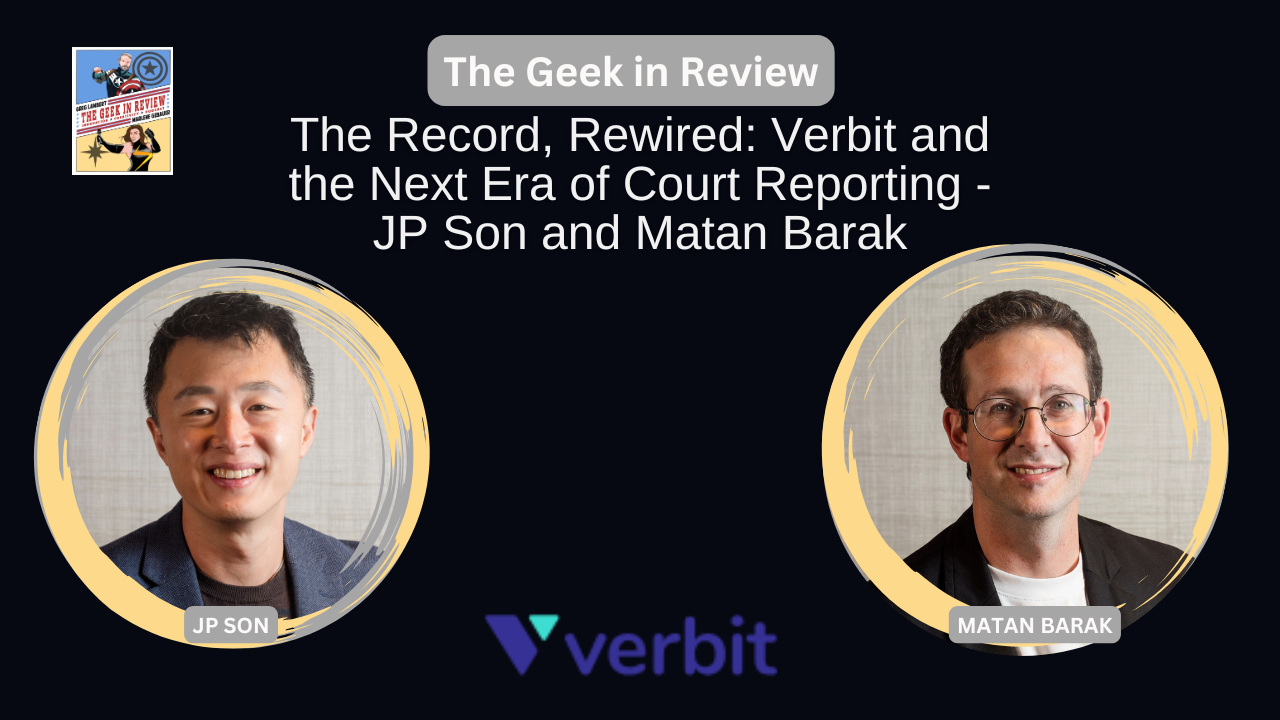
For decades, “the record” has meant one thing: a text transcript built by skilled stenographers, trusted by courts, and treated as the backbone of due process. In this episode of The Geek in Review, Marlene Gebauer and Greg Lambert sit down with JP Son, Verbit’s Chief Legal Officer, and Matan Barak, Head of Legal Product, to talk about what happens when a labor shortage, rising demand, and better speech technology collide. Verbit has been in legal work since day one, supporting court reporting agencies behind the scenes, but their latest push aims to modernize the full arc of proceedings, from depositions through courtroom workflows, with faster turnaround and more usable outputs.
A core tension sits at the center of the conversation: innovation versus legitimacy. Marlene presses on whether digital records carry the same defensibility as stenographic ones, and JP frames Verbit’s posture as support, not replacement. Verbit is not a court reporting agency; their angle is tooling that helps certified professionals and agencies produce better outcomes, including real-time workflows that once required heavy manual effort. The result is less “robots replace reporters” and more “reporters with better gear,” which feels like the only way this transition avoids an industry food fight in every courthouse hallway.
From there, the discussion shifts into the practical, lawyer-facing side: LegalVisor as a “virtual second chair.” JP describes it as distinct from the official transcript, a real-time layer built to surface insights, track progress, and support strategy while the deposition is happening. Matan adds the design story, discovery work, shadowing, and interviews to build for what second chairs are already doing, hunting inconsistencies, chasing exhibits, and keeping the outline on track. A key theme: the transcript is not going away, because lawyers still rely on it for clients, remote teammates, and quick backtracking, but the value climbs when the transcript turns into a live workspace with search, references, and outline coverage in front of you while testimony unfolds.
Accuracy and trust show up as recurring guardrails. Greg pokes at the “99 percent accurate” claims floating around the market, and Matan makes the point every litigator appreciates, the missing one percent contains the word that flips meaning. Verbit’s “human in the loop” posture and its Captivate approach focus on pushing accuracy toward the level legal settings require, including case-specific preparation by extracting names and terms from documents to tune recognition in context. The episode also tackles confidentiality head-on, with JP drawing a hard line: Verbit does not use client data to train generative models, and they keep business pipelines separate across verticals.
Finally, the crystal ball question lands where courts love to resist, changing the definition of “the record.” Marlene asks whether the future record becomes searchable, AI-tagged video rather than text-first transcripts. JP says not soon, pointing to centuries of text-based infrastructure and the slow grind of institutional acceptance. Matan calls the shift inevitable, arriving in pieces, feature by feature, so the system evolves without pretending it is swapping the engine mid-flight. Along the way, there are glimpses of what comes next, including experiments borrowing media tech, such as visual description to interpret behavior cues in video. The big takeaway feels simple: the record stays sacred, but the work around it no longer needs to stay stuck.
Listen on mobile platforms: Apple Podcasts | Spotify | YouTube
[Special Thanks to Legal Technology Hub for their sponsoring this episode.]
Email: geekinreviewpodcast@gmail.com
Music: Jerry David DeCicca