
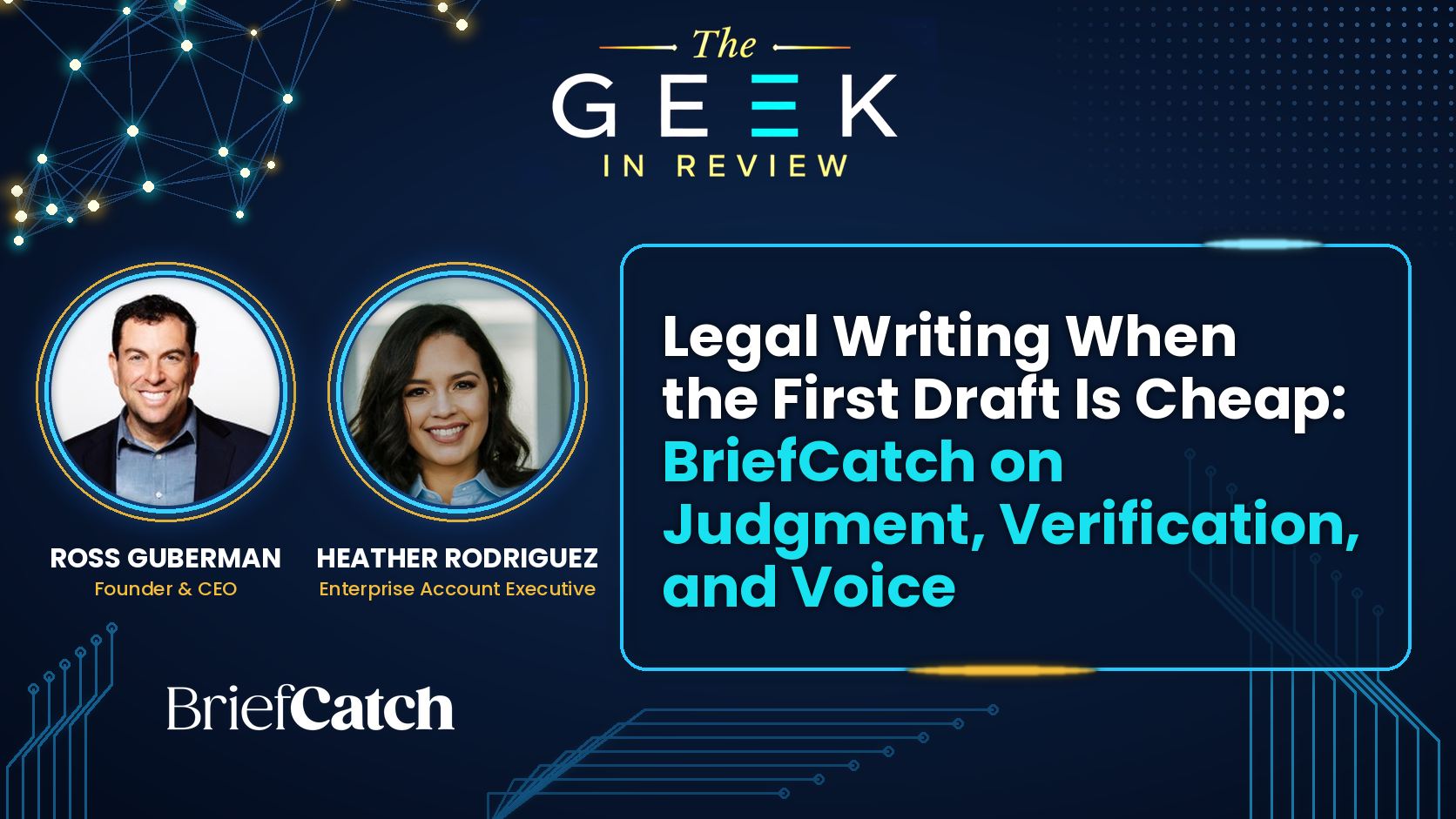
This week we talk with Ross Guberman, founder and CEO of BriefCatch, and Heather Rodriguez, the company’s enterprise account executive. Ross built BriefCatch to put the lessons from his books and workshops in front of lawyers while they write. It started as a rules engine that flagged everything from typos to sentence flow. He admits he was never a coder, and says he would have looked for a technical co-founder if he had known the term existed. Today BriefCatch pairs that original engine with generative AI to review whole briefs, motions and judicial opinions for persuasiveness and consistency. The company has spent much of 2026 on checking how accurately briefs describe cases and statutes.
Greg opens by testing the premise that AI makes a first draft cheap and abundant. Ross agrees that ChatGPT, Claude or Gemini will produce a serviceable draft of an NDA, a motion or a client letter. He warns that the polish can be “dangerously seductive.” He expects the gap between weaker and stronger legal writers to widen, and thinks the best writers will produce better work than the profession has ever seen. Heather names judgment as the scarce skill: can the lawyer tell whether a polished draft is accurate and strategically sound? Marlene asks how junior lawyers will learn when they start by editing. Heather points out that lawyers have always started from a brief bank or a prior motion, so strong editing has always been part of strong writing. Ross suggests running a draft through a second model and asking it to verify and source every legal and factual statement.
That leads to RealityCheck, BriefCatch’s citation verification tool. Heather explains that it checks whether the cited opinion supports the proposition, pulls up the relevant language and flags potential problems. An experienced lawyer can disagree with its reading, and the lawyer still owns the argument. Ross adds that running RealityCheck on briefs from the 1990s through the 2010s turns up plenty of case law errors, so the problem predates generative AI. The talk then turns to how alike AI prose sounds, and Marlene warns she may lose her mind if she reads “it hits differently” one more time. Heather describes how BriefCatch offers choices the attorney can accept or reject. Ross gives the example of lawyers who use “indicate” for everything; the tool suggests more precise verbs such as specify, convey or reflect. On Anthropic’s plan to watermark text written by Claude, Ross praises the accuracy of the AI detector Pangram. He hopes the profession will start asking a better question about AI-assisted work: was it a good brief?
Heather then describes where enterprise adoption stands. The Legal Technology Hub map has grown so crowded you need a magnifying glass to read it. Firms now ask whether a product is the best fit for a specific use case and whether it can replace tools they already own. Workflow fit, ROI and security reviews dominate the conversation, and she has seen firms that love a product spend months in security and procurement. Ross credits his reputation in legal writing with helping BriefCatch earn trust, though the company still answers the same questionnaires as every vendor. He walks through the WordRake acquisition, closed in January, which brought Gary Kinder’s conciseness and plain language technology and a new customer base to BriefCatch, and he hints that more acquisitions may follow. BriefCatch is also expanding past its Word plug-in into web apps, Outlook, an admin platform and PDF reports for courts, while Ross notes that most lawyers still do their real work in Word. When Greg asks about an MCP integration with Claude or OpenAI, Ross says one could arrive before the end of the year.
Marlene asks what is true today that wasn’t a year ago. Heather says AI has become a normal part of legal work, and hands-on experience has taught lawyers what the tools do well and where they fall short. Ross calls the weekly stream of new possibilities energizing and overwhelming, for founders and customers alike. Looking ahead, Heather expects firms to build their own AI ecosystems and pick the right tool for each stage of the work. Ross predicts that courts, which are quietly experimenting with generative AI, will use it far more within a year. Once courts signal their approval, he expects lawyers to stop debating whether to use these tools and start choosing which ones. Marlene drops off near the end with technical issues, so Greg wraps up the conversation with both guests.
Resources mentioned
- BriefCatch
- RealityCheck (BriefCatch support page)
- BriefCatch launches unified legal writing suite (LawNext, Sept. 2026)
- BriefCatch acquires WordRake and its 12 editing patents (LawNext)
- WordRake
- Pangram AI detection
- Anthropic to embed invisible watermarks in Claude-generated text (VKTR)
- Study finds AI-generated prose in more than 50 federal appellate opinions
- Legal Technology Hub
- Ross Guberman bio (Legal Writing Pro)
Transcript
Marlene Gebauer (00:07)
Welcome to The Geek in Review, the podcast focused on innovative and creative ideas in the legal industry. I’m Marlene Gebauer.
Greg Lambert (00:14)
And I’m Greg Lambert. And this week we are joined by Ross Guberman, who’s the founder and CEO of BriefCatch, and Heather Rodriguez, who is the enterprise account executive at BriefCatch. Ross, we should have had you on a long, long time ago. But we’re finally glad to get you on here.
Ross Guberman (00:34)
Thanks, I appreciate it.
Heather Rodriguez (00:35)
Thanks for having us.
Marlene Gebauer (00:37)
So for years, BriefCatch has focused on helping lawyers become better writers. But legal writing is changing quickly. Generative AI is producing more of a first draft. BriefCatch has acquired a long-time competitor WordRake, and the company has expanded into verification, professional development, and enterprise writing tools.
Greg Lambert (00:57)
And I guess that raises a bigger question than just whether AI writes well. It’s, you know, what happens to lawyers when generating the words becomes really kind of the easy part. So again, guys, welcome to the show. Ross, I wanted to kick this off by letting you have a chance to kind of give the listeners an overview of what BriefCatch is and what it’s become over the past year or so.
Ross Guberman (01:25)
Yeah, absolutely. So the original idea behind BriefCatch was to take all my books and my tips and my workshops and try to somehow get all that into a tech format that would make it easy for busy lawyers to access those kinds of edits and tips and suggestions while they’re actually working. So the original product was, as you can guess, pure code. It was kind of an editing rules engine that just grew and grew over the years and we would tackle everything from you know very specific kinds of typos or errors that lawyers make to opportunities to have better flow, more variety in sentences and everything in between.
So that kept us very busy and very excited for several years. But again, we stuck to our format of a rules engine and spotting patterns in language, trying to match up all the teachings to an actual coded rule. And then also we got a lot of input from judges and partners and firms for more and more ways we could help lawyers write more effectively and edit more effectively. Now, of course, as everyone knows, we’re in the Gen AI era, which is a little scary on the pedagogical front, as you already alluded to, but also really exciting on the tech front. So now we’re entering the realm of verifying accuracy and integrity in discussions of cases and statutes.
So that’s been occupying us quite a bit this year. And we’re actually moving into something that’s really exciting for me personally, which is a much broader concept of legal writing improvement and legal editing. So with Gen AI and our own proprietary tools and our original rules engine, we’re now going to be looking at, for example, an entire brief or motion or judicial opinion and we’re able to spot opportunities for better persuasiveness, more consistency, like all the kinds of things that Gen AI enables you to do quite well, as long as you have a lot of guardrails in place. So I’ve kind of lived through this whole legal tech evolution myself, going from like pure code to Gen AI.
So it’s been really exciting. And I’d say right now is probably the most stimulating time since I started.
Greg Lambert (03:38)
Now, were you a coder when you started or were you like me, you just kinda jumped in and you knew this could be done?
Ross Guberman (03:46)
I absolutely was not and I have to say I’m still not really a coder. I picked up a little bit by osmosis here and there. So you know, I didn’t really know that I’d be a founder of a tech company, to be honest. If I had to do it over again I would have gotten a technical co-founder. I didn’t even know that term, by the way, existed at the time. But I’ve managed pretty well. You know, I play to my strengths, I know my weak spots, so we hire accordingly. But no, I did not know how to code. And I wish I had. I mean I really admire the skill.
I think it’s an important skill even today when you can do so much code by automation. But no I’ve had to do it mostly as I said by osmosis.
Greg Lambert (04:29)
I imagine that the LLMs helping with the coding have also been beneficial as well.
Ross Guberman (04:38)
Yeah, I mean, you know, people like video games and I do too, but I really, really like watching, like if you put code up and you ask ChatGPT to optimize it, and you kinda watch and, you know, it’s mesmerizing in a very nerdy way, and you can get a little bit of a sense of how to improve code and automate the process that way too.
Greg Lambert (04:59)
Well, I wanted to start off by asking you something. I think we all think that AI is making writing cheaper. That we’re able to actually, you know, produce at least a draft much more quickly, and reduce the effort that it takes to make the draft. And so I’m gonna ask you a question, but I want you to first start with: Is the premise of this question correct? And that is if the producing of a first draft becomes cheap and abundant, what becomes scarce and valuable in legal writing? And I really wanna say, does AI make a first draft cheap and abundant?
Ross Guberman (05:47)
Well, there’s no doubt that even today, you can go to ChatGPT or Claude or Gemini and ask it to generate a first draft of, let’s say, an NDA, you know, a motion in limine, even a letter to a client, give it some background, give it the jurisdiction, give it some of your own perspective. And you will get, you absolutely will get in many ways a serviceable first draft. Now it will be dangerously seductive in the sense that it will often look much more polished than it really is. But it is, as you said, cheap and abundant, right? And I think, you know, people want to deny the truth because they’re worried about overreliance.
And I get it, but we should just admit that although you can find some counterexamples, in general the first draft you’re going to get is decent and it will hit most of the hot spots. So I think the premise is correct. It’s correct with the caveat that it’s often dangerously seductive in its exhaustiveness and polish. And that kind of leads me to the answer to the actual question, which is then that’s what’s going to become really, really scarce. Because you’re gonna end up having a very broad and ever-widening gap between the weaker players and the stronger players in legal writing. And because of the growing temptation to rely on these tools, not just for the first draft, but in let’s say kind of the middle stages, what’s gonna become really rare, I would say, will be a truly top-notch, well-thought-through, tailored product.
I do think the very strongest players, like the people who are really gonna shine in whether it’s contract drafting or litigation or appellate advocacy, they will probably be better writers than we’ve ever seen in the history of legal writing because they will be able to harness all of their own knowledge, their own perspective, and learn how to use the power of these tools effectively. And that is actually, you know, pretty exciting, right? The ceiling’s probably gonna be higher than ever.
Greg Lambert (07:47)
And Heather, are you seeing the same thing?
Heather Rodriguez (07:50)
Yeah, well in my opinion, I think that what’s going to become more valuable is the judgment. So yeah, AI can make a plausible first draft and it can be polished, but does it necessarily mean that it’s accurate and is it strategically sound? So the interesting part is yeah, it may become easier to produce something that looks good, but how do we know if it’s actually good? And so I think it’ll be incredibly valuable for attorneys to be able to evaluate and verify and actually prove that the work is accurate, you know, and a great work product.
Ross Guberman (08:26)
Heather talks to firms every day and I think I mean you can speak to this much better than I can, Heather, but there is some anxiety, right, about especially junior lawyers and their skill sets.
Marlene Gebauer (08:38)
Yeah, actually I wanted to focus on that, focus on like lawyer skills and how we’re seeing that change and how we’re seeing a change in the writing process. So Heather, I mean, young lawyers have traditionally learned through, you know, doing drafts, getting feedback, rewriting,
Heather Rodriguez (08:57)
Okay.
Marlene Gebauer (08:58)
But AI now of course produces this starting point, you know, this basic draft. So if lawyers are learning by editing rather than creating the work from a blank page, what are the types of skills that they’re going to need in order to do the writing process?
Heather Rodriguez (09:19)
So I look at this a little differently. I don’t think lawyers have ever really started from a complete blank page. There’s always a brief bank, a precedent, prior motion, or something that another lawyer at the firm has written that provides that starting point. So I feel that part of becoming a good lawyer has always been knowing how to take that starting point, think critically about it, make it better for your particular argument or client. And although AI makes finding or creating that starting point dramatically more efficient, you then still edit it, but I don’t think being a great editor is a lower level skill at all.
In fact, with AI, I think it’s becoming one of the more important skills that a lawyer can develop. You have to have the ability to look at something and ask, is this a strong argument? Is it persuasive? Does this belong here? So I don’t think that the concern should be that we’re training lawyers to become editors. We should have always been focused on training them to become better writers. And in my opinion, great editing is part of great writing.
Marlene Gebauer (10:27)
Yeah, so basically critical analysis isn’t gone. That still continues.
Heather Rodriguez (10:32)
No. Correct.
Greg Lambert (10:35)
Yeah, well, I guess I want to push on that one just a little bit because you hear a lot about, you know, because the AI looks so good right out of the gate, that the lawyers, especially those who are working in an area where they may not be all that knowledgeable in the ins and outs of it are relying too heavily on it, giving a little bit of too much cognitive offloading to the AI. When either of you are talking to lawyers, are you finding that to be the case? And if so, how are more experienced lawyers kind of pushing back and making sure that the younger lawyers aren’t kind of offloading?
Is that through the red pen or how are they doing that?
Ross Guberman (11:26)
Well there are you know, there are some sophisticated uses of AI that you’re seeing right now in firms and elsewhere, at all parts of the food chain, like senior partners down to first year associates. So for example, one thing that I’ve recommended and many people have tried this and found it to be successful, is if you are gonna use the Gen AI for the first draft, and let’s be honest, a lot of people are going to, regardless of what any of us on this podcast think they should do. And you immediately switch to another model and you have it scrutinize the draft and what I recommend is have it verify every single legal and factual statement and every single statement related to case law.
Verify that it’s accurate, but give you a link or some sort of source. You can actually already capture a lot of the functions of a human editor yourself, right? But you have to, again, know how to add that level of scrutiny. That’s not gonna happen automatically. Like that’s the kind of thing that people are realizing they can do so that they’re able to actually maximize the value of these tools.
Greg Lambert (12:37)
Yeah, well that brings me to one of the tools that I think that you’ve developed in order to kind of help with this as well, and that’s RealityCheck, which can verify that you know cases exist and kind of help to make sure that the AI is sticking to the fact patterns and the reality and isn’t going off and inventing something. So talk to us about how RealityCheck works, what the effect is, and then kind of how the lawyers interact with that when it works and when they disagree with it.
Ross Guberman (13:18)
I’m gonna invite Heather to describe RealityCheck because she deals with it every day and I’m a little bit biased since I created it, but I will give you one quick preview and that is if we use RealityCheck on briefs written in the 1990s or the 2000s or the 2010s, we uncover all sorts of errors in relation to case law. That’s right. Yeah, I know.
Greg Lambert (13:38)
No, sorry, it only started after 2022.
Heather Rodriguez (13:41)
Mm-hmm.
Ross Guberman (13:43)
There’s a lot of romanticizing of the past going on. So anyway, with that little preview, I’ll turn it over to Heather to tell everyone about
Heather Rodriguez (13:49)
[Laughter]
Ross Guberman (13:52)
RealityCheck. That’s RealityCheck, one word, by the way.
Heather Rodriguez (13:55)
RealityCheck is there to inform lawyers’ judgment. It’s not there to replace it. So the big difference here is between confirming that a case exists and analyzing whether that case actually supports the proposition being made. So that’s why we created it. RealityCheck can surface the relevant language, explain what the opinion says, identify any potential issues, and give lawyers a much more efficient way to evaluate that citation. So we’re not only confirming the citation exists. But legal arguments can be nuanced. So reasonable lawyers can interpret authority differently. So maybe an experienced lawyer may disagree with RealityCheck, and the goal isn’t for the technology to have the final word.
Again, we want to give the lawyer another layer of analysis to consider and the information that they need to make their own determination. So, again, the lawyer always needs to own the argument and the final work product. So, I think that’s where legal judgment should remain. We’re there to provide that assistance.
Marlene Gebauer (14:54)
So one criticism of AI-generated writing is that everyone’s writing begins to sound increasingly similar. Like if I hear “it hits differently” one more time,
Ross Guberman (15:07)
Mm-hmm.
Marlene Gebauer (15:07)
I think I’m going to go insane.
Greg Lambert (15:09)
How did that land? That’s what I wanna know.
Ross Guberman (15:10)
And how does it land? Also,
Heather Rodriguez (15:10)
Yeah.
Ross Guberman (15:12)
Something is load-bearing. Every point is load-bearing.
Greg Lambert (15:14)
Yeah.
Marlene Gebauer (15:16)
So we all understand.
Greg Lambert (15:18)
Yeah.
Marlene Gebauer (15:19)
But as AI becomes embedded in legal writing, how do we preserve lawyers’ individual voice and style so that they don’t sound like everybody else?
Ross Guberman (15:29)
I’m gonna toss that over to Heather too, because she gets this question a lot and I think she has a good answer.
Heather Rodriguez (15:34)
And there’s a real risk in that. And you don’t want everyone to sound the same, but that’s not how we think about it here at BriefCatch. We’re here to preserve the attorney’s voice and actually help them strengthen their writing. And so we’re giving attorneys the choice and examples for inspiration. Rather than saying, Here’s how you should write this, the attorney is still making that decision. So they can accept a suggestion, they can completely reject it entirely. So if there’s, let’s say, a specific phrase or stylistic choice that feels authentic to them, then they can keep it. So we’re not trying to standardize everyone’s voice here.
We’re helping firms standardize the quality of the writing that goes out the door while allowing individual lawyers to still sound like themselves. So it’s just not about producing a better document. By leveraging BriefCatch, they’re able to learn those different choices and that improves their own voice as a writer over time.
Ross Guberman (16:26)
Well a good example is a lot of lawyers and judges will gravitate toward indicate, whatever they’re talking about. The record, the docket, the case, the client, the witness, opposing counsel, indicate, indicate, indicate, indicate, indicate all day long. So one of the first challenges I took on was to try to give people a menu of more specific options when they write indicate in the first draft, like specify or convey or reflect or state or say. So that’s a good example of what Heather is getting at. So in regular human produced writing, there’s a lot of homogeneity too, because we’re all inclined to pick the most obvious verb or noun or term of art.
So a lot of what we do is actually again try to make people sound more like themselves and a little bit more specific and more precise as an antidote to this very real problem of, homogenization.
Greg Lambert (17:21)
Ross, there was a recent announcement by Anthropic and I think other companies are gonna do this as well, to where they’re gonna start adding kind of unseen watermarks in the AI writing, which you know if you think about somebody that’s using it to create something whole cloth and using it, yes. But you know, a lot of people were arguing that, you know, they’re using the AI to like fine tune some of the arguments that they’re having and yet they’re worried that this you know it’s going to be able to look like it’s been created completely by AI. Is that a worry that you’re hearing from your customers?
Ross Guberman (18:04)
Yeah, I mean I think a lot of people were surprised by that announcement from Anthropic. I know that I personally and many others have used a tool called Pangram that is, to be honest, incredibly accurate in predicting the percent of text that was generated by AI. I’ve tried to trick it and I’ve failed.
Greg Lambert (18:25)
I can’t trick it either.
Ross Guberman (18:26)
You can’t trick it. I mean it’s an incredible tool. I like to give praise where praise is due. What I would say, and this is especially true in our particular profession, is I think we need to get over the sort of automatic gotcha and smugness in catching someone using AI. You might have heard the I think it was an academic study a few weeks ago. It looked at a bunch of federal court opinions and singled out, I don’t know, a handful, you know, accusing them of using AI to write the opinion. But no one ever gets to the next question, which is: Was it a good brief?
Was it a good opinion? Was it a good LinkedIn post? Right? There are plenty of human-generated examples of all the above that are crappy. There are some AI-generated examples of all the above that are also not very good, but there are a lot that are really great as well. Look, there’s a reason there’s a market for the watermark. There’s a market for Pangram. There’s a reason we have this database of hallucinated case studies all over the country. But what I would guess is that we’re gonna probably get to a point pretty soon where there’s a little bit of nuance and it’s not treated as a crime.
Like you’re not automatically presumed guilty here unless the AI-generated content itself is otherwise flawed.
Greg Lambert (19:46)
Makes sense. Heather, I’m gonna change gears a little bit on you and talk about adoption of the technologies within law firms. I know when you guys go into law firms and you talk about things like enterprise adoption of your software, what are you seeing in law firms now? Because I know I’m being asked a lot about what’s the return on investment that we’re getting. And in fact I’m seeing some changes in the way law firms are structuring their AI teams now where IT is now stepping in and doing a lot more. And so what are you seeing as far as behavior, changing the lawyers’ behavior, the security issues, proving ROI, what’s the conversation that you’re having these days with law firms?
Heather Rodriguez (20:46)
There’s so many pieces to it and the conversation has definitely changed. There’s so much more technology today than ever before. I remember two years ago looking at that Legal Technology Hub map of all the different tech and today you can’t even read the names.
Ross Guberman (21:02)
Yeah.
Marlene Gebauer (21:02)
So small.
Heather Rodriguez (21:03)
It’s so small. You need a magnifying glass. And so I think firms are almost overwhelmed with all the options. And they’re not just asking, does technology work? We know it works. Is this the best technology for this use case? Can it help us consolidate some of the tools we already have? When it comes to workflow integration, I think that’s still a big factor. Most AmLaw firms, they have a significant tech stack. So they’re thinking about how everything works together for the attorney rather than just adding another tool for the sake of having it. They’re being much more intentional about the tools that they’re choosing. And I think changing lawyer behavior is less of an obstacle than people assume.
Most firms that I speak with, they are wanting to be the most innovative. And I think the big challenge, though, is giving attorneys the technology that fits naturally into their workflow, ensuring that it gives them a reason to keep using it. So the ROI, that’s always coming up in the discussion. And firms want to understand the value early on in the process, even if they understand that realizing that full value takes time, but it’s really in how they’re gonna implement it and how they’re gonna get the attorney to keep using it. Security is a major part of every discussion when speaking with enterprise firms. Again, it’s less of if they’re holding back because they’re not comfortable with generative AI.
I think it’s more that security and innovation teams, they’re being asked to evaluate more technology now than ever before. So those reviews take time. And I’ve worked with firms that genuinely are excited about a product, but it can still take months to get through that security, that procurement, and just other approvals that are required to actually deploy the tool. So for firms, it is less about trusting the AI and more about how to responsibly evaluate it and approve the tech that’s coming at such a fast pace for the firm.
Greg Lambert (23:01)
Yeah. Ross, I know you know, you were well before the AI transformation, but you were still a technology that was coming in. And I think, you know, watching your company over the years, just kind of the trust level that you’ve earned, was that a worry that through the AI era that might change for you and how did you fight that?
Ross Guberman (23:28)
Yeah, that’s a really great question. I mean, I’ve been lucky to enter the tech world with a reputation already for trustworthiness on the subject matter, right? That doesn’t necessarily mean it translates into trustworthiness on tech, but that did help. Because it also means that not only do I understand legal writing and I am reliable for legal writing advice, but I totally understand law firms and how they work and how they think. So that did help, especially when we were a fully deterministic product, as I mentioned, just code. When it comes to Gen AI, I think it helps on the margins, right? Because again, I do understand the security pressures that firms and individual attorneys face.
I mean I understand them at the core of my very being, not just intellectually. But, you know, as Heather suggested, we, you know, we face the usual gauntlet of questions and questionnaires. And although no legal tech company enjoys that process, we all believe in it and we all understand the concerns that these firms have. Luckily, I’ve noticed the sort of anxiety level has plummeted in the last couple of months. I think firms have kind of hit their stride. I mean they’re able to reassure their clients that they have the right type of account, that data is not being shared and the like. So it’s a little easier now than it was a couple of months ago.
But although again, I’m very glad that, you know, firms and judges and courts trust me as an individual, we still have to prove, as Heather suggested, we still have to prove our security bona fides just as any other legal tech company does.
Marlene Gebauer (24:52)
Okay. So I want to talk a little bit about the acquisition of WordRake. So WordRake was also a very established legal writing product. And I think BriefCatch and WordRake had kind of different approaches to improving lawyers’ work. I’m curious, how is the WordRake acquisition impacting the direction of the company and sort of the direction that you’re going?
Ross Guberman (25:37)
Yeah, I mean it was my first acquisition or our first acquisition.
Marlene Gebauer (25:41)
Congratulations.
Ross Guberman (25:42)
Thank you. Yeah, I didn’t know what to expect. It was kind of fun to be a client of law firms, since I used to be a lawyer at one of those firms. So the acquisition itself was, as I think these things go, like very, very smooth, very positive. You know, one of our star employees, in fact, right now at BriefCatch came from WordRake. So the acquisition and the integration in general were quite pleasant. I have good memories of them. It’s been almost a year. It was January, so you know, nine months or so. As far as the two startups, Gary Kinder is the founder of WordRake.
He and I generally think alike about legal writing itself. WordRake had a slightly different focus and a different kind of tech stack. It mainly focused on conciseness and plain language. So there’s some overlap, but then we have a lot of other layers as well. So we have a lot of former WordRake clients, of course, they are now BriefCatch users. They’re very, very happy because we have these AI features as well and other edits, but it was a really good synergy to use a trite word for mergers and acquisitions, but it’s true. And you know it’s been great because they also had a kind of a different customer base, you know, they were strong in different areas in the market.
So it’s been a really great transaction for us. And actually, we can’t reveal anything right now, but we’re looking at a couple of other possible acquisitions and hope that we’re on a roll since the first one was quite
Greg Lambert (27:13)
Mm-hmm.
Ross Guberman (27:14)
Quite successful. So stay tuned. I don’t think even Heather knows this. No one knows it. It’s all in my head.
Greg Lambert (27:16)
It gets addictive. Gets addictive.
Heather Rodriguez (27:18)
Yeah.
Ross Guberman (27:21)
But, yeah, we are looking at some other startups right now.
Greg Lambert (27:25)
Well, maybe this is leading into the question I’m about to ask then. Because you know it used to be BriefCatch was a Word-based, you know, plug-in that you used in Word and you know, the old workflow where the lawyers are working in Word. And now you’re looking at a much broader platform where you’re encompassing the writing, the verification, the training, the enterprise administration of it. So what changes when legal technology, writing technology stops being just another tool where the lawyers are working and actually becomes part of the infrastructure in which the legal work gets produced? How’s that change for the law firm and how’s that change for you?
Ross Guberman (28:09)
Yeah, I mean, great question. I mean, just an example. Like RealityCheck is really, really popular with the nation’s courts, but they don’t work in Word. I mean, they work in Word on their opinions, but that’s not how they process briefs. Right.
Greg Lambert (28:19)
Please don’t tell me they’re still in WordPerfect 4.2.
Ross Guberman (28:22)
No, no. There are a couple of judges who are WordPerfect users. They tend to be very proud.
Greg Lambert (28:25)
Yeah.
Ross Guberman (28:27)
But I think probably a handful, max, of WordPerfect stalwarts. So yeah, that’s an example, right? So when judges get a motion or brief in their docket and they want to run through RealityCheck, that’s obviously gonna be a PDF. And they don’t want the output in Word, right? They want it as a report. So to your point, it’s exciting and challenging, right, because one good thing about the original setup was it made things very easy for us, right? Just as our customers wanted to work in Word, all of our work was within the Word plugin. And now we have all these other layers and all these other plans and features on our roadmap, including web-based tools, Outlook, a web-based administrative platform, and web-based tools outside the platform for courts.
It goes on and on and on. But I will tell you, even with all that in mind, it is still true in September, October 2026, that the vast majority of lawyers are still doing most of their actual legal work in Word. Not WordPerfect and not Google Docs and not online. At the same time because we’re trying to capture a larger segment of the entire life cycle of a legal document, including the verification step and the review steps. We’re working on court formatting rules and the like. We are getting the opportunity to add to our tech stack while still letting our very content users do most of their editing in Word.
Greg Lambert (29:56)
I have to ask, the key thing is: Do you have an MCP yet?
Ross Guberman (30:01)
We actually haven’t integrated, you know, with Claude or OpenAI with an MCP yet. We use an MCP for RealityCheck in the other direction. But you’ve kind of probably read our minds because that’s you know, we have a long list of things we’re working on right now, but that’s you know, we’ve gotten some interest from those companies and that might be happening before the end of the year.
Marlene Gebauer (30:22)
So Ross and Heather, I want to pose the question to you. What’s true today that wasn’t true a year ago?
Ross Guberman (30:29)
Heather?
Heather Rodriguez (30:30)
I’d say that we’ve talked a bit about this, but AI is much more normalized within the legal industry than ever before. I remember being at a conference not even a year ago, and there was still a lot of hesitation. Firms had significant reservations, and I think now the conversation feels very different and there’s much more acceptance. It’s just gonna be part of how legal work gets done. For me, firms and attorneys have more of a hands-on experience now, so they’re much more comfortable and have a much better understanding of not only what it can do, but where it falls short. And so I think the experience has made the conversation much more mature, with less fear around technology and more recognition that it’s a tool.
And so it’s less hesitant to touch it and it’s really learning how to work alongside the attorney.
Greg Lambert (31:18)
Any observations of what’s true today that wasn’t true a year ago?
Ross Guberman (31:23)
I mean, Heather was about to say she now has the world’s greatest boss, which she didn’t have a year ago. So I took the words right out of her mouth. But yeah, that may not actually be true, so I won’t push my luck. So
Heather Rodriguez (31:28)
It is true.
Ross Guberman (31:33)
What I’d say if you’re a founder or you feel like you’re at the vanguard here with legal tech, one thing is there’s legitimate excitement almost every single week. There’s something in the legal tech or frankly broader Gen AI news to get you thinking, to get you creative, to get you thinking about possibilities that didn’t seem within the realm of possibility even let’s say a month ago. So that’s mostly really exciting. It keeps me going since I don’t sleep at all. It helps me
Heather Rodriguez (32:04)
Yeah.
Ross Guberman (32:05)
With my energy level 22 hours a day running this company. But it can also be, I think most legal tech founders would tell you, overwhelming, right? Even when you asked about MCP, I mean that’s one of like 50 things I think about every day that we need to get going. So I assume that this pace of innovation will ebb and flow, but right now it seems to be pretty maxed out, which as I said is mostly good but overwhelming I think for us and then probably overwhelming for the legal tech customers as well.
Greg Lambert (32:39)
All right, so that brings us from the past to the present. Now I need you both to pull out your crystal balls and look into the future for us. From your vantage point on the changes that you see in the way that lawyers you know create, evaluate, communicate legal work, what do you think that we need to be prepared for that will be a change or challenge in the near future? Heather, you want to start it off?
Heather Rodriguez (33:07)
Yeah, I’ll start off. I think we’re underestimating how intentional law firms are gonna become about building their own internal AI ecosystems. I think there’s a lot of focus on consolidation and finding the right technology to solve multiple problems. So I think there’s a lot of questions about if the future is necessarily one AI platform. I don’t agree. I think in three to five years it’s gonna be more of which AI are we using and how do we want AI to support the attorneys at each stage. So, yeah. I think that law firms are gonna be thinking about creating their own ecosystems and the right technology to do the right job and just making the attorney better at their own job.
Greg Lambert (33:50)
Mm. And Ross, what do you see in the future?
Ross Guberman (33:53)
I think an underreported story is how much the nation’s courts, you know, federal and state alike are quietly experimenting with all sorts of Gen AI tools within the courts. Like the only thing you hear about is sanctions for hallucinated cases, and it’s really misleading. And we’re very lucky because, again, especially with RealityCheck, but even with BriefCatch, we’re already, we’ve already penetrated the courts fairly well. And I think probably less than a year, but definitely in a year, what’s probably going to happen is the courts are going to be using Gen AI tools, 10 times more than they are today, and that is going to really open the floodgates on the adoption front.
I think the courts would be seen as sort of the last sort of source of resistance. Once they send the signal that they think overall this is good for our profession, good for access to justice, good for private practice and public sector lawyers alike, then it’s not going to be really a question of whether you use these tools. It’s going to be really which ones you use. And I think as exciting as legal tech seems right now, it’s probably going to be 10 times as exciting in a year, if my prediction comes true at least.
Greg Lambert (35:05)
Are you excited to be involved in the legal tech industry at this time?
Ross Guberman (35:11)
This is probably the most excited I’ve been since I started seven years ago. Yes. A little tired some days, but very excited. I think we’re lucky.
Greg Lambert (35:20)
Well, you said you didn’t sleep.
Ross Guberman (35:21)
I think we’re lucky. We’re lucky to be living through this, to be honest.
Greg Lambert (35:25)
Yeah, I feel the same way. So well, Ross Guberman and Heather Rodriguez from BriefCatch, we’ve dropped Marlene with technical issues. But we wanna thank you both for taking the time to come on and talk with us on the Geek in Review.
Ross Guberman (35:40)
Thanks so much, really enjoyed it.
Heather Rodriguez (35:40)
Thanks for having us. Thank you.
Ross Guberman (35:43)
Say bye to Marlene from us.
Greg Lambert (35:43)
And I’ll cover Marlene’s part. And thanks to everyone for listening. If you enjoyed the show, please share it with a colleague. We’d love to hear from you. Check us out on LinkedIn and Substack and other places. Ross and Heather, what’s the best place for listeners to find out more about you and BriefCatch and follow your work?
Ross Guberman (36:04)
I’ll keep it simple, BriefCatch.com. But what do you have, Heather?
Heather Rodriguez (36:08)
Follow us on LinkedIn, Ross Guberman and Heather Rodriguez.
Greg Lambert (36:12)
Right. And as always, the music you hear is from our friend Jerry David DeCicca. So thanks, and bye, everyone.
Ross Guberman (36:18)
Nice.
Heather Rodriguez (36:19)
Bye.
Ross Guberman (36:20)
Thank you.