
(See Day Two Coverage for the In-House Programs over on The Geek in Review Substack page – GL)
Day One of Texas Trailblazers in Dallas had a different tone than most legal tech conferences I attend. The conversations stayed close to the work. Less speculation, more discussion about what people are doing right now, where it is working, and where it is breaking.
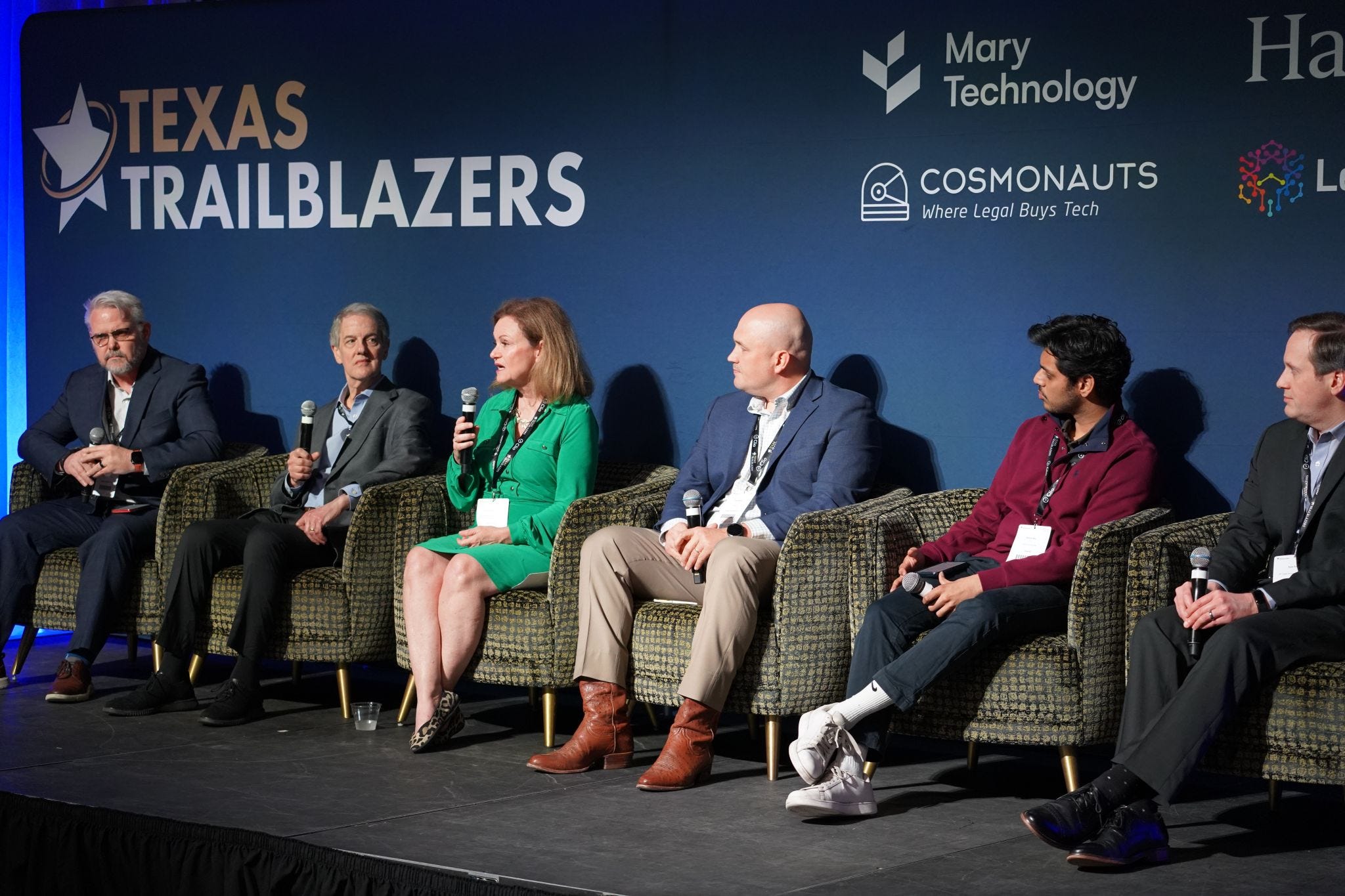
Organized by Cosmonauts in partnership with LegalOps.com and held at The Statler Dallas, the Private Practice Day brought together law firm leaders, legal operations professionals, and technology vendors for a full day of keynotes, panels, and product demos. Joy Heath Rush, CEO of ILTA, chaired the day and opened with a fireside on the new era of conversations between general counsel and outside counsel. Her framing set the tone: AI is living at the intersection of business and technology, and it is creating conversations that simply did not exist two years ago.
Across the sessions and hallway conversations that followed, a few themes kept showing up. They were consistent whether the speaker came from a law firm, an in-house team, or a vendor building the tools.
Trust in AI is becoming a workflow problem
Rowan McNamee, Co-Founder and COO of Mary Technology, opened the sponsor keynote with a point that came up repeatedly throughout the day. AI outputs are persuasive. They read well. They look complete. That creates a tendency to move forward without enough friction in the process.
McNamee cited a recent study on what researchers call “cognitive surrender,” based on the work of Sean Hay and building on the framework in Thinking, Fast and Slow. Under time pressure, people rely on AI even when they know they should verify the result. In a series of experiments, override rates improved from 20% to 42% when participants had real money on the line. Even then, more than half still followed the AI’s answer. “You can reduce it, but you can’t eliminate it just by telling people to be careful,” McNamee noted.
In a legal setting, the implication is straightforward. Review cannot be optional. It has to be built into the process in a way that does not depend on someone remembering to slow down.
That concern echoed later in the day during the panel I moderated. Laura Ewing-Pearle, Senior Manager of eDiscovery and Practice Support Technology at Baker Botts, described a clear split even among e-discovery practitioners who are enthusiastic about AI. They lean heavily toward document interrogation and querying. They are far less comfortable with AI making responsiveness calls, and they are “definitely not comfortable with AI making privilege calls.” The line between assistance and reliance is still being worked out in real time.
Adding urgency to the conversation, panelists referenced a recent New York case in which a court ruled that AI-generated legal advice obtained through a public tool was not protected by attorney-client privilege. The ruling was specific to a consumer-facing chatbot, but the message landed clearly: enterprise AI tools with proper security and licensing are becoming a matter of professional risk management.
Adoption follows incentives, not access
The panel on Culture, Change, and Collaboration brought together Emma Dowden of Burges Salmon, Thom Wisinski of Haynes Boone, Kelley Lugo of Bryan Cave Leighton Paisner, Rowan McNamee, and Tammy Covert of Nachawati. The discussion stayed focused on what actually drives adoption inside organizations.
Kelley Lugo described how the initial reaction at many firms was to block AI tools. That position has shifted. Lawyers are experimenting, often on their own. But the challenge is whether there is a reason to use AI consistently. She offered a concrete example: in BCLP’s UK real estate group, roughly 80% of matters are handled on a fixed-fee basis. Write-offs on those fixed matters directly hurt partner compensation. That pain point, she explained, is exactly where AI efficiency aligns with real motivation. When the people doing the work see a direct connection between AI-assisted speed and their own metrics, engagement follows.
Emma Dowden framed it in terms of mindset and behavior. Transformation efforts stall when they focus on the technology without addressing how people are measured and rewarded. She also noted that the pace of change is creating a real business risk. In the UK, the Big Four are telling firms what percentage of their revenues are at risk from disruption, and the numbers are serious.
Lugo shared a story that captured the adoption dynamic well. A senior leader at her firm went on a two-week safari, came back, and told her he had not thought about work at all the entire trip. But he had thought about AI the entire time. When people get enough distance to think clearly about where the profession is headed, the conclusions tend to be similar.
No one on this panel suggested that training alone will move the needle. The focus stayed on incentives, visibility, and examples that resonate with how lawyers already operate.
Building sustainable innovation foundations
The fireside on Beyond Technology: People, Process, and Policy brought together Joanna Penn, Chief Transformation Officer at Husch Blackwell, Rochelle Rubin, Director of Client and Business Operations at Barnes & Thornburg, and Louise Thomas, Director of Transformation at Burges Salmon.
Husch Blackwell’s approach stood out for its scale. Their virtual office, “The Link,” now has over 850 people, including more than 250 attorneys, working in a distributed model that lets the firm recruit specialized talent in markets where they have no physical office. They are also hiring “architects” whose job is to translate between technical and legal teams. That is a role you are starting to see more firms create.
Barnes & Thornburg shared a result that had nothing to do with technology and everything to do with process. Their client interview program, built on the simple act of asking clients what the firm could do better, produced a 90% or greater revenue increase within 12 to 18 months for the clients who received that in-person attention. The takeaway: sometimes the highest-value innovation is a conversation.
Workflow design is where the gains are showing up
Kyle Poe, VP of Legal Innovation and Strategy at Legora, presented a framework for measuring AI ROI that moved the conversation past speed alone. His point was that firms seeing real results are looking at outcomes and pricing, not just how many minutes a task takes. The ROI, he argued, varies dramatically by use case. Some tasks show minimal time savings. Others produce modest reductions, like going from ten hours to eight. And some are transformative, compressing weeks of due diligence into hours. He also projected that firms will likely raise rates around 25% to offset AI costs while repositioning how they describe the value they deliver.
That idea came into sharper focus during the Automation in Action panel, which I moderated. Paul Pryzant, a partner at Seyfarth Shaw with 45 years in M&A, described how his group now runs deep research on target companies on day one of receiving a letter of intent. Information that used to take two or three weeks to surface during due diligence is now available immediately. Pryzant also emphasized starting from the client relationship: “My favorite question is, how are you using AI? How are members of your team using it?” That approach opens a two-way conversation rather than a one-sided pitch.
Rutvik Rau, CEO and Co-Founder of August, reinforced the importance of starting with the deliverable and working backward. That approach forces clarity about what steps are required, where the bottlenecks sit, and which parts require judgment. The most successful users, he said, are the ones with a strong sense of how they deliver a service to their client. Curiosity and creativity matter more than technical skill.
Chad Barton, a corporate transactions partner at Holland Knight, described how his lending team built AI into their existing process for handling matters with rigid institutional parameters. He also raised a tension that no one else on the panel had addressed directly. When AI makes associates dramatically more efficient, it creates a compensation problem. “If I’m really efficient, I can’t hit my target,” is something associates are already thinking about. Barton was clear that this falls on firm leadership to address, especially during compensation reviews. Partners need to defend associates who produce excellent work product even if the hours look different.
Kyle Poe added a practical observation about change management. “Workflow is just the orchestration of multiple things you could do within the product,” he said. Teams that learn the individual tools first and then map the process manually tend to have a clearer path to automation. He also described building workflows in plain English instructions, the same way you would brief a literal-minded associate, and then iterating based on mistakes.
The Legora demo and a question about legal research
During the break, Harry St. John, VP of Revenue at Legora, ran a product demo that filled the room. Legora’s platform centers on two main tools: an assistant for conversational document interrogation and a tabular review for bulk extraction across large document sets. St. John showed how the two connect. Extraction results from tabular review can be queried through the assistant, and outputs can be pushed into Microsoft Word using firm-specific templates. A newer feature called WordEdits generates multiple unique Word documents from a single instruction set, useful for tasks like drafting a set of resignation letters for every officer in a transaction.
I asked St. John about the legal research capability they had flagged, given that at Jackson Walker we tell our people not to use AI for legal research unless they are inputting their own materials. He said Legora has ingested district, appellate, and Supreme Court caselaw from a number of providers, with their legal research database launching soon. He was transparent that bankruptcy coverage was not included yet.
Pricing is moving into the center of the conversation
The panel titled Billing on Trial: Rethinking the Economics of Legal Work brought together Jon Lindrus of Foley and Lardner, Jonathan Safran of Polsinelli, Marlene Gebauer of K&L Gates, and Katon Luaces of PointOne.
Time-based billing is still the dominant model, but it is under more scrutiny than ever. AI changes how long work takes. That raises questions about how value is measured and communicated. One of the clearer moments came earlier in the day during my panel when Kyle Poe described a dynamic playing out between firms and in-house counsel. Some firms are trying to benchmark what a task would have taken with humans last year, apply a discount, and offer that as a fixed fee. But if AI produces savings far beyond 20%, clients will eventually ask why they should lock in rates that still capture most of the efficiency gains for the firm. The honest answer is that both sides are still figuring this out.
Jonathan Safran, in a pre-conference interview published by the Cosmonauts team, made a point that resonated throughout the day. Clients say they want alternative fee arrangements, but many still ask for shadow billing to verify what they would have paid under an hourly model. That tension makes standardization difficult. And on the firm side, three partners at the same firm might manage the same project three very different ways, which makes fee estimation genuinely hard.
Disrupting the citator: open data meets modern AI
John Rizner, Head of AI Legal Drafting at Filevine, gave a presentation that most of the audience probably had not expected. His argument: the legal research market is approaching an inflection point. An unprecedented volume of American caselaw is now freely accessible and processable by digital tools. At the same time, language models have reached a level of legal sophistication that would have been unimaginable five years ago. Taken together, Rizner argued, these developments create the possibility of meaningful competition in legal research and call into question long-held assumptions about who can build a citator and what it should cost.
A practical example from litigation
The emotional journey ahead
Where this leaves us
By the end of the day, the conversation felt less like an introduction to new technology and more like a working session on how legal services are being reshaped. Thomson Reuters data shared during one of the sessions put current AI adoption rates at 35 to 40 percent across the industry. That is meaningful progress, but it also means more than half the profession is still watching from the sidelines.
A few observations stand out from the day:
- Trust in AI needs structure, not reminders. Even with financial incentives, people follow AI outputs more than they should. Verification has to be designed into the process.
- Adoption depends on incentives and visible use cases. When AI efficiency connects directly to compensation or profitability, people engage. When it does not, they wait.
- Workflow clarity is a prerequisite for meaningful automation. The firms getting results are mapping their processes before automating them.
- Pricing discussions are tied directly to how work is performed. As tasks get faster, the economics of client relationships change alongside them.
- Clients are already engaged and influencing expectations. They are using AI in their own organizations and forming opinions about how outside counsel should be using it too.
- The human side of this transition deserves more attention. Junior associates worried about billable hours, senior partners rethinking their identity, and support staff facing higher-stress work after the easy tasks are automated. These are real concerns that training programs and leadership need to address.
The examples came from people who are testing, adjusting, and in some cases rethinking long-standing approaches to legal work. That is what made Day One useful. The focus stayed on decisions that need to be made now.
And if there was a consistent thread across all of it, it is this: the tools are moving quickly. The harder work is aligning people, processes, and expectations around them.
Texas Trailblazers was held March 25-26, 2026 at The Statler Dallas, organized by Cosmonauts in partnership with LegalOps.com. Day One focused on private practice; Day Two on in-house operations. Joy Heath Rush (ILTA) chaired Day One.