This week on The Geek in Review, Greg Lambert and Marlene Gebauer sit down to compare notes from a busy conference season. Marlene shares her experience at the American Legal Technology Awards where The Geek in Review was honored for excellence in journalism. She recounts the surreal joy of being recognized among friends and peers in legal tech, including fellow nominees like Steve Embry, and how a spontaneous speech turned out to be one of the night’s highlights. The duo reflects on how events like this underscore the sense of community that continues to define the innovation side of the legal industry.

Greg takes listeners behind the scenes at ClioCon, describing it as one of the most energetic user conferences around. He dives into his conversation with Clio CEO Jack Newton and how the company’s recent vLex acquisition signals a bold expansion into the Big Law space. With $900 million in funding, Clio appears ready to bridge the divide between small-firm technology and enterprise-level workflows. Greg also teases an illuminating hallway chat with Ed Walters, now at Clio Library (formerly vLex/Fastcase), about the major leap forward in legal research accuracy driven by improvements in RAG (retrieval-augmented generation) and vector database indexing.

Marlene offers her own takeaways from the Association of Corporate Counsel (ACC) Annual Meeting, where AI and governance dominated the agenda. She describes a landscape where in-house lawyers are wrestling with both the promise and peril of generative AI, from shadow AI concerns to data hygiene challenges. Her biggest surprise was seeing law firms themselves exhibiting at the ACC conference, signaling a shift toward direct engagement between firms and their corporate clients in shared learning spaces.

Together, Greg and Marlene unpack the emerging themes of human-centered governance, the evolving role of AI in matter management, and the race among vendors to automate core workflows without losing the human touch. From Clio’s plans to build AI-driven workflow mapping that could auto-draft documents, to Marlene’s caution about how bespoke law firm processes might resist one-size-fits-all automation, their discussion paints a picture of a profession both accelerating and self-checking at once.

The episode winds down with lighter reflections on travel mishaps, conference after-parties, and the long arc of Richard Susskind’s The End of Lawyers? conversation—still ongoing, now infused with cautious optimism about AI’s role in expanding access to justice. As always, they end where The Geek in Review thrives: at the intersection of humor, humility, and the hopeful chaos of legal innovation.

Listen on mobile platforms:  ⁠⁠⁠⁠⁠⁠⁠⁠⁠⁠⁠⁠⁠⁠Apple Podcasts⁠⁠⁠⁠⁠⁠⁠⁠⁠⁠⁠⁠⁠⁠ |  ⁠⁠⁠⁠⁠⁠⁠⁠⁠⁠⁠⁠⁠⁠Spotify⁠⁠⁠⁠⁠⁠⁠⁠⁠⁠⁠⁠⁠⁠ | ⁠⁠⁠⁠⁠⁠⁠⁠⁠⁠⁠⁠⁠YouTube⁠⁠⁠⁠⁠⁠⁠⁠⁠⁠

[Special Thanks to Legal Technology Hub for their sponsoring this episode.]

⁠⁠⁠⁠⁠Email: geekinreviewpodcast@gmail.com
Music: ⁠⁠⁠⁠⁠⁠⁠⁠⁠⁠⁠⁠⁠⁠⁠⁠⁠Jerry David DeCicca⁠⁠⁠⁠⁠⁠⁠⁠⁠

Transcript:

Continue Reading Conferences, Catch-ups, and Clio’s Big Swing at Big Law

Artificial intelligence has moved fast, but trust has not kept pace. In this episode, Nam Nguyen, co-founder and COO of TruthSystems.ai, joins Greg Lambert and Marlene Gebauer to unpack what it means to build “trust infrastructure” for AI in law. Nguyen’s background is unusually cross-wired—linguistics, computer science, and applied AI research at Stanford Law—giving him a clear view of both the language and logic behind responsible machine reasoning. From his early work in Vietnam to collaborations at Stanford with Dr. Megan Ma, Nguyen has focused on a central question: who ensures that the systems shaping legal work remain safe, compliant, and accountable?

Nguyen explains that TruthSystems emerged from this question as a company focused on operationalizing trust, not theorizing about it. Rather than publishing white papers on AI ethics, his team builds the guardrails law firms need now. Their platform, Charter, acts as a governance layer that can monitor, restrict, and guide AI use across firm environments in real time. Whether a lawyer is drafting in ChatGPT, experimenting with CoCounsel, or testing Copilot, Charter helps firms enforce both client restrictions and internal policies before a breach or misstep occurs. It’s an attempt to turn trust from a static policy on a SharePoint site into a living, automated practice.

A core principle of Nguyen’s work is that AI should be both the subject and the infrastructure of governance. In other words, AI deserves oversight but is also uniquely suited to implement it. Because large language models excel at interpreting text and managing unstructured data, they can help detect compliance or ethical risks as they happen. TruthSystems’ vision is to make governance continuous and adaptive, embedding it directly into lawyers’ daily workflows. The aim is not to slow innovation, but to make it sustainable and auditable.

The conversation also tackles the myth of “hallucination-free” systems. Nguyen is candid about the limitations of retrieval-augmented generation, noting that both retrieval and generation introduce their own failure modes. He argues that most models have been trained to sound confident rather than be accurate, penalizing expressions of uncertainty. TruthSystems takes the opposite approach, favoring smaller, predictable models that reward contradiction-spotting and verification. His critique offers a reminder that speed and safety in AI rarely coexist by accident—they must be engineered together.

Finally, Nguyen discusses TruthSystems’ recent $4 million seed round, led by Gradient Ventures and Lightspeed, which will fund the expansion of their real-time visibility tools and firm partnerships. He envisions a future where firms treat governance not as red tape but as a differentiator, using data on AI use to assure clients and regulators alike. As he puts it, compliance will no longer be the blocker to innovation—it will be the proof of trust at scale.

Listen on mobile platforms:  ⁠⁠⁠⁠⁠⁠⁠⁠⁠⁠⁠⁠⁠⁠Apple Podcasts⁠⁠⁠⁠⁠⁠⁠⁠⁠⁠⁠⁠⁠⁠ |  ⁠⁠⁠⁠⁠⁠⁠⁠⁠⁠⁠⁠⁠⁠Spotify⁠⁠⁠⁠⁠⁠⁠⁠⁠⁠⁠⁠⁠⁠ | ⁠⁠⁠⁠⁠⁠⁠⁠⁠⁠⁠⁠⁠YouTube⁠⁠⁠⁠⁠⁠⁠⁠⁠⁠

[Special Thanks to Legal Technology Hub for their sponsoring this episode.]

⁠⁠⁠⁠⁠Email: geekinreviewpodcast@gmail.com
Music: ⁠⁠⁠⁠⁠⁠⁠⁠⁠⁠⁠⁠⁠⁠⁠⁠⁠Jerry David DeCicca⁠⁠⁠⁠⁠⁠⁠⁠⁠

Transcript:

Continue Reading Trust at Scale: Nam Nguyen on How TruthSystems is Building the Framework for Safe AI in Law

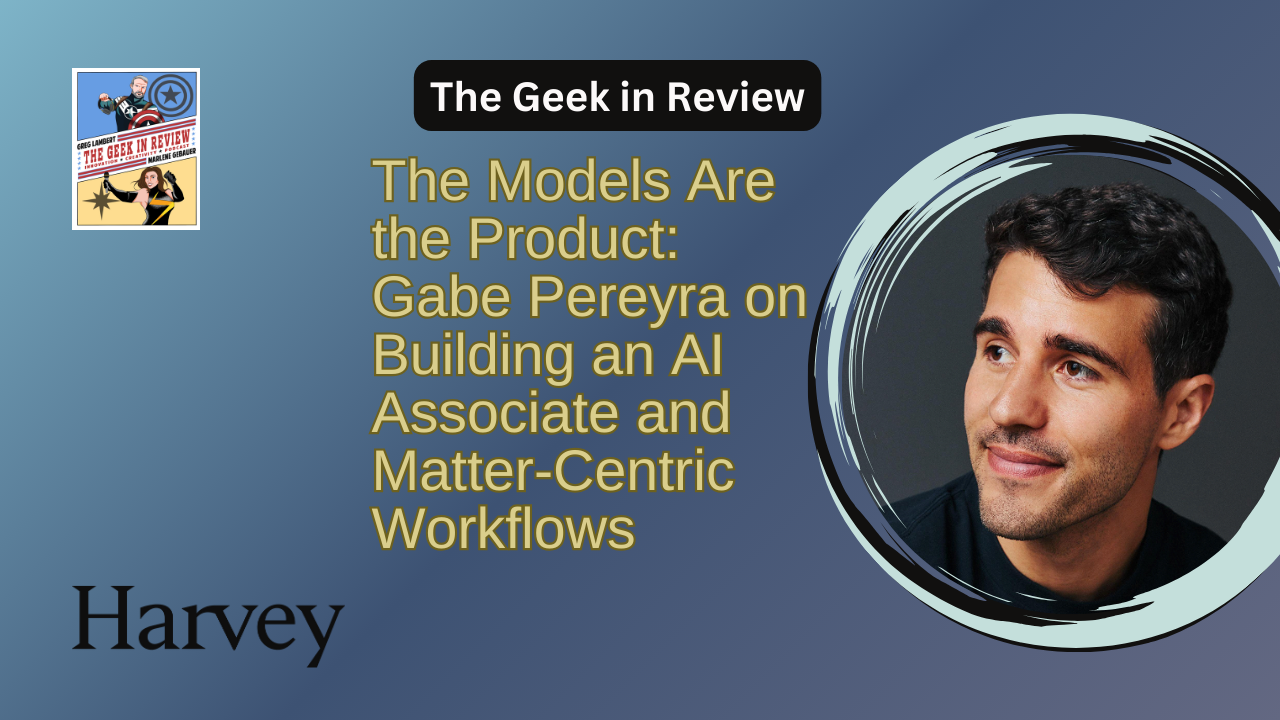
This week, we talk with Gabe Pereyra, President and co-founder at Harvey, about his path from DeepMind and Google Brain to launching Harvey with Winston Weinberg; how a roommate’s real-world legal workflows met early GPT-4 access and OpenAI backing; why legal emerged as the right domain for large models; and how personal ties to the profession plus a desire to tackle big societal problems shaped a mission to apply advanced AI where language and law intersect.

Gabe’s core thesis lands hard, “the models are the product.” Rather than narrow tools for single tasks, Harvey opted for a broad assistant approach. Lawyers live in text and email, so dialog becomes the control surface, an “AI associate” supporting partners and teams. Early demos showed useful output across many tasks, which reinforced a generalist design, then productized connections into Outlook and Word, plus a no-code Workflow Builder.

Go-to-market strategy flipped the usual script. Instead of starting small, Harvey partnered early with Allen & Overy and leaders like David Wakeling. Large firms supplied layered review, which reduced risk from model errors and increased learning velocity. From there the build list grew, security and data privacy, dedicated capacity, links to firm systems, case law, DMS, data rooms, and eDiscovery. A matter workspace sits at the center. Adoption rises with surface area, with daily activity approaching seventy percent where four or more product surfaces see regular use. ROI work now includes analysis of write-offs and specialized workflows co-built with firms and clients, for example Orrick, A&O, and PwC.

Talent, training, and experience value come next. Firms worry about job paths, and Gabe does not duck that concern. Models handle complex work, which raises anxiety, yet also shortens learning curves. Harvey collaborates on curricula using past deals, plus partnerships with law schools. Return on experience shows up in recruiting, PwC reports stronger appeal among early-career talent, and quality-of-life gains matter. On litigation use cases, chronology builders require firm expertise and guardrails, with evaluation methods that mirror how senior associates review junior output. Frequent use builds a mental model for where errors tend to appear.

Partnerships round out the strategy. Research content from LexisNexis and Wolters Kluwer, work product in iManage and NetDocuments, CLM workflows via Ironclad, with plans for data rooms, eDiscovery, and billing. Vision extends to a complete matter management service, emails, documents, prior work, evaluation, billing links, and strict ethical walls, all organized by client-matter. Global requirements drive multi-region storage and controls, including Australia’s residency rules. The forward look centers on differentiation through customization, firms encode expertise into models, workflows, and agents, then deliver outcomes faster and at software margins. “The value sits in your people,” Gabe says, and firms that convert know-how into systems will lead the pack.

Listen on mobile platforms:  ⁠⁠⁠⁠⁠⁠⁠⁠⁠⁠⁠⁠⁠⁠Apple Podcasts⁠⁠⁠⁠⁠⁠⁠⁠⁠⁠⁠⁠⁠⁠ |  ⁠⁠⁠⁠⁠⁠⁠⁠⁠⁠⁠⁠⁠⁠Spotify⁠⁠⁠⁠⁠⁠⁠⁠⁠⁠⁠⁠⁠⁠ | ⁠⁠⁠⁠⁠⁠⁠⁠⁠⁠⁠⁠⁠YouTube⁠⁠⁠⁠⁠⁠⁠⁠⁠⁠

[Special Thanks to Legal Technology Hub for their sponsoring this episode.]

⁠⁠⁠Email: geekinreviewpodcast@gmail.com
Music: ⁠⁠⁠⁠⁠⁠⁠⁠⁠⁠⁠⁠⁠⁠⁠⁠⁠Jerry David DeCicca⁠⁠⁠⁠⁠⁠⁠⁠⁠

Transcript

Continue Reading The Models Are the Product: Gabe Pereyra on Building an AI Associate and Matter-Centric Workflows

This week, we welcome back Kara Peterson and Rich DiBona of Descrybe to talk about the company’s rapid growth and its expanding role in legal research. Since their last appearance, Descrybe has not only built out new tools but also entered academia by joining the curriculum of more than 350 universities around the world. Kara reflects on her earlier career in legal education and how this new partnership feels like coming full circle. Together, she and Rich share how Descrybe is positioning itself to fill the gap left by other providers while keeping affordability and accessibility at the core of their mission.

A major highlight of the discussion is Descrybe’s unique approach to legal citators. Unlike traditional tools that often provide a blunt “treatment” of a case, Descrybe’s citator allows issue-level analysis and even introduces a “backwards citator.” This means researchers can see not only how later courts interpreted a case but also how the judges who wrote the opinion cited and treated earlier authorities. Rich explains the technical challenges involved in training their system on 30 million citations, while Kara describes how these innovations give researchers new storytelling and analytical power when building arguments.

The conversation also dives into the Legal Research Toolkit, Descrybe’s paid tier that offers a collection of tools designed for professionals who need more advanced case law analysis. While the company continues to provide free access to its core research platform, the toolkit adds features such as issue explorers and advanced citator functions. Kara emphasizes the company’s deliberately simple pricing model, which prioritizes trust and accessibility. At just $10 a month for non-commercial use and $20 for commercial users, the service is priced more like everyday software than the traditional high-cost legal research platforms.

The discussion moves into broader industry trends, including the wave of acquisitions by major players like Thomson Reuters and Clio. Kara and Rich note that while consolidation is reshaping the market, it also leaves space for new entrants to innovate. With data becoming the most valuable commodity in legal tech, Descrybe is building curated and clean datasets across statutes, regulations, state constitutions, and even attorney general opinions. Both guests highlight the importance of accuracy, data hygiene, and minimizing hallucinations, explaining how their closed-system approach helps ensure that results remain grounded in actual legal documents rather than speculative AI outputs.

Finally, the episode touches on ethics, recognition, and the future. Descrybe recently won the Anthem Award for Ethical AI, a nod to its safeguards against hallucinations and commitment to transparent data practices. At ILTACon, the team found themselves impressing not only potential clients but also leaders from larger companies who were curious about how such a lean startup was able to achieve so much. Looking ahead, Kara predicts the pace of change in legal technology will only accelerate, challenging law firms to keep up, while Rich warns of the commoditization of AI capabilities and stresses the importance of staying ahead of the curve. Together, they bring both humor and insight, reminding listeners that the legal research market is shifting quickly and that affordability, accuracy, and ethics will shape its next chapter.

Listen on mobile platforms:  ⁠⁠⁠⁠⁠⁠⁠⁠⁠⁠⁠⁠⁠⁠Apple Podcasts⁠⁠⁠⁠⁠⁠⁠⁠⁠⁠⁠⁠⁠⁠ |  ⁠⁠⁠⁠⁠⁠⁠⁠⁠⁠⁠⁠⁠⁠Spotify⁠⁠⁠⁠⁠⁠⁠⁠⁠⁠⁠⁠⁠⁠ | ⁠⁠⁠⁠⁠⁠⁠⁠⁠⁠⁠⁠⁠YouTube⁠⁠⁠⁠⁠⁠⁠⁠⁠⁠

[Special Thanks to Legal Technology Hub for their sponsoring this episode.]

Blue Sky: ⁠@geeklawblog.com⁠ ⁠@marlgeb⁠
⁠⁠⁠⁠⁠Email: geekinreviewpodcast@gmail.com
Music: ⁠⁠⁠⁠⁠⁠⁠⁠⁠⁠⁠⁠⁠⁠⁠⁠⁠Jerry David DeCicca⁠⁠⁠⁠⁠⁠⁠⁠⁠

Transcript:

Continue Reading The Cytator Strikes Back: Kara Peterson & Rich DiBona On Descrybe’s Fresh Take on Legal Research