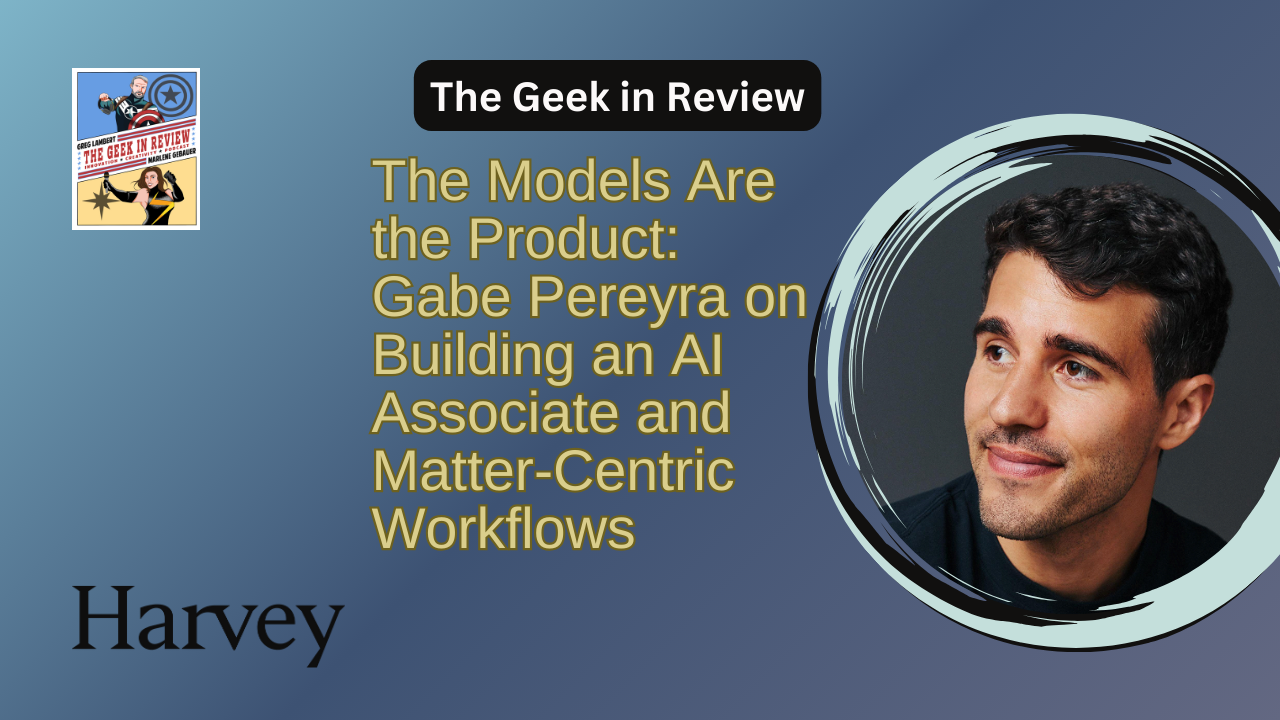
This week, we talk with Gabe Pereyra, President and co-founder at Harvey, about his path from DeepMind and Google Brain to launching Harvey with Winston Weinberg; how a roommate’s real-world legal workflows met early GPT-4 access and OpenAI backing; why legal emerged as the right domain for large models; and how personal ties to the profession plus a desire to tackle big societal problems shaped a mission to apply advanced AI where language and law intersect.

Gabe’s core thesis lands hard, “the models are the product.” Rather than narrow tools for single tasks, Harvey opted for a broad assistant approach. Lawyers live in text and email, so dialog becomes the control surface, an “AI associate” supporting partners and teams. Early demos showed useful output across many tasks, which reinforced a generalist design, then productized connections into Outlook and Word, plus a no-code Workflow Builder.

Go-to-market strategy flipped the usual script. Instead of starting small, Harvey partnered early with Allen & Overy and leaders like David Wakeling. Large firms supplied layered review, which reduced risk from model errors and increased learning velocity. From there the build list grew, security and data privacy, dedicated capacity, links to firm systems, case law, DMS, data rooms, and eDiscovery. A matter workspace sits at the center. Adoption rises with surface area, with daily activity approaching seventy percent where four or more product surfaces see regular use. ROI work now includes analysis of write-offs and specialized workflows co-built with firms and clients, for example Orrick, A&O, and PwC.

Talent, training, and experience value come next. Firms worry about job paths, and Gabe does not duck that concern. Models handle complex work, which raises anxiety, yet also shortens learning curves. Harvey collaborates on curricula using past deals, plus partnerships with law schools. Return on experience shows up in recruiting, PwC reports stronger appeal among early-career talent, and quality-of-life gains matter. On litigation use cases, chronology builders require firm expertise and guardrails, with evaluation methods that mirror how senior associates review junior output. Frequent use builds a mental model for where errors tend to appear.

Partnerships round out the strategy. Research content from LexisNexis and Wolters Kluwer, work product in iManage and NetDocuments, CLM workflows via Ironclad, with plans for data rooms, eDiscovery, and billing. Vision extends to a complete matter management service, emails, documents, prior work, evaluation, billing links, and strict ethical walls, all organized by client-matter. Global requirements drive multi-region storage and controls, including Australia’s residency rules. The forward look centers on differentiation through customization, firms encode expertise into models, workflows, and agents, then deliver outcomes faster and at software margins. “The value sits in your people,” Gabe says, and firms that convert know-how into systems will lead the pack.

Listen on mobile platforms:  ⁠⁠⁠⁠⁠⁠⁠⁠⁠⁠⁠⁠⁠⁠Apple Podcasts⁠⁠⁠⁠⁠⁠⁠⁠⁠⁠⁠⁠⁠⁠ |  ⁠⁠⁠⁠⁠⁠⁠⁠⁠⁠⁠⁠⁠⁠Spotify⁠⁠⁠⁠⁠⁠⁠⁠⁠⁠⁠⁠⁠⁠ | ⁠⁠⁠⁠⁠⁠⁠⁠⁠⁠⁠⁠⁠YouTube⁠⁠⁠⁠⁠⁠⁠⁠⁠⁠

[Special Thanks to Legal Technology Hub for their sponsoring this episode.]

⁠⁠⁠Email: geekinreviewpodcast@gmail.com
Music: ⁠⁠⁠⁠⁠⁠⁠⁠⁠⁠⁠⁠⁠⁠⁠⁠⁠Jerry David DeCicca⁠⁠⁠⁠⁠⁠⁠⁠⁠

Transcript

Continue Reading The Models Are the Product: Gabe Pereyra on Building an AI Associate and Matter-Centric Workflows

This week we are joined by Patrick DiDomenico and Kevin Klein, two longtime builders of knowledge programs and legal tech gatherings. They walk through the evolution of KM&I for Legal, now entering year three, and the debut of its co-located counterpart, Legal Tech Connect. Both events run in New York on October 22 and 23, with a single community, two distinct agendas, and one big goal, stronger conversations across buyers, builders, and backers of legal tech.

Patrick traces the roots, from the ARK KM era to the launch of KM\&I, then to twisting Kevin’s arm to join as a producer. A larger home opened the door to ambitious programming, Ease Hospitality at 3rd and 40th near Grand Central. Think bright rooms, live plants, strong AV, plenty of seating, and an adjacent tenant lounge with coffee, terrace, and breakout nooks. Lessons from last year show up in smart touches, an overflow room streaming the main stage for those who need to handle calls or email without missing core content, longer breaks for real conversations, and, yes, food worthy of repeat trips.

Format matters here. KM&I holds firm on peer-to-peer sessions led by law firm professionals. Providers participate through tight five-minute spotlights between talks, plus optional demo rooms during generous coffee breaks and lunch. Legal Tech Connect flips the lens, product stories on stage, founder journeys, market forces, and regulatory themes. A crossover ticket lets attendees roam freely between both programs. Breakouts return by popular demand, a C-suite roundtable, KM 101 for newcomers, a track for KM attorneys and PSLs, and a managers and directors forum that grew from attendee feedback.

Themes thread across both days. ROI from AI and KM tools appears throughout, from data strategy as a differentiator to co-development case studies. Expect a lively take on the rise of the legal engineer, with skills for scaling tools and driving adoption, plus a frank discussion about where these roles sit inside firms. Professor Michele DiStefano opens with client centricity, drawing on her research and book, with every attendee receiving a copy. She then moderates a session at Legal Tech Connect on how legal tech companies sell to law firms, bridging provider goals with buyer needs. Another panel stages the AI conversation among a partner, pricing director, client, and innovation lead, a timely look at value, billing, and collaboration.

The bigger story is community. Patrick and Kevin highlight the peer network that forms in hallways and over coffee, mentors found by chance, and ideas that travel home in workable form. Legal Tech Connect brings investors and founders into the mix, which raises the quality of dialogue on funding, product focus, and adoption. Looking ahead, they predict fewer conferences, higher quality bars, and a shift toward substance over appearance. Listeners who want more details, including registration, should visit kmniforlegal.com and legaltechconnect.com. The two events sit side by side in October, and the goal is simple, leave with practical ideas, new contacts, and a clearer view of where legal innovation heads next.

Listen on mobile platforms:  ⁠⁠⁠⁠⁠⁠⁠⁠⁠⁠⁠⁠⁠⁠Apple Podcasts⁠⁠⁠⁠⁠⁠⁠⁠⁠⁠⁠⁠⁠⁠ |  ⁠⁠⁠⁠⁠⁠⁠⁠⁠⁠⁠⁠⁠⁠Spotify⁠⁠⁠⁠⁠⁠⁠⁠⁠⁠⁠⁠⁠⁠ | ⁠⁠⁠⁠⁠⁠⁠⁠⁠⁠⁠⁠⁠YouTube⁠⁠⁠⁠⁠⁠⁠⁠⁠⁠

[Special Thanks to Legal Technology Hub for their sponsoring this episode.]

Blue Sky: ⁠@geeklawblog.com⁠ ⁠@marlgeb⁠
⁠⁠⁠⁠⁠Email: geekinreviewpodcast@gmail.com
Music: ⁠⁠⁠⁠⁠⁠⁠⁠⁠⁠⁠⁠⁠⁠⁠⁠⁠Jerry David DeCicca⁠⁠⁠⁠⁠⁠⁠⁠⁠

Transcript:

Continue Reading KM&I Meets Legal Tech Connect: Two Tracks, One Community with Patrick DiDomenico and Kevin Klein

This week, we welcome back Kara Peterson and Rich DiBona of Descrybe to talk about the company’s rapid growth and its expanding role in legal research. Since their last appearance, Descrybe has not only built out new tools but also entered academia by joining the curriculum of more than 350 universities around the world. Kara reflects on her earlier career in legal education and how this new partnership feels like coming full circle. Together, she and Rich share how Descrybe is positioning itself to fill the gap left by other providers while keeping affordability and accessibility at the core of their mission.

A major highlight of the discussion is Descrybe’s unique approach to legal citators. Unlike traditional tools that often provide a blunt “treatment” of a case, Descrybe’s citator allows issue-level analysis and even introduces a “backwards citator.” This means researchers can see not only how later courts interpreted a case but also how the judges who wrote the opinion cited and treated earlier authorities. Rich explains the technical challenges involved in training their system on 30 million citations, while Kara describes how these innovations give researchers new storytelling and analytical power when building arguments.

The conversation also dives into the Legal Research Toolkit, Descrybe’s paid tier that offers a collection of tools designed for professionals who need more advanced case law analysis. While the company continues to provide free access to its core research platform, the toolkit adds features such as issue explorers and advanced citator functions. Kara emphasizes the company’s deliberately simple pricing model, which prioritizes trust and accessibility. At just $10 a month for non-commercial use and $20 for commercial users, the service is priced more like everyday software than the traditional high-cost legal research platforms.

The discussion moves into broader industry trends, including the wave of acquisitions by major players like Thomson Reuters and Clio. Kara and Rich note that while consolidation is reshaping the market, it also leaves space for new entrants to innovate. With data becoming the most valuable commodity in legal tech, Descrybe is building curated and clean datasets across statutes, regulations, state constitutions, and even attorney general opinions. Both guests highlight the importance of accuracy, data hygiene, and minimizing hallucinations, explaining how their closed-system approach helps ensure that results remain grounded in actual legal documents rather than speculative AI outputs.

Finally, the episode touches on ethics, recognition, and the future. Descrybe recently won the Anthem Award for Ethical AI, a nod to its safeguards against hallucinations and commitment to transparent data practices. At ILTACon, the team found themselves impressing not only potential clients but also leaders from larger companies who were curious about how such a lean startup was able to achieve so much. Looking ahead, Kara predicts the pace of change in legal technology will only accelerate, challenging law firms to keep up, while Rich warns of the commoditization of AI capabilities and stresses the importance of staying ahead of the curve. Together, they bring both humor and insight, reminding listeners that the legal research market is shifting quickly and that affordability, accuracy, and ethics will shape its next chapter.

Listen on mobile platforms:  ⁠⁠⁠⁠⁠⁠⁠⁠⁠⁠⁠⁠⁠⁠Apple Podcasts⁠⁠⁠⁠⁠⁠⁠⁠⁠⁠⁠⁠⁠⁠ |  ⁠⁠⁠⁠⁠⁠⁠⁠⁠⁠⁠⁠⁠⁠Spotify⁠⁠⁠⁠⁠⁠⁠⁠⁠⁠⁠⁠⁠⁠ | ⁠⁠⁠⁠⁠⁠⁠⁠⁠⁠⁠⁠⁠YouTube⁠⁠⁠⁠⁠⁠⁠⁠⁠⁠

[Special Thanks to Legal Technology Hub for their sponsoring this episode.]

Blue Sky: ⁠@geeklawblog.com⁠ ⁠@marlgeb⁠
⁠⁠⁠⁠⁠Email: geekinreviewpodcast@gmail.com
Music: ⁠⁠⁠⁠⁠⁠⁠⁠⁠⁠⁠⁠⁠⁠⁠⁠⁠Jerry David DeCicca⁠⁠⁠⁠⁠⁠⁠⁠⁠

Transcript:

Continue Reading The Cytator Strikes Back: Kara Peterson & Rich DiBona On Descrybe’s Fresh Take on Legal Research

In this episode of The Geek in Review, we welcome back Pablo Arredondo, VP of CoCounsel at Thomson Reuters, along with Joel Hron, the company’s CTO. The conversation centers on the recent release of ChatGPT-5 and the rise of “reasoning models” that go beyond traditional language models’ limitations. Pablo reflects on his years of tracking neural net progress in the legal field, from escaping “keyword prison” to the current ability of AI to handle complex, multi-step legal reasoning. He describes scenarios where entire litigation records could be processed to map out strategies for summary judgment motions, calling it a transformative step toward what he sees as “celestial legal products.”

Joel brings an engineering perspective, comparing the legal sector’s AI trajectory to the rapid advancements in AI developer tools. He notes that these tools have historically amplified the skills of top performers rather than leveling the playing field. Applied to law, he believes AI will free lawyers from rote work and allow them to focus on higher-value decisions and strategy. The discussion shifts to Deep Research, Thomson Reuters’ latest enhancement for CoCounsel, which leverages reasoning models in combination with domain-specific tools like KeyCite to follow “breadcrumb trails” through case law with greater accuracy and transparency.

The trio explores the growing importance of transparency and verification in AI-driven research. Joel explains how Deep Research provides real-time visibility into an AI’s reasoning path, highlights potentially hallucinated citations, and integrates verification tools to cross-check references against authoritative databases. Pablo adds historical and philosophical perspective, likening hallucinations to a tiger “going tiger,” stressing that while the risk cannot be eliminated, the technology already catches a significant number of human errors. Both agree that AI tools must be accompanied by human oversight and well-designed workflows to build trust in their output.

The conversation also delves into the challenges of guardrails and governance in AI. Joel describes the balance between constraining AI for accuracy and keeping it flexible enough to handle diverse user needs. He introduces the concept of varying the “leash length” on AI agency depending on the task—shorter for structured workflows, longer for open-ended research. Pablo challenges the legal information community to break down silos between disciplines like eDiscovery, research, and litigation, envisioning a unified information ecosystem that AI could navigate seamlessly.

Looking to the future, Joel predicts that the adoption of AI agents will reshape organizational talent strategies, elevating the importance of those who excel at complex decision-making. Pablo proposes “ambient AI” as the next frontier—intelligent systems that unobtrusively monitor legal work, flagging potential issues instantly, much like a spellchecker. Both caution that certain legal tasks, especially in judicial opinion drafting, warrant careful consideration before fully integrating AI. The episode closes with practical insights on staying current, from following AI researchers on social platforms to reading technical blogs and academic papers, underscoring the need for informed engagement in this rapidly evolving space.

Listen on mobile platforms:  ⁠⁠⁠⁠⁠⁠⁠⁠⁠⁠⁠⁠⁠⁠Apple Podcasts⁠⁠⁠⁠⁠⁠⁠⁠⁠⁠⁠⁠⁠⁠ |  ⁠⁠⁠⁠⁠⁠⁠⁠⁠⁠⁠⁠⁠⁠Spotify⁠⁠⁠⁠⁠⁠⁠⁠⁠⁠⁠⁠⁠⁠ | ⁠⁠⁠⁠⁠⁠⁠⁠⁠⁠⁠⁠⁠YouTube⁠⁠⁠⁠⁠⁠⁠⁠⁠⁠

[Special Thanks to Legal Technology Hub for their sponsoring this episode.]

Blue Sky: ⁠@geeklawblog.com⁠ ⁠@marlgeb⁠
⁠⁠⁠⁠⁠Email: geekinreviewpodcast@gmail.com
Music: ⁠⁠⁠⁠⁠⁠⁠⁠⁠⁠⁠⁠⁠⁠⁠⁠⁠Jerry David DeCicca⁠⁠⁠⁠⁠⁠⁠⁠⁠

Guest’s Go-To Resources:

Blue Sky: ⁠@geeklawblog.com⁠ ⁠@marlgeb⁠
⁠⁠⁠⁠⁠Email: geekinreviewpodcast@gmail.com
Music: ⁠⁠⁠⁠⁠⁠⁠⁠⁠⁠⁠⁠⁠⁠⁠⁠⁠Jerry David DeCicca⁠⁠⁠⁠⁠⁠⁠⁠⁠

Transcript

Continue Reading Pablo Arredondo and Joel Hron on Reasoning Models, Deep Research, and the Future of Legal AI

This week, we sit down with Ilona Logvinova, Director of Practice Innovation at Cleary Gottlieb, and Max Junestrand, CEO and Founder of Legora, for a deep dive into how their partnership is reshaping the legal landscape through AI-driven innovation. The conversation kicks off with the origin story behind Cleary’s strategic alliance with Legora, a legal tech platform focused on collaborative, AI-first workflows. The two share how this relationship, built on a year-long pilot and mutual alignment in vision, is now delivering real-world benefits across Cleary’s legal teams.

Max walks listeners through the evolution of Legora’s product suite, which includes a general-purpose assistant, tabular contract review, and a Microsoft Word plugin, all wrapped into a seamless collaborative workspace. Ilona elaborates on Cleary’s multi-pronged AI strategy, emphasizing a hybrid approach that integrates both in-house tools (such as Springbok AI) and external partnerships like Legora. This merger of internal and external capabilities reflects a broader shift in legal innovation—from static solutions to agile, embedded systems designed for continuous learning and adaptation.

One major theme explored is the shift in legal AI from isolated tools to interoperable ecosystems. Max stresses the importance of collaboration and avoiding silos, pointing to a future where legal tech isn’t just smarter, but also more connected. Ilona reinforces this by describing Cleary’s vision of AI as a co-worker, not a replacement, likening AI oversight to supervising junior associates. The goal, they argue, isn’t to eliminate human involvement, but to elevate it—using AI to take over repetitive tasks while freeing lawyers to focus on high-value strategy and creativity.

The episode also covers practical aspects of deployment and adoption, offering insight into why Cleary’s rollout has been so successful. Ilona credits the intuitive design and high-value use cases as key drivers of firmwide engagement. From Zoom calls with 1,000 attendees to chatbots that feel more like using Google than enterprise software, Cleary’s AI integration strategy is centered on simplicity, accessibility, and a relentless focus on user experience. The team’s use of analytics and continuous feedback loops further ensures the platform evolves to meet real-world needs.

In the crystal ball finale, Max and Ilona speculate on what’s next. Max anticipates a dramatic consolidation in user experience across legal tech platforms, driven by agents and large language models that enable seamless workflows. Ilona envisions a future shaped by AI-native infrastructure and even screenless computing environments, where collaboration is immersive and spatial rather than tethered to screens. Their shared message is clear: the future of legal work is collaborative, AI-enhanced, and closer than we think. Whether you’re a tech-savvy partner or a cautious associate, this episode offers a compelling look at how forward-thinking firms are already building the legal practice of tomorrow.

Listen on mobile platforms:  ⁠⁠⁠⁠⁠⁠⁠⁠⁠⁠⁠⁠⁠⁠Apple Podcasts⁠⁠⁠⁠⁠⁠⁠⁠⁠⁠⁠⁠⁠⁠ |  ⁠⁠⁠⁠⁠⁠⁠⁠⁠⁠⁠⁠⁠⁠Spotify⁠⁠⁠⁠⁠⁠⁠⁠⁠⁠⁠⁠⁠⁠ | ⁠⁠⁠⁠⁠⁠⁠⁠⁠⁠⁠⁠⁠YouTube⁠⁠⁠⁠⁠⁠⁠⁠⁠⁠

[Special Thanks to Legal Technology Hub for their sponsoring this episode.]

https://youtu.be/vkt8mU0WtVU

Blue Sky: ⁠@geeklawblog.com⁠ ⁠@marlgeb⁠
⁠⁠⁠⁠⁠Email: geekinreviewpodcast@gmail.com
Music: ⁠⁠⁠⁠⁠⁠⁠⁠⁠⁠⁠⁠⁠⁠⁠⁠⁠Jerry David DeCicca⁠⁠⁠⁠⁠⁠⁠⁠⁠

Transcript

Continue Reading Max Junestrand and Ilona Loginova: How Cleary Gottlieb and Legora Are Redefining Legal Work

This week on The Geek in Review podcast Marlene Gebauer and Greg Lambert featured guests Colin Levy, Ashley Carlisle, and Dorna Moini discussing Levy’s recently published book “Handbook of Legal Tech.” Levy edited the book and contributors included Moini, Carlisle’s CEO, Tony Thai, and many more legal technology experts. The book provides an overview of key technologies transforming the legal industry like automation, AI, blockchain, document automation, CLM, and more.

Levy shared how he ended up editing the book, describing it as “herding cats” to get busy experts to contribute chapters. He wanted the book to serve as a comprehensive introduction to legal tech, with each chapter written by leaders in the various subject matter areas. Carlisle and Moini explained their motivations for taking time out of their demanding schedules to write chapters – spreading knowledge to help move the industry forward and impart insights from their work.

The guests reflected on their favorite parts of the experience. Levy enjoyed bringing together the community and seeing different perspectives. Carlisle appreciated being able to consolidate information on contract lifecycle management. Moini was proud to contribute right before having a baby. Lambert highlighted Levy juggling this book and writing his own solo book on legal tech stories from the front lines.

The guests offered advice to law students and lawyers looking to learn about and leverage legal tech. Carlisle emphasized starting with an open mind, intentional research, and reading widely from legal tech thought leaders. Moini recommended thinking big but starting small with iterative implementation. Levy stressed knowing your purpose and motivations to stay focused amidst the vast array of options.

Lambert prompted the guests to identify low-hanging fruit legal technologies those new to practice should focus on. Levy pointed to document automation and AI. Moini noted that intake and forms digitization can be a first step for laggards. Carlisle advised starting small with discrete tasks before tackling advanced tools.

For their forward-looking predictions, Carlisle saw AI hype fading but increasing tech literacy, Levy predicted growing focus on use and analysis of data as AI advances, and Moini forecasted a rise in online legal service delivery. The guests are excited about spreading awareness through the book to help transform the legal industry.

LINKS:

Listen on mobile platforms:  ⁠Apple Podcasts⁠ |  ⁠Spotify⁠ | YouTube (NEW!)

Contact Us: 

Twitter: ⁠⁠⁠⁠⁠@gebauerm⁠⁠⁠⁠⁠, or ⁠⁠⁠⁠⁠@glambert⁠⁠⁠⁠⁠

Threads: @glambertpod or @gebauerm66

Email: geekinreviewpodcast@gmail.com

Music: ⁠⁠⁠⁠⁠Jerry David DeCicca⁠⁠⁠⁠

Transcript:Continue Reading Colin Levy, Dorna Moini, and Ashley Carlisle on Herding Cats and Heralding Change: The Inside Scoop on the “Handbook of Legal Tech”

On this episode of The Geek in Review, hosts Marlene Gebauer and Greg Lambert delve into how AI can transform legal writing with ClearBrief founder and CEO Jacqueline Schafer. As a former litigator, Schafer experienced firsthand the frustrating scramble to finalize briefs and prepare filings. She founded ClearBrief in 2020 to leverage AI to analyze documents and suggest relevant evidence and citations to streamline drafting.

ClearBrief integrates into Microsoft Word to align with lawyers’ existing workflows. By uploading case documents and discovery materials, the AI can pull facts and quotes directly from the record to support legal arguments in the brief. New features even generate chronologies and timelines from case files automatically. Schafer explains the AI doesn’t hallucinate text from scratch, avoiding ethical pitfalls. Rigorous security and confidentiality controls provide the trust needed to gain adoption at top law firms.

According to Schafer, attorneys now exhibit much greater openness to tailored AI tools that enhance productivity versus disrupting their workflows entirely. Younger associates and paralegals tend to be most enthusiastic about the technology while firm leadership lags. She believes empowering the next generation of legal professionals with AI will modernize law practice to better serve unmet needs.

Looking ahead, Schafer expects to expand ClearBrief’s features to assist paralegals along with corporate attorneys beyond litigation. By leveraging AI to handle tedious tasks like cite-checking, lawyers can focus their time on high-value analysis and strategy. With the aid of trusted AI writing assistants, attorneys can craft compelling briefs and filings more efficiently while still verifying the underlying sources.

Listen on mobile platforms:  ⁠Apple Podcasts⁠ |  ⁠Spotify⁠ | YouTube (NEW!)

Contact Us: 

Twitter: ⁠⁠⁠⁠⁠@gebauerm⁠⁠⁠⁠⁠, or ⁠⁠⁠⁠⁠@glambert⁠⁠⁠⁠⁠

Threads: @glambertpod or @gebauerm66

Email: geekinreviewpodcast@gmail.com

Music: ⁠⁠⁠⁠⁠Jerry David DeCicca⁠⁠⁠⁠

Transcript:Continue Reading Jacqueline Schafer on Writing Briefs at the Speed of AI: How ClearBrief is Transforming Legal Drafting

On this episode of The Geek in Review, hosts Marlene Gebauer and Greg Lambert interview Thomas Suh, Founder and CEO, and Ken Block, Senior Account Executive of LegalMation. The company provides AI-powered tools to help litigators automate repetitive tasks and work more efficiently. The conversation focuses on LegalMation’s products, overcoming resistance to adopting new legal tech, and predictions for the future evolution of legal service delivery.

Suh provides background on founding LegalMation about seven years ago to help streamline the “scut work” litigation associates spend time on. The flagship product automates drafting responses to lawsuits, discovery requests, demand letters, and more by leveraging a firm’s historical data. LegalMation initially built an automation tool internally at a law firm before deciding to spin it off into a standalone legal tech company. The product found an early champion in the form of a corporate legal department interested in licensing it. Today, LegalMation serves large corporate legal departments, law firms, and insurance companies.

Suh and Block discuss common roadblocks to adopting new legal technology like lack of trust and skepticism. Suh notes the importance of identifying the right use cases where efficiency gains matter most. For high-stakes litigation, efficiency may be less of a concern than for high-volume routine matters. Corporate legal departments are often early adopters because they are focused on efficiency and supplementing personnel. Law firms still incentivized by billable hours may be warier of efficiency gains.

For the YouTube Viewers, Block demonstrates LegalMation’s Response Creator tool for automating drafting of responses to complaints and discovery requests. The AI leverages a firm’s historical data to maintain proper tone and style while speeding up document preparation significantly. Lawyers can still review and edit the AI-generated drafts before finalizing. Suh explains that because the AI relies solely on a firm’s data, it maintains consistency rather than attempting to generate random creative language.

Looking ahead, Suh predicts that the litigation process will become more modular, with different firms or providers specializing in discrete phases rather than handling a case end-to-end. Block emphasizes that younger lawyers expect to leverage more technology and are unwilling to slog through repetitive manual tasks, which will force law firms to adapt. Technology stacks and automation will become selling points for recruiting top young talent.

Listen on mobile platforms:  ⁠Apple Podcasts⁠ |  ⁠Spotify⁠ | YouTube (NEW!)

Contact Us: 

Twitter: ⁠⁠⁠⁠⁠@gebauerm⁠⁠⁠⁠⁠, or ⁠⁠⁠⁠⁠@glambert⁠⁠⁠⁠⁠

Threads: @glambertpod or @gebauerm66

Voicemail: 713-487-7821

Email: geekinreviewpodcast@gmail.com

Music: ⁠⁠⁠⁠⁠Jerry David DeCicca⁠⁠⁠⁠

Transcript

Continue Reading Thomas Suh and Ken Block on How LegalMation is Revolutionizing Litigation Efficiency (TGIR Ep. 222)

In this episode of The Geek in Review, hosts Marlene Gebauer and Greg Lambert have an illuminating discussion with Christina Wojcik, the new Managing Director of Corporate for LexFusion. Christina has over 20 years of experience pioneering innovation in the legal services and technology space.

The conversation covers Christina’s diverse background and journey into legal tech, including formative experiences at companies like Pangea3, IBM, Seal Software, and Citi. She shares key lessons learned about the importance of visionary leadership, solving real client problems, and embracing a fearless, entrepreneurial spirit.

Christina provides insights into top pain points for legal departments today, especially at highly regulated organizations like major banks. She discusses the cautious approach many are taking with emergent technologies like generative AI—treating it like a “monster behind the door” to be carefully studied before fully unleashing.

Christina advocates for “failing fast” when testing innovations, allowing for rapid iteration in a safe sandbox environment. She explains her rationale for joining LexFusion and how she hopes to leverage her well-rounded expertise to drive value for legal tech providers and clients alike.

The conversation concludes with Christina’s predictions for the legal industry’s evolution in areas like AI adoption, CLM consolidation, and new service delivery models. She provides a fascinating insider perspective on the future of legal innovation.

Listen on mobile platforms:  ⁠Apple Podcasts⁠ |  ⁠Spotify⁠ | YouTube (NEW!)

Contact Us: 

Twitter: ⁠⁠⁠⁠⁠@gebauerm⁠⁠⁠⁠⁠, or ⁠⁠⁠⁠⁠@glambert⁠⁠⁠⁠⁠
Threads: @glambertpod or @gebauerm66
Voicemail: 713-487-7821
Email: geekinreviewpodcast@gmail.com
Music: ⁠⁠⁠⁠⁠Jerry David DeCicca⁠⁠⁠⁠

Transcript

Continue Reading Unleashing the Legal Monster Behind the Door – LexFusion’s Christina Wojcik (TGIR Ep. 221)