
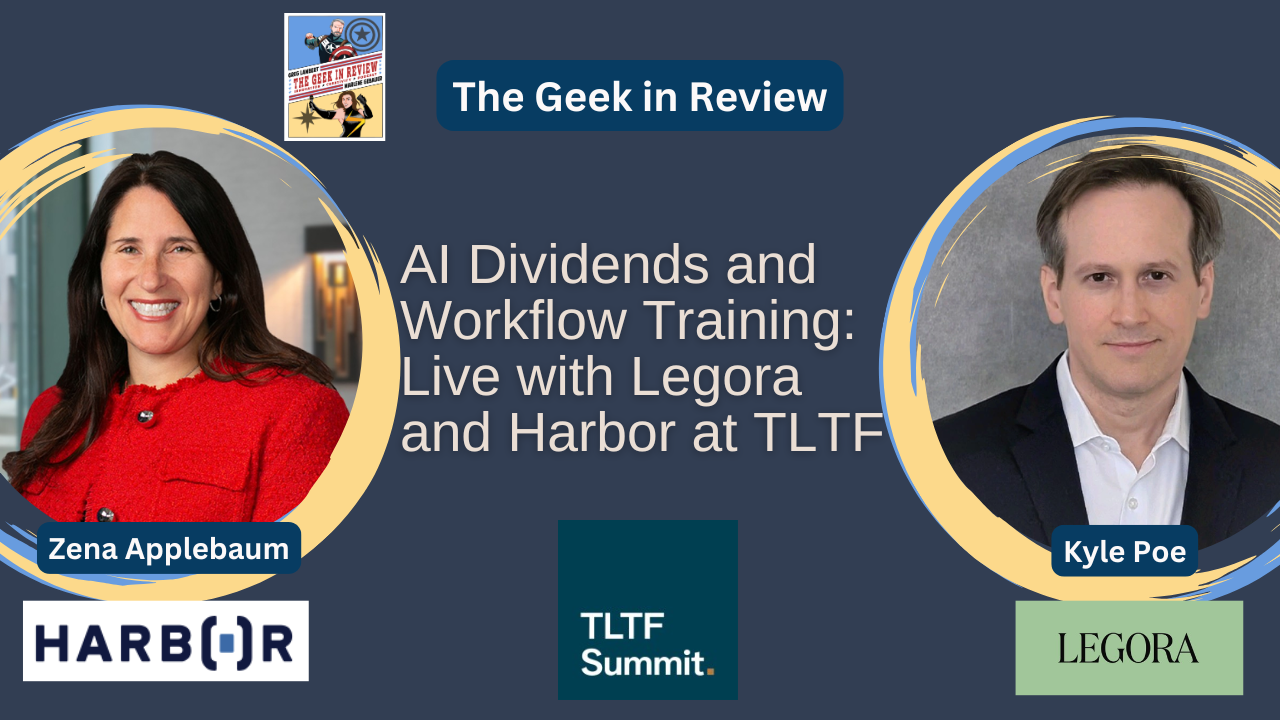
We recorded this episode live at the TLTF Summit and the energy in the room made it feel like the perfect place for a conversation about growth, training, and the rapid climb of legal tech. We grabbed our gear, claimed a corner in the podcast room, and pulled in two guests with front row seats to the changes hitting the industry. Joining us were Kyle Poe from Legora and our friend and guest host, Zena Applebaum of Harbor. The Summit attracts a focused group of founders, investors, and leaders, and the four of us jumped straight into what this event represents and what attendees hope to get from it.
Kyle had been on the job for only two months, but Legora moves at a pace that feels closer to dog years. In that short time the team doubled, a new round of funding closed, and the company introduced a major product release. Kyle walked us through Legora’s new Portal experience, which brings clients inside the legal workflow in a controlled, collaborative environment. Instead of long email chains and static work product, the Portal supports shared editing, direct review of diligence work, and a more responsive model for client engagement. In an era when clients expect quick turnarounds, this shift sets up a new dynamic for firms.
Zena added helpful perspective from her prior trips to TLTF. She described the Summit as a place that rewards conversation, curiosity, and hallway exchanges. It is also a place to study the different stages of the legal tech journey, from early ideas on the startup stage to the seasoned players on the scale stage. She also brought timely news of Harbor’s acquisition of Encore Technologies, a move that strengthens Harbor’s ability to support training and adoption workflows across firms and corporate legal teams. Her focus on education paired well with Kyle’s insights on how Legora approaches enablement through its team of legal engineers.
Training became the heart of the conversation. We compared old habits with the expectations of a generation of associates who have been taught to avoid AI until they enter a firm. Kyle stressed the need to anchor attorney training in real use cases and to give them early wins so they build trust in the tools. He described the shift from task-based training to workflow-based thinking. Zena echoed this point and highlighted the growing trend of firms reserving time for associates to explore AI tools as part of their professional development rather than treating experimentation as a side project squeezed between billable work.
We also talked about how AI is influencing both the pace and structure of client service. Kyle shared examples of how Legora uses prior work product to build integrated workflows, such as interrogatory response generators that pull from a full library of past responses. This not only speeds up production but also increases consistency and helps attorneys understand the reasoning behind revisions. Zena pushed the idea even further, noting that these systems give associates a chance to study the rationale behind changes in a way that human reviewers rarely have time to provide. This leads to better training and stronger validation of the final work product.
We closed with our crystal ball question. Kyle sees more adoption on the horizon but also anticipates uneven impacts across different practices as firms figure out how to adjust their business models. Zena pointed to the operational challenges ahead, especially the pressure to invest in data management and cloud infrastructure that supports true AI enablement. Her message was clear. If firms want the benefits later, they need to start organizing the foundations now. This episode blends optimism with realism, and it highlights the practical work ahead for firms, vendors, and everyone in between. Tune in for the full conversation and get ready for a lively discussion recorded right in the middle of the Summit buzz.
Listen on mobile platforms: Apple Podcasts | Spotify | YouTube
[Special Thanks to Legal Technology Hub for their sponsoring this episode.]
Email: geekinreviewpodcast@gmail.com
Music: Jerry David DeCicca
Transcript:
Marlene Gebauer (00:00)
Hi, I’m Marlene Gabauer from the Geek in Review. I have Sam Moore here from Legal Technology Hub. Sam, I understand that ⁓ you’re getting an uptick in firms that are asking for help for their clients for their AI strategy. That’s really interesting, so tell us more about that.
Sam Moore (00:20)
Yeah, that’s right, Marlene. Thank you. So we have been seeing an increase in requests working with law firms on exciting new advisory projects that are going towards their clients’ AI strategies. So clients across all sectors are rolling out AI, both via broad platforms like ChatGPT and also point solutions. And they’re looking to their lawyers for guidance and advice around best practices, compliance approaches, regulatory concerns, and things of that nature.
and those law firms are now increasingly coming to us to make sure that they have the best possible information to work with. Now in some cases, we’ve been collaborating with a law firm to predict likely client questions about AI, both in general and also specific to certain products, to help ensure that the lawyers have the right knowledge and the right confidence to be prepared to support those clients going forward.
So if anyone has any similar requirements, we’d love to help you. You can go to legaltechnologyhub.com slash advisory to learn more about it and to book a consultation.
Marlene Gebauer (01:31)
That sounds wonderful. So thank you very much, Sam.
Sam Moore (01:34)
Thank you.
Speaker 4 (01:41)
Welcome to The Geek in Review, the podcast focused on innovation and creative ideas in the legal profession. ⁓ I’m Arlene Gehbauer.
Speaker 3 (01:47)
And I’m Greg Lambert and this week we are at TLTF. I say it right because I can see it here on the sign now and saying it incorrectly for a while now. And we decided that we would bring some recording equipment out here and kind of grab people and see how they’re doing and today’s guest.
Speaker 4 (02:10)
But what I just going say, we’re also very grateful to TLTF for having a podcast room. I think this is really terrific.
Speaker 3 (02:16)
Yeah, we finally found the power. So we’re good. We’re good. So this week or today we have Kyle Poe from Legora with us. Kyle, you’ve been there all of two months now. So, yeah, absolutely. So AI, you only need two months to get caught up on AI. and before I forget, our special guest host is Zena Applebaum, our guest number one and still number one in our hearts. That’s right.
Speaker 4 (02:29)
So you’re an expert.
Speaker 3 (02:45)
From Harbor. Don’t forget. Thanks. So Kyle, we’ve been there a couple of months now. How are things going?
Speaker 1 (02:51)
are incredible. It’s a rocket ship. think the company has probably doubled in the time that I’ve been there. So I’m already at two months, you know, above the median in terms of tenure. ⁓ People like to say like a month of the Vora time is like a year in regular time. So, so much is happening in the past year. We of course closed our Series C about a week, about two weeks ago. We also had a large product announcement last week where we announced the new portal that we’re coming out with and as well as some other new features. So a lot’s happening really quick and really fast. ⁓ It’s really exciting to be there. Yeah.
Speaker 3 (03:20)
Well, the summit hasn’t kicked off yet at TLTF. ⁓ have you been to TLTF before or your first? Okay, and then Zena, you’ve been.
Speaker 1 (03:27)
This will be my first time.
Speaker 2 (03:30)
here last year as well.
Speaker 4 (03:32)
So, like,
I’m just curious, being a new, someone new to the conference, sort of what are your, kind of what are your expectations coming in?
Speaker 1 (03:40)
I mean, it comes with a lot of hype behind it, right? This is certainly one of the most exclusive events, somewhat opaque what exactly is scheduled. I don’t think there’s a public agenda listed. So I am really expecting really high caliber speakers and really high caliber participants who I’m gonna be chatting with. So I’m ready for anything.
Speaker 4 (04:00)
And Zena , as someone who has been here before, sort of what are your reflections on the conference?
Speaker 2 (04:04)
think it is exactly everything you describe. I think you will get high quality speakers. You will get an engaged crowd that actually wants to be here, wants to talk, wants to listen. You’ll see things on the startup stage and on the scale stage and you’ll see where different people are in their legal tech journeys. And then the conversations that happen in the hallway are always the conference gold, right? Like that’s really where you hear what people are struggling with, where companies like Legora can help fill in the gaps.
I think you’re in for a great couple of days.
Speaker 3 (04:36)
Just last night, we had the opening drinks and the women had the women’s dinner. ⁓ But just listening to the conversations that were out there, know, VC, private equity money, financing, ⁓ the conversation is completely different.
Speaker 4 (04:52)
mix of people.
Speaker 3 (04:55)
And Marlene, this is your third. So ⁓ any words of advice for the two of us who this is our first one?
Speaker 4 (04:57)
This is my third.
Speaker 1 (04:58)
Yes.
Speaker 4 (05:04)
Well, I I would say, again, what Zena was talking about, like, get out there, start talking to people, interact, network. There’s so many opportunities here to do that. I mean, not only just the breaks, but ⁓ the opening event last night, we had the women’s event last night, which was fantastic. And it’s one of these things that is very unique, I think, to this summit. And we’ll have some other things, ⁓ some other surprises, I think, in the next couple days.
Just get out there and and mingle
Speaker 3 (05:35)
I think the people that are going to watch us on video are going to watch me age even more as I go through the conference and get more experience.
Speaker 4 (05:43)
I
will say that, you’re not going to be sitting around.
Speaker 3 (05:48)
Yeah. Well, Kyle, let’s turn back to Legora. With the funding around, I know that brought the valuation of the company up a lot. Gives you some operating cash. And then the big announcement. So, do you mind kind of walking us through a couple of big things going on? Do you want to start with the announcement from the…
Speaker 1 (06:13)
Sure, so last week we had our keynote flagship event, which we call Precedent. And we had some really high caliber speakers we invited to come speak, including the General Counsel of Anthropic, as well as the Chief Compliance Officer at OpenAI. ⁓ In addition to the speakers, we also made some major product announcements. The headline product announcement being the launch of the Legora Portal, which is a way that clients can, customers of Legora can invite their clients into.
the collaborative environment of Legora in order to share workflows and documents, as well as co-author and co-collaborate on documents.
Speaker 3 (06:46)
And we were talking before about this, before we started recording the on that does the client need to be a customer of Lagora in order to take advantage of the portal.
Speaker 1 (06:58)
The firm needs to be a customer of Legora, but the client does not.
Speaker 3 (07:02)
What kind of use cases do you see with firms collaborating with clients? Are there specific things that you discussed at the meeting?
Speaker 1 (07:13)
Yeah, absolutely. So, I mean, we start from the premise that like the way that clients and attorneys collaborate really hasn’t changed in the past 30 years. It’s primarily done via email, know, in-person meetings, maybe Zoom calls today. I mean, that’s been like the biggest innovation in client-assorney collaboration. But if you think about the way you interact with, you know, in the B2C market,
It’s you have much more dynamic experiences interacting with your electric company than you do at a Fortune 500 company interacting with your law firm. And so we really think that the time is right, particularly with AI, to rethink how clients and attorneys can collaborate more closely, think client expectations are, of course, ever increasing. But in light of AI, the way that attorneys are in firms are practicing law and the way they’re delivering legal services is changing and the timelines at which clients are expecting turnarounds.
You know, for example, a due diligence might have taken three weeks in the past. so maybe email is a suitably slow format, given how long it takes you to do a traditional due diligence. But now thanks to AI, where you can accelerate that workflow into a matter of hours, now clients expect the turnaround time to also be similarly responsive. And so we are creating new experiences around that. So for example, the ability to deliver due diligence is in a dynamic, interactive way. So you can invite clients directly into the diligence so they can review.
not only the kind of conclusions, but also the underlying documents and ask their own questions of that ⁓ is sort of one example. I think there’s other examples in terms of ⁓ other workflows that firms are building. We really see a rethinking of the delivery of legal services more broadly, right? So firms are asking themselves questions that are kind of unthinkable a couple of years ago. They’re asking themselves, how can we productize our legal services in light of AI?
And then once you productize those, how can you then deliver those and repackage those services? So as you rethink the packaging and pricing, we need technologies that can support that new form of delivery. And that’s what we’ve built through the Client Portal to deliver.
Speaker 4 (09:15)
How are clients responding to that?
Speaker 1 (09:18)
⁓ super excited both from the client and the customer side. So from the firm side and from the client side. ⁓ From the client side, so the ultimate client side, I think for them, you know, they’re looking more and more as you know, like they’re asking in RFPs, they’re asking their law firms, what are you doing in terms of AI? They’re expecting ⁓ to see their firms using AI, leveraging AI, they want to see, you know, an AI dividend, right? They want to see some savings ⁓ from the delivery of legal services using AI.
there’s some concerns, but I think there are more and more these days interested in seeing the benefits of AI. So they’re really excited about having their firms. And I think for the most part, the ultimate clients are often looking to their firms to lead the way in AI. ⁓ Just given the dynamics of like budgets within corporations, oftentimes the incentive structures are different at firms. And so the firms are sort of more readily able to make the investments in AI. And so in-house counsel is looking to their firms
to make those investments in AI and then deliver new legal services using those AIs.
Speaker 4 (10:22)
Well, I Zena has some news too, don’t you? Just share with us?
Speaker 2 (10:26)
Sure, absolutely. In terms of enabling the ⁓ education, the adoption of tools like Legora, Harbor actually announced today that it closed the acquisition of Encore Technologies, which offers training as a service. ⁓ And we are very excited about the opportunity to help firms and clients likewise on the other side get the most out of you. You called it an AI dividend. I really like that. And I think we have the opportunity to help companies get the most out of their AI tools.
Very exciting.
Speaker 3 (10:57)
That’s a, I think a good pivot here. When it comes to, because these tools, it’s almost like every week, you talk about a week feels like a year. It also feels that way on the user side. ⁓ Yeah. And so when it comes to training, how’s Legora looking at the training and how does what Harbor’s doing, know, kind of run parallel or assist in that?
Speaker 1 (11:26)
Yeah, I think that ⁓ what everyone is sort of realizing now is that ⁓ AI enablement is really a high touch process, right? So it requires a lot of investment. And so we’ve made huge investments at Legora hiring, you know, what we call legal engineers. And so these are former practicing attorneys, like typically three to seven year timeframe ⁓ from some of the top tier firms in a variety of different practice areas. And so we bring them on site, both as part of the pilot, as well as part of the general onboarding to
set up sessions practice by practice to ⁓ go on site sort of ahead of time, pre-onboarding, pre-implementation. We typically will work with knowledge management, innovation departments to identify two to three use cases, which we think are going to be high impact for that practice area. And then we have our legal engineers go typically on site as part of the onboarding to walk through those use cases, but also sort of after we’ve turned on the tools, they work one-on-one oftentimes with the practicing attorneys.
for them to develop their own use cases. So as they’re using the tools, trying to get the most value out of it, crafting prompts, creating workflows, setting up things like tabular review, we have our legal engineers there to help them enable ⁓ themselves. And so they are getting up and running.
Speaker 3 (12:40)
And, good.
Speaker 4 (12:42)
I’m curious, when you’re talking about sort of the high impact projects, how have you seen that firms actually make that determination? Like, what process do they go through?
Speaker 1 (12:55)
Which, the, which determination, the determination of like the use cases to begin with.
Speaker 4 (13:00)
These are the high impact use cases that we want to focus on.
Speaker 1 (13:04)
Yeah, I think it’s, ⁓ it varies by firm. Sometimes they have already identified, depending on where they are, the AI journey, as you guys know, sometimes they’ve already identified a couple of key use cases for a particular practice area. So sometimes the firm will handle more of that kind of initial discussion with their practice groups directly. Sometimes they’ll look to us, depending on, you know, the sophistication of the firm’s knowledge management innovation department, if they’re very lean.
And they haven’t really done a lot. They’ll often look to us and our experience that we have in a particular practice area to recommend a couple of initial use cases where we would focus on. we’ve got demo environments and demo documents that we can show as part of that initial.
Speaker 3 (13:44)
I’m curious, I was talking to our attorney development team at Jackson Walker and one of the things that they were saying, especially like on associates is when it comes to training, they want to get away from the individual task type like here’s how to draft an email, here’s how to do this and look more at the process. ⁓ And they used a good example of, know, we want them to find ways
of finding ways to make the work easier, not just make the one task easier. And she used an example of internally for them, they have a teams meeting and it used to be they would have this meeting and then someone would then have to go through and write up the action items for that. And now they know the process is the teams will create a draft for the action items on it.
And what used to take an hour to create now takes a few minutes just to edit. ⁓ And so when it comes to training, maybe too early in the process on this, but ⁓ is that something that you’re seeing kind of a shift in? Let me stop just showing you this one thing and rather let me show you how this works in the total process.
Speaker 2 (15:01)
that the key word there is workflow, right? So what is the workflow? What are you trying to accomplish? What is the output you want to create? And the steps along the way where you can automate, where you need to review, where you can lean in with AI, I think that’s what’s changing and getting. And as much as you want your associates to be thinking differently, they need to go through the process, at least once to know where those places are, but they’re actually very good at identifying the work that can be automated and the work that can be
⁓ technology enabled, right? So the associates are very good at understanding that. They’re like, why are we doing this this way? This doesn’t have to be done this way. Whereas some of us that have been in firms for as long as some of us have been in firms ⁓ don’t necessarily see those opportunities because we’ve just done it the way we’ve always done it. And so it’s really about that workflow. And I think we’re going to start to see ⁓ efficiency gains out of the workflow rather than on a task by task basis.
Particularly as integrations increase too and we start to be able to connect different applications to one another, you’re going to start to see those workflows really impact firm efficiency.
Speaker 3 (16:07)
This is nice Marlene not having the mic so she has to wait.
Speaker 4 (16:12)
No, like she was actually, she actually said what I was going to ask about, sort of the, we seeing the integration and workflows of different types of tools? I know that that is something I’m hearing people are excited about, but is it actually happening?
Speaker 3 (16:30)
Yeah. how about, I mean, you know, Legora and a lot of the AI tools are setting up these workflows now, not just the individual tasks. ⁓ And so do you see that making its way into how the law firms are looking at how to leverage the AI as well? Is there any examples that you have?
Speaker 1 (16:52)
Yeah, I think that it certainly is. think there’s, there’s kind of two layers at which this happens. think one, just kind of piggybacking off the point a second ago was that, you know, the first thing that needs to happen with these tools is we need to develop muscle memory in the terms of the associates, as well as partners to use this. Cause if you, especially if you’re, you’re it was more senior associate, you know, the way to do things you have like, you know, when you go do a say prep for deposition, like there are certain tasks and steps you take today as part of that workflow.
that don’t evolve AI. And so you have to develop some muscle memory when to use AI and when not to when it will add value to the process. And I think that that’s where the couple of use cases to show people, hey, look, this is where you can get value immediately. They need a reason to get immediate value with the tools because like if they go into the tools, the worst case scenario is they go into a tool, they ask you to do something it’s not really capable of doing, they get a bad experience and they never touch it again, right, with any AI tool.
⁓ that’s a bad experience. And so what’s really important is to show them a couple of things they can do today. They can get immediate value that way they keep coming back into the tool and they start experimenting because attorneys don’t get paid to experiment with software or beta test software. So it has to be delivering immediate value as they’re using the tool. And then they’ll start to experiment around the edges. So I think the first thing that needs to happen is to develop kind of that muscle memory kind of broadly throughout the organization among attorneys, among partners about what the technology is capable of.
⁓ I think that with workflows though, and specifically, there’s kind two layers at which firms are thinking about this. One is kind of at the grassroots level, right? So that’s for like the forward thinking associates, the ones who are really learning the technology for them as they gain that experience of what it can do, the different features of like a product like Legora, they learn how to stitch those together using workflows. I think from the kind of top down, that’s where firms are really asking themselves, how can they self disrupt, right? How can they productize their knowledge and experience?
into reusable workflows. And so for there, it would be a great example of workflow that I created was an interrogatory response generator, right? So I come from a product liability background where I was representing defendants in repeat litigation scenarios where we were defending the same, we were using the same defendant in different cases over the course of many years. And so we would have to respond to interrogatory requests. So where we would be getting the similar, very similar questions in the interrogatories from case to case.
And so what we would do is we’d have like a library, kind of a knowledge, traditional knowledge management function, where you’d have a precedent library of prior discovery responses. And every time you got a new set of interrogatories for a particular client, you would control F through those prior responses to see if those questions have been asked before. And now with the tool like Legora, what you’re able to do is bundle all of that together into a single workflow where I can just upload the interrogatory requests and the AI will search through those prior responses and find if that question has been answered before.
And if it needs to verbatim or not, can substantively rewrite it into the response for the interrogatory responses. So I’m able to get a jumpstart on that process as well as not just save time, but also increase efficiency or increase quality of the output, right? Because I might miss with control left, I might miss a time that we had previously asked it, the AI has infinite time, infinite patience.
And so it’s able to do a, oftentimes a better job than I could have done manually in terms of finding a, from the large corpus of prior responses, previous questions.
Speaker 2 (20:17)
I just wanted to pick up on the comment you made around associate training. We are starting to see firms make announcements that they’re saving associate time. And by saving, I mean putting aside associate time to experiment with AI. So we actually are seeing that shift in the market a little bit, which I think will just go a long way to helping with adoption of the tools and identification across the workflow of where the tools can be used and how. ⁓
there’s really this opportunity to not limit training to the implementation phase, but to make sure that you’re training throughout the use, right? that it’s perpetual training and perpetual adoption that happens throughout time as the use cases change, as the adoption increases, you want to make sure that people are being trained in different ways as well. I do think it is a shift we’re seeing in that firms are recognizing the importance of this stuff and ⁓ allocating, saving time for associates to play.
Speaker 3 (21:14)
Yeah, and I think one of the things that firms need to be careful of is assuming that the associates understand the AI tools because they’re young. We had a guest on last week that we’re talking about, just this group over the past three years that have come out of law school has basically been told, don’t use AI because it might be a violation of the ethics code, right? And so they’re not showing up now.
quite as prepared as we had hoped they would be. And also one of the things with AI that people have to remember is, really when you’re starting off, you need to use something that you’re an expert in so that you can evaluate the results that you’re getting back. Because it sounds super confident, whether it’s right or wrong. And with associates, they’re not, they don’t know, so it might trip them up.
Speaker 4 (22:10)
I want to follow up on that and ask, know, have either of you kind of heard, given the fact that associates who may not be familiar with some of these, this workflow, are going to be using these things, is there some sort of training that’s kind of built into the use, or are you seeing anything like that? Are you helping firms with that?
Speaker 1 (22:32)
Yeah, I think it’s important as part ⁓ of training to show what the tools are good at and what they’re not good at. Like it’s very important to classify for them like, look, this is a task, like a good use.
Speaker 4 (22:42)
whether
like this is right or this is wrong. mean, any type of,
Speaker 1 (22:45)
⁓ whether to help vet with the outputs. I think there are a couple of ways that can be done, right? So the AI can be used, think broadly, you you can have the AI draft in a human review, or you can have a human draft in AI review. So in a lot of instances, what you can do, and this, I think translates to what we’re doing with like the law school clinics. So I think the good news is that, you know, help is coming, right? So the associates should be more trained in like a year or two, because we’re starting to see a lot of traction in the law school clinic program. And we’re going through these same sorts of questions where the law school clinics
you know, we’ll go in there, we’ll say, hey, look, you can automate this entire process. And there’s, they’ll say, wait a second, we want to train these people to actually do the work themselves. And so we then have to step back and say, okay, let’s rethink this. And so maybe we create a workflow or like a contract playbook that effectively reviews the, the students output. And the same thing can be approached, I think, in the law firm environment, where you could create like a playbook or a workflow that double checks something that was drafted manually, as well as something that was drafted with AI, you know, so you can have
a way to sort of proctor their analysis.
Speaker 2 (23:48)
And it was initially, I think, the biggest hesitation on behalf of firms to use the tools was like, well, this is how associates learn. They learn by drafting these things from scratch. They learn from creating contracts or reviewing 600 contracts by themselves. ⁓ That is inefficient use of time. I think we know that. ⁓ But I do think this refers to engineering of the AI output and tasking. we are seeing firms do this where they use the AI to create whatever it is the output, you contract analysis. And then
asking the student to review the output. And they do this in a very controlled environment. And so it’s sort of the new training that a lot of associates are going through in the firms is not just how to use the tools, but how to review the output. Because you do want to make sure that your ⁓ work has integrity behind it as well, right? And you’re not just relying on the AI. think that’s where people were getting tripped.
Speaker 3 (24:37)
Yeah, and think one of the things that I’ve seen associates do to help themselves is they’ll take their output, run it back through, but then have it view it from the perspective of the partner. It’s like, what questions are the partner going to ask me? What are some things that I may have missed? Which I think, ⁓ that’s one of the best use cases is, okay, I think I got everything.
have I missed something? Check my work, me some more suggestions. Yeah, usually the story that I get from even partners that do this is it gave me 10 things, seven of those were completely something I didn’t care about, but three of them, and especially one of them was like, oh my God, yeah, that’s right. So it’s gonna be interesting to see how they can use it to train themselves as well.
Speaker 1 (25:29)
Yeah, I think that there’s a lot of opportunity for training. think that one premise when this question is often asked assumes that like law firms do a great job of training associates to begin with. And I think the truth is that it’s very hit or miss, right? Like, it’s often very selective, like, it’s certainly not equal, right? Not all associates get equal opportunities for advancement and training in firms. It’s very much up to whether a partner likes you or whether you’re able to find a mentor within a firm. And so quite often, even if you know, if you don’t have a partner who
you know, choose it to mentor you, you’ll just get redlined back, right? So like, if you think about a second year associate is like, right, marking up a contract, they send a draft to the partner and the partner redlines and sends it back. There are no explanations as to why the partner made those changes, unless that partner comes to take it. maybe some comments, but very, very little. And so my experience as an associate quite often was like, I just got redline changes back from briefs was writing, and there was no explanations. And so one thing you can use the AI for is, you you can ask the AI,
Speaker 4 (26:14)
in the sun.
Speaker 1 (26:28)
what what’s behind these red line changes like explaining what’s the logic or the interrelated logic of these changes. So sort of like what’s in the mind of the partner. And then especially with things like contract playbooks, where you’ve kind of codified that into, you know, a pre baked playbook that you can then run with a tool like legora, you get not just red lines back, but you get actually at a rationale like an explanation of every single change. And so there’s no partner in the world who has that kind of time to give you an explanation for every single change that they’re recommending.
And so these tools, if used properly, should be training tools as well. It just takes a little bit of thought ahead of time from kind of the design perspective, both from the company at Legora, but also from, you know, our, knowledge management innovation attorneys to make sure they’re thinking, okay, as we’re building these tools, as we’re building out these workflows, let’s not forget that this should also be a training tool for the associates who are using them. So it’s going to explain. And I think it dovetails two things, kind of two birds with one stone. It solves both the training problem and the verification problem because it’s showing its work.
And so that serves as a training tool as well as a validation layer.
Speaker 2 (27:33)
It puts a lot of onus on the associate though to want to engage in that way. But I actually think that those, this is where you’re going to see the associates who want to lean in and want to use the tools and want to understand and become better lawyers, ⁓ that they’ll leverage the tools in new ways too, even if their firms aren’t encouraging them to do it.
Speaker 4 (27:53)
There’ll be a difference.
Speaker 3 (27:55)
Well, we want to ask you guys our crystal ball question.
Speaker 4 (28:01)
Well, did we
want to ask what they use for learning and current awareness and keeping on top of all the good things that are happening in legal technology right now?
Speaker 3 (28:14)
Yeah, is there any go-to places that you… Any go-to resources you use to kind of keep on top of things?
Speaker 1 (28:22)
Well, certainly, y’all’s podcasts as well as some of the other podcasts that are out there, I think are huge. I think a lot of people are sleeping on them, frankly. There’s just tons of knowledge and experience and market insights and business insights and practice insights that are encoded in these podcasts. That as well as I think general resources. Dwarkish Patel podcast is one of my favorites in terms of just general AI. I think, you know, we’re in a moment where the AI is reaching legal, like it’s being developed. know, GPT-5 came out, it was being used like a week later.
The pace of ⁓ dispersion from general AI to legal AI is so quick these days that if you want to know what’s coming in legal AI, you just need to watch what’s happening in AI broadly, and then it will circle down within a few weeks.
Speaker 2 (29:04)
Yeah, and the other thing I would add is like use your own strategic intelligence tools that are out there. For firms, use your libraries. Because your librarians are changing and the way that they’re thinking is changing too. So use those tools and for those that don’t have it, you can outsource strategic intelligence as well and you can get vendors that will provide that service to you on a regular basis.
Speaker 3 (29:27)
Zena’s history and competitive intelligence just came back out. done. Well done. All right. Well, crystal ball question time. What do you think over the next few months to a year that kind of change or challenge are we going to face that we should get ready for?
Speaker 1 (29:47)
⁓ that’s a good question. mean, I think that I’m maybe too much of an optimist for this question. I think there’s going to be, you know, even more ⁓ adoption. I think there will be, I guess what probably the biggest challenge would be as firms are asking tough questions about how to self disrupt, you know, that’s going to have unequal effects on different practices. And some, you know, will be more threatened by the changes than others. And so I think there’ll be some pushback in certain areas ⁓ that firms are going to have to navigate because this technology, it won’t
It’s going to be practice, you know, when we think about like return on investment and these kinds of questions, it’s going to play out differently across different tasks and across different practice areas. So I think navigating how this affects particularly for firms, like so the managing partners I’m talking to, those are some of the tough questions they’re figuring out. It’s like, how does this affect things like acquisition strategy for firms? How do you, when you’re considering acquiring a practice, you now have to ask yourself, how is AI going to, you you think you’re bringing a team into your firm?
It’s not just about evaluating where they are today. You’ve got to think how AI is going to affect that practice in the next 16 months, right, or next 18 months. So I think those are some of the challenges that firms are now starting to think about and having to navigate.
Speaker 2 (30:56)
I think, well, I hope you’re absolutely right and I want to be as optimistic as you are that the practice of law will eventually change in a very material way that will influence commercial models. think operationally firms have to really think about the investments that they’re making in IT. Like this stuff is expensive. ⁓ The cloud is expensive. Getting your data ready and together. so thinking about ways in which firms can start to take advantage of that growth three to five years out.
but thinking about it now and not waiting ⁓ until you get pushed. Firms need to start thinking today operationally about how they can get their data house in order, how they can leverage their data in a really ⁓ innovative and efficient way, quite frankly, to take advantage of these tools in the best way. And that does mean a lot of work and a lot of investment. And I don’t think that those dots have necessarily been connected.
Speaker 3 (31:52)
Well, I like the optimism. ⁓ Kyle Poe from Legora and Zena Applebaum from Harbor. Thank you very much. If people want to reach out and learn more about you or Legora, where’s the best place to…
Speaker 1 (32:08)
Legora .com, can email me at Kyle at Legora or just find me on LinkedIn. I’m happy to respond to any questions you guys have.
Speaker 2 (32:15)
and harborglobal.com and zena.applebaum at harborglobal.com as well.
Speaker 3 (32:20)
Are
you the only Zena Apple Bomb out there or are others?
Speaker 2 (32:23)
I am the only Zena Apple bomb. ⁓
You know the answer, Greg.
Speaker 3 (32:28)
All right, and thanks to our listeners for tuning in and I’ll let you run this out.
Speaker 4 (32:36)
Well, you took my line, so it’s like, now I got to think. Thanks to all of you, our listeners, for taking the time to listen to the Geek in Review podcast. If you enjoy the show, please share it with a colleague and subscribe. And we love to hear from you, so reach out on LinkedIn and TikTok.
Speaker 3 (32:39)
You can do it again.
All right, and I’ll do it. Okay, and the music is always by our friend Jerry David DeSecca. Thank you, Jerry. All right, thanks guys. Thanks.