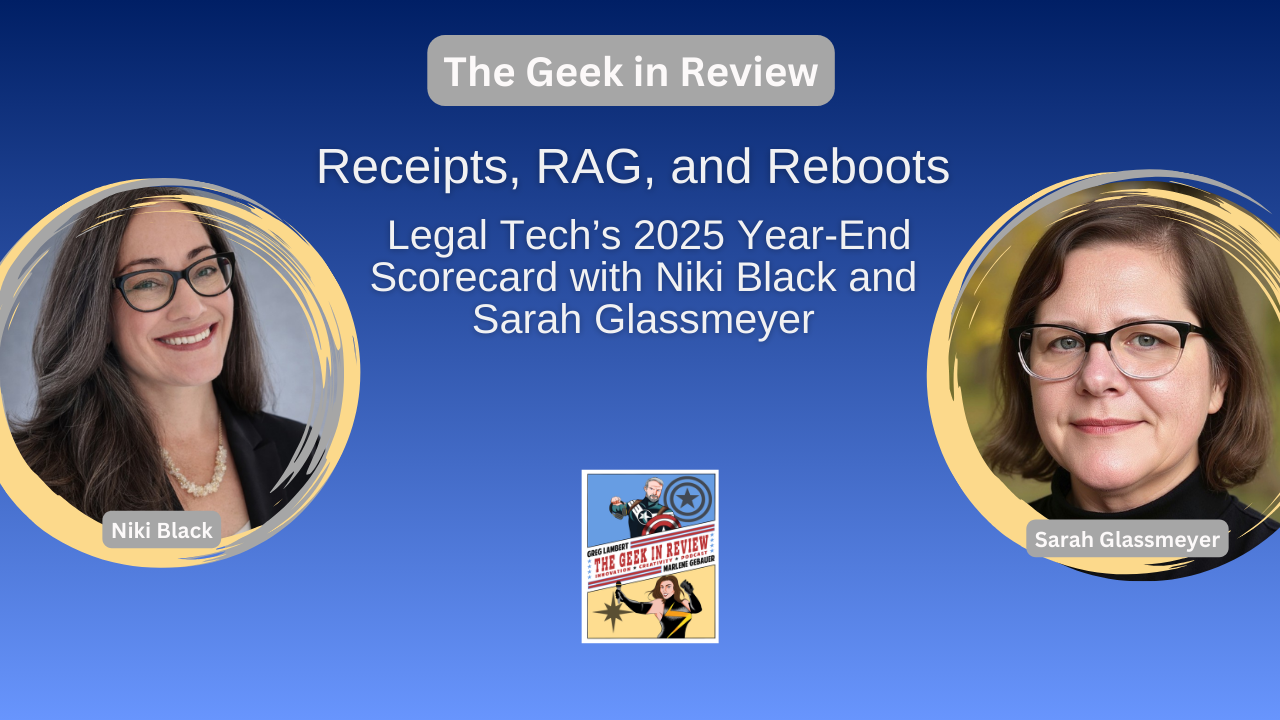
The Geek in Review closes 2025 with Greg Lambert and Marlene Gebauer welcoming back Sarah Glassmeyer and Niki Black for round two of the annual scorecard, equal parts receipts, reality check, and forward look into 2026. The conversation opens with a heartfelt remembrance of Kim Stein, a beloved KM community builder whose generosity showed up in conference dinners, happy hours, and day to day support across vendors and firms. With Kim’s spirit in mind, the panel steps into the year-end ritual: name the surprises, own the misses, and offer a few grounded bets for what comes next.

Last year’s thesis predicted a shift from novelty to utility, yet 2025 felt closer to a rolling hype loop. Glassmeyer frames generative AI as a multi-purpose knife dropped on every desk at once, which left many teams unsure where to start, even when budgets already committed. Black brings the data lens: general-purpose gen AI use surged among lawyers, especially solos and small firms, while law firm adoption rose fast compared with earlier waves such as cloud computing, which crawled for years before pandemic pressure moved the needle. The group also flags a new social dynamic, status-driven tool chasing, plus a quiet trend toward business-tier ChatGPT, Gemini, and Claude as practical options for many matters when price tags for legal-only platforms sit out of reach for smaller shops.

Hallucinations stay on the agenda, with the panel resisting both extremes: doom posts and fan club hype. Glassmeyer recounts a founder’s quip, “hallucinations are a feature, not a bug,” then pivots to an older lesson from KeyCite and Shepard’s training: verification never goes away, and lawyers always owed diligence, even before LLMs. Black adds a cautionary tale from recent sanctions, where a lawyer ran the same research through a stack of tools, creating a telephone effect and a document nobody fully controlled. Lambert notes a bright spot from the past six months: legal research outputs improved as vendors paired vector retrieval with legal hierarchy data, including court relationships and citation treatment, reducing off-target answers even while perfection stays out of reach.

From there, the conversation turns to mashups across the market. Clio’s acquisition of vLex becomes a headline example, raising questions about platform ecosystems, pricing power, and whether law drifts toward an Apple versus Android split. Black predicts integration work across billing, practice management, and research will matter as much as M&A, with general tech giants looming behind the scenes. Glassmeyer cheers broader access for smaller firms, while still warning about consolidation scars from legal publishing history and the risk of feature decay once startups enter corporate layers. The panel lands on a simple preference: interoperability, standards, and clean APIs beat a future where a handful of owners dictate terms.

On governance, Black rejects surveillance fantasies and argues for damage control, strong training, and safe experimentation spaces, since shadow usage already happens on personal devices. Gebauer pushes for clearer value stories, and the guests agree early ROI shows up first in back office workflows, with longer-run upside tied to pricing models, AFAs, and buyer pushback on inflated hours. For staying oriented amid fractured social channels, the crew trades resources: AI Law Librarians, Legal Tech Week, Carolyn Elefant’s how-to posts, Moonshots, Nate B. Jones, plus Ed Zitron’s newsletter for a wider business lens. The crystal ball segment closes with a shared unease around AI finance, a likely shakeout among thinly funded tools, and a reminder to keep the human network strong as 2026 arrives.

Sarah Glassmeyer

Niki Black

Marlene Gebauer

Greg Lambert

Transcript

Continue Reading Receipts, RAG, and Reboots: Legal Tech’s 2025 Year-End Scorecard with Niki Black and Sarah Glassmeyer

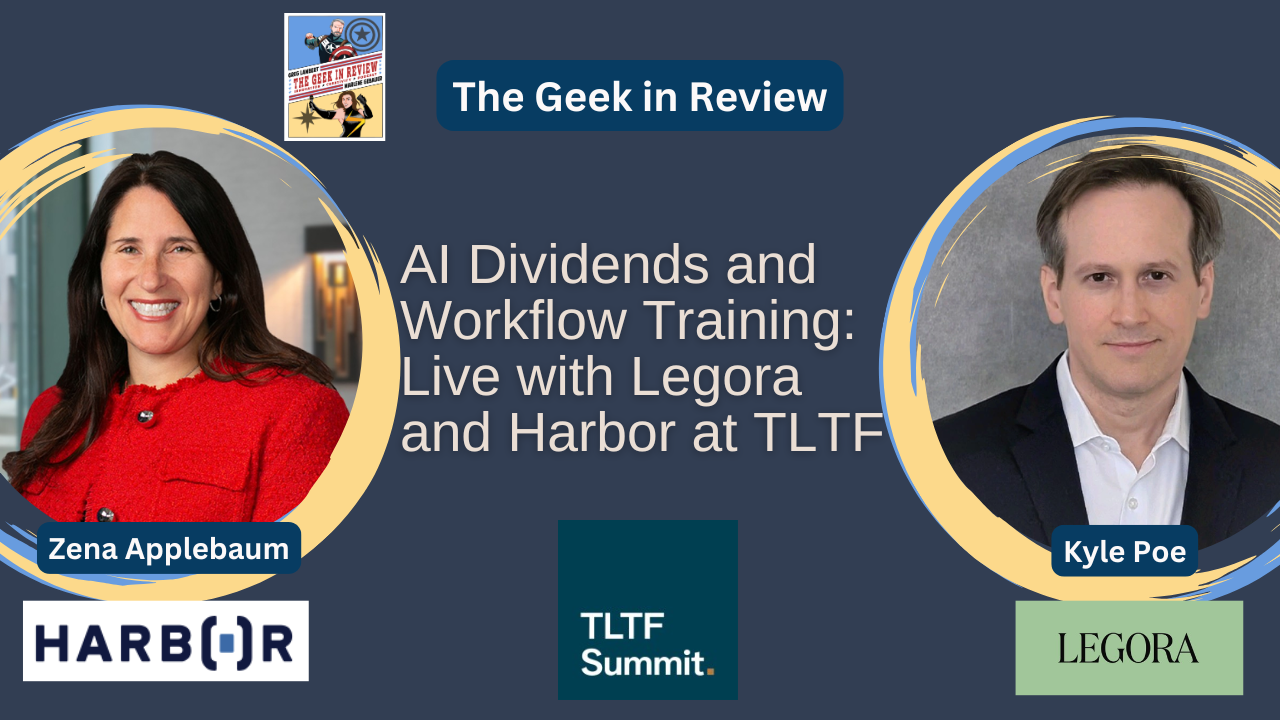
We recorded this episode live at the TLTF Summit and the energy in the room made it feel like the perfect place for a conversation about growth, training, and the rapid climb of legal tech. We grabbed our gear, claimed a corner in the podcast room, and pulled in two guests with front row seats to the changes hitting the industry. Joining us were Kyle Poe from Legora and our friend and guest host, Zena Applebaum of Harbor. The Summit attracts a focused group of founders, investors, and leaders, and the four of us jumped straight into what this event represents and what attendees hope to get from it.

Kyle had been on the job for only two months, but Legora moves at a pace that feels closer to dog years. In that short time the team doubled, a new round of funding closed, and the company introduced a major product release. Kyle walked us through Legora’s new Portal experience, which brings clients inside the legal workflow in a controlled, collaborative environment. Instead of long email chains and static work product, the Portal supports shared editing, direct review of diligence work, and a more responsive model for client engagement. In an era when clients expect quick turnarounds, this shift sets up a new dynamic for firms.

Zena added helpful perspective from her prior trips to TLTF. She described the Summit as a place that rewards conversation, curiosity, and hallway exchanges. It is also a place to study the different stages of the legal tech journey, from early ideas on the startup stage to the seasoned players on the scale stage. She also brought timely news of Harbor’s acquisition of Encore Technologies, a move that strengthens Harbor’s ability to support training and adoption workflows across firms and corporate legal teams. Her focus on education paired well with Kyle’s insights on how Legora approaches enablement through its team of legal engineers.

Training became the heart of the conversation. We compared old habits with the expectations of a generation of associates who have been taught to avoid AI until they enter a firm. Kyle stressed the need to anchor attorney training in real use cases and to give them early wins so they build trust in the tools. He described the shift from task-based training to workflow-based thinking. Zena echoed this point and highlighted the growing trend of firms reserving time for associates to explore AI tools as part of their professional development rather than treating experimentation as a side project squeezed between billable work.

We also talked about how AI is influencing both the pace and structure of client service. Kyle shared examples of how Legora uses prior work product to build integrated workflows, such as interrogatory response generators that pull from a full library of past responses. This not only speeds up production but also increases consistency and helps attorneys understand the reasoning behind revisions. Zena pushed the idea even further, noting that these systems give associates a chance to study the rationale behind changes in a way that human reviewers rarely have time to provide. This leads to better training and stronger validation of the final work product.

We closed with our crystal ball question. Kyle sees more adoption on the horizon but also anticipates uneven impacts across different practices as firms figure out how to adjust their business models. Zena pointed to the operational challenges ahead, especially the pressure to invest in data management and cloud infrastructure that supports true AI enablement. Her message was clear. If firms want the benefits later, they need to start organizing the foundations now. This episode blends optimism with realism, and it highlights the practical work ahead for firms, vendors, and everyone in between. Tune in for the full conversation and get ready for a lively discussion recorded right in the middle of the Summit buzz.

Listen on mobile platforms:  ⁠⁠⁠⁠⁠⁠⁠⁠⁠⁠⁠⁠⁠⁠Apple Podcasts⁠⁠⁠⁠⁠⁠⁠⁠⁠⁠⁠⁠⁠⁠ |  ⁠⁠⁠⁠⁠⁠⁠⁠⁠⁠⁠⁠⁠⁠Spotify⁠⁠⁠⁠⁠⁠⁠⁠⁠⁠⁠⁠⁠⁠ | ⁠⁠⁠⁠⁠⁠⁠⁠⁠⁠⁠⁠⁠YouTube⁠⁠⁠⁠⁠⁠⁠⁠⁠⁠

[Special Thanks to Legal Technology Hub for their sponsoring this episode.]

⁠⁠⁠⁠⁠Email: geekinreviewpodcast@gmail.com
Music: ⁠⁠⁠⁠⁠⁠⁠⁠⁠⁠⁠⁠⁠⁠⁠⁠⁠Jerry David DeCicca⁠⁠⁠⁠⁠⁠⁠⁠⁠

Transcript:

Continue Reading AI Dividends and Workflow Training: Live with Legora and Harbor at TLTF

In this episode of The Geek in Review, we welcome back Pablo Arredondo, VP of CoCounsel at Thomson Reuters, along with Joel Hron, the company’s CTO. The conversation centers on the recent release of ChatGPT-5 and the rise of “reasoning models” that go beyond traditional language models’ limitations. Pablo reflects on his years of tracking neural net progress in the legal field, from escaping “keyword prison” to the current ability of AI to handle complex, multi-step legal reasoning. He describes scenarios where entire litigation records could be processed to map out strategies for summary judgment motions, calling it a transformative step toward what he sees as “celestial legal products.”

Joel brings an engineering perspective, comparing the legal sector’s AI trajectory to the rapid advancements in AI developer tools. He notes that these tools have historically amplified the skills of top performers rather than leveling the playing field. Applied to law, he believes AI will free lawyers from rote work and allow them to focus on higher-value decisions and strategy. The discussion shifts to Deep Research, Thomson Reuters’ latest enhancement for CoCounsel, which leverages reasoning models in combination with domain-specific tools like KeyCite to follow “breadcrumb trails” through case law with greater accuracy and transparency.

The trio explores the growing importance of transparency and verification in AI-driven research. Joel explains how Deep Research provides real-time visibility into an AI’s reasoning path, highlights potentially hallucinated citations, and integrates verification tools to cross-check references against authoritative databases. Pablo adds historical and philosophical perspective, likening hallucinations to a tiger “going tiger,” stressing that while the risk cannot be eliminated, the technology already catches a significant number of human errors. Both agree that AI tools must be accompanied by human oversight and well-designed workflows to build trust in their output.

The conversation also delves into the challenges of guardrails and governance in AI. Joel describes the balance between constraining AI for accuracy and keeping it flexible enough to handle diverse user needs. He introduces the concept of varying the “leash length” on AI agency depending on the task—shorter for structured workflows, longer for open-ended research. Pablo challenges the legal information community to break down silos between disciplines like eDiscovery, research, and litigation, envisioning a unified information ecosystem that AI could navigate seamlessly.

Looking to the future, Joel predicts that the adoption of AI agents will reshape organizational talent strategies, elevating the importance of those who excel at complex decision-making. Pablo proposes “ambient AI” as the next frontier—intelligent systems that unobtrusively monitor legal work, flagging potential issues instantly, much like a spellchecker. Both caution that certain legal tasks, especially in judicial opinion drafting, warrant careful consideration before fully integrating AI. The episode closes with practical insights on staying current, from following AI researchers on social platforms to reading technical blogs and academic papers, underscoring the need for informed engagement in this rapidly evolving space.

Listen on mobile platforms:  ⁠⁠⁠⁠⁠⁠⁠⁠⁠⁠⁠⁠⁠⁠Apple Podcasts⁠⁠⁠⁠⁠⁠⁠⁠⁠⁠⁠⁠⁠⁠ |  ⁠⁠⁠⁠⁠⁠⁠⁠⁠⁠⁠⁠⁠⁠Spotify⁠⁠⁠⁠⁠⁠⁠⁠⁠⁠⁠⁠⁠⁠ | ⁠⁠⁠⁠⁠⁠⁠⁠⁠⁠⁠⁠⁠YouTube⁠⁠⁠⁠⁠⁠⁠⁠⁠⁠

[Special Thanks to Legal Technology Hub for their sponsoring this episode.]

Blue Sky: ⁠@geeklawblog.com⁠ ⁠@marlgeb⁠
⁠⁠⁠⁠⁠Email: geekinreviewpodcast@gmail.com
Music: ⁠⁠⁠⁠⁠⁠⁠⁠⁠⁠⁠⁠⁠⁠⁠⁠⁠Jerry David DeCicca⁠⁠⁠⁠⁠⁠⁠⁠⁠

Guest’s Go-To Resources:

Blue Sky: ⁠@geeklawblog.com⁠ ⁠@marlgeb⁠
⁠⁠⁠⁠⁠Email: geekinreviewpodcast@gmail.com
Music: ⁠⁠⁠⁠⁠⁠⁠⁠⁠⁠⁠⁠⁠⁠⁠⁠⁠Jerry David DeCicca⁠⁠⁠⁠⁠⁠⁠⁠⁠

Transcript

Continue Reading Pablo Arredondo and Joel Hron on Reasoning Models, Deep Research, and the Future of Legal AI