
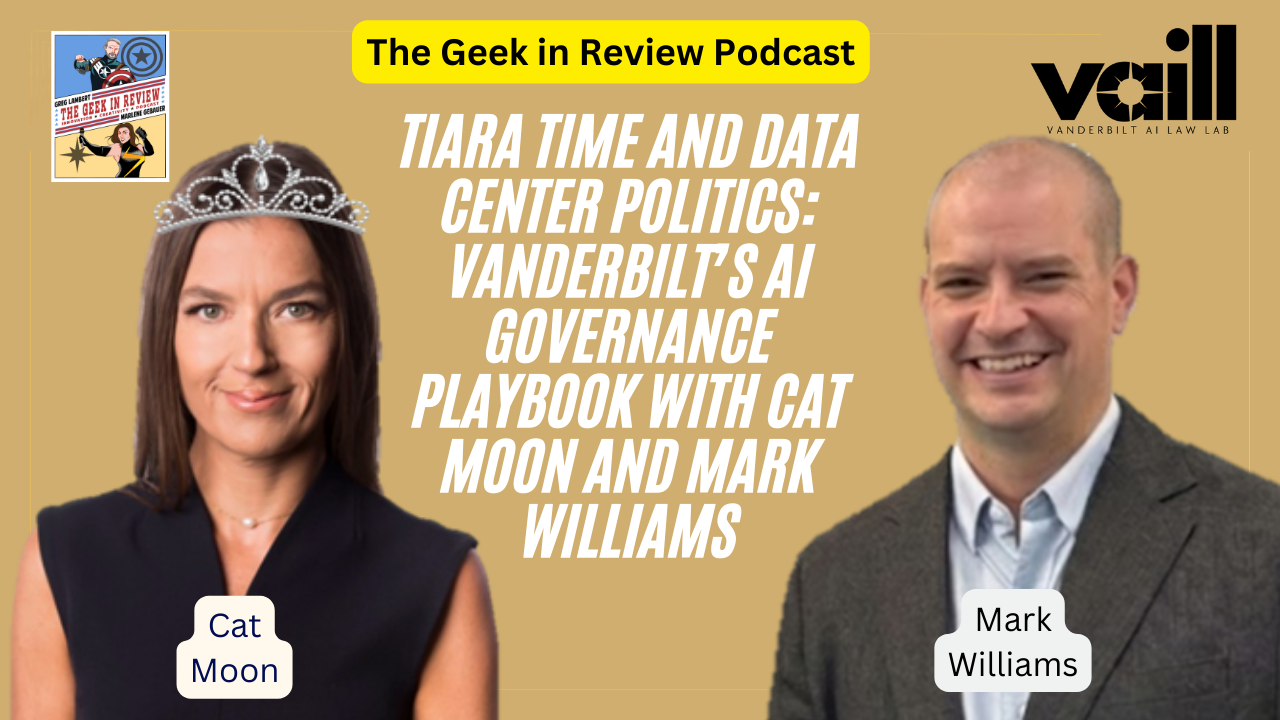
Cat Moon and Mark Williams return to The Geek in Review wearing two hats, plus one tiara. The conversation starts at Vanderbilt’s inaugural AI Governance Symposium, where “governance” means wildly different things depending on who shows up. Judges, policy folks, technologists, in-house leaders, and law firm teams all brought separate definitions, then bumped into each other during generous hallway breaks. Those collisions led to new research threads and fresh coursework, which feels like the real product of a symposium, beyond any single panel.
One surprise thread moved from wonky sidebar to dinner-table topic fast, AI’s energy appetite and the rise of data centers as a local political wedge issue. Mark describes needing to justify the topic months earlier, then watching the news cycle catch up until no justification was needed. Greg connects the dots to Texas, where energy access, on-site generation, and data-center buildouts keep lawyers busy. The point lands, AI governance lives upstream from prompts and policies, down in grids, zoning fights, and infrastructure decisions.
From there, the episode pivots to training, law students, and the messy transition from “don’t touch AI” to “your platforms already baked AI into the buttons.” Mark shares how students now return from summer programs having seen tools like Harvey, even if firms still look like teams building the plane during takeoff. Cat frames the real need as basic, course-by-course guidance so students gain confidence instead of fear. Greg adds a perfect artifact from the academic arms race, Exam Blue Book sales jumping because handwritten exams keep AI out of finals, while AI still helps study through tools like NotebookLM quiz generation.
Governance talk gets practical fast, procurement, contract language, standards, and the sneaky problem of feature drift inside approved tools. Mark flags how smaller firms face a brutal constraint problem, limited budget, limited time, one shot to pick from hundreds of products, and no dedicated procurement bench. ISO 42001 shows up as a shorthand signal for vendor maturity, though standards still lag behind modern generative systems. Marlene brings the day-to-day friction, outside counsel guidelines, client consent, and repeated approvals slow adoption even after a tool passes internal reviews. Greg nails the operational pain, vendors ship new capabilities weekly, sometimes pushing teams from “closed universe” to “open internet” without much warning.
The closing crystal ball lands on collaboration and humility. Cat argues for a future shaped by co-creation across firms, schools, and students, not a demand-and-defend standoff about “practice-ready” graduates. Mark zooms out to the broader shift in the knowledge-work apprenticeship model, fewer beginner reps, earlier specialization pressure, and new ownership models knocking on the door in places like Tennessee. Along the way, Cat previews Women + AI Summit 2.0, with co-created content, travel stipends for speakers, workshops built around take-home artifacts, plus a short story fiction challenge to write women into the future narrative, tiara energy optional but encouraged.
Listen on mobile platforms: Apple Podcasts | Spotify | YouTube
[Special Thanks to Legal Technology Hub for their sponsoring this episode.]
Email: geekinreviewpodcast@gmail.com
Music: Jerry David DeCicca
LINKS:
CAT MOON
Vanderbilt AI Law Lab
VAILL Substack
Women + AI Summit
Practising Law Institute (PLI)
American Arbitration Association (AAA)
Legal Technology Hub
MARK WILLIAMS
Hotshot Legal
The Information
Understanding AI (Timothy B. Lee)
One Useful Thing (Ethan Mollick)
SemiAnalysis
ISO/IEC 42001 standard overview
EU AI Act (Regulation (EU) 2024/1689)
Chip War (Chris Miller, publisher page)
