
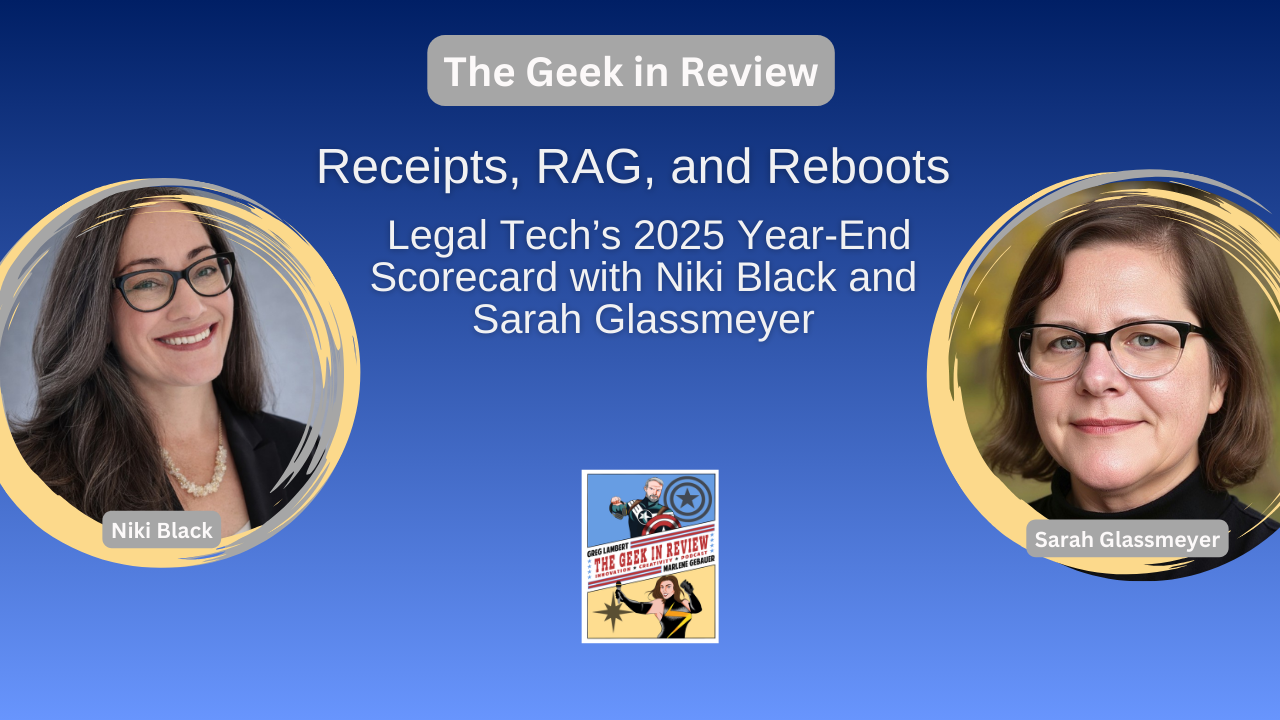
The Geek in Review closes 2025 with Greg Lambert and Marlene Gebauer welcoming back Sarah Glassmeyer and Niki Black for round two of the annual scorecard, equal parts receipts, reality check, and forward look into 2026. The conversation opens with a heartfelt remembrance of Kim Stein, a beloved KM community builder whose generosity showed up in conference dinners, happy hours, and day to day support across vendors and firms. With Kim’s spirit in mind, the panel steps into the year-end ritual: name the surprises, own the misses, and offer a few grounded bets for what comes next.
Last year’s thesis predicted a shift from novelty to utility, yet 2025 felt closer to a rolling hype loop. Glassmeyer frames generative AI as a multi-purpose knife dropped on every desk at once, which left many teams unsure where to start, even when budgets already committed. Black brings the data lens: general-purpose gen AI use surged among lawyers, especially solos and small firms, while law firm adoption rose fast compared with earlier waves such as cloud computing, which crawled for years before pandemic pressure moved the needle. The group also flags a new social dynamic, status-driven tool chasing, plus a quiet trend toward business-tier ChatGPT, Gemini, and Claude as practical options for many matters when price tags for legal-only platforms sit out of reach for smaller shops.
Hallucinations stay on the agenda, with the panel resisting both extremes: doom posts and fan club hype. Glassmeyer recounts a founder’s quip, “hallucinations are a feature, not a bug,” then pivots to an older lesson from KeyCite and Shepard’s training: verification never goes away, and lawyers always owed diligence, even before LLMs. Black adds a cautionary tale from recent sanctions, where a lawyer ran the same research through a stack of tools, creating a telephone effect and a document nobody fully controlled. Lambert notes a bright spot from the past six months: legal research outputs improved as vendors paired vector retrieval with legal hierarchy data, including court relationships and citation treatment, reducing off-target answers even while perfection stays out of reach.
From there, the conversation turns to mashups across the market. Clio’s acquisition of vLex becomes a headline example, raising questions about platform ecosystems, pricing power, and whether law drifts toward an Apple versus Android split. Black predicts integration work across billing, practice management, and research will matter as much as M&A, with general tech giants looming behind the scenes. Glassmeyer cheers broader access for smaller firms, while still warning about consolidation scars from legal publishing history and the risk of feature decay once startups enter corporate layers. The panel lands on a simple preference: interoperability, standards, and clean APIs beat a future where a handful of owners dictate terms.
On governance, Black rejects surveillance fantasies and argues for damage control, strong training, and safe experimentation spaces, since shadow usage already happens on personal devices. Gebauer pushes for clearer value stories, and the guests agree early ROI shows up first in back office workflows, with longer-run upside tied to pricing models, AFAs, and buyer pushback on inflated hours. For staying oriented amid fractured social channels, the crew trades resources: AI Law Librarians, Legal Tech Week, Carolyn Elefant’s how-to posts, Moonshots, Nate B. Jones, plus Ed Zitron’s newsletter for a wider business lens. The crystal ball segment closes with a shared unease around AI finance, a likely shakeout among thinly funded tools, and a reminder to keep the human network strong as 2026 arrives.
Sarah Glassmeyer
- AI Law Librarians: https://ailawlibrarians.com
- “Where’s Your Ed At?” (Ed Zitron): https://www.wheresyouredat.com
- Sarah’s site: https://sarahglassmeyer.com
Niki Black
- Legaltech Week hub (LawSites topic page): https://www.lawnext.com/topics (scroll to “Legaltech Week”)
- Legaltech Week on YouTube: https://www.youtube.com/@legaltechweek
- Google NotebookLM: https://notebooklm.google
Marlene Gebauer
- Moonshots podcast: https://podcasts.apple.com/us/podcast/moonshots-with-peter-diamandis/id1596428189
Greg Lambert
- Nate B. Jones newsletter (Substack): https://natesnewsletter.substack.com
