
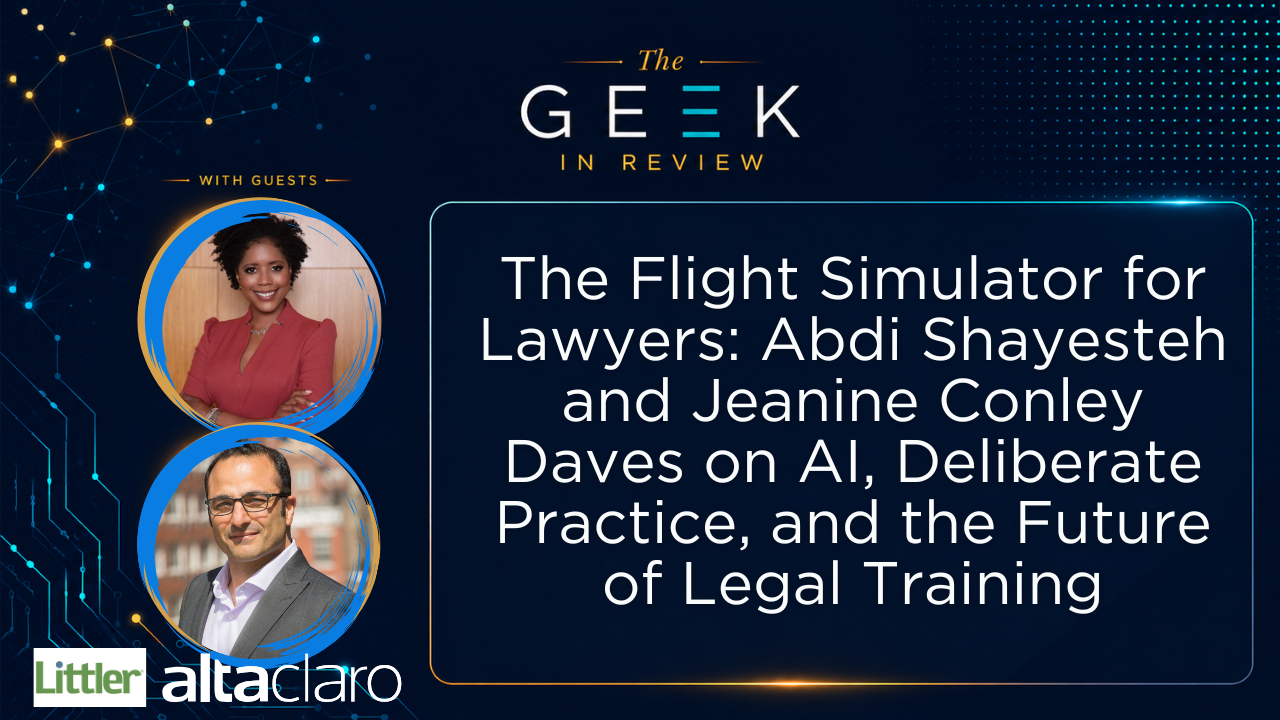
This week on The Geek in Review, we talk with Abdi Shayesteh, CEO of AltaClaro, and Jeanine Conley Daves, Littler’s New York office managing shareholder, about a different question in the legal AI conversation. Instead of asking whether AI will write the brief, summarize the contract, or replace the junior associate, they focus on whether AI might help lawyers learn how to practice law. Their recent work around AltaClaro’s DepoSim points toward a model of legal training built less on passive observation and more on structured repetition, feedback, and skill development.
Shayesteh traces the origin of AltaClaro back to his own early years at King & Spalding, where he benefited from proximity to a mentor willing to explain the work. That experience also showed him the unevenness of the old apprenticeship model. Access to assignments, feedback, and sponsorship often depended on luck, relationships, and office geography. For Shayesteh, the idea of a “flight simulator for lawyers” grew out of the realization that pilots, athletes, and musicians all practice in structured environments before performance, while lawyers too often learn in front of clients, courts, and opposing counsel.
DepoSim applies this flight simulator concept to one of litigation’s highest-pressure skills: taking and defending depositions. The platform gives attorneys a simulated witness, opposing counsel, court reporter, and feedback system, with options to vary the difficulty and personalities involved. Conley Daves explains why this kind of realism matters. In a real deposition, a lawyer might face an evasive witness, a hostile witness, an aggressive opposing counsel, or a combination of all three. The simulator lets lawyers practice those moments repeatedly, receive targeted feedback, and return to specific skills such as exhibit handling, follow-up questions, or managing objections.
The conversation also connects AI training to equity in professional development. Conley Daves notes that access to high-quality assignments and sponsorship has not always been distributed evenly across firms. A standardized, rubric-based feedback system gives more lawyers a chance to build core skills without waiting to be selected by the right partner or assigned to the right matter. Shayesteh adds that firms seeing the strongest results are not treating training as an after-hours side quest. They are creating protected time for deliberate practice, pairing AI feedback with human mentorship, and using simulation as a bridge rather than a substitute for coaching.
Looking ahead, Shayesteh and Conley Daves see simulation moving well beyond depositions. Oral argument, cross-examination, meet-and-confer sessions, negotiations, client interviews, and even Supreme Court preparation all fit within this training model. The larger shift is not automation for its own sake. It is the use of AI to help lawyers build judgment before the stakes are real. For law firms, that means better preparation, more consistent training, stronger associate development, and a clearer path toward delivering value to clients. For the profession, it suggests a future where competence is practiced deliberately, measured thoughtfully, and taught more fairly.
Listen on mobile platforms: Apple Podcasts | Spotify | YouTube | Substack
[Special Thanks to Legal Technology Hub for their sponsoring this episode.]
Email: geekinreviewpodcast@gmail.com
Music: Jerry David DeCicca