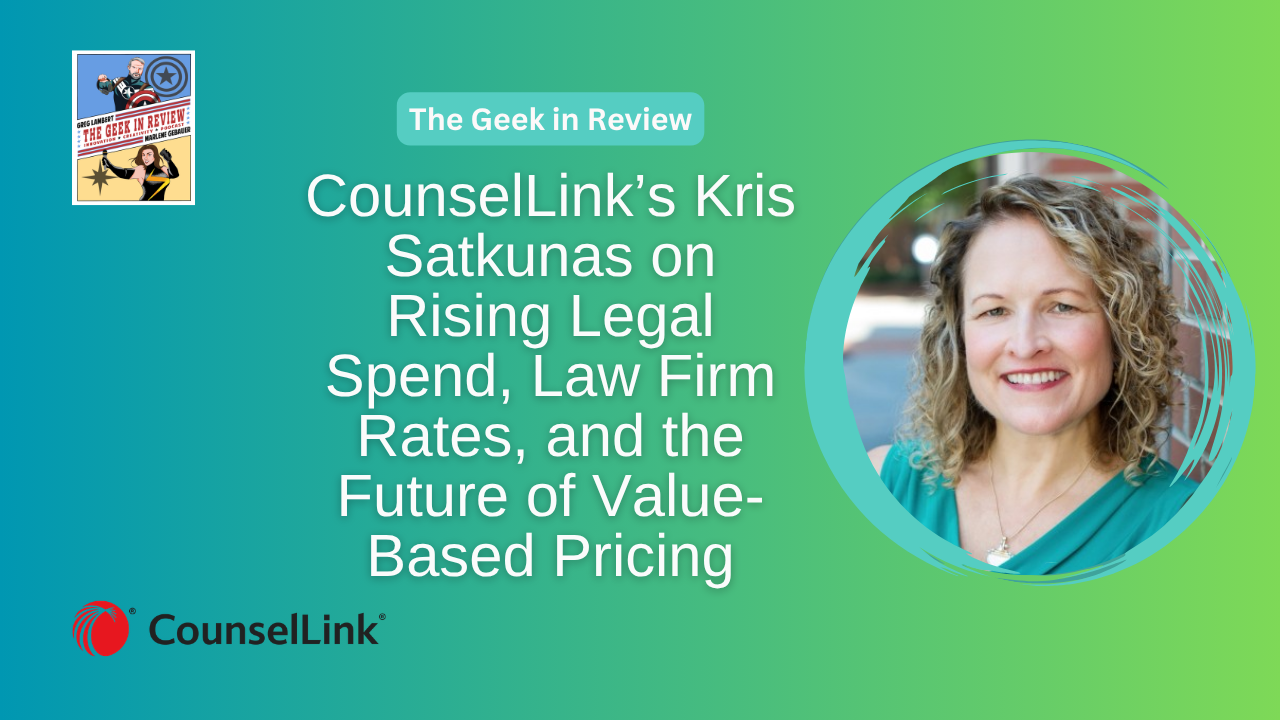
This week on The Geek in Review, we talk with Kristina Satkunas of CounselLink about what the numbers are saying in a legal market that still talks about change while clinging hard to old billing habits. Kris discusses the hard data behind outside counsel spend, drawing on CounselLink invoice data and Harbor survey results to compare what legal departments say they expect with what the bills are already showing. She makes the case that the objective data is stubbornly clear. Rates are rising, demand is not falling, and the biggest firms continue to capture a larger share of work.

There is a widening gap between hope and reality. Legal departments may believe they are on the verge of controlling outside counsel costs, moving more work in house, or shifting matters to smaller firms, but Satkunas notes that the billing data has not caught up to those ambitions. She sees some room for in-house expansion in more routine areas like employment work, especially with AI helping legal teams absorb more volume, yet the largest and most sensitive matters are still flowing to outside counsel. That tension gives the episode much of its energy. Everyone sees pressure building in the system, but the old habits of legal buying and legal staffing remain firmly in place.

The discussion also gets into the mechanics of better decision-making, and where there is practical value for legal operations leaders. Satkunas emphasizes that data only becomes useful when departments have enough discipline in their enterprise legal management systems to categorize work correctly, clean out outliers, and separate different matter types instead of lumping everything into broad buckets like litigation. She also explains why finance data alone will not do the job. The real insight sits inside invoice-level detail, where hours, rates, firms, and timekeepers reveal what is happening beneath the headline spend numbers. For listeners trying to build a stronger legal ops function, this part of the conversation feels like a polite but firm warning that dirty data still tells stories, but some of them are fiction.

There is an obvious strain on the billable hour model that AI is placing on it. Satkunas notes that while average partner rate growth has hovered around 5 percent, top-end lawyers are often raising rates even faster, especially as firms try to protect revenue from the work and people they still believe clients will pay for. At the same time, she argues that alternative fee arrangements have remained stuck for years, though AI may finally force movement toward value-based pricing. If technology reduces the hours required to complete the work, then the old logic behind both hourly billing and many flat fees starts to wobble. That leaves firms facing an uncomfortable question, which is how to price legal services based on value delivered rather than time consumed.

We’d say that Satkunas is neither cheerleader nor doomsayer. She is a patient observer of a market trying to pretend nothing is happening while the floorboards creak under everyone’s feet. Her prediction is that real value-based billing will begin to appear in pockets over the next couple of years, even as firms continue squeezing what they can from the billable hour in the meantime. For law firm leaders, legal ops teams, and general counsel, this episode is a sharp reminder that disruption does not arrive with a trumpet blast. Sometimes it arrives as a spreadsheet, a trend line, and a guest who quietly points out that the data has been trying to warn us for years.

Listen on mobile platforms:  ⁠⁠⁠⁠⁠⁠⁠⁠⁠⁠⁠⁠⁠⁠Apple Podcasts⁠⁠⁠⁠⁠⁠⁠⁠⁠⁠⁠⁠⁠⁠ |  ⁠⁠⁠⁠⁠⁠⁠⁠⁠⁠⁠⁠⁠⁠Spotify⁠⁠⁠⁠⁠⁠⁠⁠⁠⁠⁠⁠⁠⁠ | ⁠⁠⁠⁠⁠⁠⁠⁠⁠⁠⁠⁠⁠YouTube⁠⁠⁠⁠⁠⁠⁠⁠⁠⁠ | Substack

[Special Thanks to Legal Technology Hub for their sponsoring this episode.]

⁠⁠⁠⁠⁠Email: geekinreviewpodcast@gmail.com
Music: ⁠⁠⁠⁠⁠⁠⁠⁠⁠⁠⁠⁠⁠⁠⁠⁠⁠⁠Jerry David DeCicca⁠⁠⁠⁠⁠⁠⁠⁠⁠

Transcript:

Continue Reading CounselLink’s Kris Satkunas on Rising Legal Spend, Law Firm Rates, and the Future of Value-Based Pricing

The latest episode of The Geek in Review finds Greg Lambert and Marlene Gebauer back from Dallas with a sharp, grounded recap of the Texas Trailblazers conference, an event that stayed close to the daily realities of legal work instead of drifting into glossy predictions. Their conversation centers on a legal industry trying to sort out what AI means right now, in billing, workflow, training, pricing, governance, and client expectations. What stands out most is the hosts’ focus on the practical tension between what the tools are capable of and what law firms and legal departments are structurally ready to absorb.

A major thread in the discussion is the risk of what one speaker called “cognitive surrender,” the habit of trusting AI output too quickly and handing off too much human judgment in the process. Greg and Marlene treat this as less of a software issue and more of a workflow and education issue. The point is not whether AI produces polished work. The point is whether organizations are building systems where review, judgment, and accountability still sit with people. Their conversation ties this concern to legal practice, education, and even K-12 learning, showing how widespread the temptation has become to accept fluent output without enough friction or scrutiny.

The episode also takes a hard look at the pressure AI is putting on the billable hour. Marlene frames the issue well when she notes that AI does not kill the billable hour so much as expose its weaknesses. Across the conference, the hosts heard repeated concern about the mismatch between efficiency gains and the financial structures law firms still rely on. If AI reduces the time needed for many tasks, then firms, associates, pricing teams, and clients all have new incentives to sort through. Greg and Marlene highlight the awkward moment the industry is in, where firms want to talk about value while clients are also eyeing the chance to pay less for faster work. The result is a growing need for honest conversations about pricing, outcomes, and what legal value should mean when time is no longer the cleanest measure.

What gives the episode its energy is the number of concrete examples pulled from the conference. The hosts discuss lower-cost multi-state surveys, large-scale analysis of rights-of-way documents, and internal workflow improvements built with existing tools like SharePoint and Copilot on little or no budget. These stories show AI not as abstract promise, but as a way to get work done that used to be too expensive, too tedious, or too slow to tackle at all. At the same time, Greg and Marlene stay skeptical in the right places, especially when the conversation turns to legal research, citation accuracy, and the idea that technology vendors have somehow solved problems that law librarians and researchers know are stubbornly difficult.

By the end of the episode, the biggest takeaway is not that the legal industry has a clear answer, but that waiting for certainty is no longer a serious option. Greg and Marlene come away from Texas Trailblazers with a sense that real progress is happening through testing, discussion, and repeated adjustment, not through perfect plans. Their recap captures an industry in transition, one where law firms, legal ops teams, vendors, and clients are all feeling the strain between old business models and new technical possibilities. The message is simple and urgent: start the conversations now, use the tools now, and get honest about what must change before the gap between what is possible and what is workable gets even wider.

Listen on mobile platforms:  ⁠⁠⁠⁠⁠⁠⁠⁠⁠⁠⁠⁠⁠⁠Apple Podcasts⁠⁠⁠⁠⁠⁠⁠⁠⁠⁠⁠⁠⁠⁠ |  ⁠⁠⁠⁠⁠⁠⁠⁠⁠⁠⁠⁠⁠⁠Spotify⁠⁠⁠⁠⁠⁠⁠⁠⁠⁠⁠⁠⁠⁠ | ⁠⁠⁠⁠⁠⁠⁠⁠⁠⁠⁠⁠⁠YouTube⁠⁠⁠⁠⁠⁠⁠⁠⁠⁠ | Substack

[Special Thanks to Legal Technology Hub for their sponsoring this episode.]

⁠⁠⁠⁠⁠Email: geekinreviewpodcast@gmail.com
Music⁠⁠⁠⁠⁠⁠⁠⁠⁠⁠⁠⁠⁠⁠⁠⁠⁠Jerry David DeCicca⁠⁠⁠⁠⁠⁠⁠⁠⁠
Transcript:

Continue Reading Texas Trailblazers and the Hard Truth About AI in Legal Work

This week on The Geek in Review, we sit down with Jennifer McIver, Legal Ops and Industry Insights at Wolters Kluwer ELM Solutions. We open with Jennifer’s career detour from aspiring forensic pathologist to practicing attorney to legal tech and legal ops leader, sparked by a classic moment of lawyer frustration, a slammed office door, and a Google search for “what else can I do with my law degree.” From implementing Legal Tracker at scale, to customer success with major clients, to product and strategy work, her path lands in a role built for pattern spotting, benchmarking, and translating what legal teams are dealing with into actionable insights.

Marlene pulls the thread on what the sharpest legal ops teams are doing with their data right now. Jennifer’s answer is refreshingly practical. Visibility wins. Dashboards tied to business strategy and KPIs beat “everything everywhere all at once” reporting. She talks through why the shift to tools like Power BI matters, and why comfort with seeing the numbers is as important as the numbers themselves. You cannot become a strategic partner if the data stays trapped inside the tool, or inside the legal ops team, or inside someone’s head.

Then we get into the messy part, which is data quality and data discipline. Jennifer points out the trap legal teams fall into when they demand 87 fields on intake forms and then wonder why nobody enters anything, or why every category becomes “Other,” also known as the graveyard of analytics. Her suggestion is simple. Pick the handful of fields that tell a strong story, clean them up, and get serious about where the data lives. She also stresses the role of external benchmarks, since internal trends mean little without context from market data.

Greg asks the question on everyone’s bingo card, what is real in AI today versus what still smells like conference-stage smoke. Jennifer lands on something concrete, agentic workflows for the kind of repeatable work legal ops teams do every week. She shares how she uses an agent to turn event notes into usable internal takeaways, with human review still in the loop, and frames the near-term benefit as time back and faster cycles. She also calls out what slows adoption down inside many companies, internal security and privacy reviews, plus AI committees that sometimes lag behind the teams trying to move work forward.

Marlene shifts to pricing, panels, AFAs, and what frustrates GCs and legal ops leaders about panel performance. Jennifer describes two extremes, rigid rate programs with little conversation, and “RFP everything” process overload. Her best advice sits in the middle, talk early, staff smart, and match complexity to the right team, so cost and risk make sense. She also challenges the assumption that consolidation always produces value. Benchmarking data often shows you where you are overpaying for certain work types, even when volume discounts look good on paper.

We close with what makes a real partnership between corporate legal teams and firms, and Jennifer keeps returning to two themes, communication and transparency, with examples. When an AFA starts drifting, both sides raise their hands early, instead of waiting for invoice rejection drama. When a client invests in “law firm days” that include more than relationship partners, the firm learns the business context, the work improves, and outcomes improve. Jennifer’s crystal ball for 2026 is blunt and useful, data first, start the hard conversations now, and take a serious look at roles and skills inside legal ops, because the job is changing fast.

Links:

Listen on mobile platforms:  ⁠⁠⁠⁠⁠⁠⁠⁠⁠⁠⁠⁠⁠⁠Apple Podcasts⁠⁠⁠⁠⁠⁠⁠⁠⁠⁠⁠⁠⁠⁠ |  ⁠⁠⁠⁠⁠⁠⁠⁠⁠⁠⁠⁠⁠⁠Spotify⁠⁠⁠⁠⁠⁠⁠⁠⁠⁠⁠⁠⁠⁠ | ⁠⁠⁠⁠⁠⁠⁠⁠⁠⁠⁠⁠⁠YouTube⁠⁠⁠⁠⁠⁠⁠⁠⁠⁠

[Special Thanks to Legal Technology Hub for their sponsoring this episode.]

⁠⁠⁠⁠⁠Email: geekinreviewpodcast@gmail.com
Music: ⁠⁠⁠⁠⁠⁠⁠⁠⁠⁠⁠⁠⁠⁠⁠⁠⁠Jerry David DeCicca⁠⁠⁠⁠⁠⁠⁠⁠⁠

Transcript:

Continue Reading Data First, Partner Better. Jennifer McIver on Legal Ops Benchmarks, AI Agents, and Pricing Reality Checks