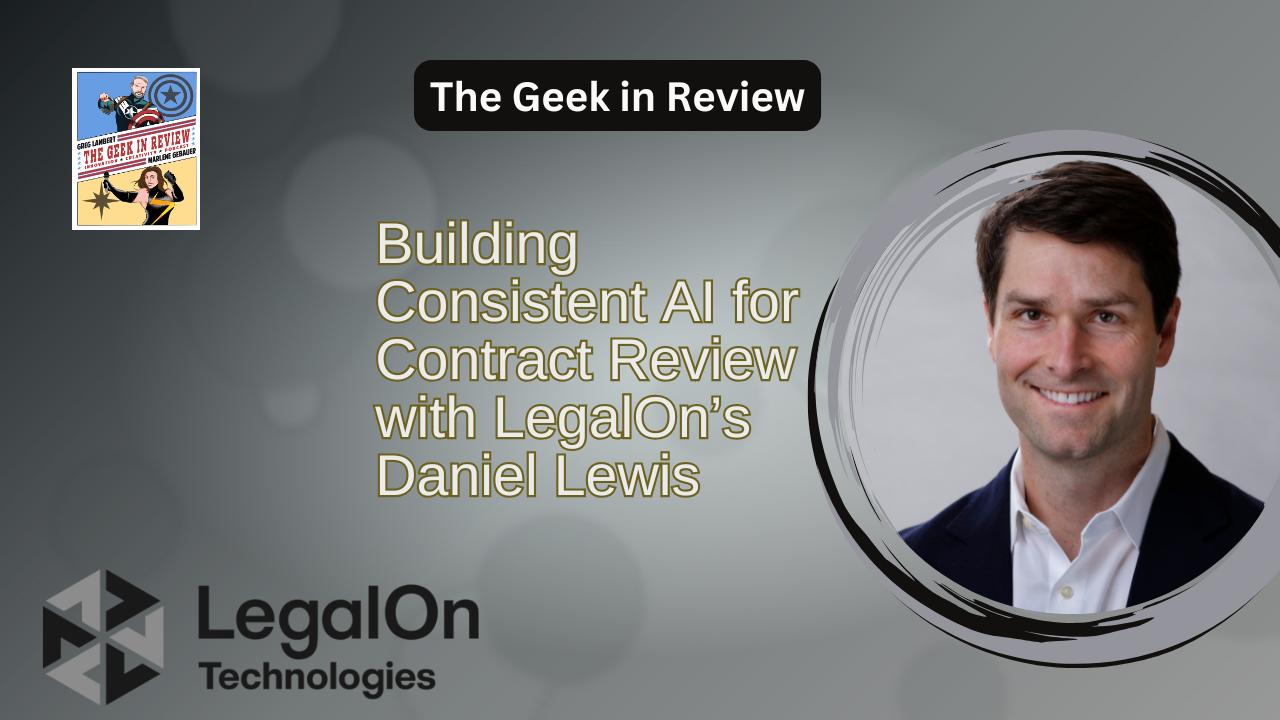
Daniel Lewis joins us this week to trace a path from Ravel Law to LexisNexis to LegalOn, with a throughline of data-driven thinking and practical outcomes for lawyers. Stanford roots shaped early work on judicial analytics, then a front-row view inside a global publisher broadened focus to content, guidance, and the daily reality of in-house teams. That experience pointed straight at contract review as a top pain for corporate counsel, which led to LegalOn’s product mission and global push.

Data access still shapes progress. Case law digitization advanced through projects like Harvard’s archive, yet comprehensive coverage, secondary sources, and news remain guarded by incumbents. Daniel explains why large datasets give scale, why startups face steep hurdles, and why thoughtful product scope matters. The lesson, build where data, workflow, and user value intersect.

LegalOn’s hybrid approach blends large models with attorney-built playbooks, practice notes, and suggested clause language. Consistency matters more than clever one-offs, so reviews align to standards, not model whimsy. Daniel shares a memorable demo from a rival where a phantom “California Code section 17” alert appeared, a cautionary tale that underscores the need for guardrails, verification, and explainability.

Conversation turns to multi-step agents and matter management. Picture an intake email from sales, missing key fields. An agent requests what is needed, opens a matter, applies a tailored playbook, highlights non-negotiables and fallbacks, then keeps stakeholders informed as work progresses. LegalOn also converts existing playbooks and prior redlines into AI-ready guidance, reducing setup chores while preserving organizational risk preferences.

Finally, Daniel outlines new muscles for legal teams. Daily AI usage shifts time from line-by-line edits to judgment, negotiation strategy, and process leadership. Tech fluency, business orientation, and change leadership rise in importance, along with a steady diet of outside-legal analysis from voices like Ben Thompson and Benedict Evans. The message, free lawyers from sludge, raise the ceiling on strategic work, and build for long-term improvement across the legal function.

Listen on mobile platforms:  ⁠⁠⁠⁠⁠⁠⁠⁠⁠⁠⁠⁠⁠⁠Apple Podcasts⁠⁠⁠⁠⁠⁠⁠⁠⁠⁠⁠⁠⁠⁠ |  ⁠⁠⁠⁠⁠⁠⁠⁠⁠⁠⁠⁠⁠⁠Spotify⁠⁠⁠⁠⁠⁠⁠⁠⁠⁠⁠⁠⁠⁠ | ⁠⁠⁠⁠⁠⁠⁠⁠⁠⁠⁠⁠⁠YouTube⁠⁠⁠⁠⁠⁠⁠⁠⁠⁠

[Special Thanks to Legal Technology Hub for their sponsoring this episode.]

⁠⁠⁠⁠⁠Email: geekinreviewpodcast@gmail.com
Music: ⁠⁠⁠⁠⁠⁠⁠⁠⁠⁠⁠⁠⁠⁠⁠⁠⁠Jerry David DeCicca⁠⁠⁠⁠⁠⁠⁠⁠⁠

Transcript:

Continue Reading Building Consistent AI for Contract Review with LegalOn’s Daniel Lewis

In this episode of The Geek in Review, we welcome Feargus MacDaeid and Nnamdi Emelifeonwu, co-founders of Definely, to discuss how their shared experiences as practicing lawyers shaped a groundbreaking accessibility solution for contract review. Feargus, who is visually impaired, and Nnamdi, his former colleague at Freshfields, describe how their friendship and professional collaboration led to a tool designed not only for those with disabilities but for all attorneys grappling with voluminous transactional documents. Listeners learn that Definely began as a way to help Feargus navigate complex contracts more efficiently, and through iterative prototyping, evolved into a productivity suite that addresses universal pain points in the pre-execution stages of contract life cycles.

Feargus explains that his journey to co-founding Definely began with personal necessity: having gone blind from a degenerative condition by his early twenties, he pivoted from a computer science career at Microsoft to law school, relying on assistive technology and immense personal support. Once at Allen & Overy, the limitations of existing tools became starkly apparent—searching for defined terms meant losing one’s place in a 300-page agreement and juggling layers of nested definitions by reading aloud via text-to-speech. The cognitive load was immense. By collaborating with Nnamdi, who recognized that if a solution could serve Feargus, it would benefit everyone, they embraced the principle of “designing for the edge”—creating a platform that brought definitions, clauses, and cross-references into context without interrupting a lawyer’s focus.

Nnamdi takes listeners on a tour of Definely’s three core components: Vault, Draft, and Proof. Vault functions as a dynamic repository for templates, clauses, and precedent documents, enabling users to pull in the most relevant resources from connected document management systems. Draft keeps the user anchored in the current clause while instantly displaying any linked provisions or schedules in a sidebar, eliminating the need to scroll, split screens, or flip between pages. Proof automates common pre-signing checks—verifying cross-references, punctuation, and legal grammar—to ensure a polished final draft. Together, these tools exemplify how Definely streamlines contract creation by surfacing precisely the needed information in a lawyer’s line of sight, thereby maintaining context and reducing manual navigation.

The conversation shifts to quantifying Definely’s impact on law firms. Nnamdi cites a study indicating that attorneys save up to 45 minutes per day—roughly a 90 percent reduction in time spent on tedious tasks—by using Definely’s context-aware navigation. Beyond hard metrics, the founders emphasize “soft benefits” such as reduced cognitive fatigue, higher morale, and improved client value. To capture these less tangible gains, Definely’s customer success team works closely with firms to customize usage dashboards and collect feedback. Feargus and Nnamdi also reflect on the broader legal tech landscape, noting that firms are experimenting with in-house development, acquisitions, and partnerships. They believe collaboration between vendors and firms will ultimately prevail, as specialized expertise in areas like machine learning ops and user experience is hard to cultivate internally and essential for maintaining cutting-edge tools.

Finally, the episode zeroes in on technical and operational safeguards to ensure accuracy and maintain the “human in the loop.” Feargus describes how Definely uses a retrieval-augmented generation (RAG) approach, chunking and embedding each contract so that any language model query is strictly grounded in the document’s own text. By setting the model’s temperature to zero and building guardrails at every step, they contain hallucinations and ensure that the attorney remains the arbiter of correctness. Looking ahead, both founders predict a rise in agentic workflows—small, task-specific language models that plug into a suite of specialized tools—and a greater emphasis on UX design as software shifts from simple point-and-click interactions to more dynamic agent-driven processes. As the hosts close the interview, Definely’s mission emerges clearly: empower lawyers to work smarter by bringing critical contract information into focus, while preserving the essential human judgment at the core of legal practice.

Listen on mobile platforms:  ⁠⁠⁠⁠⁠⁠⁠⁠⁠⁠⁠⁠⁠⁠Apple Podcasts⁠⁠⁠⁠⁠⁠⁠⁠⁠⁠⁠⁠⁠⁠ |  ⁠⁠⁠⁠⁠⁠⁠⁠⁠⁠⁠⁠⁠⁠Spotify⁠⁠⁠⁠⁠⁠⁠⁠⁠⁠⁠⁠⁠⁠ | ⁠⁠⁠⁠⁠⁠⁠⁠⁠⁠⁠⁠⁠YouTube⁠⁠⁠⁠⁠⁠⁠⁠⁠⁠

[Special Thanks to Legal Technology Hub for their sponsoring this episode.]

Blue Sky: ⁠@geeklawblog.com⁠ ⁠@marlgeb⁠
⁠⁠⁠⁠⁠Email: geekinreviewpodcast@gmail.com
Music: ⁠⁠⁠⁠⁠⁠⁠⁠⁠⁠⁠⁠⁠⁠⁠⁠⁠Jerry David DeCicca⁠⁠⁠⁠⁠⁠⁠⁠⁠

Transcript

Continue Reading Designing for the Edge: Feargus MacDaeid and Nnamdi Emelifeonwu on Definely’s AI-Powered Contract Navigation

In this episode, Marlene Gebauer interviews attendees at two recent legal tech conferences – the TLTF Summit and the Legal AI Pathfinder’s Assembly. She asks them about the biggest impacts they foresee AI and other innovations having on the legal industry in 2024. Their responses range from predictions that AI will help automate legal workflows and build tools faster, to allowing for better data analytics and metrics to improve client relationships and retention.

Marlene and Greg comment on the various perspectives shared. Key themes that emerge include leveraging AI to improve efficiency and processes, being cautious not to move too quickly, opportunities to reduce legal costs and enhance Access to Justice and hopes that 2024 will see AI tools become more practical and move beyond “party tricks”. While recognizing the excitement around AI, they emphasize focusing on real business problems to solve rather than just implementing solutions for their own sake.

List of Speakers:

Listen on mobile platforms:  ⁠Apple Podcasts⁠ |  ⁠Spotify⁠ | YouTube

⁠⁠⁠⁠Contact Us: 

Twitter: ⁠⁠⁠⁠⁠@gebauerm⁠⁠⁠⁠⁠, or ⁠⁠⁠⁠⁠@glambert⁠⁠⁠⁠⁠
Threads: @glambertpod or @gebauerm66
Email: geekinreviewpodcast@gmail.com
Music: ⁠⁠⁠⁠⁠Jerry David DeCicca⁠⁠⁠⁠

Transcript

Continue Reading Projections for Legal Tech and Innovations in 2024 (TGIR Ep. 232)