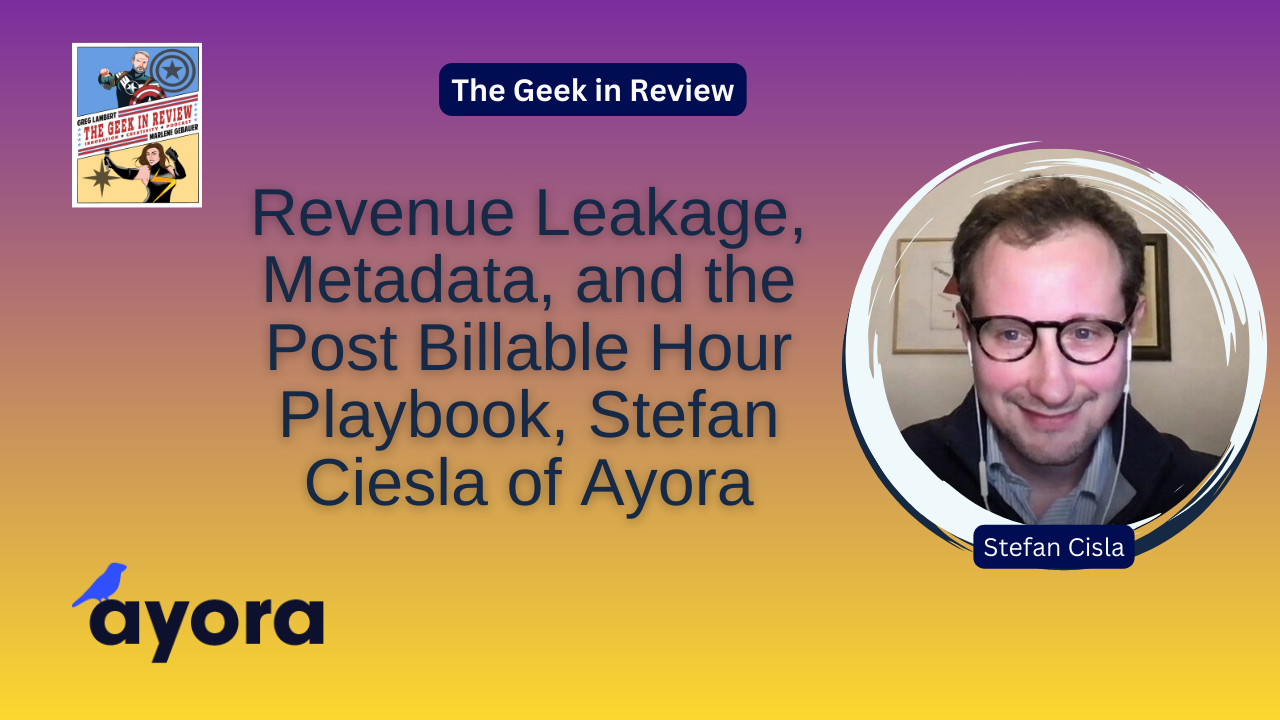
The billable hour has survived a lot of threats, from alternative fee arrangements to client procurement, but this episode makes the case that AI changes the pressure level. We open with a blunt assessment, time compresses, clients push back, and the old strategy of “work more to earn more” stops scaling. Enter Stefan Cisla, co-founder and CEO of Ayora, who frames the moment as less a tech problem and more an operating model problem. Law firms still place P&L accountability on individual partners who carry deep legal specialization, then ask them to moonlight as revenue managers. Stefan argues firms are starting to replace that fragile setup with tools that support decision-making across pricing, budgeting, and matter management.

Stefan’s origin story is half high finance, half clinical decision science. He came out of investment banking and professional services transactions, his co-founder Dr. Gordon McKenzie came out of surgery and a PhD path tied to decision science and software. Together they pulled lessons from clinical triage and continuous improvement into the law firm context, focusing on how experts make better decisions under constraints. The hosts tease out the cultural weirdness at the center of the partnership model. Partners often take the long view for client relationships, yet short-term firm economics still take damage through write-offs, scope creep, and messy budgeting. Stefan’s pitch is reconciliation, align client-first instincts with firmer, data-backed pricing and project discipline.

A core anchor for the conversation is the often-quoted $36 billion annual “value gap,” described as preventable revenue leakage tied to write-offs, weak billing practices, bad data, and poor working capital hygiene. Stefan suggests the number matters less than the trend line. AI pushes a new kind of risk, mispricing innovation. If AI reduces billable hours, firms face a squeeze between steep rate increases and client resistance, then end up forced to express value in new ways. The show leans into a spicy idea, the push to change is no longer only client-driven. Stefan sees rising pressure from inside firms, often from the CFO and operations leaders trying to fund AI investment and protect cash flows in a higher-interest-rate environment. Greg sums it up with the line, “the call is coming from inside the house.”

Ayora’s product angle lands on two hard truths, pricing tools in legal have a rough track record, and law firm data quality has been a “25-year overnight problem.” Stefan explains why earlier tools struggled, low urgency when billable hours printed money, ugly underlying time and matter data, and products that were either too complex for occasional users or too simplistic for real-world exceptions. Ayora’s bet is that the data problem is solvable. Their system uses large language models plus proprietary approaches, including work-type ontologies, to extract signal from messy time narratives and matter metadata. The goal is consistent fields and usable categorization across tasks and phases, even when client taxonomies differ. Stefan claims field-level reconstruction and normalization at high accuracy, enough to power a chatbot-style interface that generates a pricing proposal in roughly 90 to 120 seconds by finding precedent matters and adapting them to the new scope.

The conversation closes on the part everyone in a partnership feels in their bones, culture beats software. Moving away from the billable hour is not only a finance shift, it is an identity shift, habit shift, and trust shift. Stefan describes adoption as a joint change strategy, with peers inside the firm as allies, and lots of direct conversations with lawyers to build trust in the recommendations. On the “generational gap” question, he leans toward curiosity over age. Some of their heaviest users have plenty of gray hair, and they tend to be the lawyers who care about how a practice runs. For his personal AI usage, Stefan gives an honest founder answer, meal planning for a two-year-old, automating company chores, and using AI as a sparring partner, with Notion as his favorite tool.His crystal ball point is one law firm leaders should underline twice, gross margin dynamics get messier as tech and LLM costs become part of the delivery mix, and the distance between inputs and outputs grows, driving both consolidation pressure and a new wave of innovation.

Listen on mobile platforms:  ⁠⁠⁠⁠⁠⁠⁠⁠⁠⁠⁠⁠⁠⁠Apple Podcasts⁠⁠⁠⁠⁠⁠⁠⁠⁠⁠⁠⁠⁠⁠ |  ⁠⁠⁠⁠⁠⁠⁠⁠⁠⁠⁠⁠⁠⁠Spotify⁠⁠⁠⁠⁠⁠⁠⁠⁠⁠⁠⁠⁠⁠ | ⁠⁠⁠⁠⁠⁠⁠⁠⁠⁠⁠⁠⁠YouTube⁠⁠⁠⁠⁠⁠⁠⁠⁠⁠ | Substack

[Special Thanks to Legal Technology Hub for their sponsoring this episode.]

⁠⁠⁠⁠⁠Email: geekinreviewpodcast@gmail.com
Music⁠⁠⁠⁠⁠⁠⁠⁠⁠⁠⁠⁠⁠⁠⁠⁠⁠Jerry David DeCicca⁠⁠⁠⁠⁠⁠⁠⁠⁠

Links:
Transcript:

Continue Reading Revenue Leakage, Metadata, and the Post Billable Hour Playbook, Stefan Ciesla of Ayora

In this episode of The Geek in Review, we sit down with Narrative founder John Tertan to talk about law firm pricing, messy data, and why substance matters more than shiny tools. We pick up from our first meeting at the Houston Legal Innovators event, where John had the pricing and KM crowd buzzing, and ask what he is hearing from those teams as they look toward 2026. John explains how Narrative focuses on “agentifying” business-of-law work, starting with pricing and analytics, so firms stop guessing and start grounding decisions in better data. The goal is simple, improve decisions for pricing teams, finance, marketing, and partners who want to win work that also makes financial sense.

John walks through the pain points that drive firms to seek out Narrative, from low realization and high write-offs to tedious non-billable work and a lack of trust in the data behind pitches and budgets. Many firms track key metrics in scattered spreadsheets, checked once in a while rather than used as a daily guide for strategy. Narrative steps into that gap by improving the accuracy of historical matter data, identifying the right reference matters for new proposals, and supporting alternative fee structures. John explains how this foundation supports better scoping, more confident pricing conversations, and far stronger alignment between firm goals and client expectations.

We also dive into John’s founder journey, which runs from Freshfields associate to innovation work, then through venture-backed tech in other sectors before returning to legal. That mix of big law, startup experience, and prior success with HeyGo shapes how he builds Narrative. John talks about serving “mature customers” who expect more than a slick interface, they expect real understanding of their business, their politics, and their constraints. Relationships sit at the center of his approach, not only with clients and prospects, but also with advisors, former firm leaders, and legal tech veterans who guide both product and go-to-market strategy.

The name “Narrative” is no accident, and John explains why time entry narratives sit at the heart of his product. Those lines of text describe what lawyers did, for whom, and why, yet they often sit underused in billing systems. Narrative improves and structures that data, then uses it to highlight scope, track what remains in or out of scope, and surface early warnings when matters drift away from the original plan. John talks through the life cycle, from selecting comparable matters, through modeling AFAs and scenarios, to monitoring work in progress and feeding lessons back into future pricing efforts. Along the way, better transparency supports stronger trust between partners and clients.

We close by asking John to look ahead. He shares his view on how firms will move toward more sophisticated pricing models and better measurement, while the billable hour continues to evolve rather than vanish overnight. Stronger baselines, cleaner matter histories, and better tracking create room for fee caps, success components, and other structures that clients want to sell internally. John also shares how he stays informed through alerts, networks, and a new chief of staff who helps turn those insights into resources for pricing and finance professionals. For listeners who want to learn more or follow Narrative’s work, John points them to narrativehq.com and invites outreach from anyone wrestling with data, pricing, or margin questions inside their own firm.

Listen on mobile platforms:  ⁠⁠⁠⁠⁠⁠⁠⁠⁠⁠⁠⁠⁠⁠Apple Podcasts⁠⁠⁠⁠⁠⁠⁠⁠⁠⁠⁠⁠⁠⁠ |  ⁠⁠⁠⁠⁠⁠⁠⁠⁠⁠⁠⁠⁠⁠Spotify⁠⁠⁠⁠⁠⁠⁠⁠⁠⁠⁠⁠⁠⁠ | ⁠⁠⁠⁠⁠⁠⁠⁠⁠⁠⁠⁠⁠YouTube⁠⁠⁠⁠⁠⁠⁠⁠⁠⁠

[Special Thanks to Legal Technology Hub for their sponsoring this episode.]

⁠⁠⁠⁠⁠Email: geekinreviewpodcast@gmail.com
Music: ⁠⁠⁠⁠⁠⁠⁠⁠⁠⁠⁠⁠⁠⁠⁠⁠⁠Jerry David DeCicca⁠⁠⁠⁠⁠⁠⁠⁠⁠

Transcript:

Continue Reading From Bad Data to Better Deals: John Tertan on Narrative, Pricing, and Law Firm Relationships