
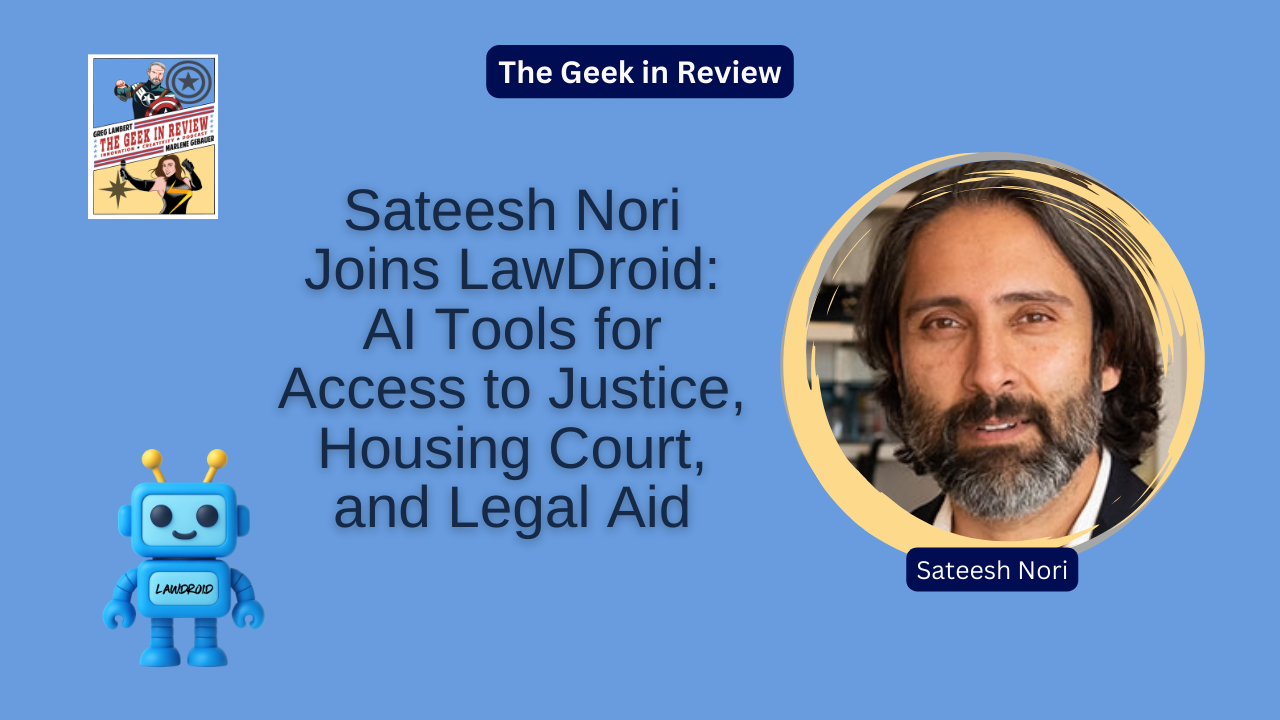
Sateesh Nori joins us on The Geek in Review for an episode that flips the usual legal innovation conversation away from law firm efficiency and toward survival-grade help for people stuck in housing courts and legal aid queues. They open with news from Sateesh himself, he has started a new role with LawDroid, working with Tom Martin, and he frames the mission in plain terms. Legal tech should stop orbiting lawyers and start serving the person with the problem, especially the person who does not even know where to begin.
Sateesh traces his path into law through debate, literature, politics, and a desire to push back on a family tradition of medicine. He describes his work as a long, continuous pursuit of fairness rather than a single turning point, and he admits the early myth that drew many into the profession, the dream of dramatic courtroom advocacy. The conversation quickly lands on the core tension, the legal system sells itself as rule of law and due process, yet ordinary people experience confusion, delay, and closed doors.
From there, Sateesh offers his critique of the current AI gold rush in legal. Too many products promise “faster horses” for lawyers, while the access to justice gap remains untouched because the real bottleneck sits upstream. People need early guidance, clear pathways, and tools that reduce friction before problems metastasize into crises. He argues for technology as “life-preserving tools,” not lawyer toys, and pushes the industry to center tenants, families, and workers navigating high-stakes issues without counsel.
The episode gets concrete with Depositron, a tool Sateesh helped bring to life with LawDroid to help renters recover security deposits through a simple, mobile-friendly workflow. He shares back-of-the-napkin math showing how large the problem is in New York, and why small, focused tools matter at scale. Greg ties the theme to earlier Geek in Review conversations about courts as a service, with the reminder that users experience the justice system like a bureaucracy, not a public utility built for them.
Finally, Sateesh expands the lens to systemic redesign, triage and intake failures, burnout in legal aid, and the hard truth that the current one-on-one model leaves most people unserved. He explores funding ideas ranging from public investment to small-fee consumer tools that sustain themselves, and he sketches future-facing concepts like AI-assisted dispute resolution to provide faster closure. In the crystal ball segment, he predicts a reckoning for the legal market as AI reshapes client expectations, with major implications for law students, staffing models, and the profession’s sense of purpose.
Listen on mobile platforms: Apple Podcasts | Spotify | YouTube | Substack
[Special Thanks to Legal Technology Hub for their sponsoring this episode.]
Email: geekinreviewpodcast@gmail.com
Music: Jerry David DeCicca
Links
- LawDroid
- LawAnswers AI
- Depositron
- Roxanne AI (Housing Court Answers)
- Housing Court Answers
- Josef
- Sateesh Nori, The Augmented Lawyer (Substack)
Transcript
Greg Lambert (00:00)
Hi, I’m Greg Lambert with The Geek in Review, and I’m here with our friend Nikki Shaver from LegalTech Hub. Nikki, I know the maps you create are constantly updated, and you released a new one. Can you tell us a little more about it?
Nikki Shaver (00:17)
Yeah, that’s right. Hi, Greg. Hi, everyone. We’ve been releasing our GenAI in Legal Tech maps every quarter since February last year. We updated in March, and then every quarter since then. In early January, we released the latest one. The cutoff date for that was the end of December 2025. It has 855 generative AI product placements by 682 vendors across 19 categories, which is obviously a massive landscape now.
Back in March last year, I said a year from now we’ll have a thousand products on this map, and I think we’re well on track for that. Now that we have a year’s worth of these maps, it’s interesting to see the trends, and some are worth calling out.
First, the areas where we’re seeing the most startup activity have changed over time. This map shows a different pattern than the previous ones. For most of last year, AI Legal Assistant was the hottest category, a lot of concentrated startup activity, new startups coming to market in that category. In December, interestingly, that cooled a little, and the concentration of startup activity shifted into operational tools for both law firms and legal departments.
For example, intake of both work and clients, and also compliance and governance solutions. This tracks with what we’re seeing in the market in terms of where firms are focused. It also suggests new entrants are seeing the broad assistant category as relatively settled right now, and also quite crowded. So that’s one to watch.
The other thing I wanted to call out is that we can see, quarter to quarter over the past year, how the market is evolving. The growth trajectory has been consistent, with about 100 companies added to the map every quarter. If you go to LegalTechHub.com, we have our clickable map where you can click into each logo and explore the categories. We also have a graph showing that trajectory.
It’s remarkable to see how steady it is, which indicates we haven’t seen a slowdown yet. No sign of a bubble bursting, or anything like that. We look forward to continuing to track it this year.
Greg Lambert (02:56)
All right, well good, my 401(k) is safe for at least one more year, right? Thank you, Nikki. Where can people go to learn more about this?
Nikki Shaver (03:00)
Don’t take it from me. They can go to LegalTechHub.com.
Greg Lambert (03:13)
Thanks.
Marlene Gebauer (03:21)
Welcome to The Geek in Review, the podcast focused on innovative and creative ideas in the legal industry. I’m Marlene Gebauer.
Greg Lambert (03:28)
And I’m Greg Lambert. Marlene, you know, when we talk about legal innovation or legal and AI, the conversation drifts toward efficiency for Big Law or cost savings for corporate legal departments. I think we’re going to look at this differently this week.
Marlene Gebauer (03:46)
Yeah, that’s true. We’re flipping the script this time. We’re looking at innovation through the lens of survival, specifically how technology is being deployed on the front lines of housing courts and legal aid offices.
Greg Lambert (04:00)
And we are joined this week by Sateesh Nori. Sateesh is a legal innovation strategist and a veteran of the access to justice fight. He has spent over 20 years in the trenches of housing court, served on commissions addressing homelessness, and is helping build the next generation of AI tools to close the justice gap.
Greg Lambert (04:26)
Depositron, let me do that again.
Greg Lambert (04:28)
Sateesh challenges the industry to stop thinking about legal tech and start thinking about life-preserving tools. He is advising on projects like LawAnswers.ai and Depositron, and teaches at NYU Law.
Greg Lambert (04:41)
So Sateesh, that’s a heck of an intro and a big bar to match. Welcome to The Geek in Review.
Sateesh Nori (04:49)
Thank you, guys. It’s such a pleasure and an honor to be here. I’ve been a long-time fan, so I’m overjoyed to be with you today.
Greg Lambert (04:58)
And I know we’ve been trying for a while to get this together, so I’m glad we were able to pull it off this time.
Greg Lambert (05:02)
Sateesh, your career path crosses legal aid, academia, innovation strategy, commissions on homelessness, and now AI. What were the hinge moments that pulled you toward this mix of advocacy and technology, and what keeps you in the fight today?
Sateesh Nori (05:07)
No, no fault.
That’s such a great question. I like the way you frame it, the hinge moments. For me, it’s always been about trying to solve problems. That’s why I became a lawyer, to help ordinary people solve problems. You know, everyone wants to look out for the little guy. When you see a little old lady crossing the street and her grocery bag breaks open and groceries are all over the street, most of us would stop and help pick them up and get her across the street.
As lawyers, I think a lot of us feel that way, but we’re trapped by the jobs we have, the roles we’re in, and the systems we work in. So for me, it wasn’t about hinge moments. The big picture was always, how do I help people? And if I hadn’t become a lawyer, my alternate path would have been elementary school teacher, which I realized later is a lot harder than being a lawyer. So I think I lucked out there.
All the things I’ve done have been along that bigger path. That’s why I was never afraid to venture outside my skis, lean out over my skis, or think outside the box. For me, there was never really a box. It was what I happened to be doing at the time, and how I could fit that into the larger issue, why isn’t the law more accessible to people, why don’t things work? The law is a great example of a system that doesn’t work that well.
Greg Lambert (06:57)
I’m curious, as you were planning to go to law school, I know that was a couple of years ago. Was there something in your family dynamic or your individual experience that motivated you to go to law school to help people?
Sateesh Nori (07:03)
Yeah. Part of it is I had to rebel against everything in my family. My parents are doctors. My sister and her husband are doctors. Sometimes I joke that if we had a family reunion, we could open a small hospital. I pushed against that. I didn’t want to study math and science. I was more interested in the arts and literature and politics, and I was on the debate team, big nerd in high school.
Part of that was thinking about how to convey ideas, balance issues, think about pros and cons. That interested me. The law seemed like a natural fit. Some of my role models, when I was growing up, I had to watch the movie Gandhi because it came out when I was seven or eight. I didn’t know he was a lawyer until I watched that movie and read more later. He turned his legal training on its head and said, let’s adopt principles drawn from people like Ralph Waldo Emerson, and ask how we can logically frame right and wrong and convince people of the right way forward.
Later I realized these same ideas were adopted by Martin Luther King Jr. and others trying to use the rule of law, justice, and due process. Fundamentally, it comes down to fairness. Some things are not fair. We all know that, but we close our eyes because it’s hard to deal with. Out in the world, you see unfairness and think, I wish I could help, but I have my own problems.
As lawyers, I think we should help with these things. That drove me. But there’s also the vain part, I thought it would be fun to be a lawyer. I didn’t know most lawyers don’t go to court. You read To Kill a Mockingbird, The Firm by John Grisham, you see movies, and you think being a lawyer is cool. You get to wear suits and have dramatic encounters in court. I wanted to do that. Public interest lawyers do get to do that. Most lawyers don’t, and that’s sad in some ways.
Greg Lambert (09:58)
There was a recent Substack article you wrote. A lot of people think of legal tech as the solution for access to justice, and you’ve been pushing back, arguing these are life-preserving tools, not only lawyer-facing apps. What motivated you to write that and put it in everyone’s face?
Sateesh Nori (10:30)
I’ve been in this space for only a year and a half or so. Today happens to be the one-year anniversary of the first legal AI tool I built with friends. It’s called Roxanne AI, and it helps tenants in New York City. It’s a RAG bot. It feels simple now, but back then it was hard to get it out the door and on a website. Being new, I saw where things were going.
We all know there’s a huge AI bubble. There are 700-plus legal AI companies right now, and they’re growing. Most of these companies center the lawyer. They take the things we do every day and make them faster, easier, more efficient. People are going to make a lot of money selling these tools.
But if you take a step back and look at the problem, helping lawyers work a little better isn’t going to solve the access to justice gap. It’s delivering help to people who are not lawyers, who have life problems. They don’t even know they need a lawyer, or where to go for legal redress. I wanted to reframe it and push back on this arms race, getting toys so our firm has more toys than the other firm, even though no one is using them, or doesn’t know how, or isn’t willing to change.
Let’s not center the lawyer, let’s center the person with the problem. There’s a Henry Ford quote I overuse, if you ask people what they want, they’ll say faster horses because they can’t imagine the automobile. That’s where we are in legal tech. We’re thinking about faster horses. If only Word and Outlook worked better with AI, and Lexis and Westlaw worked better with AI. Why do we even need that at all? Why not rethink legal research, filing papers, even resolving disputes? Why are we suing each other in the same way? Could things be resolved earlier through another mechanism? I’m not sure that’s the answer, but I want to push the envelope and get people thinking differently.
Greg Lambert (13:10)
Kind of like reverse engineering it. Here’s what you ultimately want, how should you do it, as opposed to how do you do it now.
Sateesh Nori (13:12)
Yeah. Yes. Exactly.
Greg Lambert (13:21)
So you’re a builder, and you’ve been involved in building or advising on AI tools like LawAnswers and Depositron. You’ve talked publicly about chatbots preventing homelessness. As a builder, what core design principle do you insist on when building or advising on AI for vulnerable communities?
Sateesh Nori (13:45)
Let me challenge your assumption that I’m a builder. I can’t tell you how the internet really works, or how this call works, beyond general terms. With AI, I’m the same way. Sometimes I feel like an impostor. I talk about it, but can I explain it?
What I reconcile is that it doesn’t matter. The thing I bring is the idea and the experience of how that idea could be applied in the real world. Then I have friends I’ve made, like you guys and others I’ve met at conferences, who can put it to paper and say, here’s an MVP, here’s a prototype. I like the idea. That’s the part I can do because of my experience.
I know how the tech works. I know how to build a RAG bot. I know how to make sure it’s secure, and can live on a website and connect to OpenAI or Claude or Anthropic, and so on. I’ve been lucky to make friends like Joseph (from Legal), and Tom Martin at LawDroid.
I can announce right now I’m joining Tom Martin as an employee of LawDroid. Today’s my first day, so it’s great to announce that. You heard it here first. Tom helped me put Depositron out there, which is a tool that helps people who haven’t been able to get their security deposits back from landlords.
Greg Lambert (15:17)
That’s great. Dropping it here first, everybody. Congratulations.
Sateesh Nori (15:36)
This is a problem I hear about all the time, from friends, relatives, lawyers, and even pod dog Georgie. Depositron helps you generate a letter from your phone and upload photographs. It’s not even AI. The AI part comes in if you want to ask questions about the law, then it becomes a RAG bot.
A simple letter-builder tool was unavailable to hundreds of thousands of people in New York City who face this problem every year. Back-of-the-napkin math tells me it’s a $100 million problem annually in New York City. Security deposit money improperly withheld by landlords totals about $100 million out of $500 million collected. Even conservatively, if landlords do the right thing 80% of the time, 20% of $500 million is $100 million.
Ideas like this are easy to build, but you need technical background, partners, and you have to take a risk putting them out there. The opponents to these things, believe it or not, are often lawyers, courts, judges, and nonprofits like the ones I worked at. They say you’re cutting lawyers out, and people can’t do this on their own. I say, why not? What’s so special about us? We make mistakes. We’re flying blind sometimes. We look up the law as we go. Why can’t people do this on their own if it’s easier to understand, translated into their language, and they can fill out forms and navigate courts more easily?
Greg Lambert (17:36)
It makes it easier. Even something like a letter generator. We recently had Judge Scott Schlegel on, and he talked about courts needing to stop being the DMV. Sorry, DMV. Can we make some of these things simpler for people to use and understand? Not cutting people out, but making it easier to do it the right way and saving time and hassle.
Sateesh Nori (18:16)
Yeah, absolutely. I love that framing. People don’t think about it that way.
Greg Lambert (18:21)
I don’t think we do. We don’t see the court as a service. I think Richard Susskind stole that from librarians, who have been saying since the turn of the century that the library is a service, not a place. Courts are catching up to that.
Sateesh, you’ve been in the legal tech part for less than a couple of years, but you’ve been in housing court for over 20 years. How has that frontline experience shaped how you think about AI doing more and more? We hear the old adage, just because you can do something doesn’t mean you should do it. What should AI do, and what should it not do in the justice system?
Sateesh Nori (19:25)
Great question. I spent 20 years in the courts and working at legal aid in New York City, but sometimes I think I wasted 10 years. I learned what I needed pretty early. One big lesson is we will never be able to help everyone who needs help. There will never be enough people, enough funding, or enough time to do things the one-on-one bespoke way we do them.
I might have helped maybe a thousand people in those 20 years, but I probably turned away 10,000 people. That’s immoral. Imagine an emergency room turning away 90% of people with diseases.
Greg Lambert (20:26)
Is that time, or a staffing issue? What is it that gets 90% turned away?
Sateesh Nori (20:33)
All of it. Intake is time-consuming. Determining eligibility is time-consuming. Learning someone’s problem is outside our scope, or they’re ineligible for funding, takes time. Dealing with courts, welfare agencies, and public housing agencies is paperwork-intensive. Legal aid offices still use fax machines because other agencies only receive info through fax, and email and phone systems are overloaded. Everything takes time.
In intake and triage, we have no idea what’s coming. There’s no good way for people to self-select out because there’s no good information. Everyone comes to the same entry point, whether we can help them or not. That makes everyone’s job harder.
In Queens, where I worked for 10 years, every day there were 50 to 75 people lined up outside our courthouse office door. Maybe we can help 10. Another 10 are in the wrong building, but don’t know it because there’s no good information. Another 10 are too late, the problem is months old, and it’s hard to undo.
We can’t sort people properly, and they can’t sort themselves. People burn out. They’re fatigued and demoralized from turning people away. They feel like they have blood on their hands when something bad happens to clients, or to people they couldn’t help. They quit, we train new people, and it’s inefficient.
We have to do this better. We have to apply expertise where it’s most valuable. Imagine a restaurant where the head chef hands out menus or orders meat and vegetables personally. That’s not efficient. Yet in legal aid offices, managers fill in, answer phone calls, write emails, and do work that isn’t the best use of their expertise.
We need to focus on harder, higher-leverage work, like appeals. There’s another justice gap beyond getting a lawyer in the first place. On appeals, there are almost no lawyers available because everyone is doing frontline work and burning out. Appeals are where the law can change and impact many people. We’re working backwards. We should be doing appeals, as long as people have viable ways to get claims heard fairly in the first place.
Greg Lambert (24:27)
What are things AI should not be seen as the answer for?
Sateesh Nori (24:34)
Sometimes we treat AI as a panacea, the idea of a robot lawyer doing everything. Maybe that’s true someday. We have self-driving cars, which no one thought were possible, and now they’re in places like Los Angeles, San Francisco, and Phoenix. They’re fun. I take them when I can because I want to put my butt where my mouth is.
There’s hype about what AI can do at the extreme end. People worry about hallucinations and harm. Those are real concerns, but focusing only on them leaves a lot on the table. There are easy use cases, like Roxanne, Depositron, and LawAnswers. Simple things that don’t require a lot of compute. We worry too much about errors when most of the time it’s fine.
We should focus on high-volume, low-risk issues like intake, giving basic legal information, telling people where the courthouse is, helping fill out forms for a name change, custody, an order of protection, or filing a small claims case. These have real impact. There’s so much we can address with tools, but fear and the idea that lawyers are special and nobody else can do this hurts people. Lawyers highlight risks first, that’s what we’re trained to do, so we’re sometimes the wrong people to lead the thinking.
Greg Lambert (27:11)
Would you start with high-volume, low-risk if you were redesigning the justice system? I was listening to Jennifer Leonard and Bridget McCormack’s podcast, their 2026 prediction episode. Bridget talked about an AI moderator as a second mediator, getting prep done so the human mediator can focus on the case. Is that where you’d start, or something more complicated like appeals?
Sateesh Nori (28:22)
It’s exactly that. I’ve been talking to Bridget and folks at the AAA about an idea I have called Claimsy. It’s a dumb name, but it sticks. Claimsy could help ordinary people resolve disputes. Imagine a contract dispute, someone was supposed to paint a fence, it didn’t turn out right, one party isn’t happy and doesn’t pay. Otherwise you go to small claims or hire lawyers, it gets tense, delayed, and everyone is unhappy. Win or lose after a year of litigation, you’ll be unhappy.
What if we had an alternate dispute resolution system powered by AI? Both parties pay $10 each, submit evidence, push a button, and 10 minutes later get a decision about who’s right. Maybe that’s too far for people, so maybe it aids a human judge or arbitrator. Either way, it speeds up the process you described. Used thousands of times a day, it could be self-sustaining. If 10,000 people paid $20, that covers maintenance, support, and a human worker.
It would ease the burden on local courts. Judges don’t want to hear a dog walker case, a dry-cleaning mistake, things like that. The challenge is trust, and getting it incorporated into existing systems. Courts could say, file here, or use this tool and be done in days instead of months. People lack closure. Win or lose, everyone feels like a loser sometimes. The payoff is small, the time is huge, people get bitter, and lose faith in the system. Claimsy is a way to address that.
Greg Lambert (31:16)
I have an idea. Call your mediator Judge Wapner, and have Doug Llewellyn, the AI version, interview them on the way out. The People’s Arbitration.
Sateesh Nori (31:24)
Exactly. The People’s Court, or Judge Judy. Judge Judy AI.
Greg Lambert (31:49)
So, Sateesh, tell us about funding models. Where does the money come from to develop these tools? Agencies and courts don’t have it. We do have organizations with resources, big tech, big law, investors. How do we redirect money toward closing the justice gap?
Sateesh Nori (32:35)
The way we fund this work is broken. We rely on courts, foundations, local communities, governments, charities. They’re never going to fund it effectively. Priorities change. People chase new toys. The result is underpaid, overworked staff.
I’ve seen it as an executive director of a nonprofit, going door to door with my hat in my hand, asking wealthy people for a couple thousand dollars. It was demeaning, demoralizing, and never enough.
There are a couple ways this could be different. One is to look at how tech companies are making money. The stock market is being propped up by a handful of tech companies. They’ve never made more money. There are more billionaires than ever. What if we taxed them and said, give us 0.01% of annual profits? That would be billions, many times what we have now.
Why would they do it? One reason is they’ve caused harm. They owe society something. Another is they say they want to do good. A tiny percentage would matter.
But that probably won’t happen. So the other way is to make solutions available without the overhead of lawyers, firms, nonprofits, and bureaucracy. What if it’s an app? Would you pay five bucks to resolve a legal problem that’s weighed on you for months, or at least get pointed in the right direction? The price of a slice of pizza, a burrito at Chipotle, or a coffee at Starbucks or Dunkin’.
The problem is the information isn’t available, and there are barriers like unauthorized practice rules. But if we overcome those and give people help early, before it becomes a legal crisis, these things fund themselves. Susskind says build fences at the top of the cliff, not ambulances at the bottom. These are fences. Then legal nonprofits can focus on the hard stuff. Everyone else gets help from a simple app that does one thing well.
Greg Lambert (37:12)
It’s legal service without lawyers. With your new role at LawDroid and working with Tom Martin, what do we expect to see from you in the next six months?
Sateesh Nori (37:15)
Tom is creative and supportive. Two ways forward, speaking for myself and not for him or LawDroid. One is building more tools and plugging them into legal aid, better intake tools, better websites with chatbots, so fewer people are stuck in line and more people get help sooner.
The other is building services like LawAnswers.ai that deliver legal help independently of lawyers and legal aid, accurate and efficient within the boundaries of the law where people live, and making it sustainable as a business model.
Immediately, we’re working on expanding Depositron to other cities. It exists in New York City and New York State because the laws are the same statewide. Why not California, Illinois, Florida, Texas? In some states, laws vary county to county, which is harder. In New York, it’s the same statewide, so it’s easier. With local partners, it’s not impossible.
Greg Lambert (39:17)
Before the crystal ball question, what resources do you use to keep up with changes? A2J, tech, anything. What are your go-to resources?
Sateesh Nori (39:41)
Surprisingly, LinkedIn is the best place I’ve found to learn and connect. People are open to talking, meeting, learning from each other, and sharing resources. That’s how I started, putting my name out there, writing, people asking me about it, then being on podcasts like this and meeting people.
I also read Substack. There are people writing timely, topical pieces, and it’s helped me learn the space. Third is travel, going to conferences and talking outside slide decks, at a reception or happy hour. There are many people, but also not that many. The legal tech world is small. You see the same people, build relationships, get introductions, and move things forward together.
There are more academic ways too, scholarly articles, and books by people like Richard Susskind and others. Also Ethan Mollick, from Penn, who wrote Co-Intelligence. People like that write thoughtful pieces that open your eyes, and you can apply them to daily work.
Greg Lambert (41:19)
Ethan Mollick.
Now we’re at the crystal ball question. What changes or challenges do we need to prepare for now? What groundwork do we need to lay?
Sateesh Nori (42:03)
As a skeptic, I’m afraid the legal market is going to crash at some point. The way we deliver legal help, private and public, is broken. The billable hour is outdated. As clients understand how much AI tools can do, in-house teams will question why they’re hiring Big Law. That trickle-down impacts partners, associates, in-house counsel, and law students.
If I were a law student right now, I’d be terrified. Schools aren’t telling them what’s coming. They’re teaching the same old stuff, and it won’t help because it will be irrelevant. Students will be hundreds of thousands of dollars in debt.
That reckoning will come and clear the field, then we rebuild. We need different ways to deliver services. Lawyers will become more specialist or more generalist. It will be one or the other. Lawyers will either do many things using AI tools, or focus on narrow things only humans can do. Those might be the poles of the legal market. I’m worried about the people in the middle, and law students looking for jobs. But the system doesn’t work, and there’s no good way to justify it, so maybe this is the path forward, unfortunately. That’s my prediction. Let’s see what happens.
Greg Lambert (44:01)
We need to bring you back someday and play this part back to you.
Sateesh Nori (44:06)
All right. I’ll be under a bridge.
Greg Lambert (44:11)
Sateesh Nori, thank you for coming on. It’s been great to have the human side of legal innovation. Thanks.
Sateesh Nori (44:23)
Thank you. This has been a real pleasure.
Greg Lambert (44:26)
Thanks to all our listeners for taking the time to listen to The Geek in Review. If you enjoyed the show, please share it with a colleague. We’d love to hear from you on LinkedIn, TikTok, or Bluesky.
Greg Lambert (44:37)
And Sateesh, for listeners who want to read your Substack or learn more about your projects, where’s the best place to go?
Sateesh Nori (44:46)
Find me on LinkedIn, Sateesh Nori. My Substack is called The Augmented Lawyer. I have a book coming out in the next couple of months, also called The Augmented Lawyer, published by the ABA. Stay tuned.
Greg Lambert (44:56)
Thanks.
Greg Lambert (44:59)
And as always, the music you hear is from Jerry David DeCicca. Thank you, Jerry.
Greg Lambert (45:02)
Thanks, Jerry. Bye, everyone.
Marlene Gebauer (45:04)
Bye.