
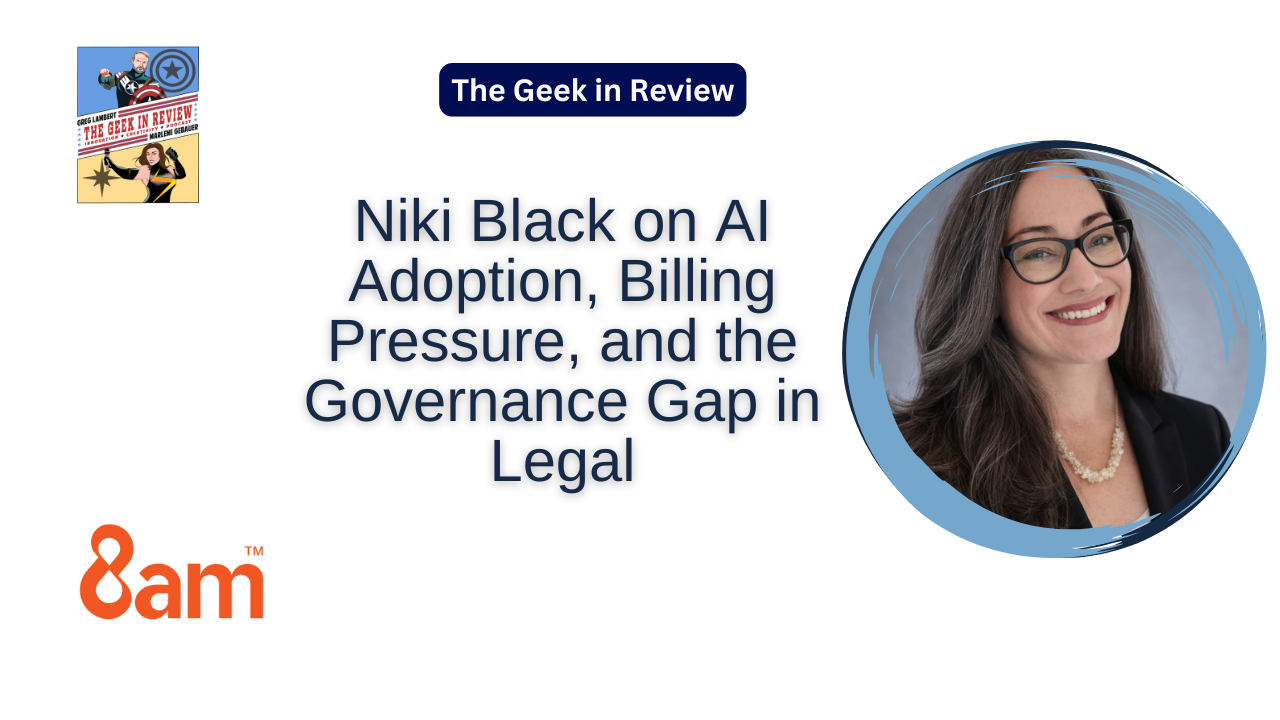
This week we welcome back Niki Black to unpack the findings from the newly released 2026 Legal Industry Report from 8am The conversation centers on a legal profession moving into a new phase of AI adoption, where individual lawyers are embracing general purpose AI tools at a striking pace, while many firms still lack even basic policies or training. Niki explains that this disconnect is especially visible among solo, small, and mid-sized firms, where limited resources often slow formal governance even as day-to-day use rises fast.
A major theme of the discussion is the widening gap between personal experimentation and institutional readiness. Niki notes that lawyers are not waiting for permission, and many are already relying on AI to support research, drafting, and routine work. At the same time, firms are struggling to provide guidance, training, and guardrails. The episode highlights the growing risk of shadow AI in legal practice, especially when lawyers and staff turn to unsanctioned tools to keep pace with client demands. For smaller firms, the answer is not elaborate bureaucracy, but practical direction, clear expectations, and a recognition that even a modest policy is better than none.
The conversation also turns to client expectations and the economic pressure AI is placing on the traditional law firm model. Greg and Marlene press Niki on whether firms are truly ready to move away from the billable hour as AI compresses the time needed to complete legal work. Niki argues that large firms face deep structural obstacles because compensation systems, staffing models, and internal economics remain tied to hourly billing. Still, she sees pressure building from in-house counsel, boutique competitors, and smaller firms that use technology to deliver comparable work at lower cost. The result is a market that may resist change, but not escape it.
Another standout part of the episode explores how AI is reshaping access to justice. Niki points to the promise of generative AI as a force multiplier for legal aid lawyers and public defenders, especially when paired with trusted tools and better funding. She rejects the idea that technology alone will solve the justice gap, but makes a strong case that AI, combined with stronger institutional support, helps lawyers serve more people with better results. At the same time, the hosts and Niki acknowledge the risks of a two-tiered system, where wealthier clients benefit from high quality tools while vulnerable users face lower quality, error-prone outputs.
By the end of the episode, the conversation expands from AI tools to a broader structural shift across firms, clients, and law schools. Niki sees the next three to five years as a period of deep change, where pricing, training, competition, and professional expectations all evolve at once. She also shares her own methods for keeping up, including RSS feeds, trusted blogs, and LinkedIn, with a few playful complaints about Substack making life more complicated. The episode leaves listeners with a clear message: the biggest issue is no longer whether AI will affect legal practice. It already is. The real question is whether the profession can adapt fast enough to manage the consequences wisely.
Listen on mobile platforms: Apple Podcasts | Spotify | YouTube | Substack
[Special Thanks to Legal Technology Hub for their sponsoring this episode.]
Email: geekinreviewpodcast@gmail.com
Music: Jerry David DeCicca
Transcript:
Continue Reading Niki Black on AI Adoption, Billing Pressure, and the Governance Gap in Legal