As mentioned in my last post, law students often respond to their poor scores on a basic Word assessment by explaining to me that they need not need worry about this tech stuff because “that is what secretaries are for.” I think this is wrong for a number of reasons, a few of which I outline below:

  • Legal work still entails some drudgery
  • Drudgery is a rite of passage for young lawyers
  • Drudgery increasingly falls on young lawyers as law firms reduce support staff
  • Doing work themselves also plays into lawyers’ propensity for autonomy and urgency
  • Delegation remains of critical importance
  • But proper delegation requires proper oversight
  • Proper oversight requires some of level of tech competence in order to:
  • Delegate the right work
  • Delegate to the right people
  • Delegate the right way (i.e., appropriate instructions and expectations)

The Law Factory

Grunt work is a rite of passage for young lawyers toiling in a “law factory.” There is even a genre of legal reporting where the lede is the human-interest angle of the author-as-young-attorney laboring through some thankless task. For example, last month’s Atlantic article asking the question “Why Are So Many Law Firms Trapped in 1995?” begins:

After I graduated from law school, my first assignment at a large New York law firm was to assist in the discovery phase of a securities case. For 12 hours a day, I sat in a conference room jammed with bankers’ boxes full of documents, reviewing them one page at a time.

On what it is like to be a young lawyer, I can’t recommend enough the insightful and empathetic writings of The People’s Therapist, an associate turned psychotherapist. He writes of “a sweatshop where the billable hour is all that matters, no one tells anyone anything, and young associates are reduced to a fungible commodity.” (see also, here, here, here). For a lighter take, I suggest this parody video of a young lawyer who identifies a typo amidst an endless hell of due diligence and is celebrated as a conquering hero (until he leaves the office and tries to explain this grand feat to a normal human being). It’s funny because it’s true. It’s sad because it’s true. It’s a core reason that young lawyers are miserable (see here).

The notion that young lawyers are burdened with rote, routine, and repetitive work is not limited to young lawyers. More than 95% of hiring partners believe new attorneys lack key practical skills. The menial tasks young attorneys are consequently given has resulted in more than half of managing partners being able to envision their new hires replaced by Watson-like software in the next 5 to 10 years (much to Ryan’s chagrin). Young lawyers consigned to drudgery is so systemic that Vault rates legal employers on whether or not they give new recruits “substantive work.”

Everyone knows that young lawyers are handling labor-intensive work that can be augmented (if not completely replaced) by a machine. Except when they don’t. Except when someone like me comes along and suggests that lawyers (like staff) should therefore get better at using the basic technology tools of their trade. Then the condescension kicks in, and someone explains to me, “That’s what secretaries are for.” My agitated interlocutors include law students, who, as I explained last post, when presented empirical evidence of their technological shortcomings explain that this tech stuff is unimportant because the labor-intensive work will be handled by someone else. To that, I respond:

In theory, you will get no objection here (well, a few, that I get to below). For me, law is a team sport where staffing, process, and trust in allied professionals are mission critical. But I have a number of questions about how that theory is actually applied in the vast majority of legal settings.

Missing Delegates

Legal support staff will be heartened to learn that their jobs are secure because lawyers rely on them for all labor-intensive work. But this sentiment will be of little consolation to the thousands who have already lost their livelihood. Lawyers, apparently are using technology instead (see, e.g., herehere, hereherehere, hereherehere, here, herehere, here, here, here, here, here, here, here, here, here, here, here, here, here). In announcing staff layoffs, the firms release public statements like:

“Advances in technology have resulted in a need for fewer support staff and related services in law firms.”

 “Technology has changed the legal industry – the way we work today is very different than the way we worked as recently as five years ago.”

“our need for secretaries has been substantially reduced as a result of technology and the work style of our attorneys, who themselves perform a number of functions previously handled by secretaries.”

Law firms seem to want it both ways. They lay off support staff because lawyers are using technology and then dismiss the need for lawyers to get technology training because lawyers rely on support staff.

There is less support staff. The support staff that remains prioritizes the work from partners. Both of these realities (less staff, focus on partners’ work) are all the more conspicuous during the late nights, early mornings, and long work weekends in which so many lawyers take such perverse pride. Lawyers, especially young lawyers, end up doing much of the labor-intensive work themselves.

Work-Hoarding Lawyers

It has been suggested to me more than once that the post-Recession staff layoffs are evidence of greed. Greed by the partners trying to boost their profits by directing a higher percentage of work to billable resources. Greed by the individual attorneys trying to pad their timesheets. While I can not disprove this hypothesis, avarice is not essential to the explanation. We can take law firms at their word that the lawyers really have changed the way they work due to technology.

Whether or not lawyers are naturally proficient at using computers (the answer is definitely not), the computer-centric model of working is conducive to maintaining independence. The tape from a dictaphone and the handwritten notes on a printed page are intended for someone else. Digitization, however, is meant to empower the user to accomplish tasks themselves. Control is attractive to many lawyers.

In a previous post, I outlined two psychological traits where lawyers most consistently diverge from the general population. High skepticism and low resilience drive a deep statu quo bias and orient lawyers’ issue-spotting prowess towards resisting change. The other traits that separate lawyers from the general population: autonomy, sociability, and urgency.

    Autonomy: lawyers prefer to maintain control

    Sociability: lawyers prefer not to interact with others

    Urgency: lawyers want it done now

Sound familiar? Personal computers make it possible for lawyers to work independently, avoid interaction, and ensure their work gets immediate priority. There are many people, some of whom are lawyers, who would rather take ten minutes to do something themselves rather than wait two hours for someone else to get to it–even if takes that other person one minute to complete.

Combine these predilections with a lack of staff support for junior attorneys, and it is fairly easy to envision lawyers’ work habits changing over time without reference to any perverse financial incentives.

An Empirical Question

My father was an educated, curious man who also liked to imbibe when the opportunity presented itself. He took great pleasure in sitting at a bar stool and holding forth endlessly on topic after topic (yes, as this blog proves, I am very much his son). I frequently joined him. In the few years before his passing, however, I would often ruin the fun. As soon as his idle speculation entered the realm of fact (e.g., did Marco Polo introduce pasta to Italy after visiting China?), I would pull out my smartphone and let Google resolve the issue (No. That myth started as food-industry propaganda). He never much liked my adherence to the dictum that we are all entitled to our own opinions but not our own facts. His personalized factual universe was so much more congenial.

While there are normative questions to be addressed with respect to delegation (more below), these should not distract from the extant empirical reality. Law firms should have a good sense of who is doing what kind of work. They track time meticulously and have document management systems that can tell them who is spending how much time in which applications. There is no need to speculate.

Indeed, a firm that I profoundly respect not just pulled but published their document management statistics to demonstrate their commitment to data-driven change. The firm found that, consistent with the changes described above, their lawyers’ share of the keystrokes in Microsoft Word had increased from 39% to 80% between 2004 and 2014. Over that same period, the top shareholder’s share was unchanged. In 2004, the top shareholders accounted for 0% of the keystrokes in Microsoft Word, and, in 2014, the top shareholders accounted for 0% of the keystrokes in Microsoft Word. If the top shareholders had based training priorities on their own lived experience, the firm would have provided no technology training for attorneys. But these were trial lawyers interested in the evidence. They based their training priorities on the data, and their firm is better for it.


But Delegation Is Important

Yes, yes it is. Staffing is part of my Service Delivery Review because I believe that even technologically-enabled lawyers should take a team-based approach to large-scale projects. Delegation may run counter to the lawyer personality profile, but it is an important aspect of proper client service. That said, tech competence is important not only for lawyer-as-doer but also for lawyer-as-delegator. Here’s why.

What To Delegate

Delegation has costs, including communications overhead, the attendant dangers of miscommunication, waiting for the work to be returned, review of the returned work, and the opportunity costs of occupying the resource to whom the work is delegated. If technology is used properly, it can reduce work that would take hours down to a matter of seconds and thereby mitigate the need to delegate to a human. That is, it frequently requires less time and effort to delegate to the machine than it does to delegate to a human, as I hope I demonstrate in that video I always use:

Delegating to the machine can be a better option than delegating to a person (who is just going to use the machine). But the machine, like the person, requires proper instruction. Technology training is key to knowing what work to give to the machine and how to instruct the machine in completing the work.

To Whom To Delegate

I advocate for competence-based technology testing and training for lawyers and staff. There is rarely good reason to assume that either has natural facility with basic technology. In fact, one explanation for why some lawyers learn not to delegate is the designated person to whom they are supposed to delegate is spectacularly bad at the delegated tasks.

I’ve tested lawyers, law students, and staff. Of these, staff has the highest level of variance. Some staff (especially from the ranks of trainers and word processors) are amazing. Perfect accuracy, unparalleled speed. My LTA is a joke to them (one advantage of competence-based testing being that they can prove this quickly and test out of training they do not need). But these superheroes have foils–often, but certainly not always, from the admin ranks–who appear to have almost no clue what they are doing on the most basic functions of the most common desktop software.

I don’t need to imagine (because it is my personal story) a young lawyer determining they should just do everything themselves because their support is excruciatingly slow and error prone. Why have your work wait in a queue only to spend more time correcting the returned product than is required to do the work yourself? Staff quality is a key factor in delegation. Training staff is important.

This, of course, is another advantage of competence-based testing. Ascertaining who knows what is great for creating individualized training curricula and raising tech competence, but it is also foundational for team assembly and workflow design. Transparent, objective measurement of proficiency can give lawyers the confidence that the person to whom they are delegating is much better and faster than they are at the task being delegated.

Excel, as always, is my favorite example. I love Excel. I am convinced that Excel is “the most important computer application of all time.” As a data-driven, in-house lawyer, I spent more time in Excel — company financial and performance data — than I did in Word. But I recognize that my experience is not typical and concede that not every lawyer needs to be an Excel expert. Ubiquitous expertise is not what I asked of my outside firms. Instead, I expected them to (a) have a few, identified Excel experts on their team and (b) a workflow designed to direct spreadsheet-intensive work to those experts.  

How To Delegate

That technology is now part of a lawyer’s ethical duty of competence is well-trod ground. (see here, here, and here). Less commented upon (at least in the sources I read) is the interplay between evolving ethical duty of competence and the rules governing delegation. Specifically, Rule 5.1 covers delegation to other attorneys (e.g., from partner to associate), and Rule 5.3 covers delegation to nonlawyers (a term I dislike but that is used in the text of the rule). While “certain tasks are delegable, the lawyer remains responsible for ensuring that those tasks are performed competently, diligently, and otherwise in conformance with the lawyer’s own ethical obligations.” Since the lawyer’s own ethical obligation of competence encompasses technology, the lawyer cannot avoid that duty by delegating the task to someone else.

Granted, these paired obligations can be challenging to fulfill in highly technical areas. While the facts of the particular were egregious,that lawyers will be sanctioned for relying on vendors during the ediscovery process has some troubling implications. But, fortunately, I do not have to deal with edge cases. When it comes to technology training, I’m primarily focused on the basics, for now.

In this regard, I will forever be in the debt of a commenter who responded to one of the first stories on my testing of outside counsel’s tech competence. This commenter has become the posterchild in my discussions of delegation. Because one area of my portfolio included managing a fair amount of small-bore litigation, I would test whether associates and staff could use the automatic Bates-numbering function built into their PDF software. One commenter to the ABA Journal piece that mentioned this was horrified that I expected an exalted J.D. to know such things:

All I am saying is that there is no need to charge a client $250+/hr for me to put page numbers on a stack of documents. I will do the substantive document review, prepare the written responses to the document requests, etc. My secretary or paralegal can do the photocopying and numbering. If a firm has the resources (and I recognize that not all do), I maintain that this would be the proper way to handle such tasks.

All I am saying is that I’m grateful. If I had presented this as a hypothetical, no one would have believed me. The lawyer was so locked into the way things had always been done that the concept of a technology-based solution was outside the realm of comprehension. Commenting on an article referencing the fact that the computer can apply Bates labels in seconds, the lawyer could only envision the laborious manual process and be appalled at the idea that a lawyer might be involved it. God bless the Interwebs!

If a lawyer knows how to use the Bates-label function, the process takes seconds to complete. But even if a lawyer doesn’t know how to use the function, the lawyer still needs to have an idea that such a function exists in order to delegate properly. There is a material difference between (i) expecting your secretary or paralegal to return digital documents in a couple of minutes and (ii) accepting scanned images after several hours. Speed and costs are a concern (copies cost and paralegals bill) but so is quality. The manual process introduces hundreds, if not thousands, of opportunities for error (e.g., two pages stuck together) and drastically reduces the quality of the documents (from digital document to scanned image).

I’ve seen that dynamic over and over again. The attorney not only doesn’t know how to complete the project in a few minutes, but also doesn’t know that the project can/should be completed in a few minutes. The support person also lacks the requisite training and resorts to the most manual, brute-force approach to getting the work done. How the work actually gets done is frequently far more important than whether or not it is delegatedThe most common examples come from Word (e.g., auto-numbering, cross-references, tables of contents) and PDF (e.g., generation, assembly, footers, redactions). The most spectacular examples come from Excel (e.g., filter, sort, math functions, lookup, pivot tables).

I once encountered a paralegal who was in her second week of trying to reconcile three mammoth spreadsheets. One contained customer reference numbers and customer contact information. A second contained customer reference numbers and customer purchase information, including product serial numbers. A third contained a list of serial numbers of purchased products with respect to which the client needed to contact the customers (think warranty, class actions, recalls, etc.). The paralegal was filling out customer contact information on the third list by (i) using the Find function to locate the serial numbers on second list and (ii) then using the Find function again to locate the related customer ID on the first list. She was doing this for tens of thousands of products and was on pace to take several weeks. In a few minutes, I used Vlookup function to complete the entire project for her and reduce the opportunities for human error by several orders of magnitude. Until I came along, neither she nor the attorney who had delegated the task had any idea that she was doing anything wrong.

I harbor no expectation that everyone in the chain will be fully trained in every aspect of the software. The person actually doing the work should be trained in the relevant labor-saving, quality-improving features. The person overseeing them need not know the specifics; the delegator should have a general sense of what the work requires and how long it should take. A rough idea that the software can do X is a different level of competence than knowing how to make the software do X. But it is still a level above where most lawyers and staff currently operate.

Conclusion

We don’t know what we don’t know. Yet, everything is obvious once we have the answer. The people in the preceding stories are good for a chuckle if you are familiar with the functionality they aren’t. Except it isn’t funny. These are real people doing mind numbing and unnecessary work that matters. They are smart, talented, hard working, and well meaning. They just want to do a good job. They have the tools to do a good job. But they don’t know how to use those tools. This situation is unfortunate. It is also remediable. This is a problem we can solve in the near term. Part of the solution, however, entails understanding how technological competence intersects with proper delegation.

Lawyers should know how to complete the work they do not delegate. Lawyers should properly oversee the work they do delegate. Staff should know how to properly perform the work delegated. Not everyone needs to be an expert. But almost everyone would be better served by a higher tech baseline.

++++++++++++++
Casey Flaherty is the founder of Procertas. He is a lawyer, consultant, writer, and speaker focused on achieving the right legal outcomes with the right people doing the right work the right way at the right price. Casey created the Service Delivery Review (f.k.a., the Legal Tech Audit), a strategic-sourcing tool that drives deeper supplier relationships by facilitating structured dialogue between law firms and clients. There is more than enough slack in the legal market for clients to get higher quality work at lower cost while law firms increase profits via improved realizations.
The premise of the Service Delivery Review is that with people and pricing in place, rigorous collaboration on process offers the real levers to drive continuous improvement. Proper collaboration means involving nontraditional stakeholders. A prime example is addressing the need for more training on existing technology. One obstacle is that traditional technology training methods are terribleCompetence-based assessments paired with synchronous, active learning offer a better path forward. Following these principles, Casey created the Legal Technology Assessment platform to reduce total training time, enhance training effectiveness, and deliver benchmarked results.
Connect with Casey on LinkedIn or follow him Twitter (@DCaseyF).

90% of people don’t know how to use CTRL+F to find a word in a document or web page. Instead, they search the old-fashioned way, manually skimming the text.

This preponderance of ignorance is stupefying to me. But I want to be very clear that I am using the word “ignorance” in its most neutral form–i.e., lack of information or knowledge–rather than to convey any judgment or pejorative connotation. Ignorance is unavoidable. The only settled part of the debate as to who was the last person to know everything is that the person is long dead.

The curse of ignorance is that you don’t know what you don’t know. Previous posts have touched on this obstacle of metacognition, and our ignorance of our own ignorance. But there is another side of the coin: the curse of knowledge. The curse of knowledge is that once we know something, it is really hard to imagine not knowing it. This incapacity undermines communication and, especially, instruction because of the lack of shared information and assumptions. If I, for example, were going to put together some tips on internet research, I doubt that, absent the article cited above, I would have thought to include CTRL+F. I would have assumed that most everyone already knew it. I would have been wrong.

Indeed, I am a posterchild for both curses. I’ve told the story many times that my inflection point in using technology involved a client discovering that I printed and scanned to create PDFs. But how was I supposed to know what I didn’t know–there’s an app for that–without already knowing it? Yet, several years later, I delegated a task where one of the steps involved converting a large volume of documents into PDF. I was shocked (shocked!!!) to find that the person was spending hours printing and scanning. I assumed that because I knew how to convert a file to PDF, they knew it, too, despite the fact that I had been Exhibit A that this was not knowledge everyone possessed.

Thus, whether we know something or not, we too often assume that others know it. The tech-averse frequently fall into the trap of thinking the tech-comfortable know everything there is to know about tech. And those who know tech sometimes assume that others do, too. Both curses are reason that competence-based assessments are such excellent training tools. Figuring out what people do and do not know is superior to speculation. But assessments alone are not enough. The primary objective of identifying gaps is to tailor the training to fill them. In this regard, I have been an abject failure in speaking to law school classes.

I speak to law school classes for free. I provide them a copy of my Legal Technology Assessment (“LTA”) for free. I then provide a copy of the LTA Training Edition (which pairs the competence-based assessment with synchronous, active learning) for free. Finally, they can retake the LTA (for free). Not only do have the opportunity to address identified deficiencies in their skill but a qualifying score is also something they can add to the bottom of their resume to replace the meaningless “proficient in MS Office.” After speaking to hundreds upon hundreds of students, I’ve had exactly zero take me up on my full offer.

The class I wrote about last week is representative. Twelve students took the LTA because it was a class assignment. The results (below) were bad, as usual. I spoke to them for 40 minutes and offered the Training Edition to anyone who wanted it. Only two of the twelve emailed to ask for the Training Edition. And, if history is any guide, neither of them will return to take and pass the LTA.

In approaching these classes, my idea is that taking the LTA beforehand will puncture delusions of adequacy. We won’t get bogged down in an abstract conversation about how fluent they are with technology. 32% correct on some fairly simple Word tasks leaves little room for debate:

Pretty bad but not unexpected. As I try to communicate to them, it is not their fault. Everyone just assumes that they know things that they had no way of knowing absent training. They are not stupid, lazy, or untalented. They are smart, hard working, and full of promise. They simply lack training in one particular area that has the potential to make their lives better.

On the issue of their immediate future, I point out that their most recent predecessors are miserable human beings. In fact, the students are auditioning for the unhappiest job in America.

I then try to persuade them that technology plays a role in this dissatisfaction. Before technology takes our jobs, it can make them easier. At least, in theory. The technology has to actually be good, and we have to use it correctly. Otherwise, it is a source of frustration rather than leverage. Technology initially substitutes for labor at the most severe pain points. Machines can reduce the hours spent reviewing, proofing, conforming, collating, updating, and otherwise fiddling around the edges of the substantive legal work. Using technology well can improve both speed and accuracy, as I try to convey in the video below, and thereby alleviate a fair amount of the agony associated with being a young lawyer:

My contention is that having the right technology and learning to use it correctly will permit legal professionals to reduce the amount of their finite time and attention that is directed towards misery-inducing busywork. I’ve added to my spiel some recent confirmation of this theory from the cover story of last month’s American Lawyer. AmLaw’s annual associate satisfaction survey found that technology, including technology training, has a material effect on satisfaction:

One unsung key to retention could be technology. We found that overall satisfaction of midlevel associates, as measured on our survey, was strongly statistically correlated to their law firm’s scores on four questions involving technology. (The questions ask respondents to rate their firms’ technology generally, as well as technology training, support and use of technology in meeting client needs.) 

….In fact, eight of the top 11 firms in the national satisfaction rankings also were at the top on the technology questions. Conversely, many of the firms that occupy the bottom of the national satisfaction rankings also place low in the technology survey.

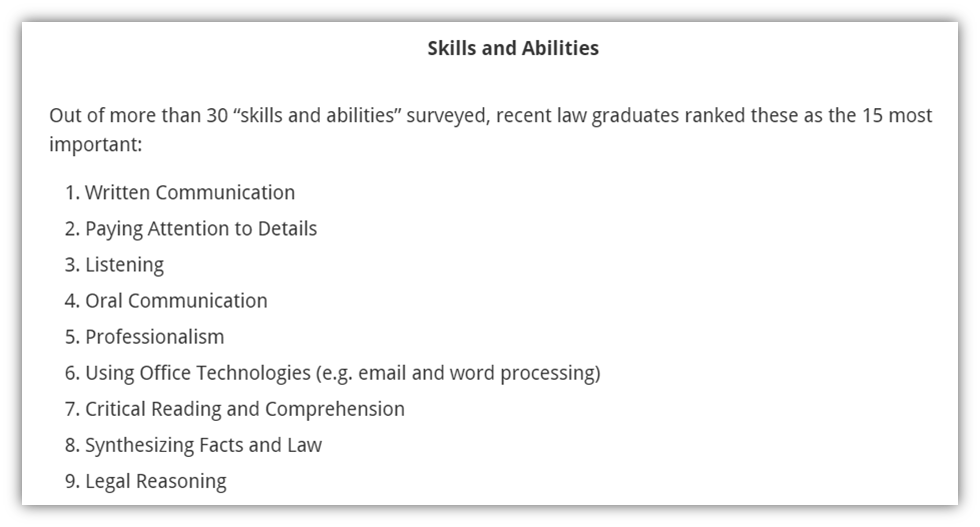
The AmLaw conclusions comport with an earlier study I cite from the National Conference of Bar Examiners that surveyed recent law graduates about the most important skills for young lawyers. Out of 30 skills, using basic office technology ranked 6th:

Seeing basic office technology ahead of legal reasoning is a bit jarring, even for me. But the incongruence is heightened by the fact that, unlike the rest of the skills listed above, using technology is not taught in most law schools (or, generally, in most colleges or high schools). 
Then again, the idea that law school is not geared towards turning out practice-ready lawyers is well-worn territory. As discussed in Mark’s previous post, a LexisNexis survey found that “95% of hiring partners and associates believe that recently graduated law students lack key practical skills.” The dissatisfaction of associates is mirrored (and, maybe partially driven) by the dissatisfaction with associates. This is not just abstract griping. Anecdotally, partners report writing off massive amounts of associate time for perceived inefficiency. These claims appear to be borne out by the Georgetown Law and Peer Monitor realization data (which I dug into here):
 

So that’s my story. You’re great. You just haven’t gotten the training you need in technology. This training will benefit you directly in the form of improved satisfaction and performance. Here it is, for free. Followed by crickets.

I’m not quite sure how to interpret my utter inability to make any progress with these students (thankfully, the people who actually pay me are considerably more engaged). Am I, yet again, suffering from the curse of knowledge? Is there some assumption that I am making about these students that is impeding communication? As I try to put myself in their shoes, I increasingly come to conclusion that there isn’t anything I can say.

In general, it is challenging to get anyone to use their precious spare time to buckle down and really learn something new, even if they are persuaded that they should. The last time I decided to tackle a new area of study, I felt compelled to pay for online courses that included tests and graded assignments. I needed real stakes and real structure to have the discipline to systematically engage with the material (all of which I could have found for free on the internet). Here, the students took the LTA as a diagnostic because it was an assignment, and, I have no doubt, that they would have trained for and passed the LTA if that were assigned. As a law student, I suspect I would have behaved much the same way (I know my scores would have been just as bad).

Stakes and structure matter. These students have had both all their life. From speaking to them, I get the sense that they believe this will continue. They believe that law school is designed to prepare them for law practice. They believe that whatever they do not know upon leaving law school, their firms will teach them. And, more than anything, they believe that they do not need to worry about this tech stuff because they will have secretaries to do it for them. More on that last point in my next post.

For me, the primary myth of the digital native is that, by virtue of their age, they already know what they need to know with respect to using technology. The corollary myth is that which they do not already know is not worth learning. But there exists a softer formulation that hits much closer to the truth. Rather than automatically knowing that which they need to know with respect to technology, we (and they) tend to believe that people who grew up with technology have the capacity to learn it and will do so when the situation requires. It’s that last part, however, where there continues to be a disconnect.

The older generations seem to think that the situation will somehow mandate the acquisition of new skills. In this, they are not totally wrong. Most people, including the older generations themselves (with their fancy new iPhones and Surface Pro 4’s), learn what they need to learn to get by with technology. Some people learn more. But most satisfy the bare threshold of survival. This results in massive underutilization of extant technology. And study after study has shown that younger generations are the same as their predecessors in this regard–i.e., learn the minimum to get by.

The younger generations, on the other hand, think that they will quite literally be required to learn it. Someone in a position of authority is going to lay out a curriculum, objectives, and a timeline. At that point, they will do what they’ve always done: work hard to meet the expectations set for them. A few will fall short. Some will excel. But most will quite effectively do what they are asked to do. I, for one, think we ought to oblige them.

At some point, I will dig deep into my data. But, on average, people (lawyers and staff) in practice outperform the kids in school on the LTA. In part, this reflects a general raising of the baseline as the skill set required for bare survival expands upon entering the professional workforce. But there is still significant interorganizational and intraorganizational variance.

The variance between organizations appears to be entirely attributable to mandatory training. Different organizations have different attitudes towards training (is it available, is it mandatory, does it include competence-based assessments) that, unsurprisingly, have an appreciable impact on how well trained their employees are. The variance within organizations stems from outside training. Frequently, I learn that the person who outpaced her colleagues on a diagnostic assessment had some previous career that demanded a more robust technology skill set. Sometimes, I meet people who, like me, had some sort of rude awakening and decided they did not like being embarrassed. Every now and then, I encounter a true tech geek (meant with love and affection) who happens to also work in law. My own data reinforces previous empirical findings that, rather than age, facility with technology is a product of “breadth of use, experience, self-efficacy and education.”

Technology training is important for everyone, including the digital natives. I just wish I could convince them of that.

++++++++++++++++++++++++++++++++++++

Casey Flaherty is the founder of Procertas. He is a lawyer, consultant, writer, and speaker focused on achieving the right legal outcomes with the right people doing the right work the right way at the right price. Casey created the Service Delivery Review (f.k.a., the Legal Tech Audit), a strategic-sourcing tool that drives deeper supplier relationships by facilitating structured dialogue between law firms and clients. There is more than enough slack in the legal market for clients to get higher quality work at lower cost while law firms increase profits via improved realizations.
The premise of the Service Delivery Review is that with people and pricing in place, rigorous collaboration on process offers the real levers to drive continuous improvement. Proper collaboration means involving nontraditional stakeholders. A prime example is addressing the need for more training on existing technology. One obstacle is that traditional technology training methods are terribleCompetence-based assessments paired with synchronous, active learning offer a better path forward. Following these principles, Casey created the Legal Technology Assessment platform to reduce total training time, enhance training effectiveness, and deliver benchmarked results.

Connect with Casey on LinkedIn or follow him Twitter (@DCaseyF).

I am disappointed every time I guest lecture a law school class.

Because anecdote is often more compelling than data, I’ll start with an example from two weeks ago. An adjunct professor who teaches one of those great law school classes with cool titles like Tomorrow’s Lawyer had his students take the Word module of my Legal Tech Assessment. They performed exactly as you (well, I) would expect of an untrained group: poorly. Their anonymized scores are below:

I’ll explain the scoring in a subsequent post. But, for now, just focus on the accuracy. On average, students were able to correctly complete less than a third of the following tasks in a live Word document:

  • Accept/Turn-off changes and comments
  • Cut & Paste
  • Replace text
  • Format text (font, margin)
  • Footers
  • Insert hyperlink
  • Apply/Modify style
  • Insert/Update cross-references
  • Insert page break
  • Insert non-breaking space
  • Clean document properties
  • Create comparison document

To put it in anecdotal context (though these numbers are representative of the larger data set), around the same time the class was taking the assessment, a similarly-sized pilot group at a large law firm achieved an average accuracy of 68% while a group of lawyers and staff who had just been through LTA-specific training achieved an average accuracy of 95%. Training matters.

Training matters even for so-called digital natives like the law school students I’ve tested. Acquiring a Twitter account in utero does not engender natural facility with technological tools because most technological tools are not intuitive.

My wife thinks my sons are geniuses. One piece of evidence she submits in their favor is how well they use an iPad. I agree with her that the fact that my 1.5 year old can use an iPad is a testament to genius. But not his. For me, it is a testament to the genius of the designers at Apple who created a device so intuitive that 1.5 year old can use it. The kid touches a picture, it moves. Congratulations to him!

While we can discuss design principles that would move work software in the direction of our consumer experience, I don’t actually believe that individual apps are the best basis of comparison for complex business software. Rather than thinking of Word as an app, we should think of it as a bundle of apps. Each of the icons on the ribbon is a solution to a particular problem. The challenge is that there are so many icons (just as there are so many apps). While design principles can bridge some of the gap, there remains a tradeoff between depth and intuitiveness. Most of us therefore only become comfortable with a few functions while ignoring the rest (just as most of us use a limited number of mostly single-purpose apps):

In this, the younger generation is no different than their predecessors. Survival is the threshold they achieve with most of their technology. That their milieu demands facility with a few more social apps sooner does not change the fundamental fact that using technology properly is a collection of acquired skills, not some innate talent that Lamarckian evolution bestowed on those under the age of 30. Expecting them to automatically know how to use complicated technology because of their familiarity with basic technology is like expecting them to automatically know how to prepare a gourmet meal because they know how to cook a Hot Pocket in the microwave.

Digital native first entered the popular lexicon in 2001. In an article entitled Digital Natives, Digital Immigrants, education consultant Marc Prensky explained that “Our students today are all ‘native speakers’ of the digital language of computers, video games and the Internet.” In many respects, the article looks terrible 14 years later. Prensky, for example, speaks glowingly of Digital Natives’ ability to multi-task, despite the fact that contemporary research (subsequently extended and validated) had already demonstrated the opposite. But just because it suffers from some poor assumptions and hyperbole (Prensky claims we’ve already arrived at a singularity) does not mean the thesis needs to be totally rejected.

You can reconcile (i) a belief that, on average, younger generations are more accustomed to technology (and the rapid evolution thereof) than their predecessors with (ii) the recognition that this comfort does not automatically translate into proficiency. Indeed, in his seminal article, Prensky talks about the need to train a bunch of Digital Natives on a CAD program that “contained hundreds of new buttons, options and approaches.” Prensky takes pride in efforts to gamify the training and “create a series of graded tasks into which the skills to be learned were embedded.” For Prensky, this approach translated training into the language of the Digital Native. He reports that the main impediment was the reluctance of the Digital Immigrant professors to adjust their pedagogical approach. But even Prensky realized that the Digital Natives still needed training (competence-based assessments paired with synchronous, active learning).

Prensky’s article was anecdotal, not empirical. It did not address the fact that most of what Digital Natives did with technology was related to consumption, not application. It also ignored the inconvenient fact that it was Digital Immigrants who had invented the technologies on which the Digital Natives relied. And it introduced a term that conflates general familiarity with specific facility. A decade later, the London School of Economics would publish a paper entitled Digital natives: where is the evidence? The paper concluded that there was no real evidence of fundamental differences between generations. What differences existed were best explained by “breadth of use, experience, self-efficacy and education.” Or as another academic paper would find:

Young people’s engagements with digital technologies are varied and often unspectacular – in stark contrast to popular portrayals of the digital native. As such, the paper highlights a misplaced technological and biological determinism that underpins current portrayals of children, young people and digital technology.

Subsequently, the Organization of Economically Developed Countries (OECD) ran an international study. Instead of asking people about their general comfort with technology, the study asked them to actually solve basic problems using technology (again, a competence-based assessment). Millennials did not fare well. In the words of The Washington Post, “U.S. millennials performed horribly.” Or, as Fortune summarized it:

We hear about the superior tech savvy of people born after 1980 so often that we tend to assume it must be true. But is it?

…. It turns out, says a new report, that Millennials in the U.S. fall short when it comes to the skills employers want most: literacy (including the ability to follow simple instructions), practical math, and — hold on to your hat — a category called “problem-solving in technology-rich environments.”

The advocacy group Change the Equation put out a related report about the High Cost of Low Technology Skills, which included the following graphics:

Digital natives are not at fault for the fact that comfort does not automatically translate into skill. The myths surrounding the digital native, however, have done them a disservice. The belief that they already know everything about technology has convinced us and them that they do not need training in technology. As discussed in the last post, the notion that they are already tech savvy introduces barriers associated with metacognition and mindset.

Metacognition is thinking about thinking. The related concept of metaignorance is ignorance about our own ignorance. We don’t know what we don’t know. Not recognizing how incompetent we are results in unfounded confidence in our own skill level. For this reason, the people most in need of training are the least likely to recognize it. Moreover, confidence begets ego. Those who have a high opinion of themselves are the least inclined to admit facts that undermine their self image.

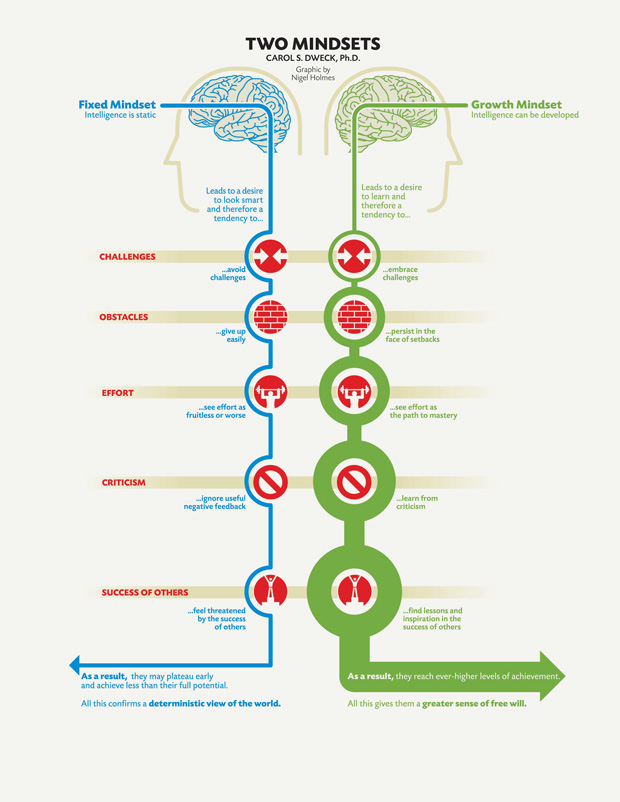
The problems of ego are compounded by mindset. People with a fixed mindset believe that cognitive traits are stable. You are either smart or you aren’t in the same way that you are either tall or you aren’t. You are born with it, or you are not. To the extent tech acumen is treated as product of age, it will be approached with a fixed mindset, which means that people will try to hide their deficiencies rather than recognize and remedy them.

Because we take a fixed mindset approach, we tend to act as if neither older professionals nor younger professionals will benefit from training. The former because they lack the capacity. The latter because they lack the need. We are wrong on both counts.

I am not trying to pick on anyone. I understand why both older and younger generations buy into the myths surrounding digital natives. But they are myths with pernicious consequences. Many of the decisions about training (or lack thereof) made at law schools and legal employers rest on an illusory foundation. It isn’t always what we don’t know that gives us trouble, it’s often what we know that ain’t so. 

Part 2 (originally posted separately)

90% of people don’t know how to use CTRL+F to find a word in a document or web page. Instead, they search the old-fashioned way, manually skimming the text.

This preponderance of ignorance is stupefying to me. But I want to be very clear that I am using the word “ignorance” in its most neutral form–i.e., lack of information or knowledge–rather than to convey any judgment or pejorative connotation. Ignorance is unavoidable. The only settled part of the debate as to who was the last person to know everything is that the person is long dead.

The curse of ignorance is that you don’t know what you don’t know. Previous posts have touched on this obstacle of metacognition, and our ignorance of our own ignorance. But there is another side of the coin: the curse of knowledge. The curse of knowledge is that once we know something, it is really hard to imagine not knowing it. This incapacity undermines communication and, especially, instruction because of the lack of shared information and assumptions. If I, for example, were going to put together some tips on internet research, I doubt that, absent the article cited above, I would have thought to include CTRL+F. I would have assumed that most everyone already knew it. I would have been wrong.

Indeed, I am a posterchild for both curses. I’ve told the story many times that my inflection point in using technology involved a client discovering that I printed and scanned to create PDFs. But how was I supposed to know what I didn’t know–there’s an app for that–without already knowing it? Yet, several years later, I delegated a task where one of the steps involved converting a large volume of documents into PDF. I was shocked (shocked!!!) to find that the person was spending hours scanning and printing. I assumed that because I knew how to convert a file to PDF, they knew it, too, despite the fact that I had been Exhibit A that this was not knowledge everyone possessed.

Thus, whether we know something or not, we too often assume that others know it. The tech-averse frequently fall into the trap of thinking the tech-comfortable know everything there is to know about tech (i.e., they can’t tell the difference between someone who knows slight more than them and someone who knows infinitely more than them). And those who know tech sometimes assume that their tech knowledge is widely shared.

Both curses are reason that competence-based assessments are such excellent training tools. Figuring out what people do and do not know is superior to speculation. But assessments alone are not enough. The primary objective of identifying gaps is to tailor the training to fill them. In this regard, I have been an abject failure in speaking to law school classes.

I speak to law school classes for free. I provide them a copy of my Legal Technology Assessment (“LTA”) for free. I then provide a copy of the LTA Training Edition (which pairs the competence-based assessment with synchronous, active learning) for free. Finally, they can retake the LTA (for free). Not only do have the opportunity to address identified deficiencies in their skill set but a qualifying score is also something they can add to the bottom of their resume to replace the meaningless “proficient in MS Office.” After speaking to hundreds upon hundreds of students, I’ve had exactly zero take me up on my full offer.

The class I wrote about last week is representative. Twelve students took the LTA because it was a class assignment. The results (below) were bad, as usual. I spoke to them for 40 minutes and offered the Training Edition to anyone who wanted it. Only two of the twelve emailed to ask for the Training Edition. And, if history is any guide, neither of them will return to take and pass the LTA.

In approaching these classes, my idea is that taking the LTA beforehand will puncture delusions of adequacy. We won’t get bogged down in an abstract conversation about how fluent they are with technology. 32% correct on some fairly simple Word tasks leaves little room for debate:

Pretty bad but not unexpected. As I try to communicate to them, it is not their fault. Everyone just assumes that they know things that they had no way of knowing absent training. They are not stupid, lazy, or untalented. They are smart, hard working, and full of promise. They simply lack training in one particular area that has the potential to make their lives better.

On the issue of their immediate future, I point out that their most recent predecessors are miserable human beings. In fact, the students are auditioning for the unhappiest job in America.

I then try to persuade them that technology plays a role in this dissatisfaction. Before technology takes our jobs, it can make them easier. At least, in theory. The technology has to actually be good, and we have to use it correctly. Otherwise, it is a source of frustration rather than leverage. Technology initially substitutes for labor at the most severe pain points. Machines can reduce the hours spent reviewing, proofing, conforming, collating, updating, and otherwise fiddling around the edges of the substantive legal work. Using technology well can improve both speed and accuracy, as I try to convey in the video below, and thereby alleviate a fair amount of the agony associated with being a young lawyer:

My contention is that having the right technology and learning to use it correctly will permit legal professionals to reduce the amount of their finite time and attention that is directed towards misery-inducing busywork. I’ve added to my spiel some recent confirmation of this theory from the cover story of last month’s American Lawyer. AmLaw’s annual associate satisfaction survey found that technology, including technology training, has a material effect on satisfaction:

One unsung key to retention could be technology. We found that overall satisfaction of midlevel associates, as measured on our survey, was strongly statistically correlated to their law firm’s scores on four questions involving technology. (The questions ask respondents to rate their firms’ technology generally, as well as technology training, support and use of technology in meeting client needs.) 

….In fact, eight of the top 11 firms in the national satisfaction rankings also were at the top on the technology questions. Conversely, many of the firms that occupy the bottom of the national satisfaction rankings also place low in the technology survey.

The AmLaw conclusions comport with an earlier study I cite from the National Conference of Bar Examiners that surveyed recent law graduates about the most important skills for young lawyersOut of 30 skills, using basic office technology ranked 6th:

Seeing basic office technology ahead of legal reasoning is a bit jarring, even for me. But the incongruence is heightened by the fact that, unlike the rest of the skills listed above, using technology is not taught in most law schools (or, generally, in most colleges or high schools). 
Then again, the idea that law school is not geared towards turning out practice-ready lawyers is well-worn territory. As discussed in Mark’s previous post, a LexisNexis survey found that “95% of hiring partners and associates believe that recently graduated law students lack key practical skills.” The dissatisfaction of associates is mirrored (and, maybe partially driven) by the dissatisfaction with associates. This is not just abstract griping. Anecdotally, partners report writing off massive amounts of associate time for perceived inefficiency. These claims appear to be borne out by the Georgetown Law and Peer Monitor realization data (which I dug into here):
 

So that’s my story. You’re great. You just haven’t gotten the training you need in technology. This training will benefit you directly in the form of improved satisfaction and performance. Here it is, for free. Followed by crickets.

I’m not quite sure how to interpret my utter inability to make any progress with these students (thankfully, the people who actually pay me are considerably more engaged). Am I, yet again, suffering from the curse of knowledge? Is there some assumption that I am making about these students that is impeding communication? As I try to put myself in their shoes, I increasingly come to conclusion that there isn’t anything I can say.

In general, it is challenging to get anyone to use their precious spare time to buckle down and really learn something new, even if they are persuaded that they should. The last time I decided to tackle a new area of study, I felt compelled to pay for online courses that included tests and graded assignments. I needed real stakes and real structure to have the discipline to systematically engage with the material (all of which I could have found for free on the internet). Here, the students took the LTA as a diagnostic because it was an assignment, and, I have no doubt, that they would have trained for and passed the LTA if that were also assigned. As a law student, I suspect I would have behaved much the same way (I know my scores would have been just as bad).

Stakes and structure matter. These students have had both all their life. From speaking to them, I get the sense that they believe this will continue. They believe that law school is designed to prepare them for law practice. They believe that whatever they do not know upon leaving law school, their firms will teach them. And, more than anything, they believe that they do not need to worry about this tech stuff because they will have secretaries to do it for them. More on that last point in my next post.

For me, the primary myth of the digital native is that, by virtue of their age, they already know what they need to know with respect to using technology. The corollary myth is that which they do not already know is not worth learning. But there exists a softer formulation that hits much closer to the truth. Rather than automatically knowing that which they need to know with respect to technology, we (and they) tend to believe that people who grew up with technology have the capacity to learn it and will do so when the situation requires.

The older generations seem to think that the situation will somehow mandate the acquisition of new skills. In this, they are not totally wrong. Most people, including the older generations themselves (with their fancy new iPhones and Surface Pro 4’s), learn what they need to learn to get by with technology. Some people learn more. But most satisfy the bare threshold of survival. This results in massive underutilization of extant technology. And study after study has shown that younger generations are the same as their predecessors in this regard–i.e., learn the minimum to get by.

The younger generations, on the other hand, think that they will quite literally be required to learn it. Someone in a position of authority is going to lay out a curriculum, objectives, and a timeline. At that point, they will do what they’ve always done: work hard to meet the expectations set for them. A few will fall short. Some will excel. But most will quite effectively do what they are asked to do. I, for one, think we ought to oblige them.

At some point, I will dig deep into my data. But, on average, people (lawyers and staff) in practice outperform the kids in school on the LTA. In part, this reflects a general raising of the baseline as the skill set required for bare survival expands upon entering the professional workforce. But there is still significant interorganizational and intraorganizational variance.

The variance between organizations appears to be entirely attributable to mandatory training. Different organizations have different attitudes towards training (is it available, is it mandatory, does it include competence-based assessments) that, unsurprisingly, have an appreciable impact on how well trained their employees are.

The variance within organizations stems from outside training. Frequently, I learn that the person who well outpaced her colleagues on a diagnostic assessment had some previous career that demanded a more robust technology skill set. Sometimes, I meet people who, like me, had some sort of rude awakening and decided they did not like being embarrassed. Every now and then, I encounter a true tech geek (meant with love and affection) who happens to also work in law.

My own data reinforces previous empirical empirical findings that, rather than age, facility with technology is a product of “breadth of use, experience, self-efficacy and education.” Technology training is important for everyone, including the digital natives. I just wish I could convince them of that.

++++++++++++++++++++++++++++++++++++

Casey Flaherty is the founder of Procertas. He is a lawyer, consultant, writer, and speaker focused on achieving the right legal outcomes with the right people doing the right work the right way at the right price. Casey created the Service Delivery Review (f.k.a., the Legal Tech Audit), a strategic-sourcing tool that drives deeper supplier relationships by facilitating structured dialogue between law firms and clients. There is more than enough slack in the legal market for clients to get higher quality work at lower cost while law firms increase profits via improved realizations.
The premise of the Service Delivery Review is that with people and pricing in place, rigorous collaboration on process offers the real levers to drive continuous improvement. Proper collaboration means involving nontraditional stakeholders. A prime example is addressing the need for more training on existing technology. One obstacle is that traditional technology training methods are terribleCompetence-based assessments paired with synchronous, active learning offer a better path forward. Following these principles, Casey created the Legal Technology Assessment platform to reduce total training time, enhance training effectiveness, and deliver benchmarked results.

Connect with Casey on LinkedIn or follow him Twitter (@DCaseyF).

I am more expert than most of the people in the world about The Wire, James Baldwin, Breaking Bad, David Foster Wallace, the films of Quentin Tarantino, and many, many other topics. This is not because I know much but because I know anything. The baseline used makes my claim to status meaningless. Only a minute percentage of the world’s population has any familiarity with the aforementioned. Of course I know more than people who know nothing. Being more expert than they does not mean I am an expert (I’m not).

Often, when we judge something, including ourselves, we encounter a reference class problem. Last season, was Mike Miller of the Cleveland Cavaliers a good or bad basketball player? Of the already small percentage of the basketball playing population that makes their high school squad, only .03% make it to the NBA. So Miller is, inarguably, among the basketball playing elite. At the same time, in the 52 games his coach chose to play him, Miller only averaged 2.1 points on 32.5% shooting to rank dead last in player efficiency rating among all NBA players. Miller, a 15-year veteran nearing the end of a solid career, was so unproductive that you get 816 hits on Google for  “corpse of Mike Miller”. If you are putting together a pick-up basketball squad at your local rec center, probability suggests that Miller remains a phenomenal addition. If you are building an NBA rotation, you hope to have better options. Playground and NBA players are different reference classes.

When I became a lawyer, I was immediately ordained “tech savvy” because of the reference class. My reputation was sealed when the partner in the adjacent office (an otherwise brilliant lawyer) was screaming about the computer eating valuable documents. I superheroed in to press CTRL+Z (undo). When the files resurrected, he stared at me like I was some sort of wizard. From then on, I handled ediscovery on his cases despite the inconvenient fact that, in the beginning, I knew jack all about ediscovery (that’s changed). It required dangerously little knowledge of, and facility with, technology to be tech savvy among the reference class of lawyers.

It was, of course, one thing for technophobic partners to think I knew everything about technology because I demonstrably knew more than they did. It was yet another for me to believe I was tech savvy in any meaningful sense. Yet, I started to believe just that because, well, ego. After all, I spent my days knowing more about technology than almost everyone I encountered. And those who did know more (IT professionals, word processors, and our bad-ass librarian who switched her keyboard to Dvorak) were not lawyers. The word “lawyer” was doing most of the heavy lifting in the appellation “tech-savvy lawyer.”

I had my delusions of tech adequacy punctured by a client. He happened to be in my office and asked me to turn a document into a PDF. I obliged. I printed the document, walked to the printer, walked to the scanner, and returned to my desk where he was sitting mouth agape. For months, I had been the sole associate on a PDF-intensive arbitration. He was doing the math on how much time I must have already wasted. He was apoplectic. If I had not already proven my value as a lawyer, he would have had me thrown off the case. But I had. And he didn’t. Still, he had words with the partner (the same partner who had designated me as a tech expert).

Let me be clear: I believed I was tech savvy despite the fact that I did not know how to convert a Word file into a PDF.

I was absolutely embarrassed. I changed my whole approach to technology based on the incident. But, at the time, how was I supposed to know? Everything is obvious once you know the answer. It is obvious to me now that converting one filetype (e.g., a Word document) to another filetype (a PDF) is something that the machine should do. But, to that point, no one had ever taught me that. Without training, how was I supposed to know that which I did not know?

This is the problem of metacognition. In the book, Talent is Overrated: What Really Separates World-Class Performance from Everybody Else, Geoff Colvin explains the role metacognition plays in superior performance (h/t Farnam Street):

The best performers observe themselves closely. They are in effect able to step outside themselves, monitor what is happening in their own minds, and ask how it’s going. Researchers call this metacognition – knowledge about your own knowledge, thinking about your own thinking. Top performers do this much more systematically than others do; it’s an established part of their routine.

Metacognition is important because situations change as they play out. Apart from its role in finding opportunities for practice, it plays a valuable part in helping top performers adapt to changing conditions…[A]n excellent businessperson can pause mentally and observe his or her own mental processes as if from the outside:…Am I being hijacked by my emotions? Do I need a different strategy here? What should it be?

…Excellent performers judge themselves differently from the way other people do. They’re more specific, just as they are when they set goals and strategies. Average performers are content to tell themselves that they did great or poorly or okay. The best performers judge themselves against a standard that’s relevant for what they’re trying to achieve. 

Not only do people not know what they don’t know, but their ignorance begets confidence. Metaignorance as the source of unfounded confidence is known as the Dunning-Kruger effect. Illusory superiority means that the people most in need of assistance (e.g., training, education, help) are the least likely to recognize their need.

And with confidence comes ego. Many people who have declared themselves tech savvy (or some other positive designation) are only interested in that which confirms their self image. Faced with the choice of changing their self conception and proving there is no need to do so, most get busy on the proof. For lawyers, this urge towards ego preservation combines with a psychological profile that sees any admission of fallibility as an admission of incompetence.

Thus, in administering my tech competence assessment, I often come across ‘tech-savvy lawyers’ who, like I was, are merely tech savvy for a lawyer. They do well on the assessment. But they do not do perfectly. They then go to great lengths–one penned a 1,500 word memo–to explain why the features they struggled with should not be tested. While I think there is a worthwhile discussion to be had about who should be training on which skills (a later post), it amazes how people are able to delude themselves that they already know everything worth knowing. Any assessment that fails to completely confirm that self image is flawed.

When I then explain to them where the disputed features fit into a rational legal workflow, as well as the important concepts of fluency and fluidity (another later post), they, more often than not, begrudgingly concede that I may have a point. Maybe, just maybe, they might have some worthwhile things left to learn. But…there is always a but…but, they inquire, how can I expect the majority of lawyers or staff to score perfectly on a first attempt when they themselves–the cream of the crop within the profession–did not do so? I, of course, have no such expectation.

There are lawyers and staff who have flown through my assessment modules because there are people who are both legal professionals and tech savvy. But not many. For most people, there are areas where they could use training. That’s the point. Competence-based assessments are designed to identify who needs training on what, and then to verify the training has been effective. An assessment that everyone, trained and untrained, can pass on the first attempt is pointless.

Our problem is not the dearth of individuals who operate above the profession’s tech baseline. Our problem is that the baseline is so low. My goal is to raise the baseline.

ADDENDUM: All that said, I cannot help but feel like an impostor because I am one. As I detail above, I had my bubble burst with respect to my own tech savvy. It was the epiphany I needed to start taking tech and tech training seriously. Converts make the greatest zealots. But I’ve never really recovered. Indeed, the more I learn, the more I recognize how little I know. Lawyers are no longer my reference class for properly using technology. People who are genuinely expert at using technology are my reference class (though some of them are lawyers). And they make me realize that I still have so far to go. It makes my evangelism feel hypocritical.

But this particular brand of humility is also helpful. I know enough to know how much low-hanging fruit is within our immediate grasp. But my lack of confidence in my own expertise also helps me empathize with those who are unaware of their own ignorance or who struggle with their ego. I’ve been there. Just because you have room to improve at using tech does not mean you are stupid, lazy, or bad at your job. It just means that you have room to improve at using tech, which you should do. Progress, not perfection, is the objective. And getting better is evidence of a commitment to excellence, not an indictment of past performance.

++++++++++++++++++++++++++++++++++++

Casey Flaherty is the founder of Procertas. He is a lawyer, consultant, writer, and speaker focused on achieving the right legal outcomes with the right people doing the right work the right way at the right price. Casey created the Service Delivery Review (f.k.a., the Legal Tech Audit), a strategic-sourcing tool that drives deeper supplier relationships by facilitating structured dialogue between law firms and clients. There is more than enough slack in the legal market for clients to get higher quality work at lower cost while law firms increase profits via improved realizations.
The premise of the Service Delivery Review is that with people and pricing in place, rigorous collaboration on process offers the real levers to drive continuous improvement. Proper collaboration means involving nontraditional stakeholders. A prime example is addressing the need for more training on existing technology. One obstacle is that traditional technology training methods are terribleCompetence-based assessments paired with synchronous, active learning offer a better path forward. Following these principles, Casey created the Legal Technology Assessment platform to reduce total training time, enhance training effectiveness, and deliver benchmarked results.

Connect with Casey on LinkedIn or follow him Twitter (@DCaseyF).


Pat Lamb, who I mentioned in my last post, recently wrote a piece that while excellent was not exactly groundbreaking. Or so I thought. Pat’s premise was that everyone makes mistakes. Everyone includes lawyers. Mistakes happen. Mistakes are bad. We should therefore learn from mistakes to avoid repeating mistakes. Towards this end, Pat explained the usefulness of After Action Assessments and root-cause analysis. Great stuff. But, for me, it was akin to a health expert recommending that couch potatoes exercise, consume less junk food, and eat vegetables. Perfectly sound, uncontroversial, well-worn advice that is too often ignored and should therefore be repeated as often as possible.

As usual, I was so very wrong. The ABA Journal comments section exploded with adverse wisdom like:

CHRISTIE WAGNER said:
Yes, dear Patrick J. Lamb. Let us embrace our mistakes, such as missing statutes of limitations and whatnot. Don’t our mistakes just empower us? Gag. How about doing all you can NOT to make a mistake and then doing all you can to rectify it and if you can’t do all you can to make amends? Hmm?

associate said:
Mistakes are simply unacceptable.  That’s the reality of our profession, especially since the law schools and ABA have flooded it with excess attorneys.

These perspectives struck me as so silly that I added satirical support to their keen ‘insight’:

Casey Flaherty said:
Mr. Lamb:

Christie and associate make some compeling points, which is unsurprising given that they are menbers of our hollowed profession. Look, I know that you reference Einstein, Drucker, the Navy Seals, Kimye, Drake, and Meek Mill. What do they all have in common other the fact that they make mistakes? None of them are lawyers.

As Justice Mustang wrote for the Untied States Supreme Court in in the semenal 2010 case of Clouseau v. Malapprop, “whatever a lawyer is doing is, ipso facto, correct because a lawyer doing it. Lawyers are, by definition, incrapable of error.” As you know, the Court held that having a J.D. (which stands for Jactanter Dealbator, or “the one who is (always) right”) was an absolute defense to a claim of malpractice. In her concurrent, Justice Abercrombie even traced the origins of the lawyer infallibility doctrine from The Federalist Papers to the Papal bull Unam Sanctam. The impact of Clouseau on the insurance industry was the primary cause of the Great Recession. And 43 of the 46 state bar associations subsequently suspended their grievance process because no one could maintain a good faith claim that a lawyer had been wrong in thought or deed.

Not only do I think that we should continue to deny that lawyers make miss takes (thereby guaranteeing that mistakes will never happen), I believe that we should also deny that any lawyer has ever written an article suggesting that might lawyer mistake make (guaranteeing that your article was never written). How’s that for an After Action Plan?

My mockery did absolutely nothing to stem the tide of abuse directed toward Pat. Pat, of course, does not need my help. Along with Jeff Carr, he is building an entire business around the idea that identifying and addressing the root causes of mistakes is key to not repeating them. But the incident left me sad for my profession.

The pursuit of perfection begins with admission of imperfection. How do we get better at what we do when reflecting on mistakes is a thought crime? when it is a sin to admit that what we do can be improved? when formalizing a mistake-reduction process is the height of unprofessionalism?

Michael Jordan believes Michael Jordan is the best basketball player of all time, just ask Michael Jordan (see his Hall of Fame induction speech). Yet, Michael Jordan is, arguably, right. Michael Jordan may have been the best basketball player in history, in part, because he understood that being the best required being fanatical about eradicating his weaknesses (which, of course, he had to admit in order to address). Jordan even made a commercial entitled Failure.

You can be the best at what you do without being perfect. You can stand in high regard in your profession (and your own mind) without pretending you are infallible. Indeed, framed properly, your ruthless pursuit of better can be a signal of your stature, not a threat to it.

As Seth Godin says, “Yo Yo Ma isn’t perfect… he’s just better than everyone else.” Like Jordan, Ma is also, arguably, the best at what he does. He has pretty much always been great. He was a child prodigy. He chose the cello at the age of four. By seven, he was playing for American presidents. Yet, Ma still practices 2,000 hours per year–a solid year of lawyer performance. Yo-Yo Ma is Yo-Yo Ma precisely because he is the kind of person that will practice 2,000 hours per year even after he is established as the best in the world.

In the book, Talent is Overrated: What Really Separates World-Class Performance from Everybody Else, Geoff Colvin explains that the best of the best take a different approach to self-analysis and error (h/t Farnam Street):

Excellent performers judge themselves differently from the way other people do. They’re more specific, just as they are when they set goals and strategies. Average performers are content to tell themselves that they did great or poorly or okay. The best performers judge themselves against a standard that’s relevant for what they’re trying to achieve. Sometimes they compare their performance with their own personal best; sometimes they compare with the performance of competitors they’re facing or expect to face; sometimes they compare with the best known performance by anyone in the field….

….If you were pushing yourself appropriately and have evaluated yourself rigorously, then you will have identified errors that you made. A critical part of self-evaluation is deciding what caused those errors. Average performers believe their errors were caused by factors outside their control: My opponent got lucky; the task was too hard; I just don’t have the natural ability for this. Top performers, by contrast, believe they are responsible for their errors. 

The kind of people who proclaim that mistakes are unacceptable even when they recognize mistakes are unavoidable do not really believe they are perfect. Rather, they believe that people like them are not supposed to admit imperfection. This remains one of the biggest impediments to change in our industry. As I try to convince law firms and law departments to engage in structured dialogue, I constantly run into people on both sides of the relationship who are threatened by the idea of an open discussion about doing better. If I concede that we might do better then I am confessing that I’ve been wrongWe have to get beyond the idea that improvement is an indictment of the past. Our job is not to be perfect. Our job is to do the best we can until we can do better, and then do better.

But better means different. And different requires experimentation. Unfortunately, this runs counter to the lawyer psychological profile, as explained in this stellar post on Adam Smith, Esq.

It’s a truth universally acknowledged that Law Land resists change like the plague. And, yes, this is pretty widely attributed to the phenom known as the “lawyer personality,” characterized by an almost pathological aversion to risk. But let’s unpack this a bit to better understand why lawyers, in particular are so risk averse.

Lawyer-psychologist Dr. Larry Richard, the leading expert on the psychology of lawyer behavior has quantitatively established that a preponderance of lawyers share (among others) two personality traits that in combination scotch the very notion of experimentation. The first is “Resilience.”  Somewhat surprisingly, lawyers score really low on “Resilience,” essentially the ability to recover quickly after a setback. On this trait, Lawyers score only 30%, which would be enough on its own to seriously dampen any appetite for experimentation.

But wait – there’s more. What won’t surprise anyone is that lawyers score really high on “Skepticism.”  Dr. Richard’s work reveals that lawyers score 93% on this attribute (only 5% of the population is as skeptical). Lawyers can (and do!) poke holes in anything.  So, any proposed change will be scrutinized and picked over to such a degree as to discourage all but the most stout-hearted.

These two characteristics, lack of resilience coupled with a high degree of skepticism are a double whammy to the notion of experimentation. Failure is perceived anything but “noble” in Law Land.

In short, we have the wrong mindset. We are inclined to hide deficiencies instead of overcoming them. That’s the easy way out. The problem with the easy way is that eventually it makes everything so damn hard.


++++++++++++++++++++++++++++++++++++
Casey Flaherty is the founder of Procertas. He is a lawyer, consultant, writer, and speaker focused on achieving the right legal outcomes with the right people doing the right work the right way at the right price. Casey created the Service Delivery Review (f.k.a., the Legal Tech Audit), a strategic-sourcing tool that drives deeper supplier relationships by facilitating structured dialogue between law firms and clients. There is more than enough slack in the legal market for clients to get higher quality work at lower cost while law firms increase profits via improved realizations.
The premise of the Service Delivery Review is that with people and pricing in place, rigorous collaboration on process offers the real levers to drive continuous improvement. Proper collaboration means involving nontraditional stakeholders. A prime example is addressing the need for more training on existing technology. One obstacle is that traditional technology training methods are terribleCompetence-based assessments paired with synchronous, active learning offer a better path forward. Following these principles, Casey created the Legal Technology Assessment platform to reduce total training time, enhance training effectiveness, and deliver benchmarked results.

Connect with Casey on LinkedIn or follow him Twitter (@DCaseyF).  
 

Batman should spend more time and money securing Gotham’s prisons. As my soon-to-be five year old gets increasingly enthralled by super heroes (and Legos and Star Wars), I find myself watching many animated series where the chain of events commonly commences with a super villain’s prison break. Gotham’s lax security protocols are the source of considerable mischief. It would seem to me that some portion of the billions Batman spends on crime-fighting contraptions and the trillions the city spends rebuilding after every villainous rampage would be better directed towards keeping evil geniuses behind bars. But that, of course, would make for uninteresting TV and would mean far less of Batman being Batman.
This tangent was inspired by the announcement that one of my legal super heroes, Jeff Carr, is heading to ValoremNext. In the legal nerd version of the Justice League or The Avengers, he will be joining forces with fellow superhuman crusader, Pat Lamb. As described in their press release, ValoremNext is “a platform designed to diminish the need for legal services by preventing problems before they occur.” Jeff is quoted, “as businesses expand their geographic base, the demands on law departments to do more with less becomes acute, and the savings available from doing the same things better are not sustainable. The only sustainable savings can come from a program that prevents the demand for legal services in the first place.”

Two more analogies.

Firefighting is a heroic activity. But fire codes and fire prevention engineers have done far more to preserve life and property. In most urban environments, firefighters now spend very little of their time actually fighting fires. Likewise, few people recognize that plumbing is more important to public health than doctors. Neither of these facts, while true, has eliminated the need for firefighters or doctors, nor do they diminish the nobility of those vocations. But systemic prevention initiatives are critical for allocating finite response resources to their highest and best use.

A profile I wrote several months back on VMware is a superb example of combining process and technology to #DoLessLaw. VMware’s legal operations team lead by Aine Lyons worked in conjunction with legal department stakeholders and their LPO provider to redesign the contracting workflow. Post redesign, the number of deals escalated to the legal department declined by 74 percent. The annual savings was in the millions. Quality also improved. And, importantly, finite lawyer time was directed towards higher-value activities.

It is worth focusing on the fact that VMware initiative relied on the legal ops team. As I’ve mentioned in previous posts and will detail more in the future, I see the rise of nontraditional stakeholders as key to increasing our sophistication as the suppliers and consumers of legal services. It’s not that traditional lawyers are intellectually incapable of leading these projects. They are, however, very busy lawyering. Lyons herself is a trained lawyer who now primarily focuses her efforts on systemic issues rather than individual matters.

Capacity constraints should be understood and respected. Empowering specialists to focus on areas within their domain expertise is an excellent first step towards success. But that presupposes such specialists exist. I was therefore excited to learn that Jeff Carr is taking his expertise in preventative law beyond the confines of a single in-house department. The legal market will be a richer, more interesting (and hilarious) place.

++++++++++++++++++++++++++++++++++++
Casey Flaherty is the founder of Procertas. He is a lawyer, consultant, writer, and speaker focused on achieving the right legal outcomes with the right people doing the right work the right way at the right price. Casey created the Service Delivery Review (f.k.a., the Legal Tech Audit), a strategic-sourcing tool that drives deeper supplier relationships by facilitating structured dialogue between law firms and clients. There is more than enough slack in the legal market for clients to get higher quality work at lower cost while law firms increase profits via improved realizations.
The premise of the Service Delivery Review is that with people and pricing in place, rigorous collaboration on process offers the real levers to drive continuous improvement. Proper collaboration means involving nontraditional stakeholders. A prime example is addressing the need for more training on existing technology. One obstacle is that traditional technology training methods are terribleCompetence-based assessments paired with synchronous, active learning offer a better path forward. Following these principles, Casey created the Legal Technology Assessment platform to reduce total training time, enhance training effectiveness, and deliver benchmarked results.

Connect with Casey on LinkedIn or follow him Twitter (@DCaseyF).  

No offense, but….

I can’t help but perk up when a sentence starts that way.

No offense, but how did a mid-level lawyer at mid-tier company get so much pub for saying something that everyone already knows?”

I’m paraphrasing. But someone recently asked me that question. I couldn’t be offended. I have often wondered the same thing. I’m best known for saying that lawyers aren’t all that proficient with the technology they already have and it would be good if they got better. That’s not exactly Nobel worthy. Yet, I received all sorts of awards and publicity. It is kind of bizarre. And I have a few different theories.

First, it is not true that everyone knows the same things to the same degree. The most ignorant are the most likely to labor under delusions of adequacy. This problem of meta-ignorance—we don’t know what we don’t know—affects the way that legal professionals evaluate themselves. They really have no idea how much effort they are wasting because of bad process and technology utilization. This obliviousness also affects their perception of their colleagues, especially the ones that know slightly more than them. I’ll return to the myth of the digital native in a subsequent post.

Second, it was not so much the saying as the doing. I might have been saying that which everyone already knew, but I was the first in-house counsel (as far as I know) to be so public in my efforts to systematically seek to do something about it. Everyone may complain about inefficient behavior in vague terms, but actually defining, measuring, and improving upon inefficient behavior is rare.

Third, everyone knowing something does not make it common knowledge. Common knowledge has a key element beyond everyone knowing something: everyone has to know that everyone else knows it. To quote Wikipedia:

Common knowledge is a special kind of knowledge for a group of agents. There is common knowledge of p in a group of agents G when all the agents in G know p, they all know that they know p, they all know that they all know that they know p, and so on ad infinitum.

As a recent, excellent piece on the special properties of common knowledge observed:

The moral is that the mere act of saying something publicly can change the world—even if everything you said was already obvious to every last one of your listeners. For it’s possible that, until your announcement, not everyone knew that everyone knew the thing, or knew everyone knew everyone knew it, etc., and that could have prevented them from acting.

I have to remind myself of this in my darker moments. Being on the speaking circuit, you see the same people, in the same places, delivering the same messages year after year. It can be easy to succumb to cynicism. It’s all kabuki theater. After all, one of the best ways to maintain the status quo is to talk about change constantly while doing nothing. Then again:

Don’t Stop Believin’. The great Dan Katz and I speak at many of the same conferences. We’re not quite at the point of Einstein’s chauffer (who, in the apocryphal story has heard Einstein’s speech so many times that Einstein lets him give it), but I have heard his insights often enough that I am in danger of starting to think they are my own. Commenting on the repetitive nature of these speaking engagements, Dan likes to compare the experience to being in the epic band Journey, which is always expected to play its greatest hits. Get up there and sing the song everyone came to hear! But, like Dan, I realize that repetition is one of the four levers of persuasive certainty and can give the illusion of truth even when an argument is weak, which his is not.

Further, ours is the speaker’s perspective. The speakers and their messages have limited turnover. But the audience usually consists of first timers. For example, while it may be something they’ve spoken on for years, I left ILTACON finally ready to tackle Agile because of chat with John Grant, as well as thinking deep thoughts about what the Baby Boomers have done to the practice of law because of talk by Joshua Lenon. It would have been a shame for me if either of them had declined to spread their message just because they had shared it before.

Collective conversations like ILTACON and 3 Geeks have many positive effects. The focus is education—creating awareness of new information. But the pursuit of real education—the audience internalizing the message—often compels us to repeat and reinforce information that is already out there. And translating real education into action often turns on that information becoming common knowledge. This first one can make us feel noble. The second can make us feel redundant. The last one can make us feel silly. Re-stating the obvious does not seem like it has much merit. Again:

The moral is that the mere act of saying something publicly can change the world—even if everything you said was already obvious to every last one of your listeners. For it’s possible that, until your announcement, not everyone knew that everyone knew the thing, or knew everyone knew everyone knew it, etc., and that could have prevented them from acting.

In a similar vein, the amazing Seth Godin has some valuable advice for those of us (essentially, all of us) who let embarrassment result in self-censorship:

Embarrassed

It’s a tool or a curse, and it comes down to the sentence, “I’d be embarrassed to do that.”

If you’re using it to mean, “I would feel the emotion of embarrassment,” you’re recognizing one of the most powerful forces of our culture, a basic human emotion, the fear of which allows groups to control outliers, and those in power to shame those that aren’t.

The stress that comes from merely anticipating the feeling of embarrassment is enough to cause many people to hold back, to sit quietly, to go along.

And this anticipation rarely leads to much of anything positive.

On the other hand, if you’re saying, “doing that will cause other people to be embarrassed for me, it will change the way they treat me in the future,” then indeed, your cultural awareness is paying off. There’s a reason we don’t wear a clown suit to a funeral–and it’s not precisely because of how it would make us feel to do that. It’s because insensitive, unaware, selfish acts change our ability to work with people in the future.

Most of the time, then, “I would be embarrassed to do that,” doesn’t mean you would actually be embarrassed, it means you would feel embarrassed.

In most settings, the embarrassment people fear isn’t in the actions of others. It’s in our internal narrative. Culture has amplified the lizard brain, and used it to, in too many cases, create a lifetime of negative thinking and self-censorship.

So, yes, by all means, don’t make us feel humiliated for you, don’t push us to avert our eyes. But when you feel the unmistakable feeling of possible embarrassment, get straight about what your amygdala is telling you.

-Seth Godin

 ++++++++++++++++++++++++++++++++++++
Casey Flaherty is the founder of Procertas. He is a lawyer, consultant, writer, and speaker focused on achieving the right legal outcomes with the right people doing the right work the right way at the right price. Casey created the Service Delivery Review (f.k.a., the Legal Tech Audit), a strategic-sourcing tool that drives deeper supplier relationships by facilitating structured dialogue between law firms and clients. There is more than enough slack in the legal market for clients to get higher quality work at lower cost while law firms increase profits via improved realizations.
The premise of the Service Delivery Review is that with people and pricing in place, rigorous collaboration on process offers the real levers to drive continuous improvement. Proper collaboration means involving nontraditional stakeholders. A prime example is addressing the need for more training on existing technology. One obstacle is that traditional technology training methods are terribleCompetence-based assessments paired with synchronous, active learning offer a better path forward. Following these principles, Casey created the Legal Technology Assessment platform to reduce total training time, enhance training effectiveness, and deliver benchmarked results.
Connect with Casey on LinkedIn or follow him Twitter (@DCaseyF).

  
I yielded to an unproductive urge.

It is not so much that I think ATL’s Keith Lee is wrong in The Difference and Inch Makes as I think that he succumbs to strange compulsion towards #SlatePitch pseudo-contrarianism. 
Lee beats the crap out of an ILTACON straw man. He warns readers against the “[b]reathless enthusiasm and over-the-top bombast about how legal tech companies are going to re-shape the practice of law.” Lee’s ILTACON is a place where there “is lots of talk about algorithm this or automatic that” premised on the illusion that technology “is the panacea that cures all ills.” ILTACON, it seems, is the hotbed for discussion of how robots will replace lawyers.

That’s odd. I just got back from ILTACON (it was fantastic). So did Lee’s ATL colleague Jeff Bennion. Bennion and I definitely attended the same conference. Rather than replace lawyers, Bennion accurately (in my opinion) conveys the conference’s focus in his headline: Solutions That Are Being Discussed At ILTACON To Make Law Firms Better.

“Make better” is a drastically different theme than “replace.” Instead of a “panacea”, Bennion and I attended a conference where there was much discussion about the “communication problems,” “accountability problems,” “costly mistakes,” and “security” issues associated with properly integrating technology into the practice of law. It’s almost as if technology implementation is challenging and demands user training

Pragmatism, competence, and a systematic approach to problem solving were far more prevalent than “[b]reathless enthusiasm and over-the-top bombast.” I almost get the sense that Lee did not attend the conference about which he formed such a strong opinion that he felt compelled to share on one of the most important sources of information in the legal industry. Then again, speaking from a place of ignorance is a better look for him than actually having attended and coming away with such an asinine impression.

Maybe we just went to different sessions (there was something like 400+). I have little doubt someone somewhere was being bombastic. Or, maybe, Lee was in attendance but spent all of his time on the exhibit floor. That’s kind of like watching TV only for the commercials and complaining that the programming is crap. The exhibit floor is great fun. But everyone recognizes it for the advertising it is. The point of the floor is not to close sales but to generate awareness, which it does extremely well. Awareness is followed by discussions, demos, proofs of concepts, and contract negotiations that get past happy talk in very short order.

With respect to the exhibitors, Lee offers this hot take: “My prediction? 90% of the companies at ILTAcon this year won’t be around three years from now.” This silliness is further evidence that Lee has no understanding of what ILTACON is or who attends. Most exhibitors are mature companies that have been around for years. Anything is possible, but it would take some sort of economic cataclysm to cause 9 of these 10 to close shop in the next 3 years:

  • Thomson Reuters (1799) 
  • LexisNexis (1818)
  • HP (1905)
  • Ricoh (1936)
  • Canon U.S.A. (1955)
  • Microsoft (1976)
  • Aderant (1978)
  • Nuance (1994)
  • Intapp (2000)
  • kCura (2001)
No company is bullet proof. But even the newest kid on the block—kCura, which makes the ediscovery program Relativity—has been around for 14 years, has grown 1600% since 2008, and just raised a $125M round in February.

Maybe Lee was trying to suggest that 90% of the startup companies at ILTACON won’t be around 3 years from now. Even this is suspect. Very few true startups can afford a presence at ILTACON. Or, maybe, Lee was just using ILTACON as a metonym for the universe of legal tech startups and saying that 90% of legal tech startups will fail. If so, this is not so much a bold prediction as a banal recitation of the often-repeated statistic that 90% of all startups fail.

My guess is that Lee didn’t go to ILTACON, knows little about ILTACON, and was really just using his misconceptions about ILTACON to take a swing at the “spin” and “hype” about the promise of legal technology. There is nothing wrong with pushing back against techno-utopianism. My introductory column as the technology columnist for the ACC Docket is a warning against magical thinking.

But, even giving Lee the benefit of the doubt about his true target, his piece remains about as successful as his home repair (Lee starts the piece with an anecdote about a failed door replacement). The only legal technology that Lee actually mentions is LegalZoom, which does not exhibit at ILTACON. He seems to be suggesting that clients always need to go to a lawyer and should never use LegalZoom.  

Almost every time a client walks into a lawyer’s office, there is going to be some crinkle in the situation. For example, a client says, they just need a will, they don’t have much, it’s not complicated. They’ll assure the lawyer it’s a standard situation. They almost used LegalZoom, but decided they wanted to check with a lawyer, “just in case.” Tech cheerleaders would say, “Yes! Automate this! Low level work! Perfect for tech!”

But the more the lawyer talks with the client, the more will come out. The client starts to talk about the farm they live on. Inherited from generation-to-generation. They’ll talk about abutting lands and a private road from another farm. A power line easement that is set to renew in 15 years. Their children from three separate marriages and a girlfriend they just left their wife for. Before they know it, the lawyer is knee-deep in a Whiteacre/Blackacre hornbook problem.

This is self-serving bullocks. As a lawyer, it would be nice to believe that Lee is right. But the commoditization of certain types of legal work has been a trend for decades and, on net, has been a major boon to clients. Most wills are in fact routine. Sometimes, using a form turns out badly. Just as, sometimes, people follow their GPS into a lake. Or just as, sometimes, trained lawyers make mistakes. Overall, clients are getting quality services at radically lower cost. This includes many clients who are not able to afford a lawyer.

Again, maybe, Lee himself is engaging in a bit of bombast. Maybe he is simply warning against overreliance on technology-based, commoditized solutions like LegalZoom. Sure, it works in some cases, but not all cases. Sometimes, you need a trained lawyer. I could then again agree with him while again observing that he is attacking a position that no existing, credible person holds.

There is no group of people more adamant about the fact that LegalZoom forms are not appropriate for every legal situation than the people who run LegalZoom. For five years, LegalZoom has been building out a nationwide network of attorneys to service clients who need assistance filling out LegalZoom forms or for whom the forms are ill suited. LegalZoom has built a complementary business around their recognition of the fact that unguided use of their forms is not always in a client’s best interest. Lee cites a “DUI stop” and a “immigration problem” as exemplar situations where “anomalies arise” without any understanding that in those circumstances, instead of providing forms, LegalZoom offers consultation with licensed attorneys—you know, the very thing that Lee is advocating.

Lee makes some reasonable points about tools just being tools and still depending on the user. But those points are couched as a bizarre attack on entities and opinions that seem to be figments of his imagination. If Lee wants to attend CodeX in order to have Dan Katz hand him his rear end about “algorithm this or automatic that,” I welcome the entertainment. But he does the legal industry a disservice when he attacks ILTACON on a platform so widely read by lawyers. Our profession would improve if more lawyers attended ILTACON rather than viscerally dismissed it because of their fear that technology will make them obsolete. ILTACON is about improvement, not replacement.

ADDENDUM: I am not sure if it heresy to use my perch here at 3 Geeks to declare my affinity for another blog, but I adore Above the Law (especially Mark Herrmann, everyone should read Mark Herrmann, always). I’ve checked the site almost daily for over a decade. Moreover, I know that it is silly to ascribe to the site the opinions of just one of its many authors (its not like Lee is Lat or Elie). I certainly hope that no one imputes my sophomoric ramblings here to heroes like Greg and Toby. And the ill-conceived article that prompted this post was one small part of ATL’s otherwise stellar ILTACON coverage. But I have such a high regard for both ATL and ILTACON, I couldn’t help my strong negative reaction when someone used the former to take shots at a straw-man version of the latter. 

As a funny (to me) aside, I even made ATL part of my Legal Technology Assessment. The site is referenced in the primary Word test document and is at the center of a task that combines training on hyperlinks with a warning about cheating (ATL’s role as a watchdog is often underrated):

++++++++++++++++++++++++++++++++++++
Casey Flaherty is the founder of Procertas. He is a lawyer, consultant, writer, and speaker focused on achieving the right legal outcomes with the right people doing the right work the right way at the right price. Casey created the Service Delivery Review (f.k.a., the Legal Tech Audit), a strategic-sourcing tool that drives deeper supplier relationships by facilitating structured dialogue between law firms and clients. There is more than enough slack in the legal market for clients to get higher quality work at lower cost while law firms increase profits via improved realizations.
The premise of the Service Delivery Review is that with people and pricing in place, rigorous collaboration on process offers the real levers to drive continuous improvement. Proper collaboration means involving nontraditional stakeholders. A prime example is addressing the need for more training on existing technology. One obstacle is that traditional technology training methods are terribleCompetence-based assessments paired with synchronous, active learning offer a better path forward. Following these principles, Casey created the Legal Technology Assessment platform to reduce total training time, enhance training effectiveness, and deliver benchmarked results.
Connect with Casey on LinkedIn or follow him Twitter (@DCaseyF).
This article I wrote on Bank of America’s diversity program brings together so many themes discussed in previous posts.

Target: The Bank has a commitment to diversity. I share this commitment. But for purposes of this post, it could be any general, abstract goal.

Measure: The Bank actually measures diversity internally and externally. The Bank is not alone in this. But I have been shocked at how many law departments that make public commitments to diversity take the next logical step of measuring it. Instead, they setup committees, join task forces, sponsor events, etc. These are all commendable except they have proven insufficient by themselves to actually move the diversity statistics. 

[Can you imagine the sea change if every large, corporate client meaningfully measured dollars out the door to diverse timekeepers in terms of billed services and originations? Add to that some differentiation by level (e.g., paralegal, partner) and spend with MWBE firms. Wow]

Baseline/Benchmark: Meaningful measurement normally needs baselines and target values. This is where we are at. This is where we want to be. The target values may, in many instances, need to be arbitrary. But that does not mean they have to be random. It helps to have a reference class of peers to measure against each other. Even if your goal is to raise the baseline, you get a sense of practical parameters.

Discuss: It is amazing what results can be achieved when a law department asks its law firms to make verifiable progress against an empirically-established baseline. This structured dialogue begins with the one-way measurement, but it does not end there.

Key to this self-evaluation is a question that recognizes the dual responsibility of the law firm and the client: “What could Bank of America do better to enhance your Firm’s diversity performance/metrics for the coming year?”

Align: As the Bank of America profile demonstrates, the discussion can go beyond the numbers to the challenges faced and the other ways in which the law firm is striving to serve the commonly held goal. The discussions are key for reinforcing the goal, as well as deepening the law department/firm relationship by creating dialogue, a sense of shared purpose, and alignment in perspectives on the problem being addressed.

Improve: None of the foregoing matters unless it actually results in improvement. But it does. What we choose to measure is a form of incentive in its own right. And client goodwill is of key importance in a highly competitive environment that is so dependent on relationships.

Understanding they are falling behind their peer firms has a substantial motivational impact on legal overachievers. ‘Law firms are competitive by nature. So any constructive comment on areas for improvement is usually enough to motivate change within the firm,’ remarks Quarmby.

Reward: Firms that perform well should be rewarded. In addition to high marks on their performance reviews and the attendant goodwill, Bank of America actually hosts an awards dinner for its top performing firms. The winner even gets their award directly from the Bank’s GC.

Repeat: There is no finish line. There is a sustained commitment to continuous improvement.

++++++++++++++++++++++++++++++++++++

Casey Flaherty is the founder of Procertas. He is a lawyer, consultant, writer, and speaker focused on achieving the right legal outcomes with the right people doing the right work the right way at the right price. Casey created the Service Delivery Review (f.k.a., the Legal Tech Audit), a strategic-sourcing tool that drives deeper supplier relationships by facilitating structured dialogue between law firms and clients. There is more than enough slack in the legal market for clients to get higher quality work at lower cost while law firms increase profits via improved realizations.
The premise of the Service Delivery Review is that with people and pricing in place, rigorous collaboration on process offers the real levers to drive continuous improvement. Proper collaboration means involving nontraditional stakeholders. A prime example is addressing the need for more training on existing technology. One obstacle is that traditional technology training methods are terribleCompetence-based assessments paired with synchronous, active learning offer a better path forward. Following these principles, Casey created the Legal Technology Assessment platform to reduce total training time, enhance training effectiveness, and deliver benchmarked results.
Connect with Casey on LinkedIn or follow him Twitter (@DCaseyF).
I’ve written multiple posts in praise of allied professionals, specialists, and experts who are increasingly vital to the delivery of competent legal services. But just as lawyers are not alone in the legal supply chain, lawyers are not alone in bearing responsibility for its deficits. As we head into ILTACON, I want to restore some balance to The Force by pointing out that we are all (author included) predisposed to myopia and stay-off-my-lawn syndrome.

Three extreme anecdotes:

  • A CIO I know feels like he serves in the clandestine services: our failures are known, our successes are not. He is so fed up with criticism from his lawyers that he reflexively dismisses any complaint as rooted in a toxic mix of technophobia, change aversion, and ignorance. He has developed a bad habit of publicly complaining that his lawyers are endangering sensitive client information by copying it to their unencrypted personal devices. Yet, if you relax the man with a few libations, he will admit that the frontline lawyers have a point. For years, he has been unable to get the budget he needs to upgrade the firm to a mobile but secure digital work environment. Lawyers who need to take work home or on the road often have to choose between security and actually getting the work done. Unsurprisingly, they choose the work. But the CIO does not totally understand why. Since security is part of his mandate, it trumps all else in his mind.
  • A lawyer I know was handling a sizable matter involving a high volume of PDFs. Among other things, she needed to be able to redact information and compare two versions of the same document. She determined that her best option was to upgrade to her PDF software to the Pro version. But when she approached the office manager, she was told that such an upgrade was impractical because the partners in her practice group had no use for the additional features. The firm had a policy that partners are the first to receive upgraded hardware or software. Information technology was treated as a perk rather than a tool–as if the soldier should never be armed with a higher caliber weapon than the general or the professional video editor must limit herself to the hardware and software the company CEO needs to send email.
  • A knowledge manager I know was disheartened that her new KM system was being ignored by the lawyers. She understood why they were not yet using it for research. First, it had to be populated with tagged documents. But she could not fathom why the lawyers were not taking the time to tag documents and populate the system. After all, the system was purchased for their benefit. And, if used properly, the system would make their lives easier. She did not recognize the incentives that ran counter to her program. She did not comprehend the tradeoffs between billable and nonbillable time. She did not see the free-rider problem of expecting a lawyer to take the time to update a searchable database with information that the particular lawyer would never need the database to find. Instead of trying to overcome some fairly common (though still challenging) collective action problems, she spent her time wondering how lawyers could be so smart in some areas and so very dumb in others.

Specialization is one of the hallmarks of sophistication. Specialization drives economies of scale. But specialization can also lead to diseconomies of scale as work becomes siloed and communications overhead explodes. It is not easy to collaborate for real. Lawyers do themselves and their clients a disservice if they fail to recognize the value that can be provided by allied professionals in technology, project management, pricing, marketing, knowledge management, research, professional development (including training), etc. But allied professionals do themselves and their clients a disservice by not understanding what the lawyers actually do and why.

There are lawyers who recognize the potential contribution from allied professionals. And there are allied professionals who genuinely comprehend the lawyers’ perspective. But, in general, there is a failure to communicate that both sides are responsible for remedying. All of us are susceptible to making the fundamental attribution error:

We disagree because we explain our own conclusions via detailed context (e.g., arguments, analysis, and evidence), and others’ conclusions via coarse stable traits (e.g., demographics, interests, biases [, job title, credentials]). While we know abstractly that we also have stable relevant traits, and they have detailed context, we simply assume we have taken that into account, when we have in fact done no such thing. (Overcoming Bias)

Just as I recommend structured dialogue between law firms and their clients that includes nontraditional stakeholders, I am also in favor of internal dialogue between lawyers and allied professionals. Given how law depts/firms are typically structured, the responsibility is ultimately on the lawyers to be willing to work differently. There are already too many mandates for allied professionals to change everything while making sure that the lawyers don’t have to change anything. But, when the opportunity presents itself, allied professionals need to be able to comprehend the lawyers’ perspective, understand the tradeoffs the lawyers face, communicate with the lawyers in terms the lawyers understand, and offer viable solutions that minimize the disruption to client work. Neither side should assume that the other is petty, parochial, or obtuse. And both sides need to work at not appearing petty, parochial, or obtuse.

I plead guilty to every crime outlined above. Even recognizing my own shortcomings, I can’t say that I’ve found a great message. But I am evolving. As someone who genuinely wants legal professionals to work differently, I was seduced by stark statements like, “if you dislike change, you’re going to dislike irrelevance even more.” I was attracted to the self-certain rectitude and the sense of inevitability. And, in the long run, I do believe that the only thing that we can say for certain about the future is that it will be different. But the long run can be quite long. In the mean time, there are minds to be change and real gains to make. I have therefore concerned myself with being able to articulate positive cases for near-term change like deepening relationships, return on investment, profit, and quality of life. The core message remains the same. But finding a framing that resonates with my intended audience has improved its salability.

While I enjoy going to ILTACON to figure out what’s coming in the next decade, I have to say the most valuable sessions and conversations for me are those in which people explain how they got their organization to embrace the advances of the last decade. I can’t think of any such story that is primarily one of shoving an innovation down everyone’s throat. There are always holdouts. But they are holdouts from a new consensus that only exists because of buy-in and effective change management. The hard work of collaboration is really hard. But it is also necessary.

Some people are idiots. But not many. Mostly, we are hard-working, well-meaning people who all bear some responsibility for our failures to communicate.

++++++++++++++++++++++++++++++++++++

Casey Flaherty is the founder of Procertas. He is a lawyer, consultant, writer, and speaker focused on achieving the right legal outcomes with the right people doing the right work the right way at the right price. Casey created the Service Delivery Review (f.k.a., the Legal Tech Audit), a strategic-sourcing tool that drives deeper supplier relationships by facilitating structured dialogue between law firms and clients. There is more than enough slack in the legal market for clients to get higher quality work at lower cost while law firms increase profits via improved realizations.
The premise of the Service Delivery Review is that with people and pricing in place, rigorous collaboration on process offers the real levers to drive continuous improvement. Proper collaboration means involving nontraditional stakeholders. A prime example is addressing the need for more training on existing technology. One obstacle is that traditional technology training methods are terribleCompetence-based assessments paired with synchronous, active learning offer a better path forward. Following these principles, Casey created the Legal Technology Assessment platform to reduce total training time, enhance training effectiveness, and deliver benchmarked results.
Connect with Casey on LinkedIn or follow him Twitter (@DCaseyF).