Actions are supposed to speak louder than words. Directionally, client action seems fairly unambiguous:

Managing partners are well aware of these broad trends. Yet they still claim that clients aren’t asking for change:

I tackled those pesky partners last post. Not only is the net impact less than dire—erosion, not extinction—the danger is also not evenly distributed. The pain isn’t that acute for most rainmakers who can point to decades of empirical evidence that suggests they will be fine. Given their stature, relationships, and time horizons, most are probably right.

In addition to robust data, the rainmakers can probably offer a fair amount of anecdotal evidence, or the absence thereof, about clients’ supposed interest in change. The top partners probably don’t hear much about change from clients. And if they do, it is probably while trying to quickly get past the annual unpleasantness of rack-rate kabuki—where the two sides keep using the word “discount” while actually dickering over how much to raise rates.

This does not mean that clients are content or passive. It means they are bad at articulating their concerns or do not consider complaining worth the effort. Very few firms know they’ve been fired. The phone just stops ringing. Even fewer firms know why they’ve been fired. Or why they didn’t win the RFP. Or why their work from the client was down 2% instead of up 2%. Or….It can be a very slow bleed. There are many ways to lose business that do not involve a formal “you’re fired.” And there are just as many possible explanations for the loss.

In short, clients are using exit, not voice. In the classic treatise Exit, Voice, and Loyalty, the economist Albert O. Hirschman outlined a client’s options when quality declines (or fails to keep pace with what is available elsewhere).

Clients can be loyal–i.e., they keep returning to the firm because of relationships, complacency, lack of alternatives, high switching costs, devil-you-know conservatism, etc. Loyalty is major part of the legal market, in part, because there are genuine advantages to incumbency. Loyalty continues to be the most important aspect of the client/firm relationship. We’re witnessing a steady accumulation of minor paroxysms, not a mass exodus.

Clients, however, can and do exit. They take their business elsewhere. Alternative destinations include other firms, in-house, and managed service providers. As the headlines above demonstrate, exit is becoming a more prominent part of the legal landscape.   

Or clients can exercise voice. They can express their dissatisfaction but still afford the firm an opportunity to course correct. The managing partners’ “clients aren’t asking” response suggests that clients rarely do this. Clients choose exit instead.

Voice is critical. Loyalty signals acceptance of the status quo. Exit signals dissatisfaction and decline. Voice is the informative middle ground that demonstrates loyalty, raises the spectre of exit, and provides the path forward to bolster the former while avoiding the latter.

There is a vital difference between asking for a manager and leaving the store to shop elsewhere. So why don’t sophisticated corporate clients exercise voice? My friend Connie Brenton of NetApp/CLOC provided part of an explanation in a piece we co-authored on the topic:

Client preference for exit over voice has much to do with resource constraints. We need results now, innovation now, efficiencies now. We haven’t the time to wait for our firms to catch up. There are also an increasing multitude of accessible alternative solutions and technologies that were not previously available, making the exit not only easy but the responsible decision for our businesses. Organizations such as the Corporate Legal Operations Consortium (CLOC) provide a forum to share best practices including how to better in-source legal work or move day-to-day work to lower cost alternatives.

Frankly, as Ron Friedmann has observed, it is often easier and quicker to start from scratch than to try to retool. Not only are established processes resource intensive to amend, but interpersonal dynamics also consistently fall back into familiar patterns. If the inside lawyer and outside lawyer are accustomed to resolving every hiccup with a discount, it may feel unnatural to have any other conversation, especially when there is ‘real’ work that needs to get done.

In the short term, it is simple to show ROI on moving to a firm with lower rates, bringing work in-house, or diverting work to a managed-service provider. Each option can be far less daunting than asking a long-time incumbent to cut their rates in half, let alone make an abrupt move to value fees (which Pat Lamb compares to reciting the alphabet backwards). You don’t necessarily let the incumbent go immediately. You taper their work, which subtly moves from increasing to flattening to declining as the new resources come online. Indeed, by keeping the incumbent around, you get to have a control to validate your ROI calculation.

The right question may not be why clients don’t use voice but, instead, why they should even bother. Since I wrote a guidebook entitled Unless You Ask, I feel compelled to try to answer in my next post.

Full Arc: Law Firm Resistance to Change and Law Department Responsibility

_______________________________________
D. Casey Flaherty is a consultant who worked as both outside and inside counsel and serves on the advisory board of Nextlaw Labs. Find more of his writing here. Connect with Casey on Twitter and LinkedIn. Or email casey@procertas.com.

It is rational for someone who has been wildly successful doing something a certain way to keep doing it that way, especially when the odds appear favorable that they will continue to be successful. Most people don’t exit their comfort zone without a compelling reason. This is doubly true of many high-status experts.

Any story about lack of change in the legal market premised solely on lawyers being stupid has limited explanatory power. I’m partial to a more nuanced narrative where the incentives to change are not evenly distributed. More specifically, those with the most power, by definition, encounter the least pressure to embrace innovation.

continuation, this post will focus on law firm partners resisting change.

A Primer On The Legal Economic Landscape

For context. Legal Business just released the Global 100 under the banner Hitting the Wall. The headline for this year’s Am Law 100 was Signs of a Slowdown. The Altman Weil 2016 Law Firms in Transition survey opens with the observation that “most firms are choosing to proceed with lawyerly caution in the midst of a market that is being reinvented around them.” The key findings from the survey are:

  • Unreliable demand
  • Surplus of lawyers
  • Inefficient delivery of legal services
  • Proactivity is a competitive advantage
  • Resistance to change

Likewise, the Peer Monitor/Georgetown 2016 Report on the State of the Legal Market states, “U.S. law firms continued to experience very sluggish growth in demand, coupled with negative growth in productivity, and continuing downward pressure on rates and realization.” The Report warns of BigLaw’s Kodak moment:

This story of the demise of Kodak is an important cautionary tale for law firms in the current market environment. Since 2008, the market for law firm services has changed in significant and permanent ways….

The reactions of the law firm market to the rapidly changing environment in which firms operate parallels in some respects the story of Kodak. The current challenge in the legal market is not that firms are unaware of the threat posed to their current business model by the dramatic shift in the demands and expectations of their clients. Instead, as in the case of Kodak, the challenge is that firms are choosing not to act in response to the threat, even though they are fully aware of its ramifications.

There are many reasons that may lead firms to make this choice, but one of the primary ones is surely that, like Kodak, many law firm partners believe they have an economic model that has served them very well over the years and that continues to produce good results today. They are consequently reluctant to adopt any changes that could put that traditional business model at risk. While that might appear to be a viable short-term strategy, the danger is – again like Kodak – that this effort to preserve their past and current success could result in law firms failing to respond to trends that over time could well challenge their traditional market positions.

“Over time.” That’s the thing. There was no single ‘moment’ that caused Kodak’s demise. There was a long series of choices that resulted in Kodak becoming less competitive in the market it once dominated. The market for photography did not collapse. Especially accounting for smart phones and social media, photography is far healthier than it has ever been. But the economics of the market changed, and the largest incumbent did not (enough).

Certainly, advances in technology—from film to digital—underpinned the economic recalibration. But technology was not Kodak’s problem. The Report does a nice job laying out the history in which Kodak itself was responsible for much of the innovation that would undermine its market dominance. Rather, as explained in a new post up at the Harvard Business Review entitled “Kodak’s Downfall Wasn’t About Technology”:

The right lessons from Kodak are subtle. Companies often see the disruptive forces affecting their industry. They frequently divert sufficient resources to participate in emerging markets. Their failure is usually an inability to truly embrace the new business models the disruptive change opens up. Kodak created a digital camera, invested in the technology, and even understood that photos would be shared online. Where they failed was in realizing that online photo sharing was the new business, not just a way to expand the printing business.

The reason we still talk about the “Kodak moment” is that it made for really good copy. Headline writers jumped at the opportunity to use the company’s tagline when describing the rare cataclysm of a premier company filing for bankruptcy. But it was a moment of reckoning that was decades in the making. And the bell was tolling for a once prestigious participant, not the industry itself.

As an industry, legal is doing relatively well. Contrary to the headlines, demand is not flat. Rather, demand for law firm services is flat. According to HBR, the ACC, and LEI, the surplus is being captured by clients and, to a lesser extent (for now), their alternative service providers.

For law firms as a group, the story is one of stagnation, not collapse. There is, however, more volatility at the individual law firm level with bankruptcies and mergers. Unsurprisingly, the volatility is greatest at the individual lawyer and staff level. We’ve experienced significant de-equalizations and layoffs. This year, nearing a decade since the start of the Great Recession, the Am Law 100 again reduced the number of equity partners.

Pretty bleak picture, right? Not really. Not for everyone.
Profits Per Me
Anyone who is interested in this topic should read Bruce MacEwan’s Growth is Dead and Bruce in general. Among the many reasons to read Bruce is the compelling way he explains that the top lawyers at the top firms have never really experienced a bad year. In the almost three decades (1987-2016) of the Am Law 100, revenues have increased from $7 billion to $83 billion, a compound annual growth rate of 8.9%. Over that time, profits per partner have quintupled (5x) from $324K to $1.6M (2.3x if we adjust for inflation).

And that’s the average firm and the average partner. Averages are misleading. Many lawyers substantially outperform the average. At most firms, including the average and below average, the compensation spreads among equity partners keep growing. That is, the people with the most power within law firms have been doing quite well for a long time and there are few signs of their good times ending anytime soon. Soon matters. Most rainmakers are closer to the end of their career than the beginning. Time horizons affect perspective.

The top partners at the top firms probably figure that clients hire them for their deep expertise. They probably figure clients will continue to do so. Many of them are probably right. And those that are right will continue to have the most power in traditional firms because they will be the ones bringing in the business. The participants with the most interest in shifting the business model—and it is more about business model than tech, which is just one piece—will either not be enfranchised to begin with (e.g., associates and allied professionals with little to zero chance to make partner) or will find themselves disenfranchised (e.g., de-equitization) once the new normal intrudes on their professional tranquility.

Ken Grady recently had some tweets that did a wonderful job summing up partner resistance to change:


Why take risks when you can be rich without doing so? Why try to disrupt yourself when the market is not? If you’ve been extremely successful for 30 years and that is likely to continue for the next 10—when you’ll retire—why change course?

And the explanation need not be avarice. Attention is a finite resource. The most successful lawyers are stunningly busy. They are busy doing important work for key clients. If they are not feeling pressure from those clients (“client’s aren’t asking for it” is the subject for next post) and if market machinations are not affecting their wallets, how much attention are they really going to devote to what appear to be other people’s problems. How much effort are they going to put into real change, which requires real resources (attention, time, money).

Managing partners are paying rapt attention. Isn’t it their role to force their partners to also come to terms with the shifting market? Call a partners’ meeting. Hand out Bruce’s book and George Beaton’s Remaking Law Firms (both highly recommended). Restructure compensation to tie it more to firm than individual performance. Invest in infrastructure. AFAs. Legal project management. Technology. Alternative staffing models. Experiment….

That’s all well and good until a few key rainmakers decamp for other firms where they are guaranteed to make more money. Those people who don’t usually pay attention because they don’t have to will still notice if the firm pursues change initiatives that affect their time, workflow, or bank account. On the latter point, supported by strong historical evidence, these successful, high-status professionals consider substantial annual growth in their compensation to lie somewhere between a natural law and a birthright.

Even now, their belief in their ever-escalating economic value seems well founded. The lateral market is nuts93.7% of firms are pursuing growth via the zero-sum game of acquiring laterals. Unhappy rainmakers are coveted free agents subject to bidding wars. This makes the BigLaw business model—where your most valuable assets can walk out the door—inherently fragile. Even the largest law firms are susceptible to animal spirits and the cascade effect of rainmaker defections.

The prime directive of the managing partner is to keep the firm solvent and intact. That limits their leverage to force through changes that key partners resist. Successful partners need someone to handle the administrative side of the business. But, as autonomy-seeking missiles, they hate to be managed. Martin Bragg captured this well in exchange we had after my first post on the topic (reprinted with permission):

I am of the view that the real power lies (in most firms) with the king makers rather than the kings which in turn means that (most firms) are herded rather than led. The irony of this is that most lawyers in my experience hate anything to do with firm management but are unwilling to let others do it for them!

As a Martin alludes to, the foregoing is a bit of a caricature. My posts are about “most firms” and are already too long without nuance. There are some managing partners who are empowered to take a “let’em leave” attitude to partner defections. There are large firms with interesting, innovative approaches to business models, R&D, and productizing services. It’s not that change isn’t happening. It just doesn’t seem to be happening enough.

I’ll leave the final word to Bruce, who had a great post reacting to the Global 100:

In Law Land the cynical smart money is almost always on stasis; nothing will really change because any talk otherwise will spook the partners. If nothing else, this view has years and years of solid predictive success behind it.

But I wonder.

Rates of growth and decline—I emphasize decline because it is largely a story of decline in the only currency that matters, purchasing power—in overall gross revenue, RPL, PPL, and even PEP are to almost all of the 120,000+ lawyers toiling in these firms pretty abstract and denatured concepts.

One number, however, is as hard core and riveting as can be: One’s own personal compensation. This is where the abstracted figures have an impact people recognize and understand.

We can all have a debate in the parlor about whether too many lawyers with room temperature C+/B- talent were too highly paid by too many firms for too long, but as the reality of these numbers, “the New Normal” as far as the eye can see, and heaven only knows what other exogenous shocks intrude on our world, begin to sink in, real take-home pay is going to fall, and barring “something radical,” continue to fall for the great majority of these 120,000+ souls. (You guys gathered under the Wachtell banner, and few others of similar caliber, are excused—but then I stipulated I’m talking about C+/B- talent, so you knew that already.)

Upton Sinclair (1878—1968) was among many other things , author of the 1906 classic The Jungle, exposing malfeasance in the US meat packing industry and contributing to momentum behind passage of the Pure Food and Drug Act. He also gets credit for this barbed quip:

It is difficult to get a man to understand something, when his salary depends upon his not understanding it.

For quite some time now—coming up upon a decade—for partners in highly successful firms to “understand” that the good old days aren’t about to return would have entailed their understanding that the ever-upward trajectory of their compensation could be imperiled. No wonder the notion of change, much less “something radical,” spooked them. Self-interest required no less.

What if that is something that might be about to change?

Full Arc: Law Firm Resistance to Change and Law Department Responsibility

_______________________________________
D. Casey Flaherty is a consultant who worked as both outside and inside counsel and serves on the advisory board of Nextlaw Labs. He is the primary author of Unless You Ask: A Guide for Law Departments to Get More from External Relationships, written and published in partnership with the ACC Legal Operations Section. Find more of his writing here. Connect with Casey on Twitter and LinkedIn. Or email casey@procertas.com

Word limits are a very good idea. Constraints benefit my regular writing (which needs all the help it can get). Here, however, I get to ramble, which has its own virtues.

As some you may have seen, Legaltech News published the first Legal Tech Assessment case study in November. This was a milestone moment for my fledgling company. But there was much more to say. So, if you are interested, what follows is an annotated version.

The case study opens:

People, some of whom are lawyers, do not like training. Training takes time out of their day. The time taken is not always offset by skills gained.

Justin Hectus knows this. As Director of Information for boutique powerhouse Keesal, Young, & Logan (KYL), he anticipated the audible rolling of eyes when he announced a basic technology training program for all associates and paraprofessionals. What he did not expect was that when the program finished every participant would answer “Yes” to the following two questions: Was it worth it? Did you learn something that you now use every day?

Lawyers will protest free food or anything else that takes them away from their desk. While a sandwich and a cookie remains the most proven method for persuading lawyers to exit their office during normal business hours, griping commences the moment it becomes mandatory. This has much to do with incessant deadlines and the attendant sense of urgency that drives lawyers. I’ve mentioned the studies on lawyer urgency in previous posts, but I think Bill Henderson captured it best in a comment:

In my experience, lawyers (and law students) are very anxious to get to work. If they feel busy, they feel productive — even if that sense of productivity is objectively wrong from a systems engineering perspective. Learning something new is non-billable time (or for students something not on the final exam). It feels wasteful to lawyers/law students because the payoff is uncertain/speculative.

Yet, it is this same sense of urgency combined with a penchant for autonomy and alterations in the office/tech landscape that have reduced the incidence of delegation. Or, at least, that is the theory that seems to underpin many law firms’ announcements of staff reductions:


For more examples of firms citing lawyer use of technology as the impetus for support-staff reductions see here, here, here, herehere, here, here, here, here, here, here, here, here, here, here, here, here, here, here, here, herehere, here
It is easy to construct a narrative based on greed where the firms are intentionally shifting labor-intensive work from nonbillable to billable resources. And there may be something to that. But I take the firms at their word. I believe them when they claim that lawyers are using tech more and relying on staff less. Even if, as Bill observes, it is not optimal from a systems engineering perspective, self-reliance comports with the lawyer compulsions towards autonomy, urgency, and a subjective sense of productivity. 
Lacking a typewriter of their own, a lawyer speaking into a Dictaphone or editing a document in pen was embedded in a workflow that demanded delegation. Lawyers outfitted with computers have the capacity, but not necessarily the training, to do many more tasks themselves. They have to affirmatively choose to delegate. Even if they suspect they are not quite as fast as the person to whom they might delegate, the lawyer may conclude that they will still have the task completed sooner by doing it themselves because it will not wait in a queue.
There is, of course, an interplay between youth, staff reductions, and operating environment. One should expect to see differences in delegation among the generations.

I repeatedly warn about the pernicious myth of the digital native–i.e., because they grew up with technology, younger people are automatically capable of using technology well in all its forms. The analogy I always return to is that expecting familiarity with single-purpose apps (e.g., Twitter, Instagram) to translate into facility with deep desktop software (e.g., Word, Excel) is like expecting someone who can microwave a Hot Pocket to be capable of cooking a gourmet meal. They are capable if you train them.

But disputing the conclusions re digital natives is not to dispute all of the premises. As a matter of chronology, the younger someone is, the more likely it is they grew up surrounded by and using technology. If theorizing about digital natives only went so far as to suggest a broad correlation between age and a general comfort with technology, I could get on board.

Moreover, I repeatedly lament the myth of the digital native because it is so pervasive. Almost everyone, including the digital natives themselves, seems to have bought into it. People of all ages make decisions based on the perception that the young are innately skilled with technology. This conviction could drive two different but reinforcing dynamics.

(A) Partners might see staff as less necessary based on the perception that younger attorneys don’t need them as much. So, over time, the partners alter the attorney/staff ratio. Younger attorneys therefore have no choice but to do work themselves.

(B) Younger attorneys are less inclined to delegate work to staff because of their self-perception of being good–or, at least, just as good–with technology. Staff has less to do. Observing this, the partners alter the attorney/staff ratio over time. 

Those are theories. Theories are debatable. At the end of the day, there is an empirical question: are lawyers doing more labor-intensive work themselves? One of the many things that makes KYL so remarkable is that they actually endeavored to answer that question when designing their training initiative:

KYL’s recent initiative to refresh timekeeper basic technology training commenced with an empirical investigation of where it was needed most. As detailed in a previous LTN article, Hectus and his team pulled usage statistics from KYL’s document management system. Most interesting was their finding as to how the generations differed in balancing delegation and autonomy. While senior attorneys relied heavily on support staff, many younger attorneys maintained direct control over their own documents in a variety of applications.

As explained in that previous article, between 2004 to 2014, the share of Word keystrokes attributable to KYL’s senior shareholders held steady at 0%. If firm management had based their decision on their own lived experience, the training emphasis would have been entirely on staff. Fortunately, these were trial lawyers, and evidence was their primary consideration. The evidence demonstrated that, over the same time period, the share of Word keystrokes attributable to all attorneys rose from 39% to 80%.

The empirical investigation identified a subset of people, including attorneys, who might need training in specific applications. But what training? How much? While individual trainees struggle with the fact that they don’t know what they don’t know—and, therefore, do not know what questions to ask—trainers, likewise, struggle with knowing where to begin:

KYL had identified who should be proficient in which applications. But they still lacked information as to who needed training or how much. Hectus did not want to waste anyone’s time on things they already knew. He considered lecture-style info dumps an ineffective way to deliver technology training, in part, because trainees start from such different baselines. He wanted to ensure that people were learning, not just enduring a demonstration from which they took nothing. Time is a poor proxy for learning. Hectus preferred to measure learning directly.

KYL introduced the Legal Technology Assessment (LTA) to identify gaps and validate gains. The diagnostic assessment allowed users to test out of training they did not need. Some trainees tested out of training modules entirely. For those who needed training, the pre-identification of both skills and gaps reduced total training time to almost a third.

Returning to the sense of urgency, a great advantage of competence-based approaches is that once training has been made mandatory, the assessment becomes a carrot rather than a stick. Telling people you are going to give them a test creates anxiety. By contrast, telling them that you are going to permit them to test out of mandatory training is a relief.

The assessment also gives trainees something to shoot for and, as Hectus informed me, gets the competitive juices flowing (objective measurement is conducive to gamification). But, at the end of the day, it is all about the training. Proving that many lawyers and staff struggle with technology is an exercise in confirmation bias. Correcting those deficiencies in a way that translates into day-to-day improvements in quality and efficiency is the object of the exercise:

KYL does not merely claim to have enhanced legal service delivery. The firm actually has enhanced legal service delivery and can prove it. From diagnostic assessment to certification testing, KYL’s tailored training program implemented by trainer Mike Carillo improved the average LTA score more than 40 percent with substantial gains in both time and accuracy. Each participant met KYL’s competence threshold with firm personnel earning 47 portable COBOT badges (Certified Operator of Basic Office Technology) for exceptional acumen on Word, Excel, or PDF.

Most critically, the users were able to transfer what they learned to their daily practice. Associate Erin Weesner-McKinley remarks, “some tasks that I previously delegated can now be done with the click of a button, and I have a better understanding of other tasks which I still choose to delegate to nonbillable personnel or colleagues with lower billing rates.”

The idea of certifications as a means to measure and drive improvement was not new to KYL. As Hectus explained to me in an exchange (reprinted with permission) that is not part of the case study:

From the top down, the firm has committed to developing a community of experts requiring baseline competency and giving its professionals at all levels the latitude to follow their passion and become measurably “the best” in their area of choice. KYL has produced more Certified EDiscovery Specialists (through ACEDS) than any firm in the world as a % of timekeepers and KYL was the first firm in the U.S. to have certified Eclipse SE admins on staff. We have been proud contributors to the development of standards outside the firm and that has resulted in two ILTA Distinguished Peer Awards, top individual and firm honors with ACEDS, and an InfoWorld 100 designation. Our staff participated in developing our award-winning certification program in 2008 and from that point forward we have recognized that pulling out the measuring tape is one of the most important parts of continuous improvement. We support each other and take great pride in our shared accomplishments as individuals and as a firm.

It is this commitment to being a learning organization that enabled KYL to avoid the kind of staff reductions outlined above. When machines replace clerical work, clerical workers need to find new employment. Yet individuals who have been trained to work with the machine and get the most out of it are scarce. Rather than engage in a cycle of (i) waiting too long to purge staff perceived as deadweight and then (ii) scrambling to find staff with the requisite technology skills, KYL has chosen to train the talented, hard-working people already embedded in the firm’s unique culture.

I am reminded of a quote from Tyler Cowen’s Average is Over that I use often:

This imbalance in technological growth will have some surprising implications. For instance, workers more and more will come to be classified into two categories. The key questions will be: Are you good at working with intelligent machines or not? Are your skills a complement to the skills of the computer, or is the computer doing better without you? Worst of all, are you competing against the computer?

KYL is committed to making sure that its staff fit squarely in the first two categories. This requires the disciplined pursuit of better.

Measurement is central to the disciplined pursuit of better. KYL’s analysis started with measuring who spent how much time in which applications. It continued with empirical evidence that the appropriate users had increased their skill set. That evidence was then bolstered by survey data that the new skills were translating to daily work. Finally, Hectus investigated how the improvements might affect the firm’s bottom line. While it will be a while before enough post-intervention data is accumulated, Hectus was able to compare initial LTA scores to historical realization rates:

To validate this ostensible relationship between tech acumen and firm performance, Hectus compared the diagnostic test results to the firm’s realization data. Unsurprisingly, he found a correlation between high initial LTA scores and high historical realizations. More efficient service delivery appeared to translate into greater value for the firm’s clients even before the formal initiative.

My reading of this finding is that the partners were already doing a pretty good job of trimming client invoices. Although they might not have been able to identify the root cause, their gut instinct that some tasks were taking certain timekeepers too long seems validated by the data. And while the firm is dedicated to improving legal service delivery whether clients notice or not, that clients do take note is not lost on KYL:

Continuously improving client service is embedded in KYL’s DNA. But the firm is also cognizant of the way that clients are shifting the burden of proof. Beyond the merits of the LTA itself, Hectus knew that corporate law departments were already rolling out the LTA internally and asking law firms for their LTA scores. In fact, the leader of a renowned Silicon Valley law department encouraged Hectus to help KYL become the first law firm to have its support system pass the LTA. The firm did just that.

KYL recognizes that it is no longer sufficient for a firm to claim to be something—secure, efficient, innovative. Clients demand evidence. In addition to a number of traditional IT security audits, KYL has recently been through (and passed) a client review of firm-generated PDFs. The client wanted to ensure that PDFs were being properly redacted and secured. This kind of scrutiny, and the attendant marketing opportunity, suggests a greater emphasis on third-party verification.

There are some firms that, in retrospect, would have been well served to be similarly pro-active. Candidly, however, corporate law departments inserting LTA score requests into RFP’s (there was a fair amount of informal pressure) took much longer than I initially expected. I will absolutely write a post on the pace of diffusion of innovations in legal including all sorts of admissions of my own naiveté. But that is for another day. Here, I want to heap as much glory as I can on KYL.

KYL did not need to do this. The firm is what Bruce McEwan might label a “synergistic super-boutique.” I attended USC Law where the eponymous Skip Keesal is a legend. USC is not the only place. Keesal was named the most powerful person in Long Beach (the mayor was 3rd). His firm could probably get away with simply being a collection of exceptional legal minds. Yet, KYL has committed to data-driven, continuous improvement of legal service delivery that goes beyond purchasing new toys:

In 2008, KYL proclaimed “Everyone is in the IT department.” The firm recognized that information technology contributes to stellar client service. Superior lawyering remains paramount. But client communication, securing client data, and methods for generating client documents all factor into client satisfaction and retention. Much of legal service delivery—turning legal insight into concrete deliverables—now entails a technology component that combines infrastructure with user input.

At KYL, the investment in the infrastructure is ongoing. Users keep pace through the KYL Keeps You Learning framework, a program that produced the 2014 ILTA IT Professional of the Year (Hectus) and 2015 ACEDS eDiscovery Person of the Year (Janice Jaco) and utilizes the workflow-based training of the Legal Technology Core Competencies Certification Coalition (LTC4), on whose board of directors Hectus serves.

Julie Taylor, a partner in the firm’s San Francisco office, explains, “Buying the best technology is the easy part. Making sure that every member of our team knows how best to use it to the greatest effect and in a manner that is seamlessly integrated into our daily practice is the challenge. That is where we focus our efforts.”

At KYL, improvement is the way forward, not an indictment of the past. And the firm has constructed a team that is superb at driving and managing change. I know this from first-hand experience, not only from watching them run the LTA program, but also in the ways they helped us improve the LTA. Everyone could stand to get better. Everyone includes me.

My original conception of the LTA was as a single, unified assessment. One score that would indicate whether an individual possessed basic tech competence. But KYL’s empirical data on who spent how much time in which applications convinced me to break up the LTA into software specific modules (i.e., there are now stand-alone modules and micro-certifications for Word, Excel, and PDF).

Excel is a prime example. As inside counsel, I spent more time in Excel than Word. I ♥ Excel. Excel is the “most important software application of all time.” But for many lawyers Excel is an ignored green icon. Fair enough. As inside counsel, my expectation was not that every external resource be an Excel expert. My expectation was that each firm had a few identified Excel experts and a workflow designed to send spreadsheet-intensive work their way. A tool like the LTA can be used to identify and certify those internal experts. Skill validation can be as much about proper team assembly as it is about individual competence.

Further, KYL’s suggestions as to new/different content, phrasing, etc. also had an impact on the way we approached modularity. We redesigned our software so that the individual tasks became building blocks. We can now offer a menu of features and then custom build assessments based on the features selected. So as not to lose the ability to benchmark as our feature set grows, we intend to divide the micro-certifications into levels (X set of features in Level 1, Y set in Level 2). The client can then select a level for which the end user will be certified and add features from other levels to create a customized assessment. As we expand vertically (more levels) and horizontally (additional applications), we would like to get to a place where firms can construct custom, continuous micro-learning paths that culminate in competence-based assessments and micro-certifications. That vision would have been unlikely without the feedback from the KYL team.

Learning means training, not just testing. My original opinion was that many lawyers and staff already have access to training, they just don’t take advantage of it. Legal tech trainers are excellent. Training companies know their business. And the web is replete with free training content. My role, as I saw it, was to change the incentives around training, to give it some urgency. But witnessing what Carillo did with his trainees altered my conception of when and how training should be delivered. By sitting with the trainees while they took the diagnostic assessment, Carillo delivered synchronous, active learning. Though nothing can replace a live trainer like Carillo, we designed the LTA Training Edition to approximate the experience for those who don’t have immediate access to such a resource.

In short, I’m eternally grateful to KYL. They played an instrumental role in developing the LTA and in my understanding of how the LTA can fit into advancing the delivery of legal services. The amazing thing, of course, is that the LTA is only one among a host of initiatives that KYL has underway. I’m the first to admit that basic tech competence is not the be-all and end-all of legal service delivery. It is one piece of a much larger puzzle. KYL demonstrates mastery at putting those pieces together. The firm’s initiatives in knowledge management, ediscovery, information governance, and risk management are just as ambitious and just as successful. I’m honored that the LTA is counted among those successes.

_______________________________________
D. Casey Flaherty is a consultant at Procertas. He is an attorney worked as both outside and inside counsel. He is on the board of advisors of Nextlaw Labs. He is the primary author of Unless You Ask: A Guide For Law Departments To Get More From External Relationships, written and published in partnership with the ACC Legal Operations Section. Find more of his writing here. Connect with Casey on Twitter and LinkedIn. Or email casey@procertas.com.

It is hard to feel sympathy for extremely successful people. The problems of the powerful pale in comparison to the problems of the powerless. But the thing about power is that those who lack it have a difficult time understanding its limitations. Those who earn at the poverty line don’t really see the gap between the person making $100K and $1M, let alone the orders of magnitude that separate $1M from $100M.

Among the many great exchanges in The Wire is a former mayor giving advice to the mayor elect. The soon-to-be mayor is so enthralled by the potential of his new position that he cannot take seriously his predecessor’s warnings about being beholden to those who put you there. The ambitious politician cannot imagine feeling powerless upon achieving such heights. Pride goeth before destruction, and an haughty spirit before a fall.

Many politicians find themselves straining to hold together loose coalitions in order to govern effectively. Many politicians have it easy compared to managing partners (MP) of law firms. MPs’ constituents are mostly lawyers. Dr. Larry Richard, the expert on lawyer psychology, explains, “Managing lawyers is like herding cats.

MP’s most powerful constituents are really successful lawyers who can take their book of business elsewhere in the blink of an eye. During a lateral frenzy, it is probably not that much fun to run a “hotel for lawyers.

To the extent one deems the legal market as insufficiently dynamic–change occurs but is not fast enough, broad enough, or deep enough–you might be inclined to think that the people nominally in charge are burying their heads in the sand. But the data suggests otherwise. While there can be an unbridgeable gap between knowledge and action, the MPs seem well versed in the shifting economic landscape.

In the 2016 Altman Weil MP survey, the MPs provided their opinions on the permanency of important trends.

Many of these questions have been asked before. Below are trends of trends—i.e., how MPs have responded over the past eight years as to whether or not they think certain trends are permanent. First up is a graph with all the data points from 2009 to 2016. For example, the percentage of MPs who think the profit slowdown is permanent increased from 13% in 2009 to 47% in 2016 while the percentage of MPs who think price competition is permanent increased from 42% to 95% over the same period.
Next is a table that provides the results from 2009 and 2016 only but also calculates the difference between them as a raw number (Δ) and a multiple. There was, for example, a 62.8 point increase (25.5% to 88.3%) in the percentage of MPs who believe commoditized work is permanent while the percentage of MPs who believe the reduction in first years is permanent has increased 5.5 fold (from 11.4% vs. 62.8%).

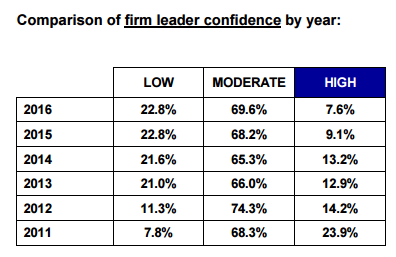
In short, an MP’s job has gotten appreciably harder. Yet they mostly remain confident that their firms will be able to adapt to the changing economic landscape.

This question has been asked six years in a row. While the median response is consistent, look at what has happened at the tails. About a quarter of the MPs used to be highly confident. But that number is now below ten percent. Instead, where less than ten percent of MPs used to be pessimistic, now almost a quarter are.

The confidence question only goes back to 2011. By 2011, the MPs were already convinced that many of the trends identified above were permanent. The average increase in perceived permanence between 2009 and 2011 was 36 percentage points. The average increase from 2011 to 2016 is only 10 percentage points.

The shift in MPs’ confidence does not appear to be rooted in a changing perspective on external forces. My supposition is that the shift is due largely to internal dynamics. In 2011, the MPs were were fully convinced change was needed. By 2016, they realized just how hard real change is.

We don’t have the same kind of historical data on MPs’ views on the barriers to change. Altman Weil has only been asking my favorite question for two years. But the evolution in the MPs’ response in the last year is fascinating.

2015

2016

In one year, the response that Partners resist change jumped 20 points. Clients aren’t asking was down slightly (3.6 points). Despite “crummy” economic results even at the top of the industry, the law-firm pain threshold seems to have increased by more than 10 points. Partner (un)awareness makes its first, and very strong, showing. Less importantly, but not necessarily less interestingly, MPs appear to have slightly more misgivings about their organizational capacity (up 2.6 pts), are less likely to be convinced that their model is not broken (down 5.2 pts), and are less apt to believe that they’re already doing enough (down 4.6 pts).

Next post, I intend to further explore partner resistance and economic pain.

D. Casey Flaherty is a consultant who worked as both outside and inside counsel and serves on the advisory board of Nextlaw Labs. He is the primary author of Unless You Ask: A Guide for Law Departments to Get More from External Relationships, written and published in partnership with the ACC Legal Operations Section. Find more of his writing here. Connect with Casey on Twitter and LinkedIn. Or email casey@procertas.com.
I am the primary author of Unless You Ask: A Guide For Law Departments to Get More From External Relationshipswritten and published in partnership with the External Resources Interest Group of the ACC Legal Ops Section. The book was introduced at last week’s fantastic ACC Legal Ops Section Conference. I guarantee this will be the most compelling guidebook you have ever read, or I will personally refund the full list price (it’s free). The book lays out why and how law departments and law firms should weave continuous process improvement into the fabric of their relationships. From the opening:

“Clients aren’t asking for it.” When surveyed, law firms’ response as to why they are not doing more to change the way they deliver legal services is that “clients aren’t asking for it.” Given that clients are already voting with their wallets and their feet, “clients aren’t asking for it” might not be the best guide to action. But there is some merit to the argument that while law firms know they need to change, they don’t know how to change in visible ways that will satisfy their clients. You should be asking for more and be more specific in what you ask for.

You should be asking your external providers to get demonstrably better. Stripped to its most basic, you should always be able to identify how your primary providers are measurably improving their delivery of legal services to you. You should have credible evidence— descriptions and metrics—of their process improvements and innovation.

While this compilation will go deep into potential methodologies for starting and structuring such data-driven conversations, do not get distracted by the details or paralyzed by a compulsion to develop a comprehensive approach. If you can’t answer the question, “What evidence do I have that my primary providers are measurably improving their delivery of legal services to us?” ask them for some. Then ask again in six months. Repeat.

Don’t detour into discounts. Discounts are fine, as far as they go. But they do not go very far in actually modifying behavior. Your relationships with your primary providers most likely resemble long-term supplier commitments with high switching costs and intermittent price renegotiation. With people and price in place, it is process that offers the most levers to drive continuous improvement.

You are the urgency driver. If you ask, your external providers will find new ways to add value. If you ask, your external providers will improve the processes by which they deliver legal services to you. This volume will provide you with a menu of potential asks that go directly to process.

At its core, Unless You Ask is about conversations. How to start them and what you can get out of them. You may not get everything you ask for. But unless you ask, you are almost guaranteed to get none of it.

A bit more theatrically, what follows (not in the book) is a hypothetical conversation between me (Q) and a caricature of an inside counsel (A) who has a familiar flair with the English language [Forgive me. I am compelled to be a bit goofy after a long stint of serious writing.]:

Q: Do you select quality outside counsel?

A: Oh, the best. They are really, really smart. The smartest. From the most famous firms. They went to the classiest schools. They know the best words. Really, really fabulous words. Luxurious words.

Q: Fantastic. Are you happy with the rates or fees that you have negotiated?

A: Absolutely. We win every negotiation. We win on rates. We win on AFAs. We win on invoice reductions. We win all the time. We win so often that my firms ask me, “Aren’t you tired of winning?” We have negotiated the very best deals. Huge deals. Ask anybody.

Q: Outstanding. So you’ve got the people and the price in place. You must be satisfied with your firms.

A: No. It’s terrible. Really, really awful. These people, they are not innovative or cost conscious. Transparency? Forget about it. Cycle times are way, way too long. Sad!

Q: That’s not good. How do you address those kind of service delivery issues?

A: I’ll tell you what we do. We do it better than anyone. We cut their invoices. Bam! Every month. And then when they come around begging for a rate increase, we are so very, very good at negotiating new discounts. Huge discounts. And then if they don’t get better, if they don’t meet our high, really high standards, we stop sending them work. Like that! [snaps fingers] It happens so fast your head would spin. You know, we don’t even tell them “You’re fired!” We just stop calling them.

Q: How long have you been doing this?

A: Doing what?

Q: Addressing service delivery issues through people and price rather than addressing process directly.

A: That. We’ve always done that.

Q: How is that working out for you?

A: [Puzzled look]

Q: How do you know your approach is actually modifying behavior? Can your law department point to ways in which your primary providers have measurably improved the delivery of legal services?

A: Frankly, I have no idea what you are getting at. Are you suggesting that we are not really, really terrific at what we do? Because, let me tell you, we are terrific.

Q: No. No offense intended. Let me try to switch to language that is more appealing. I’m sure you are great. The best. Fabulous. Truly fabulous. It’s just that I’ve written a little book. Really, the smallest book. In this book, I have distilled some uncommon practices from some great law departments. Some of the best, most famous law departments. Abbott Labs, Abbvie, AIG, Flex, Marsh McLennan, Shell, Voya. Really, really innovative stuff for getting additional value from your external relationships. The most value, really. And it is presented as a menu, a luxurious menu, very posh. I think it would be huge if you read the book. It would be even huger if you adopted some of the practices and told me about your amazing implementation so I could add a case study to a subsequent iteration. And if you don’t like what’s on the menu—if you think it’s all terrible—tell me that too. It’s a living document. It’s adaptable. So very adaptable. I would really appreciate feedback from someone as successful as yourself.

A: What are you trying to sell me? I’ve been in this business a long time. I know this business better than anyone. I’m big league.

Q: I’m trying to sell you on some ideas. Classy ideas. Proven ideas. Ideas about taking what’s already terrific and making it better by creating deep supplier bonds through structured dialogue that weaves continuous improvement into the fabric of your external relationships. Trust me, it is all very tastefully done. Really elegant. And the book itself is free.

A: Free? Kid, you are terrible at business. A real moron. I could teach you many, many things. Too many things. But I can’t resist a deal. Even I can’t say no to free. Send me the link.

Q: Deal.

The basic themes of the book should be familiar to regular readers. Unless You Ask is a practical guide to structured dialogue. It provides specific guidance on the kinds of data-driven conversations that law firms and law departments should be having and how to go about them. The menu is divided into three sections.

Value-Plus. The book comes from a place of respect for legal expertise and appreciation for the contribution of outside counsel. The value-plus section of the volume is focused on finding alternative ways to take advantage of that expertise. Beyond discrete legal matters, primary providers, and their competitors, can provide value via:

  • Legal Training (CLE)
  • Company Training
  • Support Training
  • Allied Professionals
  • Secondments
  • Advice Hotlines
  • Updates/Alerts
  • Pro Bono

Value-Enablement. Because legal expertise is so valuable, whether that expertise is being properly leveraged through process and technology is worthy of sustained (though not constant) attention. If in-house counsel ask for discounts, they will get discounts. If in-house counsel ask for measurable, continuous improvement in the delivery of legal services, that is what they will get. The book provides guidance on how to ask with respect to:

  • Knowledge Management
  • Process and Project Management
  • Billing Hygiene
  • Data/Analytics
  • Paper Lite
  • Expert Systems
  • Technology Training
  • Staffing
  • Firm Defined (i.e., letting firms present their own innovations)
Why. Some departments have already implemented these ideas. The book is a distillation of their practices. But the approach will be foreign to many law departments/firms. Since new is not something lawyers handle all that well, the Why section is presented in FAQ format to forearm those with the courage to suggest a new approach to improving on the status quo:
  • Shouldn’t we be focused on finding great lawyers?
  • You keep referring to “strategic sourcing” and “deep supplier relationships.” What do those terms even mean? How do they relate to law?
  • Should we really have to ask our firms to do things they should already be doing?
  • How will our firms respond to these kinds of additional requests?
  • Don’t we need to get our own house in order before asking our firms to do so?
  • Aren’t we too busy to run someone else’s business for them?
  • Doesn’t this only speak to incremental improvement?
  • Shouldn’t we use our leverage to ask our firms for deeper discounts on billable rates?
  • Wouldn’t much of this be addressed by a transition to AFAs?
  • How does all of this apply to working with alternative service providers?
  • Why is this suddenly so important?

Finally, this is Version 1.0 of the book. We worked hard to get it out before last week’s stellar ACC Legal Ops Conference. It isn’t complete. It won’t ever be complete. If the book ends up being read and the ideas get implemented (two big ifs), then we will continue to update the volume with new ideas and upgrades of existing ideas. Towards that end, I look forward to comments, criticisms, and suggestions to improve on what we’ve got so far.

_______________________________________
D. Casey Flaherty is a consultant who worked as both outside and inside counsel. Find more of his writing here. Connect with Casey on Twitter and LinkedIn. Or email casey@procertas.com.

Praise for Unless You Ask

“It’s a great read – recommend all in-house to embrace, all outside to get ahead of the curve.” –Jeff Carr

“This is an incredibly valuable roadmap for in-house legal dept management of outside counsel. I mean turn by turn.” –Liam Brown

“A report I think qualifies for gold standard treatment by both corporate law firms and the in-house law departments they serve. So many good ideas—a tour de force in my book. Ignore at your peril” –Betsy Munnell

“A terrific (and free) vade mecum for general counsel – to use a good old-fashioned expression with a contemporary flavour….Whether you are a GC or a BigLaw practitioner, read why Casey titled his book Unless You Ask – and learn from a pathfinder.” –George Beaton

“Must-Read: Unless You Ask or ‘Open your mouth or open your wallet'”–Silvia Hodges Silverstein

“Great read and reference for firms and law departments. Terrific ideas for all.” –Lisa Damon

“Terrific and mandatory summer reading for all lawyers, in-house and outside. I mean really…read it!” –Martin Salomon

“I can’t do UYA justice in this space – you need to download it and binge-read it.” –John Calve

“Read this.” –Jordan Furlong

“Read this. That is all.” –Toby Brown

In Part 1, I introduced the idea that we are all professional cyborgs. I used my personal experience with a diabetic toddler whose life literally depends on computers attached to his body to ruminate on how technology is so deeply intertwined with our professional lives that we often don’t even notice it. I rejected the notion that the use of technology can somehow be considered as distinct from ‘real’ lawyering.

In Part 2, I compared a decade of reading that an artificial pancreas is right around the corner to the even more drawn out asymptotic dawn of artificial lawyers. I used the professional progression of a composite successful lawyer who graduated law school in 1977–the mean and modal graduation year of the chairs of the AmLaw 10–as a touchstone for comparing the various AI hype cycles to more mundane progress that actually had an impact (desktop computing, the internet, mobile). I, however, concluded with the idea that the failure of technology to live up to the hype was a good reason to be skeptical of hype but a terrible reason to be skeptical of technology.

In this Part 3, I will talk about what happens when technology does live up to the hype (we stop thinking about it) and why our technology always appears to lag behind (because it does).

Expectation Calibration and Self-Driving Technology

We pay attention to that which demands our attention. The only reason I ever think about my own pancreas working is because my son’s doesn’t. Likewise, I don’t think about my pulmonary, respiratory, or digestive systems unless something is wrong (like we only notice the miracle that is breathing when we’re congested). If my son were ever to acquire the long-promised artificial pancreas, I would stop thinking about it. Just as when he switched over to an insulin pump I stopped thinking about giving him insulin shots.

We are predisposed to focus on what the technology doesn’t do well yet. As the comedian Louis C.K. discusses in this clip–which I pilfered from this great Daniel Pollick presentation at Lexpo–our expectations ratchet up almost instantaneously:

[For those of you who didn’t watch it, Louis recounts being on one of the first planes to test in-flight wifi. It works for a while. Then the wifi goes down. The gentleman in the next seat remarks, “This is bull&^!#.” Louis jokes about the guy being mad at something not working when five minutes before he hadn’t known it existed. The guy had recalibrated his expectations that quickly. This leads to a longer reflection by Louis on how we all complain about the hassle of air travel instead of constantly marvelling at the fact that we beat gravity. We are human beings flying through the air at hundreds of miles an hour thousands of feet above the Earth, and we’re pissed off about it.]

The partner who grew up on a Dictaphone and banker boxes is not going to proceed in a state of perpetual amazement that she can access all the world’s knowledge and all of her firm’s files from a $600 computer that weighs 5 oz., fits in her pocket, and performs 120,000,000x faster than the $23,000,000 computer that weighed 600 lbs. and guided Apollo 11 to the moon. She is going to complain that the connection is slow, the battery runs down too fast, and something mission critical isn’t quite working right. Alternatively, she is not going to learn to operate the device anywhere near its capability and, on the basis of her own ignorance, conclude that the device is not all that useful. Most commonly, a little of both.

We want self-driving technology. When we get it, we stop thinking about it and recalibrate our expectations. When we get partially self-driving technology, we focus on all the driving we still have to do. We are not built to be satisfied.

We’re Running The Red Queen’s Race And We’re Always Losing

“Now, here, you see, it takes all the running you can do, to keep in the same place. If you want to get somewhere else, you must run at least twice as fast as that!”

From Carroll’s Through the Looking Glass, those who run the Red Queen’s race go as fast as they can in order to stay put. When I was growing up, grandparents expected you would send them a school picture every year. Today, grandparents complain if you don’t post daily kid photos to Facebook. It is not just that expectations reset at warp speed. They also tend to ratchet in ways that outpace our ability to deliver.

Enterprise IT, for example, faces all manner of expectations problems due to the consumerization of technology. In the beginning of the digital era, businesses always had the best technology. People had to go into the office so they could use this or that machine. For your standard knowledge worker, the dynamic has flipped. Now most people complain that what they have at home is better than what they have at the office.

Their personal phone is newer. Not bogged down by security protocols, their personal computer is faster. Google embarasses their enterprise search capabilities. Amazon is light years ahead on filtering functionality. Dropbox seems better for document management. The result is incessant complaining and dangerous forays into shadow and stealth IT. People want something that works, now. They don’t care to hear about systems integration or that Apple took years to offer its consumer-targeted iPhone with enterprise-level security controls. IT can’t win, they can only try to keep up.

Arguably, legal has it even worse. Our technology is often reactive. We didn’t know we needed virtual deal rooms or electronic discovery until enterprise data volumes had already exploded. We were ‘late’ on information governance, social media, cybersecurity, privacy, BYOD, etc. because there was no role for us to play until there was role for us to play, at which point we and the technology we use were in perennial catch-up mode.

Relative to any time in the past, our tech is greatly improved. Relative to our actual reference classes–(i) what is available on the consumer market and (ii) the scale of the task at hand–the tech we notice is almost invariably deficient.

Real Lawyers Didn’t Need Tech To Be Successful

This is not where I launch into a diatribe about older people not getting tech. I consider such thinking to be lazy, essentialist nonsense. Older people invented tech. Being an impostor, I know many people, some of them lawyers, who are older than me and wipe the frakin floor with me on tech acumen. Oh, and the digital native is a load of malarkey.

Yet that older people are entirely capable of getting tech does not mean that they do. Some do. Many don’t. And many who don’t are wildly successful. You can be a successful lawyer without tech having much of a felt impact on your career, let alone contributing in any discernible way to your success.

The lawyer who graduated in 1977 probably made partner in 1985, a year Bruce MacEwen recently recalled:

Second, the staff:lawyer ratios today would be unrecognizable to a time traveler from, say, 1985. They might be tempted to protest, “how can we afford to pay lawyers to type?” Don’t scoff; an early and terminally benighted boss of mine uttered those unforgettable words to me in about that very year, when I offered to bring in my own very primitive DOS-based, green-screen IBM PC clone on which I’d taught myself WordPerfect.

Things have changed since 1985. But they have changed far more at the bottom than at the top of the pyramid where our successful lawyer now resides. In many respects, our successful lawyer may be like Bruce’s hypothetical time traveler. They sometimes visit the tech-centric inner workings of their firm, but they find it alien and have no need to live there.

I promise to someday explore some of the ramifications of this social distance. But today is not that day.

_______________________________________
D. Casey Flaherty is a consultant who worked as both outside and inside counsel. Find more of his writing here. Connect with Casey on Twitter and LinkedIn. Or email casey@procertas.com.

Continuing with my two-year-old son, Pickle. As I laid out last post, Pickle is a cyborg. A Type 1 diabetic, his life literally depends on computers that are attached to his body. Because of him, I find myself contemplating the fact that we are almost all professional cyborgs. Technology is now an inescapable element of delivering legal services. The objection that using technology somehow differs from ‘real’ lawyering is misguided. If it affects the outcome or the bill, it is real enough.

Still, just because technology is essential does not mean it is all that good. With respect to my diabetic Pickle, I have one question: where the @#%& is his artificial pancreas?

My wife is also an insulin-deficient cyborg, I have therefore been reading the same damn story about the same pending breakthrough for over a decade (e.g., 200620112016). We are eternally on the cusp of the machine finally replacing humans in the labor-intensive process that is monitoring blood sugar levels and delivering insulin when necessary.

Pickle has a continuous glucose monitor. But it needs to be calibrated multiple times a day. And it is not accurate enough to be relied on for dosing insulin. So the monitor does not obviate the need to regularly prick his fingers and draw blood to check sugar levels. Indeed, the best commercially available glucose monitor is actually a trained dog— the repurposing of 26,000-year-old technology and more evidence against functional fixedness. But a dog, like the monitor he actually has, cannot communicate with his insulin pump, which still needs to be run manually (i.e., we still have to direct the pump to dose insulin).

The cycles of hype and disappointment around an artificial pancreas gives me quite a bit of sympathy for older lawyers who have been through many such cycles re artificial intelligence. As a stand-in for older, successful lawyers, I am going to assume a law school graduation year of 1977 since that is the median and modal graduation years of the chairs of the AmLaw 10. They have been hearing how machines were going to replace them since long before they took the bar.
If you believed the hype on artificial intelligence, it was silly for our successful lawyer to even attend college, let alone law school. In 1970, they would have read the following in Life magazine:

In from three to eight years we will have a machine with the general intelligence of an average human being. I mean a machine that will be able to read Shakespeare, grease a car, play office politics, tell a joke, have a fight. At that point the machine will be able to educate itself with fantastic speed. In a few months it will be at genius level and a few months after that its powers will be incalculable.

Instead, their law school graduation in 1977 was at the tail end of the first AI winter–a period of reduced interest in AI due to its failure to live up to the hype. 
A far cry from human-level general intelligence, the technological marvel of 1977 would be the Apple II. Poor predictions, of course, run in both directions. In reacting to the Apple II, Ken Olson, founder of Digital Equipment Corp. stated, “There is no reason anyone would want a computer in their home.” 
But there is a legitimate question as to how long a prediction has to remain valid to be considered accurate. While Mr. Olson was dead wrong in the long run, a decade later, in 1987–when our successful lawyer had already made partner–only 10% of households had a personal computer. In the midst of that not-so-disruptive diffusion of computing power, important publications would continue to print pablum about the coming robot revolution. The New York Times ran stories with ledes like, “Before today’s teen-agers finish college, computers will interpret changes in tax law and plan tax strategies for business.”
Yet 1987 was also the year when economist Robert Solow observed his eponymous paradox, “You can see the computer age everywhere but in the productivity statistics.” In related news, another brutal AI winter was coming. After a resurgence in AI research and hype, the collapse of the Lisp machine market in 1987 presaged the imminent failures and fall from grace of the early expert systems, “fifth generation” computers, and the Strategic Computing Initiative leading to New York Times articles like “Computer Fails as Job-Killer.” 

In 1997, the machines finally won…at chess. IBM’s Deep Blue topped Gary Kasparov under tournament conditions. The press went nuts:

When Gary Kasparov beat IBM’s chess computer in 1989 he arrogantly told the programmers to “teach it to resign earlier”. Yesterday, though, the world champion found himself humbled by a 1.4-ton heap of silicone in a victory for IBM’s Deep Blue that marks a milestone in the progress of artificial intelligence. It is a depressing day for humankind in general. (here)

In brisk and brutal fashion, the I.B.M. computer Deep Blue unseated humanity (here)

Elsewhere in 1997, our successful lawyer had been a partner for more than a decade and practicing for two decades. The home computer market had not yet broken 40%. The still nascent home internet market had not yet cracked 20% penetration. In developments that would actually make an impact, the domain and famous spelling error www.google.com would be registered, almost a year before the company would be incorporated.

In 2007, our successful lawyer had been a partner for more than 20 years and practicing for 30 years. They could read increasingly more about the coming singularity and contemporary regurgitations of the Life article from 1970:

Social security will have to be expanded, introduced at lower and lower ages, till essentially everyone lives on social security. The taxes will be paid by fully-automated businesses run by robots. And human beings have to deal with the problem of excess leisure…I am afraid that the long term future we are building will have no space left for human beings…a world where we have these robots and better and better artificial intelligence, where systematically those systems replace humans, human services, human work…Is it a good or bad thing if robots become our natural successors and we fade into extinction?

But evidence of true machine intelligence outside of very narrow domains like chess remained illusory. As a practical matter, the tangible breakthroughs were mostly about being able to take the office with you everywhere. In 2007, Blackberries were a thing, and Apple announced the iPhone.

We are closing in on 2017 when our successful lawyer will celebrate 40 years in practice with more than 30 of those years as a partner. Much closer to the end of their career than the beginning, they can still read the same damn story about their imminent obsolescence. Or they can read the counterprogramming. We should forgive them for being a bit skeptical.

Yet there is something disingenuous about my account. It is accurate, as far as it goes. But it is also needlessly reductive in a way that I think is best captured by the incomparable xkcd:

Returning to my understandable focus on the perpetual promise of the artificial pancreas. In fixating on a closed system that eliminates the human factor post installation, I  miss the genuine progress being made. What used to be a death sentence is now an inconvenience. And that inconvenience has gotten considerably easier to manage now that we can do things like monitor my son’s blood sugar remotely on a watch–continuous glucose monitor links to his iPhone; his iPhone transmits to my wife’s iPhone; her iPhone transmits to her Apple Watch. None of those devices were commercially available when my wife was diagnosed a decade ago. That is amazing even if it is not the technological nirvana we were promised.

One way to react to hype cycles is to laugh at the peaks in hindsight. Another is to pay attention to the progress that follows:

Because the story I told above focused on the more sensational claims of machines making humans obsolete, it treated the PC, the internet, and mobile as inconsequential asides that only served to demonstrate the hyperbolic nature of the press coverage. But like a good lawyer, I could use the same facts to tell a very different story in which technology crept into every aspect of our professional lives. There will be real similarities between the immediate lived experience of a lawyer who graduated in 1977 and the one who graduates in 2017. But there will also be real differences that would have seemed like bad science fiction to someone entering an analogue professional environment four decades ago.

I think there will be an artificial pancreas soon. Machines will be able to do that one sequence of things well enough. Likewise, I suspect that machines will continue to progress at doing other things well, including some things traditionally done by lawyers. But I am doubtful* that we are nearing artificial general intelligence. Focus should therefore remain directed towards the automation of tasks rather than the complete elimination of jobs. As Robin Hanson has observed, while technology gains are exponential, the impact may be linear because job power levels are distributed lognormally:

I often meet people who think that because computer tech is improving exponentially, its social impact must also be exponential. So as soon as we see any substantial social impact, watch out, because a tsunami is about to hit. But it is quite plausible to have exponential tech gains translate into only linear social impact. All we need is a lognormal distribution, as in this diagram:

Imagine that each kind of jobs that humans do requires a particular level of computing power in order for computers to replace humans on that job. And imagine that these job power levels are distributed lognormally.

In this case an exponential growth in computing power will translate into a linear rate at which computers displace humans on jobs. Of course jobs may clump along this log-computing-power axis, giving rise to bursts and lulls in the rate at which computers displace jobs. But over the long run we could see a relatively steady rate of job displacement even with exponential tech gains. Which I’d say is roughly what we do see.

For our successful lawyer, however, the felt impact of technology progress on their professional accomplishments may be less than linear, it may be negligible. This has consequences for how lawyers in position of power react to those of who emphasize that we are all cyborgs now. More on that in Part 3.

_______________________________________
D. Casey Flaherty is a consultant who worked as both outside and inside counsel. Find more of his writing here. Connect with Casey on Twitter and LinkedIn. Or email casey@procertas.com.

*I’m way too dumb to have a smart take on the timing of general artificial intelligence. But the implications are so profound that it almost makes them not worth talking about. It would be similar to debating how the legal profession might change if the Earth were again struck by a meteor like the one that wiped out the dinosaurs. Everything changes, and almost no one is going to care what effect it has on profits per partner. Until then, I am in Ryan’s camp. It is only AI/magic until we start to use it, then it is software. It is only a human-displacing robot until we start to rely on it, then it is a dishwasher.

My two-year old just got his first iPhone. Now, Pickle (yes, Pickle!) is never without it. The iPhone goes everywhere with him the way other kids might drag along a stuffed bear. We are even thinking about getting Pickle a haute couture fanny pack to ensure his iPhone is on him at all times.

I’ll give some of you moment to catch your breath…. Scrambling to ascend that high horse so quickly probably took a lot out of you. Yes, I am familiar with the research on screen time and brain development. I don’t care. I don’t care because we didn’t get Pickle an iPhone so we could subject him to the perverse moral dystopia of Thomas the Train.

We got him an iPhone because he was recently diagnosed as a Type 1 diabetic. The iPhone links to his continuous glucose monitor and transmits the readings to his mother and me. It alarms if Pickle’s blood sugar gets too high (so we can dose him with insulin) or too low (so we can pump him full of sugar). If you don’t think that is a good enough reason to get a two-year old an iPhone (an older model donated to us), you can take it up with my wife. Let me know how that works out for you.

Of course that means that my kid is a cyborg. How sweet is that?


Pickle’s life literally depends upon computers—a glucose monitor and an insulin pump—that are attached to him. He is a being with both organic and biomechatronic body parts. He is an organism that has restored function due to the integration of some artificial component or technology that relies on feedback. My Pickle is a cyborg.

Using the term a little more loosely, however, aren’t most of us professional cyborgs at this point? I know that I feel my ability to conduct business draining away anytime the battery life on my iPhone or laptop approaches critical level. How exactly does a modern lawyer operate without relying on modern technology?

How do you not Google? How do you exchange documents your clients without email? How do you file anything according to local court rules and efiling protocols without an entire array of hardware and software? How do you conduct a litigation of any appreciable size without some understanding of ediscovery? How do you handle divorces without knowing about Facebook? How do you complete an M&A transaction without considering IT and information assets?

You can actually be ignorant of all those things and still be an obscenely successful lawyer. The trick is to already be successful. I was in the audience a few years ago when the great Ted Olson gave the opening remarks at Legaltech. His talk was not well received because he made it clear at the outset that he considered the audience a bunch of nerds (which, to be fair, we are). After all, a yellow pad was all the legal tech he needed to be Ted freakin Olson. And that’s fine, for Ted Olson. Ted Olson is so ridiculously good at the things that Ted Olson is hired to do that no one should care that Ted Olson doesn’t use tech. If Ted Olson decided to incorporate augury into his preparation for oral argument, most clients would happily pay for the birds.

But you know who is probably using tech pretty heavily? Some of the people on Ted Olson’s team. I believe Ted Olson when he claims that he operates without any device that requires electricity. I doubt the same can be said for his team, let alone his firm. As a client, you want Ted Olson as your lawyer (if it is the kind of matter that demands Ted Olson) but you would not necessarily want Ted Olson chairing the firm’s technology committee.

Ted Olson telling a room full of legal tech folks that the only tech he needed was a legal pad would be like him telling a room full of legal marketing professionals that the only marketing he ever had to do was establish himself as one of the most prominent and successful appellate lawyers in history. True enough. But not exactly replicable at scale.

I am reflecting on this because I often get lured into pointless philosophical debates about what constitutes ‘real’ lawyering. Frankly, I am ill equipped to discuss such lofty Platonic ideals. If it affects the outcome or the bill, it is real enough for me. Delegation to associates or nonlawyers does not make it any less real or obviate the duty of oversight. (As always, I hate the term “nonlawyer” and prefer allied professional, but the ABA did not put me on the drafting committee for the model rule).

If I am feeling generous, I try to reframe what the person is saying. Usually, they are not actually arguing that tech is unnecessary. Rather, they are often expressing a belief that the tech-related work is not where lawyers add the most value. On this we almost completely agree. Which is why I find it so tragic that lawyers (and staff) waste so much time on tech-dependent activities because they have never trained to properly use the core technology tools at their disposal. We often find a place of consensus where we would both prefer a world where lawyers spent more of their finite time devoted to applying their learned judgment to solving client problems.

Sometimes, however, I discover that we are having a different discussion. It is not the one about whether lawyers should use tech. It is the complaint that while lawyers have to use tech, the tech has not lived up to the hype. Here I have even more sympathy. I’ll express it in Part 2.

Part 2 (originally a separate post because I’m trying to get more into the whole brevity thing)

Continuing with my two-year-old son, Pickle. As I laid out last post, Pickle is a cyborg. A Type 1 diabetic, his life literally depends on computers that are attached to his body. Because of him, I find myself contemplating the fact that we are almost all professional cyborgs. Technology is now an inescapable element of delivering legal services. The objection that using technology somehow differs from ‘real’ lawyering is misguided. If it affects the outcome or the bill, it is real enough.

Still, just because technology is essential does not mean it is all that good. With respect to my diabetic Pickle, I have one question: where the @#%& is his artificial pancreas?

My wife is also an insulin-deficient cyborg, I have therefore been reading the same damn story about the same pending breakthrough in closed-loop insulin delivery for over a decade (e.g., 2006, 2011, 2016). We are eternally on the cusp of the machine finally replacing humans in the labor-intensive process that is monitoring a diabetic’s blood sugar levels and delivering insulin when necessary.

Pickle has a continuous glucose monitor. But it needs to be calibrated multiple times a day. And it is not accurate enough to be relied on for dosing insulin. So the monitor does not obviate the need to regularly prick his fingers and draw blood to check sugar levels. Indeed, the best commercially available glucose monitor is actually a trained dog—the repurposing of 26,000-year-old technology and more evidence against functional fixedness. But a dog, like the monitor he actually has, cannot communicate with his insulin pump, which still needs to be run manually (i.e., we still have to direct the pump to dose insulin).

The cycles of hype and disappointment around an artificial pancreas give me quite a bit of sympathy for older lawyers who have been through many such cycles re artificial intelligence. As a stand-in for older, successful lawyers, I am going to assume a law school graduation year of 1977 since that is the median and modal graduation years of the chairs of the AmLaw 10. They have been hearing how machines were going to replace them since long before they took the bar.

If you believed the hype on artificial intelligence, it was silly for our now successful lawyer to even attend college, let alone law school. Near their high school graduation in 1970, they would have read the following in Life magazine:

In from three to eight years we will have a machine with the general intelligence of an average human being. I mean a machine that will be able to read Shakespeare, grease a car, play office politics, tell a joke, have a fight. At that point the machine will be able to educate itself with fantastic speed. In a few months it will be at genius level and a few months after that its powers will be incalculable.

Instead, their law school graduation in 1977 was at the tail end of the first AI winter—a period of reduced interest in AI due to its failure to live up to the hype.
A far cry from human-level general intelligence, the technological marvel of 1977 would be the Apple II. Poor predictions, of course, run in both directions. In reacting to the Apple II, Ken Olson, founder of Digital Equipment Corp. stated, “There is no reason anyone would want a computer in their home.”
But there is a legitimate question as to how long a prediction has to remain valid to be considered accurate. While Mr. Olson was dead wrong in the long run, a decade later, in 1987—when our successful lawyer had already made partner—only 10% of households had a personal computer. In the midst of that not-so-disruptive diffusion of computing power, important publications would continue to print pablum about the coming robot revolution. The New York Times ran stories with ledes like, “Before today’s teen-agers finish college, computers will interpret changes in tax law and plan tax strategies for business.”
Yet 1987 was also the year when economist Robert Solow observed his eponymous paradox, “You can see the computer age everywhere but in the productivity statistics.” In related news, another brutal AI winter was coming. After a resurgence in AI research and hype, the collapse of the Lisp machine market in 1987 presaged the imminent failures and fall from grace of the early expert systems, “fifth generation” computers, and the Strategic Computing Initiative. These disappointments resulted in New York Times articles like “Computer Fails as Job-Killer.”
In 1997, the machines finally won…at chess. IBM’s Deep Blue topped Gary Kasparov under tournament conditions. The press went nuts:

When Gary Kasparov beat IBM’s chess computer in 1989 he arrogantly told the programmers to “teach it to resign earlier”. Yesterday, though, the world champion found himself humbled by a 1.4-ton heap of silicone in a victory for IBM’s Deep Blue that marks a milestone in the progress of artificial intelligence. It is a depressing day for humankind in general. (here)

In brisk and brutal fashion, the I.B.M. computer Deep Blue unseated humanity (here)

Elsewhere in 1997, our successful lawyer had been a partner for more than a decade and practicing for two. The home computer market had not yet broken 40%. The still nascent home internet market had not yet cracked 20% penetration. In developments that would actually make an impact, the domain and famous spelling error www.google.com was registered, almost a year before the company would be incorporated.

In 2007, our successful lawyer had been a partner for more than 20 years and practicing for 30 years. They could read increasingly more about the coming singularity and contemporary regurgitations of the Life article from 1970:

Social security will have to be expanded, introduced at lower and lower ages, till essentially everyone lives on social security. The taxes will be paid by fully-automated businesses run by robots. And human beings have to deal with the problem of excess leisure…I am afraid that the long term future we are building will have no space left for human beings…a world where we have these robots and better and better artificial intelligence, where systematically those systems replace humans, human services, human work…Is it a good or bad thing if robots become our natural successors and we fade into extinction?

But evidence of true machine intelligence outside of very narrow domains like chess remained illusory. As a practical matter, the tangible breakthroughs were mostly about being able to take the office with you everywhere. In 2007, Blackberries were a thing, and Apple announced the iPhone.

We are closing in on 2017 when our successful lawyer will celebrate 40 years in practice with more than 30 of those years as a partner. Much closer to the end of their career than the beginning, they can still read the same damn story about their imminent obsolescence. Or they can read the counterprogramming. We should forgive them for being a bit skeptical.

Yet there is something disingenuous about my account. It is accurate, as far as it goes. But it is also needlessly reductive in a way that I think is best captured by the incomparable xkcd:

Returning to my understandable focus on the perpetual promise of the artificial pancreas. In fixating on a closed system that eliminates the human factor post installation, I miss the genuine progress being made. What used to be a death sentence is now an inconvenience. And that inconvenience has gotten considerably easier to manage now that we can do things like monitor my son’s blood sugar remotely on a watch—continuous glucose monitor links to his iPhone; his iPhone transmits to my wife’s iPhone; her iPhone transmits to her Apple Watch. None of those devices were commercially available when my wife was diagnosed a decade ago. That is amazing even if it is not the technological nirvana we were promised.

One way to react to hype cycles is to laugh at the peaks in hindsight. Another is to pay attention to the progress that follows:

Because the story I told above focused on the more sensational claims of machines making humans obsolete, it treated the PC, the internet, and mobile as inconsequential asides that only served to demonstrate the hyperbolic nature of the press coverage. But like a good lawyer, I could use the same facts to tell a very different story in which technology crept into every aspect of our professional lives. There will be real similarities between the immediate lived experience of a lawyer who graduated in 1977 and the one who graduates in 2017. But there will also be real differences that would have seemed like bad science fiction to someone entering an analogue professional environment four decades ago.

I think there will be an artificial pancreas soon. Machines will be able to do that one sequence of things well enough. Likewise, I suspect that machines will continue to progress at doing other things well, including some traditionally done by lawyers. But I am doubtful* that we are nearing artificial general intelligence. Focus should therefore remain directed towards the automation of tasks rather than the complete elimination of jobs. As Robin Hanson has observed, while technology gains are exponential, the impact may be linear because job power levels are distributed lognormally:

I often meet people who think that because computer tech is improving exponentially, its social impact must also be exponential. So as soon as we see any substantial social impact, watch out, because a tsunami is about to hit. But it is quite plausible to have exponential tech gains translate into only linear social impact. All we need is a lognormal distribution, as in this diagram:

Imagine that each kind of jobs that humans do requires a particular level of computing power in order for computers to replace humans on that job. And imagine that these job power levels are distributed lognormally.

In this case an exponential growth in computing power will translate into a linear rate at which computers displace humans on jobs. Of course jobs may clump along this log-computing-power axis, giving rise to bursts and lulls in the rate at which computers displace jobs. But over the long run we could see a relatively steady rate of job displacement even with exponential tech gains. Which I’d say is roughly what we do see.

For our successful lawyer, however, the felt impact of technology progress on their professional accomplishments may be less than linear, it may be negligible. This has consequences for how lawyers in position of power react to those of who emphasize that we are all cyborgs now. More on that in Part 3.

*I’m way too dumb to have a smart take on the timing of general artificial intelligence. But the implications are so profound that it almost makes them not worth talking about. It would be similar to debating how the legal profession might change if the Earth were again struck by a meteor like the one that wiped out the dinosaurs. Everything changes, and almost no one is going to care what effect it has on profits per partner. Until then, I am in Ryan’s camp. It is only AI/magic until we start to use it, then it is software. It is only a human-displacing robot until we start to rely on it, then it is a dishwasher.

Part 3 (originally a separate post)

In Part 1, I introduced the idea that we are all professional cyborgs. I used my personal experience with a diabetic toddler whose life literally depends on computers attached to his body to ruminate on how technology is so deeply intertwined with our professional lives that we often don’t even notice it. I rejected the notion that the use of technology can somehow be considered distinct from ‘real’ lawyering.

In Part 2, I compared a decade of reading that an artificial pancreas is right around the corner to the even more drawn out asymptotic dawn of artificial lawyers. I used the professional progression of a composite successful lawyer who graduated law school in 1977—the mean and modal graduation year of the chairs of the AmLaw 10—as a touchstone for comparing the various AI hype cycles to more quotidian progress that had real impact (desktop computing, the internet, mobile). I, however, concluded with the idea that the failure of technology to live up to the hype was a good reason to be skeptical of hype but a terrible reason to be skeptical of technology.

In this Part 3, I will talk about what happens when technology does live up to the hype (we stop thinking about it) and why legal technology always appears to lag behind (because it does).

Expectation Calibration and Self-Driving Technology

We pay attention to that which demands our attention. The only reason I ever think about my own pancreas working is because my son’s doesn’t. Likewise, I don’t think about my pulmonary, respiratory, or digestive systems unless something is wrong (like we only notice the miracle that is breathing when we’re congested). If my son were ever to acquire the long-promised artificial pancreas, I would stop thinking about it. Just as when he switched over to an insulin pump I stopped thinking about giving him insulin shots.

We are predisposed to focus on what the technology doesn’t do well yet. As the comedian Louis C.K. discusses in this clip—which I pilfered from this great Daniel Pollick presentation at Lexpo—our expectations ratchet up almost instantaneously:

[For those of you who didn’t watch it, Louis recounts being on one of the first planes to test in-flight wifi. It works for a while. Then the wifi goes down. The gentleman in the next seat remarks, “This is bull&^!#.” Louis jokes about the guy being mad about something not working when five minutes before he hadn’t known it existed. The guy had recalibrated his expectations that quickly. This leads to a longer reflection by Louis on how we all complain about the hassle of air travel instead of constantly marvelling at the fact that we beat gravity. We are human beings flying through the air at hundreds of miles an hour thousands of feet above the Earth, and we’re pissed off about it.]

The partner who grew up on a Dictaphone and banker boxes is not going to proceed in a state of perpetual amazement that she can access all the world’s knowledge and all of her firm’s files from a $600 computer that weighs 5 oz., fits in her pocket, and performs 120,000,000x faster than the $23,000,000 computer that weighed 600 lbs. and guided Apollo 11 to the moon. She is going to complain that the connection is slow, the battery runs down too fast, and something mission critical isn’t quite working right. Alternatively, she is not going to learn to operate the device anywhere near its capability and, on the basis of her own ignorance, conclude that the device is not all that useful. Most commonly, a little of both.

We want self-driving technology. When we get it, we stop thinking about it and recalibrate our expectations. When we get partially self-driving technology, we focus on all the driving we still have to do. We are not built to be satisfied.

We’re Running The Red Queen’s Race And We’re Always Losing

“Now, here, you see, it takes all the running you can do, to keep in the same place. If you want to get somewhere else, you must run at least twice as fast as that!”

From Carroll’s Through the Looking Glass, those who run the Red Queen’s race go as fast as they can in order to stay put. When I was growing up, grandparents expected you to send them a school picture once a year. Today, grandparents complain if you don’t post daily kid photos to Facebook. It is not just that expectations reset at warp speed. They also tend to ratchet in ways that outpace our ability to deliver.

Enterprise IT, for example, faces all manner of expectations problems due to the consumerization of technology. In the beginning of the digital era, businesses always had the best technology. People had to go into the office so they could use this or that machine. For your standard knowledge worker, the dynamic has flipped. Now most people complain that what they have at home is better than what they have at the office.

Their personal phone is newer. Not bogged down by security protocols, their personal computer is faster. Google embarrasses their enterprise search capabilities. Amazon is light years ahead on filtering functionality. Dropbox seems better for document management. The result is incessant complaining and dangerous forays into shadow and stealth IT. People want something that works, now. They don’t care to hear about systems integration or that Apple took years to offer its consumer-targeted iPhone with enterprise-level security controls. IT can’t win, they can only try to keep up.

Arguably, legal has it even worse. Our technology is often reactive. We didn’t know we needed virtual deal rooms or electronic discovery until enterprise data volumes had already exploded. We were ‘late’ on information governance, social media, cybersecurity, privacy, BYOD, etc. because there was no role for us to play until there was role for us to play, at which point we were in perennial catch-up mode.

Relative to any time in the past, our tech is greatly improved. Relative to our actual reference classes—(i) what is available on the consumer market and (ii) the scale of the task at hand—the tech we notice is almost invariably deficient.

Real Lawyers Didn’t Need Tech To Be Successful

This is not where I launch into a diatribe about older people not getting tech. I consider such thinking to be lazy, essentialist nonsense. Older people invented tech. Being an impostor, I know many people, some of them lawyers, who are older and considerably more tech savvy than me. Oh, and the digital native is a load of malarkey.

Yet that older people are entirely capable of getting tech does not mean that they do. Some do. Many don’t. And many who don’t are wildly successful. You can be a successful lawyer without tech having much of a felt impact on your career, let alone contributing in any discernible way to your success.

The lawyer who graduated in 1977 probably made partner in 1985, a year Bruce MacEwen recently recalled:

Second, the staff:lawyer ratios today would be unrecognizable to a time traveler from, say, 1985. They might be tempted to protest, “how can we afford to pay lawyers to type?” Don’t scoff; an early and terminally benighted boss of mine uttered those unforgettable words to me in about that very year, when I offered to bring in my own very primitive DOS-based, green-screen IBM PC clone on which I’d taught myself WordPerfect.

Things have changed since 1985. But they have changed far more at the bottom than at the top of the pyramid where our successful lawyer now resides. In many respects, our successful lawyer may be like Bruce’s hypothetical time traveler. They sometimes visit the tech-centric inner workings of their firm, but they find it alien and have no need to live there.

I promise to someday explore some of the ramifications of this social distance. But today is not that day.

_______________________________________
D. Casey Flaherty is a legal operations consultant who worked as both outside and inside counsel. Find more of his writing here. Connect with Casey on Twitter and LinkedIn. Or email casey@procertas.com.

The CLOC Institute last week was phenomenal. I barely tweeted because I was so engaged by the content and conversation. I did, however, transcribe one quote that got some attention from the legal commentariat:

I gravitated to the quote because it was consistent with my pre-existing notions of the role clients and structured dialogue play in driving improvements in legal service delivery. But because the statement only reinforced my extant beliefs, it did not inspire any sort of reflection. Another speaker from the same Big Thinkers panel, however, added another dimension to my musings on collective conversations.

Firoz Dattu used to teach economics at Harvard. Among many other cogent points, he talked about getting past the failings of individual firms and thinking more about how we can correct market failures. In particular, he emphasized the lack of perfect information. As someone who has long labeled law a credence good subject to Baumol’s cost disease, this observation resonated with me.

Perfect markets are purely theoretical. The textbook conditions for competitive markets—perfect information, rational market actors, homogeneity, free entry and exit, numerous participants, no regulation, no externalities, no principal/agent problems, etc.—exist in degrees, not absolutes. But understanding how and why a particular market deviates from the competitive ideal is critical for efforts to correct how that market functions.

In a perfect-information condition, all consumers and suppliers have perfect knowledge of price, utility, quality, and production methods. This differs from omniscience. Perfectly knowledgeable participants can still compete. Chess is a competitive game with perfect information. Both players have seen every move and can derive the range of possible future moves from the rules.

Backgammon is also a perfect-information game despite the role of the dice. Rolling the dice introduces quantifiable exogenous uncertainty from chance events—i.e., we do not know what numbers will come up, but we do know the range of possibilities and their probabilities. Working from a fresh deck, blackjack and poker with all cards facing up would be perfect information games. But stacked decks and hidden cards result in an imperfect-information condition and also much of the fun of gambling.

Legal action is a gamble with plenty of stacked decks and hidden cards. There are known unknowns and unknown unknowns that drive activities like discovery and due diligence. But even the basic decisions, like which lawyer to hire, are fraught with imperfect information. With the billable hour still dominant, we are generally guessing about price. With contingent outcomes, we have limited ability to judge utility. We have almost no barometer of quality apart from the poor proxy of pedigree. And we harbor deep suspicions but traditionally have had no real transparency into production methods.

We can’t eliminate risk or uncertainty. We can’t have perfect information. So shouldn’t we just get back to doing the law stuff? This is the point where many market participants throw up their hands. Having cogitated for a few painful minutes, most people return to their days jobs with some implicit, if grumbling, acceptance of the status quo.

Firoz Dattu is not most people. One of the founders of the General Counsel Roundtable (now CEB Legal Leadership Council), Dattu is the CEO of AdvanceLaw. AdvanceLaw has brought together the GC’s of over 100 of the largest corporate clients (e.g., Google, McDonald’s, Nike, Sony, Deutsche Bank, Mastercard) into something that looks from afar like a loose consortium. Rather than buying together, the GC’s of these legal service consumers pool resources to vet law firms and, once firms qualify for the go-to list, commit to sharing feedback on quality of service.

But how much can you really vet law firms? Law firms look pretty much the same. There are no agreed upon measures of quality. Likewise, there are no bright lines for judging outcomes. Who is the better trial attorney: the one who ‘won’ a case that should have been worth $10M to the plaintiff or the one who ‘lost’ the case while limiting the damages paid by the defendant to $100K? How do we measure the outcome if the parties avoided trial by settling for $1M? How do we evaluate the deal or contract that never resulted in litigation? As Deming said, “Without data you’re just another person with an opinion.”

That is probably what it would be: opinion. I don’t have any insight into the AdvanceLaw methodology, but I suspect it involves a fair amount of subjective evaluations on both the front and back end. Kind of like Yelp or the reviews on Amazon. Not exactly hard science.

But it does not need to be hard science to be useful. General accuracy is preferable to false precision. I find the scores on Yelp and Amazon to be quite informative (and AdvanceLaw is far less susceptible to fake reviews). Customer satisfaction is inherently subjective but terribly important. Knowing that 100 people subjectively determined they enjoyed a meal is a better guide to action than having a precise measurement of the max temperature of the oven in which the food was cooked.

While we can’t have perfect information, we can have better information. We can reduce, rather than eliminate, risk and uncertainty. A few well-informed customers sharing their opinion provides infinitely more information than nothing and is more credible than advertising (either you have no information or you believe what the seller tells you). There are numerous methodologies for capturing qualitative metrics. But these measurement methodologies work best with scale and diversity of sources—the two things the AdvanceLaw loose consortium approach provides.

Think about the advantages from the buyer’s perspective. One major barrier to dynamism in the legal market is high switching costs. Despite long-standing dissatisfaction with their incumbent law firms, client purchasing behavior reflects a devil-you-know conservatism. This behavior is rational in a low-information condition where the primary method to determine if there is a better alternative is a resource-intensive vetting process followed by a risk-intensive trial run.

Pooling resources on the vetting process reduces the burden. Sharing feedback reduces the risk—someone credible has already done the trial run. The formal system for building reputational capital also creates an extra level of market discipline for the participating firms because a bad customer experience will have effects beyond the individual client relationship. Law firms go from operating in an environment where they are almost guaranteed that their performance will not be shared to an environment where they are almost guaranteed that it will. Incentives affect behavior.

Clients are not the only ones who suffer from an information deficit. Firms believe they do great work. But only a third of corporate counsel would actually recommend their primary law firm to a peer. Returning to the quote that opened the post—“I’m at a large law firm. The only time I have seen changes is when clients have initiated it”—think about the advantages from the seller’s perspective. Single-source vetting combined with a robust feedback mechanism from over a hundred clients does more than preserves resources. It introduces consistency and transparency.

Often, law firms that do not get past the vetting process have no idea why. Those that make it on a panel list then have little insight into the circumstances that lead to the ebbs and flows of business volume. The conventional way to fire a law firm is to stop calling them. The lack of dynamism among law firms is not just because clients don’t switch often. Clients’ reasons for switching, or not, are usually opaque

Presumably, AdvanceLaw tells firms why they don’t make it on the go-to list and what they would need to improve in order to so. Likewise, I’m assuming that law firms are made aware of the feedback so that they have guidance on how to get better. The subsequent rewards for getting better and doing exceptional work are amplified by the transparency to other potential clients. Law firms move from a situation where there is often no feedback to one with constant feedback that is shared with over a hundred existing and potential clients.

Moreover, the dynamism driven by better information is not limited to individual clients and firms. There are system implications. Where thorough vetting and detailed, quantified feedback displace brand and pedigree as indicia of quality, the playing field becomes leveled for smaller firms and challengers. This does not necessarily presage the death of BigLaw, but it does intensify competition and accelerate the pace at which law firms are remade.

I’ve been focused on information problems for years with my Service Delivery Review and Legal Tech Assessment. The market needs more information. But the market also needs to be structured in a way that facilitates the dissemination of information. Recently, I’ve been reflecting about the roles played by geography (Toronto) and organization (CLOC) but Dattu, along with some exciting things my friend Bill Henderson is working on, has really got me ruminating on the importance of collective feedback loops. Structured dialogue is a powerful feedback mechanism, but it can be amplified if it is embedded in the proper collective structure.

We need to make a better market rather than focus on the shortcomings of individual market participants.

_______________________________________
D. Casey Flaherty is a consultant who worked as both outside and inside counsel. Find more of his writing here. Connect with Casey on Twitter and LinkedIn. Or email casey@procertas.com.

I hate outside counsel guidelines. Hate. It’s visceral. I have never encountered a set of guidelines I liked. My antipathy includes guidelines I had a hand in writing.

As an associate I worked for a client whose guidelines forbade time entries that suggested any form of communication between lawyers–meetings, conversations, conferences, correspondence. So, too, any form of research and many other essential elements of producing work that were impossible to avoid within the delivery framework within which we were operating.

The client’s guidelines did not change the underlying behavior. The SOP remained:

  1. Get assignment from the partner (which necessitated communication)
  2. Do whatever research needs to be done
  3. Draft
  4. Iterate – ask questions of or receive feedback from partner (more communication)
  5. Do additional research
  6. Repeat ##3-5 until product satisfies partner

Because lawyers are pretty good at playing games with language, this would all be captured under “write motion” or some other acceptable description. While the guidelines saved the client no money, they did waste considerable time. Because the client had an extensive external review process, the firm had an intensive internal review process to make sure the billing language satisfied the client’s guidelines. Internally, entries were constantly being sent back for rewrite but not writedown.

Few associates mastered the word games because we actively avoided working on the account. Beyond the painful time-entry protocol, the client had negotiated steep discounts. That’s fine in and of itself, except the firm was then experimenting with making associate bonuses and promotion (instead of partner compensation) dependent on revenue and realizations, rather than just hours. Associates chafed at being forced to do work that generated little revenue and reduced their realizations with each hour recorded–accountability without authority is aggravating. The result was that the client did not benefit from the accumulation of intellectual capital within the firm.

From where I sat, the relationship screamed out for a fixed fee or other AFA. I still believe that. But leaving pricing aside, I understand the client’s urge to play a role in shaping the way legal services were being delivered. What I object to is the counterproductive combination of micromanagement and blunt instrument.

For all the effort that both put sides into satisfying and enforcing the guidelines, they would have been much better served to engage in a structured dialogue about continuously improving project management (communication) and knowledge management (research), as well as other aspects of service delivery such as templates, automation, analytics, and staffing. With respect to staffing, the client should have been interested in maintaining a stable team that was familiar with their work. Which, of course, means that I just suggested a new guideline as part of a screed against guidelines. I’m a bit of a hypocrite.

While I disdain billing guidelines, I consider them a necessary evil. Clients need to communicate how and when invoices are to be submitted. Clients should have policies on traditional pass-through costs like ediscovery, court reporting, and expert witnesses. We can debate the merits of particular policies and prohibitions, but I have yet to meet anyone who advocates for a total abolition of billing guidelines. After all, “send invoices to” is a billing guideline.

And, yet, there’s a problem: we don’t really have a forum to debate particular policies and prohibitions. Outside counsel guidelines are presented as a fait accompli. Pushing back on them in the context of the relationship is hard. Simon Chester, the former GC of the former Heinan Blake, has detailed many of the problems in billing guidelines and believes that firms “have to be prepared to walk away” from the engagement. But how many firms can afford to walk away in a world of flattening demand, lateral hypermobility, and inherently fragile firm structures?

Content is not the only challenge. Outside counsel guidelines are sometimes quite long–they are, after all, written by lawyers. And they tend to be all over the map, not just in requirements but in language and structure. Billing guidelines are frequently not read, let alone followed, by outside counsel or even the inside counsel who were not part of the drafting team. Guidelines are often treated as formalities, trivialities, and inconveniences more honored in the breach.

Compounding the problem is that firms often provide, and clients frequently sign, engagement letters that contradict the guidelines. These, too, often go unread. In not being read, guidelines and engagement letters are like 99.9% of the executed contracts in existence. As litigators know well, most people only read the contract when something goes wrong, which, frankly, is not too often in percentage terms but is common enough in raw numbers to keep us employed.

Ironically, the law department/firm relationship is among the worst papered commercial relationships a corporation will enter into because their lawyers are otherwise so vigilant when it comes to the business units’ commitments and obligations. Most of the time it’s fine. Except when it isn’t. And then it is bad. I didn’t realize how bad until I had a recent chat with someone who audits legal bills for a living. We’re talking five to seven figures and immense stress on relationships. He explained to me that violations of the billing guidelines were, by far, the lowest hanging fruit.

Both law departments and law firms have a contract management problem.

Even recognizing all this, what is to be done? If you are a client and want to write new, improved guidelines, where do you start? For the firm, while a few clients may actually have really good guidelines (some do), the good ones still won’t align with the disparate guidelines from all your other clients. Both clients and firms may, understandably, be inclined to turn to technology. But technology vendors have to deal with the same problems of lack of standardization and the attendant need for deep customization, especially on the firm side.

I don’t have a solution. But, if there is a solution, it will probably not be unilateral. I once wrote a piece on a billing guidelines project that did not get off the ground. Here was my take:

Conformity gets a bum rap. Absent the crowd, there is nothing to stand out from. Common standards bring clarity, provide bases of comparison, and establish frames of reference. Total separation from the herd is isolation, not freedom. Indeed, the entire idea of coming together as [organization] is to bring collective resources to bear on common challenges. In many areas, clients are probably not conformist enough.

Thus, the newly formed [sub-group] invites you to submit your outside counsel guidelines (or legal procurement policies or master outside counsel relationship document or matter engagement agreements or….) to [email address]. The billing guidelines committee, under the leadership of [awesome person from awesome company] is expanding on a project begun by [other awesome person]—also on the committee—to collect and synthesize member guidelines. The tactical objectives are to create a set of model guidelines and an automated template assembly tool that will permit any member to craft custom guidelines by selecting from a series of dynamic menus. The strategic goals are far more profound.

The immediate value of the collected billing guidelines are the similarities. By pulling out common language on, for example, photocopying charges, the committee can craft model clauses for each of the standard approaches (e.g., price limits, requirement that jobs above a certain size go to a pre-selected vendor). Offering these model clauses within an automated tool will make it much easier for members to update their guidelines, for law firms to understand their obligations, and for technology vendors to embed automated rules in the products used by both inside and outside counsel.

The intermediate value of the shared resource is gaining statistical insight about variation. The existing guidelines submitted and the guidelines produced through the document-assembly tool will reveal consensus or the lack thereof. Where there is consensus, the data will provide communal reinforcement and establish member expectations for our firms and vendors. The baseline consensus will relieve members of the burden of discussing standard industry practices and instead focus their supplier outreach efforts on their unique requirements. Likewise, by exposing areas where consensus is absent—e.g., whether law firms should be required to pay a fee to the client’s ebilling vendor—the [organization] will be able to identify topics that warrant further constructive debate. The most interesting panels are usually those where the panelists disagree.

The long-term value of the project will most likely to be found in the outliers. That is, not the areas where most member companies agree or have reached divergent conclusions, but in those areas where only a few members have even thought to create policies. The outliers are where the innovations happen. By establishing a communal resource, the committee hopes to create a new mechanism to introduce those innovations into the collective consciousness. Precedent is a powerful force in the legal marketplace. Our community is well served to collect and learn from our own precedents, especially those that have yet to become part of our paradigm. New ideas always feel a little foreign, and we need a means to shift the Overton Window.

The Overton Window is an idea that for a new policy to gain traction it must, at the very least, be within a window of acceptable alternatives.

The sweet spot is in the middle. Too much distance on either side of center means a concept is not ready for prime time. The initial step is to establish the Window. The next step is to identify those policies that fit within the Window. The final step, however, is to shift the Window so that once radical ideas can be deemed acceptable, sensible, and popular on their way to becoming policy. The [sub-group’s] billing guidelines project has the potential to accomplish all three (establish the Overton Window, identify the policies that fit within it, and shift the Window over time).

The project has considerable potential. But realizing that potential depends on you. This is a collective effort. It begins with members submitting their outside counsel guidelines to [email address]. This is an ongoing duty. New or updated guidelines should also be submitted. The guideline-assembly tool will make that easier. Finally, it is incumbent on us all to innovate, introduce those innovations to our fellow members, and participate in the on-going discussion of what innovations are worth spreading. Conformity gets a bum rap because it is too often another way to refer to unthinking complacency. Neither descriptor—“unthinking” or “complacent”—attaches to the members of [organization].

So that didn’t happen. But I am reflecting on what could have been because something that has the potential to be better has filled the vacuum. The members of the Corporate Legal Operation Consortium (CLOC) recently published some mercifully short model Industry Billing Guidelines. In addition, CLOC made the decision to invite everyone–law firms, alternative providers, law schools, vendors–to participate in their CLOC Institute (starts tomorrow).

The first part, common billing guidelines, is good. The second part, an ecosystem approach to addressing communal problems, is intriguing. You’ll notice that the proposal I wrote about only contemplated input from corporate counsel. While I take a client-centric view of the legal market, I think it is folly to treat clients as the sole stakeholders or as somehow having a monopoly on insight.

As our environment becomes more complex, the need for collective conversations grows. We do not need unanimity on every detail, but consensus frameworks around billing guidelines, task codes, cybersecurity standards, etc. would go a long way towards making everyone’s life easier. Clients would not need to reinvent the wheel. Law firms would benefit from clarity of obligations and settled expectations. Vendors would have the critical mass necessary to embed rules in their systems.

Per usual, I am note sure if I am skeptical optimist or an optimistic skeptic. I do not expect magic. I do not expect the industry to change overnight. But I do see the existence and orientation of the CLOC Institute as another sign that incremental improvement continues and may be speeding up. We may not be anywhere close to perfect (a world that has no need of outside counsel guidelines), but we do seem on track for better.

++++++++++++++++++++++++++++
Casey Flaherty is the founder of Procertas. He is a lawyer, consultant, writer, and speaker focused on achieving the right business outcomes with the right people doing the right work the right way at the right price. Casey created the Service Delivery Review (f.k.a., the Legal Tech Audit), a strategic-sourcing tool that drives deeper supplier relationships by facilitating structured dialogue between law firms and clients. The SDR is premised on rigorous collaboration and the fact that law departments and law firms are not playing a zero sum game–i.e., there is more than enough slack in the legal market for clients to get higher quality work at lower cost while law firms increase profits via improved realizations.
The premise of the Service Delivery Review is that with people and pricing in place, process offers the real levers to drive continuous improvement. Proper collaboration means involving nontraditional stakeholders. A prime example is addressing the need for more training on existing technology. One obstacle is that traditional technology training methods are terribleCompetence-based assessments paired with synchronous, active learning offer a better path forward. Following these principles, Casey created the Legal Technology Assessment platform to reduce total training time, enhance training effectiveness, and deliver benchmarked results.
Connect with Casey on LinkedIn or follow him on Twitter (@DCaseyF).