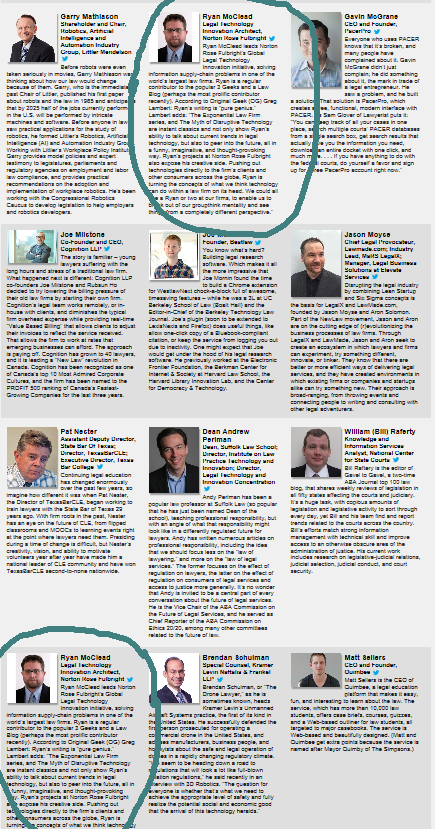
We constantly make fun of the lack of innovation in the legal field, but there are a number of highly talented people out there that battle the constant resistance to change, and make a difference for their own organizations and profession. For the past five years, Ed Walters, CEO of Fastcase, has recognized those whom he lists as innovators, visionaries, and leaders in the law through his Fastcase 50 Award Winners. I was honored to be a part of the inaugural Fastcase 50 back in 2011, and I’m even happier that my fellow Geek, Ryan McClead, received the award this year. (In fact, Ryan is so good, that when the list was initially displayed, he showed up twice!)

Here’s the write-up on Ryan:


Ryan McClead
Legal Technology Innovation Architect, Norton Rose Fulbright

Ryan McClead leads Norton Rose Fulbright’s Global Legal Technology Innovation initiative, solving information supply-chain problems in one of the world’s largest law firms. Ryan is a regular contributor to the popular 3 Geeks and a Law Blog (perhaps the most prolific contributor recently). According to Original Geek (OG) Greg Lambert: Ryan’s writing is “pure genius.” Lambert adds: “The Exponential Law Firm series, and The Myth of Disruptive Technology are instant classics and not only show Ryan’s ability to talk about current trends in legal technology, but also to peer into the future, all in a funny, imaginative, and thought-provoking way. Ryan’s projects at Norton Rose Fulbright also expose his creative side. Pushing out technologies directly to the firm’s clients and other consumers across the globe, Ryan is turning the concepts of what we think technology can do within a law firm on its head. We could all use a Ryan or two at our firms, to enable us to break out of our groupthink mentality and see things from a completely different perspective.”

Ryan is just one of those people that sees things in a different way, and finds ways of making things work, sound, and look better. Much of that comes from his creative background of working in the fine arts and applying his ability to tell a story in a way that makes us all sit up and say “ohh, I get it.”

Congratulations to Ryan and the other 49 recipients of the Fastcase 50 award.

[Ed. Note: Please welcome guest blogger Noah Waisberg, CEO of Kira Systems, and a good friend of the 3 Geeks. Noah was on an ILTA Panel with me last year, and will participate in the follow up to that panel this year called, Legal Technology Innovation: Bolstering AND Destroying Legal Work.  This post originally appeared on the Kira Inc. Blog. – RM]

[CC] Gengiskanhg

Watson is almost certainly the most significant technology ever to come to law, and it will give lawyers permission to think innovatively and open up the conversation about what is possible in a field that has been somewhat “stuck.” 

 –10 predictions about how IBM’s Watson will impact the legal profession“, Paul Lippe and Daniel Martin Katz, ABA Journal

IBM’s Watson AI has received a lot of attention for how it might change law practice. Should it? Or should commentators expecting “Watson” to change the world instead refocus their attention on “artificial intelligence” or “machine learning”?

Recently, legal market observer Ron Friedmann wrote, in a post on potential business models for Watson in the legal space:

if we aim to improve the efficiency of the legal market, there is no lack of technology to choose from. Whether Watson is the best place to bet remains an open question.

  1. What is Watson currently good it, and is it even the best avenue for automating tasks where it is strongest?
  2. Is Watson strong in the most promising areas for legal automation?
  3. Will Watson grow to become leading machine learning or AI technology across the board, or will it remain high quality only for question answering?

Watson, Currently

From Wikipedia: “Watson is an artificially intelligent computer system capable of answering questions posed in natural language”. Today, it appears to be a leading machine learning offering for question answering of a very specific sort (as we will cover below). IBM looks to be attempting to build Watson out into leading general purpose artificial intelligence software, but there is no consensus that it is at or better than the state of the art in areas beyond question answering. Indeed, early reviews on released Watson APIs have been underwhelming. As Ron Friedmann points out, it is not even clear whether Watson is a better technological approach for legal question answering tasks than, say, Neota Logic.

Apparently, one vendor is currently using Watson to extract data from contracts. I have yet to see any data suggesting that identifying contract provisions is in Watson’s sweet spot (by data, I mean information such as, say, published provision extraction accuracy numbers for a system built using Watson; the vendor claims their “goal today is to deliver a 20% cost reduction for a law firm in a typical diligence exercise”, which would not stand out relative to claims from other contract review software vendors (e.g., our clients tell us they find from 20–45% time savings on page-by-page review using our contract review software, and 60–90% time savings when they rely on it more heavily)).

Is Current Watson Right for Legal Problems?

Watson is currently a leading technology for question answering tasks. Are most legal tasks that could be impacted by software question answering tasks?

“Question answering” could be very broad, and most or all legal tasks could be interpreted as giving answers to questions. However, today Watson only stands out for performance on a narrow definition of question answering.

Each of the following questions illustrates a type of legal problem technology could help solve:

  1. Is it illegal for individuals to have ferrets in the state of California? (Watson-type question answering)
  2. Which of these 1 million documents are relevant to determining if anti-competitive behavior occured in this specific case? (eDiscovery technology-assisted review)
  3. How long does it tend to take for cases to get to trial in front of Judge Vernon Broderick? (Lex Machina)
  4. Who will the Supreme Court decide for in King v. Burwell? (Katz/Bommarito/Blackman algorithm)
  5. Can you draft a brief for us to submit to the court for this case? (NarrativeScience, Automated Insights (neither appear to be currently targeting legal))
  6. Do any expense items on this legal bill seem inappropriate? (SimpleLegal)
  7. Which of these contracts have change of control or exclusivity clauses? (us (Kira) and others)
Despite how all of these legal automation areas were phrased as questions, current Watson seems to only have documented high quality performance on tasks similar to the first, legal researchey issue. Is there any data to support the idea that Watson could best other currently-existing technology solutions on the other questions?
Alternatively, is being great at legal research question answering sufficient to make Watson the leading legal technology? Are all the other areas insignificant compared with an ability to know the law? As an ex-corporate lawyer, not to me. I know there are large numbers of lawyers that hardly ever do legal research.*

Will Future Watson Be Better Than Alternatives?

A Watson proponent might say maybe Watson is only truly great at question answering right now, but it will grow into the accross the board leading AI technology. After all, Watson won Jeopardy!, and IBM is pouring tons of resources into bettering it. As Friedmann states, after listing off a number of companies—including us—who build contract review software:

But as Paul points out, Watson’s R&D investment is probably 100x all these companies combined, and so has the potential to ride a much steeper performance curve.

Since machine learning does not yet have one approach that is better than others across the board, it is hard to say how much value Watson’s extensive R&D investment matters in the contract review software space (or, for that matter, in most other areas of technology, legal or otherwise). The argument that Watson will dominate outside its core because of overall R&D investment is akin to arguing that Lance Armstrong, straight off winning seven consecutive Tour de Frances, would win the 2006 New York Marathon. After all, he had incredible aerobic capacity, slow twitch muscle training, toughness, and more spent on his training than others in the field. Plus, running is basically just putting one foot in front of the other. For what it’s worth, Armstrong finished in 856th place his first try, and 232nd the next year.
Winning Jeopardy! is great, but there have been many other very impressive machine learning feats, including self driving cars; translation, including of live speech; and writing decent enough quality news articles that human reviewers could not necessarily tell the difference. Even on question answering, was Ken Jennings easy competition at Jeopardy! relative to a different current AI system like Google DeepMind?
Moving past Jeopardy!, IBM may be putting significant resources into Watson, but other companies are doing the same. Some equally large companies to IBM, including Google, HP, Facebook, and Baidu, are also putting a lot of resources into machine learning. Why will IBM beat them? Why will IBM even beat out newer AI focused startups such as DeepMind (bought by Google in 2014 for $650 Million), MetaMind, or many others? IBM itself appears to recoginize that others are building valuable machine learning technology, acquiring deep learning focused AlchemyAPI in May
Lots of companies are building AI technology for specific verticals (like us with contract review). Current machine learning is quite problem-specific, and these companies are getting experience honing their technology for their particular use cases. Will Watson’s technology really be better for specific verticals than companies focused on those specific verticals? Would you use Watson for eDiscovery ahead of offerings from companies who have been focused on that challenge for years? Will Watson do machine learning fraud detection better than well-funded Sift Science? Or movie recommendation better than Netflix? Will Watson even be better on legal research than something Thomson Reuters builds? IBM may be a lot bigger than TR, but TR is not small and has to nail this, whereas IBM does not need to get legal research right.
There are a lot of different legal tasks ripe for automation. There are also a lot of different technological approaches to solving AI problems. I suspect we’re a long way out from saying any one vendor’s technology is going to transform law practice on the whole.
* There is one other way Watson could transform law practice that I did not discuss here. Perhaps question answering lies behind as-yet-undiscovered-but-transformative legal applications. No doubt, there is a lot of opportunity to improve law practice through technology.

[Ed. Note: Please welcome guest blogger, Keith Lipman, President at Prosperoware. Keith is a long-time friend of the Geeks, and well-known leader in the information management field of the legal industry. This post originally appeared on June 24th on LinkedIn. – GL]

What’s in a word? Lack of precision often. The terminology in the legal industry around phases, task codes, and tasks can drive you crazy. The word “task” is particularly imprecisely used. Generally in our industry, the term task does not actually apply to a task in the traditional sense of the word but actually applies to work performed during a phase or a sub-phase of a matter. Confused? So are many of us. Let’s de-bunk the most common misuse of this terminology and get everyone on the same page.

The root problem dates back to the design of the ABA task codes and the Uniform Tasks Based Management System (UTMBS). The purpose of these coding systems was to enable electronic invoice processes. The primary use of the code set are in the areas of litigation and the cost codes around managing expenses and disbursement.

Take the example of discovery in the ABA Litigation Code Set. The phase code for “Discovery” is L300, which represents the discovery phase and the task codes include “Written Discovery,” “Document Production,” “Depositions,” “Expert Discovery,” “Discovery Motions,” and “Other Discovery.” However, these labels all represent sub-phases not tasks. The “real tasks” lie underneath.

Things got worse when many clients and law firms decided they didn’t like the ABA labels and changed them to fit their needs. For example, the official label for L200 is “Pre-trial Pleadings and Motions” but some clients want it to read “Pleading and Motions.” As a result, within a single firm the same code can have slightly different meanings for different clients or for internal firm purposes.

The problem with all these codes is that a significant number of lawyers don’t use them accurately. Anecdotally, I’ve been told on many occasions that 60 to 80% of time entries have inaccurate codes. Much of the problem stems from the fact that there are over 29 codes in the litigation code set. A choice of 29 codes is a lot, especially when you need to enter codes all the time. If a lawyer bills 8 hours per day, they’ll need to make somewhere between 8 and 20 time entries per day or 2,000 to 5,000 time entries per year.

My general experience with look-up lists on frequents activities is that they should ideally number less than 5 entries and no more than 10. After 10, the accuracy of picking the correct choice diminishes pretty quickly. I based this conclusion on best practices that emerged from my experience designing and managing document management systems, which have exactly the same problem.

While the UTMBS tasks codes are good for billing, they actually don’t help you effectively price or estimate a matter. When you go back and look at a prior matter, there is little information about critical details. In most U.S. litigations, the critical details that make the difference in cost is number of motions, number of documents, and number of depositions. This is next to impossible to find out because traditionally no one tracks the “real tasks” underneath the sub-phases.

To understand this better, let’s turn back to the task label that are really sub-phases, such as “Document Production,” a sub-phase during which carry out many specific tasks. Examples of these tasks include collecting documents, processing documents, planning for document review, reviewing documents, quality assurance about the reviews, and producing the documents. Some sub-phases are simpler but still problematic. For example, in the area of “Depositions,” you have two fundamental tasks, take a deposition and defend a deposition. These are very different things, but under e-billing they all get grouped under “Depositions.”

If you notice, all tasks start with a verb. Under each of these tasks are a multitude of activities performed by a multitude of people. Let’s take the example of taking a deposition:

  • Schedule the deposition (secretary/paralegal)
  • Pull the hot documents (associate)
  • Review the documents (partner)
  • Build an outline (partner)
  • Take the deposition (partner)
  • Update the factual timeline (associate)

As you can see, we have three people involved in this one task, which means that process improvement may simply need improving the speed with which one of these activities gets done.

Measuring and getting to this level of detail is the nirvana. However, to get there, your current technology needs to evolve, and the partners in your firm will need to agree on the list of tasks and activities in each phase and sub phase. I believe I have the answer to this and will present it in the Fall.

What you should do in the interim is setting up a limited set of tasks codes in any matter and use a time entry system that can limit the list of available codes to those that are available for a particular matter. This is going to create more work in setting up matters, but it’s the price you’ll have to pay for better data. The other critical interim step is to create a scope or assumptions that go with any budget and write a post action report on any matter to understand the difference between your assumptions and reality.

As I said, look for a follow-up on this in the Fall.

The American Association of Law Libraries (AALL) announced two name changes for its Special Interest Sections (SIS) this morning. These changes represent a broadening of the SIS appeal to law librarians and information professionals, as well as a modernization of who the SIS represents, and the mission it serves. The two SIS changes are:

  • Government Law Libraries (GLL-SIS) formerly the State, Court, and County SIS.
  • Private Law Librarians & Information Professionals (PLLIP-SIS) formerly the Private Law Libraries SIS.

I’ve been a member of both of these Special Interest Sections and like where both are going with the name changes.

The GLL-SIS has a continued focus on supporting those within libraries or other government information services with the Access to Justice (A2J) issues that these members work every day to promote on the local level.

The PLLIP-SIS name change represents the changes in the basic structures of our profession. Turning the focus away from libraries as a place, to the librarians and other professionals that contribute to the overall gathering, compiling, analyzing, and distribution of information and knowledge resources found throughout the private legal practice profession.

These may be subtle changes on the surface, but are really leading indicators that the profession has changed, and the association that represents the profession is beginning to change in order to meet the needs that its members face. I see these changes as foreshadowing upcoming changes in other parts of the organization. More focus on individuals rather than maintaining traditional facility models; more focus on supporting services, processes, and strategic missions of the groups, and; more focus on expanding the base of the organization to include those who align with these missions and goals, rather than simply looking at the department in which they work.

It’s a new day for the profession. I am happy to see the changes and look forward to seeing more.

Below is the official statement from AALL HQ:

FOR IMMEDIATE RELEASE
Contact: Cara Schillinger
Director of Membership, Marketing, and Communications
312.205.8020
cschillinger@aall.org

AMERICAN ASSOCIATION OF LAW LIBRARIES ANNOUNCES SPECIAL INTEREST SECTION NAME CHANGES

CHICAGO, June 18, 2015 — The American Association of Law Libraries (AALL) announced today
that it has approved the name changes of two special interest sections (SISs) — member groups
with specialized areas of interest in law librarianship and legal information.

The AALL Executive Board approved the following SIS name changes:
• Government Law Libraries Special Interest Section (GLL-SIS) is the new name for the former State, Court, & County Special Interest Section (SCCLL-SIS).
• Private Law Librarians & Information Professionals Special Interest Section (PLLIP-SIS) is
the new name for the former Private Law Libraries Special Interest Section (PLL-SIS).

The SIS name changes reflect the interests of their members and required member votes, SIS bylaw
amendments, and final approval from the AALL Executive Board.

“AALL’s special interest sections represent the interests of more than 2,800 of our members who
belong to one or more group,” said AALL President Holly M. Riccio. “It is important for our SIS
members to feel that the names of their sections represent the types of institutions in which they
work, their areas of expertise, and their roles within those areas.”

“Changing our name to GLL-SIS reflects the multiple levels of government where our members
serve the public, the practicing bar, and the judiciary,” said GLL-SIS Chair Maryruth Storer. “Maintaining access to justice is imperative to a democratic society.”

“The PLLIP-SIS name change reflects the expansion of new roles undertaken by legal information
professionals in law firms including competitive intelligence, practice alignments, analytics,
knowledge management, pricing, and business development,” said Jean O’Grady, immediate past
chair of the PLLIP-SIS. “As the legal industry has changed, our members have been at the forefront
of driving innovation in the development of information strategies and the delivery of knowledge to all facets of the business and practice of law.”

AALL will gradually implement the name changes on the AALL website and in forthcoming
publications and communications.

For more information about AALL Special Interest Sections, visit bit.ly/AALL-SISs. For more
information about AALL, visit www.aallnet.org or contact AALL Member Services at membership@aall.org.

About AALL
The American Association of Law Libraries was founded in 1906 to promote law libraries’ value to the legal and public communities, foster the law librarianship profession, and provide leadership in the legal information field. With nearly 5,000 members, AALL represents law librarians and related professionals who are affiliated with law firms; law schools; corporate legal departments; courts; and local, state, and federal government agencies. For more information, visit www.aallnet.org.

# # #

[Ed. Note: Please welcome Holly Riccio, AALL President and long-time friend of mine, as today’s guest blogger. Recently, Holly attended the invitation-only National Summit on Innovation in Legal Services and she asked if we would allow her to give an overview of her experience at the event so that she could share it with our readers. Holly originally wrote this for the AALL Spectrum blog, but since many of our readers here at 3 Geeks are not members of AALL, we thought this would put it in front of many people that would otherwise not see the original writing. The theme of the summit caught my attention immediately:

[C]hallenge thought leaders both from within and beyond the legal profession to…spark fresh thinking about the delivery of legal services and to find new, actionable ideas that are not constrained by traditional models and are rooted in the essential values of protecting the public, enhancing diversity and inclusion, and pursuing justice for all.

After reading Holly’s review, I wished I would have gotten an invitation.

I hope you enjoy Holly’s highlights of the Summit. – Greg Lambert]

Earlier this year, ABA President William Hubbard established the Commission on the Future of Legal Services to improve the delivery of—and access to—legal services. The Commission published an Issues Paper, requesting that key stakeholders submit written comments, which the American Association of Law Libraries (AALL) did. The Commission also held hearings at the ABA Midyear Meeting in Houston, in February, and, in my role as AALL President, I was able to attend on behalf of AALL and testify—along with other bar leaders, judges, law firm practice managers, and legal service providers—focusing my remarks on libraries’ integral role in expanding access to justice for all individuals and communities.
The culminating event for this Commission was the invitation-only National Summit on Innovation in Legal Services, which took place last month at Stanford Law School, assembling 200 participants, all proven leaders and innovators in the legal profession.

AALL was invited to participate in this event, convened to “challenge thought leaders both from within and beyond the legal profession to…spark fresh thinking about the delivery of legal services and to find new, actionable ideas that are not constrained by traditional models and are rooted in the essential values of protecting the public, enhancing diversity and inclusion, and pursuing justice for all.” The two-day event—packed with inspiring keynote speakers, panelists, and TED-style mini-lectures, and combined with ample time for breakout sessions organized around the key areas identified in the Issues Paper—was not only a great opportunity for AALL to start developing richer relationships and collaborations with the ABA in the access to justice arena, but also reflective of the commitment by the ABA leadership to bring about real change in the way we define and deliver legal services.

I can’t possibly condense everything that I heard or learned into this blog post, but I will share some of what I considered to be the highlights.

Sunday morning kicked off with a panel of innovators from outside the legal world, including Judit Rius Sanjuan from Doctors Without Borders, Ron Dolin from Stanford Law’s Center on the Legal Profession, and innovation and design strategist Denis Weil. Sanjuan told us that “9 out of 10 lawyers are trying to maintain the status quo” and that the most creative thinking has to come from those working in other professions. Dolin focused on metrics, telling the audience that the legal profession is not really running on quality metrics. “General counsels want to see return on investment,” he said. “Law firm reputation is just a stand-in for ROI metrics, but it is not a good one.” Sanjuan echoed this sentiment by stating that “corporations don’t want to stop legal spending, they just want to quantify what they’re getting.” Weil, formerly Corporate Vice President, Concept and Design, at McDonald’s, argued for focusing on leading indicators (customer satisfaction), not lagging indicators (ROI metrics), and urged lawyers to stop “backcasting” and start forecasting. “Teaching innovation is not enough,” said Weil. “Lawyers have to find comfort with ambiguity…and be serious about giving clients choice and control.” The panel got a round of applause when Dolin said he didn’t know why we are still producing court opinions and contracts without XML markup. The panel, while inspiring, was also realistic about the challenging road ahead, with Dolin stating that “we have an ecosystem of barriers” to overcome.

The next panel addressed some of the challenges to innovation. Moderated by Deborah Rhode, Summit Co-Chair and Director of the Program in Law and Social Entrepreneurship at Stanford, it included two professors, USC’s Gillian Hadfield and Marshall Van Alstyne of Boston University/MIT, and the founder and CEO of Avvo, Mark Britton. Van Alstyne emphasized the need to create an innovation ecosystem and encouraged openness to allow outsiders to come in and innovate, solving the legal profession’s problem of having “a homogeneous pool of potential innovators.” He also talked about platforms, arguing that platforms beat services almost every time and that “platforms drive innovation through openness, modularity, and enabling of third parties.” Britton organized his remarks around three things the legal profession needs for future success: the right mindset, the right support, and the right rewards. He encouraged the audience to be opportunity-focused, think big, accept and reward failure, share knowledge, cultivate innovation, and create rewards that are personal, qualitative, and quantitative. His goal is “to make a legal check-up as regular as a medical check-up.”

What followed these two panels was a series of short, rapid-fire presentations focusing on the client and illuminating disparate experiences with the legal system from a variety of client perspectives. A few of the highlights for me included:

• Rebecca Sandefur, associate professor of sociology and law at the University of Illinois at Urbana-Champaign, shared many illuminating and enlightening statistics, including that when the general public is asked to explain why certain problems happen in their lives, only 9 percent think of these problems as legal. She suggested that bridging this gap could be solved, or at least improved, by advertising: connecting problems to law and people to legal services. “We need to be timely, targeted, and trustworthy,” she said, “and meet them where they are.” Sandefur suggested a few solutions where law libraries could play a role: co-located services that can extend our reach and “human handholding” with the use of Internet and technology legal resources.

• The executive director of Bay Area Legal Aid, Alex Gulotta, made sure no one in the audience was dozing off, as he wore the passion and commitment he has to access to justice issues on his sleeve. “We need a single point of entry to the legal justice system,” Gulotta stated, “but there are hurdles to overcome, the first of which is fear.” Echoing what others speakers had shared, Gulotta said that we need to find ways to incentivize the creation of such a system, then left us with one final thought: mere access to the justice system does not equal justice.

• What Pima County (Ariz.) Superior Court Judge Charles Harrington is doing to bring the courts to the people is a great model, one that I see as being ripe for law librarian input and collaboration. Because the Grand Canyon cleaves Mojave County, Judge Harrington explained that residents on the north side have to drive great distances to get to the county courthouse on the south. To address this, the Superior Court set up the North Canyon Kiosk, an automated booth at the Mojave County DMV that allows users to file papers, speak with court clerks, and pay fines…all remotely. (I could easily see county law librarians providing input on ways to incorporate links to their resources for self-represented litigants from these remote kiosks.) Another project originating from Judge Harrington’s court is a collaboration between University of Arizona English majors and law students called Simpla Phi Lex. The two groups worked together to create an easy-to-use workflow around common court forms and also provide easy-to-understand explanations and form language.

This took us to the first of two sessions with our assigned breakout groups. I was in one of the two groups focused on access solutions for the underserved, and in our first session we were tasked with identifying the challenges that stand in the way of providing better access to justice, and then prioritizing our ideas to come up with the top five challenges. When we came back together later in the day, we took those top five challenges and brainstormed together to offer some possible solutions. Based on what came out of our group alone, there are definitely some potential areas for law librarians to partner and collaborate with the ABA as these solutions take more shape and become a reality.

In between our two breakout sessions, we enjoyed lunch and another keynote presentation, this time from author and legal consultant Richard Susskind, who focused on how technology can make the legal process quicker, cheaper, and better. Susskind spent quite some time describing the recently launched Online Dispute Resolution project he developed for the ODR Advisory Group of the Civil Justice Council. Echoing what others had already shared, Susskind described the ways in which our legal system is outdated and urged us to embrace technology from a customer’s perspective. His PowerPoint slide that got the most laughs? The one that said, “It is not the purpose of the law to provide a living for lawyers.”

Following lunch, there was another series of TED-style talks, this time focused on real-world examples of programs that are bridging the justice gap. As with the mini-presentations in the morning, the presenters shared a plethora of innovative programs and inspirational stories. The common denominator among all the programs is that these individuals saw a problem, challenge, or deficit and came up with a creative, proactive, and often no- or low-cost solution.

• In Oregon, Judge Aiken created a re-entry program that employs wearable technology that can track whether individuals show up for appointments and other court-required activities. The program has resulted in a 16 percent decrease in recidivism, and Aiken estimates that the 160 re-entry court graduates have saved Oregon over $1.6 million. “We don’t take services away when they fail,” Aiken said. “We increase them.” Her motto for the program: truth, transparency, trust, and trying.

• Judge White started her talk by sharing some startling statistics: 1 in 75 Louisianans is incarcerated, twice the national average. “Louisiana can’t arrest and incarcerate our way out of this problem,” she said. White launched a re-entry program that matches felons sentenced to terms of 10 years or less with prisoners serving life terms, the latter acting as teachers of professional trades as well as social, spiritual, and personal mentors. Judge White monitors the former inmates for five years after their release from prison and requires monthly visits to her office to check on their progress. She screened a video of the program for the audience and, when the video ended, concluded her talk with a “mic drop” moment, leaving us with the following as she prepared to exit the stage: “This program receives no funding and costs the taxpayers nothing.”

• Other inspiring ideas included Suffolk’s new Accelerator-to-Practice program, the legal entrepreneur incubation program at the Chicago Bar Foundation, and the ODR model that Modria is currently providing.

The day concluded with a reception at the Stanford Faculty Club, where attendees were encouraged to learn more about the novel approaches to access to justice being taken by the exhibitors in the Innovators Showcase. At dinner we were treated to an emotional and inspiring speech from NAACP Legal Defense and Educational Fund President and Director-Counsel Sherrilyn Ifill, fresh off her appearance on Face the Nation as part of the panel “Searching for Solutions in Baltimore.” Ifill called on lawyers to help preserve democracy and fix a broken legal system, stating that “whether we deserve it or not, people look to lawyers to be leaders.”

Monday took us into the home stretch, starting with a hot breakfast and more speakers from both inside and outside the legal profession sharing their advice and insight, kicking off with ABA President Hubbard in conversation with Richard Barton, founder of Expedia, Zillow, and most recently, Glassdoor. Barton told the audience that he sees “an information asymmetry” between the consumer and the services being provided. He urged lawyers to give “power to the people to bridge the information gap,” inciting a sense of urgency by adding that “transparency is an efficiency generator.”

What followed was a stellar panel, moderated by Monica Bay, now a fellow at CodeX at Stanford, focusing on innovations from within the legal sphere. One of the most intriguing presentations came from Margaret Hagan, a fellow at the Center on the Legal Profession and lecturer at the Stanford Institute of Design, who is leveraging both her law and design school education to devise better ways to provide access to legal services in a mobile environment. She is taking the design process, which is focused on how to generate new solutions, and applying it to law. If we could get Hagan together in a room with legal hackers and law librarians, I can only imagine the kinds of platforms, apps, and portals we could develop.

The morning concluded with a presentation by Renee Knake, professor of legal ethics at Michigan State University College of Law and the official reporter for the ABA Commission, who took all the notes and flip chart pages generated by the 10 breakout groups the day before and condensed them into a series of slides, essentially creating a wish list for the future. The list included a wide variety of suggestions, ranging from permanently altering the law school model, establishing the right to counsel in civil cases (“Civil Gideon”), allowing non-lawyer ownership of law firms, co-location as a means to provide legal services and resources, and the establishment of ABA Technology Innovation Grants, just to name a few.

What followed were comments from a reaction panel moderated by legal consultant and analyst Jordan Furlong. Stanford’s Deborah Rhode stated that “we must open up the regulatory process and change the rules that prevent effective collaboration across disciplines.” Lisa Foster, director of the DOJ’s Access to Justice Initiative, called for each state to develop its own legal help portal, where users could post a legal problem or question and get directed to potential answers. “It’s feasible,” said Foster, “we just haven’t done it.”

The final remarks of the Summit came from Stanford University President John Hennessy and ABA Commission on the Future of Legal Services Chair Judy Perry Martinez. President Hennessy reminded the audience that we can’t solve our current problems with the same thinking used to create them. Martinez, who had earlier stated that “access to affordable legal services…has been [something] that our profession has struggled with…[and] we have not been able to make justice for all a reality,” summed up the takeaways from the event in this hopeful remark: “We have to make a difference, and the time to make it is now.” Or, put in a slightly different way by ABA President Hubbard earlier that morning, “If you don’t have a seat at the table, you become part of the menu.”

Now, the hard work really begins, with the Commission taking all the inspiration and information from the Summit and creating and prioritizing action items to implement change in the legal profession. Judging from what I experienced in my breakout session and the reports from the other breakout groups, there are definitely possibilities for AALL to partner with the ABA on some of these newly identified opportunities to provide better access to justice.

For additional coverage of the ABA National Summit on Innovation in Legal Services, you can also take a look at the following articles, blog posts, and Twitter roundups:

Summit on Legal Innovation in Legal Services Gets Underway in Silicon Valley
True Innovation in the Legal Industry Requires Outside Views and Thinking, Summit Speakers Say
Legal Innovation Summit Attendees Are Long on Ideas But Short in Data
How a Mexican Kid from the Ghetto Winds Up Hanging with Elite Legal Minds
The ABA Turns Up the Heat on Legal Service Innovation
New Law Strategies Needed to Expand Services to the Poor
ABA on Innovation: Blue Skies Ahead or Pie in the Sky?
ABA National Summit on Innovation in Legal Services Crowdsourced Coverage (Storify)

[NOTE: A version of this summary was originally posted on the AALL Spectrum Blog.]

It’s conference season again for many of us. I get to go to Chicago next week for the P3 Conference and then to Philadelphia in July for AALL. If I get really lucky, I’ll sneak in to the ILTA conference in Las Vegas in late August. I enjoy catching up with peers and friends, and attending the sessions to listen to speakers discuss hot topics, trends within the industry, and innovations that will revolutionize the way we provide services. That being said, I want everyone to take out a phrase that has been a trusty standby since 2008.  That phrase, of course, is “recent economic downturn.”

You all know how it is used to introduce change:

Since the recent economic downturn, law firms have significantly reduced / restructured / altered (yada, yada, yada) the way it does business.”

This phrase isn’t the first of its kind, nor will it be the last. Remember such similar introductory phrases as:

  • Since the collapse of Brobeck/Howrey/Dewey… 
  • Since 9/11
  • Since the Dot Com bubble
  • Since the collapse of the Soviet Union
  • Since the S&L crisis
  • Since the oil bust (insert relevant decade)
  • Since the OPEC embargo
  • Since the Great Depression
  • Since Noah landed the Ark
  • and so on…

I know we are all still feeling the effects of the financial industry failures of 2008 and 2009, but I think it is time to preface our reasons for changing how we conduct business on something other than subprime mortgage loan. This week, I’m starting to use “Since the Houston floods of 2015…”.

I am all for leveraging a bad situation to help change bad or outdated behavior. As Rahm Emanual, and other politicians are fond of saying, “You never let a serious crisis go to waste.” The problem with “recent economic downturn” is that it has run its course. It doesn’t have the punch it had five years ago, and I have started seeing smirks and eye-rolling whenever a speaker starts a discussion with that phrase. (Okay… maybe it’s just me that smirks and rolls my eyes.)

So all of you presenters out there who are writing your discussion points and filling in the bullet points of your PowerPoint slides, get out your red pens and cross off the phrase “recent economic downturn.” Find something a little fresher to put in its place. We’ll all be better for it.

In the meantime, I’ll start drafting next year’s blog post for outdated phrases. I think I’ll start with such things as “iPads” and “Bespoke.”

[Ed. Note: Please welcome Guest-Blogger, Matt Coatney as he gives us some insight on how to deal with the smart machines and AI technologies coming our way.]

Much has been said about how technology will disrupt the legal profession and spell the end of lawyers. From Richard Susskind’s End of Lawyers? to IBM Watson, the future does not look bright for those that practice law. Even experts originally optimistic about the technology boom are now more cautious based on new data. With all the doom and gloom, is there anything lawyers can do to at least postpone the inevitable?

A recent HBR article titled Beyond Automation argues that instead of bemoaning automation, we should focus on augmentation: people and smart machines working together. The authors lay out five strategies people can use to not only stay relevant but thrive in areas where advanced technology threatens to replace them. Here are the strategies and how they apply to lawyers.

1. Step Up

Stepping up in the context of smart machines means to stay ahead of them in terms of quality and sophistication. If technology will one day handle all of our mundane legal work – research, document drafting, and the like – then lawyers can focus more of their attention on business development, running their practice, and handling increasingly complex issues. In other words, lawyers should continue to push down work, but technology will handle more of the associate-level tasks.

What to do: Lawyers need to broaden their skills beyond a firm grasp of the law. They should pursue classes and continuing education in areas like business, marketing and technology. Law schools need to offer and require a more diverse program of classes, and law firms need to make this type of professional development a priority.

2. Step Aside

Smart machines are getting smarter, but for now they do not possess a nuanced understanding of human emotion and creativity (hold the lawyer jokes, please). Stepping aside means leveraging more of our creative, non-analytical thinking. Some areas will remain the purview of people for awhile at least. Take jury trials. Advanced technology will soon take over the role of jury selection by combining big data and predictive analytics. But lawyers will still be needed during the trial, as the complex interplay of judge, witnesses, and jurors requires someone who can relate with people, pick up subtle emotional cues, and control the situation.

What to do: Lawyers should focus on the human aspect of the law, where smart machines cannot compete. Lawyers, schools and firms need to focus education and growth in areas like emotional intelligence to stay competitive.

3. Step In

I have seen people accomplish amazing things working with smart machines. R&D chemists now find new drug leads in hours instead of months, and NGOs enact new policies based on big data findings, without the need for extensive field studies. Lawyers can do the same, and in some cases like legal research already have. Think of what lawyers can accomplish working with systems like the IBM Watson-powered Ross at their side.

Some lawyers, like tech-savvy IP attorneys, will have a leg up on those less familiar with new technology. Lawyers and firms can mitigate this by hiring, training, and leaning on a sophisticated administrative team of technologists and business analysts. But lawyers will need to treat these professionals as equal partners, not subordinates to handle their busy work.

What to do: Lawyers will need to hone their technology knowledge and skills on an ongoing basis. Law schools and firms need to make advanced technology a part of their curriculum and continuing education efforts.

4. Step Narrowly

Thanks to capitalism, there will remain nooks and crannies of the law where smart machines do not go. These niches are too specific for companies to make serious money on their technology investments, and they will move on to bigger opportunities. Lawyers, however, will still be able to carve out a healthy business, especially if they are solo or small firms with little overhead.

What to do: If you are already a lawyer in a high-value niche, congratulations! Stay there and defend your turf. For those in a more general practice, think about what specific areas you are most passionate about and begin to build expertise and a professional brand in that space.

5. Step Forward

As the saying goes, if you cannot beat them, join them. This strategy has lawyers stepping right into the thick of the smart machine revolution. They don’t just use the technology, they help build the next generation of tools. Whether working for a software company or remaining a practicing lawyer who partners with vendors, good work will be had for some time training these machines to be smarter and more human. Lawyers that are able to innovate and create new smart applications can also make significantly more money than the traditional billable hour.

What to do: Lawyers that are tech-savvy can explore opportunities with software companies and other corporations that need people with blended skill sets. Others can look to partner with tech-savvy colleagues or technology vendors. Law schools need to teach more courses on technology, innovation, and entrepreneurship. And law firms need to be open to new business models and ways of doing business.

Final Thoughts

Lawyers that embrace change and continually look for ways to add more value can stay ahead of the curve. Which strategy is best will depend on the relative strengths and interests of individual lawyers and the firm as a whole. Many of these strategies mix and match well and can be experimented with to see if they are a right fit for your personality and corporate culture.

One thing is certain though: it is a matter of when, not if, lawyers will be forced to compete for business against those using smart machines. Some say we are already at that point. If you watch what IBM, Google, Microsoft, Baidu and others have accomplished in the last few years, especially in the field of deep learning, you may start thinking the same.

++++++++++++++++++++++++++
Matt Coatney is an AI expert, data scientist, software developer, technology executive, author, and speaker. His mission is to improve how we interact with smart machines by making software smarter and teaching people how to work (and cope) with advanced technology. Great things happen when smart people and smart machines work together toward a common goal.
Follow Matt on LinkedIn and on Twitter @mattdcoatney. Follow the conversation at #BridgingTheAIGap.

A couple months ago, I had a great conversation with Kevin Mitchell of ModioLegal about his product and its “reading the news” concept. He and I talked about the different methods of delivering information and current content to lawyers and we both agreed that we thought the methods of print distribution, email, or RSS feeds allow for massive amounts of information to be disseminated, but that there should be better ways of presenting complex information in a way that is more convenient to access. Kevin’s idea was to produce a way of delivering the information in audio format and providing the listener with a way to consume the content during periods of time where hearing the information is easier than reading the information.

  
I’ve always been one for finding new ways of getting information out to the consumer. The converting text to audio has been something I’ve considered for a long time, but there are obvious issues with converting text to audio, and having it make sense.
  
Some of you may immediately think of a Siri-like voice reading the material to you, but that’s not what Mitchell is doing with this product. As most of you have realized, mechanical voices, no matter how human sounding, just cannot present the information in a way that helps the listener easily digest and understand the nuances of the information being presented. It really takes a person with an ability to read the material in their heads first, and present it in a way that assists the listener absorb the information. For a situation like this, a law student is one of the best candidates for the job.
  
The idea is this:
  • License quality current awareness content that is relevant to the legal industry
  • Pay law students for their time to produce audio narrations of the content,
  • Deliver the audio content through a high-quality, proprietary platform that can be played back on multiple devices ranging from car audio systems, mobile or home devices during multi-tasking activities such as commuting or exercising
  • Give the law students exposure by having them introduce themselves to the audience and provide access to their email address and LinkedIn profile
  • Distribute the recordings quickly so that the information is still current

As someone who used law students to help create the content at the Oklahoma Supreme Court’s online research tool, I thought it was a great idea to leverage the talent that is available and create a situation where the student, the listener, the content licensor and the company benefit. After listening to some of the content, I found it to be very easy to listen to, and easy to understand.

  
ModioLegal is just getting started, so the content is very limited. Right now the legal content is the Audio Edition of ABI Journal, which costs $9.95 a month and comes with a free 1-month trial. I think there is a bit of a “chicken and the egg” issue with a project like this where users of the product will want more content, and content providers would like for there to be more listeners before licensing more content. I imagine that is always an issue when it comes to presenting content in a novel way.
  
Since ModioLegal is a subscription service, I asked if there could be a way for people to demo some of the content without having to sign up for anything or be obligated in any way. Kevin got me a demo login and said that I could post it here and allow the readers of the blog some access to the site. Again, I found it to be very easy to listen and understand the content, so go check it out, perhaps on your smartphone, and see if this type of information dissemination is something you’d like to see more of on the market.
  
username: 3geeks
password: modiolegal


Dan and Jane return after a very long hiatus.  Inspired by Marlene’s terrific post and the impassioned discussion that it began amongst friends.


Jane: Dan!  I haven’t seen you forever.  How have you been?!

Dan: I’m sorry.  Do I know you?

Jane: It’s me, Jane.  We used to do 3 Geeks Point/Counter-point posts a couple of years ago?  You were the blowhard gasbag that was wrong about absolutely everything!

Dan: Oh! And you were the ignorant fool who incessantly contradicted me!  Yes, I remember now.  How have you been?

Jane: I’m well, I’m well.  Got promoted since we last talked.

Dan: Well, that makes sense, you do work in a law firm, right?

(Both laugh knowingly.)

Jane: I’m now the Chief Director of Innovative Solutions and Catering.  You know how things are, the firm is consolidating roles. I think I’ve got a new card in here somewhere.  Let me see…

Dan:  Oh, don’t bother. I don’t use business cards. I’ll look you up on LinkedIn.

Jane: No, no, no. It doesn’t work that way! This is a time honored tradition.  I give you a card. You give me a card. A bond is formed and we are connected.

Dan: That’s stupid. Then what do you do with all of the cards you collect?

Jane: I send LinkedIn invites to each of the people I meet and then throw away the card.

Dan: I thought you were one of those eco-terrorists, hell bent on saving the planet one tree at a time.

Jane: My cards are made of sustainable bamboo pulp, thank you very much!

Dan: I bet that costs a fortune.

Jane: It’s not cheap, but some things are worth paying more for.

Dan: At my suggestion, we did away with business cards entirely last year.  No one gets them.  We save about $800 per person per year.

Jane: But what does your firm lose in the process?

Dan: A lot of cards in the landfill?

Jane: No, you moron, in terms of good will and business relationships?

Dan: Uh…nothing?

Jane: Look, when I give you a card, I am symbolically giving you something of myself. I am quite literally trusting you with my personal identification. I am saying this is who I am and I want to share it with you. And then, you reciprocate. That creates a bond, a momentary relationship that cannot be ignored, whereas a LinkedIn invite actually has an ignore button.

Dan:  It does? Why would they do that?  The point of LinkedIn is to have as many contacts as possible. I am currently in second place in my group.

Jane: You are why they have an ignore button.

Dan: So if I take your stupid card and send you a LinkedIn invite, will you accept?

Jane: Are you asking because you want to cement our bond?

Dan: No, I’m just three contacts behind the guy in first place.

Jane: Then no.

Image [cc] Clive Darra

I started a very robust conversation with some colleagues the other day, including Dan and Jane of this site, who I am certain you will hear from soon, about a decision my team made to opt out of business cards. 

The initial conversation came up because I often get asked for cards.  I don’t carry them.  I haven’t for years.  I prefer not to carry paper around.  See, I have kids, and kids get into handbags.  Consequently, I don’t want to carry anything that is not essential, especially things that can be taken and squirreled away as “treasure”, making me spend hours searching for them to the chorus of “I don’t know where it is,” or items that can be can be used as a Chinese Stars or Mini-Frisbees.

 I tried the chic card holder, the antique card clip, stuffing cards in my wallet or pocket–none of them worked for me (the card-in-pocket idea caused a lot of laundry issues BTW).  My team and I discussed adopting QR codes on the cards and apps that scan cards, among other things, and finally came to the conclusion; why not just use our business contact info on our smart phones?

Through my discussion with colleagues, I uncovered a dizzying amount of opinions and questions.  The Artists loved their cards and expressed that when you give a card, you symbolically give something of yourself to the recipient.  The Technologists used LinkedIn (I use this as well).  The Socially-Minded voiced concern that not everyone has a business phone, much less a smart phone—there was also a side conversation here about use of private phones for business purposes,  The Environmentalists expressed dismay about the waste surrounding business cards.  The Opportunists summed it up by questioning how they would get a free lunch if they didn’t have cards to put in the fishbowl.  All valid points and food for thought, readers.

Ultimately, our team decision is an optional one.  No one is required to use their contacts as a connection mechanism, But we are raising it as a consideration.  It saves money and trees and keeps my lint screen clean.  Every little bit counts.